
Thermal Energy Harvesting From Human Warmth For Wireless Body Area Network In Medical
Healthcare System
D.C. Hoang, Y.K. Tan, Graduate Student Member, IEEE, H.B. Chng and S.K. Panda*, Senior Member, IEEE Department of Electrical and Computer Engineering
National University of Singapore Singapore 117576 Telephone: (65) 6516-6484 Email: *[email protected]
Abstract— In the medical healthcare system, wireless body area network (WBAN) is used to monitor the fall event of a patient by sensing his/her body state orientation (stand or fall posture). However, for a conventional WBAN, the only way to communicate with the doctors’ computers or hospital’s servers is through the local gateway. Hence, the reliability of the WBAN is greatly dependent on the life span of the gateway.
In this paper, a selective gateway method based on the residual energy of the sensor nodes has been proposed. By changing the gateway, the lifetime of the WBAN can be extended. To further increase the lifetime of the WBAN, a thermal energy harvesting system has been proposed to harvest heat energy from human warmth. Energy harvested using the thermoelectric generator (TEG) is stored in an energy storage device until sufficient energy is available. Based on the experimental test results obtained, the accumulated energy is around 1.369 mJ to power the loads comprising of sensor, RF transmitter and its associated electronic circuits. The sensed information is transmitted in 5 digital words of 12-bit data across a transmission period of 120 msec. The receiver platform displays the patient identification number and sounds out an alarm buzzer for aid if a fall event is detected.
I. I NTRODUCTION
Pervasive computing, ubiquitous computing and ambient intelligence are concepts evolving in a plethora of appli- cations in medical health care such as to improve the traditional way medical staffs interact with their patients and the elderly [1]. By deploying self-organized wireless physiological-monitoring hardware/software systems, contin- ual patient monitoring in certain types of patient postures becomes convenient to assure timely intervention by a health- care practitioner or a physician. Take for an example, cardiac patients wearing electrocardiogram (ECG) sensor systems can be monitored remotely without leaving their residence.
Based on the application needs, the healthcare sensor systems can be either a stand-alone system such as Wireless Body Area Network (WBAN) or a part of a Global Healthcare system [2] to be connected directly or indirectly to the Internet at all times, which allows medical staff to timely acquire arrhythmia events and abnormal ECG signals for cor- recting medical procedures. Moreover, physiological records are collected over a long period of time so that physicians can provide accurate diagnoses and correct treatment.
Various research works have been reported on develop- ing a pervasive sensor network for medical healthcare [3]
[4], which consist of wireless healthcare sensor systems
conforming to the human body, integration of different wireless networks with various transmission techniques and development of healthcare applications over these types of networks . According to a literature review paper [5], there are rich research interests on the wireless sensory systems in the form of wearable mobile devices for monitoring of human physiological data or vital signs as well as behavioral data. Hence the key target of this paper is the realization of a WBAN, a kind of wireless sensor networks (WSNs), where tiny sensor nodes are deployed on the surface or implanted inside human body to monitor vital signals for medical health diagnosis. Star-topology network is a popular option for WBAN where the central node gathers and records the sensing information as shown in Figure.1. An individual body area network can also engage in a global medical healthcare system, in which data gathered from sensor nodes is sent through gateway to hospitals or clinics and assists doctors to monitor and diagnose patient’s health condition.
Recent developments in the communication technologies have made it possible to support accurate operation and long lifetime of WBANs. Besides, network performance has been greatly affected by the available energy supply which is battery in most cases. The limited energy supply on sensor nodes becomes the bottleneck for measurement, data transmission, network connection and lifetime. One method to prolong the lifetime of the node is to increase the energy capacity of battery. Unfortunately, the capacity of battery is proportional to its size and weight; tiny sensor nodes used in body area network to be carried by human require small form factor, hence solely dependent on battery is not able to sustain the operation of the sensor node. The development of energy harvesters is one of the keystones of the global ongoing research on pervasive and ubiquitous computing [7], as this would make the wireless sensing devices meshed in network form to be self-powered and cost effective. Incorporating with a proper energy storage device, the solution of using energy harvester will be able to be applied in body area network for healthcare monitoring.
In this paper, we first study the WBAN characteristics
and understand its associated challenges. Based on that, the
thermal energy harvesting system to scavenge energy from
human warmth is then designed and implemented for pow-
ering the sensor node used for detecting the fall event of a
patient or an elderly. Once a fall event is detected, a warning
signal is sent out in a wireless manner to seek for medical attention. The rest of the paper is organized as follows.
In Section II, the details of the WBAN used in medical healthcare system are described. Section III discusses on the design of the human warmth energy harvesting system.
The experimental results are then demonstrated in Section IV with a conclusion in section V.
Fig. 1. Wireless Body Area Network Architecture in Medical Healthcare System
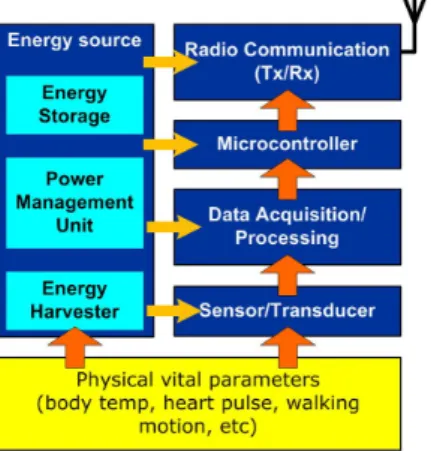
Fig. 2. Overall Structure of a Typical Wireless Sensor Node Powered by Thermal Energy Harvesting
II. W IRELESS B ODY A REA N ETWORK I N M EDICAL
H EALTHCARE S YSTEM
Wireless body area network (WBAN) has been integrated into various human related applications like (1) medical healthcare services, (2) assistance to people with disabilities and (3) body interaction and entertainment [8] to promote healthy lifestyle. On top of that, there are other benefits with integrated WBAN which include having seamless integration of data into individual personal medical records and research databases as well as discovering useful medical knowledge through data mining. In a WBAN, there are several sensor nodes, which comprises of a RF transceiver, a processing unit and some sensors, deployed on the human being in a star net- work form as illustrated in Figure.1. Various vital signs and healthcare data are collected for medical diagnosis purposes using different types of physiological sensors onboard of the sensor nodes like electrocardiogram (ECG) sensor, elec- tromyography (EMG) sensor, electroencephalography (EEG) sensor, blood pressure sensor, tilt sensor, breathing sensor, movement sensor, thermometer, etc.
Unlike a conventional WSN, which has wide coverage area in terms of tens or hundreds of m 2 supported by many sensor nodes, the sensor nodes of a WBAN are deployed either outside human body and form a wearable WBAN or operate within human body to form an implant WBAN. The coverage range of the sensor nodes in a WBAN is designed to be within the area of human body of fews m 2 with small number of nodes used to monitor the vital signs of the patients.
Therefore, WBAN has to face some of its research challenges [7] such as power consumption, biocompatibility, reliable data collection, security, context awareness, small size and weight, etc. These research challenges raise the need of developing new wireless communication technologies rather than the available standardized technologies such as Wireless Local Area Network (WLAN), Bluetooth, Wireless Personal Area Network (WPAN), etc. Currently, a new standardiza- tion of wireless communication technology for body area network, IEEE 802.15.6 [8], is under construction which focuses on scalable and reliable medium access control, low power consumption with energy harvestable power source, high quality of service, medical authorized radio frequency band, and safety for human body.
In a typical medical healthcare system with integrated wireless body area network (WBAN), the status of the patient is monitored regularly and reported back to the doctors timely through the wireless communication media.
In order to have a consistent monitoring of the patient, it is important to maintain good connectivity between the sensory system mounted on the human body and the base station connected to the doctors. However, as mentioned before, power consumption is a crucial issue in WBAN. Depending on the application and the operation of the sensor nodes in WBAN, the power consumption varies accordingly with the different components of the sensor nodes. Among the various components, radio transceiver consumes the most amount of energy during its active mode in transmitting or receiving operation. Hence, an efficient energy communication proto- col is required to save power consumption of each sensor node and prolong the network lifetime.
In [10], a low power medium access control (MAC)
protocol has been developed to deal with the wasted energy
due to inter and intra network collisions. The result shows
that the carrier sense multiple access/collision avoidance
(CSMA/CA) technique achieves lower power consumption
compared with the time division multiple access (TDMA)
technique. When a hybrid mode of the two techniques has
been implemented, more energy saving is accomplished thus
can be used in WBAN application. Usually, for a WBAN
deployed on a human body, sensor nodes are organized in
a single-hop star topology where one node becomes a local
gateway to collect data from all other nodes and send this
information to a base station, which is a hospital’s server
or a doctor’s computer. The local gateway is typically a
mobile device like PDA, which is very costly and it requires
a separate communication device to be compatible with other
body sensor nodes as well as special communication service
to send data to system’s server. More importantly, the mobile
device consumes huge amount of energy to operate, hence
the rechargeable battery needs to be recharged regularly in
order to sustain its operation. Therefore, instead of using
a fixed local gateway, this paper proposes the use of all
the sensor nodes in the WBAN to rotate their roles as the gateway to communicate the collected information to the main WSN system.
Taking the radio communication model described in [9]
as a reference, where the radio dissipates E elec = 50nJ/bit to run the transmitter or receiver circuitry and E amp = 100pJ/bit/m 2 is the transmit amplifier, the two scenarios of using one fixed sensor node and all sensor nodes being rotated as the gateways are simulated and their results are compared. The energy required to transmit a k-bit message for a distance, d, is given as [9]
E T x (k, d) = E T x−elec (k) + E T x−amp (k, d) (1) E T x (k, d) = E elec ∗ k + E amp ∗ k ∗ d 2 (2) and the energy spent to receive this message is expressed as
E Rx (k) = E Rx−elec (k) (3)
E Rx (k) = E elec ∗ k (4)
Considering a WBAN with n nodes, one of them is the gateway. The energy consumption of each node to transmit k-message to this gateway is given as
E node = E T x (k, r) = E elec ∗ k + E amp ∗ k ∗ r 2 (5) where r is the distance between the node and the gateway.
The energy consumption of the gateway to receive data from all nodes and send to a base station is as follows
E node = E T x (n ∗ k, d) + E Rx ((n − 1) ∗ k) (6)
= E elec ∗ n ∗ k + E amp ∗ n ∗ k ∗ d 2
+E elec ∗ (n − 1) ∗ k (7)
= k ∗ [(2n − 1)E elec + n ∗ E amp ] (8) To solve the problem of just relying on one energy hungry gateway to communicate with the main WSN system which is connected with the hospital’s server or the doctor’s computer, a selective gateway method to select among the body sensor nodes based on their residual energy as the local gateway has been proposed. Whenever the residual energy of the gateway reduces under a threshold value, E th , another node among the rest in the WBAN with higher energy level than E th is chosen as the current gateway. After one round of selection when all the nodes’ residual energy drop below the threshold, the original threshold value is adjusted lower.
It is required to make sure that at least one of the sensor nodes has enough energy supply to become the gateway.
The selection process is repeated again as mentioned above until the residual energy stored in all the sensor nodes are used up. The information about residual energy of each individual node is added to the sending data, and is compared at the gateway at each round of data gathering. Decision of changing gateway made by the current gateway is sent to all the other nodes through the acknowledge messages of received data in the next round.
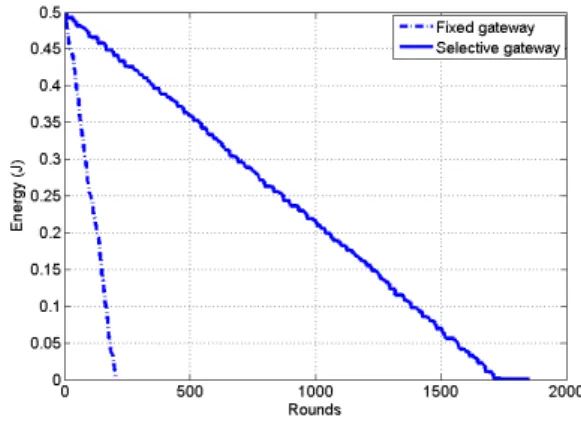
The simulation result, shown in Figure.3, illustrates the residual energy of the gateway based on the conventional fixed gateway case and the last node running out of energy
when using proposed selective gateway method with 10 nodes deployed in an area of 0.4 m x 1.7 m, a 200-bit message (i.e. header, payload, metadata, etc) is transferred from the sensor node to the gateway every round. Assuming that the distance between the gateway and the base station is within 200 m and all nodes have the same initial energy 0.5 J, the gateway in the first method spends all of its energy after 200 rounds of receiving and transmitting data, meanwhile in the second method, every node runs out of energy after an average number of 1700 rounds.
Fig. 3. Residual energy levels of the conventional fixed gateway and the selective gateway
Figure.4 shows the comparison between the lifetime of the single unique gateway and that of the last node which runs out of energy in the selective gateway method with respect to the number of nodes deployed in the WBAN. When the gateway is fixed, increasing number of nodes causes a short life of the gateway and thus shortens the network lifetime.
In another case, where the gateway is selected based on the residual energy of the sensor nodes, the average lifetime of each node in the network is much longer and its performance is independent of the number of sensor nodes. Therefore, the network lifetime, which does not depend on a unique local gateway, is much more improved.
Fig. 4. Gateway life time with different number of nodes in the network
By changing the gateway based on residual energy, the
energy among all nodes is balanced, the time that gateway
exists in the network is longer and thus, it guarantees the
connection with the base station. Furthermore, when an
energy harvesting source is added, the proposed method
provide a benefit of utilizing energy scavenged from all of
the nodes as well as let the gateway have enough time to recharge and restore its energy capacity and therefore prolong the network lifetime much more. Thus, it is necessary to harvest energy from ambient environment; in the case of WBAN, it can be scavenged from human body.
Energy harvesting approach provides sensor node and network unlimited power supply. When incorporating with energy-efficiency communication protocol, energy harvesting source will help to enhance the operation of WBAN whereas the design of sensor node can be optimized in terms of weight, size and power efficiency. Ambient energy sources, which are able to convert to electrical energy, include solar cell, motion and vibration, thermoelectric source, wind, etc.
Among these, thermal energy is one of the potential energy sources in which thermoelectric generator (TEG) is used to extract energy from human warmth. The ability of applying thermal energy harvesting to power a sensor node of the WBAN is investigated in the next section.
The application scenario is fall detection of patient in medical healthcare services. Fall detection is very significant to support elderly people’s safety in a home-dwelling envi- ronment or guarantee patients with disabilities in hospitals to be assisted by informing doctors and nurses timely. De- ployment of sensors in WBAN and some methods to identify fall events are described in [11] [12], where accelerometer sensors mounted on human body or clothes are used for fall detection. The sensing signals are transmitted to a base station to process and send to hospital network and doctors’
computers.
III. H UMAN W ARMTH T HERMAL E NERGY H ARVESTING
S ENSOR N ODE
A. Thermal Energy Harvesting Structure with Thermoelec- tric generator
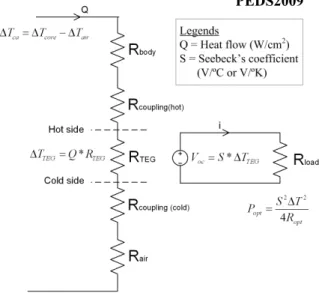
According to Stark [13], the warmness of a human body (and also an animal body) can be used as steady energy source for powering the sensor node in WBAN. The amount of energy released by the metabolism (traditionally measured in Met; 1 Met = 58.15 W/m 2 of body surface) mainly depends on the amount of muscular activity. A normal adult has a surface area in average of 1.7 m 2 , so that such a person in thermal comfort with an activity level of 1 Met will have a heat loss of about 100 W. The metabolism can range from 0.8 Met (46 W/m 2 ) while sleeping up to about 9.5 Met (550 W/m 2 ) during sports activities as running with 15 km/h. A Met rate commonly used is 1.2 (70 W/m 2 ), corresponding to normal work when sitting in an office, which leads to a person’s power dissipation of about 119 W, burning about 10.3 MJ a day. Once the input thermal energy is known, the equivalent electrical circuit of the thermal energy harvesting (TEH) structure with the thermoelectric generator (TEG), given in Figure.5, is analyzed.
On the left hand side of Figure.5, it shows the thermal equivalent circuit representation of a TEG in contact with the human skin. The heat flow, Q, takes place in between the body with a core temperature, T core , and the ambient air, T air , with lower temperature through the following thermal resistances representing the body, R body , the in- terface between body and TEG (hot side), R coupling(hot) , the TEG, R T EG , the interface between TEG (cold side), R coupling(cold) , and the surrounding air, R air . This results in
Fig. 5. Thermal analysis of the thermoelectric generator (TEG)
the following equation, eqn.9, that describes the relationship among the temperature difference between the body and the air, ∆T ca , the heat flow and the various thermal resistances of the TEH structure. Knowing this relationship, the impor- tant factors that affect the overall system efficiency can be identified for improving its performance.
Q = ∆T ca
R body + R coupling(hot) + R T EG + R coupling(cold) + R air
(9)
By keeping the R R
T EGbody
![[102-2] WNFA lab4 - A Tiny Wireless Sensor Network 2014/5/12 Chih-Hsien Ou](data:image/gif;base64,R0lGODlhAQABAIAAAP///wAAACH5BAEAAAAALAAAAAABAAEAAAICRAEAOw==)