行政院國家科學委員會補助專題研究計畫成果報告
以向量量化編碼法實現影像版權保護之研究
計畫編號:NSC 97-2221-E-153-001
執行期限:97年08月01日至98年07月31日
主 持 人:楊政興 副教授([email protected]) 屏東教育大學資訊科學研究所
計畫參與人員:黃正達、林義程、蔡孟璇、曾世偉等研究生 屏東教育大學資訊科學研究所
摘要
在本研究,我們提出二個植基於向量
量化(Vector Quantization; VQ)編碼法來產
生非嵌入式浮水印的影像版權保護技術。
我們的方法利用編碼簿,將影像中的區塊
與浮水印位元產生關連,並輸出表示關連
的 key stream,藉由此 key stream 來證明
影像與浮水印的關連性,達成宣告版權的
目的。我們的方法可以彈性調整每個區塊
對應浮水印的位元數。與學者 Lin 等所提
出的非嵌入式浮水印方法相比較,我們的
方法只需要一本編碼簿,而他們的方法需
要七本,再者我們的方法不會有某些區塊
無法與浮水印產生關連的缺點。最後,我
們提出強健型浮水印和脆弱型浮水印兩種
變型,增加我們浮水印方法在應用上的彈
性。
關鍵詞:浮水印
;
資訊隱藏
;
向量量化; 版
權保護
In the research, we propose a
non-embedded watermarking scheme, which is
based on vector quantization (VQ), to
protect the image copyright. Our approach
applies a codebook to generate a relationship
between image blocks and watermark bits,
then the relationship is outputted as the key
stream. With the key stream, the relation
between the image and the watermark is
confirmed and the copyright of the image is
declared. In our method, the number of bits
related to a block is adaptive. Compared
wi
t
h Li
n e
t
a
l
.
’
sapproach, our approach
needs only one codebook; however, their
approach needs seven codebooks. Moreover,
each block can be connected with watermark
bits in our approach; however, some blocks
can not be connected with watermark bits in
their method. Finally, we propose two
extensions: robust watermarking and fragile
watermarking, which increase the flexible
applications of our methods.
元的浮水印,則輸出最先符合的編碼簿之
標號作為該區塊的 key 值;若七本編碼簿
都不符合,則輸出(111)
2,代表此區塊不
與浮水印產生關連。持續上述動作直到所
有區塊處理完成。圖 1 為產生 key stream
的流程圖。
圖 1 學者 Lin[5]等的非嵌入式浮水印方法
產生 key stream 之流程圖
假設每個區塊將與浮水印中的 t 個位
元產生關連,則其產生 key stream 的詳細
步驟如下:
Step 1: 針對目前正在處理的區塊,到編
碼簿
C 中尋找最接近的編碼字,
0假設此編碼字的索引值為 Index,
利用公式 (1)算出 Secret 值,該
Secret 值定義如下:
表 3 區塊
H 、
1H 和
2H ,利用我們的 VQ
3編碼法進行編碼
Codewords Blocksc
0c
1c
2c
3 1H
96
98
85
64
2H
116
118
79
120
3H
74
91
53
67
圖 3 為我們的方法一的版權驗證流程
圖。版權驗證的過程,利用原先產生的
key stream,一一取出 key 值
k ,然後把
ii
k 當作編碼簿的索引值。另外,假設與
k
i產生關連的區塊
H ,其最接近的
i 2t個編
碼字依序為
c ,
0c ,
1…
,
c
2t1,則判斷
k 是
i屬 於
2t個 編 碼 字 中 的 哪 一 個 , 假 設 為
jc
,則輸出 t 位元的浮水印
W
i 。
j
圖 3 我們的方法一的版權驗證流程圖
1.
在我們的第二個方法中,利用一本編
碼簿去產生 key stream。為了增加安
全度,我們使用隨機亂數在我們的第
二個方法中。圖 4 所示我們的方法二
之 key stream 產生方式,每一個區塊
i H,加上浮水印
Wi和一個隨機亂數
r
i來產生我們的 key value k
i,每一個
key value 產生方式如下:
.
2
mod
t i i i iI
W
r
k
(2)
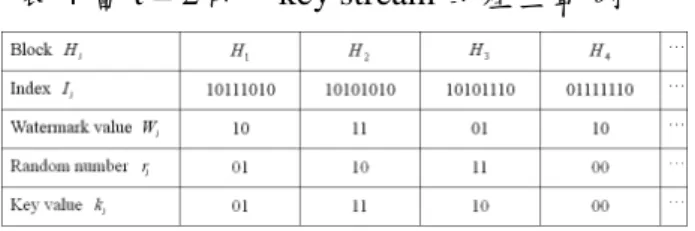
表 4 為產生 key stream 的例子,其中
t = 2 和 W = 10110110...。例如,區塊 H
1找出最接近的編碼字為(10111010)
2,隨機
亂數 r
1是(01)
2。Key value k
1計算方式如
下:
01
.
2
mod
01
10
10111010
2
mod
2 2 2 2 2 1 1 1 1
I
W
r
tk
圖 5 所示為方法二的驗證程序,浮水
印 W 萃取時需要區塊 H、key value k 和
隨機亂數 r。萃取公式如下:
.
2
mod
t i i i ik
I
r
W
(3)
續接前述例子,對區塊 H
1而言,I
1、k
1和 r
1分別是(10111010)
2、(01)
2和(01)
2。
可以計算出 W
1是(01)
2。在驗證程序中,
可以進一步對萃取出的浮水印進行驗證。
W aterm ark K ey stream generator H ost im ageRandom num ber
肆、分析比較
在此節中,我們針對方法一與 Lin 等
的方法分析比較,有關方法二的分析比
較,可以參考我們發表在 2008 ISDA 的
論文。
(一) 方法比較
我們的方法一,相較於學者 Lin 等的
方法[5],有下面幾個優點:
A. 編碼簿大小與數量
我們的方法只需要一本編碼簿,而學
者 Lin 等的方法卻需要七本編碼簿。而
且,我們的方法甚至可以使用大小為 4 的
編碼簿(當 t = 2 時)。所以我們所需要的編
碼簿空間小很多。
B. key stream 的長度
我們的方法所產生的 key 值,其位元
數可視 t 值的大小調整,當 t = 1, 2, 3
時,key 值的位元數分別為 1, 2, 3。而學
者 Lin 等的方法,其 key 值的長度固定為
3。就一般浮水印的大小來說,t = 1 或 2
是非常足夠的。所以我們的方法可以產生
較短的 key stream。以 t = 2 為例,我們所
使用的掩護影像 Lena,其為大小 512 ×
512 的灰階影像,當 Lena 被切成區塊大
小為 4 × 4 不重疊的區塊時,可以產生
(512 × 512 / 4 × 4) = 16384 個影像區塊,
一個 block 產生 2 位元的 key,則 key
圖 11 強健型方法所萃取的浮水印
(NC = 0.921143)
參考文獻
[1]
C.C. Chang, Y.H. Fan and W.L. Tai
“
Four-scanning attack on hierarchical
digital
watermarking
method
for
image tamper detection and recovery,
”
Pattern Recognition vol.41, pp.
654-661, 2008.
[2]
I.C. Lin, Y.B. Lin and C.M. Wang,
“
Hiding data in spatial domain images
with distortion tolerance,
” Comput.
Stand. Interface, vol. 31, pp. 458-464,
2009.
[3]
C.
C.
Cha
ng a
nd H.
C.
Wu,
“
A
copyright protection scheme of images
ba
s
e
d on vi
s
ua
l
c
r
ypt
ogr
a
phy,
”
The
Imaging Science Journal, pp.141-150,
2001.
[4]
T.
S.
Che
n
a
nd
H.
R.
Wu,
“
The
vec
t
or
image protection techniques based on
ve
c
t
or
qua
nt
i
za
t
i
on,
”
i
n Pr
oc
e
e
di
ngs
of
11
thInformation
Security
Conference, 2001.
[5]
C.C. Lin, Y.C. Hu, and C.C. Chang,
“
A
nove
l
i
mage
owne
r
s
hi
p
pr
ot
e
c
t
i
on
scheme based on rehashing concept
a
nd
vec
t
or
qua
nt
i
za
t
i
on,
”
Funda
me
nt
a
Informaticae, Vol. 71, pp. 443-451,
2006.
[6]
C.C. Lin, S.C. Chen and N.L. Hsueh,
“
Ada
pt
i
ve
e
mbe
ddi
ng t
e
c
hni
que
s
f
or
VQ-c
ompr
e
s
s
e
d
i
mage
s
,
”
I
nf
.
Sc
i
.
,
vol
.
179, pp. 140-149, 2009.
[7]
C.C. Chang, D. Kieu and Y.C. Chou,
“
Re
ve
r
s
i
bl
e
i
nf
or
ma
t
i
on
hi
di
ng
f
or
VQ
indices based on locally adaptive
c
odi
ng,
”
J
our
na
l
of
Vi
s
ua
l
Communication
and
Image
2009.
[8]
C.H. Yang, C.Y. Weng, S.J. Wang and
H.
M.
Sun,
“
Ada
pt
i
ve
da
t
a
hi
di
ng i
n
edge areas of images with spatial LSB
doma
i
n
s
ys
t
e
ms
,
”
I
EEE
Tr
a
ns
ac
t
i
ons
.
Information Forensics and Security,
vol. 3, pp. 488-497, 2008.
[9]
M.A.
Suhail
and
M.S.
Obaidat,
“
Di
gi
t
a
l
wa
t
er
ma
r
ki
ng-based DCT and
J
PEG mode
l
,
”
I
EEE Tr
a
ns
a
c
t
i
ons
on
Instrumentation
and
Measurement,
Vol. 52, No. 5, pp. 1640-1647, 2003.
計畫成果自評
本計畫之執行,依照原先計畫所設
定的目標,研究以向量量化編碼法實現影
像版權之保護,以及相關的資訊隱藏技
術,並且獲得良好的研究成果。上述成果
報告為我們研究成果的一部份。下面為該
計畫所發表的相關論文:
(一)期刊論文:
1.
C.
H.
Ya
ng
a
nd
Y.
C.
Li
n,
“
Re
ve
r
s
i
bl
e
Data Hiding of a VQ Index Table
Ba
s
e
d
on
Re
f
e
r
r
e
d
Count
s
,
”
J
our
na
l
of Visual Communication and Image
Representation, Vol. 20, No. 6, pp.
399-407, August 2009. (SCI, EI)
2.
C.H.
Yang
and
S.J.
Wang,
“
Tr
a
ns
f
or
mi
ng
LSB
Subs
t
i
t
ut
i
on
f
or
Image-based
Steganography
in
Matching Algorithms
,
”
J
our
na
l
of
Information Science and Engineering,
accepted on February 2009. (EI)
3.
C.H. Yang, C.Y. Weng, S.J. Wang,
Watermarking Scheme on Digital
I
mage
s
,
”
Funda
me
nt
a
I
nf
or
ma
t
i
c
ae
,
Vol. 92, No. 4,
pp. 397-409,
September 2009. (SCI, EI)
(二)研討會論文:
1.
Cheng-Hsing
Yang,
Cheng-Ta
Huang,
and
Shiuh-Jeng
Wang,
“
Re
versible Steganography Based on
Side Match and Hit Pattern for
VQ-Compr
e
s
s
e
d I
mage
s
,
”
pr
e
s
e
nt
e
d i
n
The Fifth International Conference
on
Information
Assurance
and
Se
c
ur
i
t
y (
I
AS 2009)
,
Xi
’
a
n, China,
August 18-20, 2009.
2.
Cheng-Hs
i
ng Ya
ng
,
Che
ng-Ta
Huang,
Shu-Chien
Huang,
and
Sheng-Ch
a
ng Wu,
“
Mul
t
i
pl
e
Bi
t
s
Embedding Approach for the
Hit-pattern-based
VQ
Reversible
Steganogr
a
phy,
”
pr
e
s
e
nt
e
d i
n The
Fourth
Joint
Workshop
on
Information Security (JWIS 2009),
Kaohsiung,
Taiwan,
August
6-7,
2009.
3.
楊 政 興 , 林 義 程 , 黃 正 達 ,
“
Reversible VQ Data Hiding Based
on Side-Match Prediction,”
i
n第十九
屆資訊安全會議, 台灣科技大學,
June 3-5, 2009.
4.
楊政興, 蔡孟璇, 黃正達, “
以棋盤式
預測法改善直方圖可逆資訊隱藏技
術,”
i
n第十九屆資訊安全會議, 台
灣科技大學, June 3-5, 2009.
5.
曾世偉
, 楊政興,
“植基於互動式垃
圾語音電話偵測系統,”
i
n2009數位
學習與生活研討會, 屏東教育大學,
May 25, 2009.
6.
Wen-Ya Chiang, Shiuh-Jeng Wang,
Chi-Yao Weng, and Cheng-Hsing
Ya
ng,
“
Robus
t
ne
s
s
-set
in
Watermarking Embedding Systems
Us
i
ng Code
book Cl
as
s
i
f
i
c
a
t
i
ons
,
”
presented in The 3rd International
Conference
on
Ubiquitous
Information
Management
and
Communication
(ICUIMC
2009),
SKKU, Suwon, Korea, January
15-16, 2009.
7.
Cheng-Hsing
Yang,
Shu-Chien
Huang, Cheng-Ta Huang, and
Shiuh-J
e
ng Wa
ng,
“
Non-embedded Image
Protection
Approaches
Based
on
Ve
c
t
or
Qua
nt
i
za
t
i
on,
”presented in
IEEE,
The
Eighth
International
Conference on Intelligent Systems
Design
and
Applications
(ISDA
2008)
held
at
Kaohsiung
City,
Taiwan, pp. 620-625, November
26-28, 2008.
出席國際會議報告書
報告人姓名
中文:楊政興
英文:Cheng-Hsing Yang
學校/系所/職稱
國立屏東教育大學/資訊科學系/副教授
會議期間及地點
2009/01/15-16, 韓國,水原市
Sungkyunkwan University (成均館大學校)
會議正式名稱
The
Third
International
Conference
on
Ubiquitous
Information Management and Communication
發表論文題目
Robustness-set in Watermarking Embedding Systems
Using Codebook Classifications
會議報告場次
Session Security I
報告內容:
一、
參加會議經過
1. 行程說明
會 議 前 一 天 抵 達 首 爾 , 於 會 議 結 束 後 隔 天 回 程 。 International
Conference on Ubiquitous Information Management and Communication
(ICUIMC) 是一個針對網路上資訊的發展、管理與應用的國際會議,討論
議題相當廣泛,舉凡網路技術、通訊應用、網站技術、多媒體技術、以及
資訊安全技術等都有涉及,其領域非常的多元,大致議題如下:
1.
Networking
and Communications Technologies and Applications
Broadband access networks
Wireless BAN/PAN/LAN
Wireless mesh networks, sensor networks
Mobile networks
Future Internet
RFID
Knowledge discovery and data mining, link analysis, Web mining
-Internet search, UCC management, online communities, automatic
classification,
e-commerce,
e-learning,
recommendation,
personalization - Intelligent systems and techniques
Multimedia content recognition, indexing, search - Human Computer
Interaction
Database management system (flash-based database system), personal
information management, data integration and federation, security,
privacy
3.
Foundational Technologies
Distributed
and
parallel
system
architecture,
service-oriented
architecture - Embedded systems
Software engineering
此會議 ICUIMC 2009 於 1 月 15-16 日於韓國 Sungkyunkwan University
(成均館大學校)舉行,計有 94 篇論文在本次會議中發表,而 Security 的部
份約有 13 篇。此兩天的會議中,同一時段分為三個 Session,在三個會議
場同時舉行,每個 Section 會包含幾個不同領域的論文,因此,藉由參加
本次會議,可以涉略許多不同知識背景的議題。
2. 會議參加過程
此次會議,我們報告的論文題目為
“
Robustness-set in Watermarking
Embedding Systems Using Codebook Classifications”,主要內容為提出一種
利用編碼簿來歸類的浮水印技術,利用選取和旋轉等技巧,來嵌入二元浮
水印,藉由參數的調整來增加浮水印的強韌度。我們的報告被安排在第一
中在下午的兩個 section。所有 security 方面的論文中,共有 7 篇資訊隱藏
相關的論文發表,可以說相當豐盛。我特別注意到 3 篇可逆式(Reversible)
資訊影藏技術的發表:“
A Reversible Data Hiding Scheme Based on Dual
Steganographic Images”、“
DCT-based Reversible Data Hiding Scheme”、
“
An Efficient Block-based Lossless Information Hiding Technique”。
第二天的議程中,並沒有 security 方面的論文,主要是資訊系統和資
訊應用等議題,包括影像處理的系統與應用,例如“Representative Slice
Method for Viscous Fluid Registration of Three-Dimensional Whole-Body
Human Images”和“
A Credibility Analyzing Method of Geographical Objects
from Digital Maps”兩篇論文;感測網路系統與應用,例如“
A Lightweight
Key Renewal Scheme for Clustered Sensor Networks”和“
Reporter node
determination of replicated node detection in wireless sensor networks”兩篇
論文;網路資訊的處理,例如“
Real Time Extraction of Related Terms by
Bi-directional Lexico-syntactic Patterns from the Web” 和 “
An Efficient
Clustering Framework for Relevant Web Information”兩篇論文;智慧 IC 卡
的應用,例如“
Bilinear-Pairing-Based Remote User Authentication Schemes
Using Smart Cards”此篇論文。
Robustness-set in Watermarking Embedding Systems
Using Codebook Classifications
Wen-Ya Chiang Department of Information Management, Central Police
University Taoyuan, Taiwan 333 Shiuh-Jeng Wang* Department of Information Management, Central Police University Taoyuan, Taiwan 333 *corresponding author: [email protected] Chi-Yao Weng Department of Computer Science, National Tsing-Hua University, Hsinchu, Taiwan, 300 Cheng-Hsing Yang Department of Computer Science, National PingTung
University of Education PingTung, Taiwan, 900
ABSTRACT
In this paper we propose a new watermark technique which combines bit rotation, codebook and coordinate plane division for gray-level image. We embedded binary watermark into the gray-level image successfully by selecting and rotating the pixel bits, classifying codebook and dividing the coordinate plane. Besides that to achieve more robustness, parameter setting is more important. Our scheme is flexible since the user can choose the properties of the stego image, in terms of watermarking size, randomized bit embedding and robustness to avoid frequent image multimedia attacks in computer systems. From the experimental results, it can be visualized that our scheme can extract the identifiable watermark even after image processing attacks such as cropping and JPEG compression. Proposed scheme is better than the recent study of Wu and Chang scheme in terms of robustness.
Keywords
gray-level image, watermark, bit rotation, codebook, robustness, JPEG compression
1. Introduction
Recently, the problem of copyrights in multimedia has become very important with many related technique being proposed. One of them is the watermark technique, which embed the information regarding the ownership into the multimedia files. It can verify the ownership of the respective multimedia file. Watermark techniques always emphasizes on the imperceptibility and robustness. It means that the watermark embedded into the media should not be noticed by human eyes and the receiver can extract the watermark from the stego media even after the image processing attacks take place.
In past research, many techniques for watermark were developed by some scholars [4, 7, 17, 18]. There are many watermark techniques proposed in spatial and frequency domain. In spatial domain area, embedding of watermark is done into the cover image by replacing the bits directly. In frequency domain,
we transform the cover image into many coefficients and embed the watermark into the high frequency area, which is imperceptible to human eyes. The researches about the spatial domain: Hwang et al. [9] proposed a watermark scheme based on hash function. The robustness of spatial domain techniques was discussed by Lin [12] in 2000. Shih and Wu [16] proposed a technique by combining the spatial and frequency domain. The watermark researches about the frequency domain proposed by [3, 11, 14].
It was distinguished that the watermark technique should be free from ambiguity, algorithm complexity and should be robust and so on. This paper combines the concepts of spatial domain and codebook to propose a low-complexity watermark embedding technique for gray-level images. It can sustain against the attacks of image processing such as cropping and filled the stego image with other information, JPEG compression. Through the proposed scheme we can achieve the demand of robustness.
The paper is organized as follows: The Section 2 is about the preliminaries containing the standards of estimating watermark and Wu and Chang scheme [17]. The Section 3 is our scheme including the embedding, extracting algorithms and examples. The experimental results are shown in Section 4. The Section 5 is the analysis and discussion for our scheme. Finally, the conclusion is in Section 6.
2. Preliminaries
In this section, we will review
some
standards and tools for the watermark technique and the Wu and Chang scheme [17].2.1 Standard and tools for watermark
evaluations
The digital watermark technique is proposed to solve the problem of copyright, authentication, and so on. It embeds some significant message into the multimedia to validate the legality or ownership. Generally speaking, it is divided into two types. One is visible technique and the other is invisible technique. Some standards of oblivious[6,8,15], unambiguity [2,5], transparency[1,10], robustness[2,10,13], and security[19,20], are used to evaluate the watermark technique. The tools for justifying the quality of the stego and extracted secret image are PSNR, NC, and TAF.
2.1.1 PSNR (Peak Signal to Noise Ratio)
PSNR is the indicator to estimate the modified degree of original media and stego media. If the PSNR value is higher than 30, then the modified degree is acceptable. The definition of PSNR in gray-level image is as follows:
Permission to make digital or hard copies of all or part of this work for personal or classroom use is granted without fee provided that copies are not made or distributed for profit or commercial advantage and that copies bear this notice and the full citation on the first page. To copy otherwise, or republish, to post on servers or to redistribute to lists, requires prior specific permission and/or a fee.
2
w i h j ij ijy
x
wh
MSE
MSE
PSNR
1 1 2 2 10(
)
1
)
255
(
log
10
(1)2.1.2 NC (Normalized Correlation)
This tool is used to determine the similarity of the original and extracted watermarks. The value of NC is between 0 and 1. If the value is 1, it means the two watermarks are same. Value of NC closer to 1 shows the similarity between the two original and extracted watermarks. On the other hands, more the value of NC closer to 0, more dissimilarity in the two watermarks and it’s difficult to validate the ownership. The formula of NC is as follows:
w i h j ij w i h j ij ij w w w NC 2 ' (2)Where w and h are the width and height of the watermark, wijis the ijth pixel of the original watermark and wij’istheijth
pixel of the extracted watermark. However, some mistake may occur in determining the value of NC. The mistakes are resulted from the formula of NC. In some cases, when the watermark value gets changed from 0 to 1, the numerator of NC formula remains unchanged. Hence, it can not detect the changes of watermark. In this paper, we highlight the defectiveness shown in two case studies with example demonstrations below.
Case I: The evaluation of NC is correct.
Suppose we have original binary watermark as
0
0
0
0
1
0
0
0
0
1W
,and after extracting watermark is
0
0
0
0
1
0
0
0
0
'
1W
. Using theformula of NC, we get the value
of
1
1
1
)
1
1
(
8
)
0
0
(
)
1
1
(
8
)
0
0
(
2 2
NC
.It is accurate tocompute the computation for the value of NC. Case II:The evaluation of NC is incorrect.
Assume we have original binary watermark
as
0
0
0
0
1
0
0
0
0
1W
, and after extracting watermarkis
0
0
0
0
1
0
0
1
0
'
2W
. Using the formula of NC, we get the valueof
1
1
1
)
1
1
(
8
)
0
0
(
)
1
1
(
)
1
0
(
7
)
0
0
(
2 2
NC
. In this casevalue of NC produces mistake and is not accurate to compute. The tool of the NC is not accurate. Therefore, we used the tools of TAF (Tamper Assessment Function) to replace NC to correctly evaluate the watermark.
2.1.3 TAF (Tamper Assessment Function)
TAF is a standard to judge the similarity of the originaland extracted watermark. The value of TAF is from 0 to 1. If the TAF is closer to 1, it means that the numbers of changed watermark bits are more. The TAF formula is as follows:
Nw i i i ww
w
N
w
w
TAF
1 ' '1
)
,
(
(3)2.2 Related literature reviews
Wu and Chang [17] proposed a watermark embedding technique based on vector quantization in 2005. The codebook division is used to classify the watermark bit 0 and 1 for embedding process. They emphasize that their scheme can sustain against the attacks of image processing and JPEG compressing. Their proposed methods are termed as two algorithms of
codebook division and data embedding algorithms.
The algorithm of codebook division
Step1:Let the initial codebook trained by LBG.
Step2:Use MSE to find the two closest codeword to be having the same division. The MSE of two codeword CWxand CWy
is defined as follows:
a1 0 i 1 a 0 j 2 y x 2 y x (CW (i,j) CW (i,j)) a 1 ) CW , MSE(CW (4)Step3:Each division can have two codeword either 0 or 1.
The algorithm of data embedding
Step1:Divide cover-image into m blocks and get an index table using VQ processing.
Step2:Use PRNG to choose the started index.
Step3:Take one watermark bit and search for the corresponding division and codeword number.
Step4:Replace the corresponding number bit with the watermark bit.
Step5:Renew the index values according the record items and generate the watermarked image.
In Wu and Chang scheme [17], the watermark is embedded into the VQ compressed image. In the embedding process, they divide the cover image into many blocks and renew the index according to the size and classification of codebook. The watermark is not only embedded in the VQ compressed image but also in the index table. Wu and Chang emphasized that their scheme can extract the identifiable watermark even after the stego image suffered the attacks of frequent image processing and JPEG compression.
3. Our Scheme
The key-concept of watermark technique is to keep high quality of image and enhancing robustness of the technique. The embedding watermark should be imperceptible. The extracted watermark should be identifiable even after various images processing attacks. In order to achieve the demand of quality and robustness, we proposed a flexible and adaptable watermark technique by combining the concepts of bit rotation and codebook for gray-level images.
the watermark, we divide and select bits into four blocks, then set parameters to catch the certain bits for the embedding process. Our solutions are to include the key-concepts of the bit-rotation and codebook classification with coordinate plane division so as to further upgrade the watermark extraction qualities against the frequent attacks in image processing. Because of the codebook classification and coordinate plane division, our scheme can decentralize the embedded bits and can sustain against the attacks. In addition, our method is more flexible and adaptable because of the setting of various parameters by the user himself to achieve different embedding situation.
3.1 Notation Definitions
Before the embedding process, we must definite all notations that will be used in the embedding phase.
1. GI:Cover gray-level image with size of M×M, where M is the height and length of the host image.
2. SGI:From GI to choose the latest‘a’bits of each pixel, and
create the images SGI with size of M×M×a bits. Every 2 bits constitutes one t-pixel.
3. t-pixel: Every two bits of the SGI is called a t-pixel in the order of left-to-right.
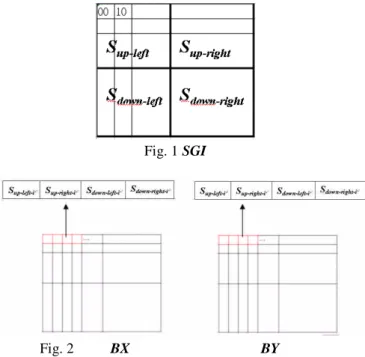
4. Sup-left, Sup-right, Sdown-leftand Sdown-right:Represent four block separations in SGI. See the location distributions in Fig. 1. 5. Sup-left-k:The ktht-pixel of the block Sup-left, where k=0,1,2…,
(M/2)2-1. Sup-right-k, Sdown-left-k, Sdown-right-kare the same as the
Sup-left.
6. BX, BY:The image contains many e-pixel composed of four
t-pixels selected from Sup-left, Sup-right, Sdown-left, Sdown-right blocks.
7. BXm:The mthe-pixel of BX block, which is composed from
Sup-left-i, Sup-right-i, Sdown-left-i, and Sdown-right-i, where i=bm+c1,
m=0,1,2…, (W×W-1).
8. BYm:The mthe-pixel of BY block and is composed of Sup-left-j,
Sup-right-j, Sdown-left-j, and Sdown-right-j, where j=bm+c2, m=0, 1, 2…, (W×W-1).
9. b, c1, c2:The constant values set by the user, and are used to select the pixel of SGI.
10. estart :It is the beginning position of the mthe-pixel in BX or BY to put Sup-left-kand is generated by random seed.
11. Cd0, Cd1, Cd2, Cd3:The four positions from left to right in the
e-pixel. If estart= 3, the positions in the e-pixel are Cd0=
Sup-right-k, Cd1= Sdown-left-k, Cd2= Sdown-right-k, and Cd3=Sup-left-k, respectively.
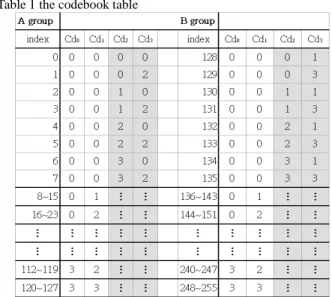
12. CB:The codebook contains 256 indices and four codeword (Cd0, Cd1, Cd2, Cd3), and it is used to classify the e-pixel. 13. IBXm, IBYm:The indices of the BXm, BYm block in the
codebook.
14. W:Binary watermark with size of W×W.
15. Wn:Single bit of the watermark, n= 0,1…, (W×W -1). 16. Wp:The watermark bit on the coordinate plane. 17. EGI:Stego image after embedding the watermark.
18. SEGI:An image with size of M×M, where the bits in each pixel of SEGI are selected from the latest ‘a’bits of each pixel in the corresponding stego image.
19. SEup-left, SEup-right, SEdown-left, SEdown-right:The blocks of left-up, right-up, left-down, and right-down located in SEGI.
20. SBX, SBY:The image contains many e-pixels composed of four t-pixels selected from SEup-left, SEup-right, SEdown-left, and
SEdown-rightblocks.
21. SBXm, SBYm:The mthe-pixel in the two blocks of SBX and
SBY.
22. ISBXm, ISBYm:The indices of the SBXm, and SBYmblocks in
the codebook.
23. SWp:An extracted Watermark from the stego image.
3.2 The Embedding and Extracting Process
Firstly, we select the least ‘a’bits of every pixel from thecover image to form SGI. Every two bits of the SGI is called one
t-pixel. The SGI is divided into four blocks of SEup-left,SEup-right,
SEdown-left, and SEdown-right which are the left-up, right-up, left-down and right-down blocks of SGI, which is shown in Fig. 1. We can construct one e-pixel by selecting one t-pixel from each block, to consist a total of 4 t-pixels. In order to decentralize the embedding area, we can set parameters b, c1, and c2 to select
t-pixel and use estart to produce the image’s BX, BY, which is shown in Fig. 2.
Fig. 1 SGI
Fig. 2 BX BY
4
Table 1 the codebook table
Assume that the index pair (IBXm, IBYm) is found from the codebook as the coordinate in the plane. The coordinate plane is pre-divided into two blocks, which is representing the watermark bit 0 or 1, respectively. It is shown in Fig. 3.
Fig 3. The coordinate plane division
Assume that we want to embed the mthwatermark bit Wm.
We just take out the e-pixel pair (BXm, BYm) and find the index pair (IBXm,IBYm) from the codebook. According to the position of coordinate (IBXm,IBYm), we can get the respective watermark bit Wpon the plane. If Wm= Wp, the index pair (IBXm,IBYm) is unchanged. In other words, if Wn
Wp, the index pair (IBXm,IBYm) is changed to (IBXm , IBY’m), which shift IBY’m to corresponding position of the IBYmon the coordinate plane. When the user wants to extract the watermark, they just need the information of estartand constants b, c1, c2to find the index pair of
(SBXm, SBYm). We can extract the watermark bit SWpsuccessfully by using the index pair (ISBXm, ISBYm) and the coordinate plane.
Our proposed two algorithms for data of watermark in the embedding and extracting processes are depicted in the following
Algorithm 1 and Algorithm 2. Algorithm 1: (embedding process)
Input:Gray-level image GI, binary watermark image W, seed, constants a, b, c1and c2.
Output:Stego-image EGI.
Step1: Take out the least a bits of each pixel of GI to form SGI containing (M×M×a) bits.
Step2: Divide SGI into four blocks. (SEup-left, SEup-right, SEdown-left,
SEdown-right)
Step3: Select Sup-left-i,Sup-right-i,Sdown-left-i,Sdown-right-i to form BXm and select Sup-left-j,Sup-right-j,Sdown-left-j,Sdown-right-j to form
BYmbased on the pre-define parameters ( b, c1, c2, estart). Step4: Classify the codebook CB and divide the coordinate plane
into two blocks representing the watermark bit 0 and 1. Step5: Take out each e-pixel pair (BXm,BYm) one by one to find
the index pair (IBXm,IBYm) on the codebook CB. Find the coordinate (IBXm,IBYm) and position of Wpon the plane. If the original watermark bit Wn is equal to Wp, then (IBXm,IBYm) is unchanged. If the Wnis opposite to Wp, change the IBYmto the corresponding position where Wn is equal to Wp.
Step6: Take out the new code words of index IBYmor IBYm’and form the new block BYm’.
Step7: Use BYm’to generate SGI’.
Step8: Use SGI’to convert the cover image GI into the stego
image EGI.
Algorithm 2: (extracting process)
Input:Stego image EGI, seed, and parameters of a, b, c1and c2. Output: binary watermark image W.
Step1:Takeoutthe least‘a’bits of each
pixel of EGI to form SEGI.
Step2: Divide the SEGI into four blocks, where contains SEup-left,
SEup-right, SEdown-left, and SEdown-right.
Step3:Use the constants b, c1, estartto select SEup-left-i, SEup-right-i,
SEdown-left-i, SEdown-right-ito form SBXm. Use the constants b,
c2, estart to select SEup-left-j , Eup-right-j , SEdown-left-j ,
SEdown-right-jto form SBYm.
Step4:Take out each e-pixel pair (SBXm,SBYm) one by one to find the index pair of (ISBXm, ISBYm) from the codebook CB.
Step5:Judge the index pair (ISBXm,ISBYm) to find the position of
SWpon the coordinate plane. The SWp is the extracted watermark.
Let us take an example to demonstrate the data embedding process in Algorithm 1 as follows.
1. GI:A cover image with size of 512
512 pixels. 2. Set the parameters a= 2, b = 4, c1= 1 and c2= 3.Step1: Take out the least 2 bits of each pixel of the GI to form
SGI which contains 512
512 bits.Step2: Divide the SGI into four blocks SEup-left, SEup-right,
SEdown-left, SEdown-right(see Fig. 4).
Step3: i=bm+c1=4m+1. select SEup-left-i, SEup-right-i, SEdown-left-i,
SEdown-right-ito form BXm;j=bm+c2=4m+1. select SEup-left-j,
Eup-right-j, SEdown-left-j, SEdown-right-j to form BYm (see Fig.
5).
Case I : m=0, assume that estart=0
1. BX0=( Sup-left-1 ,Sup-right-1 ,Sdown-left-1,Sdown-right-1)=(00,11,1 1,01).
2. BY0=( Sup-left-3,Sup-right-3,Sdown-left-3,Sdown-right-3)=(11,10,11, 01).
Case II: m=1, assume that estart=1
1. BX1=(Sdown-right-5 ,Sup-left-5 ,Sup-right-5,Sdown-left-5)=(00,10,00,1 1).
2. BY1=( Sdown-right-7,Sup-left-7,Sup-right-7,Sdown-left-7)=(10,01,11, 00).
index-pair and determine the Wpbits.
Pair I : (BX0,BY0)
1. Decimal BX0=(0,3,3,1), IBX0=158;decimal BY0=(3,2,3,
1), IBY0=246
2. (IBX0,IBY0)=(158,246), Wp=1
3. If Wn=1, (IBX0,IBY0’)=(158,246)
3-1 : BX0, BY0’are unchanged.
3-2 : ( Sup-left-1,Sup-right-1 ,Sdown-left-1,Sdown-right-1)are unchanged. ( Sup-left-3,Sup-right-3,Sdown-left-3,Sdown-right-3) are unchanged. 4. If Wn=0, (IBX0,IBY0’)=(158,118)
4-1 : BX0=(0, 3, 3, 1) is unchanged.
4-2 : BY0’=(3, 2, 3, 0). The Sdown-right-3is changed from 01 to 00.
Pair II : (BX1,BY1)
1. decimal BX1=(0,2,0,3), IBX1=145;decimal BY1=(2,1,3,0),
IBY1=78
2. (IBX1,IBY1)=(145,78), Wp=0
3. If Wn=1, (IBX1,IBY1’)=(145,206)
3-1 : BX1=(0,2,0,3) is unchanged.
3-2 : BY1’=(2,1,3,1). The Sdown-left-7is changed from 00 to 01. 4. If Wn=0, (IBX1,IBY1’)=(145,78)
4-1 : BX1,BY1’are unchanged.
4-2 : (Sdown-right-5,Sup-left-5,Sup-right-5,Sdown-left-5) are unchanged.
(Sdown-right-7,Sup-left-7,Sup-right-7,Sdown-left-7) are unchanged.
Fig 4. SGI of 512
512 t-pixelFig 5. The explanation of BX,BY with size of 128
1284. Experiment Results
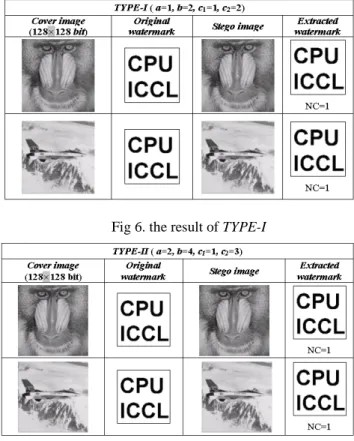
Two of the cover images with 512×512 pixels and one of watermark image with 128×128 bits are used in our experiment. In our scheme, one cover image can embed different size watermark based on the setting of different parameters in the embedding process. In this section, we demonstrate our scheme with four types. TYPE-I and TYPE-II shows the result of
embedding a binary watermark (128
128 bits) to the cover image (512
512 pixels). The parameters are set as: (TYPE-Ia=1, b=2, c1=1 and c2=2;TYPE-II a=2, b=4, c1=1 and c2=3).
TYPE-III and TYPE-IV shows the result of embedding a binary
watermark (64
64 bits) to the cover image (512
512 pixels). The parameters are set as: (TYPE-III a=2, b=4, c1=1 and c2=3, the a bits of each pixel of GI are the 5-th, 6-th bits from right to left ), (TYPE-IV a=2, b=4, c1=1 and c2=3, the a bits of each pixel of GI are the 6-th, 7-th bits from right to left).4.1 TYPE-I and TYPE-II
In TYPE-I, a=1, b=2, c1=1 and c2=2, we take out the least 1 bit of each pixel of GI to form the SGI. (512
256 t-pixels) In the four blocks, we select the first of every two t-pixels in each block to form the e-pixel of BX and the second of every two t-pixels in each block to form the e-pixel of BY. The position of bits in thee-pixel is decided by the seed estart. We embed the binary
watermark W into the gray-level image through the codebook classification and index plane division. In TYPE-II, we set the parameters as a=2, b=4, c1=1 and c2=3. We take out the least 2 bits of each pixel of GI to form the SGI (512
512 t-pixels). In the four blocks, we select the first of every four t-pixels in each block to form the e-pixel of BX and the third of every four t-pixels in each block to form the e-pixel of BY. The embedding results and PSNR values are shown in Fig. 6, Fig. 7 and Table 2, Table 3, respectively.Fig 6. the result of TYPE-I
6
4.2 TYPE-III, TYPE-IV
In TYPE-III and TYPE-IV, a=2, b=4, c1=1 and c2=3, we take the gray-level images Baboon, F16, and Pepper as the cover image with size equal to 512
512 pixels. The ICCL image (64
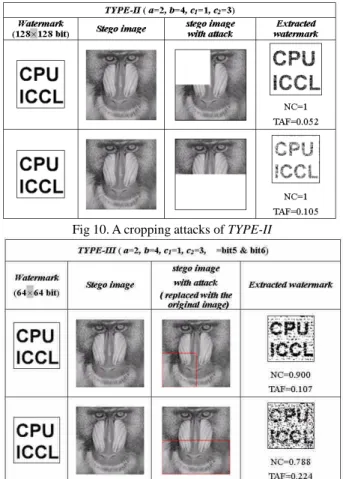
64 bits) is the binary watermark image. In the experimental result, the extracted watermark image is totally the same as the original watermark image. In TYPE-III, we take out the 5-th,6-th bits from right to left of each pixel of GI to form the SGI. InTYPE-IV, we take out the 6-th,7-th bits from right to left of each
pixel of GI to form the SGI. The PSNR value of TYPE-III and
TYPE-IV are shown in Table 4 and Table 5, respectively.
Table 4
TYPE-III ( a=2, b=4, c1=1, c2=3) ( = bit5 & bit6 )
watermark ICCL image
(64
64 bits) cover image PSNR Baboon 39.43 F16 38.28 Peppers 39.044.3 Attack Analysis
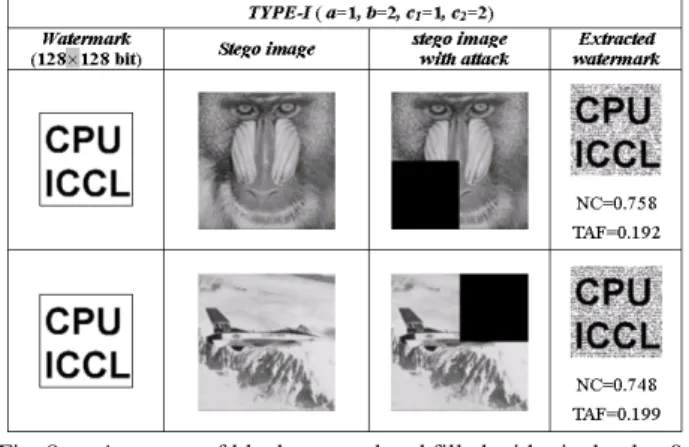
Our scheme can sustain against the image attacks, such as cropping and filling the pixels with value 0, and JPEG compression. In this section, we analyzed our scheme with all of the attacks. Fig. 8 shows the result of cropping a quarter of block and filling with value 0, the attack was done on image of TYPE-I. Fig. 9, 10 are the result of filling half of the block with value 0 and the attack was done on TYPE-II. Half and quarter of block cropped and filled with the original image of TYPE-III is shown in Fig. 11. Fig. 12 is the extracted result after the stego image is suffered the attack of JPEG compression.
Fig. 8 A quarter of block cropped and filled with pixel value 0 of TYPE-I
Fig 9. 1/2 block cropped and filled with pixel value 0 of TYPE-II Table 2
TYPE-I ( a=1, b=2, c1=1, c2=2)
watermark ICCL image
(128
128 bits) cover image PSNR Baboon 63.16 F16 63.24 Peppers 63.09 Table 3 TYPE-II ( a=2, b=4, c1=1, c2=3)watermark ICCL image
(128
128 bits) cover image PSNR Baboon 63.18 F16 63.27 Peppers 63.16 Table 5 TYPE-IV ( a=2, b=4, c1=1, c2=3) ( = bit6 & bit7 )watermark ICCL image
(64
64 bits)cover image PSNR
Baboon 32.86
F16 34.23
Fig 10. A cropping attacks of TYPE-II
Fig 11. 1/4, 1/2 block cropped and filled with the original image of TYPE-III
Fig. 12 The extracted result by using JPEG compression
5. Analyses and Discussions
5.1
The discussion regarding the watermark
sizes
In our scheme, different sizes of watermark were embedded into the cover image by setting up different parameters to achieve the best to the demand of image quality and robustness. If the selected bits used for embedding watermark are more discrete, it can stand against the attacks more effectively. The extreme watermark size and the discrete degree of selected bits are deeply related to the constants a, b, c1and c2. If the constant
‘a’is bigger, it means that the number of selected bits from the
cover image is more and it can form more t-pixels and e-pixels.
So the area used to embed watermark is more. The value b represents that we select one t-pixel from every b t-pixels to form one e-pixel. When b is bigger, it means that the selected bits are more discrete. This case has better efficiency against attacks. We illustrate the extreme size of the watermark with the two cases (a=1, a=2, cover image=512×512 pixels) as follows:
When a=1, the SGI is 512
512
1 bits (512
256t-pixels). The SGI is divided into four blocks. Each block is
256
128 t-pixels. If the value b is equal to 2, it means that we take out one of every two t-pixel to form one e-pixel of BX and BY. The extreme size of watermark will be (256
128/2) =128
128 bits.When a=4, the SGI is 512
512
4 bits (512
512
2t-pixel). The SGI is divided into four blocks. Each block is
512
256 t-pixel. If the value b is equal to 2, it means that we take out one of every two t-pixels to form one e-pixel of BX andBY. The extreme size of watermark will be (512
256/2) =256
256 bits.5.2
Robustness of our scheme
Regarding the robustness of our scheme, our method can effectively stand against the image attacks of cropping and filling the pixel with value 0, and JPEG compression attacks. Table 6 is the comparison of our method and Wu and Chang scheme [17] regarding the cropping and filled the pixel with value 0 attacks. Based on these attacks, our method has proved to have higher value of NC than Wu and Chang scheme. Also our scheme has bigger watermark size than that of theirs. (Our size 128
128 bits, their size 64
64 bits)8
Table. 6 The comparison of our scheme and Wu and Chang scheme in cropped, filled with
pixel value 0 attacks
Table. 7 The comparison of our scheme and Wu and Chang scheme in filled with the original image and JPEG compression
6. Conclusions
In this paper, we proposed a new robustness watermark technique based on pixel bits selected, rotated, decentralized, codebook classified and coordinate plane divided. By setting up the parameters we can achieve more robustness for watermark. From experimental results, TYPE-I and TYPE-II images show high image quality and can sustain against the attacks of cropping and filling with pixel value 0. Our method can effectively resist the filled with the original image and JPEG compression attacks through setting different parameters. According to the analysis and some discussion, our scheme is therefore full of flexibility and adaptability.
Acknowledgements: This work was supported in part by the
National Science Council of the Republic of China under the Grant NSC 95-2221-E-015-002-MY2, NSC 97-2221-E-153-001, NSC 97-2221-E-015-001, the TWISC@NCKU, and NSC 97-2219-E-006 -003.
REFERENCES
[1] S. Agreste and G. Andaloro, “A new approach to pre-processing digital image for wavelet-based watermark,” Journal of Computational and Applied Mathematics, In Press, Corrected Proof, Available online 5 November 2007. [2] S. Agreste, G. Andaloro, D. Prestipino and L. Puccio,“An
image adaptive, wavelet-based watermarking of digital images,” Journal of Computational and Applied Mathematics, Vol. 210, Issues 1-2, pp.13-21, 2007.
[3] M. Barni, F. Bartolini, and A. Piva, “Improved wavelet-based watermarking through pixel-wise masking,” IEEE Transactions on Image Processing 10, pp.783–791, 2001.
[4] W. Bender, D. Gruhl, and N. Morimoto, “Techniques for datahiding,” IBM SystemsJ.35,pp.313-336, 1996. [5] C.C.Chang and P.Y.Lin,“Adaptive watermark mechanism
for rightful ownership protection,” Journal of Systems and Software, In Press, Corrected Proof, Available online 28 August 2007.
[6] N. Chen and J. Zhu,“Multipurpose speech watermarking based on multistage vector quantization of linear prediction coefficients,” The Journal of China Universities of Posts and Telecommunications, Vol. 14, Issue 4, pp. 64-69, 2007. [7] I.J.Cox,J.Kilian,F.T.Leighton,and T.Shamoon,“Secure
spread spectrum watermarking for multimedia,” IEEE Transactions on Image Processing 6, pp. 1673–1687, 1997. [8] Y.G. Fu and R.M. Shen,“Color image watermarking scheme
based on lineardiscriminantanalysis,” Computer Standards & Interfaces, Vol. 30, Issue 3, pp. 115-120, 2008.
[9] M.S. Hwang, C.C. Chang, and K.F. Hwang, “A watermarking technique based on one-way hash functions,” IEEE Transactions on Consumer Electronics, Vol. 45, No.2, pp. 286-294, 1999.
[10] C.T.Kuo and S.C.Cheng,“Fusion ofcoloredgedetection and color quantization for color image watermarking using principalaxesanalysis,” Pattern Recognition, Vol. 40, Issue 12, pp. 3691-3704, 2007.
[11] Y.S. Kim, O.H. Kwon, and R.H. Park, “Wavelet based watermarking method for digital images using the human visualsystem,” ElectronicsLetters35,pp.466–468, 1999. [12] P.L. Lin, “Robust transparent image watermarking system
with spatial mechanisms,” Journal of Systems and Software, Vol. 50, Issue 2, pp. 107-116, 2000.
[13] L.D. Li and B.L. Guo,“Localized image watermarking in spatial domain resistant to geometric attacks,” AEU –International Journal of Electronics and Communications, In Press, Corrected Proof, Available online 20 December 2007.
[14] W. Lu, H.T. Lu, and F.L. Chung, “Chaos-based spread spectrum robust watermarking in DWT domain,” in Proceedings of the 4th International Conference on Machine Learning and Cybernetics, Vol. 9, pp. 5308-5313, 2005. [15] T.V. Nguyen and J.C. Patra,“A simple ICA-based digital
imagewatermarking scheme,” Digital Signal Processing, In Press, Corrected Proof, Available online 16 October 2007. [16] F.Y. Shih and S.Y.T. Wu, “Combinational image
Water mark Stego image 1/4 cropped (filled with 0) 1/2 cropped (filled with 0) Our scheme 128
128 bits Baboon NC =0.758 NC =0.516 Wu and Chang scheme[17] 64
64 bits Lena NC =0.749 NC =0.497 Water mark Stego image 1/4 cropped 1/2 cropped Our scheme 128
128 bits Baboon NC=1 NC=1 Wu and Chang scheme[17] 64
64 bits Lena NC =0.749 NC =0.497watermarking in the spatial and frequency domains,” Pattern Recognition, Vol. 36, Issue 4, pp. 969-975, 2003.
[17] H.C. Wu and C.C Chang, “A novel digital image watermarking scheme based on the vector quantization technique,” Computers & Security, Vol.24, pp. 460-471, 2005.
[18] Y.T. Wu and F.Y. Shih, “Digital watermarking based on chaotic map and reference register,” Pattern Recognition, Vol. 40, Issue 12, pp. 3753-3763, 2007.
[19] F.H. Wang, K.K. Yen, L.C. Jain and J.S. Pan, “Multiuser-based shadow watermark extraction system,” Information Sciences, Vol. 177, Issue 12, pp. 2522-2532, 2007.
[20] E.Yen and K.S.Tsai,“HDWT-based grayscale watermark for copyright protection,” Expert Systems with Applications, In Press, Corrected Proof, Available online 13 July 2007.