行政院國家科學委員會專題研究計畫 成果報告
迷你乳化聚合製備次微米高分子功能性複合乳膠顆粒(3/3)
研究成果報告(完整版)
計 畫 類 別 : 個別型
計 畫 編 號 : NSC 95-2221-E-002-152-
執 行 期 間 : 95 年 08 月 01 日至 96 年 07 月 31 日
執 行 單 位 : 國立臺灣大學化學工程學系暨研究所
計 畫 主 持 人 : 邱文英
計畫參與人員: 博士班研究生-兼任助理:羅盈達、郭國輝、陳嘉甫
碩士班研究生-兼任助理:彭郁翔、周琦恩
報 告 附 件 : 出席國際會議研究心得報告及發表論文
處 理 方 式 : 本計畫可公開查詢
中 華 民 國 96 年 10 月 22 日
行政院國家科學委員會補助專題研究計畫
■ 成 果 報 告
□期中進度報告
迷你乳化聚合製備次微米高分子功能性複合乳膠顆粒(3/3
)
計畫類別:■ 個別型計畫 □ 整合型計畫
計畫編號:NSC -95- 2221- E- 002- 152
執行期間: 95 年 8 月 1 日至 96 年 7 月 31 日
計畫主持人:邱文英
共同主持人:
計畫參與人員: 羅盈達,郭國輝,陳嘉甫,彭郁翔,周琦恩
成果報告類型(依經費核定清單規定繳交):□精簡報告 ■完整報告
本成果報告包括以下應繳交之附件:
□赴國外出差或研習心得報告一份
□赴大陸地區出差或研習心得報告一份
■出席國際學術會議心得報告及發表之論文各一份
□國際合作研究計畫國外研究報告書一份
處理方式:除產學合作研究計畫、提升產業技術及人才培育研究計畫、
列管計畫及下列情形者外,得立即公開查詢
□涉及專利或其他智慧財產權,□一年□二年後可公開查詢
執行單位:
國立臺灣大學化學工程學系暨研究所
中 華 民 國 96 年 10 月 22 日
迷你乳化聚合製備次微米高分子功能性複合乳膠顆粒(3/3)
計劃編號:NSC-95-2221-E-002-152 執行期限:95 年8 月1 日至96 年7 月31 日 計劃主持人:邱文英 (Wen-Yen Chiu) 國立台灣大學化工所
PARTⅠ:Preparation of latex particles: one to one copy of monomer droplets via a modified miniemulsion
polymerization
ABSTRACT:
One to one copy the monomer droplets to latex particles was fulfilled entirely via a modified miniemulsion polymerization in this work when the initiator, 2,2'-Azobisisobutyronitrile, was used. The character of the modified process was that polymerization was not carried out after homogenization immediately and enough equilibrium time was provided for the miniemulsion to reach a more stable state. The advantage of the modified process was that, the size distribution was narrow and the particle size was adjustable from tens of nanometers to hundreds of nanometers. The larger latex particles could be obtained with 100% droplet nucleation mechanism for this modified process rather than the smaller ones produced in our earlier work from a conventional miniemulsion polymerization. Moreover, it was possible to preserve the one-to-one feature of latex particles even though the costabilizer was absent. The importance of costabilizer for miniemulsion polymerization was related to the surfactant concentration. When initiator was changed from oil soluble to water soluble, the feature of one-to-one disappeared, that was because the fluctuation was large and the stability of droplets was destroyed when free radicals were generated in aqueous phase.
Keywords: Droplet nucleation; Narrow size distribution; Miniemulsion polymerization
INTRODUCTION
In conventional emulsion polymerization, droplets with size larger than μm served as a monomer reservoir and latex particles nucleated either in monomer swollen micelles or aqueous phase[1, 2]. However, in miniemulsion polymerization, the size of droplets was reduced substantially to 50nm-500nm[3] by variety of homogenized process such as ultrasonication[4-6], high-pressure homogenizer[7, 8]and other high shear devices[9]. The droplets
with more O/W surface area could compete with micelles to capture free radicals. As a result, monomer droplets could act as a nanoreactors and polymerized in situ, that was called droplet nucleation[10, 11]. Because of the characteristic of miniemulsion polymerization, the size distributions of monomer droplets should be identical to latex particles ideally. Unfortunately, homogeneous/micellar nucleation could not be rule out in most cases in fact. One reason was the stability of miniemulsion was insufficient to resist coalescence and Ostwald ripening. Coalescence could be avoided by adequate amount of ionic or nonionic surfactant to stabilize the O/W surface from droplet collision. The cause of Ostwald ripening was due to that the solubility of monomer in water was increasing with decreasing monomer droplets size and the size of larger monomer droplets grew by expensing smaller monomer droplets.[12-14] In order to retard destabilization from monomer diffusion, hydrophobic costabilizer like fatty alcohols[15] or long-chain alkanes[16, 17] were used as trapped species in miniemulsion to build up a counteracting osmotic pressure. Webster and Cates[18] established the stabilization effect of emulsion with trapped species in droplets theoretically. Three regions with different stability of droplets was found, RB and RS was the boundary between these three regions, R
present the radius of droplet and subscripts B and S denoted as balance and stability. When the size of droplet was larger than RB
(regionⅢ), the emulsion was unstable and droplet would coarsen immediately. If the size of droplets was smaller than RS (regionⅠ),
the emulsion was fully stable. In region Ⅱ, the size of droplet lied
between RB and RS, the emulsion was metastable, coarsening
occurred when there was a fluctuation in local environment of droplet or a few larger droplets existed in the initial state.
In our previous study and other researches, polymerization was carried out immediately after miniemulsion was homogenized, and the kinetics or nucleation mechanism was investigated[19-22]. In this way, homogenized energy was an important factor to control the size and stability of monomer droplets, if the homogenized energy was insufficient to get the critically stabilized size of monomer droplets, the emulsion was in an unstable region,
droplets would coarsen by Ostwald ripening and monomer diffusion kept going on during the course of polymerization, significant homogeneous/micellar nucleation would be induced. However, in order to achieve the critically stabilized size of droplets, the energy consuming was quite high especially in large scale production and the size of latex particles was limited to smaller values.
In this research, lower homogenization energy was adopted to make the emulsion in an unstable state initially, monomer diffusion would take place, and droplets either coarsen or shrink to lower the overall free energy. After enough equilibrium time, the monomer diffusion was much slower because of approaching or reaching the metastable state, then, the bottom part of emulsion was taken out to undergo further polymerization. Finally, PS latex particles obtained were a one to one copy of the monomer droplets and the size distribution was narrow. The equilibrium time required, importance of costabilizer and initiator were investigated, several parameters would be varied to discuss their effects on particle size. The feature of one-to-one in miniemulsion polymerization was confirmed by comparing the size distributions of monomer droplets and latex particles from dynamic light scattering experiments.
EXPERIMENTAL Materials
Styrene was distilled under reduced pressure and was stored at 5℃ before use. Hexadecane (HD; Acros), 2,2'-azobisisobutyronitrile (AIBN; Showa), potassium persulfate (KPS; Sigma), sodium dodecyl sulphate (SDS; Acros), polyethylene glycol sorbitan monolaurate (Tween 20; Acros) and cetyltrimethyl ammonium chloride (CTAC; TCI) were used without further purification. Distilled and deionized water was used throughout the work.
Preparation of Latex Particles by Miniemulsion Polymeriazation
All the components required in the experiment were divided into two parts. One was aqueous phase, and the other was oil phase. Aqueous phase was composed of deionized water and surfactant. The surfactant could be anionic (SDS), cationic (CTAC) or nonionic one (Tween 20) in the experiment. Oil phase was
composed of styrene, HD and AIBN. All the recipes were listed in Table 1 or Table 2, and the amount of deionized water used was 100g. Being mixed for each for 10min, then the aqueous phase was added to the oil phase and the O/W mixture was mixed for 10min by stirring for pre-emulsification. After that, the O/W mixture was ultrasonicated (Dr. Hielscher UP-50H, 50% amplitude output) in an ice bath for 10min. The use of ice bath was to prevent the polymerization occurring during ultrosonication. Then the homogenized miniemulsion was placed statically for one day in order to redistribute the monomer droplets in a more stable state. Finally, the bottom part of the miniemulsion was taken out by syringe and poured into 250ml four-necked glass reactor equipped with condenser and mechanical stirrer in a water bath. The stirring rate was kept at 300 rpm and polymerization was carried out for 1.5hr at 85℃. If the initiator was KPS, the procedure was the same unless AIBN was removed from oil phase and KPS was introduced to the aqueous phase when polymerization was carried out.
Latex Characterizations
The size and distribution of latex particles were measured by JOEL JEM-1230 transmission electron microscope (TEM). The latex should be diluted with deionized water and was dropped on the surface of cooper grids for observation. The size distributions of monomer droplets and latex particles were obtained by laser dynamic light scattering (DLS) instrument (Malvern Zeta Sizer 3000H). The latex sample was diluted with saturated styrene and surfactant solution with critical micelle concentration (CMC) in order to avoid monomer or surfactant diffusing from droplets to aqueous solution. Each measurement was completed within several minutes, and the size distribution was obtained with particle diameter as horizontal axis and cumulative volume percentage as vertical axis.
RESULT AND DISCUSSIONS
Suitable time for redistribution of monomer droplets into more stable state
In order to determine the suitable equilibrium time for miniemulsion, latex sample, for example S-2, was taken out from the bottom part of homogenized latex at different equilibrium times and the size distribution of monomer droplets was shown in
Fig. 1. It revealed that under low homogenized energy, size of most droplets ranged from 400nm to 550nm initially. However, because the emulsion was in an unstable state, monomer diffusion kept going on, some droplets would shrink and others coarsen by Ostwald ripening. As the equilibrium time was set as 1hr, 3hr, 6hr or 24hr, the size of the shrinking droplets changed to 100-550nm, 100-450nm, 100-200nm and 100-200nm respectively. The shrinking phenomenon was fast in the initial stage and became slower when approaching or achieving the metastable state. Although the change of droplets size was insignificant after 6hr, several factors like temperature or composition could alter the equilibrium time. As a result, 24hr was chosen as a fixed equilibrium time for our further experiment.
Latex particles showing a one to one copy of the monomer droplets
AIBN was the initiator; the concentrations of surfactant and costabilizer were 0.2g and 44mM respectively as shown in Table 1. Anionic surfactant SDS, cationic surfactant CTAC and nonionic surfactant Tween 20 were used respectively to stabilize the O/W surface and the size distributions of droplets and latex particles with different surfactants were shown in Fig. 2. The figure revealed that size distributions of droplets and latex particles were quite similar for each surfactant. It implied that the droplet nucleation was nearly 100% in our system, latex particles showed a one to one copy of the monomer droplets when miniemulsion was situated in a more stable state. The size and distribution of latex particles with different surfactants were also verified by TEM photographs in Fig. 7(a),(b) and (c). When the surfactant was CTAC, the size was smaller and ranged from 100nm to 200nm, otherwise, the size ranged from 130nm~230nm in other surfactants, consistent with the results in our DLS experiment. The difference of the size of final latex particles was ascribed to the nature of surfactant.
Control of size distribution of latex particles by surfactant concentration
The size distribution of miniemulsion was determined by both the processes of droplet fission and fusion [23]. The driving force of droplet fission came from high energy of ultrasonication, and droplet fusion was controlled by combination of droplet
coalescence and Ostwald ripening. Higher homogenized energy could enhance the droplet fission and latex particles with smaller size would be obtained[24]. If the droplet fusion was promoted by droplet coalescence or Ostwald ripening, the size of monomer droplets would shift to a larger value[25].
In our experiments, AIBN was the initiator, the concentration of costablizer was 44mM, and the droplet fission was fixed by 10min ultrasonication with 50% amplitude output. The surfactant concentration changed from 3mM, 6mM to 30mM. From the comparison of size distributions of monomer droplets and latex particles with different surfactant concentrations in Fig. 3, the latex particles always showed the one to one copy of monomer droplets and the particle size increased with decreasing the surfactant concentration. The reason of the size changing was that more surfactant could stabilize more O/W surfaces and reduced the possibility of droplet coalescence. As the droplet fusion was retarded by higher concentration of surfactant, the size of droplets would be smaller as expected. TEM photographs in Fig. 7(c),(d) and (e) also verified the results in DLS, when surfactant concentration was from 3mM to 30mM, the range of particle size changed from 110nm-250nm to 60nm-200nm. Moreover, in these three experiments, the size distributions of latex particles were quite narrow when the modified miniemulsion polymerization was used compared with the conventional miniemulsion polymerization.
Was costabilizer necessary for one to one copy the droplets to latex particles?
The initiator we used was AIBN and costabilizer concentration was varied from 0 to 44mM for studying their effects on nucleation mechanism of latex particles. In this series of experiment, the concentration of surfactant, CTAC, was low, 6mM, or high, 30mM. When the surfactant concentration was low, 6mM, the size distributions of monomer droplets and latex particles were shown in Fig. 4. The results revealed that the latex particles showed one to one copy of the monomer droplets as the costabilizer concentration was higher than 8.8mM, it presented that droplet nucleation dominated during polymerization. However, if the costabilizer was absent, two nucleation mechanisms were found and the size distribution of latex particles was in a bimodal shape, the larger ones came from droplet nucleation and the
smaller ones came from homogeneous/micellar nucleation. The results could be confirmed by TEM photographs in Fig.7(c) and (g). In Fig. 7(c), the costabiilzer was 44mM and the size distribution was narrow and ranged from 100nm-200nm. In Fig. 7(g), the costabilizer was absent, larger particles ranged from 100-250nm was one to one copy the monomer droplets and smaller particles with diameter less than 100nm nucleated from micelles or aqueous phase. The results were not surprising according to the Ostwald ripening theory because costabilizer could establish osmotic pressure and hindered the monomer diffusion between droplets with different sizes. Without costabilizer, the one-to-one feature of miniemulsion was partial in the case of lower surfactant concentration. However if the surfactant concentration was higher, the situation changed. Fig. 5 showed the size distributions of monomer droplets and latex particles with or without costabilizer, in which the surfactant concentration used was 30mM, much higher than the previous case of 6mM. The results revealed that almost 100% droplet nucleation was achieved regardless costabilizer was used or not. The TEM photographs in Fig. 7(e) and (f) showed the same results and both size distributions were narrow. For zero costabilizer concentration recipe, HD-4, the size ranged from 100nm-200nm. For 44mM costabilizer concentration recipe, HD-5, the size ranged from 60nm-160nm. The results implied that, the importance of costabilizer was related to the surfactant concentration. The phenomenon could be explained by the stability of droplets. Surfactant and costabilizer both provided the stability for droplets to resist homogeneous/micellar nucleation induced by fluctuation in the course of polymerization. More surfactant could offer better surface coverage of monomer droplets and more costabilizer reduced the Ostwald ripening. As a result, when the costabilzier was absent, the stability provided from surfactant was important. Higher concentration of surfactant could well protect the droplet surfaces and minimize the monomer diffusion out of the droplets during polymerization. These results did not conflict with the principle that the importance of costabilizer was emphasized in most literatures, because most of the miniemulsion polymerization was carried out in a concentration of low surfactant concentration near CMC.
In addition, changing of amount of costabilizer could regulate the size distribution of latex particles. When the concentration of
costabilizer was higher, the size distribution would shift to smaller values and DLS data were shown in Fig. 4 and Fig. 5. The results could be explained by the Ostwald ripening theory. Since more costabilizer could reduce the coarsening of monomer droplet and smaller latex particles would be obtained when droplet nucleation was carried out during polymerization.
When water soluble initiator was used
In order to investigate the difference of nucleation mechanism between water soluble initiator and oil soluble initiator during polymerization, size distributions of droplets and latex particles with different initiators were measured and shown in Fig. 6. The surfactant concentration was fixed at 6mM and costabilizer concentration was 44mM.
The sizes of monomer droplets with AIBN as initiator lied in smaller values than those of KPS. The reason was the same as the effect of costabilizer because of the hydrophobic nature of AIBN. It established an osmotic pressure and retarded the coarsening of droplets. As a result, smaller size distribution of droplets was obtained. When the polymerization was carried out, the latex particles showed one to one copy of the monomer droplet as AIBN was used as an initiator. The TEM observation was shown in Fig. 7(c), all latex particles came from droplet nucleation. However significant homogeneous/micellar nucleation would be observed if KPS was used as an initiator. The sizes of latex particles were much smaller than the droplets in KPS system as seen in Fig. 6 and Fig. 7(h). The latex particles were smaller than 100nm in size, which mainly came from homogeneous/micellar nucleation. The results could be ascribed to two reasons. (1) Free radicals from KPS produced in aqueous phase, which enhanced the polymerization of monomer in aqueous phase and particles generated from homogeneous/ micellar nucleation. (2) The size of monomer droplets was larger in KPS system, which was not favorable for droplet nucleation.
CONCLUSION
In this work, a modified miniemulsion polymerization was proposed in order to produce latex particles showing one to one copy of the monomer droplets. The stability of miniemulsion after homogenization depended on the composition and other factors, but it was hard to evaluate before polymerization. If the stability
was poor, monomer diffusion from droplets to droplets would occur and secondary nucleation was induced in the course of polymerization. In our modified process, enough equilibrium time was supplied for the homogenized
miniemulsion. Droplets would redistribute to a more stable state during the time of equilibrium. Better stability of miniemulsion would provide the possibility of 100% droplet nucleation. Based on the modified process, when AIBN was used as an initiator, after polymerization, the size distribution of latex particles was identical with the monomer droplets no matter the surfactant was anionic, cationic or nonionic, It implied that the latex particles generated from droplet nucleation.
The importance of costabilizer was found to be related to the concentration of surfactant. If the surfactant concentration was low, costabilizer was necessary to carry out an ideal miniemulsion polymerization. If higher surfactant concentration was used, the O/W surfaces were protected well and monomer diffusion among droplets negligible, then latex particles showed one to one copy of the monomer droplets even the costabilizer was absent.
If the initiator was changed from oil soluble to water soluble, the one-to-one feature of miniemulsion polymerization no longer existed. The phenomenon could be ascribed to two reasons. First, KPS increased the polymerization of monomer in aqueous phase and particles mostly generated from homogeneous /micellar nucleation. Second, the size of droplets increased, which was not favorable for the droplet nucleation.
Using this modified process, the size of latex particles could be regulated in a wide ranged from tens of nanometers to hundreds of nanometers. An increase of the amount of surfactant or costabilizer would decrease the size of latex particles. And the size distribution of latex particles remained quite narrow.
REFERENCE
1. Capek I. Advances in Colloid and Interface Science 2001;91(2):295-334.
2. Karaman ME, Meagher L, and Pashley RM. Langmuir
1993;9(5):1220-1227.
3. Sudol ED and El-Aasser MS. In Emulsion Polymerization
and Emulsion Polymers, Lovell, P. A.; El-Aasser, M. S., ed.
New York: Wiley, 1997.
4. Li CY, Chiu WY, and Lee CF. E-Polymers 2007:17.
5. Ando K and Kawaguchi H. Journal of Colloid and Interface
Science 2005;285(2):619-626.
6. Wormuth K. Journal of Colloid and Interface Science 2001;241(2):366-377.
7. Do Amaral M and Asua JM. Journal of Polymer Science Part
a-Polymer Chemistry 2004;42(17):4222-4227.
8. Blythe PJ, Klein A, Sudol ED, and El-Aasser MS.
Macromolecules 1999;32(21):6952-6957.
9. Ramirez JC, Herrera-Ordonez J, and Gonzalez VA. Polymer 2006;47(10):3336-3343.
10. Antonietti M and Landfester K. Progress in Polymer Science 2002;27(4):689-757.
11. Asua JM. Progress in Polymer Science
2002;27(7):1283-1346.
12. Taylor P. Advances in Colloid and Interface Science 1998;75(2):107-163.
13. Kabalnov AS and Shchukin ED. Advances in Colloid and
Interface Science 1992;38:69-97.
14. Kabalnov A. Journal of Dispersion Science and Technology 2001;22(1):1-12.
15. Bhadra S, Singha NK, and Khastgir D. Synthetic Metals 2006;156(16-17):1148-1154.
16. Zhang SW, Zhou SX, Weng YM, and Wu LM. Langmuir 2005;21(6):2124-2128.
17. Lim MS and Chen H. Journal of Polymer Science Part
a-Polymer Chemistry 2000;38(10):1818-1827.
18. Webster AJ and Cates ME. Langmuir 1998;14(8):2068-2079.
19. Bechthold N and Landfester K. Macromolecules
2000;33(13):4682-4689.
20. Chern CS and Liou YC. Polymer 1999;40(13):3763-3772. 21. Jeng J, Dai CA, Chiu WY, and Young PY. Polymer
International 2007;56(6):746-753.
22. Reimers JL and Schork FJ. Journal of Applied Polymer
Science 1996;60(2):251-262.
23. Landfester K. Macromolecular Symposia 2000;150:171-178. 24. Huang H, Zhang HT, Li JZ, Cheng SY, Hu F, and Tan B.
Journal of Applied Polymer Science 1998;68(12):2029-2039.
25. Jeng J, Dai CA, Chiu WY, Chern CS, Lin KF, and Young PY.
Journal of Polymer Science Part a-Polymer Chemistry
Table 1. Symbols and recipes for synthesized latex particles with different surfactants
The percentage of initiator was based on monomer The concentration of costabilizer was based on water
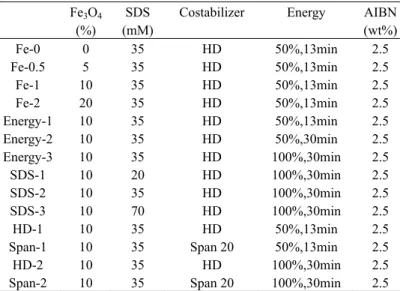
Table 2. Symbols and recipes for synthesized latex particles with CTAC as surfactants Particle diameter (nm) 0 200 400 600 800 C u mulative volume (n m) 0 20 40 60 80 100 0 hr (droplet) 1 hr (droplet) 3 hr (droplet) 6 hr (droplet) 24 hr (droplet)
Fig. 1. Size distributions of droplets with different equilibrium times for S-2 Particle diameter (nm) 0 100 200 300 400 500 Cumulative volume (%) 0 20 40 60 80 100 CTAC (droplet) CTAC (latex) SDS(droplet) SDS(latex) Tween 20 (droplet) Tween 20 (latex)
Fig. 2. Size distributions of droplets and latex particles with different surfactants (Recipes were shown in Table 1)
Particle diameter (nm) 0 100 200 300 400 500 Cu mulative v o lume 0 20 40 60 80 100 S-1 (droplet) S-1 (latex) S-2 (droplet) S-2 (latex) S-3 (droplet) S-3 (latex)
Fig. 3. Size distributions of droplets and latex particles with different amount of surfactant (Recipes were shown in Table 2)
Particle diameter (nm) 0 100 200 300 400 500 Cumulative volume (%) 0 20 40 60 80 100 HD-1 (droplet) HD-1 (latex) HD-2 (droplet) HD-2 (latex) HD-3 (droplet) HD-3 (latex)
Fig. 4. Size distributions of droplets and latex particles with different amount of costabilizer in lower concentration of surfactant (Recipes were shown in Table 2)
Particle diameter (nm) 0 100 200 300 400 500 Cumulative volume (%) 0 20 40 60 80 100 HD-4 (droplet) HD-4 (latex) HD-5 (droplet) HD-5 (latex)
Fig. 5. Size distributions of droplets and latex particles with different amount of costabilizer in higher concentration of surfactant (Recipes were shown in Table 2)
Styrene (g) Surfactant (g) HD (mM) AIBN (wt%) CTAC 10 0.2 (6mM) 44 2.5 SDS 10 0.2 44 2.5 Tween 20 10 0.2 44 2.5 Styrene (g) Surfactant (mM) HD (mM) KPS (wt%) AIBN (wt%) S-1 10 3 44 0 2.5 S-2 10 6 44 0 2.5 S-3 10 30 44 0 2.5 HD-1 10 6 0 0 2.5 HD-2 10 6 8.8 0 2.5 HD-3 10 6 44 0 2.5 HD-4 10 30 0 0 2.5 HD-5 10 30 44 0 2.5 AIBN 10 6 44 0 2.5 KPS 10 6 44 0.3 0
Particle diameter (nm) 0 100 200 300 400 500 Cumulative volume (%) 0 20 40 60 80 100 AIBN (droplet) AIBN (latex) KPS (droplet) KPS (latex)
Fig. 6. Size distributions of droplets and latex particles with different initiators (Recipes were shown in Table 2)
(a)Tween 20 (b)SDS
(c)CTAC-2, S-2, HD-3, AIBN (d)S-1
(e)S-3, HD-5 (f)HD-4
(g)HD-1 (h)KPS Fig. 7. TEM photographs of synthesized latex particles
PARTⅡ:Polystyrene/Fe3O4 Composite Latex via Miniemulsion Polymerization-Nucleation Mechanism and Morphology
ABSTRACT: In this research, oil-based Fe3O4 nanoparticles were
prepared by means of coprecipitation method followed by a surface modification using lauric acid. Oil-based Fe3O4 could
disperse in styrene, and polystyrene/Fe3O4(PS/Fe3O4) composite
particles were prepared via miniemulsion polymerization in the presence of potassium peroxide(KPS) as an initiator, sodium dodecyl sulphate(SDS) as a surfactant, hexadecane(HD) or sorbitan monolaurate(Span 20) as a costabilizer. The effects of Fe3O4 content, homogenization energy, amount of initiator, amount
of surfactant and costabilizer on the conversion, size distributions of droplets and latex particles, nucleation mechanism and morphology of composite latex particles were investigated. The results showed that different nucleation mechanisms dominated during the course of reaction when polymerization conditions changed. The most important two key factors to influence the nucleation mechanism were homogenization energy and initiator. High homogenization energy provided critically stabilized size of droplets. Otherwise, secondary nucleation, including micellar and/or homogeneous nucleation, would take place rather than droplet nucleation when a water-soluble initiator, KPS, was used. It resulted in two populations of latex particles, pure PS particles in smaller size and PS/ Fe3O4 composite particles in larger size.
Keywords: emulsion polymerization, magnetic polymers, particle nucleation, morphology
INTRODUCTION
In recent years, preparation of polymer/inorganic composite particles has attracted much attention. Polymeric particles could be easily prepared and their size and surface groups can be varied in broad range for demand of further application. Polymeric particles also acted as a matrix to disperse and maintain the inorganic particles in a nano domain structure. The function of composite particles could be varied by different inorganic particles applied. They have variety of applications in cosmetics1,2, paints3, catalyst4
and biochemistry5,6. For example, the magnetic property of Fe 3O4
and catalytic activity property of TiO2 were widely well known
and useful, and the inorganic particles could be coated on the polymer surface or be encapsulated in the interior of polymer matrix. Among variety of composite particles, magnetic polymer particles have been investigated enormously because of their diversified applications in cell separation7, food analysis8 and
targeting drug delivery9,10.
For magnetic polymer particles, a variety of encapsulation techniques have been developed including conventional emulsion polymerization11-14, precipitation polymerization15, suspension
polymerization16, seeded polymerization17-18, soapless emulsion
polymerization19,20, miniemulsion polymerization21-23, and so
on24,25. Wang et al.17 synthesized magnetic PMMA composite latex
particles by seeded emulsion polymerization and found two nucleation mechanisms involved according to the polymerization conditions. In the monomer-rich and less ferrofluid system, self-nucleation of PMMA was dominant. In the ferrofluid-rich system, seeded emulsion polymerization was the main course to
form the magnetic composite latex particles. Pich et al.19
encapsulated iron oxide in poly(styrene/acetoacetoxyethyl methacrylate) by surfactant free polymerization and the encapsulation degree was higher when iron oxide was undergone surface modification by sodium oleate. Variation of monomer to iron oxide ratio gave a possibility to change morphology.
In recent literature, miniemulsion polymerization was regarded as an effective method to obtain polymer/inorganic composite particles because of the characteristic feature, named droplet nucleation. In miniemulsion, the size of monomer droplets ranged from 50 to 500nm, adjusted by changing the amount of surfactant or costabilizer, solid content and homogenization energy26,27.
Contrary to conventional emulsion polymerization, the nucleation and propagation site was not in water or micelles, monomer droplets would directly convert to particles, so the size distribution of droplets and its corresponding latex particles were identical28,29.
However, no matter what kind of polymerization method was used, including miniemulsion polymerization, most of the researches in literature emphasized the preparation and characterization of magnetic polymer particles. There were few papers discussing the morphology and nucleation mechanism in polymer/inorganic composite particles. The aim of this paper was to investigate the nucleation mechanism and polymerization kinetics through the course of miniemulsion polymerization in the presence of
magnetic particles. In the meanwhile, parameters which could tune the morphology of PS/Fe3O4 composite particles would also be
discussed.
EXPERIMENTAL Materials
Styrene was distilled under reduced pressure and was stored at 5℃ before use. Hexadecane(HD; Acros), 2,2'-azobisisobutyronitrile (AIBN; Showa), potassium peroxide (KPS; Sigma), dodecyl sulphate (SDS; Acros), lauric acid(Acros), sorbitan monolaurate (Span 20; Showa) and 28% ammonium hydroxide solution(Acros) were used without further purification. Distilled and deionized water was used throughout the work.
Preparation of Oil-Based Fe3O4 Particles
Fe3O4 particles were obtained by coprecipitation of Fe(Ⅱ) and
Fe(Ⅲ) salts in aqueous solution of ammonium hydroxide. In this
process, 23.5g FeCl3‧6H2O and 8.6g FeCl2‧4H2O were
dissolved in 400ml deionized water with stirring. Then 50ml of 28%(w/w) ammonium hydroxide solution was added for 6min. Further 2.5g lauric acid was added to the solution under stirring at
90℃ for 30min to modify the surfaces of Fe3O4 particles to
become hydrophobic in nature. Finally, the supernatant solution was decanted and the black modified Fe3O4 residue was washed
with methanol for three times to remove non-bonded lauric acid. Then the precipitates were lyophilized for 24hr to obtain oil-base Fe3O4 particles.
Preparation of PS/Fe3O4 Composite Particles by Miniemulsion
Polymeriazation
All the components required in the experiment were divided into three parts. One was aqueous phase, one was oil phase and the other was initiator solution. Aqueous phase was composed of deionized water and SDS, oil phase was composed of styrene, Fe3O4 andHD, and initiator solution was composed of deionized
water and KPS. All the recipes were listed in Table 1 and the amount of deionized water used was 100g. Being mixed for each for 10min, then the aqueous phase was added to the oil phase and the O/W mixture was mixed for 10min by mechanical stirring for pre-emulsification. After that, the O/W mixture was ultrasonicated (Dr. Hielscher UP-50H) in an ice bath. The ultrasonication time
and amplitude were two parameters discussed in the experiment and the use of ice bath was to prevent the polymerization occurring during ultrosonication. Finally the homogenized miniemulsion was poured into 250ml four-necked glass reactor equipped with condenser and mechanical stirrer in a water bath. The stirring rate was kept at 300 rpm and polymerization was carried out by introducing initiator solution for 1hr at 85℃
Conversion
The conversion of monomer was determined by gravimetric method. During miniemulsion polymerization, certain amount of the latex was taken out of the reactor, and poured into a hydroquinone methanol solution in an ice bath. Finally, the sample was dried in an oven at 85℃ until the weight kept constant. The conversion can be calculated by eq(1). P was the weight of dry sample from the oven. F was the theoretical weight of Fe3O4 in the
dry sample. W was the weight of the latex sample and M0 was the
weight fraction of monomer in feed recipes.
%
100
0×
×
−
=
M
W
F
P
Conversion
(1)Morphology of PS/Fe3O4 Composite Particles
The PS/Fe3O4 composite latex was diluted with deionized water.
Then the sample was dropped on the surface of cooper grids, the morphology and particles size could be observed by using JOEL JEM-1230 transmission electron microscope (TEM)
Size Distributions of Monomer Droplets and Composite Latex Particles
The size distribution of the monomer droplets or composite latex particles was measured by laser dynamic light scattering (DLS) instrument (Malvern Zeta Sizer 3000H). The latex sample was diluted with saturated styrene and SDS solution in order to avoid monomer or SDS diffusing from droplets to aqueous solution. Each measurement was completed within several minutes, and the size distribution was obtained with particle diameter as horizontal axis and cumulative volume percentage as vertical axis.
RESULTS AND DISCUSSION
Effect of Content of Fe3O4
different Fe3O4 contents were showed in Figure 1. The result
showed that, in Fe-2, with 20% Fe3O4, the size distribution of
droplets was broad and ranged from 200nm to 500nm. For Fe-1, with 10% Fe3O4, the distribution of droplet size shifted to smaller
values, 170nm to 350nm, and for Fe3O4 free system, Fe-0, 60% of
the droplets had diameter less than 200nm. It revealed that Fe3O4
dispersed in monomer would reduce the efficiency of droplet fission during ultrasonication and resulted in broader size distribution and larger average diameter of droplets. After polymerization, Fe-1 and Fe-2 both had bimodal particle size distribution, the larger particles mainly formed from the shrinking of original droplets, and the smaller particles mainly came from secondary nucleation. For Fe-0, unimodal particle size distribution was obtained and most latex particles produced from secondary nucleation. From the comparison of size distributions of droplets and latex particles in these three experimental conditions, large population of particles formed from secondary nucleation.
Conversion curves with different amounts of Fe3O4 were shown
in Figure 2, when the content of Fe3O4 increased, the
polymerization rate was higher in the middle stage of polymerization, but the limiting conversion was significantly lower. As discussed in Figure 1, the size of polymer particles and the viscosity in polymer particles increased as the content of Fe3O4
increased. These two situations might induce both significant autoacceleration in the middle stage of polymerization and diffusion-controlled propagation in the final stage of polymerization. In other words, as the content of Fe3O4 increased
in the reaction system, the higher polymerization rate was due to the autoacceleration and the lower limiting conversion was due to the diffusion-controlled propagation.
TEM photographs of the obtained composite particles were shown in Figure 3. The results were consistent with the particle size distribution curves from dynamic light scattering experiment. Two groups of particles were found, one was pure polymer particles in small size and the other was composite particles in
large size. With more content of Fe3O4, the size of larger
composite latex particles increased, because the larger original droplets resulted in larger composite particles even after shrinking.
However changing the Fe3O4 content did not change the
morphology of composite particles and core-shell composite particles were observed with Fe3O4 on the shell. The formation of
core-shell structure with Fe3O4 on the shell was ascribed to the
significant occurrence of secondary nucleation. Fe3O4 were taken
out to the surfaces of particles as styrene diffused out from droplets to aqueous solution for the need of secondary nucleation.
Effect of homogenization energy
The homogenization energy applied to the O/W emulsion could be varied by adjusting the ultrasonication time and amplitude, the longer ultrasonication time and higher ultrasonication amplitude reflected more energy. From Figure 4, when homogenization energy applied increased from Energy-1 to Energy-3, the distribution of droplets would become narrower and the average particle size shifted to a smaller value. Furthermore, from the comparison of size distributions of initial droplets and latex particles, the size difference was obvious especially in Energy-1. It was because that the critically stabilized size of droplets was not achieved in the case of low homogenization energy and the possibility of droplet nucleation largely decreased. Although droplet nucleation was not the main course throughout the polymerization in these three experimental conditions, but we still could conclude that, higher homogenization energy could produce more and smaller droplets and increased the opportunity of droplet nucleation.
In Figure 5, the conversion curves of the composite latex showed that as increasing the homogenization energy, the polymerization rate would be promoted. It appeared that more energy applied to the O/W emulsion, the monomer would split into more small droplets. In other words, during polymerization, the reaction sites for droplet nucleation increased and the polymerization rate was enhanced.
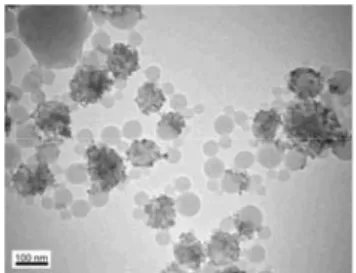
TEM photographs of the synthesized composite latex particles were shown in Figure 6 for Energy-3 and in Figure 3(b) for Energy-1. The results showed that the morphology of composite particles was in core-shell structure with Fe3O4 on the shell.
Moreover, as increasing the homogenization energy during ultrasonication, the relative amount of Fe3O4 containing latex
particles was higher owning to more tendency of droplet nucleation.
Effect of amount of initiator
particles with different amount of initiator in Figure 7, it indicated the nucleation mechanism was dominated by secondary nucleation according to emergence of numerous particles smaller than original monomer droplets regardless the amount of initiator used. Nevertheless, size distributions of latex particles were quite different, when amount of initiator increased from 0.3wt% to 2.5wt%, the distribution became broader and larger particles were observed. It could be attributed to the higher ionic strength, induced by water soluble initiator, which resulted in compression of electrical double layer. Therefore, the stability of particles was decreased and coagulation occurred during polymerization. The conversion curves with different amount of initiator were showed in Figure 8, it revealed that polymerization rate was enhanced as the amount of initiator increased. As expected, free radicals were generated from initiator, and more free radicals participated in polymerization guaranteed faster reaction. However, the final conversion was highly limited when amount of initiator was up to 2.5wt%. This phenomenon could be explained by diffusion-controlled propagation. In the course of polymerization,
Tg of polymer/monomer mixture in polymer particles increased.
As long as the Tg of polymer particles was higher than the
polymerization temperature, mobility of free radicals was hindered and the diffusion-controlled propagation was obvious especially in larger particles in I-3. Therefore, polymerization might stop and a limiting conversion was observed significantly decreased with increasing the initiator concentration.
TEM photographs of I-1 and I-3 were showed in Figure 6 and Figure 9. The morphology of PS/Fe3O4 latex particles could be
varied with particle coagulation. In less coagulation recipe, I-1, the location of Fe3O4 was on the shell of particles. However, for I-3,
Fe3O4 particles were most located in the interior of particles due to
the coagulation of particles.
Effect of amount of surfactant
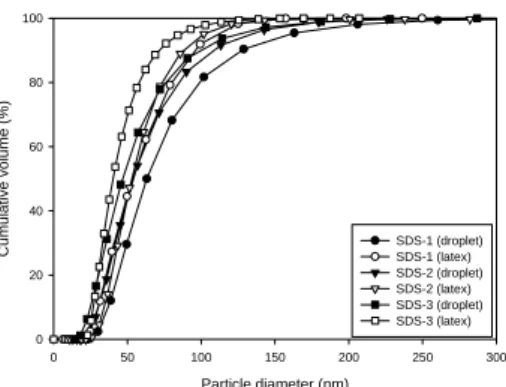
The function of surfactant, SDS, was to keep the droplets or polymer particles from coalescence and provided enough electrostatically repulsive force to maintain the stability of monomer droplets or polymer particles. From the comparison of size distributions of droplets and latex particles with different amount of surfactant in Figure 10, the size of monomer droplets was in the order of SDS-3< SDS-2< SDS-1. When the amount of
surfactant increased, monomer would split into smaller and more droplets during the process of ultrasonication. After polymerization, the size distribution of latex particles revealed that if the concentration of surfactant was 35mM, little coagulation was observed; if 20mM, particle coagulation was very significant and the size of polymer particles were larger than the original sizes of droplets. That was because the amount surfactant was insufficient to provide enough stability for droplets or polymer particles. Figure 11 showed the conversion curves with different surfactant concentration, the polymerization rate was in the order of SDS-3> SDS-2>SDS-1. It could be ascribed to that small monomer droplets acted as reaction loci and polymerization rate increased with increasing the number of droplets, and the average size of composite particles decreased.
Furthermore, compared the TEM photographs of SDS-2 and SDS-3 (shown in Figure 12 and Figure 6), in SDS-3, the location of Fe3O4 particles was on the shell of particles. However, for
SDS-2, some Fe3O4 particles were located in the interior of
particles. Like I-2, the change of morphology was caused by particle coagulation.
Effect of costabilizer
The role of costabilizer was to suppress molecular diffusion (Oswald ripening effect) by introducing osmotic pressure and maintain the droplet stability under polymerization. In this series of experiment, HD and Span 20 were chosen as two types of costabilizer where HD was a highly hydrophobic compound and Span 20 was relatively more hydrophilic due to its shorter hydrocarbon chain and three hydrophilic hydroxyl functional groups. Due to the amphiphilic nature of Span 20, it can also be used as a surfactant. Compared with the size distributions of droplets and latex particles in Figure 13, the average diameter of latex composite particles was smaller than droplets regardless what kind of costabilizers was used. It implied that particles formed from both secondary nucleation and droplet nucleation. Moreover, because of the surfactant role of Span 20, the coagulation could be avoided to some extent, thus the particles were obtained with smaller size.
Conversion curves of HD-1 and Span-1 were shown in Figure 14. When costabilizer was changed from HD to Span 20, the polymerization rate was accelerated. It was because that Span 20
acted not only a costabilizer but also a surfactant. More surfactant was available to stabilize the O/W surfaces during ultrasonication, the number of monomer droplets as reaction site increased, therefore, the polymerization rate increased.
The morphology of composite latex particles with different costabilizer was observed by TEM photographs in Figure 12 and Figure 15. The location of Fe3O4 was on the shell of particles if
using Span 20 as a costabilizer in Figure 15, in a less coagulation situation. On the other hand, if coagulation was significant as in the case of Figure 12, Fe3O4 particles were located more in the
interior of particles
Effect of initiator on nucleation mechanism
In order to investigate the difference of nucleation mechanism between water soluble initiator and oil soluble initiator during polymerization, size distributions of droplets and latex particles with different initiator were measured and shown in Figure 16. The results showed that, when AIBN was used as an initiator, the size distributions of droplets and latex particles were very similar, indicating droplet nucleation was the main route in the course of polymerization. However, if KPS was used as an initiator, after polymerization, latex particles with bimodal distribution would be obtained, the smaller particles came from secondary nucleation, and the larger ones came from droplet nucleation and coagulation of particles. As a result, we can conclude that, using AIBN as an initiator could largely decrease the possibility of secondary nucleation. The less opportunity for radicals existing in aqueous solution was the key reason to depress secondary nucleation.
TEM photographs of latex particles with different conversions were taken. Figure 17(a)-(c) showed the morphology of latex particles initiated by KPS with conversions 3%, 32% and 52% respectively. Two populations were observed. Smaller particles were pure polymer particles coming from secondary nucleation; the size was uniform and increased slightly with increasing the conversion. On the other hand, larger particles were composite particles coming from droplet nucleation and coagulation, their sizes increased slightly with conversion too. Finally, from the TEM photograph of latex particles initiated by AIBN in Figure 17(d), Fe3O4 containing latex particles were mainly observed. The
droplet nucleation dominated during polymerization with AIBN as an initiator, while both droplet nucleation and secondary
nucleation were important in the polymerization system with KPS as an initiator, consistent with the finding from DLS experiment.
CONCLUSION
In this work, PS/Fe3O4 composite particles were synthesized
successfully by miniemulsion polymerization. The conversion curves, size distributions of droplets and latex particles, nucleation mechanism and morphology were discussed in detail. Polymerization rate could be promoted by introducing more free radicals during polymerization via higher initiator concentration or increasing the number of monomer droplets, which could be achieved under the condition of high concentration of surfactant, higher homogenization energy or changing costabilizer form HD to Span 20.
The size distributions of droplets and latex particles were measured and compared to estimate the relative importance of droplet nucleation. With increasing the Fe3O4 content, the size
distributions of droplets and latex particles were broader with more population of larger particles due to the less efficiency of droplet fission during ultrasonication. Under high homogenization energy, the monomer droplets were critically stabilized and the difference of size distributions between monomer droplets and latex particles decreased. The function of SDS was to provide stabilization for O/W surfaces, insufficient amount of surfactant could not maintain the stability of monomer droplets and coagulation of particles could not be avoided during polymerization. In addition, because of the surfactant role of Span 20, changing the costabilizer from HD to Span 20 increased the stability of monomer droplets and prevented particles from coagulation. When using KPS as an initiator, secondary nucleation dominated in the course of polymerization even though the critically stabilized size of droplets was achieved by high homogenization energy. If AIBN was used as an initiator, droplet nucleation dominated and the fraction of secondary nucleation was largely reduced, in the meanwhile encapsulation degree of PS/Fe3O4 latex particles was better.
Morphology of composite latex particles could be varied with the particle coagulation during polymerization. Increasing the amount of initiator, or decreasing the amount of surfactant, coagulation of droplets and particles was more serious and Fe3O4
Fe3O4 would be located on the surfaces of particles, and core-shell
structure of composite particles was observed.
REFERENCE
1. Tang, E. J.; Cheng, G. X.; Pang, X. S.; Ma, X. L.; Xing, F. B.
Colloid Polym Sci 2006, 284, 422-428.
2. Kim, J. W.; Shim, J. W.; Bae, J. H.; Han, S. H.; Kim, H. K.; Chang, I. S.; Kang, H. H.; Suh, K. D. Colloid Polym Sci 2002, 280, 584-588.
3. Mizutani, T.; Arai, K.; Miyamoto, M.; Kimura, Y. Prog Org
Coat 2006, 55, 276-283.
4. Chen, C. W.; Serizawa, T.; Akashi, M. Chem Mat 1999, 11, 1381-1389.
5. Zheng, W. M.; Gao, F.; Gu, H. C. J. Magn Magn Mater 2005, 293, 199-205.
6. Wang, P. C.; Lee, C. F.; Young, T. H.; Lin, D. T.; Chiu, W. Y.
J Polym Sci Part A: Polym Chem 2005, 43, 1342-1356.
7. Haik, Y.; Pai, V.; Chen, C. J. J. Magn Magn Mater 1999, 194, 254-261.
8. Pyle, B. H.; Broadaway, S. C.; McFeters, G. A. Appl Environ
Microbiol 1999, 65, 1966-1972.
9. Alexiou, C.; Schmid, R. J.; Jurgons, R.; Kremer, M.; Wanner, G.; Bergemann, C.; Huenges, E.; Nawroth, T.; Arnold, W.; Parak, F. G. Eur Biophys J Biophys Lett 2006, 35, 446-450. 10. Alexiou, C.; Jurgons, R.; Schmid, R. J.; Bergemann, C.;
Henke, J.; Erhardt, W.; Huenges, E.; Parak, F. J Drug Target 2003, 11, 139-149.
11. Pollert, E.; Knizek, K.; Marysko, M.; Zaveta, K.; Lancok, A.; Bohacek, J.; Horak, D.; Babic, M. J. Magn Magn Mater 2006, 306, 241-247.
12. Xie, G.; Zhang, Q. Y.; Luo, Z. P.; Wu, M.; Li, T. H. J Appl
Polym Sci 2003, 87, 1733-1738.
13. Horak, D.; Chekina, N. J. Appl Polym Sci 2006, 102, 4348-4357.
14. Lee, C. F.; Chou, Y. H.; Chiu, W. Y. J Polym Sci Part A:
Polym Chem 2007, 45, 3062-3072.
15. Mackova, H.; Horak, D. J Polym Sci Part A: Polym Chem 2006, 44, 968-982.
16. Wang, X. B.; Ding, X. B.; Zheng, Z. H.; Hu, X. H.; Cheng, X.; Peng, Y. X. Macromol Rapid Commun 2006, 27, 1180-1184. 17. Wang, P. C.; Chiu, W. Y.; Lee, C. F.; Young, T. H. J Polym Sci
Part A: Polym Chem 2004, 42, 5695-5705.
18. Montagne, F.; Mondain-Monval, O.; Pichot, C.; Elaissari, A. J Polym Sci Part A: Polym Chem 2007, 45, 3062-3072. 19. Pich, A.; Bhattacharya, S.; Ghosh, A.; Adler, H. J. P. Polymer
2005, 46, 4596-4603.
20. Faridi-Majidi, R.; Sharifi-Sanjani, N.; Agend, F. Thin Solid
Films 2006, 515, 368-374.
21. Liu, X. Q.; Guan, Y. P.; Ma, Z. Y.; Liu, H. Z. Langmuir 2004, 20, 10278-10282.
22. Csetneki, I.; Faix, M. K.; Szilagyi, A.; Kovacs, A. L.; Nemeth, Z.; Zrinyi, M. J Polym Sci Part A: Polym Chem 2004, 42, 4802-4808.
23. Zheng, W. M.; Gao, F.; Gu, H. C. J Magn Magn Mater 2005, 288, 403-410.
24. Vestal, C. R.; Zhang, Z. J. J Am Chem Soc 2002, 124, 14312-14313.
25. Wu, T. M.; Yen, S. J.; Chen, E. C.; Sung, T. W.; Chiang, R. K.
J Polym Sci Part A: Polym Chem 2007, 45, 3062-3072.
26. Asua, J. M. Prog Polym Sci 2002, 27, 1283-1346. 27. Antonietti, M.; Landfester, K. Prog Polym Sci 2002, 27,
689-757.
28. Landfester, K.; Bechthold, N.; Tiarks, F.; Antonietti, M.
Macromolecules 1999, 32, 2679-2683.
29. Landfester, K.; Bechthold, N.; Forster, S.; Antonietti, M.
Table 1. Symbols and Recipes for Synthesized Composite Particle Particle diameter (nm) 0 100 200 300 400 500 600 Cumu lat ive v o lu me (% ) 0 20 40 60 80 100 Fe-0 (droplet) Fe-0 (latex) Fe-1 (droplet) Fe-1 (latex) Fe-2 (droplet) Fe-2 (latex)
Figure 1. Size distributions of droplets and latex particles with different amount of Fe3O4 Time (min) 0 10 20 30 40 50 60 Co nve rs ion (% ) 0 20 40 60 80 100 Fe-0 Fe-1 Fe-2
Figure 2. Monomer conversion versus time with different amount Fe3O4
(a)Fe-0
(b)Fe-1,Energy-1
(c)Fe-2
Figure 3. TEM photographs of synthesized composite latex particles with different amount of Fe3O4
Particle diameter (nm) 0 100 200 300 400 Cumu lat ive v o lu me (% ) 0 20 40 60 80 100 Energy-1 (droplet) Energy-1 (latex) Energy-2 (droplet) Energy-2 (latex) Energy-3 (droplet) Energy-3 (latex)
Figure 4. Size distributions of droplets and latex particles with different homogenized energy
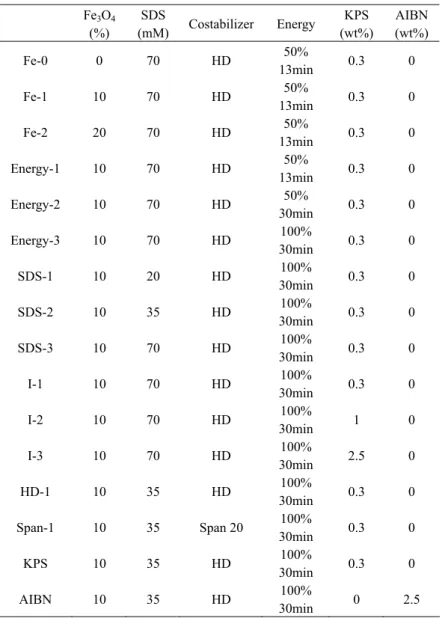
Fe3O4 (%) SDS (mM) Costabilizer Energy KPS (wt%) AIBN (wt%) Fe-0 0 70 HD 50% 13min 0.3 0 Fe-1 10 70 HD 50% 13min 0.3 0 Fe-2 20 70 HD 50% 13min 0.3 0 Energy-1 10 70 HD 50% 13min 0.3 0 Energy-2 10 70 HD 50% 30min 0.3 0 Energy-3 10 70 HD 100% 30min 0.3 0 SDS-1 10 20 HD 100% 30min 0.3 0 SDS-2 10 35 HD 100% 30min 0.3 0 SDS-3 10 70 HD 100% 30min 0.3 0 I-1 10 70 HD 100% 30min 0.3 0 I-2 10 70 HD 100% 30min 1 0 I-3 10 70 HD 100% 30min 2.5 0 HD-1 10 35 HD 100% 30min 0.3 0 Span-1 10 35 Span 20 100% 30min 0.3 0 KPS 10 35 HD 100% 30min 0.3 0 AIBN 10 35 HD 100% 30min 0 2.5
Time (min) 0 10 20 30 40 50 60 Co nve rs ion (% ) 0 20 40 60 80 100 Energy-1 Energy-2 Energy-3
Figure 5. Monomer conversion versus time with different homogenized energy
Figure 6. TEM photographs of synthesized composite latex particles SDS-3 , I-1 , Energy-3
Particle diameter (nm) 0 100 200 300 400 Cumu lat ive v o lu me (% ) 0 20 40 60 80 100 I-1,I-2,I-3 (droplet) I-1 (latex) I-2 (latex) I-3 (latex)
Figure 7. Monomer conversion versus time with different amount of initiator Time (min) 0 10 20 30 40 50 60 Co nve rs ion (% ) 0 20 40 60 80 100 I-1 I-2 I-3
Figure 8. Monomer conversion versus time with different amount of initiator
Figure 9. TEM photographs of synthesized composite latex particles I-3 Particle diameter (nm) 0 100 200 300 400 500 600 C u m u lat ive vo lu m e ( % ) 0 20 40 60 80 100 SDS-1 (droplet) SDS-1 (latex) SDS-2 (droplet) SDS-2 (latex) SDS-3 (droplet) SDS-3 (latex)
Figure 10. Size distributions of droplets and latex particles with different amount of surfactant
Time (min) 0 10 20 30 40 50 60 Co nve rs ion (% ) 0 20 40 60 80 100 SDS-1 SDS-2 SDS-3
Figure 11. Monomer conversion versus time with different amount of surfactant
Figure 12. TEM photographs of synthesized composite latex particles SDS-2 , HD-1
Particle diameter (nm) 0 100 200 300 400 500 C u m u la tive vo lum e ( % ) 0 20 40 60 80 100 HD-1 (droplet) HD-1 (latex) Span-1 (droplet) Span-1 (latex)
Figure 13. Size distributions of droplets and latex particles with different costabilizer Time (min) 0 10 20 30 40 50 60 Co nve rs ion (% ) 0 20 40 60 80 100 HD-1 Span-1
Figure 14. Monomer conversion versus time with different costabilizer
Figure 15. TEM photographs of synthesized composite latex particles Span-1 Particle diameter (nm) 0 100 200 300 400 500 C u m u lat ive vo lu m e ( % ) 0 20 40 60 80 100 Initial droplet AIBN (latex) KPS (latex)
Figure 16. Size distributions of droplets and latex particles with different initiator
(a)3% (b)32%
(c)53% (d)AIBN
Figure 17. TEM photographs of synthesized composite particles using KPS as initiator with different conversion or using AIBN as initiator
PARTⅢ:Nucleation Mechanism and Morphology of
Composite Latex Particles, Polystytrene/Fe3O4, via
Miniemulsion Polymerization using AIBN as Initiator
ABSTRACT: In this research, oil-based Fe3O4 nanoparticles were
prepared by means of coprecipitation method followed by a surface modification using lauric acid. Oil-based Fe3O4 could
disperse in styrene, and polystyrene/Fe3O4(PS/Fe3O4) composite
particles were prepared via miniemulsion polymerization in the presence of 2,2'-azobisisobutyronitrile(AIBN) as initiator, sodium dodecyl sulphate(SDS) as surfactant, hexadecane(HD) or sorbitan monolaurate(Span 20) as costabilizer. The effects of Fe3O4 content,
costabilizer, homogenization energy and surfactant concentration on the conversion, size distributions of droplets and latex particles, nucleation mechanism and morphology of composite particles were investigated. The results showed that high homogenization energy, appropriate amount of SDS and more hydrophobic costabilizer were necessary to obtain composite particles from droplet nucleation. Morphology of magnetic composite particles could be well controlled by homogenization energy or hydrophobicity of costabilizer. Fe3O4 nanoparticles could be
located inside latex particles or on the shell of latex particles depending on the polymerization conditions.
Keywords: miniemulsion polymerization, nucleation mechanism, magnetic latex particles, morphology
INTRODUCTION
In the past few years, magnetic polymer composite particles have drawn more and more attention due to vast applications in several fields, such as cell separation1,2, enzyme immobilization3,
environment and food analysis4, magnetic resonance imaging5 and
targeting drug delivery6,7. The popularity was caused by its
sensitivity to magnetic filed applied and could be separated easily by magnetic separation.
Many polymerization methods have been developed to prepare magnetic polymer composite particles, including conventional
emulsion polymerization8, precipitation polymerization9
suspension polymerization10, seeded polymerization11, soapless
emulsion polymerization12, miniemulsion polymerization13-17, and
so on18. In the method of miniemulsion polymerization, magnetic
particles were undergone surface modification using organic acid, where carboxyl functional group would anchor on the iron atom19,
and dispersed into the monomer, then, the monomer droplets with magnetic particles would act as nanoreactors and polymerization
proceeded in situ. Lu et al.15 examined the effects of the
experiment parameters on the encapsulation degree of magnetic PS composite particles, such as surfactant concentration, hydrophobe concentration, stabilizer and comonomer
concentration. Ramirez and Landfester16 synthesized magnetic
polystyrene particles with high magnetite content successfully and developed a new three-step miniemulsion preparation route. Lin et
al.17 produced thermoresponsive magnetic composite particles,
with Fe3O4 homogeneously distributed in NIPAAm, via W/O
miniemulsion polymerization.
As miniemulsion polymerization was widely taken as an effective method to prepare polymer/inorganic composite particles. Besides Fe3O4, there were other inorganic particles have been tried
and investigated. Erdem et al.20 produced TiO
2/PS composite
particles and described the encapsulation efficiency using
hydrophilic or hydrophobic TiO2 particles in the presence of
OLOA 370 as stabilizer. Peres et al.21 produced green-emitting
CdSe/poly(butyl acrylate) nanocomposite particles and investigated the morphology and electrical property. In additional, carbon black/PS22, ZnO/BA23 and CaCO
3/PS24 composite particles
were also obtained by miniemulsion polymerization. However, no matter what the polymerization method or inorganic material were used, most of the researches in literature emphasized the preparation and characterization, especially in miniemulsion polymerization. There were few papers discussing the control of morphology and nucleation mechanism in polymer/inorganic composite particles.
The aim of this paper was to examine how polymerization
conditions affected the morphology of PS/Fe3O4 composite
particles, in the meanwhile, nucleation mechanism and polymerization kinetics through the course of miniemulsion polymerization in the presence of magnetic particles would also be discussed.
EXPERIMENTAL
Styrene was distilled under reduced pressure and was stored at 5℃ before use. Hexadecane (HD; Acros), 2,2'-azobisisobutyronitrile (AIBN; Showa), sodium dodecyl sulphate (SDS; Acros), lauric acid(Acros), sorbitan monolaurate (Span 20; Showa) and 28% ammonium hydroxide solution(Acros) were used without further purification. Distilled and deionized water was used throughout the work.
Preparation of Oil-Based Fe3O4 Particles
Fe3O4 particles were obtained by coprecipitation of Fe(Ⅱ) and
Fe(Ⅲ) salts in aqueous solution of ammonium hydroxide. In this
process, 23.5g FeCl3‧6H2O and 8.6g FeCl2‧4H2O were
dissolved in 400ml deionized water with stirring. Then 50ml of 28%(w/w) ammonium hydroxide solution was added for 6min. Further 2.5g lauric acid was added to the solution under stirring at
90℃ for 30min to modify the surfaces of Fe3O4 particles to
become hydrophobic in nature. Finally, the supernatant solution was decanted and the black modified Fe3O4 residue was washed
with methanol for three times to remove non-bonded lauric acid. Then the precipitates were lyophilized for 24hr to obtain oil-base Fe3O4 particles.
Preparation of PS/Fe3O4 Composite Particles by Miniemulsion
Polymeriazation
All the components required in the experiment were divided into two parts. One was aqueous phase and the other was oil phase. Aqueous phase was composed of deionized water and SDS, oil
phase was composed of styrene, Fe3O4, HD and AIBN. All the
recipes were listed in Table 1 and the amount of deionized water used was 100g. Being mixed for each for 10min, then the aqueous phase was added to the oil phase and the O/W mixture was mixed for 10min by mechanical stirring for pre-emulsification. After that, the O/W mixture was ultrasonicated (Dr. Hielscher UP-50H) in an ice bath. The ultrasonication time and amplitude were two parameters discussed in the experiment and the use of ice bath was to prevent the polymerization occurring during ultrosonication. Finally the homogenized miniemulsion was poured into a 250ml four-necked glass reactor equipped with a condenser and mechanical stirrer in a water bath. The stirring rate was kept at 300 rpm and polymerization was carried out for 1.5hr at 85℃
Conversion
The conversion of monomer was determined by gravimetric method. During miniemulsion polymerization, certain amount of the latex was taken out of the reactor, and poured into a hydroquinone methanol solution in an ice bath. Finally, the sample was dried in an oven at 85℃ until the weight kept constant. The conversion could be calculated by eq(1). P was the weight of dry sample from the oven. F was the theoretical weight of Fe3O4 in the
sample. W was the weight of the latex sample and M0 was the
weight fraction of monomer in feed recipes.
%
100
0×
×
−
=
M
W
F
P
Conversion
(1)Morphology of Oil-Based Fe3O4 and PS/Fe3O4 Composite
Particles
The PS/Fe3O4 composite latex was diluted with deionized water
and oil based Fe3O4 particles were dispersed in toluene. Then the
sample was dropped on the surface of cooper grids, the morphology and particles size could be observed by using JOEL JEM-1230 transmission electron microscope (TEM)
Size Distributions of Monomer Droplets and Composite Latex Particles
The size distributions of the monomer droplets and composite latex particles were measured by laser dynamic light scattering instrument (Malvern Zeta Sizer 3000H). The sample was diluted with saturated styrene and SDS solution in order to avoid monomer or SDS diffuse from droplets to aqueous solution. The measurement could be completed within several minutes, and the size distribution was obtained and plotted by taking particle diameter as horizontal axis, cumulative volume percentage as vertical axis.
RESULTS AND DISCUSSION
Oil-Based Fe3O4 Particles
Figure 1 showed the XRD pattern of the oil-based Fe3O4 particles.
The characteristic peaks were quite identical to pure Fe3O425, but
the peaks were broader due to the nano size effect of Fe3O4
particles. The mean diameter of particles was calculated from the XRD pattern by Debye-Scherrer equation (shown in eq (2))26,27. D
was the average diameter of the crystal,
λ
was the wavelengthof X-ray (CuKα=1.54Å),
β
was the width of the characteristicpeak at half height and
θ
was the diffraction angle. The values ofβ
andθ
from peak (3 1 1) were used in eq(2) and the size of Fe3O4 crystal was calculated as 7.1nm.θ
β
λ
cos
9
.
0
=
D
(2)The value of D was close to the diameter observed from TEM (Figure 2). However, the particles diameter from TEM ranged from 6nm to 9nm
PS/Fe3O4 Composite Particles
Effect of the Content of Fe3O4
Conversion curves of the obtained composite particles with
different amount of Fe3O4 were shown in Figure 3. With
increasing the content of the Fe3O4, the polymerization rate and
final conversion decreased. That was because Fe2+ ions from
Fe3O4 acted as a free radical quencher to inhibit the
polymerization17,28. As a result, more Fe
3O4 participated in the
polymerization resulted in less effective free radicals and polymerization rate and final conversion would be suppressed. Figure 4 shows the size distributions of the initial droplets and final latex particles with different Fe3O4 contents. Fe-2, with 20%
Fe3O4, whose droplet size distribution was broad and ranged from
300nm to 600nm. For Fe-1, with 10% Fe3O4, droplet size
distribution shifted to smaller values, 200nm to 500nm, and for Fe3O4 free recipes, Fe-0, 50% of the droplets had diameter less
than 200nm. It revealed that Fe3O4 dispersed in monomer would
reduce the efficiency of droplets fission during ultrasonication and resulted in broader size distribution and larger average diameter of droplets.
After polymerization, Fe-1 and Fe-2 both had bimodal particle size distribution. The part of larger size particles mainly formed from the shrinking of original droplets and the part of smaller size particles mainly came from secondary nucleation. For Fe-0, unimodal particle size distribution was obtained because comparative amount of particles from both droplet shrinking and secondary nucleation resulted in a continuous distribution. Nevertheless, from the comparison of droplet and latex particle size distributions in these three experimental conditions, large population of composite particles formed from secondary
nucleation.
TEM photographs of the obtained composite particles were shown in Figure 5. The results were consistent with the particle size distribution curves from dynamic light scattering experiment. With higher content of Fe3O4, the size of larger composite particles
increased. The reason was that larger original droplets resulted in larger composite particles even after shrinking. However changing the Fe3O4 content would not change the morphology of composite
particles and the distribution of Fe3O4 in PS latex particles was
random and quite homogenous.
Effect of the Homogenized Energy
The homogenization energy applied to the O/W emulsion could be varied by adjusting the ultrasonication time and amplitude, the longer ultrasonication time and higher ultrasonication amplitude reflected more energy. In Figure 6, the conversion curves of the composite latex showed that increasing the ultrosinication energy, the polymerization rate would be promoted. It appeared that more energy applied to the O/W emulsion, the monomer would split into more small droplets. In other words, during polymerization, the reaction site for droplet nucleation increased and the polymerization rate would be enhanced.
The explanation could be verified by Figure 7, when homogenization energy applied from Energy-1 to Energy-3, the droplet distribution would become narrower and the average particle size shifted to a smaller value. Furthermore, after polymerization, Energy-3 had similar size distribution curve between droplets and composite particles. It implied that the possibility of secondary nucleation was largely reduced. In other words, most particles formed from droplet nucleation. However, for Energy-1 and Energy-2, significantly shrinking feature was observed due to the fact that the critically stabilized size of droplets was not achieved before polymerization. Therefore, the secondary nucleation dominated over the droplet nucleation especially in the system of Energy-1. It could be concluded that homogenization energy played an important role to control the nucleation mechanism and enough energy was required to attain droplet nucleation.
TEM photographs of the synthesized composite particles were shown in Figure 5(b) for Energy-1 and in Figure 8 for Energy-3. The results showed that the morphology of composite particles