行政院國家科學委員會專題研究計畫成果報告
計畫名稱:
氧化鋅丁香油酚根管充填劑與樹脂類根管充填劑之致毒性機轉研究 The toxic mechanism study of zinc oxide eugenol based and resin based
root canal sealers
計劃類別:個別型計劃
計畫編號 :NSC-88-2314-B-040-038
執行期限:89 年 8 月 1 日 至 90 年 7 月 31 日 主持人:黃翠賢
執行機構:中山醫學院牙醫系
一、 中文摘要
根管充填劑於牙齒根管中會因組織液 之接觸而產生解離,進而釋出某些物 質,而這些物質可能會對組織造成傷 害•本實驗室過去曾對根管充填劑中 樹脂類之材料如: AH26, AH plus 等作 過其生物相容性之研究比較,結果證 明此類材料會對於人類口腔癌細胞具 有細胞毒性與基因毒性,另一類含有 氧化鋅丁香油酚為基底材之根管充填 劑,於過去的文獻報告中亦指出其中 丁香油酚(eugenol)是造成細胞毒性 之原因,因此有學者建議不要使用此 類根管充填劑•但這二類材料中對細 胞造成之傷害機轉與比較究竟為何,
於目前之文獻中較少有報告•且當細 胞受到化學之刺激後,所造成之傷害 是否會不可逆之反應。本研究目的乃 1.探討比較這二類根管充填劑對於人 類牙齦纖維母細胞之細胞與基因之毒 性•2. 探討根管充填劑作用於細胞 後,細胞變化是以壞死(necrosis)或 是以細胞自殺(apoptosis)之途徑死 亡•結果發現氧化鋅丁香油酚為基底 材之根管充填劑與樹脂類之根管充填 劑 對 牙齦 纖 維細 胞 具 有 濃 度 上 之 毒 性•隨濃度之升高而毒性變大(p<0.05).
二種充填劑造成細胞之死亡乃是經由 自殺式死亡(Apotosis).
關鍵詞:根管充填劑 毒性機轉 Abstr act
According to the reports, that root canal sealer will dissociation in the root canals by contacting the tissue fluid.
When dissociation happened, the toxic material will release and cause some damage on the surround tissue. From the past, our laboratory has been done the research on the biocompatibility of resin based root canal sealer(AH 26 and AH plus sealers). Our data showed that resin based type sealer will cause the OC2 cell line toxicity and they also can show
some genotoxicity. But there are lack of paper discussed on how it damaged the cell or tissue and lack of discussion on the toxic mechanism. The purpose of this study are 1. Compare the ZnO eugenol and Resin type sealer toxicity by MTT and comet assay. 2. Discover the pathway of the cell death - by necrosis or apoptosis? The results showed that the zinc oxide based and resin based root canal sealers are dose dependent increase to the gingival fibroblast toxicity (p<0.05). The cell death mechanism is by the aptotosis.
Key words: root canal sealers, apotosis
二、 緣由與目的
Clearly, one of the principal requirements of an endodontic root canal sealer should be that it is noncytotoxic and immunologically compatible with peripheral tissue [1]. Sealer-elutable substances or the degradation or corrosion products from a root canal sealer may gain access to periodontal tissue through numerous pathways [2,3].
Root canal sealers and their diffusible components, therefore, need to be critically evaluated for their cytocompatiblity and genotoxicity prior to their general clinical use.
Genotoxicity, mutagenicity and carcinogenicity are very important issues associated with the systemic compatibility of root canal sealers [4].
Recently, a new assay for assessing the mutagenic potential of various compounds has been developed known as the alkaline single-cell gel electrophoresis assay (comet assay) [ 5], this alkaline single-cell gel electrophoresis assay is both a rapid and sensitive procedure for quantitating DNA lesions in mammalian cells, and may be used to detect specific DNA damage and also DNA repair [5]. The present study was going to use this method to evaluate the root canal sealers genotoxicity.
The purpose of this study was to analyze the biocompatibility of zinc
oxide base and the 1st and 2nd generation epoxy resin sealers, e.g. AH26 and AH Plus sealers, when treated on gingival fibroblast, by tetrazolium spectrophotometic analysis(MTT) and comet assay. Also to evaluate the mechanism of the cell death by the DNA fragmentation assay.
三、結果與討論 Result:
The MTT assay showed the toxicity existed on fibroblast treated with the resin based and zinc oxide based sealers.
There are dose dependent increase with the decrease survival rate (p<0.05).(Table 1-3)
The Comet assay showed the component of the sealers are genotoxic to the fibroblast (Table 4-5).
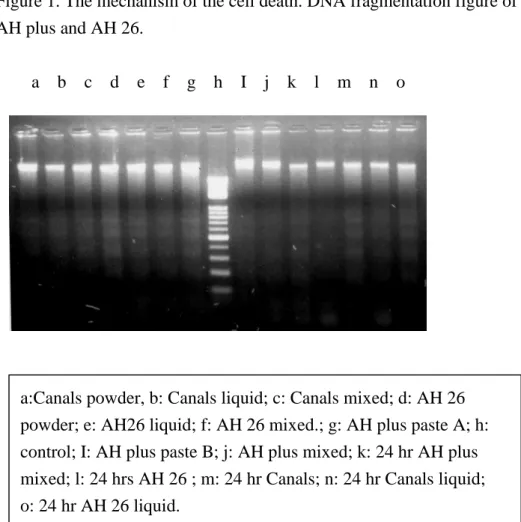
The apoptotic change of the fibroblast treated with sealers showed fragmentation on the gel electrophoresis.
(Figure 1).
Discussion
The MTT biological testing results of root canal sealers revealed a dose-dependent toxicity for Canals, AH26 and AH Plus, such results being in keeping with the observations of other workers applying AH26 to other cell culture systems [14,23]. The mixed group of AH26 sealer appears to be capable of inducing a greater degree of toxicity to astrocytes than is the case for either the pure powder or liquid form of AH26 (P<0.05).
Various
in vitro and in vivo studies
have shown that freshly-prepared and cured specimens of the epoxy resin-based root canal sealer AH26 may induce strong cytotoxic effects [7,15,16,21]. These experimental observations have been confirmed by some clinical case reports [23,24,25]. It has been reported that the formaldehyde emanating from the curing sealer may be the main causative factor for the high cytotoxicity of AH26 during,particularly, the early setting period [8].
The liquid component of the AH26 is prepared using bisphenol-A-diglycidyl ether (table 1).
From our experiments, it is apparent that the cured AH26 sealer is toxic to astrocytes in a dose-dependent manner. The strongest cell inhibition elicited by the sealer mix occurs at a concentration of 0.10mg/ml, at which concentration, both the liquid and mixed groups exhibit the same degree of toxicity, and, by contrast, the powder seems to be somewhat more compatible with astrocyte survival.
In Schweikl et al study found that DMSO eluated of themixed material, paste A and paste B clearly reduced the viability of V79 cells and was mutagenic in a dose dependent manner in V79 cells [6].
There is only scant information regarding the mutagenicity of these root canal sealers. Schweikl et al.
investigated the mutagenicity of AH26 in the v79/HGPRT mammalian cell assay [7]. They found this material induces mutagenic effects 24 h after mixing which significantly decrease within 1 week. Stea etl al. (Ames test)[8]
and Heil et al. (umu, DIT)[9] found mutagenic substance even in the set material. The alkaline single cell gel electrophoresis assay (comet assay) is a sensitive method to investigate DNA breakage in individual cells as a consequence of their
in vitro or in vivo
exposure to genotoxic compounds [10].In our experimental series, the mutagenic effects of AH26 and AH Plus demonstrated genotoxicity to astrocytes (Table 6.). Resin-based sealers mutagenic potencies were noted to occur in a dose-dependent manner; following exposure of astrocytes to these two compounds, ie an increased migration factor was noted.
Observed DNA damage at a sealer concentration of 0.25mg/ml of AH26 and AH Plus in culture medium revealed
a more pronounced migration for the AH Plus group than for its analogue, suggesting that the AH Plus sealer elicits more substantial DNA damage than is the case for the AH26 group. The effect of dying or dead cells upon the assay-derived data may be to influence the estimate of the positive response of resin-released chemicals, since dying or dead cells may increase DNA migration in this assay [5]. In our experiments, the AH Plus (ID50 = 0.04mg/ml) is more toxic than AH26 (ID50 = 0.05mg/ml);
the migration of the AH Plus moiety is larger than that of its analogue in the assay. There is a less possibility that dead cells participated in the positive responses of chemicals. In shape factor evaluation, the AH26 and AH-Plus sealers exert their influence dose-dependently, such results being similar to the results of the migration factor assessment.
Ersev et al.[11] study indicated that mixed, silver-free AH26 elicited mutagenicity in eukaryotic and prokaryotic cells, they speculating that the mutagenic effect of AH26 may arise from the liquid component bisphenol-A-diglycidyl ether and also formaldehyde. Their experimental results were similar to those from our experiments that AH26 can elicit astrocyte DNA damage.
Our experimental series indicated that the epoxy resin-based sealers AH26 or AH Plus are not true biocompatible [12,13]. From this work, we have demonstrated a direct dose-dependent in
vitro
relationship between the concentration of administered sealer and cytotoxic and mutagenic effects.The mechanism of the sealers treated on the fibroblast showed that they are by apoptotic change rather than by necrotic change. The sealer is genotoxic to the fibroblast cells. When using the sealer, one should be careful not to let the sealer through the apex of the tooth to the periodontal tissue.
計劃成果自評
In present study, the biocompatibility of the sealers are shown in the MTT assay and comet assay. From the results, the further finding on gel electrophoresis, showed that the sealer and its components can make the fibroblast DNA fragmentation.
This findings has never been published in the journal. From our work, it is provide the new findings on the biocompatible study. Also, this project provide a good study model to a serial study on the biocompatible materials.
In the next study, if possible , we will continue to find the intracellular change of the cell after sealer treatment. And try to discover more information on the cell changes.
Refer ence
1. Willershausen B, Marroquin BB, Schulze R. Cytotoxicity of root canal filling materials to three different human cell lines. J Endodon 2000; 26:703-707 2. DeDenus QD. Frequency, location and direction of thelateral secondary and accessory canals. J Endodon 1975; 1:
361-366.
3. Dongari A, Lambrianids T.
Periodontally derived pulpal lesion.
Endodon. Dent Traumatol 1988;4, 49-52 4. Leyhausen G, Heil J, Reifferscheid G, Waldmann P, Geurtsen W.
Genotoxicity and cytotoxicity of the epoxy resin based root canal sealer AH plus. J endodon. 1999;25: 109-113.
Hoogenboom LAP, Kuiper HA. The use of the MTT test for determining the cytotoxicity of veterinary drugs in pig hepatocytes. Toxicol Vitro 1997;
11:385-392.
5. Miyamae Y, Zaizen K, Ohara K, Mine Y, Sasaki YF. Detection of DNA lesions induced by chemical mutagens by the single cell gel electrophoresis (comet) assay.1.Relationship between the onset of DNA damage and the characteristics of mutagens. Mutation Res 1998; 415: 229-235.
6. Schweikl H, Schmalz G. The
induction of micronuclei in V79 cells by the root canal filling material
AH plus.
Biomat; 2000 ; 21: 939-44.
7. Schweikl H, Schmalz G, Stimmelmayer H, Bey B. Mutagenicity of AH26 in an in vitro mammalian cell mutation assay. J Endodon 1995;21:
407-410.
8. Stea S, Savarino L, Ciabetti G, Cenni E, Stea St, Trotta F, Morozzi G, Pizzoferrato A. Mutagenic potential of root canal sealers: evaluation through Ames testing. J Biomed Mater Res 1994;28:319-328
9. Heil J, Reifferscheid G, Waldmann P, Leyhausen G, Geurtsen W.
Genotoxicity of dental materials. Mutat Res 1996;368:181-194.
10. Kuchenmeister F, Schmezer P, Engelhardt G. Genotoxic bifunctional aldehydes produce specific images in the comet assay. Muta Res 1998; 419:
68-78.
11. Ersev H, Schmalz G, Bayirli G, Schweikl H. Cytotoxicity and mutagenic potencies of various root canal filling materials in Eukaryotic and Prokaryotic cells in vitro. J Endodon 1999;25: 359-363.
12. Huang TH, Kao CT, Huang MF, Liao PH, Chou MY, Lee H. Cytotoxicity of AH 26 and AH Plus root canal sealers on oral cancer cell line OC2. Chin Dent J 1999;18: 101-108.
Huang TH, Lii CK, Chou MY, Kao CT.
Lactate dehydrogenase leakage of hepatocytes with AH 26 and AH Plus sealer treatment. J Endodon 2000;26:509-512.
TABLE 1. Cytotoxicity of AH 26 in fibroblast evaluated by MTT assay.
Powder Liquid Mixed
Concentration Absorbance (M ± SD)
Survival % Absorbance (M ± SD)
Survival % Absorbance (M ± SD)
Survival %
Control 0.10 ± 0.02 0.10 ± 0.02 0.10 ± 0.02
DMSO 1.97 ± 0.09 1.97 ± 0.09 1.97 ± 0.09
0.01 mg/ml 1.85 ± 0.09 93.16 2.03 ± 0.05 103.25 1.64 ± 0.03 82.01 0.02 mg/ml 1.88 ± 0.06 94.87 1.88 ± 0.10 94.77 1.72 ± 0.07 86.28 0.04 mg/ml 1.71 ± 0.11 85.75 1.58 ± 0.04 79.24 1.10 ± 0.05 53.30 0.08 mg/ml 0.95 ± 0.12 45.62 0.30 ± 0.01 10.88 0.69 ± 0.02 31.75 0.10 mg/ml 0.79 ± 0.04 36.17 0.25 ± 0.07 7.95 0.25 ± 0.01 7.95
F value 172.9 984.25 1,111.22
P < 0.05 Yes Yes Yes
TABLE 2. Cytotoxicity of AH plus in fibroblast evaluated by MTT assay.
Paste A Paste B Mixed
Concentration Absorbance Survival % Absorbance Survival % Absorbance Survival %
Control 0.10 ± 0.02 0.10 ± 0.02 0.10 ± 0.02
DMSO 1.97 ± 0.09 1.97 ± 0.09 1.97 ± 0.09
0.01 mg/ml 2.02 ± 0.11 102.24 1.92 ± 0.04 96.95 2.04 ± 0.05 103.57
0.02 mg/ml 2.01 ± 0.08 101.97 2.05 ± 0.08 104.10 1.88 ± 0.11 95.03
0.04 mg/ml 1.20 ± 0.10 58.91 2.05 ± 0.05 103.89 0.76 ± 0.10 35.37
0.08 mg/ml 0.64 ± 0.08 28.76 1.90 ± 0.05 53.09 0.35 ± 0.03 13.39
0.10 mg/ml 0.63± 0.07 28.44 1.05 ± 0.04 50.74 0.29 ± 0.01 10.13
F value 301.04 304.67 688.41
P < 0.05 Yes Yes Yes
TABLE 3. Cytotoxicity of Canals in fibroblast evaluated by MTT assay.
Concentration (mg/100ìl) Survival rate (%) Survival rate (%) Survival rate (%) Survival rate (%) Powder (Fresh mix) Powder (After 24 hrs) Liquid (Fresh mix) Liquid (After 24 hrs)
0.02 89.79 ± 3.53 79.45 ± 0.67 88.00 ± 2.42 82.82 ± 0.68
0.1 41.71 ± 0.67 19.58 ± 0.55 63.26 ± 0.29 63.96 ± 1.14
0.5 12.06 ± 1.81 6.63 ± 0.25 38.49 ± 0.03 57.92 ± 0.98
2.5 4.75 ± 1.78 5.94 ± 0.14 17.29 ± 0.20 50.49 ± 0.49
12.5 1.12 ± 0.71 3.62 ± 0.60 3.24 ± 0.15 8.16 ± 1.15
LD50 (mg/100ìl) 0.11 0.04 0.25 0.65
Table 4. The comet assay of zinc oxide eugenol root canal sealer.
Material Concentration N Shape Factor= Length/Diameter (Mean ± SE)
Migration Factor (ìm)=Length-Diameter (Mean ± SE)
DMSO 50 1.00±0 44.16±1.47
(Negative Control)
4NQO 50 2.75±0.19 57.89±5.84
(Positive Control)
F value 89.23 5.20
P value 0* 0.025*
Canals 0.1mg/ml 50 2.33 ± 0.07 46.54 ± 2.72
0.5 mg/ml 50 2.59 ± 0.08 57.14 ± 2.91
2.5 mg/ml 50 2.44 ± 0.11 48.07 ± 3.48
F value 2.11 3.52
P value 0.116 0.032 *
TABLE 5 The comet assay of the AH26 and AH plus sealers.
Condition N Migration(M ± SD)
(Length-Diameter)
Shape Factor (M ± SD) (Length / Diameter)
DMSO 50 44.16 ± 1.47 F = 5.20 1.00 ± 0 F = 89.23
(Negative Control)
4NQO 50 57.89 ± 5.84 P=0.025* 2.75 ± 0.19 P = 0 *
(Positive Control) AH26 (mg/ml)
0.01 50 58.26 ± 4.69 F = 19.91 2.62 ± 0.17 F = 14.90
0.05 50 67.74 ± 2.32 P = 0 * 3.63 ± 0.14 P = 0 *
0.25 50 89.13 ± 3.21 3.54 ± 0.12
AH plus (mg/ml)
0.01 50 80.20 ± 4.90 F = 21.42 3.89 ± 0.27 F = 11.24
0.05 50 79.04 ± 3.23 P = 0 * 3.73 ± 0.14 P = 0 *
0.25 50 110.83 ± 3.33 4.97 ± 0.17
F value 29.2 48.44
P < 0.05 * *
*: It represented that the comparison is statistically significant difference at P< 0.05.
The entire length of the comet (including the head) is defined as its length and the diameter of the head is defined as diameter.
Shape factor was calculated as the ratio of length to diameter. Migration (ìm) was calculated as the difference between length and diameter. The negative control : DMSO concentration is 0.05% of the medium. The positive control: 4NQO concentration is 0.0003 mg/ml.
Figure 1. The mechanism of the cell death. DNA fragmentation figure of the Canals, AH plus and AH 26.
a b c d e f g h I j k l m n o
a:Canals powder, b: Canals liquid; c: Canals mixed; d: AH 26 powder; e: AH26 liquid; f: AH 26 mixed.; g: AH plus paste A; h:
control; I: AH plus paste B; j: AH plus mixed; k: 24 hr AH plus mixed; l: 24 hrs AH 26 ; m: 24 hr Canals; n: 24 hr Canals liquid;
o: 24 hr AH 26 liquid.
: