
Platinum Nanoparticles Encapsulated in Nitrogen-containing Ordered
Mesoporous Carbons as Electrocatalysts for Fuel Cell Applications
Shou-Heng Liu,1,2 Min-Tsung Wu,2 Chien-Chang Chiang2, Shang-Bin Liu2
1
Department of Chemical and Materials Engineering, National Kaohsiung University of Applied Sciences, Kaohsiung 80778, Taiwan
2
Institute of Atomic and Molecular Sciences, Academia Sinica, Taipei 10617, Taiwan E-mail : [email protected]; [email protected]
Abstract
A novel procedure is reported for synthesizing well-dispersed Pt catalyst supported on nitrogen-containing mesoporous carbon nanocomposite (CMNx) based on pyrolysis of carbon and Pt precursors in a
N-trimethoxysilylpropyl-N, N, N-trimethylammonium chloride (TPTAC) functionalized mesoporous silica, such as SBA-15, by co-condensation. The Pt-CMNx so fabricated possesses not only Pt-N active sites but also high
surface areas and extended pores (ca. 4 nm) requisite for oxygen mass transfer. Accordingly, superior electrocatalytic performance was observed for Pt-CMNx, rendering practical applications in hydrogen-energy
related areas, for examples, as supported cathodic electrodecatalysts for PEMFCs and DMFCs.
Keywords: ordered mesoporous carbons, oxygen reduction, fuel cell, Platinum
1. Introduction
The utilization of polymer electrolyte membrane fuel cells (PEMFCs) as the energy converting devices has received much attention in fundamental research as well as in practical applications. One of the major challenges for realization and commercialization of PEMFCs is the reduction of material cost, which mainly arises from the use of noble metals, such as Pt and Ru. Thus, explorations of non-noble metal catalysts and/or reduction of metal loading are potential approaches to meet the requirements. As such, development of high performance fuel cell electrodecatalysts with low noble metal loading, which limited by the slow kinetics of cathode oxygen reduction reaction (ORR), remains a demanding task. Recently, R&D invoking ordered mesoporous carbons (OMCs) as supports for metal catalyst and applications in hydrogen fuel cells have also drawn much attention [1,2]. It has been reported that active catalyst can be produced from a wide variety of metal, carbon and nitrogen-containing materials. Pyrolysis of various organic macrocycles, such as metalloporphyrins, has been used as the active sites for oxygen reduction [3,4]. We report herein a novel procedure for the synthesis of a new amino-functionalizedordered mesoporous carbon nanocomposite (CMNx) with well-dispersed Pt (Pt-CMNx) based
on the pyrolysis of furfuryl alcohol and Pt precursors, such as platinum acetylacetonate in a TPTAC functinalized mesoporous silica, namely SBA-15. The Pt-CMNx so fabricated possesses not only Pt-N active sites but also larger
pore favorable for oxygen mass transfer.
2. Experimental
The synthesized CMNx and Pt-CMNx materials were characterized by a variety of analytical and
spectroscopic techniques, such as X-ray diffraction (XRD), X-ray photoelectron spectra (XPS), N2
adsorption/desorption, and cyclic voltammetry (CV). These Pt-CMNx materials were also found to possess high
surface areas, highly accessible pores (~ 4 nm) and highly active sites, and superior electrocatalytic oxygen reduction properties, thus, rendering future practical applications in hydrogen-energy related areas, for examples, as supported cathodic electrodecatalysts for PEMFCs and DMFCs The TPTAC-functionalized SBA-15 materials were prepared by a one-pot co-condensation method. Typically, ca. 4 g of Pluronic 123 was dissolved in 125 g of 2.0 M HCl solution at room temperature. After adding TEOS, the resultant solution was equilibrated at 40 oC for 1 h to pre-hydrolyze TEOS, and then various amount of TPTAC was slowly added into the solution. The resulting mixture was stirred at 40 oC for 20 h and then transferred into a polypropylene bottle, which was later kept at 90
o
C under static condition for 24 h. The solid product was recovered by filtration then dried at room temperature. The as-synthesized material was then refluxed in ethanol to remove the organic templates. Subsequent direct replication of TPTAC-functionalized SBA-15 material into Pt-CMMs with various relative noble metal loading was accomplished by adopting a strategy analogous to that for the preparation of supported mono- and bi-functional metal catalyst (PtRu-CMMs) reported earlier (3, 4). Typically, ca. 0.5 g of calcined SBA-15 was dehydrated at 673 K for 4 h under vacuum. Varied amount of platinum acetylacetonate (Pt(acac)2); 98%, Acros)
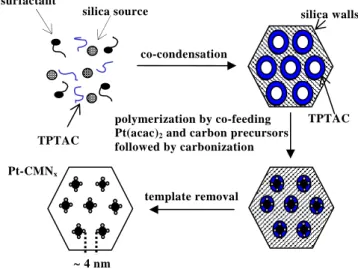
was dispersed in the furfuryl alcohol (FA; 98%, Acros) or aniline (AN) under ultrasonication. Oxalic acid (98%, Acros) was used as the acid catalyst for polymerization of FA solution. The mixture solution was infiltrated in SBA-15 by incipient wetness impregnation at room temperature, followed by polymerization in air at 333 K then at 353 K each for 12 h. The resultant composite was treated at 423 K for 3 h, ramped to 573 K with a heating rate of 1 K/min, then to 1073 K with a heating rate of 5 K/min and maintained at that temperature for 3 h. The carbonization procedure was performed under vacuum. Finally, the resultant black powders were leached with HF (1 wt.%) aqueous solution for at least 24 h to remove the silica template, washed with distilled water and alcohol, then dried at 373 K to obtain the Pt-CMNx-FA and Pt-CMNx-AN (see Figure 1).
Pt-CMNx
surfactant
TPTAC
template removal polymerization by co-feeding Pt(acac)2 and carbon precursors
followed by carbonization ∼ 4 nm silica walls silica source co-condensation TPTAC
3. Results and Discussion
As shown in Figure 2a, small-angle XRD patterns confirmed that the surface-modified TPTAC-SBA-15 sample possess long-range structural ordering with 2D hexagonal symmetry, whereas the CMNx and Pt-CMNx samples both have a structure similar to that of carbon mesoporous material CMK-3. Large-angle XRD patterns (Figure 2b) for Pt-CMNx show distinct (111), (200), (220), and (311) diffraction peaks, indicating that the Pt metal particle possesses a face-centered cubic (fcc) structure. All N2 adsorption/desorption isotherms obtained
from CMNx, Pt-CMNx-FA and Pt-CMNx-AN samples showed typical type-IV isotherms with well-defined
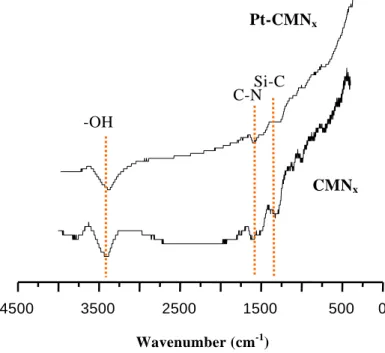
hysteresis loops, which are typical mesoporous structure. Accordingly, their structural parameters are summarized in Table 1. In brief, all supported catalyst samples were found to possess a high surface area and a uniform pore size distribution. In addition, IR spectra (Figure 3) showed the presence of absorption peaks for –OH (~ 3400 cm-1), C-N (~ 1500 cm-1), and Si-C (1250 cm-1), indicating that the surfaces of CMNx and Pt-CMNx were indeed
doped with nitrogen.
(111) (200
)
(220) (311)10 20 30 40 50 60 70 80 90 100
2 Theta
CMN
xPt-CMN
x-Pt-CMN
x-A
(b)
0 1 2 3 4 5 6 7
8
9
2 Theta
TPTAC-SBA-15 CMNx Pt-CMNx-FA Pt-CMNx-AN(a)
Figure 2. (a) Small- and (b) large-angle powdered XRD patterns of TPTAC-SBA-15, CMNx, Pt-CMNx-FA and Pt-CMNx-AN.
Table 1 Physical properties of CMNx and Pt-CMM and Pt-CMNx samples
Sample Pt (w%) da (nm) Sb (m2/g) Vd (cm3/g) CMNx -- 3.6 500 0.54 Pt-CMM 10 3.0 997 0.65 Pt-CMNx-FA 10 3.6 168 0.21 Pt-CMNx-AN 10 3.6 328 0.39 a
Pore diameter calculated by the Barrett–Joyner–Halenda (BJH) method using adsorption branches.
b
Brunauer–Emmet–Teller (BET) surface area. c Total pore volume calculated as the amount of nitrogen adsorbed at a relative pressure of 0.99.
To evaluate the electrocatalytic activities of Pt-CMNx-FA, Pt-CMNx-AN and JM-Pt/C during ORR, linear sweep voltammetry tests in O2 saturated 0.1 M sulfuric acid were performed. As can be seen in Fig. 4, the
Pt-CMNx prepared by using aniline as the carbon source possesses superior electrocatalytic performance for ORR
compared to common commercial catalysts (JM-Pt/C). That the Pt-CMNx-AN catalyst exhibits an electrocatalytic activity (i.e., onset potential and maximum current, which are kinetic and diffusion control, respectively) surpassing that of the Pt-CMNx-FA, indicating that the former possesses a more well-dispersed Pt nanoparticles in the mesoporous channels. The Pt-CMNx so fabricated should render future practical applications in
hydrogen-energy related areas, for examples, as supported electrodecatalysts for PEMFCs and DMFCs.
4500 3500 2500 1500 500 0 Wavenumber (cm-1) CMNx Pt-CMNx -OH C-NSi-C
Figure 3. FTIR spectra of CMNxand Pt-CMNxsamples.
-5.0 -4.0 -3.0 -2.0 -1.0 0.0 1.0 -0.2 0.0 0.2 0.4 0.6 0.8 E vs. Ag/AgCl (V) Cur r e nt de n sit y (mA/c m 2 ) CMM CMN\x JM-Pt/C Pt-CMNx-AN Pt-CMNx-FA
Figure 4. Polarization curves of various samples in 0.1 M H2SO4 solution saturated with oxygen
4. Conclusions
We have demonstrated that by co-feeding the noble metal (Pt) and carbon precursors in the presence of TPTAC-modified mesoporous silica template, further replication and template removal lead to the formation of Pt-CMNx materials that possess unique physical and electrochemical properties suitable for applications as
supported cathodic electrodecatalysts for PEMFCs and DMFCs.
Reference
[1] Bashyam, R. and Zelenay, P. “A class of non-precious metal composite catalysts for fuel cells,” Nature, Vol. 443, pp. 63-66, 2006
[2] Matter, P. H., Zhang, L. and Ozkan, U. S. “The role of nanostructure in nitrogen-containing carbon catalysts for the oxygen reduction reaction,” J. Catal., Vol. 239, pp. 83-96, 2006.
[3] Liu, S.-H., Lu, R.-F., Huang, S.-J. Lo, A.-Y., Chien, S.-H. and Liu, S.-B. “Controlled Synthesis of Highly Dispersed Platinum Nanoparticles in Ordered Mesoporous Carbon,” Chem. Commun., pp. 3435-3437, 2006.
[4] Liu, S.-H., Yu, W.-Y., Chen, C.-H. Lo, A.-Y. Hwang, B.-J. Chien, S.-H. and Liu, S.-B. “Fabrication and Characterization of Well-dispersed and Highly Stable PtRu Nanoparticles on Carbon Mesoporous Material for Applications in Direct Methanol Fuel Cell,” Chem. Mater., Vol. 20, pp. 1622-1628, 2008.

![[CSIE 5521] Wireless Networking: Fundamentals and Applications](data:image/gif;base64,R0lGODlhAQABAIAAAP///wAAACH5BAEAAAAALAAAAAABAAEAAAICRAEAOw==)