Asymptotic Distribution of the Number
of Isolated Nodes in Wireless Ad Hoc
Networks With Bernoulli Nodes
Chih-Wei Yi, Peng-Jun Wan, Xiang-Yang Li, Member, IEEE, and Ophir Frieder, Fellow, IEEE
Abstract—Nodes in wireless ad hoc networks may become
in-active or unavailable due to, for example, internal breakdown or being in the sleeping state. The inactive nodes cannot take part in routing/relaying, and thus may affect the connectivity. A wire-less ad hoc network containing inactive nodes is then said to be connected, if each inactive node is adjacent to at least one active node and all active nodes form a connected network. This paper is the first installment of our probabilistic study of the connectivity of wireless ad hoc networks containing inactive nodes. We assume that the wireless ad hoc network consists of nodes which are dis-tributed independently and uniformly in a unit-area disk, and are active (or available) independently with probability for some con-stant 0 1. We show that if all nodes have a maximum
transmission radius = (ln + ) for some constant
, then the total number of isolated nodes is asymptotically Poisson with mean , and the total number of isolated active nodes is also asymptotically Poisson with mean .
Index Terms—Asymptotic distribution, Bernoulli node, isolated
node, random geometric graph.
I. INTRODUCTION
A
wireless ad hoc network is a collection of radio devices (transceivers) located in a geographic region. Each node is equipped with an omnidirectional antenna and has limited trans-mission power. A communication session is established either through a single-hop radio transmission if the communication parties are close enough, or through relaying by intermediate devices otherwise. Because of no need for a fixed infrastruc-ture, wireless ad hoc networks can be flexibly deployed at low cost for varying missions, such as decision-making in the battle-field, emergency disaster relief, and environmental monitoring. In most applications, the ad hoc wireless devices are deployedPaper approved by T. T. Lee, the Editor for Wireless Communications Theory of the IEEE Communications Society. Manuscript received August 15, 2003; revised June 18, 2005. This work was supported in part by Intel. This paper was presented in part at the IEEE Wireless Communications and Networking Conference, New Orleans, LA, March 2003.
C.-W. Yi is with the Department of Computer Science, National Chiao Tung University, Hsinchu City, Hsinchu 30010, Taiwan, R.O.C. (e-mail: [email protected]).
P.-J. Wan is with the Department of Computer Science, City University of Hong Kong, Hong Kong. He is also with the Department of Com-puter Science, Illinois Institute of Technology, Chicago, IL, USA (e-mail: [email protected]; [email protected]).
X.-Y. Li and O. Frieder are with the Department of Computer Science, Illinois Institute of Technology, Chicago, IL, USA (e-mail: [email protected]; [email protected]).
Digital Object Identifier 10.1109/TCOMM.2006.869803
in a large volume. The sheer number of devices deployed, cou-pled with the potential harsh environment, often hinders or com-pletely eliminates the possibility of strategic device placement, and consequently, random deployment is often the only viable option. In some other applications, the ad hoc wireless devices may be continuously in motion or be dynamically switched to on or off. For all these applications, it is natural to represent the ad hoc devices by a finite random-point process over the (finite) deployment region. Correspondingly, the wireless ad hoc net-work is represented by a random graph.
The classic random graph model due to Erd˝os and Rényi [4], in which each pair of vertices are joined by an edge indepen-dently and uniformly at some probability, is not suited to ac-curately represent networks of short-range radio nodes, due to the presence of local correlation among radio links. This moti-vated Gilbert [5] to propose an alternative random graph model for radio networks. Gilbert’s model assumes that all devices, represented by an infinite random-point process over the entire plane, have the same maximum transmission radius , and two devices are joined by an edge if and only if their distance is at most . For the modeling of wireless ad hoc networks which consist of finite radio nodes in a bounded geographic region, a bounded (or finite) variant of the standard Gilbert model has been used by Gupta and Kumar [6] and others. In this variant, the random-point process representing the ad hoc devices is typ-ically assumed to be a uniform -point process over a disk or a square of unit area by proper scaling, and the wireless ad hoc network, denoted by , is exactly the -disk graph over . To distinguish the random graph from the classic random graph due to Erd˝os and Rényi, it is referred to as a random geometric graph.
The connectivity of the random geometric graph
has been studied by Dette and Henze [3] and Penrose [7]. For any constant , Dette and Henze [3] showed that the graph has no isolated nodes with probability asymptotically. Eight years later, Penrose [7] estab-lished that if a random geometric graph has no isolated nodes, then it is almost surely connected. These results are the exact analog of the counterpart in classic random graphs. How-ever, as pointed out by Bollobás [2], we should not be misled by the remembrance: the proof for the random geometric graph is much harder.
In this paper, we consider an extension to the random geo-metric graph by introducing an additional assumption
that all nodes are active (or available) independently with prob-ability for some constant . Such extension is mo-tivated by the fault tolerance of wireless ad hoc networks. In a practical wireless ad hoc network, a node may be inactive (or unavailable) due to either internal breakdown, or being in the sleeping state. In either case, the inactive nodes will not take part in routing/relaying, and thus may affect the connectivity. It is natural to model the availability of the nodes by a Bernoulli model, and hence, we call the nodes Bernoulli nodes. A wireless ad hoc network of Bernoulli nodes is then said to be connected if each inactive node is adjacent to at least one active node, and all active nodes form a connected network.
Our probabilistic study of the connectivity of the random geo-metric graph with Bernoulli nodes consists of two installments due to the lengthy analysis. The first installment, which is the focus of this paper, addresses the distribution of the number of nodes without active neighbors. For convenience, a node is said to be isolated from active nodes, or simply isolated, if it has no active neighbors. We shall prove that both the number of isolated nodes and the number of isolated active nodes have asymptotic Poisson distributions. The second installment, which will be re-ported in a separate paper, proves that if a random geometric graph with Bernoulli nodes has no isolated nodes, it is also con-nected almost surely.
In what follows, is the Euclidean norm of a point , and is shorthand for the 2-D Lebesgue measure (or area) of a measurable set . All integrals considered will be Lebesgue integrals. The topological boundary of a set
is denoted by . The disk of radius centered at is denoted by . The special unit-area disk centered at the origin is denoted by . For any set and positive integer , the -fold Cartesian product of is denoted by . The symbols , , and always refer to the limit . To avoid trivialities, we tacitly assume to be sufficiently large if necessary. For sim-plicity of notation, the dependence of sets and random variables on will be frequently suppressed.
The remainder of this paper is organized as follows. In Sec-tion II, we present several useful geometric results and integrals. In Section III, we derive both the distribution of the number of isolated nodes and the distribution of the number of isolated ac-tive nodes. In Section IV, we give a short summary and show future work.
II. GEOMETRY OFDISKS
The results in this section are purely geometric, with no probabilistic content. Let be the transmission radius of the nodes. For any finite set of nodes in , we
use to denote the graph over ,
in which there is an edge between two nodes if and only if their Euclidean distance is at most . For any positive
inte-gers and with , let denote the set of
satisfying that has exactly
connected components.
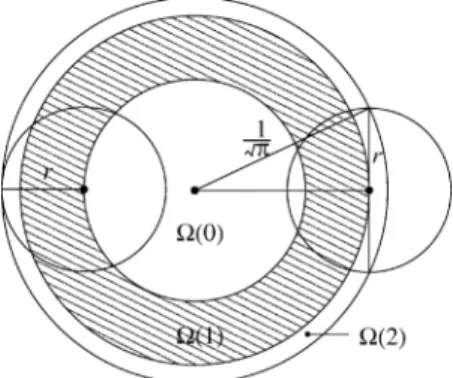
We partition the unit-area disk into three regions, , , and , as shown in Fig. 1: is the disk of radius centered at the origin; is the annulus of radii
Fig. 1. Partition of the unit-area disk.
Fig. 2. Half-disk and the triangle.
and centered at the origin; and is the annulus of radii and centered at the origin. Then
For any set and , the -neighborhood of is
the set . We use to denote the area of
the -neighborhood of , and sometimes by slightly abusing the notation, to denote the -neighborhood of itself. Obviously,
for any , . If , . If
, we have the following tighter lower bound on . Lemma 1: For any
Proof: Let be the point in such that
, and be the diameter of perpendicular to (see Fig. 2). Then contains a half-disk of
to the side of opposite to , and the triangle . Since the area of the triangle is exactly , the lemma follows.
The next lemma gives a lower bound on the area of the -neighborhood of more than one node.
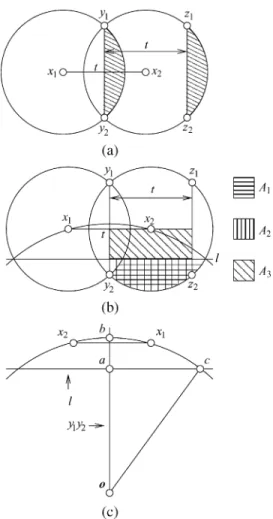
Fig. 3. Area of two intersecting disks.
Lemma 2: Assume that
Let be a sequence of nodes in , such that has the largest norm, and if and only if
. Then
Proof: We prove the lemma by induction on . We begin
with . Let and .
We first show that . Let be the common
chord of and , and let be another
chord of that is parallel to and has the same length as [see Fig. 3(a)]. Then is also equal to the area of the portion of between the two chords and
. Thus, , which is decreasing over .
Therefore, is concave over . Since and
, we have .
Now we are ready to prove the lemma for . If
, then is exactly , and
thus, the lemma follows immediately from . So we assume that . Note that for the same distance ,
achieves its minimum when both and are in . It is sufficient to prove the lemma for , .
Let and be the two chords of as above,
with , and be the line through the two intersection
points between and [see Fig. 3(b)].
We use to denote the portion of which
lies in the same side of as ; use to denote the portion of which is surrounded by , , , and the short arc between and ; and use to denote the rectangle surrounded by , , , and the line through and . Then
An upper bound on can be obtained as follows. Let be the intersection point between and , be the intersection point between and , and be an intersection point between and [see Fig. 3(c)]. Then , and
Hence
Note that one side of is exactly , and the other side is at most . Thus
As , we have
It is straightforward to verify that if
then
and thereby the lemma for follows.
In the following, we assume the lemma is true for at most nodes, and we shall show that the lemma is true for nodes. If
If , then by the inductions hypothesis
Therefore, the lemma is true by induction. Corollary 3: Assume that
Then for any with being the one of the
largest norm among
Proof: Without loss of generality, we assume that achieves . Let be a min-hop path between
and in and be the total length of .
Then every pair of nodes in that are not adjacent nodes in are separated by a distance of more than . Thus, by applying Lemma 2 to the nodes in , we obtain
Since and ,
the corollary follows.
In the remaining of this section, we give the limits of several integrals.
Lemma 4: For any , .
Proof: For any , . If
, then
Lemma 5: Let for some constant .
Then
Proof: We only give the proof of the first asymptotic equality. The second one can be proved in the similar manner together with the inequalities in Lemma 4. First, we calculate the integration over
Now, we calculate the integration over
Next, we calculate the integration over . By Lemma 1
Therefore
Lemma 6: Let for some constant .
Then for any fixed integer
Proof: Since
the second equality would follow from the first one. Hence, we only have to prove the first one. Let denote the set of satisfying that is the one with largest norm among , and is the one with longest distance
So it suffices to prove
Note that for any
for some constant by Corollary 3, and
Thus
where the last equality follows from Lemma 5.
Lemma 7: Let for some constant .
Then for any fixed integers
Proof: Since
the second equality would follow from the first one, and thus we only have to prove the first one. For any -partition
of , let denote the set
of , such that for any ,
the nodes form a connected component of
. Then is the union of over all -partitions of . So it is sufficient to show that for any -partition of
Now fix an -partition of
, and let for . Then
and for any
Thus
where the last equality follows from Lemma 6, and the fact that at least one .
Lemma 8: Let for some constant .
Then for any fixed integer
Proof: We again only give the proof of the first asymptotic equality and remark that the second one can be proved in a
sim-ilar manner, together with the inequalities in Lemma 4. For any
Thus
We show the first term is asymptotically equal to , and the second term is asymptotically negligible. Indeed
where the last equality follows from Lemma 5. Note that for any
Thus
where the last equality follows from Lemmas 6 and 7.
III. ASYMPTOTIC DISTRIBUTION OF THE
NUMBER OFISOLATEDNODES
The main result of this paper is the following theorem.
Theorem 9: Suppose that all nodes have a maximum
trans-mission radius for some constant .
Then the total number of isolated nodes is asymptotically Poisson with mean , and the total number of isolated active nodes is also asymptotically Poisson with mean .
The above theorem will be proved by using Brun’s sieve in the form described, for example, in [1, Ch. 8], which is an im-plication of the Bonferroni inequalities.
Theorem 10: Let be events and be
the number of that hold. Suppose that for any set
and there is a constant , so that for any fixed
Then is also asymptotically Poisson with mean .
For applying Theorem 10, let be the event that is iso-lated for , and be the number of ’s that hold. Then is exactly the number of isolated nodes. Similarly, let be the event that is isolated and active for , and be the number of ’s that hold. Then is exactly the number of isolated active nodes. Obviously, for any set
In addition
Thus, in order to prove Theorem 9, it suffices to show that if for some constant , then for any fixed
(1) The proof of this asymptotic equality will use the following two lemmas.
Lemma 11: For any
Proof: For any
is either outside or inactive
Lemma 12: For any and
Proof: For any
contains no active node in
For any
contains no active node in
contains inactive nodes and no active nodes
in
Now we are ready to prove the asymptotic equality (1). From Lemmas 11 and 5
So the asymptotic equality (1) is true for . Now we fix . From Lemmas 12, 6, and 7
and
From Lemmas 12 and 8 and
Thus, the asymptotic equality (1) is also true for any fixed . This completes the proof of Theorem 9.
IV. CONCLUSION
Assume that a wireless ad hoc network consists of nodes which are independently and uniformly distributed in a unit-area
disk, and become active independently with probability for some constant . Such a wireless ad hoc network can be modeled as a random geometric graph over Bernoulli nodes. We show that if all nodes have a maximum transmission
radius for some constant , then the
total number of isolated nodes is asymptotically Poisson with mean , and the total number of isolated active nodes is also asymptotically Poisson with mean . These asymptotic dis-tributions will serve as the basis for our further probabilistic study on the connectivity of the active nodes.
A variant of the random geometric graphs studied in this paper is to replace the Bernoulli nodes model by the Bernoulli links model. In this variant, all nodes are assumed to be active, but all links may be active independently with probability . It would be interesting to study the asymptotic distribution of the number of isolated nodes and asymptotic probability of the net-work being connected.
REFERENCES
[1] N. Alon and J. H. Spencer, The Probabilistic Method, 2nd ed. New York: Wiley, 2000.
[2] B. Bollobás, Random Graphs, 2nd ed. Cambridge, U.K.: Cambridge Univ. Press, Oct. 1, 2001.
[3] H. Dette and N. Henze, “The limit distribution of the largest nearest-neighbor link in the unitd-cube,” J. Appl. Prob., vol. 26, pp. 67–80, 1989.
[4] P. Erd˝os and A. Rényi, “On the evolution of random graphs,” Pub. Math.
Inst. Hungarian Acad. Sci., vol. 5, pp. 17–61, 1960.
[5] E. N. Gilbert, “Random plane networks,” J. Soc. Ind. Appl. Math., vol. 9, no. 4, pp. 533–543, Dec. 1961.
[6] P. Gupta and P. R. Kumar, “Critical power for asymptotic connectivity in wireless networks,” in Stochastic Analysis, Control, Optimization and
Applications: A Volume in Honor of W. H. Fleming, W. M. McEneaney,
G. Yin, and Q. Zhang, Eds. Boston, MA: Birkhauser, Mar. 1998, pp. 547–566.
[7] M. D. Penrose, “The longest edge of the random minimal spanning tree,”
Ann. Appl. Prob., vol. 7, no. 2, pp. 340–361, 1997.
Chih-Wei Yi received the Ph.D. degree from the
Illi-nois Institute of Technology, Chicago, and the M.S. and B.S. degrees from National Taiwan University, Taipei, Taiwan, R.O.C.
He is currently an Assistant Professor in Computer Science with the National Chiao Tung University, Hsinchu, Taiwan, R.O.C. His research focuses on wireless ad hoc and sensor networks.
Peng-Jun Wan received the Ph.D. degree from the
University of Minnesota, Minneapolis, the M.S. de-gree from The Chinese Academy of Science, Beijing, China, and the B.S. degree from Tsinghua University, Beijing, China.
He is currently an Associate Professor in Computer Science with the Illinois Institute of Tech-nology, Chicago, and with City University of Hong Kong, Hong Kong. His research interests include wireless networks, optical networks, and algorithm design and analysis.
Xiang-Yang Li (M’00) received the M.S. and Ph.D.
degrees in computer science from the University of Illinois at Urbana-Champaign in 2000 and 2001, re-spectively, and the B.S. degrees in computer science and business management from Tsinghua University, Beijing, China in 1995.
He has been an Assistant Professor of Computer Science with the Illinois Institute of Technology, Chicago, since 2000. His research interests span wireless ad hoc and sensor networks, noncooper-ative computing, computational geometry, optical networks, and cryptography. He has been a Guest Editor of special issues for
ACM Mobile Networks and Applications and the IEEE JOURNAL ONSELECTED
AREAS INCOMMUNICATIONS. He is a Member of the ACM.
Ophir Frieder (SM’93–F’02) is the IITRI Chair Professor of Computer Science
and the Director of the Information Retrieval Laboratory at the Illinois Institute of Technology, Chicago.