IEEE PHOTONICS TECHNOLOGY LETTERS, VOL. 15, NO. 5, MAY 2003 661
A Tunable Dual-Wavelength Erbium-Doped Fiber
Ring Laser Using a Self-Seeded Fabry–Pérot
Laser Diode
Peng-Chun Peng, Hong-Yih Tseng, and Sien Chi
Abstract—A tunable dual-wavelength erbium-doped fiber ring laser using a self-seeded Fabry–Pérot laser diode (FP-LD) is proposed and demonstrated. By adding an FP-LD incorporated with a tunable bandpass filter within the ring cavity, the fiber laser can lase two wavelengths simultaneously because of the self-seeded mechanism. This dual-wavelength output exhibits a good performance having the optical side-mode suppression ratio over 31 dB. The wavelength-tuning range of this tunable dual-wavelength fiber laser can be up to 9 nm.
Index Terms—Erbium-doped fiber (EDF), Fabry–Pérot laser diode (FP-LD), fiber laser, multiwavelength lasing, tunable laser.
I. INTRODUCTION
M
ULTIWAVELENGTH fiber lasers have attracted much interest in recent years because of their potential applications in wavelength-division-multiplexed (WDM) tech-nique, optical code-division multiple-access techtech-nique, fiber sensor system, and optical instrument testing [1]–[6]. Various techniques for the reduction of wavelength competition have been used to achieve stable multiwavelength oscillations. The wavelength competition originates from the homogeneous gain broadening of erbium-doped fibers (EDFs) [2]. A great deal of research has been focused on the technique by inserting a filter into the EDF laser cavity for multiwavelength oscillations [4]–[6]. In such arrangements, the cavity losses corresponding to the different wavelengths have to be balanced with the cavity gains simultaneously. As a result, the lasing wavelengths are difficult to be controlled.Recently, the self-seeded Fabry–Pérot laser diodes (FP-LDs) using fiber Bragg gratings have been proposed to generate tun-able multiwavelength short pulses [7], [8]. In this letter, we demonstrate a novel and simple configuration of a tunable dual-wavelength fiber ring laser using a self-seeded FP-LD. The con-tinuous-wave (CW) dual-wavelength output is implemented via the optical injection and feedback control of the FP-LD. By ad-justing the tunable bandpass filter (TF), the dual-wavelength output can be tuned flexibly. Furthermore, in contrast with the conventional setup, our proposed scheme is easy to be con-structed and low cost. The performance of the tunable
dual-Manuscript received October 7, 2002; revised December 19, 2002. This work was supported by the Academic Excellence Program of the Republic of China Ministry of Education under Contract 90-E-FA06-1-4-90X023.
The authors are with the Institute of Electro-Optical Engineering, National Chiao-Tung University, Hsinchu 300, Taiwan (e-mail: pcpeng.eo90g@ nctu.edu.tw).
Digital Object Identifier 10.1109/LPT.2003.809952
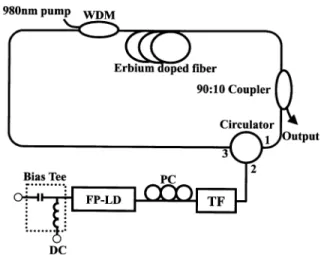
Fig. 1. Experimental setup of the tunable dual-wavelength EDF ring laser using a self-seeded FP-LD. (PC: Polarization controller. WDM: 980/1550-nm WDM coupler.)
wavelength fiber ring laser operated at optimal driving condi-tion is reported. We also discuss the relacondi-tionship between the FP-LD driving current and the optical side-mode suppression ratio (SMSR).
II. EXPERIMENTALSETUP
Fig. 1 shows the schematic diagram of the proposed tunable dual-wavelength EDF ring laser. The fiber ring laser consists of an EDF amplifier, an FP-LD, an optical circulator (OC), a TF, and a 90 : 10 optical coupler. The OC and the 90 : 10 op-tical coupler are used to construct an external fiber cavity for providing feedback to the FP-LD. The operating principle of this self-seeded setup is as follows. The feedback light at the wavelength selected by the TF travels along the following route: FP-LD PC TF OC EDF amplifier coupler OC TF PC FP-LD. In our experiment, the 980-nm laser diode with 60-mW output power pumped a 14-m EDF via a 980/1550-nm WDM coupler. It is know that using a longer EDF and the higher pump power can lead to a large gain. However, for simplicity, we fix the EDF length to discuss the proposed laser in this letter. This EDF amplifier provided a 30-dB small signal gain at the 60-mW pump power. The FP-LD was biased at 27 mA and the temperature was set at 22 C. The central wavelength and mode spacing of this FP-LD were, respectively, 1547.8 and 0.78 nm, as shown in Fig. 2. The threshold current of the FP-LD was 18 mA. The polarization controller between the
662 IEEE PHOTONICS TECHNOLOGY LETTERS, VOL. 15, NO. 5, MAY 2003
Fig. 2. Output spectrum of the FP-LD was biased at 27-mA driving current.
Fig. 3. Output spectra of the fiber ring laser with 60-mW pump power when the central wavelength of the TF was (a) at 1547.01 nm, (b) at 1546.62 nm, and (c) at 1546.23 nm, and the FP-LD was biased at 27-mA driving current.
FP-LD and OC was used to adjust the polarization of the light feedback into the FP-LD. According to the self-seeded mecha-nism [9], only one polarization direction (being parallel to the TE mode of the FP-LD) of the feedback light results in the max-imum self-seeded efficiency. The average 3-dB bandwidth of the TF was 0.37 nm and its average insertion loss was 3.42 dB in 1530–1560-nm wavelength region. The total insertion loss of the OC was 1.22 dB.
III. RESULTS ANDDISCUSSION
The optical spectra of the fiber ring laser with 60-mW pump power when the central wavelength of the TF was located at 1547.01, 1546.62, and 1546.23 nm are shown in Fig. 3(a)–(c), respectively. When the central wavelength of the TF was close to one of the wavelengths of the FP-LD lasing modes, the output of the FP-LD was limited to this specific wavelength. Thus, the fiber laser only performed on single wavelength operation, as
Fig. 4. Output spectra of the fiber ring laser when the pump power was 20 and 40 mW, and the FP-LD was biased at 27-mA driving current.
Fig. 5. Output spectrum of the tunable dual-wavelength fiber ring laser when the FP-LD was biased at 50-mA driving current.
shown in Fig. 3(a) and (c). On the other hand, the dual-wave-length output was observed when the central wavedual-wave-length of the TF was tuned approximately to the center of two of the FP-LD lasing modes, as shown in Fig. 3(b). Notice that because of the Gaussian-like transmitted profile of the tunable filter, the wave-length components satisfying the oscillation condition for dual-wavelength operation are less than those for single-dual-wavelength operation. Consequently, the linewidths of the lasing lines (in-cluding the small peaks) for dual-wavelength operation, are nar-rower than those for single-wavelength operations.
The variation of the CW dual-wavelength output with time is also shown in the inset of Fig. 3(b). The peak power variation of the two wavelengths was both smaller than 1.3 dB. However, the power variation increased if the polarization of this system was unstable. Fig. 4 shows the output spectra when the pump power was 20 and 40 mW. To further present the lasing mech-anism for the dual-wavelength operation, in the inset of Fig. 4, we illustrate the total output power of the dual-wavelength laser as a function of the pump power. The pumping threshold was 6.4 mW, approximately. After the pump power was larger than this threshold, the two wavelength outputs lased simultaneously. Fig. 5 shows the output spectrum when the FP-LD was biased at 50-mA driving current, and the pump power was 60 mW. In this case, the SMSR was 24 dB. When the FP-LD driving current
PENG et al.: TUNABLE DUAL-WAVELENGTH EDF RING LASER USING A SELF-SEEDED FP-LD 663
Fig. 6. Output spectrum of the fiber ring laser when the FP-LD was biased at 40-mA driving current.
Fig. 7. Output spectrum of the tunable dual-wavelength fiber ring laser when the FP-LD was biased at 27-mA driving current.
was 40 mA, the SMSR was 27.5 dB, as shown in Fig. 6. The op-timal SMSR for the dual-wavelength output occurred when the FP-LD was biased at 27 mA. As shown in Fig. 7, when the wave-length-tuning range was smaller than 9.46 nm the laser main-tained the SMSR up to 31 dB. In contrast with the technique by inserting filters into the EDF laser cavity for multiwavelength oscillations [4]–[6], the dual-wavelength output can easily be tuned. The SMSR performance from our self-seeded scheme is also better than those from [7] and [8]. However, when the
tuning range was over 9.46 nm, the SMSR degraded because of the low power of the side modes emerging from the FP-LD (see Fig. 2). Under this side-mode limitation of FP-LD, the SMSR cannot be improved for a wider tuning range even if we increase the pump power. Nevertheless, we can assign the central wave-lengths of different FP-LDs to select the tuning range for a prac-tical application.
IV. CONCLUSION
In this letter, we have demonstrated a novel and simple scheme to construct a tunable dual-wavelength fiber laser. This tunable dual-wavelength output is implemented by using a self-seeded FP-LD incorporated with an external fiber cavity. A TF is used within this cavity to select the lasing wavelength. Because of the FP-LD self-seeded mechanisms in combination with the tunable filter function, the fiber ring laser can stably lase two wavelengths simultaneously and is easy to be tuned dynamically. The relationship between the FP-LD driving current and the optimal SMSR of this dual-wavelength laser is also discussed.
REFERENCES
[1] G. Das and J. W. Y. Lit, “L-band multiwavelength fiber laser using an elliptical fiber,” IEEE Photon. Technol. Lett., vol. 14, pp. 606–608, May 2002.
[2] R. Slavik and S. LaRochelle, “Multiwavelength ‘single-mode’ erbium doped fiber laser for FFH-OCDMA testing,” in Proc. OFC’2002, 2002, Paper WJ3, pp. 245–246.
[3] S. Kim, J. Kwon, S. Kim, and B. Lee, “Multiplexed strain sensor using fiber grating-tuned fiber laser with a semiconductor optical amplifier,”
IEEE Photon. Technol. Lett., vol. 13, pp. 350–351, Apr. 2001.
[4] L. Talaverano, S. Abad, S. Jarabo, and M. Lopez-Amo, “Multiwave-length fiber laser sources with Bragg-grating sensor multiplexing capa-bility,” J. Lightwave Technol., vol. 19, pp. 553–558, Apr. 2001. [5] S. K. Liaw, C. C. Lee, K. P. Ho, and S. Chi, “Power equalized
wave-length-selective fiber lasers using fiber Bragg gratings,” Opt. Commun., vol. 155, pp. 255–259, 1998.
[6] J. Nilsson, Y. W. Lee, and S. J. Kim, “Robust dual-wavelength ring-laser based on two spectrally different erbium-doped Fiber amplifiers,” IEEE
Photon. Technol. Lett., vol. 8, pp. 1630–1632, Dec. 1996.
[7] M. Zhang, D. N. Wang, H. Li, W. Jin, and M. S. Demokan, “Tunable dual-wavelength picosecond pulse generation by the use of two Fabry–Pérot laser diodes in an external injection seeding scheme,”
IEEE Photon. Technol. Lett., vol. 14, pp. 92–94, Jan. 2002.
[8] S. Li, K. T. Chan, Y. Liu, L. Zhang, and I. Bennion, “Multiwavelength picosecond pulses generated form a self-seeded Fabry–Pérot laser diode with a fiber external cavity using fiber Bragg gratings,” IEEE Photon.
Technol. Lett., vol. 10, pp. 1712–1714, Dec. 1998.
[9] M. Schell, D. Huhse, W. Utz, J. Kaessner, D. Bimberg, and I. S. Taraov, “Jitter and dynamics of self-seeded Fabry–Pérot laser diodes,” IEEE J.