
Rate-Adaption Channel Assignment and Routing Algorithm for Multi-Channel WirelessMAN Mesh Networks
6
0
0
全文
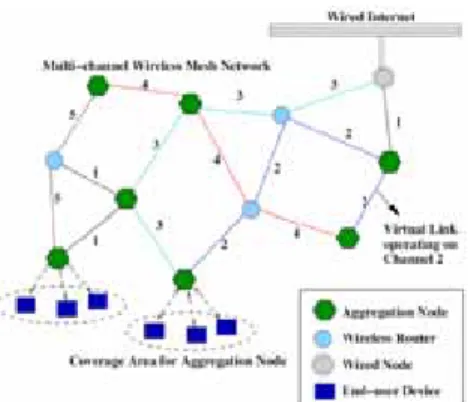
(2) Fig. 2. MMAC takes a PSM-like approach to negotiate channel and transmitting data. and gives more interesting network designing questions to be researched. For the mesh, IEEE 802.16 can be a centralized mesh or a distributed mesh networks [1].. C. Goal of the paper and paper organization In this paper, a Rate-Adaption Channel Assignment and Routing Algorithm for IEEE 802.16 wireless mesh network are proposed. The remaining of this paper is organized as follows. Section 2, we briery review the multi-channel multi-radio wireless network research issues and WMNs channel assignment and routing algorithm. The proposed Rate-Adaption Channel Assignment and Routing Algorithm will be described in Section 3. In Section 4, we show the ns-2 simulation results for the proposed scheme. At the end of the paper, we summarize our solution and results, and point out what can be done in the future in Section 5.. II. RELATED WORKS A. Multi-channel hidden terminal One-hop away nodes can not hear the control packets such as RTS and CTS from the sender or receiver if they are using radios in different channel. For example, node A and node B are communicating in channel 1 while node C in the vicinity of A or B has its radios tuned to channel 2. Node C cannot hear the RTS/CTS handshake between A and B and results in collision when C turns to channel 1 to transmit, this is called multi-channel hidden terminal problem. The problem can be solved by separating control packets and data packets transmitting in different channel. MMAC [6] proposed a PSM-like channel association procedure to solve the problem. Nodes synchronize with each other at the beginning of each Beacon Interval. In the ATIM window, nodes that have packets in queue send ATIM packet to the receiver node to negotiate which channel is going to be the data channel. ATIM packet contains the Preferable Channel List (PCL) which shows. Fig. 3. Hyacinth system architecture. Each node is equipped with 2 wireless NICs; the network as a whole uses 5 distinct channels. the desirable channel order. Each node contains a PCL and updates PCL according to the received control packets. The nodes who receive the ATIM packet compare the PCL of the sender with its own and reply the most suitable channel to the sender by the ATIM-ACK packet. And the sender needs to broadcast an ATIM-RES packet to claim the successful handshake to the adjacent nodes. When ATIM window is over, sender/receiver pairs change to the channel decided in ATIM window and begin data transmission, while the nodes have neither packets to send nor packets to receive turn to doze mode. The mechanism is not suitable to migrate to WMNs.. B. Multi-channel and multi-radio cooperation In order to increase the network aggregate throughput, some papers try to figure out how to utilize multiple Network-Interface-Cards (NICs) at each node. DCA [7] designs a default control channel for nodes to exchange control packets. All nodes should always listen to the control channel with one of the available radios. However, when the density of the network becomes larger, the control channel may become the bottleneck due to the overflow control packets. HRMA [9] takes another approach. It is based on very-slow frequency hopping spread spectrum (FHSS) radios and exploits the time synchronization necessary for frequency hopping. RICH-DP [10] is a MAC protocol based on a receiver-initiated collision avoidance handshake. It does not require carrier sense the channel or any assignment of unique codes to nodes. Nevertheless, all the three protocols mentioned above are packet-bypacket basis MAC protocols that are not suitable for WMNs.. III. PROPOSED SCHEME A. IEEE 802.16 Control Messages In IEEE 802.16 mesh mode, there are several important. - 623 -.
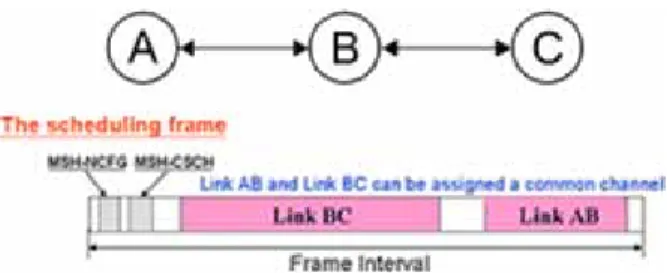
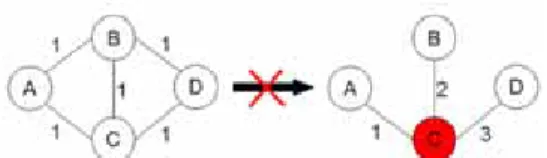
(3) control messages: MSH-NCFG messages provide a basic level of communication between nodes in different near by networks whether from the same or different equipment venders or wireless operators. All the nodes in the Mesh network shall transmit this message. MSH-NENT messages provide the means of a new node to gain synchronization and initial network entry into a Mesh network. MSH-DSCH messages shall be transmitted in Mesh mode when using distributed scheduling. A MSH-CSCH message shall be created by a Mesh BS when using centralized scheduling: The Mesh BS shall broadcast the MSH-CSCH message to all its neighbors, and all the nodes with hop count fewer then threshold shall forward the message to their neighbors that have higher hop count. Nodes can use MSHCSCH messages to request bandwidth from Mesh BS setting the Grant/Request Flag = 1. The parameter Configuration Sequence Number indicates which configuration shall be used to interpret this packet. A MSH-CSCF message shall be broadcast in Mesh mode when using centralized scheduling. The Mesh BS shall broadcast the MSH-CSCF message to its neighbors, and all nodes shall forward the message according to its index number speci_ed in the message. In our proposed scheme, Mesh BS uses MSH-CSCF message to tell all the stations the configuration that contains the channel-radio pair for each station. And Mesh BS can adjust the channel assignment either by broadcasting a new MSH-CSCF or indicating which MSH-CSCF shall be used by MSH-CSCH.. B. Proposed Channel Assignment. Fig. 4. IEEE 802.16 mesh network control messages In order to provide reliability, our channel assignment should not alter network topology which might lead to cost from node failure. Figure 5 points out the condition of inferior channel assignment. In our Rate-Adaption Channel Assignment (RA-CA) procedure, Link Criticality (LC) is introduced to accommodate the TDMA nature of 802.16 networks: In equation 1, Li is the link load and Ci is the capacity for the channel. Link Criticality has two characteristics in our scheme. First, it intuitively presents the priority of the links that needed to be assigned channel. The higher the LC is, the higher the priority. Secondly, it can be viewed as the slot number that should be scheduled in one Frame.. Fig. 5. Channel assignment procedure should not alter network topology For example, if link X has a 30Mbps traffic load on it and the capacity of the channel is 60Mbps, the Mesh BS may assign 50% time slots of the Frame for channel to link X. Moreover, we define a sufficient condition that link i can be assigned with channel k:. In equation 3, Ikj denotes the Link Criticality of link j that interferes with i in channel k. M is the 802.16 MAC overhead for a frame. This equation makes sure the ongoing channel assignment will not exceed the capacity of the channel by considering the interference from nearby links. In the scheduling phase, Mesh BS stores the requests from the Mesh SSs and sort the Link Criticality in a decreasing order. After the bandwidth request, Mesh BS starts to assign the channels to links according to the decreasing order of Link Criticality. When scheduling channel for links, the assigned channel should be checked first by equation 3. Otherwise, the channel with the least result of Ki in equation 2 will be assigned. When traffic load is above link capacity, Mesh BS can ask SS to transmit with a more stable modulation because there might be more links can be used. Takes figure 6 for example, there are only four links with 16-QAM modulation. Link BSA may become the bottleneck when the traffic load is getting higher. In this scenario, Mesh BS can ask D to turn on its second radio to channel 3 with QPSK modulation and as does the Mesh BS. Station D can now directly communication with Mesh BS without relaying packets from station A and thus ease the bottleneck. Channel assignment can be viewed as graph-coloring problems. However, because there are limited radios at each node and the number of channel is also a constraint, channel assignment problem brings special specification for multichannel environment. In node-multi-coloring formulation [16], it ignores the fact that the transmission pairs should be painted with the same color in order to communicate with each other. An edge-coloring formulation [17] faces the problem that the radios on a node are limited. And both of the coloring formulations didn’t apply TDMA concept that the close-by links could be painted with the same color if the bandwidth requirement is allowed. In order words, the graph-coloring. - 624 -.
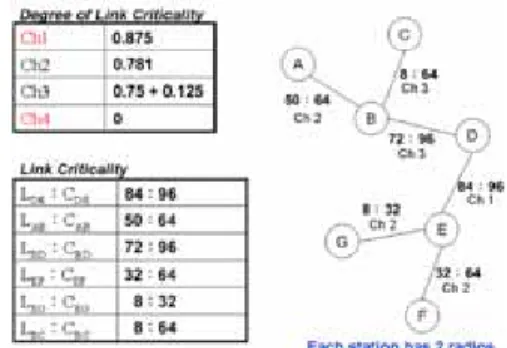
(4) and (2) Randomized Multi-Path Routing (RMR). We also. problem in multi-channel 802.16 CA should take the. Fig. 7. Rate-Adaption Channel Assignment Fig. 6. Different modulation level brings different network topology following factors into consideration: (1) The number of radios on a node is limited. We cannot assign channels for a node more than the number of radios. (2) The transmission pair should be bound to a common channel with one radio of each node. (3) Interference from adjacent links cannot be ignored. (4) TDMA characteristic should be added to the coloring principle. We categorize the channel assignment into three cases, we are going to assign channel to link AB. First, each of A and B uses a number of radios fewer than available number of channel. In this case we first check if there is one channel used by A or B that satisfies equation 3. If not any assigned channel is qualified, the Mesh BS will assign a new channel for the link. Secondly, A has all of its radios assigned and B uses a number of radio fewer than available numbers of channel. We only check if there is one channel used by A that satisfies equation 3. If not any assigned channel is qualified, the Mesh BS will assign a channel with least K value of equation 2 for the link. Finally, both A and B have all of their radios assigned. We check if there is one channel used by A or B that satisfies equation 3 in turn when merging channels of A or B into a common channel for link AB. Figure 7 shows how RA-CA should be performed. Mesh BS (station D) gather bandwidth requests from all the stations and stores LC of each link in a decreasing order. Each channel assignment is needed to be checked by equation 3 to ensure the sufficient capacity of the channel for the link. Degree of Link Criticality denotes the summation of LC that will interfere with the assigning link. It also represents how many time slots of the channel are used. The upper-left table shows the Degree of Link Criticality for link BC. By equation 3 in which we assume the MAC overhead is 0.1, therefore channel 3 is the resulting channel to be assigned.. C. Proposed Routing Algorithm The RA-CA is not tied to any specific routing algorithm. For our ns-2 simulation, we inherit the two routing algorithm from hyacinth: (1) Shortest Path Routing (SPR). proposed a (3) Rate-Adaption Randomized Multi-Path Routing (RA Routing for brief) to accommodate the multi-rate 802.16 network environment. RA-Routing takes link capacity into routing consideration. The more aggregate link capacity a route has, the higher possibility the packet will be transmitted through the path. For different hop-count routes, the aggregate link capacity of each route can be divided by hop-count to give a more objective view.. IV. SIMULATION In this chapter, we evaluate our proposed channel assignment and routing algorithm for multi-channel IEEE 802.16 Mesh Networks by ns-2 simulation. In our scenarios each station is equipped with two radios with either 16-QAM modulation or QPSK modulation. For a 20Mhz channel size, the peak data rate is 32Mbps and 64Mbps for QPSK and 16-QAM, respectively. The network is supposed to be error free, and all the traffic flows are using constant-bit-rate. We first examine our RA-CA performance by channel usage and channel utilization. Because of the limitation of wireless channels, we are going to show RA-CA needs a lower requirement for number of channel. Next part we represent the benefits from IEEE 802.16 multi-rate environment. Each station can change their radios to different modulation levels and may gain extra available links for transmitting data. RA-Routing is proposed to ease the bottleneck while not make the weaker link to be a new one. We will compare Shortest-Path-Routing, Randomized-Multipath-Routing and proposed Rate-Adaption Randomized- MultipathRouting for several different scenarios.. A. Channel Usage and Utilization We first show that RA-CA is more suitable for multi-channel IEEE 802.16 Mesh networks. Figure 8 represents the channel usage for migrated Hyacinth and RA-CA. Each point is the average number of channel usage for three different network topologies. Obvious, RA-CA uses fewer numbers of channels than. - 625 -.
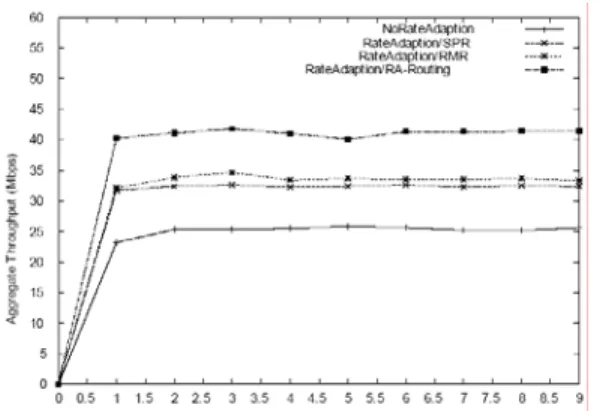
(5) Fig. 8. Channel usage comparison between RA-CA and migrated-Hyacinth. Fig. 10. With the help of Rate-Adaption, the performance is about 25%~75% better. Among the three routing protocols, RA-Routing is apparently adapted to multi-rate network.. Fig. 9. The figure shows load/channel over different number of traffic flow. The line drop means a new channel is assigned for a certain link. migrated-Hyacinth. In order to take a deeper view of how channel is being used, we investigate the aggregate channel utilization for one of the topology used. The figure shows load per channel over different number of traffic flow. The line drop means a new channel is assigned for a certain link. Consider the difference when the number of flow equals to 2, in which RACA gets a burst while migrated-Hyacinth gets a line-drop. In this scenario, RA-CA uses only two channels and migratedHyacinth uses four channels.. B. RA-CA and RA-Routing In this section, we present the performance improvement from RA-CA and RA-Routing. We set several links with QPSK modulation and others with 16-QAM modulation in the topology. Traffic is randomly generated by each subscriber to the Mesh BS. In figure 10, NoRateAdaption means a topology with all the radios set 16-QAM modulation and all stations apply SPR. With the help of RA-CA, all the routing algorithm gets better performance due to the links bring from radios that turns to QPSK modulation. RMR performs just a little better than SPR because the new QPSK link is however a weaker one, which has a maximum data rate lower than 16-QAM. RA-Routing ease the original bottleneck and. Fig. 11. This _gures show RA-Routing performs better at high load. make good use of the QPSK links as well, it proportionally divides the traffic loads into different capacity links. Figure 11 illustrates how RA-Routing performs at different traffic loads. We gradually increases the number of traffic flows to see the performance over the three routing protocols. RA-Routing still eases the bottleneck and is more adaptive to multi-rate environment. The aggregate throughput grows at the same rate for seven and eight traffic flows with flow number fewer than seven. We can tell that one of the routing paths is starving when flow number is larger than eight.. C. Improvement due to different number of radios and channels 13 shows the impact of different number of channels and number of radios per node. For the channel number of three, the throughput is only constrained by the limit number of channels and therefore no improvement when applying more radios. For the channel number of six, throughput is constrained by number of radios per node when fewer than three radios per node. We cannot get better performance by adding radios to nodes after three. - 626 -.
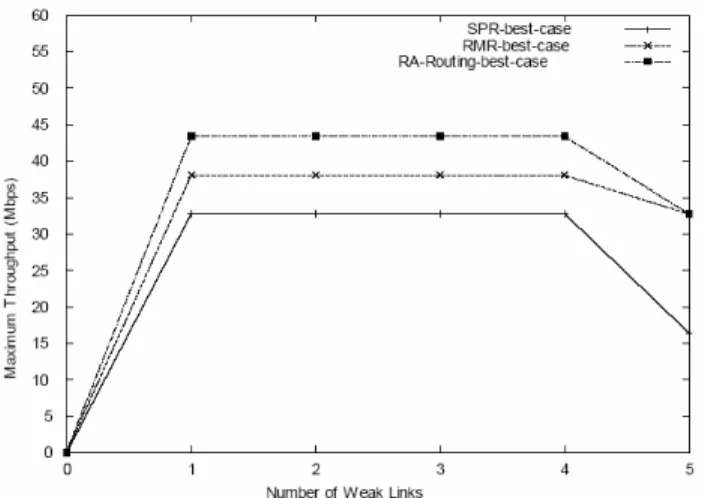
(6) links into consideration and will not turn the bottleneck to weaker links.. REFERENCES. Fig. 12. With the same traf_c load, we vary the number weak links and randomly put the links into the topology. We show RA-Routing is more robust to weak links.. Fig. 13. Impact of different number of channels and number of radios per node radios per node because of the constraint of available channel number. Moreover, for there is only one radio per node, more number of channels may benefit the performance and result in more users. This is because the transmission pairs can use different channels to transmit without interference even with only one radio per node.. V. CONCLUSION In this paper, we proposed a Rate-Adaption Channel Assignment and Rate-Adaption Randomized Multi-path Routing algorithm for multi-channel IEEE 802.16 wireless Mesh networks. We show that Rate-Adaption Channel Assignment can reduce the concurrent number of channel in use while get better channel utilization across the whole network by taking advantages of TDMA nature of 802.16. RA-CA and RA Routing exploit the links with different modulation level. We proved that RA-CA eases the bottleneck when the traffic load is high. Unlike Randomized-Multipath-Routing, RA-Routing takes weak. [1] IEEE 802.16 Presentation Submission Template (Rev. 8.3), 2005 July. [2] K. Jain. J. Padhye. V. N. Padmanabhan. L. Qiu; .Impact of interference on multi-hop wireless network performance..; Proc. ACM MobiCom, pp. 66-80, September 2003. [3] V. Bahl, A. Adya, J. Padhye, A. Wolman. .Reconsidering wireless systems with multiple radios.; ACM SIGCOMM Computer Communication Review, vol.34, pp. 39-46, October 2004. [4] K. Wu, J. Harms; "Performance Study of a Multipath Routing Method for Wireless Mobile Ad Hoc Networks"; MASCOTS, pp. 99-107, Aug 2001. [5] S. Bak, J. A. Cobb, E. L. Leiss; "Load-Balanced Routing via Bounded Randomization"; PDCS, pp. 857-862, Oct. 1999. [6] J. So, N. Vaidya; .Multi-Channel MAC for Ad Hoc Networks: Handling Multi-Channel Hidden Terminals Using A Single Transceiver..; MobiHoc, pp. 222-233, May 2004. [7] S. Wu, C. Lin, Y. Tseng, J. Sheu; .A New Multi-Channel MAC Protocol with On-Demand Channel Assignment for Multi-Hop Mobile Ad Hoc Networks..; I-SPAN, pp.232, 2000. [8] N. Jain, S. R. Das, A. Nasipuri; .A Multichannel CSMA MAC Protocol with Receiver-Based Channel Selection for Multihop Wireless Networks..; IC3N, pp. 432-439, October 2001. [9] Z. Tang and J.J. Garcia-Luna-Aceves; .Hop-Reservation Multiple Access (HRMA) for Ad-Hoc Networks..; INFOCOM, vol. 1, pp. 194-201, May 1999. [10] A. Tzamaloukas. J. J. Garcia-Luna-Aceves; .A Receiver-Initiated Collision-Avoidance Protocol for Multi-channel Networks.; INFOCOM, vol. 1, pp. 189-198, April 2001. [11] Y. Y. Huang, M. L. Molle; "An improved topology discovery algorithm for networks with wormhole routing and directed link"; IEEE Computer Networks, pp. 98-105, Sept. 1997. [12] R. Chandra, C. Fetzer, K. Hogstedt; "Adaptive Topology Discovery in Hybrid Wireless Networks"; Informatics, vol. 16, pp. 1-16, Sept. 2002. [13] K. C. Claffy, H. W. Braun, G. C. Polyzos; "A parameterizable methodology for Internet traf_c _ow pro_ling"; IEEE JSAC, vol. 13, Issue 8, pp. 1481-1494, Oct. 1995. [14] Y. J. Lin, M. C. Chan; "A Scalable monitoring approach based onaggregation and re_nement"; IEEE JSAC, vol. 20, pp. 677-690, May2002. [15] J. Deng and Z. J. Haa; .Dual Busy Tone Multiple Access (DBTMA): A New Medium Access Control for Packet Radio Networks..; ICUPC, vol. 2, pp. 973-977, October 1998. [16] T. R. Jensen, B. Toft; .Graph Coloring Problems.; Wiley Interscience, New York, 1995. [17] G. L. Nemhauser and S. Park. A polyhedral approach to edge coloring. Operations Research Letters 10 315-322, 1991. [18] I. Katzela, M. Naghshineh; "Channel assignment schemes for cellular mobile telecommunication systems: a comprehensive survey"; IEEE Personal Communications, vol. 3, pp. 10-31, Jun 1996.. - 627 -.
(7)
數據
+3
相關文件
• When the coherence bandwidth is low, but we need to use high data rate (high signal bandwidth). • Channel is unknown
• When the coherence bandwidth is low, but we need to use high data rate (high signal bandwidth). • Channel is unknown
“Ad-Hoc On Demand Distance Vector Routing”, Proceedings of the IEEE Workshop on Mobile Computing Systems and Applications (WMCSA), pages 90-100, 1999.. “Ad-Hoc On Demand
• As RREP travels backwards, each node sets pointer to sending node and updates destination sequence number and timeout entry for source and destination routes.. “Ad-Hoc On
Jiayi Zhou, Kun-Ming Yu, Chun Yuan Lin, Kuei-Chung Shih1 and Chuan Yi Tang, “Balanced Multi-process Parallel Algorithm for Chemical Compound Inference with Given Path Frequencies,”
[23] Tiantong You, Hossam Hassanein and Chi-Hsiang Yeh, “PIDC - Towards an Ideal MAC Protocol for Multi-hop Wireless LANs,” Proceedings of the IEEE International Conference
Krishnamachari and V.K Prasanna, “Energy-latency tradeoffs for data gathering in wireless sensor networks,” Twenty-third Annual Joint Conference of the IEEE Computer
Selcuk Candan, ”GMP: Distributed Geographic Multicast Routing in Wireless Sensor Networks,” IEEE International Conference on Distributed Computing Systems,
