Ultrafast carrier capture and relaxation in modulation-doped InAs quantum dots
K. W. Sun, A. Kechiantz, B. C. Lee, and C. P. Lee
Citation: Applied Physics Letters 88, 163117 (2006); doi: 10.1063/1.2197309 View online: http://dx.doi.org/10.1063/1.2197309
View Table of Contents: http://scitation.aip.org/content/aip/journal/apl/88/16?ver=pdfcov Published by the AIP Publishing
Articles you may be interested in
Carrier relaxation dynamics in InAs/GaInAsP/InP(001) quantum dashes emitting near 1.55m Appl. Phys. Lett. 103, 083104 (2013); 10.1063/1.4818759
Ultrafast release and capture of carriers in InGaAs/GaAs quantum dots observed by time-resolved terahertz spectroscopy
Appl. Phys. Lett. 94, 262104 (2009); 10.1063/1.3158958
Energy-dependent carrier relaxation in self-assembled InAs quantum dots J. Appl. Phys. 103, 124311 (2008); 10.1063/1.2947599
Excited-state dynamics and carrier capture in InGaAs/GaAs quantum dots Appl. Phys. Lett. 79, 3320 (2001); 10.1063/1.1418035
Energy level control for self-assembled InAs quantum dots utilizing a thin AlAs layer Appl. Phys. Lett. 78, 3247 (2001); 10.1063/1.1373410
This article is copyrighted as indicated in the article. Reuse of AIP content is subject to the terms at: http://scitation.aip.org/termsconditions. Downloaded to IP: 140.113.38.11 On: Thu, 01 May 2014 02:01:48
Ultrafast carrier capture and relaxation in modulation-doped InAs
quantum dots
K. W. Suna兲and A. Kechiantzb兲
Department of Applied Chemistry and Institute of Molecular Science, National Chiao Tung University, Hsin Chu, Taiwan 300, Taiwan
B. C. Lee
Center for Nano Science and Technology, National Chiao Tung University, Hsin Chu, Taiwan 300, Taiwan
C. P. Lee
Department of Electronics Engineering and Institute of Electronics, National Chiao Tung University, Hsin Chu, Taiwan 300, Taiwan
共Received 21 November 2005; accepted 23 March 2006; published online 21 April 2006兲
We report investigations on carrier capture and relaxation processes in undoped and modulation-doped InAs/ GaAs self-assembled quantum dots 共QDs兲 by using time-resolved spectroscopy technique with a time resolution of ⬃200 fs. We find that carrier capture and relaxation in the ground state of the charged QD are faster compared to the undoped dots even at an excitation level as low as 1⫻1010cm−2. It is attributed to the triggering of the vibrating polarization
field induced by the presence of cold carriers in the doped dots. The rate of an electron been captured by a positively charged QD is also calculated based on our proposed model. © 2006
American Institute of Physics. 关DOI:10.1063/1.2197309兴
The study of carrier relaxation and capture in InAs/ GaAs quantum dots 共QDs兲 has attracted much attention1–4due to their wide physical interests and their po-tential device applications. It has been predicated that the discrete atomiclike energy levels may inhibit the efficient carrier relaxation by single phonon emissions.5,6The system-atically longer PL rise times observed in the higher excited states of InAs/ GaAs QDs by Yuan et al.7,8were interpreted in the framework of sequential state filling, resulting from fast trapping and intradot relaxation. The experimental re-sults of intraband relaxation via polaron decay in InAs QDs were reported over a wide energy range from 40 to ⬃60 meV in Ref. 9. Their measured energy dependent decay time of the transmission change ranged from ⬃65 to ⬃45 ps. Few experiments have examined carrier and spin dynamics in charged QDs. Observation of quantum beats with unusual polarization properties in the PL of InP QDs was reported by Kozin et al.10In Ref. 11, the spin state of the resident electron in n-doped InAs QDs can be manipulated using nonresonant optical excitation. Recently, in the work done by Gündoğdu et al.,12,13the carrier capture and relax-ation to the ground state are much faster in the highly charged dots compared to the neutral dots. The enhancement of carrier capture and relaxation is attributed to the rapid electron-hole scattering involving the built-in carrier population.
In this letter, we investigate and compare the carrier cap-ture and relaxation processes in undoped and lightly doped InAs/ GaAs QDs using luminescence upconversion spectros-copy with ⬃200 fs time resolution. We observed ultrafast carrier capture and relaxation in charged QDs’ ground states
at very low doping concentrations and at low excitation level.
The InAs/ GaAs QD samples were grown by using a solid source molecular beam epitaxy共MBE兲 machine.14The
n-doped samples contain a Si-delta doping layer 2 nm below
the QD layer with nominal densities of about 2⫻1010cm−2.
For the p-doped samples, a Be-delta doping layer was placed 2 nm below the QD layer with nominal densities of about 2⫻1010cm−2. Atomic force microscopy 共AFM兲 and
trans-mission electron microscopy 共TEM兲 images of the self-assembled quantum dots reveal a QD density of ⬃2 ⫻1010cm−2 and an average base width and height for the
dots of approximately 20 and 5 nm, respectively. Free carri-ers from the doped layer accumulated in the low energy states within the InAs QDs. In the lightly n- 共p-兲 doped samples, most of the dots contain only a single electron共or hole兲. A QD infrared photodetector structure was also fabri-cated with the same doping scheme used in these experi-ments. The intraband absorption measurements and respon-sivity spectra from the device indicated that the doping in our samples was effective.
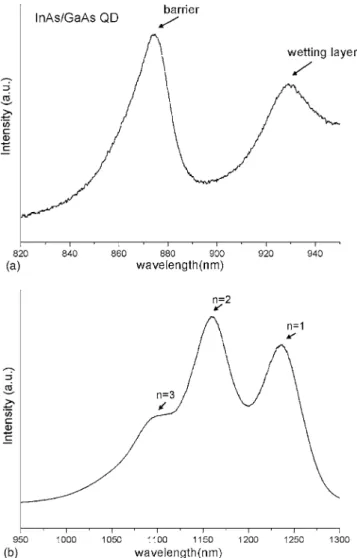
The measurements of carrier dynamics were performed by time-resolved photoluminescence.14 A femtosecond Ti:sapphire laser was operated at 770 nm with full width at half maximum共FWHM兲 of about 18 meV to excited carriers in the GaAs barrier. According to the focus spot size and the absorption depth at the photoexcitation wavelength, the laser pumping power was adjusted to give injected carrier densi-ties from 1⫻1010 共low兲 to 5⫻1011cm−2 共high兲. The room temperature time-integrated PL spectra of the undoped QD sample taken at an excitation wavelength of 770 nm and in-tensity of 1⫻103 W / cm2 共corresponding to an injected
car-rier density of⬃1011cm−2兲 are shown in Fig. 1. The spectral
lines centered at 872 and 930 nm are attributed to the band gap energies of the GaAs and wetting layer, respectively. Three spectrally well-separated PL lines at longer wave-lengths, as shown in Fig. 1共b兲, are due to electron-hole re-a兲Author to whom correspondence should be addressed; electronic mail:
b兲Permanent address: Scientific Research Division, State Engineering
Uni-versity of Armenia, Yerevan, Armenia.
APPLIED PHYSICS LETTERS 88, 163117共2006兲
0003-6951/2006/88共16兲/163117/3/$23.00 88, 163117-1 © 2006 American Institute of Physics This article is copyrighted as indicated in the article. Reuse of AIP content is subject to the terms at: http://scitation.aip.org/termsconditions. Downloaded to IP:
combination between distinct QD confined states. Only the
n = 1 peak is observed at low excitation intensity 共less than
10 W / cm−2兲 and it is assigned as the QD ground electron to
ground hole transition. The center wavelengths of the spec-tral peak from n = 1 to n = 3 are 1240, 1150, and 1080 nm, respectively. In the PL studies on doped QDs, due to the lightly doping, we did not observe significant changes in the spectra line shape or shifting of ground-state optical transi-tion. Carrier capture and relaxation to the QD’s ground level were examined as a function of excitation density and tem-perature by measuring PL rise times at the energy of QD ground state identified in the steady state PL spectra. The time evolution of the PL signal then follows from the analy-sis of the rate equations,
I共t兲 ⬀ A关1 − exp共− t/r兲兴exp共− t/d兲, 共1兲
whereranddare the PL rise and decay time constants.
In Fig. 2 we show the PL transients detected at the ground state of undoped QDs for the first 20 ps. PL spectra measured at three different excitation levels共low, moderate, and high兲 are displayed in parallel for comparison. At an excitation density as low as 1⫻1010 cm−2, the PL intensity
shows a rise time of approximately 5 ps. The PL rise times accelerate as the excitation power increases and reach a
value of less than 1 ps at a photoexcited carrier density艌1 ⫻1011cm−2. It is believed that the carrier density
depen-dence of the ultrafast relaxation is due to Auger-like carrier-carrier scattering.1,11
Experiments on modulation-doped QDs allow the relax-ation dynamics of electrons and holes to be investigated separately. At low temperature, low excitation densities, the photogenerated carriers do not significantly perturb the well-defined Fermi distribution of doped cold carriers. Therefore, the luminescence dynamics is dominated by the electron 共hole兲 dynamics in p- 共n-兲 doped QDs. For samples with doping density of 2⫻1010 cm−2, only the lowest electron
共n-doped QDs兲 or hole 共p-doped QDs兲 level is occupied prior to the optical excitation. The initial PL transient at the ground state in the doped QDs is shown in Fig. 3. The major
FIG. 1. Room temperature PL spectra of InAs/ GaAs self-assembled QDs, displaying GaAs barrier, wetting layer, and excited state radiative recombi-nation in wavelength range from 共a兲 820 to 950 nm and 共b兲 950 to 1300 nm. Spectra were excited at 788 nm with a self-mode-locked Ti:sapphire laser.
FIG. 2. Time-resolved PL intensity measured at the energy of the undoped QDs’ ground states at three different excitation levels and at low tempera-ture. The solid curves indicate fits of the PL rise to a single exponential.
FIG. 3. Results of time-resolved PL experiments at 77 K for p-doped 共circles兲, n-doped 共squares兲, and undoped QDs 共triangles兲 at an optical ex-citation level of only one electron-hole pair per dot.
163117-2 Sun et al. Appl. Phys. Lett. 88, 163117共2006兲
This article is copyrighted as indicated in the article. Reuse of AIP content is subject to the terms at: http://scitation.aip.org/termsconditions. Downloaded to IP: 140.113.38.11 On: Thu, 01 May 2014 02:01:48
difference of PL transients between charged and uncharged QDs is the presence of small built-in electron共hole兲 popula-tion in the n- 共p-兲 doped QDs prior to optical excitation. However, the fits of the PL transients in Fig. 3 indicate cap-ture times of about 1.7 ps for charged QDs which are more rapid than in undoped QDs, regardless of the species of cold carrier involved. In contrast to the earlier reports in highly charged QDs,12,13 the total carrier densities in our experi-ments are only on the order of⬃2⫻1010cm−2. The
calcu-lated Auger scattering rate15 was about 2⫻1010s−1 for a
plasma density of⬃1010cm−2and a quantum dot lateral size
of 20 nm. At such low excitation intensity, it is unlikely that the Coulomb scattering within the electron-hole plasma is responsible for the ultrafast carrier capture and relaxation observed in our charged QD experiments.16,17Another pos-sible mechanism for carrier capture and relaxation under low excitation is through carrier-phonon coupling18by which car-riers relax sequentially inside the QDs via carrier-phonon interaction. In that case, the capture and relaxation time should be slower and reveal temperature dependence. How-ever, in Fig. 4, we found no discernible temperature depen-dence on the PL rise time for charged and uncharged QDs. The above results indicate that neither carrier-carrier scatter-ing nor phonon scatterscatter-ing was responsible for the accelerated carrier capture observed in our experiments.
We have developed a theoretical model of carrier capture by taking into account the subtle difference between scatter-ing of carriers into continuous and localized electronic states when the center of the scattering is charged. In response to the localized共doped兲 charges in the dots, the lattice ions and electrons bonded to those ions were displaced. This displace-ment produces local strain of crystal lattice and atomic-size electrical dipoles. Due to the cumulative field of those di-poles around the dot, a polarization field must be induced around the QDs. During the scattering, carriers encounter two electric fields of opposite signs: positive共negative兲 field of a bare hole共electron兲 confined within the dot and screen-ing field of local polarizations around the dot. When the electric field induced strain around QDs suddenly
disap-peared due to the capture of an electron or a hole, local strain of crystal lattice must trigger vibrations of ions and bond electrons around the dot to relax strain and to release energy. By applying time-dependent perturbation calculations on the case of a mobile electron scattered on the polarization field produced by positively charged共p-doped兲 dots, we obtain the carrier capture rate of
=16 2 o 2បm*共 kc 2 −m 2兲R 0 5/2 e4共1 − 1/s兲2n1/2兩K共k兲兩2 . 共2兲
Derivation of Eq. 共2兲 can be found in Ref. 19. For given parameters in our p-doped QD experiments 共Ek= 35 meV,
⍀=2⫻103nm3, K共k兲=0.41, qR
0= 1.5, kR0= 2, m⌬t=2.13,
and n = 2⫻1016cm−3兲, Eq. 共2兲 gives a capture rate of =
⬃1.7 ps.
In conclusion, we have investigated carrier capture and relaxation in undoped and doped InAs/ GaAs QDs. We ob-served faster capture and relaxation processes in charged QDs compared to the undoped case at very low excitation densities. Our results suggest that, under low excitation in-tensity and low doping level, the relaxation of polarization field induced by the confined charge in the quantum dot is the dominant factor for the acceleration of carrier capture and relaxation in charged QDs.
This work was supported by the National Science Coun-cil of Republic of China under Contract No. NSC 94-2112-M-009-038.
1J.-Y. Marzin, J.-M. Gérard, A. Izraël, D. Barrier, and G. Bastard, Phys.
Rev. Lett. 73, 716共1994兲.
2G. Wang, S. Fafard, D. Leonard, J. E. Bowers, J. L. Merz, and P. M.
Petrov, Appl. Phys. Lett. 64, 2815共1994兲.
3R. Ferreira and G. Bastard, Appl. Phys. Lett. 74, 2818共1999兲. 4I. Magnusdottir, A. V. Uskov, R. Ferreira, G. Bastard, J. Mørk, and R.
Tromborg, Appl. Phys. Lett. 81, 4318共2002兲.
5U. Bockelmann and G. Bastard, Phys. Rev. B 42, 8947共1990兲. 6H. Benisty, C. M. Sotomayor Torres, and C. Weisbuch, Phys. Rev. B 44,
10945共1991兲.
7Z. L. Yuan, E. R. A. D. Foo, J. F. Ryan, D. J. Mowbray, M. S. Skolnick,
and M. Hopkinson, Physica B 272, 12共1999兲.
8Z. L. Yuan, E. R. A. D. Foo, J. F. Ryan, D. J. Mowbray, M. S. Skolnick,
and M. Hopkinson, Phys. Status Solidi B 224, 409共2001兲.
9E. A. Zibik, L. R. Wilson, R. P. Green, G. Bastard, R. Ferreira, P. J.
Phillips, D. A. Carder, J.-P. R. Wells, J. W. Cockburn, M. S. Skolnick, M. J. Steer, and M. Hopkinson, Phys. Rev. B 70, 161305共R兲 共2004兲.
10I. E. Kozin, V. G. Davydov, I. V. Ignative, A. V. Kavokin, K. V. Kavokin,
G. Malpuech, Hong-Wen Ren, M. Sugisaki, S. Sugou, and Y. Masumoto, Phys. Rev. B 65, 241312共R兲 共2002兲.
11S. Cortez, O. Krebs, S. Laurent, M. Senes, X. Marie, P. Voisin, R. Ferreira,
G. Bastard, J.-M. Gerard, and T. Amand, Phys. Rev. Lett. 89, 207401 共2002兲.
12K. Gündoğdu, K. C. Hall, Thomas F. Boggess, D. G. Deppe, and O. B.
Shchekin, Appl. Phys. Lett. 84, 2793共2004兲.
13K. Gündoğdu, K. C. Hall, T. F. Boggess, D. G. Deppe, and O. B.
Shchekin, Appl. Phys. Lett. 85, 4570共2004兲.
14K. W. Sun, J. W. Chen, B. C. Lee, C. P. Lee, and A. M. Kechiantz,
Nanotechnology 16, 1530共2005兲.
15U. Bockelmann and T. Egeler, Phys. Rev. B 46, 15574共1992兲. 16A. V. Uskov, J. Mclnerney, F. Adler, H. Schweizer, and M. H. Pilkuhn,
Appl. Phys. Lett. 72, 58共1998兲.
17T. R. Nielsen, P. Gartner, and F. Jahnke, Phys. Rev. B 69, 235314共2004兲. 18B. Ohnesorge, M. Albrecht, J. Oshinowo, A. Forchel, and Y. Arakawa,
Phys. Rev. B 54, 11532共1996兲.
19See EPAPS Document No. E-APPLAB-88-292616 for derivation of Eq.
共2兲. This document can be reached through a direct link in the online article’s HTML reference section or via the EPAPS homepage共http:// www.aip.org/pubservs/epaps.html兲.
FIG. 4. 共Color online兲 Temperature dependence of the PL rise times ex-tracted from the single exponential fits to the rising edge of time-resolved PL under low excitation level.
163117-3 Sun et al. Appl. Phys. Lett. 88, 163117共2006兲
This article is copyrighted as indicated in the article. Reuse of AIP content is subject to the terms at: http://scitation.aip.org/termsconditions. Downloaded to IP: 140.113.38.11 On: Thu, 01 May 2014 02:01:48