
俄罗斯與中日的能源關係 (1991-2011) - 政大學術集成
237
0
0
全文
(2) Acknowledgment. This Doctoral dissertation is devoted to my beloved parents: Mr. Leonid Grama and Mrs. Valentina Grama. I would like to express my sincere gratitude for the encouragement and support to my teachers and friends. Those include: my advisor Prof. Liou To-Hai from National Chengchi University; Director of the Graduate Institute of International Law and Diplomacy, National Chengshi University, Prof. Teng Chung-Chian; Dean of the Department of Diplomacy, National Chengchi University, Prof. Chyou Ren-Rang; Prof. Lien Hong-Yi from National Chengchi University; Prof. Kwo Wu-Ping from Nanhua University; Prof. Alexander Pisarev from Tamkang University; all teaching and administrative staff of the Department. 政 治 大 I would not be able立 to complete my Ph.D. degree without your assistance and. of Diplomacy, National Chengchi University; and Mrs. Alexandra Ordzhonikidze.. caring.. ‧. ‧ 國. 學. n. er. io. sit. y. Nat. al. Ch. engchi. i n U. v. i.
(3) Abstract Energy is one of the most important factors for the survival of humanity. It provides the fuel of the economy, heat, light and mobility. The country‘s economic growth depends on adequate, reliable and affordable supplies of energy. Key foreign policy objectives, including support for democracy, trade, sustainable economic development, poverty reduction and environmental protection rely on the provision of safe, reliable and affordable energy supplies. North East Asia is an important region in terms of its economic and political value. With a population of 1,7 billion people, and containing the world's second and third largest economies, it is a region of enormous political, economic and cultural significance. Russia, a major exporter of hydro carbonates and uranium, is one of the world‘s. 政 治 大 and highly depend on the import 立of energy resources. Moreover, Russia‘s close proximity to leaders of nuclear plant operating technology. China and Japan are the main actors in NEA. China and Japan enables a fast and a reliably efficient supply of oil and gas. These attributes. ‧ 國. 學. highlight and emphasize the excellent opportunities for energy cooperation between these countries.. ‧. Russia‘s strength in this field allows them to fortify their position in NEA as it. y. Nat. aspires to become a regional super power.. sit. The goal of this research is to study Russian energy relations with China and Japan. al. er. io. and how it affects the positions of the country in the region. The author would adopt the. n. main assumptions of the Geopolitics, theory of ―Strategic manipulation‖ and the concept of. Ch. i n U. v. ―Regional Security Complex‖ to analyze the content and consequences of Russian energy. engchi. relations with China and Japan and its impact on the situation in the region. The framework of the research is illustrated as follows: chapter one gives the background, goals and methodology of the research; chapter two provides the detailed analysis of Russian oil, natural gas, nuclear power reserves, the country‘s energy strategy and its theoretical implications; chapter three focuses on energy demand, energy diplomacy and strategy of China, the content, development, problems of Russo-Chinese energy cooperation and its theoretical evaluation; chapter four focuses on energy demand, energy diplomacy and strategy of Japan, the content, development, problems of Russo-Japanese energy cooperation and its theoretical evaluation; chapter five is devoted to the comparative study of Russian energy relations with China and Japan at the example of ESPO constructing, its results and implications; and chapter six concludes with responses to ii.
(4) research goals, evaluation of energy relations between Russia, China and Japan and recommendations for Russian energy policy in North East Asia. Key words: Russia, China, Japan, Energy diplomacy, Oil, Gas, Nuclear energy, Geopolitics, Strategic manipulation, Regional Security Complex.. 立. 政 治 大. ‧. ‧ 國. 學. n. er. io. sit. y. Nat. al. Ch. engchi. i n U. v. iii.
(5) 摘要. 能源是攸關人類生存的一大課題,它提供熱能、照明和運輸,而且是經濟發 展不可或缺的帶動因素。國家的經濟成長需仰賴充足可靠且價格合理的能源供應。對 外政策重大議題尤其需要依賴安全可靠且價格合理的能源供應,像是民主、貿易、替 代能源發展、消弭貧窮和環保等等相關發展支援計劃。 東北亞是具有高度經濟與政治價值的重要區域。在此區域內約有 17 億人口以 及世界第二、第三大經濟體,不論在政治、經濟和文化上皆有莫大影響力。 俄罗斯是世界上碳酸氫化合物與鈾的主要出口國,也擁有名列前茅的核能發 電廠運作技術。中國和日本不論在東北亞與世界都佔有重要地位,且高度依賴能源進. 政 治 大. 口。而俄罗斯鄰近中國和日本,可以快速有效提供石油和天然氣等能源。故而俄罗斯 與中日兩國在能源供應合作上顯然具有極高的發展潛力。. 立. 掌握能源供應的俄罗斯可以鞏固其東北亞的地位,進而成為該區域的超級強. ‧ 國. 學. 權。. 研究目標在於解讀俄罗斯對中日兩國的能源關係以及對東北亞情勢的影響。. ‧. 筆者將採用地緣政治學中的「策略性操縱」理論和「區域安全複合體」的概念作為主. y. sit. 的影響。. Nat. 要假設,分析俄罗斯與中日兩國能源關係的內容與後續走向,以及對區域情勢所造成. n. al. er. io. 研究架構如下:第一章是本研究的背景、目標及方法;第二章詳細分析俄罗. i n U. v. 斯的石油、天然氣與核能燃料蘊藏量、該國的能源策略及其理論上的影響範圍;第三. Ch. engchi. 章的焦點為中國的能源需求、能源政策和外交,俄罗斯與中國能源供應合作的內容、 發展與問題以及理論方面的評估;第四章探討日本的能源需求、能源政策和外交,俄 罗斯與日本能源供應合作的內容、發展與問題以及理論方面的評估;第五章就俄罗斯 對中國及對日本的能源關係進行比較分析,以 ESPO 的建設為例,探討其結果及影 響;第六章則是回應研究目標、評估俄罗斯與中日兩國的能源關係,並且對俄罗斯在 東北亞的能源政策提出建議。. 關鍵字:俄罗斯、中國、日本、能源政策、石油、天然氣、核能、地緣政治 學、策略性操縱、區域安全複合體。. iv.
(6) Content 1. Chapter1. Introduction……………………….…………………………………..…1 1.1 The research stimulus……………………………………………………………...1 1.2 The research goals and questions………………………………………………...12 1.3 The research methods and theories……...……………………………………….12 1.3.1 Research methods………………………………….…………………………13 1.3.2 The research theories…………………………………………………………15 1.4 The scope of the research and limitations….…………………………………….26 1.5 Literature and materials review…………………………..………………………30 1.6 The structure of the research…………………………….……………………….41 2. Chapter 2. The analysis of Russian energy recourses and energy strategy of Russia…………………………………….……………………………..…………………..43 2.1 The analysis of the supply of natural reserves in Russia……..…………………..43 2.2 Russian energy strategy and its implications……………………...……………..69 2.3 Theoretical evaluation of the Russian Energy Strategy……………….…………80. 政 治 大. 3. Chapter 3. Russo-Chinese Energy Relations……………………………..……..…83 3.1. The analysis of energy resources demand in China……………………………..83 3. 2. Russo-Chinese Energy Relations………………………...……………………..94 3.3 Problems and perspectives of Russo-Chinese Energy Cooperation……...…….111 3.4 Theoretic implications of Russo-Chinese energy relations…………...…..…….115. 立. ‧ 國. 學. ‧. 4. Chapter 4. Russo-Japanese Energy Relations…………………..………………..122 4.1 The analysis of energy resources demand in Japan………………………..…..122 4.2 Russo-Japanese energy cooperation……………………………...…….………143 4.3 Problems and perspectives for Russo-Japanese energy cooperation………..…..157 4.4 Theoretic implications of Russo-Japanese energy relations……………………160. sit. y. Nat. n. al. er. io. 5. Chapter 5. The implications of the energy relations between Russia, China and Japan……………………………………………………………………..…….………….163. Ch. i n U. v. 6. Chapter 6. Conclusion………………………………………………………...……….185. engchi. 7. Bibliography……………………………………………………………………………196. v.
(7) List of pictures 1. Picture 1. The process of policy analysis…………………………...……………..14 2. Picture 2. Total Energy Consumption in China, by type (2006)……………….….27 3. Picture 3. Total Energy Consumption in Japan, by type (2005)……….………….29 4. Picture 4. Oil basins in Russia……………………………………………………..44 5. Picture 5. The resource base of Russian gas industry…………..…………………52 6. Picture 6. The position of Energy Strategy to 2030 in the system of strategic documents of Russia………………………………………….…………………………………………71 7. Picture 7. China‘s Near Term Oil Import Needs…………………………………..85 8. Picture 8. Gas consumption in China 2000 – 2020………………...……………..87 9. Picture 9. Nuclear power reaction in China……………………………….………92 10. Picture 10. Japan total energy consumption 2008…………………………...…123. 政 治 大 Japan‘s Crude 立 Oil Imports by Major Sources………………...……129. 11. Picture 11. Japan‘s Oil Production and Consumption 1990 – 2010……………124 12. Picture 12.. 13. Picture 13. Japan‘s Natural Gas production and Consumption 1990 – 2009…...131. ‧ 國. 學. 14. Picture 14. Japan LNG Imports by Source, 2010………………………………133 15. Picture 15. Nuclear power plants in Japan…………………………………...…136. ‧. 16. Picture 16. The location of Sakhalin-1 project………………………………….147. y. Nat. 17. Picture 17. The location of Sakhalin-2 project………………………...………..149. sit. 18. Picture 18. Projected ESPO route…………………………….………………...152. n. al. er. io. 19. Picture 19. Final ESPO route……………………………………………...……166. Ch. engchi. i n U. v. vi.
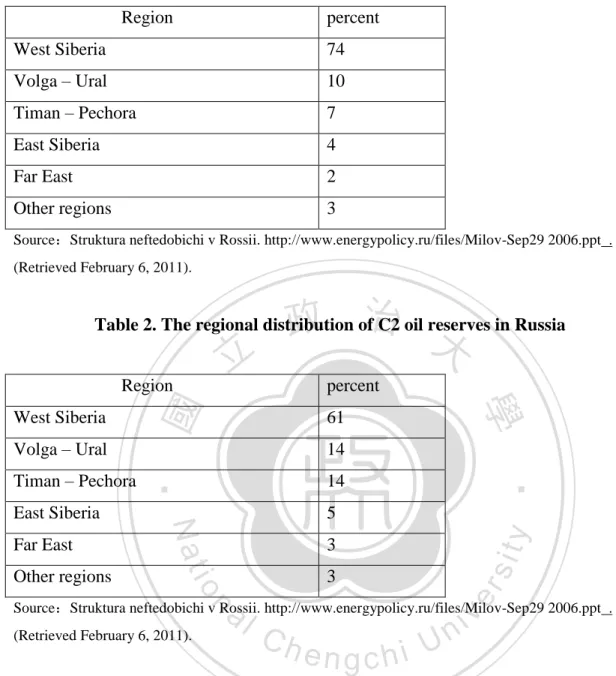
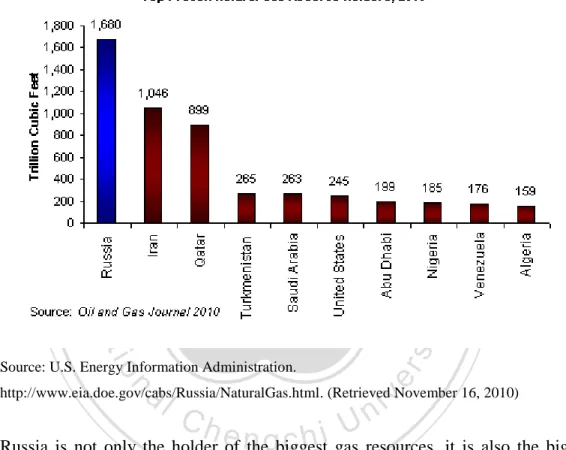
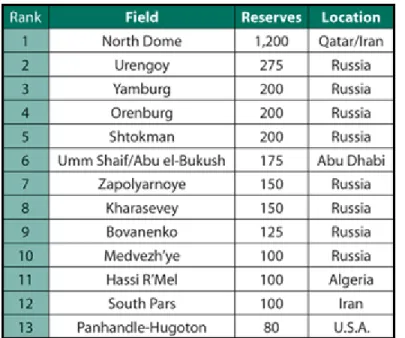
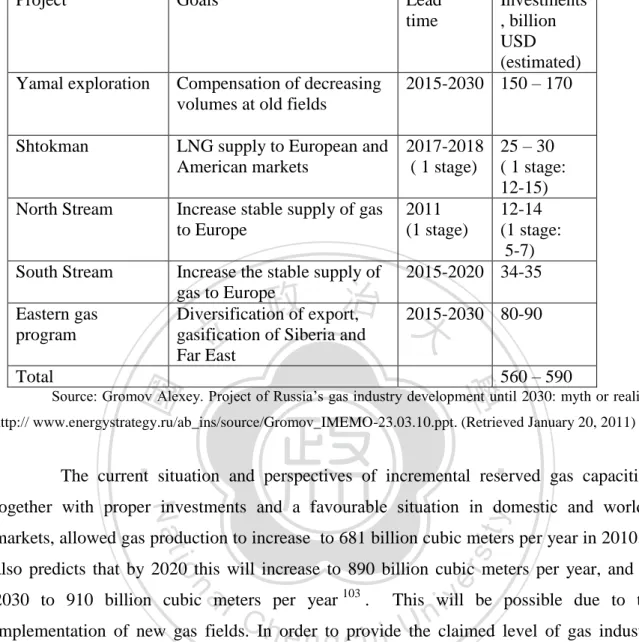
(8) List of tables 1. Table 1. The regional distribution of ABC1 oil reserves in Russia……………….48 2. Table 2. The regional distribution of C2 oil reserves in Russia…………..……….48 3. Table 3. World‘s top proven natural gas holders………………………….………51 4. Table 4. Largest gas fields in the world………………………………….………..53 5. Table 5. Crucial projects of Russia‘s gas industry until 2030…………….……….57 6. Table 6. Forecast of gas production in Russia by regions………………………...58 7. Table 7. Nuclear power reactors in operation, Russia…………………..…………63 8. Table 8. Japanese reactors under construction…………………………..………..……138 9. Table 9. Japanese reactors planned………………………………………..……..149 10. Table 10. Japan – USSR Joint Energy Initiatives in the 1970s…………………145. 立. 政 治 大. ‧. ‧ 國. 學. n. er. io. sit. y. Nat. al. Ch. engchi. i n U. v. vii.
(9) Russia’s Energy Relations with China and Japan (1991 – 2011) Chapter 1. Introduction. 1.1. The research stimulus Energy is one of the most important factors for the survival of humanity. It provides heat, light and mobility, the fuel of the economy. This is why the possession of energy is a dominant issue in the politics of every country. Mr. Matt J. Matthews made a good description of the importance of energy in the world: ―Energy is the lifeblood of economies around the world. Global economic growth depends on adequate, reliable and affordable supplies of energy. Key foreign policy objectives, including support for. 政 治 大. democracy, trade, sustainable economic development, poverty reduction and environmental protection rely on the provision of safe, reliable and affordable energy supplies‖1.. 立. To demonstrate the importance of energy factor it is worth to remind the simple. ‧ 國. 學. historical fact that oil prices were stable for most of the 100 years before 1973 at well under 5 USD per barrel. Almost three quarters of last century have been passed together with very stable prices for energy resources together with booming development of industry and. ‧. increased demand for energy. Thus, the jump of the oil price to 13 USD in 1973 and then to. y. sit. system.. Nat. 37 USD in 1980 2 was the conceptual shock for the whole world‘s political and economic. al. er. io. In 21st century, with the tremendously growing population and energy. n. iv n C agendas of the states. Global energy market h e nisgincreasingly i Uinfluenced by the location of the h c resources and the political and economic environment; growing demand from the. consumption, the energy related issues have risen to the top in the national and international. developing world, particularly from China and India; climate change, manipulation of resources for non-energy foreign policy objectives; and others. Because of the non-proportional distribution of energy resources there is a competition for the energy supply and markets in the world arena. Countries have to diversify import sources and fuels to increase storage capacity and to protect the supplying infrastructure. Countries of the Middle East and Africa are the major suppliers of oil, but 1. Matthews Matt J., ―Energy competition and international relations‖, International Journal of Global Energy. Issues, Vol. 29 Iss. 4, 2008. p. 371. 2. The historical crude oil prices (table). Retrieved September 2, 2010 from. http://www.inflationdata.com/inflation/Inflation_Rate/Historical_Oil_Prices_Table.asp.. 1.
(10) political conflicts in this countries and high transportation risks in the Malacca Strait raise concerns of energy security for importers. Thus, the question of diversification of energy import is the key question at the energy policy agenda in importing countries. Tremendous economic development of China and India is the most discussed phenomenon nowadays. India and China have been witnessing a steady increase in their energy consumption for many years. Increasing economic growth characterized by high industrial activity has been the main reason behind it. Though consumption of coal accounts for a major share of the total energy use, imported petroleum takes an irreplaceable position in the energy mix of both India and China. According to the International Energy Agency, in 2009 China overtook USA as the world‘s biggest energy user last year. China consumed 2,252 million metric tons of oil equivalents in 2009 in the form of crude, coal, natural gas, nuclear power and renewable sources that exceeded the 2,170 million tons used by USA3.. 政 治 大 Japan. Despite the global financial 立 crisis, India‘s energy demand continues to rise . Thus, In 2009, India was the fourth largest oil consumer in the world, after the China, the U.S. and 4. the world‘s energy supply balance is highly affected by those two countries and sharpens. ‧ 國. 學. the competition at the global energy arena.. Climate change also plays a great impact on global energy relations. With the. ‧. alarming evidences of global warming and its impact on humans and the ecosystems,. y. sit. globally.. Nat. climate change has become one of the new and increasingly important issues to be handled. al. er. io. The term "global climate change" usually refers to changes to the earth's climate. v. n. brought about by a wide array of human activities. Because of predictions of a steady rise in. Ch. i n U. average world-wide temperatures, global climate change is often referred to as "global. engchi. warming." Regardless of which term is used, different methods of electricity production can impact the earth's climate in ways that raise extraordinary environmental issues. There is increasing scientific evidence showing that human enterprises - especially burning fossil fuels such as coal, oil and natural gas - are altering the earth's climate. Burning fossil fuels releases carbon that has previously been locked up in coal, oil and natural gas for millions of years. The carbon in these fossil fuels is transformed into carbon dioxide (CO2), the predominant gas contributing to the "greenhouse effect," during the combustion process. 3. U.S. Energy Information Administration, “International Energy Outlook 2010”. Retrieved September 2,. 2010 from http://www.eia.doe.gov/oiaf/ieo/highlights.html. 4. U.S. Energy Information Administration, “India Energy Data, Statistics and Analysis”. Retrieved. September 2, 2010 http://www.eia.doe.gov/cabs/India/Full.html.. 2.
(11) Jumps in emissions of CO2 and other gases, such as methane, traced to fossil fuel burning and other human endeavours, boost heat trapping processes in the atmosphere, gradually raising average world-wide temperatures. The US Environmental Protection Agency observes that the surface temperature this century is as warm or warmer than any other century since at least 1400 AD. The ten warmest years on record have all occurred since 1980. The warmest year so far on record was 19985. The release of vast stores of fossilized carbon threaten to raise average global temperatures at an accelerated pace. Scientists have observed that the earth's surface warmed by approximately 1 degree Fahrenheit during the 20th century. The Intergovernmental Panel on Climate Change (IPCC), the scientific advisory body created by the United Nations to analyze the science of global climate change, reports that unless the world takes drastic and immediate steps to reduce the emissions of gases that are creating a magnified greenhouse effect, global temperatures could rise. 政 治 大 of warming since the end of the 立last ice age more than 10,000 years ago . The 4th report of. another 1,6 to 6,3 degrees Fahrenheit by the year 2100. This would represent the fastest rate 6. IPC has identified human economic activities as the main reason of the climate change 7.. ‧ 國. 學. CO2 emissions from fossil fuels cause unprecedented global warming. The consequences of climate change are devastating: 1) it poses a major threat to human health by way of. ‧. increased infectious diseases; 2) as global temperatures rise, sea levels will also rise. Much. y. Nat. of the world's population, especially the poorer people of the world, live at or close to sea. sit. level, areas vulnerable to the lethal combination of rising sea level and increasingly severe. al. er. io. ocean storms; 3) forest ecosystems evolve slowly in response to gradual natural climate. v. n. cycles. Many tree species may be unable to survive at their present sites due to higher. Ch. i n U. temperatures. Increased drought, more pests and disease attacks, and higher frequency of. engchi. forest fires, are all projected to occur at spots throughout the globe; 4) agriculture depends on rainfall, which impacts how to manage crop production, the types of seeds planted, and investments in irrigation systems. Changing weather patterns associated with changing global climate patterns pose major challenges for the farmers, who feed the world's growing population.. 5. “Electricity and climate change”. Retrieved August 20, 2010 from. http://www.powerscorecard.org/issue_detail.cfm?issue_id=1 6. Ibid. 7. For more details refer to: Intergovernmental Panel on Climate Change http://www.ipcc.ch/ipccreports/ar4-. wg1.htm ( Retrieved August 22, 2010).. 3.
(12) To slow down the global warming trends the use of fossil fuels needs to be drastically reduced or changed to the use of alternative kinds of energy in the nearest future. The most important the consumption of coil shall be gradually reduced in favour to natural gas and later to other alternative kinds of energy. The usage of such alternative kinds of energy as nuclear, wind or solar energy also will help to resolve the problem of overdependence on import of oil and gas from non stable countries and change the political situation in the world. That is why the great efforts must be given to the development of alternative kinds of energy. Together with the search for effective response to traditional and new threats to international security and stability, the importance of global energy balance has been significantly increased. Energy resources have the crucial value for providing the life quality and development of every state. The effective, stable and safe energy supply for fair. 政 治 大 The energy policy between 立 states, or ―energy diplomacy‖, as it is called by the. market prices is one of the most important questions for all global society.. specialists, is one of the most important components of international relations and one of the. ‧ 國. 學. most discussed agenda among policy makers and planners. Thus, the professional researches devoted to the studies of energy relations between states and in the whole world. ‧. have the essential practical importance for the strategic planning and implementation.. y. Nat. This current research is focuses on the study of energy relations of Russia with. sit. China and Japan and its impact to the international relations in the North East Asia.. al. er. io. North East Asia (NEA) is a very important region in terms of its economic and. v. n. political value. With a population of 1,7 billion people, and containing the world's second. Ch. i n U. and third largest economies, it is a region of enormous political, economic and cultural. engchi. significance8. Developments in the region, including the rise of China and ongoing efforts to resolve the crisis created by the last remaining corner of the Cold War have global implications. ―No other region in the world may be as confused or as significant for the coming decades of global security and integration‖9.. 8. There is no ultimate definition about which countries constitutes NEA. The author supports the interpretation. of Gilbert Rozman ―Northeast Asia is not easy to define because it is a region still in the process of formation. At its core are China, Japan, South Korea, and… North Korea. Present geographically and discussed as a factor in regionalism is the Russian Far East plus Eastern Siberia‖. USA, Mongolia, Taiwan and Hong Kong would be excluded from the analysis. 9. Gilbert Rozman. Northeast Asia‟s Stunted Regionalism: Bilateral Distrust in the Shadow of. Globalization (Cambridge University Press, 2004 ), p.3.. 4.
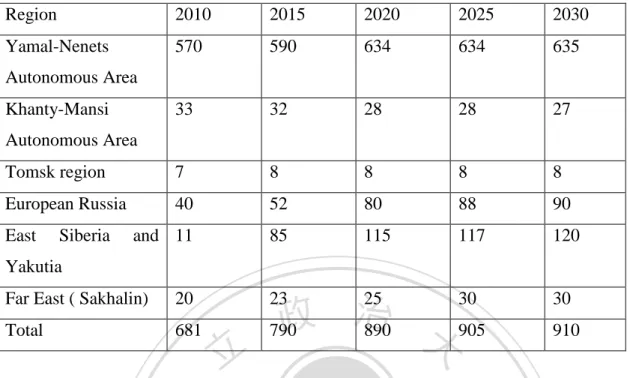
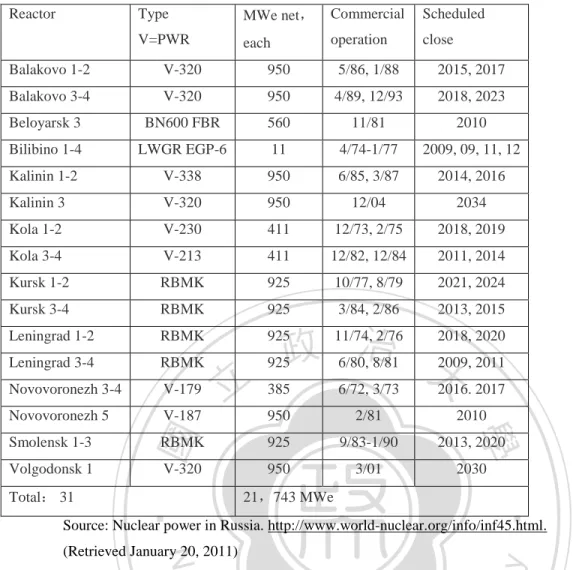
(13) Northeast Asia (NEA) has been one of the fastest growing markets and economy over the past 30 years. Thus, the problem of energy security in the region, primarily the stable energy demand and supply, has risen dramatically in recent years and this trend will persist in the foreseeable future at a higher rate than in other parts of the world. Despite the political and economic importance of NEA in whole, the energy diplomacy in the region is also substantial, because the world‘s biggest energy supplier and the world‘s second and third energy consumers are located there. Russia is a major player in the global energy market. The country holds the world's largest natural gas reserves, the second largest coal reserves, and the eighth largest oil reserves. Russia is also the world's largest exporter of natural gas, the second largest oil exporter 10. Russia's gas export in 2009 reached 168,3 billion cubic meters11 and oil exports was 247,4 million tons in 200912. In addition, the country is rich with uranium 13 and is one. 政 治 大 nuclear club which offers huge 立 future benefits. First, the country holds the secrets of. of the world‘s leaders on nuclear plants operating technology. Russia is a member of a. building state-of-the-art and reliable power plants. Second, it possesses uranium enrichment. ‧ 國. 學. technology. And third, it produces fuel for nuclear power plants. Russian companies provide the entire cycle of production, from uranium mining to nuclear power plants. ‧. construction. According to British leading newspaper The Telegraph ―Russia accounts for. y. Nat. 40 pc of the world‘s uranium enrichment facilities, 17 pc of the international fuel market, 28. sit. pc of NPP building capacity and 8pc of uranium mining‖14.. al. er. io. Traditionally, Russia was considered as the energy supplier to the western. v. n. countries, but since 1990s Russia is trying to diversify its energy supply, and NEA is a huge. Ch. i n U. market for Russian energy. Also, after the collapse of the Soviet Union, Moscow decided to. engchi. increase its involvement in NEA and to restore its role as one of the major player in the 10. U.S. Energy Information Administration , “Russia‟s Energy profile‖. Retrieved August 22, 2010 from. http://tonto.eia.doe.gov/country/country_energy_data.cfm?fips=RS. 11. Golos Rossii, ―Eksport gaza is Rossii ypal na 13,9percent”, Retrieved September 4, 2010 from. http://rus.ruvr.ru/2010/02/03/4112100.html. 12. Rosstat, “ Rosstat: Rossia v 2009 godu uvelichila eksport nefti na 1,8percent”. Retrieved August 26, 2010. from http://rosfincom.ru/news/552639.html. 13. According to World Nuclear Association ―Russia has substantial economic resources of uranium, with. about 10percent of world reasonably assured resources plus inferred resources….and 31 operating reactors‖. Retrieved December 12, 2010 from http://www.world-nuclear.org/info/inf45.html#Present_nuclear_capacity_. 14. Telegraph ―Russia now – welcome to the nuclear club”. Retrieved October 4, 2010 from. http://www.telegraph.co.uk/sponsored/russianow/6261620/Russia-Now-Welcome-to-the-nuclear-club.html.. 5.
(14) region. Thus, the supply of energy could be considered as a ―trump card‖ in achieving the abovementioned goal. According to the Russian Energy Strategy for the period up to 2020 adopted in 2003, NEA was considered as a key destination for future Russian energy export. The target of the strategy was to provide 30 percent of the oil and 15 percent of the natural gas to the NEA market15. In accordance with the recent trends, in 2009 the energy strategy of Russia was revised to the Russian Energy Strategy up to 2030 and the share of Russian oil at the NEA market is forecasted to be 22-25 percent and the share of natural gas to increase till 19-20 percent 16. Thus, it is visible, that Russia considers NEA as an important region for its energy export in a long perspective. China is one of the most rapidly developing country in the world with registered average growth of 10 percent between 2000 and 2008, but even during the harsh year of global economic crisis in 2009 it managed to maintain the high rate of economic growth of. 政 治 大 accordingly increasing. China立 has emerged from being a net oil exporter in the early 1990s. 8,7 percent. 17. . Together with economic development the demand for energy supply is. to become the world‘s third-largest net importer of oil in 2006. Natural gas usage in China. ‧ 國. 學. has also increased rapidly in recent years, and China has looked to raise natural gas imports via pipeline and liquefied natural gas (LNG). That makes Chine to be an important player in. ‧. world energy markets. As it is predicted by Erica Downs: ―Oil demand is projected to grow. y. Nat. at an average annual rate of 3,8 percent …, increasing its consumption to 8,8 million barrels. sit. per day till 2020‖ 18. The demand for natural gas will also grow ―at an average annual rate. al. er. io. of 11,7 percent, increasing the consummation to 9,5 trillion cubic feet 1920‖. The increase of. v. n. the natural gas consumption can be explained by the decision of Chinese government to. Ch. i n U. decline the use of coal. Demand for nuclear energy and alternative sources of energy will. 15. engchi. Jenergeticheskaya strategia Rossii do 2030”. Retrieved May 15, 2010 from. http://minenergo.gov.ru/aboutminen/energostrategy. 16. Ibid.. 17. The National Bureau of Statistics of China, “The Contribution of Three Major Demands to GDP Growth in. 2009”. Retrieved September 14, 2010 from http://www.stats.gov.cn/english/newsandcomingevents/t20100203_402619228.htm. 18. Downs Erica S., ―China‟s Quest for Energy Security”. Retrieved January 15, 2010 from. http://www.rand.org/pubs/monograph_reports/MR1244/MR1244.ch2.pdf. 19. Some statistic about gas is provided in tcf (trillion cubic feet). 1 cubic meter is equal to 35.3cubic feet.. 20. Downs Erica S., ―China‟s Quest for Energy Security”. Retrieved January 15, 2010 from. http://www.rand.org/pubs/monograph_reports/MR1244/MR1244.ch2.pdf... 6.
(15) also increase, but they could not to take the considerable part in energy consumption because of financial, technological and ecological constraints21. Japan with its world‘s third largest economy is the second biggest oil and the third biggest gas importer. Including nuclear power, Japan is still only 16 percent energy selfsufficient. Before March 2011, Japan was the third largest consumer of nuclear power in the world, after the United States and France. Hydroelectric power and renewable energy account for a relatively small percentage of total energy consumption in the country22.According to the Business Monitor International: ―between 2009 and 2019, we are forecasting a reduction in Japanese oil consumption of 7,22 percent, with demand slipping steadily to the end of the period and the country using 4,05 million barrels per day by 2019. Gas consumption is expected to rise from an estimated 92,5 billion cubic meters in 2009 to a possible 106,3 billion cubic meters by 2019. All of Japan‘s gas will continue to be. 政 治 大 .. imported in the form of LNG 23‖. Even there is a decrease of the crude oil consumption; the. 立. total required amount is formidable24. Japan and China have similar interests in their energy policies: to diversify and. ‧ 國. 學. secure energy supply to the country and, in future, to find out and develop alternative energy recourses.. ‧. NEA countries heavily depend on oil import from the non stable Middle East. In. y. Nat. addition to the possibility of supply interruption, these countries also have to pay the ―Asian. sit. premium‖ for imported oil than buyers from other regions25. Asian dependence on import. al. er. io. of energy resources is expected to increase in the future. Long term projections for China‘s. v. n. economic growth, the possible unification of Korea, not stable political situation at the 21. Ch. engchi. i n U. According to Erica Downs the ―Demand for nuclear energy is projected to grow at an average annual rate of. 9,2 percent between 1996 and 2020, and its share of primary energy consumption is expected to increase.. to 1,1 percent in 2020…Renewable sources of energy is expected to remain around 5percent in 2020‖. 22. U.S. Energy Information Administration. “Japan: Energy Data, Statistics and Analysis‖. Retrieved. September 14, 2010 from http://www.eia.doe.gov/emeu/cabs/Japan/Background.html. 23. Business Monitor International, ―Japan Oil and Gas Report Q2 2010”. Retrieved August 12, 2010 from. http://www.mindbranch.com/Japan-Oil-Gas-R302-9942. 24. According to China Oil and Gas Report Q2 2010 ―China‘s demand for crude oil would therefore be about. 6.53mn b/d by 2014‖. Retrieved august 15, 2010 from http://www.companiesandmarkets.com/SummaryMarket-Report/china-oil-and-gas-report-q2-2010-271636.asp. 25. Seung Jick Yoo, in his article “ Issues in Climate Change and Energy Security in Northeast Asia”. mentioned that the countries in Northeast Asia have paid about $ 1/bbl more for oil imported from the Middle East in comparison with other importers. Retrieved March 4, 2011 from http://www.nautilus.org/projects/seoul/workshop-papers/Climate_Change_and_Energy_Security.pdf.. 7.
(16) current oil exporting countries. and overall growing energy consumption lead Northeast. Asian countries to consider that diversification of their energy supplies is inevitable. In this regard, development of energy projects in Central Asia and the Russian Far East provide Northeast Asian states with good options for securing their energy. Moreover, the potential for extensive environmental deterioration caused by coal burning in China promotes the incentive to look at nearer and more competitive sources of natural gas in the Russian Far East. Regional demand for this efficient, plentiful, and clean-burning fuel is substantially increasing the momentum to produce, trade, and utilize natural gas. The demand for crossborder sale and purchase by both pipeline and Liquefied Natural Gas (LNG) by ships is spreading in the region 26 . For example, demand for natural gas has been rising at 9,3 percent per year since 1970 in this region27. Northeast Asia is a net importer of gas, and imports could potentially increase sharply in the 2010-2020 period28. For example, three. 政 治 大 of global LNG imports in 2002 立. Many experts also predict that the growth of the demand countries in the Pacific Basin – Japan, South Korea, and Taiwan – accounted for 68 percent 29. for gas will be particularly strong in China and Korea. In Korea, for example, demand for. ‧ 國. 學. natural gas will double, increasing from 25 billion cubic meters in 2003 to almost 50 billion cubic meters by 2020, whereas demand in China is forecast to increase five fold from 30. ‧. billion cubic meters in 2003 to more than 160 billion cubic meters by 202030.. y. Nat. In this regard, Russia, as the world‘s biggest natural gas and second oil exporting. sit. country, becomes an energy solution for NEA countries. In particular, Russia‘s natural gas. al. er. io. could provide an alternative to coal and oil for power generation. As a fuel, it is cleaner. n. than oil and coal, since it produces no sulphuric discharges and much less carbon dioxide31. 26. Ch. engchi. i n U. v. Ross Peter, ―Gas Pricing‖, Workshop by Director, Wimbledon Energy for 11th Annual Seminar on Gas. Pricing at Kuala Lumpur. 8-10, December 2003. 27. Cleary Peter, ―Development of East Siberian Gas for Export to China and Korea Markets‖, Presentation by. President, BP Gas Power & Renewables Korea for Sakhalin & North Asia Oil, Gas & Pipelines 2003, Seoul, Korea, 12-13 November, 2003. 28. Asia Pacific Energy Research Center, ―APEC Energy Demand and Supply Outlook 2002‖, Asia Pacific. Energy Research Center, 2002, p. 5. 29. U.S. Energy Information Administration , “Global Liquefied Natural Gas Markets: Status and Outlook/. LNG Importers, Retrieved September 7, 2010 from http://www.eia.doe.gov/oiaf/analysispaper/global/importers.html. 30. U.S. Energy Information Administration. “Global Liquefied Natural Gas Markets: Status and Outlook/. LNG Importers, Retrieved September 7, 2010 from http://www.eia.doe.gov/oiaf/analysispaper/global/importers.html. 31. Ibid.. 8.
(17) Thus the oil and natural gas pipeline projects on which Russia is currently engaged in Northeast Asia have great strategic importance for enhancing not only Russia‘s economic and energy security, but also for whole NEA. Regional energy cooperation would facilitate a reconfiguration of political and economic ties, with the Russia‘s move into a position of advantage. Specifically, Russia‘s export of energy could facilitate the investment of Chinese and Japanese capital and technology in Russia‘s oil and gas sector too. For example, the Kovykta gas project, one of Russia‘s biggest and most far-reaching projects, is approached its final stage. The project‘s ambitious goals are to develop a new East Siberian gas pipeline in the region and tap new markets in East Asia. On the energy demand side, the access to Kovykta, East Siberia Pacific Ocean (ESPO) pipeline and Sakhalin oil and natural gas is crucial for enhancing energy security of each of the NEA states32. Japan and China. 政 治 大 Russian Far East would lead to 立a drop in the cost of transporting energy sources.. have a vested interest in diversifying their energy supply sources, and its proximity to the. The high energy demand in both China and Japan and dependence on stable. ‧ 國. 學. energy supply from Russia leads to the important question about the future of Sino-Japanese relations: will China and Japan be engaged in the energy cooperation and under which. ‧. conditions or it will result in fierce competition over the energy supply? How the energy. y. Nat. interdependence inside the triangle Russia-China-Japan could affect the stability and. sit. development in NEA?. al. er. io. Energy relations ―are an especially interesting aspect of Sino-Japanese. n. relationship because they are the powerful ―double-edged sword, with the potential to. Ch. i n U. v. sharply leverage either cooperation or conflicts between these two giants‖ 33. So, here two. engchi. opposite opinions of the present and future essence of Sino-Japanese energy relations, and each of them are supported by considerable factors and studies34. From the history we know many wars happen for the obsession of energy resources. Energy plays an important role in the national security of any given country as a fuel to power the economic engine. According to national interests of any states it is vital to. 32. “The CIA World fact book: Global oil consumption and production”. Retrieved October 2, 2010 from. http://www.marktaw.com/culture_and_media/politics/GlobalOil.html. 33. Calder Kent E., ―Sino-Japanese energy relations: prospects for deepening strategic competition‖. Retrieved. April 12, 2011 from http://eastasianstudies.research.yale.edu/japanworld/calder.pdf. 34. The analysis of related literature and sources supported both points of view will be provide at the chapter. Literature review.. 9.
(18) have a reliable and stable energy supply, and, because of the shortage nature of the recourses, the competition is inevitable. Because of China and Japan are one of the most energy consuming countries, the conflicts over the energy supply are forecasted. Despite the booming increase of economic relations between China and Japan, theirs geopolitical relations are still very complicated. From the history both countries have been enemies and theirs relations started to improve just few decades before. China and Japan both have many conflicts of interest as in their bilateral relations as in the region and the whole in the world. Although the direct Sino- Japanese energy competition have been constrained, it is still a big possibility that in future it will result in sharp and direct confrontation. Recently, we could observe the tension over the reserves in the East China Sea35. Both countries are keen to possess huge reserves of oil and gas and claim to rights to possess them in their own. The competition over the oil pipe line from the Russian Far East was another. 政 治 大 irritated by the interference of立 the Japanese side to the negotiations with Russia and finally. factor lead to the tension intensification in the bilateral relations. Chinese side was very. the failure of Chinese plan.. ‧ 國. 學. China and Japan have similar confrontational interests not only in Russia, but also in Iran, Persian Gulf and other countries.. ‧. So, there are clearly deepening competitive prospects in Sino-Japanese relations. y. Nat. that could be exacerbated by other disputable issues, as, for example, territorial disputes.But,. sit. there are also many supporters that China and Japan could develop stable and efficient. al. er. io. energy cooperation and ―cooperation, rather then rivalry, will be essential not only to the. v. n. development of bilateral relationship, but also to regional stability and energy cooperation 36. in East Asia‖ .. Ch. engchi. i n U. The normalization of Sino-Japanese relations in 1970s has gradually removed obstacles to the cooperation between both countries. Thus, it became possible to find and develop cooperative norms and principles not only in economic, but in political and strategic issues. Despite many factors which stipulate the conflicts over energy resources, benefits from the bilateral energy cooperation could prevail37.. 35. In September 2005 China even sent its warships to the region and since then started to pump oil and gas. there, despite protests from Japanese side. 36. Xuanli Liao, ―The driving forces behind the Sino-Japanese energy competition‖, Harvard Asia Pacific. Review, Vol.8, Iss. 1, p. 11. 37. Shoichi Itoh in his article ―China‘s Surging Energy Demand: Trigger for Conflict or Cooperation with. Japan?‖ explains both the possible benefits from conflict and cooperation between Japan and China.. 10.
(19) In general, it is important to cooperate for the neighbour countries in energy related issues because of the same factors, such as big volumes of import crude oil, the same transportation passageway of oil imported, and sources imported. But, in Sino-Japanese energy interdependence there are other factors promoting the energy interdependence between two countries: both states are paying a great concern on energy conservation, renewable energy and clean technologies. For example, Beijing is very anxious to build a more energy saving and clean country, and Japan, being known as a world‘s more energy efficient country, has found a lot of business opportunities to transfer such technologies to China. Thus, in general, there are several factors promoting the bilateral energy cooperation as: 1) China and Japan both are interesting to promote the regional stability in order to maintain an uninterrupted flow of energy resources;. 政 治 大 countries not to bargain 立 and to promote the understanding between consumers 2). Cooperation would make it more possible to influence the energy supplying. based on all parties understanding of their mutual interdependency;. ‧ 國. 學. 3). Collective measures could secure the energy shipping routes. So far shipping. routs from the Middle East to Asia remains the most economically effective and convenient. ‧. way. Providing bilateral secure measures and sharing the transportation costs could be. io. y. problems of energy security and global warming.. al. sit. Cooperation in the sphere of nuclear energy will also favour to solve. er. 4). Nat. beneficial to both countries;. v. n. Both of these two approaches have their own support and logic. Sino-Japanese. Ch. i n U. energy relations are greatly influenced by the political, strategic and economic factors. The. engchi. Sino-Japanese competition for oil reserves could be exacerbated by shortage of supply and energy prices increase and current unresolved disputes in East China Sea and other territorial disputes. Both countries need to build more political trust and atmosphere. It could be not easy, but possible, because the benefits from common actions and mutual assistance could prevail over the possible outcome of conflicts. Thus, Russia‘s role in SinoJapanese energy cooperation is dual: it would be the catalyst of the related conflict over its energy supplies or it would stipulate the energy cooperation between these two countries. All will depend on countries interests, goals and final strategies.. 11.
(20) 1.2 The research goals and questions The goal of the research is to analyze the content and trends of Russian energy relations with China and Japan and how do they affect the Russian positions and international relations in the region . In order to comply with the research goal the author has to reply the following questions: 1). What are the stimulus for energy cooperation between Russia, China, Japan;. 2). What is the current energy export situation in Russia and its perspectives;. what are the main components and directionsof energy strategy in Russia; 3). How big is the Chinese energy demand, main trends and perspectives? What. is Chinese energy strategy and energy security? What are the trends of bilateral energy relations and Russian approach towards energy cooperation with China? 4). How big us the Japanese energy demand, main trends and perspectives?. 政 治 大 energy relations and Russian 立 approach towards energy cooperation with Japan?. What is Japanese energy strategy and energy security? What are the trends of bilateral. What is current situation of energy relations between Russia, China and. 學. ‧ 國. 5). Japan? How does Russia pursue its own energy policy within the triangle Russia-ChinaJapan and its implications for energy relations between these countries?. ‧. 6). How to define the energy relations between Russia, China and Japan and. y. Nat. what kind of implications it imposes for the Russian policy in the region.. sit. Providing the profound and detailed analysis of these questions the author could. al. n. following theoretical and research methods will be implied.. Ch. engchi. er. io. reach the goal of the research. In order to provide the relevant scientific research the. i n U. v. 1.3 The research methods and theories. It is crucial to choose the proper research methods and theoretical approaches in order to conduct the proper research. According to Robert Merton: ―The scientific method or methodology provides a systematic, organized series of steps that insures maximum objectivity and consistency in researching a problem. It provides a shared basis for discussion and analysis, and helps to promote reliability and validity (consistency and accuracy).. The. information. provided. through. this. method,. the. patterns. and. interrelationships are then explained through the Theoretical analysis. Theory directs research and research informs theory‖38.. 38. Merton Robert. The Sociology of Science (The University of Chicago Press, 1973), p.8.. 12.
(21) 1.3.1 Research methods The first research method that the author is going to implement is the Document Analysis Method. Document analysis is a systematic procedure for reviewing or evaluating documents. Like other analytical method in qualitative research, document analysis requires that data be examined and interpreted in order to elicit meaning, gain understanding and develop empirical knowledge. As a research method, document analysis is particularly applicable to qualitative case studies – intensive studies producing rich descriptions of a single phenomenon, event, organization or program39. Documents can serve a variety of purposes as a part of research undertaking. First of all, documents can provide data and background information on the context within the. 政 治 大. research operates. Second, information contained in documents can suggest some questions that need to be asked and situations that need to be observed as a part of the research. Third,. 立. documents provide supplementary research data. Information and insights derived from. ‧ 國. 學. documents can be valuable additions to the knowledge base. Fourth, documents provide a means of tracking changes and development. Where various drafts of particular documents. ‧. are accessible, the research can compare them to identify the changes. Also the examination of periodic and final reports (if available) helps to get a clear picture of the phenomenon. sit. y. Nat. development. Fifth, documents can be analyzed as a way to verify findings or corroborate evidence from other source. If the documentary evidence is contradictory rather then. io. n. al. er. corroboratory, the researcher is expected to investigate further. When there is a convergence. i n C confidence in the credibility of findings. hengchi U. v. of information from different sources, readers of the research usually have greater. In sum, documents provide background and context, additional questions to be. asked, supplementary data, a means of tracking change and development, and verification of findings from other data sources. Moreover, documents may be the most effective means of gathering data then events can not longer be observed or when informants have forgotten the details. The author is going to use the following types of documents in this research: bilateral and multilateral agreements and declarations in energy sphere; statements of leaders and high-ranking officials of Russia, China and Japan related to energy cooperation; 39. More information about the implementation of the Document Analysis Method in scientific research is. provided by Bowen G, ―Document Analysis as a Qualitative Research Method”, Qualitative Research Journal, Vol.9, No.2, 2009, pp. 27 – 40.. 13.
(22) key documents stated the energy strategy and development of the states; publications of specialists; mass media reports and discussions in related forums, etc. The Policy Analysis and Strategic Approach is applicable to study the energy policies as the approach provides the framework for policy evaluation and strategic assessment of related processes. Good analysis relies on accurate statements, verification of problems and relevant information. The policy analysis and strategic approach includes six kinds of research processes that will finally let the researcher to monitor and evaluate the policy40. Using this approach the author will gradually analyze the policy of states in energy related area, find out the alternative decisions and verify them and, finally, will evaluate the current policy and provide the alternative solutions if any.. 學. ‧ 國. 政 治 大 Picture 1. The process 立of policy analysis Verify, define and detail the Establish evaluation criteria. sit Identify. n. al. er. io. Display and distinguish among alternatives. y. Nat. Implement, monitor, and evaluate the policy. ‧. problem. Ch. i n U. v. alternative policies. engchi. Assess alternative policies. Source: Patton Carl V. and Sawick David S. ―Basic Methods of Policy Analysis and Planning‖ (Pentice Hall. 1993), p. 14.. 40. Please, refer to the Picture 1.. 14.
(23) 1.3.2 The research theories The theory plays a very important role in research. Theory is formalized conceptualization between variables, generalized explanatory principle 41 .. The theory. provides tentative explanation of the observed phenomenon, logical explanation based on currently available evidences, creditability of the research‘s findings and a context for predictions. The proper research theory must comply with several features: 1). Falsifiability: the theory must make sufficiently precise predictions that we. can at least imagine evidence that would contradict the theory; 2). Parsimony: the best theory is the one that makes a fewer number of. assumptions; 3). Generativity: the theory must not only explain results that have been found,. but also generate predictions that can be tested; 4) 5). 政 治 大 Good track record: 立 the theory must have research results; studies have tested Precision: the theory must make precise predictions, not be ambiguous;. the hypotheses and have provided support42.. ‧ 國. 學. But, each theory has its own limitations and shortages, that‘s why for explanation of complex events and phenomenon few theories could be applied. These theories must be. ‧. consistent and to provide the comprehensive framework for the research.. y. Nat. In this research the following theories will be used:. sit. 1) Geopolitical theory (Geopolitics). al. er. io. Geopolitics is the art and practice of using political power over a given territory.. v. n. Traditionally, the term has applied primarily to the impact of geography on politics, but its. Ch. i n U. usage has evolved over the past century to encompass a wider connotation.. engchi. One of the key aspects of the geopolitical theory is that it facilitates an understanding of the relations between geography and the states. It helps to understand the world as a whole and outline strategic options for the future. Geopolitics is ―the connecting bridge between geography and international relations…is the study of international relations from spatial perspectives with strategic implications…the main directions of the strategy. 41. Scientific Research Glossary. Retrieved January 18, 2011 from. http://lamar.colostate.edu/~hallahan/hglossary.htm. 42. The features was extracted from the book written by London Herbert I. Social Science Theory: Structure. and Application (New York: New York University Press, 1975).. 15.
(24) can be deduced from an understanding of the overreaching spatial relations between political actors‖43. Geopolitics provides an attractive discourse for strategic thinkers. First, geopolitical discourse deals with questions of power and danger in world politics, geopolitics is involved in world affairs, is not separate commentary on it. Second, geopolitics explains ―a great deal in simple words‖ 44 . Geopolitical discourse offers comprehensive vision of global affairs. It provides the framework where ―local events in one place can be related to a large political picture‖45. And, finally, geopolitics provides insights into the future directions of the global affairs, the coming shape of the political global map. Geopolitics helps politicians to attain their political goals. According to Karl Haushofer geopolitics presents ―…the scientific equipment of concrete facts and proven laws to help… to see political situations as they really are‖46. If before Geopolitics was. 政 治 大 revolution the geopolitics of 立 energy – who supplies it, and securing reliable access to those studied only in terms of geographic locations, sea and land terms, but since the industrial. supplies – have been a driving factors in global prosperity and security.. ‧ 國. 學. The world's diminishing sources of energy are radically changing the international balance of power. There is an increasing competition between nation-states for non-. ‧. renewable resources, particularly (but not only) for hydrocarbons (oil and gas). This. y. Nat. competition seems to be increasing in intensity and shows worrying signs that it may. sit. develop into a new kind of cold-war, with potentially disastrous consequences for our. al. er. io. global future (even if war is avoided, the cost of military build-up to service conventional. v. n. energy security needs will strip the resources needed for a transition to sustainability). Over. Ch. i n U. the coming decades, energy politics will determine the survival of the planet.. engchi. The last decade of 20 century is the period of the fundamental shift at the international arena. The country, which used to hold ―the Heartland‖ 47 position has 43. Goeff Solan, ―Classical Geopolitical Theory: Does it Still Matter?”, Journal of Global Competitiveness. Vol.. 13, Iss.1/2, 2005, p 38. 44. Tuathail Gearoid O. (1998) The Geopolitics Reader. In Tuathail Gearoid O, Dalby Simon and Routledge. Paul (Eds.), Thinking Critically about Geopolitics (pp. 2-12), p. 2 45. Ibid.. 46. Haushofer Karl. (1998) The Geopolitics Reader. In Tuathail Gearoid O, Dalby Simon and Routledge Paul. (Eds.), Why Geopolitik? (40-42), p. 41. 47. The geopolitical conception of ―the Heartland‖ was developed by Halford John Mackinder in Democratic. Ideals and Reality (Greenwood Press, 1981).. 16.
(25) disappeared from the Eurasian political map. This phenomenon resulted in the change of all basic geopolitical definitions at the Eurasian continent. The dissolution of the Soviet Union changed the geographic contours of the Russian Federation and brought new goals for the country – to elaborate and implement new policy in the international arena in the totally new historical conditions. One of the most effective ways to define and maintain the county‘s position in the world is the energy factor. It forms new political and economic centers which, in theirs own turn, form new balance of the international interests. What are the main characteristics of the world‘s energy state? First of all, the state which claims to hold the status of the world‘s energy power shall implement the relevant energy policy in the international arena. Second, the state shall implement the proper formation of the juridical basic and mechanisms of the realization its. 政 治 大 state as well as the import of 立 technologies, investments, entrance to the new energy markets,. energy diplomacy: one of the most important instruments here is the Energy Strategy of the. development of the energy projects. Third, the country shall implement proper mechanisms. ‧ 國. 學. to develop the image of the world‘s energy states which aimed at modernization and restructuring the technological basic of its energy complex and the change of the demand. ‧. and relocation of its energy resources.. Thus, the energy factors play crucial role in the. y. Nat. foreign policy of the country.. sit. The energy policy is the multicomponent concept which includes geopolitical,. al. er. io. economic, financial, ecological and other aspects of the energy policy of the country. The. v. n. geopolitical component shall be analyzed from the point of view of the transformation of. Ch. i n U. systemic characteristics of the world‘s order in the new century48. Definitely, the geopolitics. engchi. can not abstract from the territorial issues and the location of the countries, which it is its classic component and content. But in 21 century, the main object of geopolitics is ―main structures and subjects, global and strategic directions, important mechanisms or principles of functioning and evolution of the modern world‘s society‖ 49. Many experts agree that in 21 century oil and gas will have leading importance in the energy balance of the world‘s economy. Foreign policy of every state is closely depended on energy security. Constantly increasing importance of the energy resources leads to the latent and obvious political. 48 49. Gadzhiev K.S. Geopoliticheskie gorizonty Rossii (konturi novogo miroporyadka) (M.: Ekonomika, 2007). Zhiznin S.Z. Jenergeticjeskaya diplomatia (M.: MGIMO (U) MID Rossii, 2002), p. 19.. 17.
(26) struggle over them among major states. The energy production and supply is one of the most profitable businesses, this is why it affects all actors involved into the energy diplomacy. It concerns companies and whole states as well. Also, energy is one of the main industries for many states in economics, social security and politics. The energy security of every state is defined by its role at the world‘s energy market. Energy resources are not proportionally distributed, some countries have abundant energy recourses, and others are lack of them. Thus, the fierce competition for the access to the energy recourses and control of theirs supply define the foreign policy and energy diplomacy of many states. The importance of the energy factor in the world‘s politics has resulted in the formation of the energy politics and energy diplomacy of the countries as important element of the foreign policy. Russia, China and Japan are active participants of the global resource. 政 治 大 domestic requirements, it seeks 立to dominate the supply and the transportation of energy. competition.Although Russia does not need to import oil and natural gas to satisfy its. This is an alarming factor, the supply of energy recourses could help Russia to restore its. ‧ 國. 學. great-power status and its growing control over the distribution of oil and gas in Eurasia will undercut influence of other countries in the region and in the world. In response to the. ‧. Russian energy drive other countries will wish to undertaking countermoves, for example to. y. Nat. encourage the establishment of oil and gas pipelines that bypass Russia, thereby. sit. diminishing its control over the flow of energy.. al. er. io. The rising demand for energy recourses in China stipulates the enhance of. v. n. capacity for "power projection" in areas that provide them with critical raw materials,. Ch. i n U. especially fossil fuels, and that such efforts would pose a significant threat to security. engchi. interests of other countries. At a time when world supplies of oil, natural gas, uranium and key industrial minerals are beginning to shrink and the demand for them is exploding, the major industrial powers are becoming more desperate in their drive to gain control over these recourses 50 . These efforts typically entail intense bidding wars for supplies on international markets (as we can see record high prices for all these commodities on market). But they also take military form, as arms transfers and the deployment of overseas missions and bases, or supply of weapon to developing countries- exporters of oil and gas, as China does in Africa. For Japan the stable supply of energy is also the question of survival. Being geographically located close to China and being also one of the biggest energy importers 50. Klare Michael T., ― The New Geopolitics of Energy‖, The Nation. May 1, 2008. 18.
(27) Japan could by any means compete with China for the energy supply from Russia, and this could dramatically affect the relations between these two countries and in the region in the whole. Thus, the research must be analyzed with the implementation of basic assumptions of geopolitical theory. And these assumptions are provided in two collateral theories: the theory of ―Strategic Manipulation‖ and the theory of ―Region Security Complex‖. 2) The theory of “Strategic Manipulation”. The difficulty of defining the concept of ―strategic manipulation‖ lies in the fact that there is no individual theory in political science that would precisely deal with that notion. Instead of that, various adjoining theories superficially touch upon this concept within another theory as a complementary explanatory tool of particular postulates (for instance, rational choice, game theory or prospect theories). Those mechanisms were. 政 治 大 types of markets, Robert Putnam 立 that observed influence occurring in two-level games in. superficially mentioned by George Akerlof on the level of micro-agents within various. domestic politics and Zeev Maoz who observed the phenomena of manipulation within. ‧ 國. 學. group decision-making51.. The issue becomes even more complicated from the theoretical perspective when. ‧. applying ―strategic manipulation‖ to the level of state and the energy sphere, especially to. y. Nat. Russian energy recourses as the main tool for such manipulations. It appears that the only. sit. author that explored the issue of ―soft‖ dimensions of international security on the example. al. er. io. of oil, gas and nuclear energy was Adam Stulberg 52 . He examined Russia‘s success at. v. n. influencing energy advantages in Eurasia in the 10-year period of 1992-2002. Through the. Ch. i n U. usability of ―soft-power‖, indirect market and regulatory mechanisms, Russia managed to. engchi. alter the behaviour of sub-national and foreign actors according to its individual needs in the last decade. Starting from the theoretical insight, it is widely acknowledged that in the process of international policy-making states often try to influence the decisions of other political actors. Observing the practice of statecraft, Stulberg characterizes it as a ―unilateral 51. Akelrog George, ―The Market for ―Lemons‖: Quality, Uncertainty, and the Market Mechanism‖, The. Quarterly Journal of Economics, Vol. 84, No.3, 1970, pp, 488-500; Putnam Robert, ―Diplomacy and Domestic Politics: The Logic of Two-Level Games‖, International Organizations Vol. 42, No. 3, 1998, pp. 427-460; Maoz Zeev, ―Framing National Interest: The Manipulation of Foreign Policy Decisions in Group Settings‖, World Politics, Vol. 43, No.1, 1990, pp. 77-110. 52. Stulberg, Adam N. Well-Oiled Diplomacy: Strategic Manipulation and Russia‟s Energy Statecraft in. Eurasia (State University of New York Press, Albany, 2007).. 19.
(28) attempt‖ by a government to affect the decisions of another that would otherwise behave differently‖53. Modifying and extrapolating his case study examples of Central Asian states in today‘s Russian gas reality, it might be possible to analyze Russia‘s gas energy resources leverage on other countries, including China and Japan. The theoretical assumptions of ―strategic manipulation‖ developed by Stulberg derive the beginning from the idea that decisions involve risk and uncertain outcomes with known probabilities. Thus a state can affect another one by changing the amount of risk of compliance (by eliminating it) and influence the probability for loses and gains for the manipulated country. The countries that were skilfully manipulated were given options whether to comply, oppose or mutually cooperate with the ―manipulator‖. There are two evident ways how to reach the necessary outcome – through the direct violence and persuasions as a mechanisms of pressure notably used during the crises times (coercive. 政 治 大 to Stulberg, strategic manipulation 立 entails policy instruments of influencing the strategic. diplomacy), and ―soft-power‖54 sophisticated technique – strategic manipulation. According. choices of another state and reorganization of the decision by the alignment of alternatives,. ‧ 國. 學. and decreasing risks of compliance to maximize profitable ends or to diminish unfavourable results. Such an indirect method of ―directing‖ the decision-making of the states is. ‧. commonly used in today‘s global political non-crisis environment.. y. Nat. Several aspects of ―strategic manipulation‖, which are based on the existence of. sit. important conditions for the manipulation to occur should be considered (among which are. al. er. io. information asymmetry meaning the advantage of the manipulator of having more complete. v. n. information; opportunity to entail the rule by having more relative power in the global. Ch. i n U. market; exogenous factors). However, the energy sphere has its peculiarities and above. engchi. mentioned factors might be important but not fundamentally determining for the likelihood of the evolvement of manipulation. The border line between framing states as a strategic manipulator through energy means. 55. and just a rational actor performing on the. international arena is often blurred and it is frequently not important to distinguish these two.. 53. Ibid., p.17.. 54. The notion of ―soft power‖ was introduced by Joseph Nye, who claimed that states can control policy. outcomes by setting the political agenda and framing the terms of debate. 55. Such as increasing or decreasing access to a resource, process or tariffs that are extended to deter, contain or. coerce a target, refer to: Stulberg, Adam N. Well-Oiled Diplomacy: Strategic Manipulation and Russia‟s Energy Statescraft in Eurasia (State University of New York Press, Albany, 2007), p.17.. 20.
(29) It is up to the researcher to decide what he/she considers essential, depending on the case, the aim of the research, the ability to interpret the information and other determinants. Some of the most important conditions identified in the Russian energy policymaking are the following. Firstly, manipulation and its results can be estimated only if both parties are aware that the manipulation takes place. Thus, the analysis of Russian manipulating energy policies proceeds from that assumption that such awareness exists within both sides. But strategic manipulation can be perceived as a success if the manipulated state perceives the compliance to the policy of the other state as more beneficial than other alternatives rather than an enforcement that starts contradictions. The consequence of successful manipulation is affecting the situation in which the state accounts for the swap of strategically important goods and estimates the value of the transaction. For the manipulated state its vulnerability. 政 治 大 commodity. So if the manipulated 立 state estimates the value of the exchange as high or the. will be calculated as the net value that the manipulated state is ready to pay for the. possible loses as incredibly high, the vulnerability of that state is proportionally high as well.. ‧ 國. 學. Such a direct relation works the same way in the opposite direction – with low estimations56. In the case of Russian energy, the vulnerability depends greatly on the accessibility of the. ‧. necessary amount of energy recourses and the variation in the price of such recourses that is. y. Nat. bounded to the oil prices nowadays through a special formula. The manipulative state has. sit. an advantage a-priori due to recourses endowments.. al. er. io. Secondly, the state should have a weight on the global market in the energy. n. sector57. This is implicitly applicable to the Russian dominant position on the global energy. Ch. i n U. v. market as the one of the largest world‘s exporter, the owner of a wide pipeline network and. engchi. other energy assets in many countries. Naturally, it provides more chances to ―impose‖ its will on countries, which are dependent on Russian supplies, have no other alternatives due to its geopolitical location and already constructed pipelines. But as Stulberg points out, the relations between the manipulator and another state are not static as the manipulated state often takes action to redirect or eliminate the potential outcomes of coercive threats. Thus, the vulnerability does not inevitably lead to compliance as the manipulated state can increase the costs of the manipulator‘s policy or manoeuvre its own risk domain: raise its. 56. Stulberg, Adam N. Well-Oiled Diplomacy: Strategic Manipulation and Russia‟s Energy Statecraft in. Eurasia (State University of New York Press, Albany, 2007), p 46. 57. Ibid., p.7. 21.
數據
+6

Outline
Geopolitical theory (Geopolitics)
Gas consumption in China 2000 - 2020
Japanese factor
Japan’s Oil Production and Consumption 1990 - 2010
Japan LNG Imports by Source, 2010
Nuclear power plants in Japan
The location of Sakhalin-2 project
Chinese factor
The implications of the energy relations between Russia, China and Japan
Final ESPO route
相關文件
Wang, Solving pseudomonotone variational inequalities and pseudocon- vex optimization problems using the projection neural network, IEEE Transactions on Neural Networks 17
volume suppressed mass: (TeV) 2 /M P ∼ 10 −4 eV → mm range can be experimentally tested for any number of extra dimensions - Light U(1) gauge bosons: no derivative couplings. =>
For pedagogical purposes, let us start consideration from a simple one-dimensional (1D) system, where electrons are confined to a chain parallel to the x axis. As it is well known
The observed small neutrino masses strongly suggest the presence of super heavy Majorana neutrinos N. Out-of-thermal equilibrium processes may be easily realized around the
Define instead the imaginary.. potential, magnetic field, lattice…) Dirac-BdG Hamiltonian:. with small, and matrix
incapable to extract any quantities from QCD, nor to tackle the most interesting physics, namely, the spontaneously chiral symmetry breaking and the color confinement..
(1) Determine a hypersurface on which matching condition is given.. (2) Determine a
• Formation of massive primordial stars as origin of objects in the early universe. • Supernova explosions might be visible to the most
