ELSEVIER Physica B 215 (1995) 397-403
m B
Effects of electron-phonon interaction on exciton binding
energy in a quantum well
D e r - S a n C h u u , a'* W i n - L o n g W o n , b J u i - H s i a n g Pei c
Institute o f Physics, National Chiao Tung University, Hsinchu 30050, Taiwan, ROC b Department o f Electrophysics, National Chiao Tung University, Hsinchu 30050, Taiwan, ROC c Department o f Science and Mathematics Education, National Hsin Chu Normal College, Hsinchu, Taiwan, ROC
Received 19 January 1994; revised 13 March 1995
Abstract
Using Lee-Low-Pines transformation and perturbative variational method, the effect of electron-phonon interaction on the exciton binding energy in a Ga 1 _xAl~As quantum well can be solved analytically. Our results show that the phonon effect on binding energy of heavy-hole exciton is always larger than that of light-hole exciton and the correction of polaron effect on the exciton binding energy in a quantum well cannot be neglected.
1. Introduction
Recently the growth of alternate layers of con- trollable different semiconductors and relatively sharp interfaces makes the experimental studies of excitonic states possible. The exciton in the quan- tum well behaves like a quasi-two-dimensional hy- drogen atom. The exciton binding energies in a quantum well have been studied extensively in recent years. The binding energy for an exciton is typically 100 to 1000 times smaller than that of a hydrogen atom. In the previous works, the hole is usually treated as a particle with either the heavy- hole mass or the light-hole mass. Most of the previous calculations employed the variational ap- proach [1-4]. Some works [5, 6] included the non- parabolicity of the conduction band, and the degeneracy of the valence band. It is known that an electron staying in a low-lying level of conduction band of a polar crystal will interact strongly with the longitudinal optical mode of lattice vibrations * Corresponding author.
[7-12]. On the basis of the strong coupling scheme, Ercelebi and Ozdincer [8] calculated the ground- state binding energy of the e x c i t o n - p h o n o n system in GaAs/GaA1As quantum-well structures and found that the corrections due to e l e c t r o n - p h o n o n coupling are rather significant. Degani and Hip61ito [9] also found the polaronic contribution to the exciton binding energies is quite significant and increases with decreasing well thickness. Riicker et al. [12] calculated the e l e c t r o n - L O - phonon scattering rate in quasi-two-dimensional systems, based on a fully microscopic description of the phonon spectra and concluded that interface phonons are of great importance. In this work, we concentrate on the effect of e l e c t r o n - p h o n o n coup- ling on the binding energy of Wannier excitons in quantum-well structures. A perturbative variation technique [13] is employed to construct a trial wave function. The interaction between the elec- tron and surface p h o n o n and the electron and bulk longitudinal p h o n o n are taken into account. L e e - L o w - P i n e s transformation is applied to sep- arate the electron and p h o n o n variables.
398 D.-S. Chuu et al. / Physica B 215 (1995) 397 403
2. Theory
The Hamiltonian of an exciton in a GaAs slab sandwiched between two semi-infinite slabs of GaAs-Ga~ _~AI~As interacting with the longitudi- nal optical phonon can be expressed as
H = He + Hh + He-h + Hsp + Hsp e + Hsp h -'}- H b p d- H b p e + H b p e -~- H b p h, (1) where ]12 H e -- V / + Vew, 2me h 2 H ~ = - - - - V h 2 + Vhw, 2 m h _ e 2 H e h -- ~.olre - rhl' Hsp = Z h~°satqaq ' q n~. e = X ( G [ e x p ( - q = l z e -
L/21)
q + e x p ( - q = l z e - L/2J)]eiq" "°"aq + h.c.), Hsp h = ~ (Fq[exp( --qz]zh -- L/2[) q+exp(--q:]Zh + L/2])] e'q' "..'aq + h.c.), Hbp = ~
hOJbbl
bk, k H b p e = 2 W e k O ( Z e ) c ° s k ~ z e e i * " ~ " ' b k + h . c . , k Hbp h = ~ WhkO(Zh)cosk~Zheik'"'bk + h.c., kwhere Vew(ZD and Vhw(Zh) are the well potentials seen by the electron and hole; aq is the annihilation operator for optical surface (SO) phonons of wave vector q = (q~, q~) and frequency o-G ba is the anni- hilation operator for the optical bulk (BO) phonons of wave vector k = (k,, q~) and frequency oh; Hsp is the surface phonon energy; H~o_e(H~ p ~) is the inter- acting Hamiltonian between the surface phonon and the electron (hole) in the well. Hbp is the bulk phonon energy, and Hbp ~ (Hbp h) is the interacting Hamiltonian between the bulk phonon and the
electron (hole) in the well. The interaction strengths are (~hOgse2~ 1/2
= i t s )
, g , = *;o-1 e ~ - ~ ) - I ' 0, z > L / 2 or z < - L / 2 , O(z)= 1, - L / 2 < z < L / 2 , 1 U J Wjk = ~ x / ~ , V: crystal volume, / // h "~1/2 = ) , -2G~'
j = e , h ,where e.0 and e~ are the static and high-frequency dielectric constants, ~os and ~o~ are the dispersionless SO and BO phonon energies.
Now applying the first Lee-Low-Pines trans- formation [14], one obtains
H ° = He + Hh + He h hZq2 h2 - 2 \ + Z Fqe-qi:°l(aq +fq) + h.c. q + ~ Fqe-qlz'l(aq +fq) + h.c. q h k, , , -J- h(l)b + ~ + (bk + 9~)(bk + 9*) + Y, WokO(Ze)COS k=ze(bk + g,) + h.c. k + ~ WhkO(Zh)COS kzzh(bk + 9a) + h.c. (2) k
In the above derivation, we have neglected the terms involving the virtual phonon-electron and virtual phonon-hole interaction. Now assuming the trial wave function to be a product of exciton part and phonon part, we have
D.-S. C h u u et al. / P h y s i c a B 2 1 5 (1995) 3 9 7 403 399
where 4~(r) depends on the exciton coordinates and ]qJ) depends on the phonon coordinates. For lower-lying polaron states, [~k) is taken as the phonon vacuum state 60). Now applying second Lee-Low-Pines transformation [14], one obtains finally ( H ° ) = (q~(r)JHe + Hh + He blab(r)) I ~q h ~ + h2q2/2me + h2q2/2mh _ I W e ~ e ~ + WhkO~hkl 2 ~k htOb + h2k2/2me + h2kZ/2mh 9 where fleq flhq = (4) [exp( - q l z ~ - L/2i) - L / 2 <~ z~, Zh <~ L / 2 + exp( - q l z ~ + L/2])] x I~b(r)[ 2 dxedyedzedxhdyhdZh, [exp( --qlZh -- L/2]) L / 2 <~zv,zh <~L/2 + exp( - q J z h + L/21)] × [~b(r)[ 2 dxedyedz~dxhdyhdZh, O~ek = - L / 2 <~ z¢, Zh ~< L / 2 ~hk : L / 2 <~ ze, Zh <~ L / 2 O ( Z e ) COS k z z e I~(r)l 2
dx~ dye dze dxh dyh dZh, 0(Za) COS kzz h I ~ ( r ) l 2
dxe dye dze dXh dyh dZh. For excitonic part, we employ the perturbative and variational method by first adding a term
2e2/(e, o x / - ~ + y 2) to and then substracting the
same term from the hamiltonian and rearranged as
H = H~o + H=~ + Hxy + H'(2) = Ho(;O + H'()3, (5) where __h 2 8 2 H z o - 2me 8z 2 + V~w(Ze), _ _ h 2 8 2 H z , - 2mh 8Z~ + Vhw(Zh), - - h 2 ( 82 8 2 ) ,';~e 2 Hxy - 21~ + - ~x2 + ~y 2 -- e , o ~ ' ,~e 2 e 2 H'(2) ~:o x / ~ - + y2 eolre - rh[ '
and the height of the potential well seen by the electron (hole) is assumed to be Ve (Vh). The Hamil- tonian Ho can be solved exactly while the Hamil- tonian H'(2) is treated as a perturbation with 2 as a variational parameter. Up to the first-order en- ergy correction, the total energy can be expressed a s 1622e 2 ~ . . . . = 4 2 g R + a 2 e ~ J d z e l L ( z e ) l 2 Y dz.l,fh(Zh)l z - ~ - , r
x
+lZe--Zhl--glZe--Z~l
(6)where H~(x) and Nt(x) are the Struve and Neumann functions of order 1 [15]. The parameter 2 can be obtained by requiring 8E,/82 = 0 and the ground state energies Eg is then obtained. The bind- ing energy of exciton is defined as - E g .
3. Results and discussion
We have calculated the binding energies of the
heavy-hole (EBH)
and the light-hole(EBL)
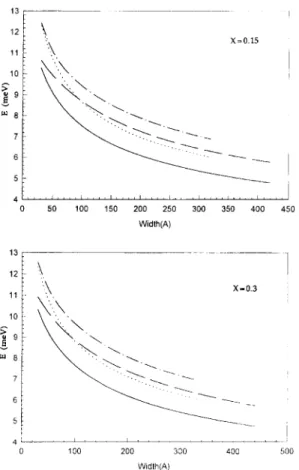
excita- tions of GaAs quantum wells for different Al con- centrations x = 0.15 and 0.3 as a function of the well width L. The physical parameters are adopted from the previous works [16, 17]. The reduced masses in the x - y plane for the heavy hole (J = 3/2) and the light hole (J = 1/2) excitons are taken as 0.04too and 0.051mo respectively.Fig. 1 shows the comparison of the binding ener- gies of the light-hole and heavy-hole excitons with and without the electron-phonon interaction for different well widths. One can see from Fig. 1 that
400 D.-S. Chuu et al. ," Physica B 215 (1995) 397 403 13 12 11 10 m 8 7 6 5 4 13
\
'.' X = 0 . 1 5!
I I I L I I L I , I I I I I I r I , I I , I , , , L I , I , , I * , , , I . . . . J 50 100 150 200 250 300 350 400 450 Width(A) 12 11 10 '~ 9 fi 8 7 6 5 4 0"~
X = 0 , 3 , , i , , i . . . . 100 200 300 400 500 Widlh(A)Fig. 1. The comparison of binding energies of heavy-hole ex- citon and light-hole exciton with and without the polaron effect for AI concentration x = 0.15 and 0.3. Solid (dotted) line is the binding energy of heavy- (light-) hole exciton. Broken (dotted and broken) line is the binding energy of heavy- (light-) hole exciton with surface and bulk phonon effects.
the polaron effect cannot yield pronounced differ- ence for different AI concentrations x. The reason that the exciton binding energies in q u a n t u m wells do not depend significantly on the barrier height may be explained as follows. In our calculation, the effective masses of the electron and hole in Ga~_xAl~As q u a n t u m wells were assumed as m~ = (0.067 + 0.083x)mo, m+ = (0.45 + 0.2x)m0, and m = (0.082 + 0.068x)mo, where m0 is the free- electron mass. These effective masses do not yield pronounced difference for different A1 concentra- tions, which is why our calculated binding energies cannot yield significant difference as x varies from 0.15 to 0.3. F r o m Fig. 1 one can also note that for
18oo ,q:,,, / '(.X . . . electron 1600 ' ~'~, heavy hole ,:, ",X light hole 1400 "'~x • ~ "'.x,,x,,,, 1 2 0 0 ",>, "'%':~v:.. 1000 "--..~.. 5 1 0 1 5 2 0 2 5 3 WIDTH (/~)
Fig. 2. The variation of amplitudes of wave functions of elec- tron, heavy-hole exciton and light-hole exciton as a function of well width.
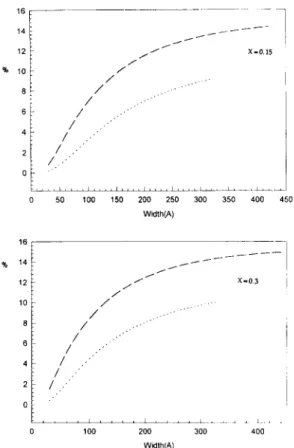
a given value of x, the effect of e l e c t r o n - p h o n o n interaction on either light-hole or heavy-hole ex- citons are significant, especially for larger well width. However, the total binding energy of light- hole exciton including the polaron effect is always larger than that of heavy-hole exciton. Fig. 2 shows the variation of the amplitude of wave function as a function of well width for electron, heavy-hole exciton and light-hole exciton. One can see that the amplitudes decrease with increasing well width. However, for small well width the wave functions for electron or exciton decrease rapidly as well width approaches zero. This is because the leakage of the electron happens as the width becomes very small. Figs. 3 and 4 show the influence of the surface and bulk p h o n o n on the heavy-hole and the light-hole exciton binding energies for AI concen- tration x = 0.15 and 0.3, respectively. Here, the influence is defined as (E* -
Eo)/E*,
where E* and Eo are the exciton binding energies with and with- out the polaron effect. One can see from Figs. 3 and 4 that the AI concentrations cannot yield signifi- cantly different phonon influence on exciton bind- ing energies. Fig. 3 also shows that the surface phonon plays more important role as the well width ranges from 80 A to 100 A. One may also note that the influence of the surface phonon on the binding energy of exciton is small for small well width. The influence becomes important as the well width ranges from 80,~ to 100A and then de- creases again as the well width becomes larger. F o rD.-S. Chuu et al. / Physica B 215 (1995) 397 403 401 / " - . \ / / / / / 5O X=O.15 \ •...-... i , , , , 4 . . . I ~ L ~ , . I . . . . J . . . . [ 100 150 200 250 300 350 400 450 Width(A)
'°I
-
51-
1 4 - - ~ - - - - 12 . ~ " X-O.15 / 10 / . .. f . . - " ~ , L . . . i .... i . . . . 0 50 100 150 200 250 300 350 400 450 Width(A) 6 F sLF
3!
'i 2. 0 / ~ X=0.3 / \ f \ \ / . . . \ , i , , i . . . . i , , , i , 100 200 300 400 Width(A)Fig. 3. The variation of percentage of surface phonon effect on heavy-hole-exciton binding energy (broken line) and light-hole exciton binding energy (dotted line) as a function of the well width L for concentration x = 0.15 a n d 0.3.
% 14 12 10 8 6 4 2 0 J / 1 " J X,0.3 7 I , / J . . . - J . . . " ." J . . . - ' " " / / / - ' i 100 200 300 400 Width(A)
Fig. 4. The variation of bulk phonon effect on heavy-hole- exciton binding energy (broken line) and light-hole-exciton binding energy (dotted line) as a function of the well width L for concentration x = 0.15 a n d 0.3.
larger well width, the surface p h o n o n effect on either the heavy-hole or light-hole exciton becomes almost the same. The reason for the small influence of the surface p h o n o n in narrow quantum well can be explained as follows. For quantum well with finite barrier height, the leakage of wave function out of the well region is much larger for very nar- row well width. This means that there is a larger probability for finding the exciton outside the quantum well and thus makes the interaction be- tween the electron and the surface p h o n o n less pronounced. One can also note that our calculated exciton binding energies do not decrease with the well thickness for very narrow quantum wells as was obtained already by previous works. We can explain this fact as follows. Since in our work we employed a perturbative variational technique
to calculate the binding energy of the exciton, the perturbation term H'(2) contained in Eq. (3) becomes so important that the approximation is no longer valid for very narrow quantum wells. Therefore, in our calculation the exciton binding energies are not able to be reproduced correctly for quantum well with thickness less than 30 A in Fig. 1. Fig. 4 shows that the bulk p h o n o n effect on the binding energy of either light-hole or heavy- hole exciton is small for very narrow quantum well. However, the bulk p h o n o n influence on the exciton binding energy becomes significant as the well width becomes larger and reaches a saturated value of about 14% for very wide quantum well. O n e can also see from Figs. 3 and 4 that the influence of either the surface p h o n o n or bulk p h o n o n on the heavy-hole exciton are always larger than that on
402 D.-S. Chuu et al. / Physica B 215 (1995) 397 403 18 16 14 12 10 8 6 4 2 0 / / J J / / . . . / . . . " ' / . - / / / , 1 .'" / / / , , , i . . . . 50 100 X = 0 . 1 5 4 , , , I . . . . i , , , , i . . . . i . . . . i , , , ~ , . J 150 200 250 300 350 400 450 Width(A) 18:. % 16 I 14[- 10 / J f / J / X = 0 . 3 / . . . . • . . . / . . . - / . . . - " / / / / 100 200 300 400 Wi0th(A)
Fig. 5. The variation of total p h o n o n effect on heavy-hole-ex- citon binding energy (broken line) and light-hole-exciton bind- ing energy (dotted line) as a function of the well width L for concentration x = 0.15 and 0.3.
the light-hole exciton, especially for the influence of surface phonon for very small well width. This is because the effective mass of the heavy hole along z-direction is heavier than that of the light hole, therefore, the heavy hole is bounded more tightly than light hole and yields a smaller interaction range. This in turn yields a larger effect on a small position for the surface phonon. The same reason can be applied to the bulk phonon case. Further- more, although the corrections due to the elec- tron phonon interaction for the heavy- and light- hole excitons differ only slightly in our calculation, the binding energies of light-hole excitons were found to be always larger than those of heavy-hole excitons. This makes the influence of the elec- t r o n - p h o n o n interaction on the heavy-hole exciton
to be always larger. Fig. 5 shows the total influence of the surface phonon and bulk on the binding energies of the light-hole and heavy-hole excitons. The comparison of Figs. 1 and 5 shows that al- though the total binding energy of light-hole ex- citon including the surface and bulk phonon effect is larger than that of the heavy-hole exciton, the polaron effect on the heavy-hole exciton plays more important role than that of light-hole exciton. Fig. 5 also shows that the total phonon effect (including the surface and bulk phonon effects) increases with increasing well width. Our cal- culated percentage of phonon effects reaches a satu- ration value of about 17.5% for heavy-hole exciton and 13.5% for light-hole exciton. Ercelebi [8] studied the electron (hole)-lattice interaction in quantum well and obtained more than 30% phonon effect as the well width becomes larger than 150 A. Their results seem to be overestimated. Degani and Hipolito [9] studied the phonon effect on the binding energy of exciton and obtained a result of 26% to 20% phonon effect as the well width ranges form 10 A to 150 A. Rogers et al. [18] reported the exciton binding energies from low magnetic field measurements. Their observations show that the binding energies are 10 and 8 meV for heavy-hole excitons and are 11 and 9 meV for light-hole excitons fOroquantum wells with thick- ness of 75 ,~ and 100 A, respectively. Table 1 lists the comparison of some available experimental data and the theoretical results of Ercelebi et al. [8] and ours. The values in the parenthesis do not include the e l e c t r o n - p h o n o n effect. One can see from the table that our calculated results for both heavy and light excitons seem to be more reliable while comparing with the results of Ercelebi et al.
4. Summary
In summary, we have studied the optical surface and bulk phonon effects of the exciton binding energy. The results show that the polaronic effects are important and cannot be neglected. Our results manifest that the correction due to polaron effect on the binding energy of heavy-hole exciton is larger than that on the light-hole exciton.
D.-S. Chuu et al. / Physica B 215 (1995) 397-403
Table 1
Comparison of binding energies (meV) of heavy-hole and light-hole excitons
403
Width (,~) x Hole level Experimental data (meV) Our results (meV) Ref. [8]
75 0.4 HI 10.5-11.5 (Ref. [19]) 9.56 (8.34) 75 0.4 Ls 11.3-12.3 (Ref. [19]) 10.45 (9.75) 75 0.35 Ha 10 12 (Ref. [18]), 9.3 (Ref. [6]) 9.43 (8.23) 75 0.35 La 11 (Ref. [18]), 11 (Ref. [6]) 10.31 (9.62) 80 0.15 Ha 9.12 (8.01) 10.60 (9.11) 80 0.15 La 9.92 (9.26) 14.19 (10.73) 80 0.30 Ha 9.34 (8.14) 10.60 (9.11) 80 0.30 La 10.17 (9.39) 14.19 (10.73) 92 0.35 H1 9.5-10.5 (Ref. [19]) 9.01 (7.82) 92 0.35 La 11.2-12.2 (Ref. [19]) 9.80 (9.14) 100 0.35 Ha 13 (Ref. [20]) 8.87 (7.60) 100 0.35 L1 10 (Ref. [19]) 9.63 (8.91) 110 0.35 H~ 8 9.5 (Ref. [18]), 8.4 (Ref. [6]) 8.69 (7.43) 110 0.35 La 9 (Ref. [19]), 11 (Ref. [6]) 9.42 (8.68) 112 0.3 H~ 12 (Ref. [21]) 8.56 (7.29) 112 0.3 La 9.31 (8.56) 120 0.15 Ha 8.31 (7.13) 9.65 (8.06) 120 0.15 L~ 9.01 (8.17) 13.01 (9.37) 120 0.30 Ha 8.46 (7.23) 9.65 (8.06) 120 0.30 La 9.23 (8.32) 13.01 (9.37)
Acknowledgements
T h i s w o r k is p a r t i a l l y s u p p o r t e d b y t h e N a t i o n a l S c i e n c e C o u n c i l o f R O C .References
[1] R.C. Miller, D.A. Kleinman, W.T. Tsang and A.C. Gos- sard, Phys. Rev. B 24 (1981) 1134.
[2] R.L. Greene, K.K. Bajaj and D.E. Phelps, Phys. Rev. B 29 (1984) 1807.
[3] Y. Shinozuka and M. Matsuura, Phys. Rev. B 29 (1984) 3717 (E).
[4] C. Priester, G. Allen and M. Lannoo, Phys. Rev. B 30 (1984) 7302.
[5] G.D. Sanders and Y.C. Chang, Phys. Rev. B 31 (1985) 6892.
[6] U. Ekenberg and M. Altarelli, Phys. Rev. B 35 (1987) 7585. [7] T.F. Jiang and D.S. Chuu, Physica B 164 (1990) 287. [8] A. Ercelebi and U. Ozdincer, Solid State Commun. 57
(1986) 441.
[9] M.H. Degani and O. Hip61ito, Phys. Rev. B 35 (1988) 4507.
[10] X. X. Liang and X. Wang, Phys. Rev. B 43 (1991-II) 5155. [11] K.T. Tsen, K.R. Wald, T. Ruf, P.Y. Yu and H. Morkoc,
Phys. Rev. Lett. 67 (1991) 2557.
[123 H. Riicker, E. Molinari and P. Lugli, Phys. Rev. B 44 (1991-I) 3463.
[133 Y.C. Lee, M.N. Mei and K.C. Liu, J. Phys. C 15 (1982) L469.
[143 T.D. Lee, F.E. Low and D. Pines, Phys. Rev. 90 (1953) 297. [15] M. Abramowitz and I.A. Stegun (eds.), Handbook of
Mathematical Functions (Dover, New York, 1965). [16] K.K. Bajaj and C.H. Aldrich, Solid State Commun. 35
(1980) 163.
[17] A. Baldereschi and N.O. Lipari, Phys. Rev. B 3 (1971) 439. [18] D.C. Rogers, J. Singleton, R.J. Nicholas, C.T. Foxon and
K. Woodbridge, Phys. Rev. B 34 (1986) 4002.
[19] P. Dawson, K.J. Moore, G. Duggan, H.I. Ralph and C.T. Foxon, Phys. Rev. B 34 (1986) 6007.
[20] J.C. Maan, G. Belle, A. Fasolino, M Altrarelli and K. Ploog, Phys. Rev. B 30 (1984) 2253.
[21] S. Tarucha, H. Okamoto, Y. lwasa and N. Miura, Solid State Commun. 52 (1984) 815.