Mechanical Properties, Morphology, and Crystallization Behavior of Polypropylene /Elastomer/Talc Composites
Jyh-Horng Wu,1 Chien-Wen Chen,2 Yao-Tsu Wu,1 Guan-Ting Wu,2 M.C. Kuo,2 Yuhsin Tsai3
1Green Energy & Eco-Technology Center, Industrial Technology Research Institute, Tainan 70955, Taiwan, ROC
2Department of Materials Engineering, Kun Shan University, Tainan 71003, Taiwan, ROC
3Graduate Institute of Chinese Medicine, China Medical University, Taichung 40402, Taiwan, ROC INTRODUCTION
Polypropylene (PP) is one of the most widely used general plastics and has been employed in the construction, automotive, cable insulation, and household goods industries. In addition to good insulating properties, PP resin has suitable properties for processing, stress crack resistance, and chemical resistance [1–3]. However, the poor impact toughness at room temperature or low temperatures restricts industrial applications of PP. Several studies have been conducted in past decades to improve the impact resistance of PP. Blending PP with elastomers such as ethylene–propylene copolymers [4–7] and ethylene–propylene– diene–monomers (EPDMs) [8–12] can effectively increase the fractural toughness of the resulting PP blends.
Recently used to toughen PP, ethylene–octene copolymers (POE) demonstrate a high toughening efficiency and are easier to process than EPDMs are [3, 13–16]. Yang et al. [17] fabricated a PP/POE (80/20) blend and reported that the notched Izod impact strength of the blend at 23C was as high as 6.0 kJ/m2. They also observed brittle– ductile transition beh6avior during impact and highspeed tensile tests. Liang [2] found that Young’s modulus and tensile strength of the PP/POE blends declined nonlinearly with increases in the POE weight fraction, whereas the V-notched impact fracture strength increased nonlinearly with the POE weight fraction. Tang et al. [3] meltblended a polypropylene random copolymer (PP-R) with a POE copolymer by using a twin-screw extruder to fabricate super-toughened PP-R/POE blends. These blends can easily yield an Izod impact strength of 500 J/m with the addition of only 10 wt% of POE, whereas neat PP-R yielded an impact strength of 180 J/m. Xu et al. [18, 19] fabricated PP/POE (80/20) blends in a rubber mixer. A wellestablished droplet/matrix morphology formed during the initial mixing, and during the dispersed phase (POE), the domain deformed from a spherical droplet into elliptical
droplet, even exhibiting a fibril or sheet morphology as the rotor speed increased.
Alternatively, nano-sized inorganic fillers can also effectively toughen PP. Chan and coworkers [20–22] used the surface-modified calcium carbonate nanoparticles (70 nm) to toughen isotactic polypropylene (iPP) and determined that the notched Izod impact strength of the PP/ CaCO3 nanocomposites containing 20 wt% of CaCO3 nanoparticles was approximately 370 J/m, whereas the impact strength of unfilled PP was 50 J/m. As expected, in PP/CaCO3 nanocomposites, the nanoparticles exhibited good nucleating effects, which increased the crystallization temperature and the average lamellar thickness. In addition, Chan and coworkers [22] suggested that intensive ligament stretching after the nanoparticles were debonded was responsible for the substantial increase in the impact toughness of annealed PP/CaCO3 nanocomposites. Other inorganic fillers, such as organoclay [23], multiwall carbon nanotubes, carbon black [24], barium sulfate (BaSO4) [25], and magnesium hydroxide (Mg(OH)2) [26], were used to fill PP and impart the functional performances to the resulting PP composites.
PP/elastomer/inorganic-filler ternary composites can increase the toughness of PP and possess outstanding mechanical properties. Premphet-Sirisinha and Preechachon [27] used calcium carbonate (CaCO3), which had an average particle size of 5.3 mm, and a maleic anhydride (MA)-grafted ethylene– octene elastomer (EOR-MA) to toughen PP. PP/EOR/CaCO3 (60/20/20) composites with varying MA
contents (0.5–1.5 wt%) exhibited a Young’s modulus ranging from 1.18 to 1.22 GPa, and that of neat PP was 1.69 GPa. However, the failure energies of the PP/EOR/CaCO3 (60/20/20) composites were as high as 107– 167 J/m, and that of neat PP was 31.3 J/m. Chen et al. [26] fabricated PP/POE/magnesium hydroxyl ternary composites and found that the resulting composites, which had a POE content of 15–30 phr, exhibited a ductile region during impact strength testing.
Talc particles are inorganic and inexpensive fillers used as polymer additives for reinforcement. In this study, talc particles were employed as alternative fillers to toughen PP polymer. PP/POE/micro-talc (MT) composites were designed for automobile bumper application to improve the flexural toughness and heat deflection temperature. For the simplicity of processing, chemical modifications or grafts were not applied to the components of PP/POE/MT composites, which are different from those of PP/CaCO3 [20–22] and PP/EOR/CaCO3 [27] composites. POE copolymers with varying melt flow index (MFI) values were selected to toughen the PP polymer, and talc powders with an average particle size of 20–25 mm were used to improve the mechanical properties and heat deflection temperature of PP/POE blends. In addition, the thermomechanical properties, morphologies, and crystallization behaviors were identified to evaluate the performances of PP blends and composites.
EXPERIMENTAL Materials
PP (grade K3029) obtained from local manufacturer in the Formosa Chemical & Fibre Corporation and was used as a matrix material for the preparation of the composites. The PP was in the form of impact copolymer pellets with MFI of 32 g/10 min. The commercial grades of POE elastomers Engage 8150 (MFI, 0.5 g/10 min), Engage 8137 (MFI, 15 g/10 min), and Engage 8407 (MFI, 30 g/10 min) were purchased from DOW Chemical (USA). The different particle sizes of talc P1250 (25 mm), talc P3000 (20 mm), and MT (20 mm) were purchased from Jatery Chemical, Taiwan.
Sample Preparation
The PP/POE/MT composites (Table 1) were extruded at temperatures ranging from 170 to 190C by a twin screw (Werner and Pflederer, Model-ZSK 26 MEGA compounder) using a screw speed of 500 rpm to form the PP composite pellets. The test specimens for mechanical properties and heat deflection
temperature were prepared by injection molding. Measurements of Mechanical Properties and Heat Deflection Temperature
Tensile strength and elongation at break were measured by a Universal Tensile Tester with a tension velocity of 25 mm/min in compliance with the specifications of ASTM D638. The three-point flexure tests were performed using a Universal Tensile Tester at a crosshead speed of 2 mm/min according to ASTM D 790. Notched Izod impact tests were carried out at ambient conditions according to the ASTM D256. The heat deflection temperature (HDT) was determined according to the ASTM D 648.
Dynamic Mechanical Property Analysis
Dynamic mechanical data were obtained using a dynamic mechanical analysis (DMA) instrument (TA Q800) with the following parameters: frequency, 1 Hz; scan rate, 5C/min, and temperature range, 2100 to
50oC.
Morphological Analysis
Morphology was evaluated using a JEOL JSM6360 Scanning Electron Microscope (SEM). The sample was fractured under cryogenic conditions using liquid nitrogen and immersed in heptane to dissolve elastomer at ambient temperature for 24 h and dried to remove the solvent. Before observation, the gold was sputtered onto the sample surface and an SEM was used to examine the sample.
Petrographic Microscope Observations
A Zeiss Axioskop 40A petrographic microscope was used to observe the spherulite morphologies of PP/ Engage/talc composites. A thin piece of sample was sandwiched between two glass cover slips and placed on a digital hot-stage under nitrogen atmosphere. The hot-stage was rapidly heated to 200C at 20 C/min and held for 5 min to erase the thermal history of specimens. Then, the PP/elastomer/MT composite melt was quenched to the ambient temperature to observe spherulite morphology.
Differential Scanning Calorimetry Measurement
A TA differential scanning calorimeter (TA Q2000) was applied to investigate the isothermal
crystallization behaviors of PP/POE/MT composites. The sample was heated up to 200C at a rate of 10C/min under nitrogen atmosphere. At 200C, this sample was held for 5 min to remove the previous thermal history, and then it was quenched to the predetermined temperatures (142, 146, and 150C) to undergo isothermal crystallization process.
RESULTS AND DISCUSSION Mechanical Properties
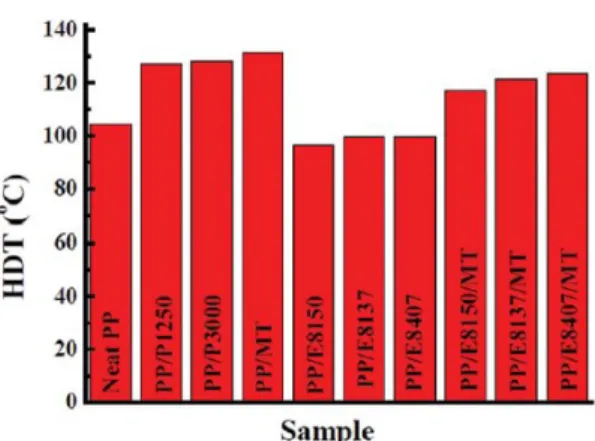
In this subsection, we focus on the mechanical properties and heat deflection temperatures of binary and ternary PP composites, including PP/talc, PP/POE blends, and PP/POE/MT composites. The studied mechanical properties were tensile and flexural properties as well as the notched Izod impact strength. Recipes for the PP composites are summarized in Table 1. Table 2 and Fig. 1 show the mechanical properties and heat deflection temperatures of the resulting PP composites, respectively. As stated in EXPERIMENTAL section, the particle sizes of talc P1250, talc P3000, and MT were 25, 20, and <20 mm, respectively. The inclusion of MT slightly increased the tensile strength, but also substantially reduced the elongation at break (eb) of the PP/talc composites. The values of eb decreased substantially from 363.1% for neat PP to 84.6% for PP/MT composites. Furthermore, the notched Izod impact strength of the PP/talc composites decreased substantially compared with that of neat PP. However, the flexural properties and heat deflection temperatures showed considerable improvement. The increases in the flexural modulus and HDT of the PP/MT composite were 142% and 27.2C respectively, compared with those of neat PP. Excluding the elongation at break and impact strength, relatively finer talc particles led to greater improvements in tensile strength, flexural properties, and HDT.
Regarding the effect that POE elastomers on the mechanical properties of PP polymer, Engage 8150 (MFI, 0.5 g/10 min), Engage 8137 (MFI, 15 g/10 min), and Engage 8407 (MFI, 30 g/10 min) can significantly and greatly increase the elongation at break and impact strength of PP/POE blends. The eb values for the blends were as high as 630–695%, with the increases ranging from 74 to 91% compared with that of neat PP. This suggests that POE copolymers can increase the PP matrix ductility. In addition, POE elastomers improved the Izod impact strength of the PP matrix. In this study, the Izod impact strength of neat PP was 36.3 kJ/m2, and that of the PP/POE blends was 59.7–63.5 kJ/m2, which is an increase of 64–75%. The MFI value exhibited less effect on the impact strength of the PP/POE blends. Liang [2] used a POE (Engage 8180,
MFI, 10 g/10 min) to toughen PP (MFI, 10 g/10 min). The PP/POE blend improved the Izod impact strength from 1.9 kJ/m2 for neat PP to 3.1 kJ/m2 for the PP/POE blend at 10 phr of Engage 8180, which is an
increase of 63%. Bai et al. [28] prepared PP/POE blends and found that the MFI values of PP and POE were 2.5 and 11.0 g/10 min, respectively. Furthermore, POE copolymer increased the Izod impact strength from 4.5 kJ/m2 for neat PP to 9.0 kJ/m2 for the PP/POE (90/10) blend. Yang et al. [17] proposed that a PP/POE (90/10) blend, which exhibited MFI values for PP and POE (Engage 8210) of 10.0 g/10 min, increased the Izod impact strength from 2.5 kJ/m2 for neat PP to 4.7 kJ/m2 for the PP/POE blend, which is an increase of 88%. In addition to increasing the ductility of PP/POE blends, blending PP with POE elastomers reduces the tensile strength, flexural properties, and HDT compared with those of neat PP.
As stated previously, the inclusion of talc particles improved the flexural properties and HDT of PP/talc composites, but deteriorated the elongation at break and impact strength. In addition, except for the elongation at break, the MT-filled PP composite (PP/MT) exhibited superior performances in tensile strength, flexural properties, impact strength, and HDT compared with the PP/P1250 and PP/ P3000 composites. Blending PP with POE elastomers improved the ductility and impact strength but reduced the tensile strength, flexural properties, and HDT. Accordingly, a compromise may exist in which the optimum combination of PP, MT particles, and POE copolymers may improve the flexural properties, impact strength, and HDT of PP/POE/MT composites. Based on this strategy, we fabricated PP/POE/MT composites by using Engage 8150, Engage 8137, and Engage 8407 as the POE copolymers, and the MT and POE contents in the composites were 25 and 15 phr, respectively. As summarized in Table 2, the PP/POE/MT composites
exhibited increased flexural properties, impact strength, and HDT. The increases in impact strength and HDT were 55–65% and 13–19.2C, respectively, compared with those of neat PP.
Thermomechanical Properties
To investigate the effects that talc fillers and POE elastomers have the dynamic mechanical properties of the resulting PP composites, a DMA instrument (TA Q800) was employed to identify the
thermomechanical properties, including the storage modulus and Tan d (damping factor) of the PP composites as shown in Fig. 2. The inclusion of MT particles increased the storage modulus of PP/talc composites compared with that of neat PP, and finer talc particles exhibited a higher storage modulus value. The talc particles increased the storage modulus from 1,233 MPa for neat PP to 2,274 MPa for MT-filled PP composites at 25C, which is an increase of 84.4%. In contrast, the inclusion of POE elastomers reduced the storage modulus of PP/POE blends by approximately 903 MPa for all PP/POE blends.
As expected, the inclusion of MT in the PP/POE blend increased the storage modulus from 903 MPa to as high as 1,781 MPa. The trends of thermomechanical measurements are consistent with the mechanical properties discussed previously. As reported, fillers with a 44-mm nominal diameter in PVAc increased the peak value of the Tan d spectrum [29, 30]. However, nanofillers simultaneously increased the bulk modulus and reduced the damping factor (Tan d) of the resulting polymer nanocomposites [29–32]. The inclusion of nano-silica in PLA increased both Young’s modulus and storage modulus, and simultaneously reduced the damping factor [33]. In this study, MT particles not only increased the storage modulus (Fig. 2a) of the PP polymer but also slightly improved the damping factor (Tan d) as shown in Fig. 2b of the resulting PP/ MT composite. This finding is consistent with those of PVAc composites. Notably, the storage modulus of PP/POE/MT was as high as 1,781 MPa, and its Tan d value considerably exceeded that of neat PP, indicating that the inclusion of a POE elastomer substantially improves the damping properties of neat PP.
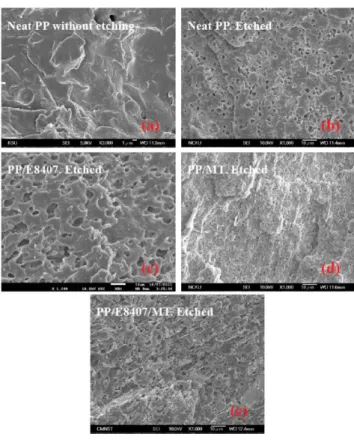
To investigate the distributions of POE elastomer and talc particles, SEM was adopted to evaluate the surface morphologies of the neat PP and PP/POE blends, as well as the PP/POE/MT composite. Before observing the morphology, fractured samples were immersed in heptane to dissolve the elastomer. Figure 3 shows SEM images of the neat PP and PP/POE blends, and the PP/POE/MT composite. Figure 3a shows neat PP that was not etched with heptane and Fig. 3b shows neat PP that was etched with heptane. The voids shown in Fig. 3b resulted from the copolymer in neat PP. As-purchased PP contains this copolymer, which may cause the PP polymer to be more ductile than the regular PP polymer is. Voids in the PP matrix were considerably larger than those in neat PP when POE copolymers were incorporated as shown in Fig. 3(c). The distribution of the POE copolymer in neat PP was extremely homogeneous. Saroop and Mathur [35] used a butadiene styrene block copolymer (SBS) to toughen iPP and found that SBS droplets dissolve, leaving black voids in PP/SBS blends [34]. The same occurrence was observed for HDPE/NBR blends. The surface morphology of the examined PP/ POE blends was similar to that of the PP/SBS blends. Regarding the morphology, incorporating MT particles substantially reduced the dimensions of voids in neat PP and PP/POE blends as shown in Fig. 3d and e. Reduction of the void dimension substantially increased the microcrack length when the PP blends and composites were subjected to external force as shown in Fig. 4. Accordingly, the toughness, ductility, and even bulk modulus of PP/POE/MT composites can be greatly improved. The findings indicated in morphological observations of PP/POE blends and PP/POE/MT composites are consistent with their mechanical properties.
Isothermal Crystallization Behavior
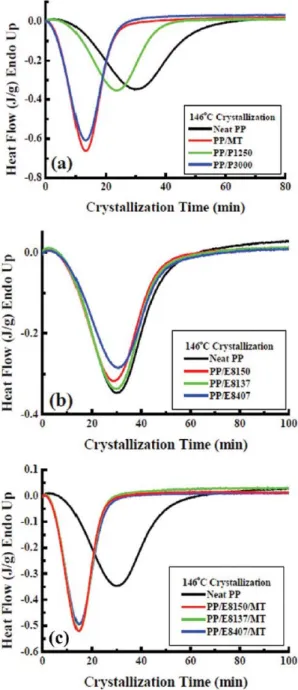
The isothermal crystallization of the neat PP, PP/POE blends, and PP/POE/MT composites was conducted using differential scanning calorimetry (DSC) at the predetermined temperatures of 142, 146, and 150C. Figure 5 shows the melt-crystallization DSC traces. As shown in Fig. 5, the crystallization
enthalpies (DHc) and peak crystallization times (sp) of the neat PP and its composites were determined. In addition, the absolute crystallinities (Xc) of the neat PP and its composites can be estimated by using the heat of fusion of an infinitely thick PP crystal, DHof [32, 36]:
Xc= [ DHc /(DHof X Wpolymer)] X 100 (1)
where DHof is approximately 209.2 J/g [37], and Wpolymer is the weight fraction of the polymer matrix. These crystallization parameters, including the peak crystallization time and absolute crystallinity, are listed in Table 3.
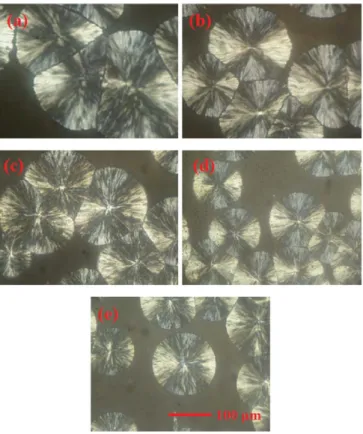
The inclusion of talc particles (including P1250, P3000, and MT) increased the crystallinities of the PP/ talc composites. Finer talc particles introduced additional crystallization sites for depositing PP molecules; consequently, the crystallinities of PP/P1250, PP/P3000, and PP/MT at 150C were 48.0, 49.2, and 52.6%, respectively, which are higher than that of neat PP (46.7%). MT particles may induce heterogeneous nucleation during isothermal crystallization and considerably reduce the sp values and crystallinities of PP/talc composites compared with that of neat PP. In addition, finer talc particles provide additional possibilities for the PP/ talc composites to undergo heterogeneous nucleation. As a result, the sp values of PP/P3000 and PP/MT composites declined compared with that of PP/P1250. Conversely, blending PP with POE copolymers reduced the crystallinity of the PP matrix because relatively fewer crystallization sites were available. As the event occurred in PP/talc composites, the inclusion of MT particles in PP/POE blends increased the crystallinity of the PP matrix and reduced the crystallization times of the blends. Thus, MT particles may serve the same function as PP/talc composites do, namely, heterogeneous nucleation. Morphologically, the dimension of PP spherulites declined continuously from approximately 250 mm for
neat PP to 150 mm for the PP/E8407/MT composite as shown in Fig. 6. This suggests that MT increased the crystallization sites and reduced the spherulite dimension of the PP/E8407/MT composite during
crystallization. Although talc particles increased both the crystallization sites and the crystallinities, they also decreased the spherulite dimension of the PP/talc composites.
The crystallization behavior of the PP/talc and PP/POE/MT composites may reflect the mechanical properties of PP composites. In this study, the inclusion of talc particles increased the tensile strength and flexural properties of PP/talc composites at the expense of reducing the elongation at break and notched impact strength. However, blending PP with POE elastomers yielded opposite effects. Increases in the tensile and flexural properties may result primarily from the stiffness of the talc particles introduced, but increases in the crystallinity of PP/talc composites can contribute to improving the tensile and flexural properties. As summarized in Table 3, the tertiary composites of PP/POE/MT effectively and practically increased the crystallization rates and crystallinities of the resulting composites. They also exhibited
excellent performances regarding mechanical properties and HDT, which indicates that PP composites with excellent mechanical properties and high impact strength can be fabricated rapidly by including MT
particles. CONCLUSIONS
The inclusion of talc particles in the PP matrix improved the tensile strength, flexural properties, and heat deflection temperature of the resulting PP composites, but reduced the elongation at break and notched impact strength. As expected, adding POE elastomers to the PP matrix yielded the opposite effect to that of PP/talc composites. However, PP/POE/MT composites were successfully fabricated. The MT particles in ternary composites induced heterogeneous nucleation and considerably reduced the
crystallization time during processing. In addition to simple and rapid processing, PP/POE/MT composites exhibited excellent flexural properties, notched impact strength, and HDT compared with neat PP and PP/POE blends.
REFERENCES
1. J.Z. Liang, J. Appl. Polym. Sci., 83, 1547 (2002). 2. J.Z. Liang, J. Polym. Environ., 20, 872 (2012).
3. W. Tang, J. Tang, H. Yuan, and R. Jin, J. Appl. Polym. Sci., 122, 461 (2011). 4. W.Y. Chiu and S.J. Fang, J. Appl. Polym. Sci., 30, 1473 (1985).
5. H.P. Blom, J.W. Teh, and A. Rudin, J. Appl. Polym. Sci., 58, 995 (1995).
6. G.M. Kim, G.H. Michler, M. Gahleitner, and J. Fiebig, J. Appl. Polym. Sci., 60, 1391 (1996). 7. I. Kotter, W. Grellman, T. Koch, and S. Seidler, J. Appl. Polym. Sci., 100, 3364 (2006). 8. V. Choudhary, H.S. Varma, and I.K. Varma, Polymer, 32, 2534 (1991).
9. A. van der Wal, R. Nijhof, and R.J. Gaymans, Polymer, 40, 6031 (1999). 10. A. van der Wal, R. Nijhof, and R.J. Gaymans, Polymer, 40, 6045 (1999). 11. W. Jiang, S.C. Tjong, and R.K.Y. Li, Polymer, 41, 3479 (2000).
12. W. Jiang, D.H. Yu, L.J. An, and B.Z. Jiang, J. Polym. Sci. B: Polym. Phys., 42, 1433 (2004).
13. T. McNally, P. McShane, G.M. Nally, W.R. Murphy, M. Cook, and A. Miller, Polymer, 43, 3785 (2002). 14. C.H. Hong, Y.B. Lee, J.W. Bae, J.Y. Jho, B.U. Nam, D.H. Chang, S.H. Yoon, and K.J. Lee, J. Appl. Polym. Sci., 97, 2311 (2005).
16. A.L.N. da Silva, M.I.B. Tavares, D.P. Politano, F.M.B. Coutinho, and M.C.G. Rocha, J. Appl. Polym. Sci., 66, 2005 (1997).
17. J. Yang, Y. Zhang, and Y.X. Zhang, Polymer, 44, 5027 (2003).
18. X. Xu, X. Yan, T. Zhu, C. Zhang, and J. Sheng, Polym. Bull., 58, 465 (2007). 19. X. Xu, T. Zhu, L. Zhu, N. Song, and J. Sheng, Polym. Int., 58, 465 (2007). 20. Y. Lin, H. Chen, C.M. Chan, and J. Wu, Polymer, 51, 3277 (2010). 21. C.M. Chan, J. Wu, J.X. Li, and Y.K. Cheung, Polymer, 43, 2981 (2002). 22. Y. Lin, H. Chen, C.M. Chan, and J. Wu, Macromolecules, 41, 9204 (2008).
23. A. Chafidz, I. Ali, M.E. Ali Mohsin, R. Elleithy, and S. Al- Zahrani, J. Polym. Res., 19, 9906 (2012). 24. S. Hom, A.R. Bhattacharyya, R.A. Khare, A.R. Kulkarni, M. Saroop, and A. Biswas, Polym. Eng. Sci., 49, 1502 (2009).
25. Z. Li, S. Guo, W. Song, and B. Hou, J. Mater. Sci., 38, 1793 (2003).
26. X. Chen, J. Yu, Z. Luo, S. Guo, M. He, and Z. Zhou, Polym. Adv. Technol., 22, 657 (2011). 27. K. Premphet-Sirisinha and I. Preechachon, J. Appl. Polym. Sci., 89, 3557 (2003).
28. H. Bai, Y. Wang, B. Song, and L. Han, J. Appl. Polym. Sci., 108, 3270 (2008). 29. G. Tsagaropoulos and A. Eisenberg, Macromolecules, 28, 396 (1995). 30. G. Tsagaropoulos and A. Eisenberg, Macromolecules, 28, 6067 (1995).
31. V. Arrighi, I.J. McEwen, H. Qian, and M.B. Serrano Prieto, Polymer, 44, 6259 (2003). 32. S.S. Ray, K. Yamada, M. Okamoto, and K. Ueda, Polymer, 44, 857 (2003).
33. J.H. Wu, M.S. Yen, M.C. Kuo, and B.H. Chen, Mater. Chem. Phys., 142, 726 (2013). 34. M. Saroop and G.N. Mathur, J. Appl. Polym. Sci., 65, 2691 (1997).
35. J. George, K.T. Varughese, and S. Thomas, Polymer, 41, 1507 (2000).
36. J.H. Wu, M.S. Yen, C.W. Chen, M.C. Kuo, F.K. Tsai, J.S. Kuo, L.H. Yang, and J.C. Huang, J. Appl. Polym. Sci., 125, 494 (2012).
37. R.A. Phillips, M.D. Wolkowicz, and E.P. Moore, Polypropylene Handbook, Hanser, Munich (1996).
FIG. 1. The heat deflection temperatures (HDT) of the neat PP, PP/talc composites, PP/POE blends, and PP/POE/MT composites.
FIG. 2. (a) Storage modulus and (b) Tan d of PP/elastomer/talc composites.
FIG. 3. Morphologies of the (a) neat PP, (b) PP etched by heptane, (c) PP/POE blend, (d) PP/MT composite, and (e) PP/POE/MT composite. The POE copolymer in (c) and (d) is Engage 8407. Except for (a), all the fractured surfaces were etched by heptane before SEM observations.
FIG. 4. Illustrative models for the fractured surfaces of the (a) PP/POE blend and (b) PP/POE/MT composite.
FIG. 5. DSC traces of the (a) PP/talc composites, (b) PP/POE blends, and (c) PP/POE/MT composites isothermal crystallization at 146oC.
FIG. 6. The spherulite dimensions of neat PP and its composites at 146C for 4 min. The spherulite
dimensions for the (a) neat PP, (b) PP/P1250, (c) PP/P3000, (d) PP/MT, and (e) PP/E8407/MT composites are approximately 250, 200, 230, 190, and 150 mm, respectively.