Fast tunable laser based on Fabry-Perot lasers
with optical injection
Chien-Hung Yeh Chien-Chung Lee Sien Chi
National Chiao Tung University Institute of Electro-Optical Engineering 1001 Ta-Hsueh Road
Hsinchu, Taiwan, 30050
E-mail: [email protected]
Abstract. We have proposed and experimentally demonstrated a new tunable laser structure, which is based on Fabry-Perot (FP) lasers with external lightwave injection. The wavelength tuning can be obtained by adjusting the bias currents of FP lasers. The wavelength tuning time of
⬍2 ns, 3.3-nm tuning range, and the side-mode suppression ratio (SMSR) of⬎19 dB have been achieved experimentally. In addition, the SMSR performance has also been investigated. This tunable laser has the advantage of simple architecture, potentially low cost, data direct modulation, and fast wavelength tuning, and is expected to benefit the applications of fast wavelength tuning. © 2004 Society of Photo-Optical Instru-mentation Engineers. [DOI: 10.1117/1.1668281]
Subject terms: Fabry-Perot lasers; wavelength-tunable; optical switching. Paper 030357 received Jul. 22, 2003; revised manuscript received Oct. 28, 2003; accepted for publication Nov. 3, 2003.
1 Introduction
Tunable lasers have been proposed to act as high-speed and wavelength selective light sources on wavelength division multiplexing 共WDM兲 and optical switching systems. Fast tunable light sources can play a key role in photonic switching networks. Recently, several research findings for fast tunable lasers have been reported, such as the rear sampled grating reflector 共GCSR兲 laser with quasi-continuous grating assisted co-directional coupler,1,2 and sample grating共SG兲 or super structure grating 共SSG兲 dis-tributed Bragg reflector共DBR兲 lasers.3–5In this paper, we have proposed and demonstrated a new fast tunable tech-nique based on Fabry-Perot共FP兲 lasers with optical injec-tion. The performances of side-mode suppression ratio 共SMSR兲 and the response time for wavelength tuning have also been studied. Compared with other wavelength-tuning techniques,1–5 this tunable laser has the advantage of simple architecture, potentially low cost, data direct modu-lation, and fast wavelength tuning, and is expected to ben-efit the applications of fast wavelength tuning.
2 Experiments
Figure 1 shows the experimental setup of the proposed tun-able laser. The FP laser, LD-1, in the left side provides the optical injection to the FP lasers LD-2 and LD-3 in the right side. The lightwave from LD-1 passes through an optical circulator 共OC兲 and is injected into LD-2 and LD-3 by a 1⫻2 optical coupler. All the FP lasers used have similar output spectra with 1.12-nm mode spacing and 20-dB bandwidth of 10 nm. The optical spectrum of this tunable laser can be observed at position ‘‘a’’ in Fig. 1 by using an optical spectrum analyzer 共OSA兲. To measure the perfor-mance of the SMSR of this proposed laser, a variable opti-cal attenuator 共VOA兲 is placed in front of LD-1 to adjust various power levels of injection light. To investigate wave-length tuning response, the tunable laser output is con-verted into the electrical domain by two optic-to-electric
共O/E兲 converters after passing through an erbium-doped fi-ber amplifier to compensate the device loss, and a 1⫻2 optical coupler and two dense wavelength-division multi-plexing demultiplexers for wavelength filtering. The elec-trical signals are measured by a digital scope with 20-GHz bandwidth and the response time for wavelength tuning can also be observed.
3 Results and Disscussions
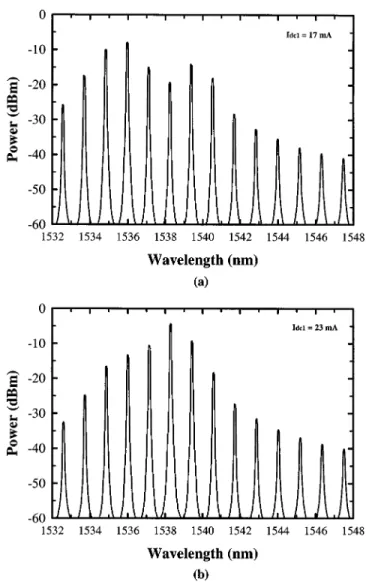
The wavelength of the proposed tunable laser can be tuned by controlling the bias currents of the FP lasers in Fig. 1. Different bias currents will produce various output spectra for FP lasers. By properly selecting bias current settings for the optical injection source共LD-1兲 and host sources 共LD-2 and LD-3兲, different single-frequency spectra can be ob-tained. The operating current ranges of these LDs were all between 10 mA to 30 mA, respectively. The central wave-lengths of these LDs were different and the tuning ranges were near 5 nm. Figures 2共a兲 and 2共b兲 show the original spectra of LD-1 without optical injection when Idc1⫽17 and 23 mA, respectively. Figure 3共a兲 shows the optical spectra of the proposed tunable laser without optical injec-tion. The operation condition of the FP lasers in Fig. 3共a兲 are Idc1⫽0 mA, Idc2⫽17 mA, and Idc3⫽0 mA and Idc1 ⫽0 mA, Idc2⫽0 mA, and Idc3⫽14 mA. The multi-mode spectra are observed when no external light is injected. When optical injection is added, this tunable laser can be operated in single-frequency mode. Figure 3共b兲 shows the optical spectra of the tunable laser for wavelengths operat-ing from 1 to 4, which represents the optical wave-lengths at 1537.64, 1538.63, 1539.74, and 1540.93 nm, re-spectively. The operation conditions of the FP lasers are Idc1⫽17 mA, Idc2⫽0 mA, and Idc3⫽14 mA, for 1; Idc1 ⫽17 mA, Idc2⫽17 mA, and Idc3⫽0 mA for 2; Idc1 ⫽23 mA, Idc2⫽0 mA, and Idc3⫽14 mA for 3; Idc1 ⫽23 mA, Idc2⫽17 mA, and Idc3⫽0 mA for 4. The output 812 Opt. Eng. 43(4) 812–815 (April 2004) 0091-3286/2004/$15.00 © 2004 Society of Photo-Optical Instrumentation Engineers Downloaded From: http://opticalengineering.spiedigitallibrary.org/ on 04/27/2014 Terms of Use: http://spiedl.org/terms
powers for wavelengths from1 to4 are ⫺11.9, ⫺12.3, ⫺12.8, and ⫺12.4 dBm, and the power variation from 1 to 4 is less than 0.9 dB. From Fig. 3共b兲, the SMSR of ⬎19 dB and the tunable range of 3.3 nm are achieved. The circuit model共or rate equations兲6,7for the Fabry-Perot laser has been reported. When the bias current is increased, the output power increases and the central wavelength of the FP laser shifts to the longer wavelength. Therefore, the single and tunable frequency output of this proposed laser depended on the photon competition to the FP laser with optical injection.
To investigate the SMSR performance, the SMSR versus different power level of optical injection are measured as shown in Fig. 4. The injected power needs to be large enough to dominate the optical amplification in the host FP laser for single-frequency operation. Therefore, the lower power level of injection lightwave will result in SMSR deg-radation for this proposed tunable laser. However, too high a level of injection light will not increase the SMSR due to the gain saturation of host FP lasers. Besides, it should be noted that the minimal injection powers of⫺13.5 dBm are needed to keep the SMSR⬎19 dB from Fig. 4. During three hours of observation, the variation of output light was less than 0.1 dB for this proposed laser.
The response time for wavelength tuning can be inves-tigated by using the experimental setup shown in Fig. 1. To measure the response time for wavelength switching from 2to4, LD-1 is modulated by a negative pulse signal and operated at bias current of 17 mA and 23 mA for low and high levels. Due to the bandwidth limitation of the signal generator used, the applied pulse signal has pulse width of 6.8 ns and rising/falling time of 5 ns. As shown in Fig. 5, the effective response time of less than 2 ns is observed for wavelength switching from2 to4.
4 Conculsion
In summary, a new tunable laser structure, which is based on FP lasers with external lightwave injection, has been
Fig. 1 Experimental setup of the proposed tunable laser.
Fig. 2 Original spectra of LD-1 without optical injection when Idc1
⫽17 and 23 mA, respectively. Yeh, Lee, and Chi: Fast tunable laser . . .
813 Optical Engineering, Vol. 43 No. 4, April 2004
proposed and experimentally demonstrated. The wave-length tuning can be obtained by adjusting the bias currents of FP lasers. The wavelength tuning time of ⬍2 ns, the 3.3-nm tuning range, and the SMSR of⬎19 dB have been achieved experimentally. In addition, the SMSR perfor-mance has also been investigated. This tunable laser has the advantages of simple architecture, potentially low cost, data direct modulation, and fast wavelength tuning, and is ex-pected to benefit the applications of fast wavelength tuning.
Acknowledgments
This work was supported in part by the Academic Excel-lence Program of R.O.C. Ministry of Education under Con-tract 89-E-FA06-1-4-90X023, and the National Science Council of R.O.C. under Contract NSC-92-2215-E-009-008. The authors would like to thank Mr. Y.-W. Hsu and H.-Y. Sung for help with the experiments.
References
1. Y. Fukashir, K. Shrikhande, M. Avenarius, M. S. Rogge, I. M. White, D. Wonglumsom, and L. G. Kazovsky, ‘‘Fast and fine wavelength tuning of a GCSR laser using a digitally controlled driver,’’ in Digest OFC 2000 2, 338 –348共2000兲.
2. Y. Gustafsson, S. Hammerfeldt, J. Hammersberg, M. Hassler, T. Hor-man, M. Isaksson, J. Karlsson, D. E. Larsson, O. D. Larsson, L. Lun-dqvist, T. Lundstrom, M. Rask, P.-J. Rigole, E. Runeland, A. Saave-dra, G. Sarlet, R. Siljan, ‘‘Record output power 共25 mW兲 across C-band from widely tunable GCSR lasers without additional SOA,’’ Electron. Lett. 39共3兲, 292–293 共2003兲.
3. I. A. Avrutsky, D. S. Ellis, A. Tager, H. Anis, and J. M. Xu, ‘‘Design of widely tunable semiconductor lasers and the concept of binary superimposed gratings 共BSGs兲,’’ IEEE J. Quantum Electron. 34共4兲, 729–741共1998兲.
4. P. J. Rigole, S. Nilsson, L. Ba¨ckbom, T. Klinga, J. Wallin, B. Sta˚l-nacke, E. Berglind, and B. Stoltz, ‘‘114-nm wavelength tuning range of a vertical grating assisted codirectional coupler laser with a super structure grating distributed Bragg reflector,’’ IEEE Photonics Tech-nol. Lett. 7共7兲, 697–699 共1995兲.
5. V. Jayaraman, Z.-M. Chuang, and L. A. Coldren, ‘‘Theory, design, and performance of extended tuning range semiconductor lasers with sampled gratings,’’ IEEE J. Quantum Electron. 29共6兲, 1824–1834 共1993兲.
6. D. E. Dodds and M. J. Sieben, ‘‘Fabry-Perot laser diode modeling,’’ IEEE Photonics Technol. Lett. 7共3兲, 254–256 共1995兲.
7. P. J. Herre and U. Barabas, ‘‘Mode switching of Fabry-Perot laser diode,’’ IEEE J. Quantum Electron. 25共8兲, 1794–1799 共1989兲. Fig. 4 SMSR versus different power level of optical injection of the
proposed laser.
Fig. 3 (a) The optical spectra of the proposed tunable laser without
optical injection, while the operation condition of the FP lasers are Idc1⫽0 mA, Idc2⫽17 mA, and Idc3⫽0 mA and Idc1⫽0 mA, Idc2
⫽0 mA, and Idc3⫽14 mA. (b) The optical spectra of the tunable
la-ser for wavelengths operating from1to4, which represents the
optical wavelengths at 1537.64, 1538.63, 1539.74, and 1540.93 nm, respectively.
Fig. 5 The signal waveforms of channel 1 (2) and channel 2 (4)
of the digital scope in Fig. 1 for wavelength tuning operation and the waveform of the wavelength switching signal.
Yeh, Lee, and Chi: Fast tunable laser . . .
814 Optical Engineering, Vol. 43 No. 4, April 2004
Chien-Hung Yeh received the BS and MSc degrees from the Phys-ics Department, Fu Jen Catholic University, Taiwan in 1998 and 2000, respectively. He is now working toward his PhD degree at the Institute of Electro-Optical Engineering, National Chiao Tung Univer-sity, Taiwan.
Chien-Chung Lee received the MSc degree in electro-optical engi-neering from National Central University in 1991 in Taiwan. Also in 1991, he joined the Telecommunication Laboratories, Ministry of Transportation and Communications, in Taiwan (now renamed as Chunghwa Telecomm Labs). Since that time he has been working on fiber-in-the-loop technologies, including fiber measurement and optical CATV transmission. His current research interests include in-service surveillance technologies for optical networks, and appli-cations of EDFA for WDM transmission and analog video HFC net-works. He received his PhD from the Institute of Electro-Optical En-gineering, National Chiao Tung University, Taiwan in 2001. Sien Chi received his BSEE degree from National Taiwan University and his MSEE degree from National Chiao Tung University, Taiwan, in 1959 and 1961, respectively. He received his PhD in
electrophys-ics from Polytechnic Institute of Brooklyn, New York, in 1971, and he joined the faculty of National Chiao Tung University, where he is currently a professor of electro-optical engineering and vice-president of the university. From 1972 to 1973 he chaired the De-partment of Electrophysics; from 1973 to 1977 he directed the Insti-tute of Electronics; from 1977 to 1978 he was a resident visitor at Bell Laboratories, Holmdel, New Jersey; from 1985 to 1988 he was the principal advisor with the Hua-Eng Wires and Cables Company, the first manufacturer of fibers and fiber cables in Taiwan, develop-ing fiber makdevelop-ing and cabldevelop-ing technology; and from 1988 to 1990 he directed the Institute of Electro-Optical Engineering. He was the symposium chair of the International Symposium of Optoelectronics in Computers, Communications and Control in 1992, which was co-organized by National Chiao Tung University and SPIE. From 1993 to 1996 he received the Distinguished Research Award sponsored by the National Science Council, Taiwan. Since 1996 he has been the chair professor of the Foundation for the Advancement of Out-standing Scholarship. His research interests are optical fiber com-munications, optical solitons, and optical fiber amplifiers. He is a fellow of the Optical Society of America and the Photonics Society of Chinese-Americans.
Yeh, Lee, and Chi: Fast tunable laser . . .
815 Optical Engineering, Vol. 43 No. 4, April 2004 Downloaded From: http://opticalengineering.spiedigitallibrary.org/ on 04/27/2014 Terms of Use: http://spiedl.org/terms