Superzone Fresnel Liquid Crystal Lens for Temporal
Scanning Auto-Stereoscopic Display
Yi-Pai Huang, Chih-Wei Chen, and Yi-Ching Huang
Abstract—The fast response superzone Fresnel liquid crystal
(LC) lens with multiple transparent electrodes was proposed for
temporal scanning auto-stereoscopic display. The experimental
results indicated that the superzone Fresnel LC lens not only
performed fast switching time ( 0.2 s), but also had the benefit
of low driving voltage ( 5
rms). A 4-inch 2D/3D switchable
auto-stereoscopic display with superzone Fresnel LC lens was
further demonstrated. Finally, by driving the multiple electrodes
alternatively, the superzone Fresnel LC lens array could be
moved on horizontal direction for increasing the resolution of
auto-stereoscopic display.
Index Terms—Liquid crystal (LC) lens, Fresnel lens,
auto-stereo-scopic, 3D display.
I. I
NTRODUCTIONR
ECENTLY, developing high quality glasses-free 3D
dis-play to produce more natural images has become a
cut-ting-edge technology. There are existing works such as
holo-graphic type [1], [2] and volumetric type [3]–[5] that have been
proposed for years; nevertheless, these large volume and
com-plicated systems are still an issue. Thus, another approach is the
multiplexed-2D method [6]–[11], which is widely used now due
to its easy implementation and high potential for flat panel
dis-play application. Furthermore, the electrically controlled liquid
crystal lens (LC lens) [12]–[16], which can be switched on and
off by changing the driving voltage, has also been proposed for
3D display application. Combining the panel with LC lens, the
2D/3D switchable display [17]–[23] is achieved and used to
dis-play high resolution images in 2D mode, and low resolution but
auto-stereoscopic images in 3D mode.
Although the LC lens can supply 2D/3D switching property,
the image resolution is dramatically decreased when switched
to multi-view 3D mode. Thus, Huang et al. [24] proposed
temporal scanning LC-lens to combine spatial-multiplexed
and time-multiplexed method for improving the 3D image
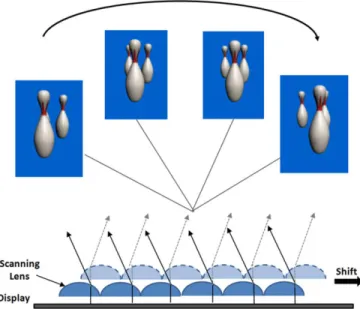
resolution, as shown in Fig. 1. However, the prior scanning LC
lens had thick LC-cell gap ( 60
m) which resulted in slow
Manuscript received May 17, 2012; revised June 14, 2012; accepted June 15, 2012. Date of publication October 02, 2012; date of current version November 19, 2012. This work is supported in part by National Science Council, Taiwan, under Academic Project NSC101-2221-E-009-120-MY3.
Y.-P. Huang and C.-W. Chen are with the Department of Photonics & In-stitute of Electro-Optical Engineering/Display InIn-stitute, National Chiao Tung University, 30010 Hsinchu, Taiwan (e-mail: [email protected]; [email protected]).
Y.-C. Huang is with the Taiwan Semiconductor Manufacturing Company, Science-Based Industrial Park, Hsin-Chu, Taiwan 300 (e-mail: yhuangs@tsmc. com).
Color versions of one or more of the figures are available online at http:// ieeexplore.ieee.org.
Digital Object Identifier 10.1109/JDT.2012.2212695
Fig. 1. Scheme of scanning time-multiplexed 3D display.
response and high driving voltage. According to LC response
time formula, shown in (1) [25], the response time can be
accelerated by reducing the cell gap
(1)
where
and
are viscosity, elastic constant, cell
gap, driving voltage, and threshold voltage, respectively.
Hence, Fresnel LC lens will be a good candidate for a
tem-poral scanning device. However, not every kind of Fresnel LC
lens can be used for temporal scanning function. Accordingly,
in this paper, we propose superzone Fresnel LC lens with
multi-electrode driven structure for fast switching, low-voltage
oper-ation, and temporal scanning.
II. S
UPERZONEF
RESNELLC L
ENS FORT
EMPORALS
CANNINGThe Fresnel LC lens can be grouped into three types: Fresnel
zone plate, continuous Fresnel zone lens, and superzone Fresnel
lens [26], [27], as shown in Fig. 2. Many prior approaches have
illustrated the switchable LC Fresnel zone plate uses the
polymer-stabilized method to form the fixed binary-zone
[28]–[31]. However, it is not suitable for scanning because the
phase of each zone is fixed by a polymer wall (Fig. 2). Lu et al.
[23] proposed continuous Fresnel LC lens formed by various
widths of Fresnel zone prisms (Fig. 2). Nevertheless, it is also
not available for scanning movement due to the width of each
Fresnel zone not the same as shown in Fig. 3(a). Therefore,
Fig. 2. Different structures of Fresnel LC lens—Fresnel zone plate, continuous Fresnel zone lens, and superzone Fresnel lens.
Fig. 3. Sketches illustrate that (a) the continuous Fresnel LC lens cannot be shifted for the same period; on the contrary; and (b) the scanning superzone Fresnel LC lens performs scanning function under shifting driving voltages. (Here, the lens shift from left side to right side, and the different gray levels on electrodes indicate different driving voltages.)
in this paper, we propose a superzone Fresnel LC lens with
equalized ITO pitch (Fig. 2). Consequently, the superzone
Fresnel LC lens can be shifted step by step by simply applying
the different voltages on each electrode sequentially, as shown
in Fig. 3(b). In the following section, the detail design and
optimization of superzone Fresnel LC lens will be illustrated.
III. S
IMULATION ANDO
PTIMIZATIONIn this paper, the parameters of a superzone Fresnel LC lens
are based on a 4-inch panel with pixel size 96
m, and the
viewing distance and view-number are of 96 cm and six-views
respectively. The superzone Fresnel LC lens array is slanted
9.46 relative to vertical direction of pixel to suppress the moiré
effect. Then, the corresponded six views image information is
addressed according to the slanted lenses. Hence, the six views
auto-stereoscopic display can be obtained [6]. Accordingly, the
total pitch of a single superzone Fresnel LC lens is 188 , and
it is divided into 6 zone prisms with equalized width. As
illus-trated in Fig. 4, different electrode patterns and ITO slit ratio
were simulated. In the reconstructed figures, blue dash-line
in-dicates the ideal curve of Fresnel lens, and the red solid-line
shows the simulated results. Consequently, multiple ITO
elec-trodes at both substrates with electrode to slit ratio equal to 2:1
is the optimized one, as shown in Fig. 4(b). The final parameters
TABLE I
PARAMETERS OF THEOPTIMIZEDSUPERZONEFRESNELLC LENS
for fabrication are listed in Table I. Each superzone Fresnel LC
lens has 24 fine electrodes at both substrates inside the LC cell.
And the cell gap of superzone Fresnel LC lens is almost half of
the prior scanning LC-lens [24]. Thus, the response time of the
superzone Fresnel LC lens are expected to be reduced to at least
a quarter of the prior approach. Finally, the focal length of the
LC lens also can be calculated from the following formula [21]:
(2)
IV. E
XPERIMENTIn this experimental session, the response time of proposed
superzone Fresnel LC lens is first illustrated. Following the
lens quality and proto-type of the auto-stereoscopic display are
demonstrated. Finally, the superzone Fresnel LC lens array is
driven to further perform scanning function on the horizontal
movement for increasing 3D image resolution.
In the measurement, a 632.8 nm He-Ne laser and a fast CCD
located at the focal plane were used to measure the intensity
distribution and response time. The overdrive method was also
used to further accelerate the response time. A pulse voltage
(3 times the stable driving voltage with 100 ms pulse width) was
firstly applied to electrodes to induce strong electric field in the
LC cell, and then switch to the stable driving voltage (5
,
1 kHz) to perform the final lens curvature. Fig. 5 shows the
mea-sured results. For the prior scanning LC-lens, its response time
was more than 6 s (green line), which was not enough for
tem-poral scanning. For the proposed superzone Fresnel LC lens,
its response time could be extremely reduced to 0.2 s with
ap-plying overdriving method [32], [33] (purple line). The captured
images for the superzone LC lens switching from off state to on
state are also shown in Fig. 6. Moreover, in order to reduce the
lens’ total switching time
, Chen et al. [34] also
proposed a dual-directional overdriving method which can
pro-vide vertical and lateral electric field to accelerate both LC lens’
rising and decay time.
For evaluating the lens profile, Fluorescence Confocal
Po-larizing Microscope (FCPM) [35], as shown in Fig. 7(a), was
utilized. The FCPM can measure the LC orientation of each
horizontal layer ( – plane) according to the captured
inten-sity. Fig. 7(b) shows a sampled intensity image of a single layer
within the LC cell. In the measurement, LC cell was divided
into 10 layers along the cell gap, -direction, as illustrated in
Fig. 7(c). The 1st and 10th layers were located at the boundaries
of top and bottom substrate respectively. Finally, the profile of
superzone Fresnel LC lens was reconstructed by integrating the
Fig. 4. Simulated cases for finding out the optimized structure design—Multiple electrode on both top and bottom side of substrate.
Fig. 5. Response time curves of prior scanning LC lens, and superzone Fresnel LC lens with/without overdrive method.
Fig. 6. Focusing images of the superzone Fresnel LC lens with overdrive method. The proposed superzone Fresnel LC lens becomes stable after 0.2 sec.
10 layers (Fig. 8). The result shows that the superzone Fresnel
LC lens was really established, yet the phase change was not as
ideal as simulated. By further analyzing the detail, it was caused
by the cell gap variation, which is smaller in fabricated sample
than that of ideal simulating condition.
After demonstrating a single superzone Fresnel LC lens, the
lens array for 4-inch 3D display was further fabricated. The light
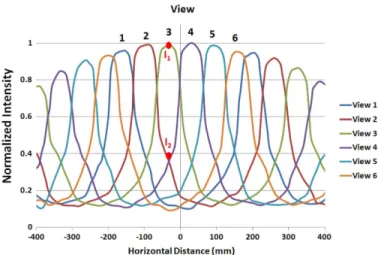
intensity distributions of each viewing zone are shown in Fig. 9.
The distance between each view is 65 mm which is the average
gap of human eyes. The crosstalk of using superzone Fresnel LC
lens for 3D display here is around 25% according to (3), where
is the maximum intensity value for a single viewing zone at
a specific position, and
is the intensity value of the nearest
neighboring zone at the same position. Additionally, the
proto-type 4-inch 3D display with superzone Fresnel LC-lens is shown
in Fig. 10, which demonstrated the switched 2D and 3D images
respectively. And the captured images under 3D mode are also
clearly illustrated the different perspectives of the objects (e.g.,
the chairs)
%
(3)
In addition, we also briefly analyze the diffraction effect of
using our superzone Fresnel LC lens: for the lens-off state (2D
mode), because the Fresnel LC lens is aligned as homogeneous
cell (very small phase difference), as well as the ITO pattern is
thin (
nm thickness) and high transparent, the diffraction
Fig. 7. (a) Confocal microscope system. (b) A sampling intensity image captured by the confocal microscopy of a single layer inside the superzone Fresnel LC lens. (c) Different images captured along the cell gap,z-direction. (LC cell was separated into 10 layers for measuring in this paper.)
Fig. 8. Reconstruction of superzone Fresnel LC lens from experiment and simulation.
effect is not obvious (2D mode in Fig. 10); for the lens-on state
(3D mode), however, we can find slight color dispersion which
may caused by the discrete Fresnel prisms. Thus, suppressing
the color dispersion can be the next research topic.
Developing the fast response superzone Fresnel LC lens was
not only for switching between 2D/3D images, but also for
tem-poral scanning to produce high 3D image resolution. In our
ex-periment, 3 frames scanned (0.2
3
0.6 s) across a period of
LC lens, which means the 3D image resolution can be ideally
increased by a factor of 3. Fig. 11 shows the scanning results,
Fig. 9. Light distributions for 6-views 3D display using superzone Fresnel LC lens. The distance between each view is 65 mm at the viewing plane, and the horizontal-axis represents left-right direction of viewer.
Fig. 10. Snapshots under 2D and 3D modes from the proposed 2D/3D switch-able display using superzone Fresnel LC lens array. The captured images in 3D mode from two different viewing positions (view1 & view2) illustrate different perspectives.
where the scanning time was illustrated from top to bottom, and
the focus of the lens moved from left to right. The result
demon-strates that the proposed superzone Fresnel LC lens successfully
performs scanning function; however, the response time, which
is only 200 ms, still has to be improved for future temporal
scan-ning 3D display. Using the fast response LC material can be the
next step.
The blue phase LC (BP-LC) [36]–[38], ferroelectric LC
(FLC) [39], [40], and high birefringence LC (HB-LC) [41],
[42], are the three candidates. The BP-LC and FLC had
been demonstrated with sub-millisecond response speed. For
HB-LC, the cell gap of LC lens can be further reduced.
Con-sequently, by using the fast response LC material with the
proposed superzone Fresnel LC lens structure, a temporal
scan-ning 3D display for high resolution auto-stereoscopic image
can be achieved in the future.
Fig. 11. Captured images of scanning superzone Fresnel LC lens across a pe-riod of a LC lens (0.2 s/frame).
V. C
ONCLUSIONThe 3D image resolution of current multi-view 3D display is
a major issue which needs to be improved. In prior approaches,
scanning LC lens for increasing the image resolution in
tem-poral domain was proposed, yet it still suffered from the slow
response time. In this paper, we proposed superzone Fresnel LC
lens to reduce the lens’s response time (from 6 sec to 0.2 sec),
as well as the driving voltage (from 30
to 5
). Not only
was a single lens, but also lens array was fabricated for a 4-inch
auto-stereoscopic display, which could perform fast switching
between 2D and 3D images. Moreover, the superzone Fresnel
LC lens with the equalized ITO pitch could be shifted step by
step by simply applying the different voltages on each
elec-trode sequentially. Finally, the scanning function was
success-fully demonstrated in the experimental result. In the future, a
full resolution temporal scanning 3D display could be achieved
by further implementing fast response or high birefringence LC
materials.
A
CKNOWLEDGMENTThe authors also would like to thank A. Markman,
Univer-sity of Connecticutt, Storrs, B. W. Xiao, Y. H. Pai, C. H. Tsai,
Mrs. S. Y. Fu, K. J. Hu and J. F. Huang, ITRI, Taiwan, for their
valuable discussion and technical support.
R
EFERENCES[1] B. Javidi and E. Tajahuerce, “Three dimensional object recognition using digital holography,” Opt. Lett, vol. 25, pp. 610–612, 2000. [2] J. Y. Son, B. Javidi, S. Yano, and K. H. Choi, “Recent developments
in 3D image technologies,” J. Display Technol., vol. 6, no. 10, pp. 394–403, Oct. 2010.
[3] P. Soltan, J. Trias, W. Dahlke, M. Lasher, and M. McDonald, “Laser based 3-D volumetric display system,” Naval Engineers J., vol. 107, pp. 233–243, 1995.
[4] H. H. Rakki, “Static volumetric three-dimensional display,” J. Display
Technol, vol. 5, no. 10, pp. 391–397, Oct. 2009.
[5] M. Gately, Y. Zhai, M. Yeary, E. Petrich, and L. Sawalha, “A three-dimensional swept volume display based on LED arrays,” J. Display
Technol., vol. 7, no. 9, pp. 503–514, Sep. 2011.
[6] C. V. Berkel and J. A. Clarke, “Characterization and optimization of 3D-LCD module design,” Proc. SPIE, vol. 3012, pp. 179–187, 1997. [7] S. J. Young and B. Javidi, “Three-dimensional image methods based
on multi-view images,” J. Display Technol, vol. 1, no. 1, pp. 125–140, Sep. 2005.
[8] W. Maphepo, Y. P. Huang, and H. P. D. Shieh, “Enhancing the bright-ness of parallax barrier based 3D flat panel mobile displays without compromising power consumption,” J. Display Technol, vol. 6, no. 2, pp. 60–64, Feb. 2010.
[9] Y. Takaki, K. Tanaka, and J. Nakamura, “Super multi-view display with a lower resolution flat-panel display,” Opt. Express, vol. 19, pp. 4129–4139, 2011.
[10] M. Tsuboi, S. Kimura, Y. Takaki, and T. Horikoshi, “Design conditions for attractive reality in mobile-type 3-D display,” J. Soc. Inf. Display, vol. 18, pp. 698–703, 2010.
[11] Y. Takaki, “Multi-view 3-D display employing a flat-panel display with slanted pixel arrangement,” J. Soc. Inf. Display, vol. 18, pp. 476–482, 2010.
[12] S. Sato, “Liquid-crystal lens-cells with variable focal length,” Jpn. J.
Appl. Phys., vol. 18, pp. 1679–1684, 1979.
[13] H. W. Ren, Y. H. Fan, S. Gauza, and S. T. Wu, “Tunable-focus cylin-drical liquid crystal lens,” Jpn. J. Appl. Phys., vol. 43, pp. 652–653, 2004.
[14] H. W. Ren, D. W. Fox, B. Wu, and S. T. Wu, “Liquid crystal lens with large focal length tunability and low operating voltage,” Opt. Express, vol. 15, pp. 11328–11335, 2007.
[15] T. Nose, S. Masuda, S. Sato, J. Lin, L. C. Chien, and P. J. Bos, “Effects of low polymer content in a liquid-crystal microlens,” Opt. Lett., vol. 22, pp. 351–353, 1997.
[16] S. T. Kowel, D. S. Cleverly, and P. G. Kornreich, “Focusing by elec-trical modulation of refraction in a liquid crystal cell,” Appl. Opt., vol. 23, pp. 278–289, 1984.
[17] G. J. Woodgate and J. Harrold, “Key design issue for autostereoscopic 2-D/3-D displays,” J. Soc. Inf. Display, vol. 14, pp. 421–426, 2006. [18] G. J. Woodgate and J. Harrold, “Efficiency analysis for multi-view
spatially multiplexed autostereoscopic 2-D/3-D displays,” J. Soc. Inf.
Disp., vol. 15, pp. 873–881, 2007.
[19] O. H. Willemsen, S. T. De Zwart, M. G. H. Hiddink, and O. Willemsen, “2-D/3-D switchable displays,” J. Soc. Inf. Display, vol. 14, pp. 715–722, 2006.
[20] H. K. Hong, S. M. Jung, B. J. Lee, and H. H. Shin, “Electric-field-driven LC lens for 3D/2D autostereoscopic display,” J. Soc. Inf. Display, vol. 17, pp. 399–406, 2009.
[21] Y. P. Huang, L. Y. Liao, and C. W. Chen, “2-D/3-D switchable autostereoscopic display with multi-electrically driven liquid-crystal (MeD-LC) lenses,” J. Soc. Inf. Display, vol. 18, pp. 642–646, 2010. [22] C. W. Chen, Y. C. Huang, Y. P. Huang, and J. F. Huang, “Fast
switching fresnel liquid crystal lens for autostereoscopic 2D/3D display,” in SID Symp. Dig., 2010, vol. 41, pp. 428–431.
[23] J. G. Lu, X. F. Sun, Y. Song, and H. P. D. Shieh, “2-D/3-D switchable display by Fresnel-type LC lens,” J. Display Technol, vol. 7, no. 4, pp. 215–219, Apr. 2011.
[24] Y. P. Huang, C. W. Chen, T. C. Shen, and J. F. Huang, “Au-tostereoscopic 3D display with scanning multi-electrode driven liquid crystal(MeD-LC) lens,” J. 3D Res., vol. 1, pp. 39–42, 2010. [25] S. T. Wu and D. K. Yang, Reflective Liquid Crystal Displays. : Wiley,
2001.
[26] M. T. Gale, M. Rossi, J. Pedersen, and H. Schutz, “Fabrication of con-tinuous-relief micro-optical elements by direct laser writing in phot-toresist,” Opt. Eng., vol. 33, pp. 3556–3566, 2004.
[27] M. B. Fleming and M. C. Hutley, “Blazed diffractive optics,” Appl.
Opt., vol. 36, pp. 4635–4643, 1997.
[28] Y. H. Fan, H. W. Ren, and S. T. Wu, “Switchable fresnel lens using polymer-stabilized liquid crystals,” Opt. Express, vol. 11, pp. 3080–3086, 2003.
[29] H. W. Ren, Y. H. Fan, and S. T. Wu, “Tunable fresnel lens using nanoscale polymer-stabilized liquid crystals,” Appl. Phys. Lett., vol. 83, pp. 1515–1517, 2003.
[30] L. C. Lin, H. C. Jau, T. H. Lin, and Y. G. Fuh, “High efficient and po-larization-independent fresnel lens based on dye-doped liquid crystal,”
Opt. Express, vol. 15, pp. 2900–2906, 2007.
[31] K. Rastani, A. Marrakchi, S. F. Habiby, W. M. Hubbard, H. Gilchrist, and R. E. Nahory, “Binary phase Fresnel lenses for generation of two-dimensional beam arrays,” Appl. Opt., vol. 30, pp. 1347–1354, 1991.
[32] S. T. Wu and C. S. Wu, “Small angle relaxation of highly deformed ne-matic liquid crystals,” Appl. Phys. Lett., vol. 53, pp. 1794–1796, 1988. [33] S. T. Wu, “Nematic liquid crystal modulator with response time less than 100 us at room temperature,” Appl. Phys. Lett, vol. 57, pp. 986–988, 1990.
[34] C. W. Chen, Y. P. Huang, and P. C. Chen, “Dual direction overdriving method for accelerating 2D/3D switching time of liquid crystal lens on auto-stereoscopic display,” J. Display Technol., vol. 8, no. 10, pp. 551–561, Oct. 2012.
[35] O. D. Lavrentovich, “Fluorescence confocal polarizing microscopy: Three-dimensional imaging of the director,” J. Phys., vol. 61, pp. 3.–384, 2003.
[36] K. M. Chen, S. Gauza, H. Xianyu, and S. T. Wu, “Submillisecond gray-level response time of polymer-stablized blue-phase liquid crystal,” J.
Display Technol., vol. 6, no. 2, pp. 49–51, Feb. 2010.
[37] Z. Ge, L. Rao, S. Gauza, and S. T. Wu, “Modeling of blue phase liquid crystal dsipalys,” J. Display Technol., vol. 5, no. 7, pp. 250–256, Jul. 2009.
[38] K. M. Chen, S. Gauza, H. Xianyu, and S. T. Wu, “Hysteresis effects in blue-phase liquid crystals,” J. Display Technol., vol. 6, no. 8, pp. 318–322, Aug. 2010.
[39] N. A. Clark and S. T. Lagerwall, “Submicrosecond bistable electro-optic switching in liquid crystal,” Appl. Phys. Lett, vol. 36, pp. 899–901, 1980.
[40] X. H. Li, A. Muruuski, A. Muravsky, P. Z. Xu, H. L. Cheung, and V. G. Chgrinov, “Grayscale generation and stabilizaion in ferroelectric liquid crystal display,” J. Display Technol, vol. 3, no. 7, pp. 273–279, Jul. 2007.
[41] S. Gauza, H. Wang, C. H. Wen, S. T. Wu, A. J. Seed, and R. Dabrowski, “High birefringence isothiocyanato tolane liquid crystals,” Jpn. J. Appl.
Phys, vol. 42, pp. 3463–3466, 2003.
[42] S. Gauza, C. H. Wen, S. T. Wu, N. Janarthanan, and C. S. Hsu, “Super high birefringence isothiocyanato biphyenyl-bistolane liquid crystals,”
Jpn. J. Appl. Phys., vol. 43, pp. 7634–7638, 2004.
Yi-Pai Huang received the B.S. degree from
Na-tional Cheng Kung University, Hsinchu, Taiwan, in 1999 and the Ph.D. degree in electro-optical engi-neering from the National Chiao Tung University, Hsinchu, Taiwan, in 2004.
He is currently an full-time associate professor in the Department of Photonics & Display Institute, Na-tional Chiao Tung University, Hsinchu, Taiwan. Also he is a visiting associate professor of Cornell Uni-versity, Ithaca, NY, from 2011 to 2012. His expertise includes 3D display and interactive technologies,
dis-play optics and color science, micro-optics. In the above-mentioned research, he have so far published more than 110 International Journal and conference pa-pers (including the 57 SID Conference Papa-pers and 10 invited talks), and have obtained 25 granted patents, with another 48 patents currently publicly avail-able.
Dr. Huang is the secretary general of SID Taipei Chapter, and Chair of Ap-plied-Vision program sub-committee of SID. In addition, he had three times received the SID’s distinguished paper award (2001, 2004, 2009). Other impor-tant awards include 2011 Taiwan National Award of Academia Inventor, 2010 Advantech Young Professor Award, 2009 Journal—SID: Best paper of the Year Award, and 2005 Golden Dissertation Award of Acer Foundation.
Chih-Wei Chen received the B.S. degree from
Department of Mechatronics Engineering, National Changhua University of Education, Changhua, Taiwan, in 2007, and is currently working toward the Ph.D. degree from the Department of Photonics, Institute of Electro-Optical Engineering, National Chiao Tung University, Hsinchu, Taiwan.
His current research is including high image-quality LCDs, 3-D displays, and liquid crystal lens design.
Yi-Ching Huang received the B.S. degree from
Department of Opto Electronic Communication Engineering, National Kaohsiung Normal Univer-sity, in 2007, and M.S. degree at the Department of Photonics, Institute of Electro-Optical Engineering, National Chiao Tung University in 2010.
She is currently a Process Integration Engineering at Taiwan Semiconductor Manufacturing Company, Hsin-chu, Taiwan.