行政院國家科學委員會專題研究計畫 成果報告
以 siRNA 調降 Toll-like 接受器之表達可抑制以 minimally modified LDL 處理之內皮細胞 Monocyte Chemoattractant
Protein-1 與 Interle
計畫類別: 個別型計畫
計畫編號: NSC94-2314-B-038-068-
執行期間: 94 年 08 月 01 日至 95 年 07 月 31 日 執行單位: 臺北醫學大學醫學系
計畫主持人: 胡朝榮
報告類型: 精簡報告
處理方式: 本計畫可公開查詢
中 華 民 國 95 年 10 月 3 日
中 華 民 國 九十五 年 9 月 30 日
以 siRNA 調降 Toll-like 接受器之表達可抑制以 minimally modified LDL 處理之內皮細胞 Monocyte Chemoattractant Protien-1 與 Iinterleukin-8 表達
計畫編號:NSC 94-2314-B-038-068
執行期限:94 年 8 月 1 日至 95 年 7 月 31 日
主持人:胡朝榮 單位名稱:北醫大醫學系神經學科
一、中文摘要
腦中風是台灣的第二死亡原因,腦中風的病 因相當分歧,目前的趨勢顯示缺血性中風與 出血性中風的比例逐年增加,因此缺血性中 風應是腦中風最重要的一部份。同樣的,缺 血性中風的病因也相當多,其中包括粥狀動 脈硬化(大血管疾病)、小洞性中風(小血 管疾病)、心因性、凝血病變、血管炎等,
及其他不明病因。粥狀動脈硬化可引起腦中 風、冠狀動脈疾病、週邊血管阻塞疾病等為 缺血性中風最主要之病因。許多研究指出粥 狀動脈硬化是一種慢性發炎反應,在血管內 皮細胞受損後,許多發炎介質 (cytokines and chemokines)均參與其中;吾人在稍早的研究 指出阿司匹林 (aspirin),一種普遍用於缺血 性中風預防的藥物,可以抑制發炎介質及單 核球對血管內皮細胞的粘黏、穿移。Toll-like receptor 4 (TLR4)是一種細胞膜上的接受器 可 啟 動 固 有 的 免 疫 反 應 (innate immune responses),以基因技術移除 TLR4 之老鼠較 不會罹患粥狀動脈硬化;在白人族群中 TLR4 之基因多型性, Asp299Gly,被證實與粥狀動 脈硬化相關,而吾人的研究指出華人雖很少 有 Asp299Gly 基因多型性,但在第一內子的 一個基因多型性的確與缺血性中風相關;因 此可以推論 TLR4 應在粥狀動脈硬化扮演重 要角色。流行病學研究發現高血脂症,特別 是高低密度脂蛋白 (LDL)為粥狀動脈硬化 之危險因子;最近研究支持脂肪可引起發炎 反應,進而引發粥狀動脈硬化。
本研究要以 mmLDL 處理血管內皮細胞引 發發炎反應,以 siRNA 抑制 TLR4 之表達,
並測量多發炎介質及單核球對血管內皮細 胞的粘黏、穿移,並探討 NF-kB 在此一路
徑之角色,希望可以了解 TLR4 在粥狀動 脈硬化的分子機制,未來 TLR4 可作為治 療粥狀動脈硬化的一個標第。目前本研究 已經建立 siRNA 抑制 TLR4 表達之系統,
未來可應用於功能性之評估。
關鍵詞:粥狀動脈硬化、缺血性中風、慢性 發炎反應、低密度脂蛋白、分子機制、固 有的免疫反應
Abstract
Stroke is the second leading cause of death in Taiwan. The causes of stroke are quite diverse. It’s a trend that the ratio of cerebral infarction (CI) and cerebral hemorrhage (CH) is increasing. It implicates that CI plays the most important role in stroke. Many kinds of pathophysilogy are attributed to CI, including atheroscelrosis (large vessel diseases), lacunar infarction (small vessel diseases), cardiogenic origins, coagulopathy, vasculiatis, et al and some of unknown mechanisms.
Atherosclerosis resulting in stroke, coronary artery disease (CAD) and peripheral atery occlusion diseases (PAOD) is the major causes of CI. The compelling evidence shows that atherosclerosis is a chronic inflammatory process. Many cytokines and chemokines are involved after endothelial cell damage. In our previous report, we had provided the data the support that Aspirin, the most popular drug for stroke prevention, inhibited monocyte chemoattractant protein-1 (MCP-1) and interleukin-8 (IL-8) expression in TNF-alpha stimulated human umbilical vein endothelial cells. Toll-like receptor 4 (TLR4) is the key
receptor for initiating the innate immune responses. Animals without TLR4 were less susceptible to atherosclerosis even taking high cholesterol diet. There is a genetic polymorphism of TLR4 gene, Asp299Gly, associated with atherogenesis among Caucasian populations. In our another recent study, there is very rare Asp299Gly polymorphism in Chinese population but we still found a polymorphism at intron 1 associated with CI. Based on epidemiological researches, hyperlipidemia, especially high low-density-lipoprotein (LDL) strongly contributes to the atherogenesis. The recent studies have raised the mechanism that lipid plays a role in induction of inflammation, which is one of the most important part of atherogenesis.
In this study, we will down-regulate the TLR4 expression by siRNA and survey the MCP-1, IL-8 expression at mRNA and protein levels, and then test the effects on monocytes adhesion/migration function in the endothelial cells treated by minimally modified LDL (mmLDL). We also will explore the role of NF-kB in this pathway.
Hopefully, we can clarify the molecular mechanism of TLR4 on the atherogenesis and TLR4 might be a target to develop a novel therapy for atherosclerosis.
Key Words: Atheroscleosis, Toll-like receptor 4, MCP-1, IL-8, adhesion, migration, siRNA, mmLDL, endothelial cell, monocyte 二、緣由與目的
1. Stroke is the second leading cause of death in Taiwan. The complications of the survivors include disability in motor, sensory and even metal functions. Every episode of stroke induces huge impacts to the patient and his family. Stroke is not only a common neurological disease but also an urgent issue of public health in
Taiwan. Stroke patients are used to
classified according to the causes, in terms of hemorrhage and ischemia [5]. Although the causes of stroke are very diverse, most of stroke patients are classified as
ischemic stroke. [6]
2. Athelosclerosis resulting in cerebral or carotid arterial stenosis/occlusion plays the most important role in occurrence of ischemic stroke. Atherosclerosis and its complications such as stroke,
myocardial infraction and peripheral vascular disease, remain the major causes of morbidity and mortality in the world.
The patheophysiology of atherosclerosis consists of consequent events, including endothelial cell injury, monocytes adhesion, migration, proliferation of smooth muscle cells in sub-endothelial space. [7] In our stroke registration and other series, large vessel disease, associated with atherosclerosis, is the leading cause of Ischemic stroke). [8]
3. Atherosclerosis is an inflammatory process. Inflammatory cells infiltrate in the atheroma, the pathologic presentation of atherosclerosis. Cytokines, chemokines and adhesion molecules are involved in the atheroscleosis. [9] Studies have showed that chemokines and adhesion molecules are involved in causing atherosclerosis by promoting directed migration of inflammatory cells. [7].
There is compelling evidence showing atherosclerosis is a chronic inflammatory disease. Inflammatory processes may be potential targets of therapy in preventing or treating atherosclerosis and its
complications. [10]
4. Toll-like receptor 4 (TLR4) is one of toll-like receptors (TLRs) family. TLRs are pattern-recognition receptors and they initiate innate immune responses
after interaction with pattern-specific ligands. [11] Endothelial cells could be activated by microbial ligands through TLRs with resultant expression of inflammatory mediators. [12] (Figure 1) TLR4 was found in human atherosclerotic coronary arteries by
immunohistochemistry detection in plaque and adventitia. [13] Genetically knockout mice studies document TLR4 is
contributed to atherogenesis via NF-kB signal pathway. [14]
TLR4 genetic polymorphisms are associated with atherogenesis. [8,15]
These findings implicate the important role of TLR4 in atherogenesis.
5. Oxidized LDL (oxLDL) and miminally modified LDL (mmLDL) induce atherosclerosis. Hyperlipidemia, especially high serum level of LDL, is a risk factor for atherosclerosis. [16]
OxLDL might alter TLR4 expression and has been linked to innate immune
responses which affect the down-steam pathway by activating NF-kB. This is a relevant mechanism for LDL associated with chronic inflammation and
atherosclerosis. [17]
6. Minimally modified LDL (mmLDL) activates NF-kB pathway and is involved in pathophysiology of atherosclerosis. MmLDL is a ligand of CD14, which contains no down stream signal pathway but MmLDL, similar to LPS, is a ligand of CD14, which is closely linked to TLR4. The signals from CD14 would be transduced to TLR4 and then affect the NF-kB pathway. [18]
(Figure 1) These findings implicate mmLDL could induce an inflammatory response by the
CD14-TLR4-NF-kB-inflmmation pathway.
7. siRNA can work in animals by
intravenous (IV) administration. There have been a few reports documenting the systemic (IV) administration of siRNA can alter the gene expression in target organs. [19] These findings have shed light on the new approach of
atherosclerosis. Our in vitro study might provide a piece of basic information for the further in vivo researched on siRNA therapy for atherosclerosis. [20]
8. The specific aims of this study are as below.
Specific aim 1: siRNA down-regulating TLR4 expression in endothelial cells
Specific aim 2: Down-regulation of TLR4 suppresses IL-8, MCP-1 expression Specific aim 3: Down-regulation of TLR4 suppresses IL-8, MCP-1 expression by inhibition of NF-kB activity
Specific aim 4: Down-regulation of TLR4 interfering the monocytes dhesion/migration to endothelial cells
三、研究方法 Cell culture
We purchased human umbilical vein endothelial cells (HUVECs) and endothelial cell growth medium (EGM-2, CC3156), from Clonetics (San Diego, CA), which contains 10% fetal bovine serum, hydrocortisone, hFGF-B, vEGF, R3-IGF-I, ascorbic acid, hEGF, GA-1000 and heparine.
HUVEC which was used between passages 1 and 6, were maintained in EGM-2 medium in a humidified chamber containing 5% CO2 at 37 oC. Cells were cultured in 6-well or 24-well plates until confluent, and were washed twice and incubated with serum-free medium for 12 h before different concentrations of ticlopidine (0.1, 1, 10, 30 μg/ml) were added. After being incubated for12 h, cells were stimulated with TNF-α (10 ng/ml) (R&D Systems; Minneapolis, MN)
for 24 h for MCP-1 and IL-8 expression.
After incubation, the supernatants were collected for ELISA analysis, and the cells were used for RNA isolation.
siRNA for Toll-like receptor 4
1. Design siRNA according to the TLR4 mRNA (BC025294)
2. Four siRNA sequences were chosen, the sequences as following
siRNA 1: Sense strand:
AUCCAGACAAUUGAAGAUGtt Antisense strand:
CAUCUUCAAUUGUCUGGAUtt siRNA 2: Sense strand:
GCCACCUCUCUACCUUAAUtt Antisense strand:
AUUAAGGUAGAGAGGUGGCtt siRNA 3: Sense strand:
ACCCCAUCCAGAGUUUAGCtt Antisense strand:
GCUAAACUCUGGAUGGGGUtt siRNA 4: Sense strand:
CUUCCCCAUUGGACAUCUCtt Antisense strand:
GAGAUGUCCAAUGGGGAAGtt
3. The siRNA was synthesized by in vitro transcription by Silencer™ siRNA Construction Kit (Ambion). The
procedure will be performed according to the manufacture guide.
4. The siRNA was transfected to endothelial cells by Silencer™siRNA Transfection Kit (Ambion).The procedure will be performed according to the manufacture guide.
5. The efficiency of siRNA will be determined by western blot analysis to assay the amount of TLR4 protein level at time point 24, 48 and 72 hours after
transfection.
6. Optimal time point will be chosen according to the western blot data.
RNA isolation and reverse
transcription–polymerase chain reaction (RT-PCR) analysis
Total RNA was extracted from 1 x 10⁶ cells according to manufacturer’s instructions. Briefly, Trizol (1 ml) (Life Technologies, Grand Island, NY) was added to the plates to lyse the cells, and then the cells were transferred to the microfuge tube.
Chloroform was added and total RNA was collected in the aqueous phase after centrifugation. Finally, RNA was precipitated by isopropyl alcohol, then washed and re-dissolved in DEPC treated water. The concentrations of RNA samples were measured with a spectrophotometer (GeneQuant II, Pharmacia Biotech) to determine the OD 260 and OD260/280 values. In total,5 μg ofRNA sampleswas reverse-transcribed with an oligo-dT primer to synthesize first-strand cDNA consecutively under 65 oC for 15 min, 25oC for 10 min, 42oC for 60 min, 95oC for 10 min, using SuperScript reverse transcriptase (Life Technologies, Grand Island, NY) and followed by storage of products at 4oC24. 四、結果及討論
(1) 結果
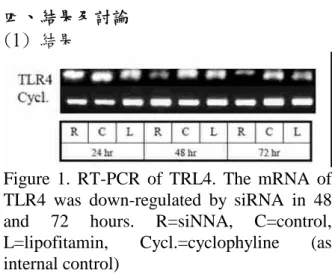
Figure 1. RT-PCR of TRL4. The mRNA of TLR4 was down-regulated by siRNA in 48 and 72 hours. R=siNNA, C=control, L=lipofitamin, Cycl.=cyclophyline (as internal control)
Figure 2. RT-PCR of TLR4 and MCP-1.
MRNA of both TLR4 and MCP-1 is down-regulated by siRNA at 48 hour.
R=siNNA, C=control, L=lipofitamin, Cycl.=cyclophyline (as internal control) (2) 討論
At present, we have established an in vitro system of cerebral endothelial cells for down-regulation of TLR4. Suppression of TLR4 might result in decrease of MCP-1 expression. We will use this system to investigate the consequences, especially on the adhesion function, after down-regulation of TLR4.
五、參考文獻
[1] Yang YY*, Hu CJ*, Chang SM, Tai TY, Leu SJ. Aspirin inhibits monocyte chemoattractant protein-1 and
interleukin-8 expression in TNF-alpha stimulated human umbilical vein endothelial cells. Atherosclerosis.
2004;174:207-13.
[2] Lin YC, Chang YM, Yu JM, Yen JH, Chang JG, Hu CJ. Toll-like receptor 4 gene C119A but not Asp299Gly polymorphism is associated with ischemic stroke among Chinese in Taiwan. Atherosclerosis (under revision) [3] Chang WS, Cheng CC, Wei IL, Chen PL,
Chang YM, Hu CJ. The Association of Folate, Vitamin B6, B12, and
Homocysteine Blood Levels with Ischemic Stroke. Taipei City Medical
Journal 2004, 1:321-417
[4] Chang YM, Lee KY, Lee LS, Chang JG, Hu CJ. Polymorphisms of the Human Platelet Antigens and Coagulation Factor V Leiden are not Risk Factors for Stroke.
Taipei City Medical Journal 2004, 1:142-149
[5] Barnett HJM, Mohr JP, Stein BM, Yatsu FM. Strpke—pathophysiology, diagnosis and management. 2ndEdt, Churchill Livingstone. 1992. pp271-80
[6] Hu HH, Sheng WY, Chu FL, Lan CF, Chiang BN. Incidence of stroke in Taiwan. Stroke. 1992; 23: 1237-41.
[7] Christopher K. Glass and Joseph L.
Witztum. Atherosclerosis: The Road Ahead. Cell 2001 104: 503-516
[8] Toll-like receptor 4 gene C119A but not Asp299Gly polymorphism is associated with ischemic stroke among Chinese in Taiwan YC Lin, YM Chang, J-M Yu, JH Yen, JG Chang, CJ Hu. Atherosclerosis.
2005 (in press)
[9] Eldika N, Yerra L, Chi DS,
Krishnaswamy G. Atherosclerosis as an inflammatory disease: implications for therapy. Front Biosci. 2004;9:2764-77.
[10] Paoletti R, Gotto AM Jr, Hajjar DP.
Inflammation in atherosclerosis and implications for therapy. Circulation.
2004;109 (S):III20-6.
[11] Michelsen KS, Doherty TM, Shah PK, Arditi M. TLR signaling: an emerging bridge from innate immunity to atherogenesis. J Immunol.
2004;173:5901-7.
[12] Pasterkamp G, Van Keulen JK, De
Kleijn DP. Role of Toll-like receptor 4 in the initiation and progression of
atherosclerotic disease. Eur J Clin Invest.
2004;34:328-34.
[13] Vink A, Schoneveld AH, van der Meer JJ, van Middelaar BJ, Sluijter JP, Smeets MB, Quax PH, Lim SK, Borst C,
Pasterkamp G, de Kleijn DP. In vivo evidence for a role of toll-like receptor 4 in the development of intimal lesions.
Circulation. 2002;106:1985-90.
[14] Michelsen KS, Wong MH, Shah PK, Zhang W, Yano J, Doherty TM, Akira S, Rajavashisth TB, Arditi M. Lack of Toll-like receptor 4 or myeloid differentiation factor 88 reduces atherosclerosis and alters plaque phenotype in mice deficient in
apolipoprotein E. Proc Natl Acad Sci U S A. 2004;101:10679-84.
[15] Kiechl S, Lorenz E, Reindl M, Wiedermann CJ, Oberhollenzer F, Bonora E, Willeit J, Schwartz DA.
Toll-like receptor 4 polymorphisms and atherogenesis. N Engl J Med.
2002;347:185-92.
[16] Grundy SM, Cleeman JI, Merz CN, Brewer HB Jr, Clark LT, Hunninghake DB, Pasternak RC, Smith SC Jr, Stone NJ; Coordinating Committee of the National Cholesterol Education Program.
Implications of recent clinical trials for the National Cholesterol Education Program Adult Treatment Panel III Guidelines. J Am Coll Cardiol.
2004;44:720-32.
[17] Miller YI, Chang MK, Binder CJ, Shaw PX, Witztum JL. Oxidized low density
lipoprotein and innate immune receptors.
Curr Opin Lipidol. 2003;14:437-45.
[18] Miller YI, Viriyakosol S, Binder CJ, Feramisco JR, Kirkland TN, Witztum JL.
Minimally modified LDL binds to CD14, induces macrophage spreading via
TLR4/MD-2, and inhibits phagocytosis of apoptotic cells. J Biol Chem.
2003;278:1561-8
[19] Soutschek J, Akinc A, Bramlage B, Charisse K, Constien R, Donoghue M, Elbashir S, Geick A, Hadwiger P, Harborth J, John M, Kesavan V, Lavine G, Pandey RK, Racie T, Rajeev KG, Rohl I, Toudjarska I, Wang G, Wuschko S, Bumcrot D, Koteliansky V, Limmer S, Manoharan M, Vornlocher HP.
Therapeutic silencing of an endogenous gene by systemic administration of modified siRNAs. Nature.
2004;432:173-8.
[20] Andreakos E, Foxwell B, Feldmann M.
Is targeting Toll-like receptors and their signaling pathway a useful therapeutic approach to modulating cytokine-driven inflammation? Immunol Rev.
2004;202:250-65.