Heterogeneous Wireless Networks Integration RFID and
Face Recognition for Technical and Vocational Education
and Training on ARM and Windows CE
Chwen-Fu Horng1、Gwo-Jiun Horng2* 1
Department of Industrial Technology Educational, National Kaohsiung Normal University, Kaohsiung, 802 Taiwan R.O.C.
2
Department of Electronic Engineering, National Kaohsiung University of Applied Sciences, Kaohsiung, 807 Taiwan R.O.C.
*
E-mail: [email protected] (for respond purpose)
ABSTRACT
In this paper, we present a technique of mobile platform learning for relating paper maps and electronic information resources using radio frequency identification (RFID) and face recognition on the Intel XScale PXA270 CPU target ARM system, mobile device and heterogeneous wireless networks (HWN) technology. The system combining paper maps with electronic guide resources. Information about a training problem or region is accessed by waving a handheld computer equipped with an RFID reader above the region of interest on a paper map. Mobile device have been used as tools for navigation learning and mobile platform learning information. It presents the prototyping efforts, including vocational education and training problems learned about using RFID and face recognition for mixed media Windows CE operating system (OS) interfaces.
Keyword: RFID, Mobile platform learning, HWN, Vocational education and training,
Face recognition, ARM
1. Introduction
Recently, Mobile learning is growing explosively. With the development of the internet, wireless communication technology and mobile device, mobile commerce becomes more and more popular. Mobile learning enables you to do study in any time, any place [1][2].
Radio frequency identification (RFID) is anticipated to be a core technology that will be used by various ubiquitous services. Mobile RFID is a new application to use mobile phone as RFID reader with a wireless technology and provides new valuable services to user by integrating RFID and ubiquitous sensor network infrastructure with mobile communication and wireless internet. With the help of mobile RFID technology, people could contract with goods attached RFID tag anywhere. Mobile RFID technology will greatly improve mobile leaning [10].
Embedded system based on ARM has been widely used in many different fields. Windows CE is a real-time, multi-task operating system on 32-bit embedded processor. This paper introduced Windows CE embedded operating system, and how to build a platform for Windows CE embedded in a ARM microprocessor XScale PXA270, and also the design of Windows CE embedded applications.
2. System Integration
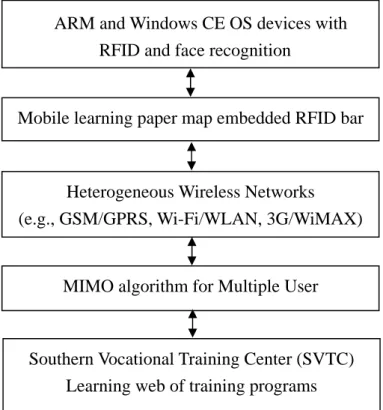
The Multiple users for mobile devices of student via RFID reads are continuously sent to the server, which keeps track only of the most recent tag ID. The mobile devices user interface was accomplished using a standard web browser. Pressing a physical button on the handheld computer (or mobile devices) mapped to a request for the server’s base URL causes the server to retrieve html-formatted information mapped to the most recently read tag ID, which is then displayed on the mobile devices screen. The mobile learning was developed to synchronise wireless with a user’s personal web based portfolio from any remote location where a cellular telephone signal or wireless (Wi-Fi) connection could be obtained shown as Figure 1.
ARM and Windows CE OS devices with RFID and face recognition
Mobile learning paper map embedded RFID bar
Heterogeneous Wireless Networks (e.g., GSM/GPRS, Wi-Fi/WLAN, 3G/WiMAX)
MIMO algorithm for Multiple User
Southern Vocational Training Center (SVTC) Learning web of training programs
3. ARM and Windows CE OS for XScale PXA270
Embedded systems are computer systems that are part of larger systems and they perform some of the requirements of these systems. Some examples of such systems are automobile control systems, industrial processes control systems, mobile phones, or small sensor controllers. Embedded systems cover a large range of computer systems from ultra small computer-based devices to large systems monitoring and controlling complex processes. The overwhelming number of computer systems belongs to embedded systems: 99% of all computing units belong to embedded systems today [17].
By developing electronic technology, the chip manufacture to be lower cost and enhanced function, so that embedded microprocessor has become a mainstream of embedded system design. However, the only embedded microprocessor is not enough, but also need an embedded operating system platform on microprocessor. Embedded operating system is transplantable, can be running on different microprocessor, with little kernel spending, high efficiency, highly modular and expansibility. It can provide multi-task, multi-process, multi-thread, and support a variety of equipments, network, user interface [18].
The target board contains an Intel's XScale PXA270 processor, a VGA size LCD panel, and a Flash memory storage system. The Intel PXA270 is a RISC (Reduced Instruction Set Computer) processor with 520MHz clock speed [19].
3.1 Windows CE Embedded Operation System
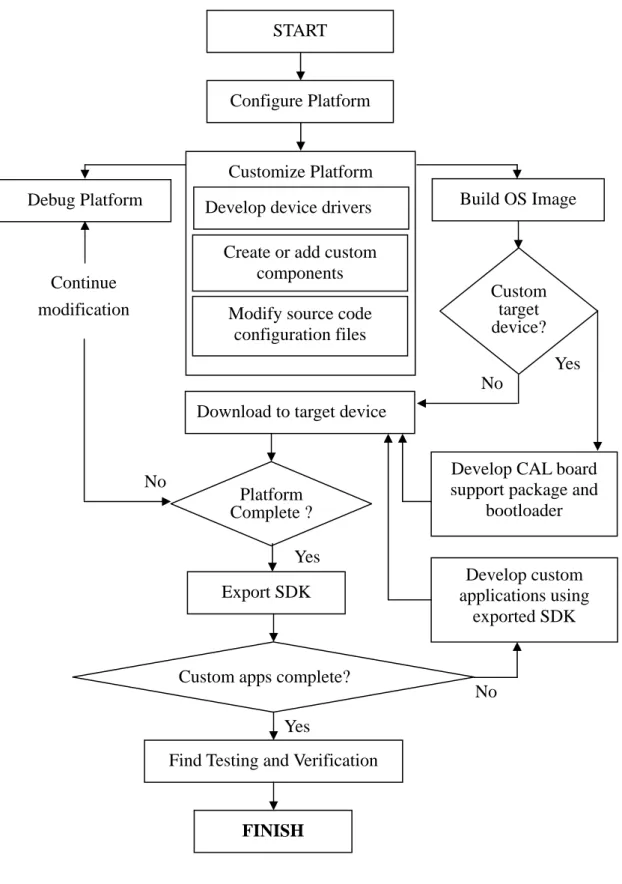
Windows CE (WinCE) is a multi-task and real-time embedded operating system for 32 processors. It is compact, efficient and reducible, be applied to hardware resource-constrained systems. From the system point of view, WinCE is not merely an operating system, but also includes equipment support, system development kit, application development kit, integrated application procedure and so on. A WinCE system can be divided into four layers: hardware, hardware support, operating system and application. The hardware layer includes microprocessor and all peripheral equipment. Board support package (BSP) provides interface between hardware and operating system. The operating system layer visit hardware through API provided by BSP. OS with WinCE components can customize to optimal performance. Application layer is user applications for embedded system development. WinCE has good real-time performance, high reliability, openness and good man-machine interface. Embedded system based on WinCE provides unified and expandable solution. The special hardware durability and the PC flexibility unifies in together.
START
Configure Platform
Customize Platform
Build OS Image Debug Platform Develop device drivers
Create or add custom components Modify source code
configuration files
Develop CAL board support package and
bootloader Develop custom applications using exported SDK Continue modification
Download to target device
Custom target device? Export SDK No Yes Platform Complete ? No Yes
Custom apps complete?
No
Find Testing and Verification
FINISH
Yes
4. Heterogeneous Wireless Networks
Providing network services to users by using multi–hop wireless connections is becoming evermore popular. In multi-hop wireless networks, communication between two nodes is carried out through a number of intermediate nodes. In the last few years, many research activities have been focused on multi-hop ad hoc networks, consisting of mobile nodes whose operation does not require infrastructure support. At the same time, an increasing number of multi-hop wireless deployments and proprietary commercial solutions gave rise to a class of networks known as mesh networks. Mesh networks serve as access networks to send traffic to and from the wireline Internet in a multi–hop fashion. The intermediate nodes will typically play a role of static relays.
Provisioning of high network capacity is a critical point for multi–hop access networks. The bandwidth in such networks is often limited, as nodes within the network carry the burden of forwarding (routing) packets that are not destined for them but to other nodes in the network. As wireless multi–hop networking grows in its usage, the services requested by users are extending and become more sophisticated. With continuously growing device capabilities, users demand services similar to those accessible on wired and infrastructure-based wireless networks.
Heterogeneous wireless network (HWN) provides the solution that supports basic and advanced requirements to wireless personal communication systems. Generally, subscribers in HWN can initiate internet connection, voice conversation and interactive conference in an integrated manner. Consequently, HWN provides convenient and high-speed communications including global Internet, cellular network and wireless local area network.
Technically, HWN integrates the features of cellular network and ad hoc network is shown as Figure 3. We assume that each node could be equipped with a cellular (e.g., GSM) interface and an ad hoc (e.g., wireless LAN) interface. The basic idea of HWN is that mobile stations can communicate directly with each other or access cellular network through other mobile stations via multiple hops. It keeps the bene-fits of cellular network and incorporates the adaptability of ad hoc networks as well. Therefore, HWN supports all nodes in ad hoc network to connect to farther nodes via cellular network and nodes in cellular network can communicate with linking nodes with high-speed transmission service by ad hoc network without infrastructure. Therefore, HWN can make good use of infrastructure of cellular network and the feature of ad hoc network – fast and simple re-configuration. Besides, HWN can reduce the number of required base stations and improve the performance. Furthermore, it facilitates connections without base stations, multiple connections within the same cell, and high-speed packet transmission services. Last but not least, since base stations can help reduce the wireless hop count, paths are more stable and steady.
the cellular network. If the source (S3) is in the cell coverage while the destination (D3) is not in any cell coverage, the traditional network will not support this type of connection. But in the HWN, packets can be sent to the base station first via a one multihop path, and forwarded to the base station where the destination resides, and afterwards packets will be forwarded to the destination, probably via another multihop path again. Based on this method, connections of different types can be supported by the HWN [13][14].
Figure 3. HWN topology
5. Mobile Platform Learning
The convergence of mobile communications and handheld computers offers the opportunity to develop technology that will assist individuals and groups to learn anytime, anywhere [5]. Emerging mobile technologies provide a vehicle for evolving threaded discussion to a third generation (3G) that better emulates face-to-face discussions by delivering the discourse, in device-scaled form, to the participants in real time wherever they are. Constructivist learning has taken on increasing attention in the popular shift of instructor/learner roles toward a learner-centric model. Constructivism emphasizes the ability of learners to build their own knowledge and understanding of a given topic. As mobile computing clients have evolved, they have incorporated the ability to access many different types of networks from centralized LANs and Wide Area Networks (WANs), to 802.11 hotspots, and peer-to-peer connectivity via infrared, Radio Frequency (RF), and Bluetooth. The presence of all these options in single devices opens up the possibility of extending ubiquitous access beyond the reach of current telecommunications build-outs. On the other hand, users can connect directly with other devices using peer-to-peer networks, bypassing the centralized networks and servers to share data directly with each other. Mobility is quickly being embraced by the learning community and promises to effect dramatic changes. Aside from providing true anytime, anywhere access to resources, mobile devices can be used as data collection tools for students conducting primary research, and in support of direct client interaction in professional disciplines like instrument marking, mechatronics and instrument testing and control [4].
Much electronic tour guide research has grappled with the tension between context-driven information ‘push’ and user-driven information ‘pull’. Integrating an electronic resource like a guide with a paper map provides a clear way to achieve information pull, recognizing that information needs while touring or way-finding are not always dictated by current location [1].
6. Mobile RFID Service
Mobile RFID loads a compact RFID reader in a cellular phone, providing diverse services through mobile telecommunications networks when reading RFID tags through a cellular phone [11]. The RFID technology provides a lot of information of goods to make-up convenient. Researchers have proposed utilizing RFID and PDA-size mobile device to improve Mobile learning. But the mobile device is separated from RFID reader. The RFID reader gathers data and sends them to the internet. The mobile device only receives or gets these data via Internet and wireless network. In this paper, the system will focus on how to use this technology to improve regular the mobile learning for common students.
Figure 5. Vocational training paper map with RFID
Figure 6. 13.56MHz RFID chip
7. MIMO Algorithm for Multiple-user
Multiple-input multiple-output (MIMO) communication techniques have been an important area of focus for next-generation wireless system because of their potential for high capacity, increased diversity, and interference suppression. For applications such as mobile platform learning information system and GSM module, MIMO systems will likely be deployed in environments where a single base must communication with many users simultaneously [20].
7.1 Multiple-user MIMO downlink model
The downlink channel, where the base station is simultaneously transmitting to a group of users, is illustrated Figure 7. In the situation depicted, the base attempts to transmit over the same channel to users, but there is some inter-user interference for user 1 generated by the signal transmitted to user 2 and vice versa. With the aid of MUD, it may be possible for a given user to overcome the multiple access interference (MAI), but such techniques are often too costly for use at the receivers [20].
K k k k k K k k k k k k K k k k k 1,2...., for , 1 , 1 = + = ⎟⎟ ⎠ ⎞ ⎜⎜ ⎝ ⎛ + + = + ⎟⎟ ⎠ ⎞ ⎜⎜ ⎝ ⎛ + =
∑
∑
≠ = ≠ = z x H n x H x H n x x H y μ μ μ μ μ μ (1)With the M matrix channel between the M base-station array elements and the array elements of user k represented by . The received additive noise plus intercell interference is characterized by the covariance matrix
BS k×M k M BS k H
{
H}
k k n nk k E n n R = k z ) 1 ( log2 +SINR. The received vector at antenna array k can be written as a superposition of the desired signal H and noise plus intercell plus intercell interference in Figure 8. That will be non-Gaussian. However, it has been
shown that the capacity may still be closely approximated by the Shannon formula , if the noise plus interference is zero-mean, additive, and statistically independent from user signal
k y k x k x . k k z k z … User 1 User 2 User n M-learning information database Client user …
Figure 7. The system model for MIMO
x Tx and y Rx
- multiple parallel channels
Multi-element Receiver Multi-element
x
y
Transmitter Basest ati o n Te rm in a l Channel Matrix,H
MIMO Channel7.2 Multiple-user MIMO uplink model
In contrast to the multiple-user MIMO downlink, where each received vector signal only depends on a single MIMO matrix, the received signal in the uplink is influenced by a total of K MIMO channels of dimension from each user to the receiving base station [21]. The received signals at the base station can be written as k H MBS×Mk
[
]
k K K k K K k k k n x x x H H H n Hx n x H y + ⎥ ⎥ ⎥ ⎥ ⎦ ⎤ ⎢ ⎢ ⎢ ⎢ ⎣ ⎡ = + = + =∑
= M 2 1 2 1 1 ... (2)With the vector n including again noise and intercell interference. The mult
1 × BS M
iple-user MIMO uplink may be viewed as large MIMO system represented by the MIMO channel matrix H of dimension MBS×
∑
Mk . However, although fast feedback from the base station to each user term es joint optimization of the antenna weight vectors, powers, and modulation and coding schemes (MCS) for all parallel data streams of all users (at least for low terminal speed and hence quasi-static channels), we cannot assume any correlation between user data. Therefore, the joint signal covariance matrixinal enabl
{
xx}
Rxx =E H is block diagonal, i.e., ) ,..., , ( ( xx xx xx xx blockdiag R R R R = 2 2 1 1 k k 3)
In a cellular network there are tow communication problems to consider: the uplin
8. Technical and Vocational Education and Training
ng for non employed resid
k, where a group of users all transmit data to the same base station, and the downlink, where the base station attempts to transmit signals to multiple users. In single-user MIMO channels, the benefit of MIMO processing is gained from the coordination of processing among all the transmitters or receivers. In the multiple-user channel, it is usually assumed that there is no coordination between users is that the problem differs somewhat between the uplink and downlink channels.
Vocational training in this research refers to before job traini
9. 3D Face Recognition
logy can be used in wide range of application such as ss control, and surveillance. Interests and research activ
Face recognition techno identity authentication, acce
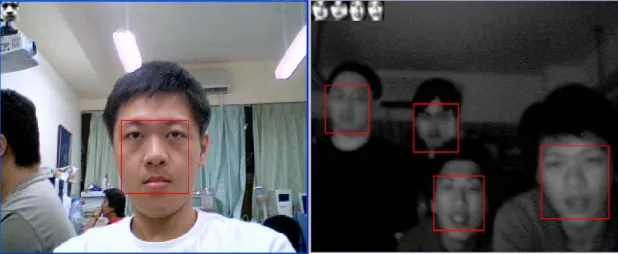
ities in face recognition have increased significantly over the past few years. A face recognition system should be able to deal with various changes in face images. Every face image in the database is represented as a vector of weights, which is the projection of the face image to the basis in the eigenface space. Usually the nearest distance criterion is used for face recognition [15][16]. Figure 9 is presented a basically uniform intensity, and the difference between the average gray values of the center part and the upper round part is significant. To train the face recognizer we first ran the component-based detector over each image in the training set and extracted the components are shown in figure 10.
Figure 9. A typical face localization
Figure 10. (a) is shown as the Face detector. (b) is shown as the face recognition y
com n
calcu
The geometrical configuration classifier performed the final face detection b bining the results of the component classifiers. The search regions have bee
lated from the mean and standard deviation of the components’ locations in the training images is shown as figure 11. Students face detection and recognition simulation at light and night in classroom are shown as figure 12 and 13.
Figure 12. Student’s face detection and recognition at light and night
Figure 13. The 3D student face detection and recognition
10. Conclusion
This system given the advantages of handheld technologies, the exponential growth of its use in vocational training d the computing and data management
capabilities of support the
mobile use of portfolios in the training program learning environment. A puting and communications platform it appears that the wireless and it improve vocational training learning, and this point the refer
an
the PDA it would seem a logical and powerful tool to multifunctional com
PDA can support
Figure 14. Mobile RFID System
11. References
[1]Derek Reilly, Malcolm Rodgers, Ritchie Argue, Mike Nunes, Kori Inkpen, “Marked-up maps: combining paper maps and electronic information resources”, Personal and Ubiquitous Computing, Volume 10, Number 4 / May. 2006.
[2]Garrett, Bernard Mark; Jackson, Cathryn, “A mobile clinical e-portfolio for nursing and medical students, using wireless personal digital assistants (PDAs)”, Nurse Education Today Volume: 26, Issue: 8, December, 2006, pp. 647-654.
[3]Weiping Zhu; Dong Wang; Huanye Sheng;, “Mobile RFID technology for improving m-commerce”, e-Business Engineering, ICEBE 2005. IEEE International Conference on 18-21 Oct. 2005 Page(s):118 – 125.
[4]Timothy R. Hill, Malu Roldan, “Toward Third Generation Threaded Discussions for Mobile Learning: Opportunities and Challenges for Ubiquitous Collaborative Environments”, Information Systems Frontiers, Volume 7, Number 1 / Feb. 2005. [5]Mike Sharples, Dan Corlett, Oliver Westmancott, “The Design and Implementation
of a Mobile Learning Resource”, Personal and Ubiquitous Computing, Volume 6, Number 3, May. 2002.
[6]Hyangjin Lee; Jeeyeon Kim, “Privacy threats and issues in mobile RFID”, Availability, Reliability and Security, ARES 2006. The First International Conference on 20-22 April 2006 Page(s):5.
[7]Gwo-Jiun Horng; Ming-Liang Hou; Gwo-Jia Jong; Chwen-Fu Horng, “The Intelligent Safety Care System of the Wireless Mesh Network”, International MultiConference of Engineers and Computer Scientists 2007, 21-23 March,2007 Page(s):1242-1245 vol.2.
[8]Ryoson, H.; Goto, K.; Ueno, M.; Kikuchi, A.; Shimpuku, Y.; “A 13.56 MHz RFID device and software for mobile systems”, Consumer Communications and Networking Conference, 2005. CCNC. 2005 Second IEEE, 3-6 Jan. 2005 Page(s):241 – 244.
[9]Sandoval-Reyes, S.; Soberanes Perez, J.L.;, “Mobile RFID reader with database wireless synchronization”, Electrical and Electronics Engineering, 2005 2nd International Conference on 7-9 Sept, 2005 Page(s):5 – 8.
[10]Weiping Zhu; Dong Wang; Huanye Sheng;, “Mobile RFID technology for improving m-commerce”, e-Business Engineering, 2005. ICEBE 2005. IEEE International Conference on 18-21 Oct. 2005, Page(s):118 – 125.
[11]Jun Seob Lee; Hyoung Jun Kim;, “RFID code structure and tag data structure for mobile RFID services in Korea”, Advanced Communication Technology, 2006. ICACT 2006. The 8th International Conference Volume 2, 20-22 Feb. 2006 Page(s):3 pp.
[12]Potter, Bruce;, “RFID: misunderstood or untrustworthy?”, Network Security Volume: 2005, Issue: 4, April, 2005, pp. 17-18.
Heterogeneous Wireless Network”, Mobile Networks and Applications, Volume 9, , 2004.
ol. 2, 09-12 July
[1
[1
rement and Instruments, 2007. ICEMI '07. 8th International
[1
05. Proceedings. 27th International [2
[2
. VTC 2002-Fall. 2002 IEEE 56th, Volume 2, 24-28 Sept. 2002 Page(s):879 - 883 vol.2
Number 3 / Jun
[14]Patrick Seeling, Martin Reisslein, Tatiana K. Madsen, Frank H. P. Fitzek;, “Performance Analysis of Header Compression Schemes in Heterogeneous Wireless Multi–Hop Networks”, Wireless Personal Communications, Volume 38, Number 2 / Jul, 2006.
[15]G. Guo, S.Z. Li, K. Chan, “Face Recognition by Support Vector Machines”, Proc. of the IEEE International Conference on Automatic Face and Gesture Recognition, 26-30 March 2000, Grenoble, France, pp. 196-201.
[16]B. Heisele, P. Ho, T. Poggio, “Face Recognition with Support Vector Machines: Global versus Component-based Approach”, Proc. of the Eighth IEEE International Conference on Computer Vision, ICCV 2001, V
2001, Vancouver, Canada, pp. 688-694.
7]Chang, Hoseok; Lee, Youngjoon; Sung, Wonyong;, “Performance Optimization of a Multimedia Player on a Mobile CPU Platform”, Signal Processing Systems, 2007 IEEE Workshop on 17-19 Oct. 2007 Page(s):163 – 168.
8]Min, Jiang;, “A Design of Embedded Terminal Unit Based on ARM and Windows CE”, Electronic Measu
Conference on Aug. 16 2007-July 18 2007 Page(s):2-336 - 2-340.
9]Crnkovic, I.;, “Component-based software engineering for embedded systems”, Software Engineering, 2005. ICSE 20
Conference on 15-21 May 2005 Page(s):712 – 713.
0]Spencer, Q.H.; Peel, C.B.; Swindlehurst, A.L.; Haardt, M., “An introduction to the multi-user MIMO downlink”, Communications Magazine, IEEE, Volume 42, Issue 10, Oct. 2004 Page(s):60 – 67