行政院國家科學委員會補助專題研究計畫成果 報告
※※※※※※※※※※※※※※※※※※※※※※※
(計畫名稱) 矯正支架與金屬線之腐蝕性與釋出物之生物相容性 研究
※※※※※※※※※※※※※※※※※※※※※※※
計畫類別:*個別型計畫 □整合型計畫 計畫編號:90-2314-B-040-013-;
執行期間:90 年 8 月 1 日至 91 年 7 月 31 日 執行單位:中山醫學大學口腔醫學研究所
計畫主持人:高嘉澤 共同主持人:丁信智
中 華 民 國 91 年 10 月 1 日
(計畫名稱) 矯正支架與金屬線之腐蝕性與釋出物之生物相容性
研究
計畫編號:90-2314-B-040-013-;
執行期間:90 年 8 月 1 日至 91 年 7 月 31 日 執行單位:中山醫學大學口腔醫學研究所
計畫主持人:高嘉澤 共同主持人:丁信智
中文摘要
金屬矯正之架長期使用於口腔內,因 口腔內環境之變化會對金屬產生腐蝕 之現象。本研究之目的比較金屬矯正 支架新的與經熱處理後之矯正支架進 泡於不同pH值環境下經四十八週後,
觀察與比較其金屬離子支釋放。金屬 矯正裝置經浸泡於不同酸鹼值之緩衝 液後,以金屬原子吸收光譜儀分析定 量其中之Ni, Cr, Fe, Cu, Co, Mg等離 子。以ANOVA統計比較差異性。結果 發現:一、經熱處理過之矯正支架其 金屬梨子釋出量較高。二、於酸之緩 衝以中釋放之金屬離子較於中性環境 下較高。三、隨著時間增加,四十八 週浸泡之矯正支架其釋放金屬離子有 增加之現象。研究結果顯示:金屬矯 正 之 架於 口 腔環 境 下 會 發 生 腐 蝕 現 象。因此如何改善金屬矯正之架之腐 蝕反應為日後研究之重要目標。
Abstract
Objectives. Orthodontic appliances can corrode with time in the mouth. The purpose of this study was to compare the release of metal ions from
new and recycled brackets immersed in buffers of different pH values over a 48-week period.
The brackets were divided into two groups: new and recycled. The base of the latter was coated with adhesive and the bracket was heat treated before being immersed in test solution for 48 weeks. The release of nickel, chromium, iron, copper, cobalt and manganese ions was analysed by atomic absorption spectrophotometry. Differences were analyzed using one-way analysis of variance. The result showed that (1) The recycled brackets released more ions than the new brackets. (2) Brackets immersed in solutions of pH 4 released more ions than those immersed in solutions of pH 7. (3) The total amount of ions released increased with time over the 48 week immersion period. This study shows that both new and recycled brackets will corrode in the oral environment. To avoid clinical side-effects, metal brackets should be made more resistant to corrosion, and
recycled brackets should not be used.
Key words: metal bracket, corrosion,
buffer solution, metal ion release
二、緣由與目的
In the oral environment, orthodontic appliances are exposed to potentially damaging physical and chemical agents which may cause metallic corrosion. Corrosion will occur continuously in the mouth, due to the release of ions with the abrasion of foods, liquids and tooth brushes [1].
Orthodontic appliances may corrode over time. Electrochemical breakdown of corrosion-resistant high-nickel and titanium wire can also occur [2]. Thus the orthodontic brackets and other auxiliary components should be made of highly corrosion-resistant metals and metal alloys.
Recycled orthodontic brackets may be used in the clinic for several reasons, including cost. A survey of 300 members of the British Orthodontics Society found that 47.5% of respondents recycled metal brackets, and this was done more so by specialist practitioners than consultants [3]. The use of recycled brackets can accelerate the corrosion process, which in turn can be responsible for the failure of orthodontic appliances, either fixed or removable [4].
It is proposed that corrosion of the bracket can cause the uptake of metal ions into the body. Approximately 10%
of the general population exhibits a hypersensitive reaction to nickel.
Peltonen reported that women were 10
times more sensitive to nickel than men [5]. Moffa found that 31.9% of women and 20.7% of men in a population of 403 showed a positive hypersensitivity reaction in a similar patch test of nickel sulfate [6]. In vitro experiments on cultured human gingival fibroblasts showed that ions released from implanted nickel-chromium alloys caused altered cellular functions [7]. In addition, other studies have reported decreased DNA synthesis and inhibition of enzymes in cultured cells when exposed to nickel-based alloys [8,9].
High-gold alloys are extremely resistant to corrosion, due to the high thermodynamic stability of gold [10,11].
In low-gold alloys, corrosion occurs primarily in silver rich regions and secondarily in copper-rich regions [12].
In the oral environment, there are different levels of moisture, changes in pH and variations in oxygen pressure.
The type and level of ions degraded from new and recycled metal bracket appliances introduced into the mouth need to be investigated. There is a lack of studies that compare the behaviour of new and recycled brackets in a long-term corrosive environment, in terms of ion leakage from the metal brackets. Discussion and clarification of this problem is needed.
The aim of this study was to compare the metal ions released from new and recycled metal brackets following immersion in buffer solutions for an extended time interval.
三、結果與討論
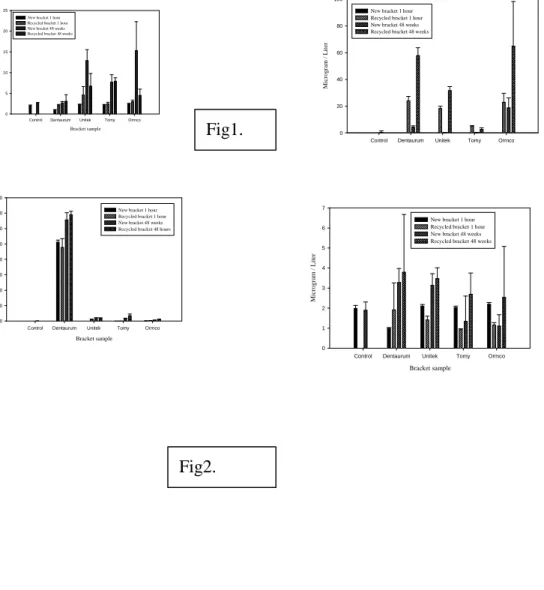
The results of graphite atomic absorption analysis of the solutions are presented in Figures 1 to 6.
Release of nickel ions:
Following immersion in the pH 4 buffered solution (Figure 1a), there were more nickel ions released from the recycled brackets than from the new samples, and more released after 48 weeks than after 1 hour for all samples tested. The Ormco brackets immersed for 48 weeks released the highest level of nickel ions, with the recycled group (307.3 ± 67.5 µg/ml) releasing more than its new counterparts (260.5 ± 17.9 µg/ml). There were more nickel ions released in the pH 4 solution (Figure 1a) than in the pH 7 solution (Figure 1b). At pH 7, the recycled samples released more ions than the new samples, with the highest levels coming from the recycled Dentaurum (57.82 ± 5.82µg/ml) and Ormco (65.0 ± 33.4µg/ml) brackets, respectively, both after immersion for 48 weeks.
Release of chromium ions:
At pH 4 (Figure 2a), new brackets from Unitek and Ormco immersed for 48 weeks showed the highest levels of
chromium release. There was no significant difference between new and recycled samples from Dentarum and Tomy treated for 48 weeks.
Brackets immersed in the pH 7 solutions (Figure 2b) showed no statistical difference between the new and recycled groups in chromium ion release, and also between those immersed for one hour and 48 weeks.
Release of copper ions:
At pH 4 (Figure 3a), all Dentaurum samples showed higher copper release than any of the other brands, regardless of the type of bracket and period of immersion. There was no statistical difference between the amount of copper ions released from the new and recycled Dentaurum brackets, with more released after 48 weeks.
After immersion in the pH 7 buffered solution (Figure 3b), the new Dentaurum brackets released the highest levels of copper ion, with over 2 times more released after 48 weeks than 1 hour immersion. These figures were approximately 2- and 5-fold higher, respectively, that the recycled Dentaurum bracket immersed for 48 weeks. The Unitek, Tomy, and Ormco brackets showed comparatively very small amounts of copper ion release.
Release of cobalt ions:
At pH 4 (Figure 4a), the recycled brackets showed higher levels of cobalt ion release than the new counterparts for all 4 bracket brands and at both time points of immersion.
At pH 7 (Figure 4b), the brackets immersed for 48 weeks showed the only noteworthy levels of cobalt ion release, with the Dentaurum and Unitek samples releasing the highest amounts.
Release of iron ions:
At pH 4 (Figure 5a), more iron ions were released from all the bracket types after 48 weeks immersion than after 1 hour, and the recycled brackets consistently released more iron than the new group, except for the Tomy brackets where the difference between new and recycled at 48 weeks was not statistically significant. The highest iron ion released was from the Unitek recycled brackets (52.9 ± 6.3µg/ml) and Ormco recycled bracket (48.9 ± 1.3 µg/ml) after 48 weeks immersion.
There was less iron ion released in the pH 7 buffered solution (Figure 5b) than in the solution at pH 4. The recycled brackets released more iron ions than their new counterparts. The Ormco recycled brackets at 48 weeks immersion showed the highest iron ion release (8.6 ± 2.6 µg/ml).
Release of manganese ions:
At pH 4 (Figure 6a), the Tomy and Ormco recycled brackets released less manganese ions than their new counterparts at 48 weeks immersion, whereas the Unitek and Dentaurum recycled brackets released more manganese ions than the new samples.
The new (112.2 ±5.1 µg/ml) and recycled (121.9 ± 5.7 µ g/ml) brackets of
Unitek released the highest concentration of manganese ions.
At pH 7 (Figure 6b), the new brackets from Ormco and Tomy released higher amounts of manganese ions than the recycled brackets at 48 weeks immersion. The highest concentration of manganese ions released overall at this pH was observed from the new (105.7
± 3.9µg/ml) and recycled (104.53 ± 6.7 µg/ml) brackets from Unitek following 48 weeks immersion.
Discussion
Metal brackets immersed in buffered solutions for 48 weeks released more ions than those immersed for only one hour. This result was independent of the pH of the solutions or whether the bracket was new or recycled, and demonstrated that corrosion of a metal surface increases over time.
In general, recycled brackets released more ions than new ones, with the exception of the following:
chromium ions from Unitek and Ormco new brackets immersed in the pH 4 solution for 48 weeks; manganese ions released from new Tomy brackets in both the pH 4 and pH 7 solutions; and the manganese ions released from new Ormco brackets immersed in the pH 4 solution for 48 weeks.
The general mechanism for the corrosion and subsequent release of metal ions from stainless steel involves loss of the passivated layer of chromium oxide and chromium hydroxide which forms on the surface upon contact with
oxygen. Heat treatment of a metal bracket can alter the surface protection of the alloy. If the steel is heated to between 400 and 900
o
C, a chromium carbide precipitate is formed and, as a result, becomes susceptible to intragranular corrosion, leading to a general weakening of the structure [13-15]. During the recycling process, the brackets are heated to between 300 and 500o
C, which decreases the corrosion resistance [16]. Park et al.showed that the heat can cause intergranular corrosion due to loss of chromium carbide at the grain boundaries [17]. This is why most of the recycled brackets showed higher amounts of ions released than the new samples. From this point of view, if a bracket undergoes heat treatment, it is less able to resist corrosion.
Most metal brackets are not cast or fabricated in one piece. Instead, the wing and the base portion of metal bracket are connected by solder, which is primarily comprised of copper. The Dentaurum brackets released more copper ions than all other bracket brands, in either the pH4 or 7 solutions. In the pH4 solution, the new and recycled Dentaurum brackets released similar amounts of copper ions, but in the pH7 solution, more copper ions were released from the new brackets than from the recycled group. Berge et al. reported that silver solder introduces a galvanic couple, which influences both the stainless steel and the solder, by
facilitating the release of nickel as well as other metals [18]. It was seen in this study that large amounts of nickel, copper and manganese ions were released from some brackets following long-term immersion, with relatively lower amounts of chromium ions released. It is presumed that this is due to heat applied to the bracket during the fabrication process.
The corrosive environment can be discriminated into atmospheric corrosion, water corrosion, chemical corrosion, temperature corrosion, and microbiological corrosion. Acid solutions that cause chemical corrosion can be divided into inorganic, organic or mineral acid. During the fabrication process, the corrosive ability of inorganic acid is stronger than that of organic acid [13]. In the present study, the buffer solution consisted of NaHNO
3
and the pH was adjusted using HCl or NaOH, making the solution an inorganic acid, and therefore highly corrosive to metal alloys. More metal ions were released in the pH 4 solutions than in the solutions at pH 7, showing that bracket corrosion can be influenced by solution condition.
Chromium in an alloy can increase its corrosion resistant properties.
Chromium is added to nickel-based alloys to improve the alloy’s ability to form a protective oxide film on its surface. Generally, the alloy surface consists of a chromium oxide layer. It has been suggested that a chromium
content of 16-27% will provide the optimal corrosion resistance for nickel-based alloys, while the addition of molybdenum will further enhance the corrosion resistance [19]. In this study, more chromium was released from the brackets immersed in the pH 4 solution than from those treated at pH 7, with the new Unitek and Ormco samples releasing the highest chromium levels at pH 4. At pH 7, there was no difference between bracket brands. Gil el al. found that more ions were released from nickel-chromium alloys than from palladium alloys and gold silver alloys in lactic acid in vitro [20]. He suggested that nickel-chromium alloy microstructures are not single-phase and accordingly, do not present chemical homogeneity throughout their structure.
Thus the alloy structure would act as if it were an electrochemical cell, making the corrosion properties higher than with other alloys. Most orthodontic brackets are made of Ni-Cr alloy, containing 8-12% nickel and 17-22% chromium.
Recently, titanium brackets were developed, and according to the manufacturer’s descriptions, have many benefits, such as no patient hypersensitivity. Titanium is also highly corrosion resistant and appears to bind nickel [21], making the alloy corrosion resistant [21]. Whether or not these new titanium brackets are more corrosion resistant than other alloy brackets warrants further investigation.
In the study presented here, metal brackets were immersed in buffered solutions. In the clinical setting, the brackets are used in the oral cavity where they are mechanically activated to enable the movement of teeth. That is a dynamic situation, as opposed to the static condition used in the experiments described here. Thus, the movements of wires and friction in the brackets might result in other types of corrosion, for example, fretting corrosion, which might further enhance the release of constituents from the appliance [22].
Further study is needed to simulate this additional variable in an analysis of ion release from the bracket appliances.
As mentioned earlier, recycled brackets might be considered in the clinic on the basis of cost. Recently, many types of bracket have been developed, all of a reasonable price to the public. It should be stated that the recycled bracket conditions simulated here represented not only those seen with old brackets, but also the situation in the clinic when a lost bracket is reused on the same patient. From the present study, it is obvious that the ion released from a bracket is increased after one year of immersion. In consideration of patient health, the use of recycled and poor quality brackets should be avoided.
Further to this, it is important to continue improving new brackets to resist corrosion.
計劃成果自評
The present study showed that the metal brackets tended to releasing the metal ions in tested environments. From the study we may understand in vitro the orthodontic appliance will corroded in the buffer solutions. But will it be the same results when in vivo test? It will be the project in the feature. The buffer solution can not be actually represent the condition in oral environment. The better solution should be considered in vitro test. Such as the solution is needed to be de-oxygen treatment before use.
The oxygen and chloride can affect the result. But in this study the buffer solution adjustment is adjusted without ion contained solution. We try to minimal the ions pollution. The more the health we needed, the more the accurate study is needed.
Reference
[1]. Geis-Gerstorfer J. In vitro corrosion measurements of dental alloys. J Dent, 1994; 22:247-251.
[2]. Maijer R and Smith DC.
Biodegradation of the orthodontic bracket system. Am J Orthod Dentofacial Orthop, 1986;
90:195-198.
[3]. Coley-Smith A and Rock WP.
Bracket recycling-who does what? Br J Orthod, 1997; 24: 172-174.
[4] Muller HJ. Tarnish and corrosion of dental alloys. In: Metals Handbook, 9th ed. ASM Metals Park, OH, 1986;
Vol. 13, p. 1340
[5]. Peltonen L. Nickel sensitivity in the general population. Contact Dermatitis, 1979; 5:27-532.
[6] Moffa JR. Biological effects of nickel-containing dental alloys.
Council on Dental Materials, Instruments and Equipment. J Am Dent Assoc, 1982; 104:501-5
[7] Messer RL and Lucas LC.
Cytotoxicity of nickel-chromium alloys: bulk alloys compared to multiple ion salt solutions. Dent Material, 2000; 16: 207-212.
[8] Wataha JC, Hanks CT and Craig RG.
The in vitro effects of metal cations on euckarotic cell metabolism. J Biomed Mater Res, 1991;
25:1133-1149.
[9] Bumgardner JD and Lucas LC.
Cellular response to metallic ions released from nickel-chromium dental alloys. J Dent Res, 1995;
74:1521-1527.
[10] Canay S and Oktermer M. In vitro corrosion behaviour of 13 prosthodontic alloys. Quintessence Int, 1992; 23: 279-287.
[11] Lucas LC and Lemons JE.
Biodegradation of restorative metallic systems. Adv Dent Res, 1992; 6:
32-37.
[12] Laub LW and Stanford JW. Tarnish and corrosion behaviour of dental gold alloys. Gold Bull, 1981;
14:13-18.
[13] Matasa CG. Attachment corrosion and its testing. J Clinic Orthod, 1995;
29:16-23.
[14] Kerosuo H, Moe G and Hensten-Pettersen, A. Salivary nickel and chromium in subjects with different types of fixed othodontic appliances. Am J Orthod Dentofacial Orthop, 1997; 111:595-598.
[15] Philip RW. Skinner’s science of dental materials. 7
th
ed. Philadelphia, WB Saunder Co. 1973; pp.217-41;641-55.
[16] Hensten-Pettersen A, Gjerdet NR, Kvan E und Lyberg T. Nickelallergi og Kjeveortopedisk behandling. Nor Tannlefor Tid, 1984; 94: 567-572.
[17] Park HY and Shearer TR. In vitro release of nickel and chromium from simulated orthodontic appliances. Am J Orthod, 1983; 84:156-159.
[18] Berge M, Gjerdet NR and Erichsen ES. Corrosion of silver soldered orthodontic wires. Acta Odontal Scand, 1982; 40:75-79.
[19] Brune D. Metal release from dental biomaterials. Biomaterials, 1986; 7:163-175.
[20] Gil FJ, Sanchez LA, Espias A and Planell JA. In vitro corrosion behaviour and metallic ion release of different prosthodontic alloys. Int Dent J, 1999; 49:361-367.
[21] Dunlap CL, Vincent SK and Barker BF. Allergic reaction to orthodontic wire: report of case. J Am Dent Assoc, 1989;118:449-450.
[22] Magnusson B, Bergman M, Bergman B and Soremark R. Nickel allergy and nickel-containing dental alloys. Scand J Dent Res, 1982;
90:163-167.
TABLE 1. Details of the metal brackets
Company Bracket type Position Size Order No.
Tomy Co. (Tokyo, Japan)
Micro-LOC bracket, standard edgewise
upper bicuspid .018’ 920-45
Ormco Co. (Orange, Ca, USA)
Diamond bracket, standard edgewise
upper bicuspid .018’ 340-0604
Unitek 3M. Co.
(Monrovia, Ca, USA)
Twin torque bracket Andrew
upper bicuspid .018’ 018-203
Dentaurum Co.
(Pforzheim, Germany)
Discovery direct bond bracket
System Ricketts Universal
upper bicuspid .018’ 790-136-00
TABLE 2. The content of the artificial saliva.
Company Sinphar Pharm Co.LTD.Taipei, Taiwan Content Sali Lube (Saliva substitute)
Soldium Chloride 0.844 mg Potassium Chloride 1.2 mg Calcium Chloride Anhydrous 0.146 mg Magnesium Chloride 6 H2O 0.052 mg Potassium Phosphate dibasic 0.34 mg Sorbitol Solution 70% 60 mg Methyl Paraben 2 mg Hydroxyethyl Cellulose 3.5 mg
Figure 1. Nickel ion released from the new and recycled metal brackets after one hour and 48 weeks immersion. a. immersion in buffer at pH 4. b. immersion in buffer at pH 7.
Figure 2. Chromium ion released from the new and recycled metal brackets after one hour and 48 weeks immersion. . a. immersion in buffer at pH 4. b. immersion in buffer at pH 7.
Figure 3. Copper ion released from the new and recycled metal brackets after one hour and 48 weeks immersion. . a. immersion in buffer at pH 4. b. immersion in buffer at pH 7.
Figure 4. Cobalt ion released from the new and recycled metal brackets after one hour and 48 weeks immersion. . a. immersion in buffer at pH 4. b. immersion in buffer at pH 7.
Figure 5. Iron ion released from the new and recycled metal brackets after one hour and 48 weeks immersion. . a. immersion in buffer at pH 4. b. immersion in buffer at pH 7.
Figure 6. Manganese ion released from the new and recycled metal brackets after one hour and 48 weeks immersion. . a. immersion in buffer at pH 4. b. immersion in buffer at pH 7.
Bracket sample
Control Dentaurum Unitek Tomy Ormco
Microgram / Liter
0 20 40 60 80 100
New bracket 1 hour Recycled bracket 1 hour New bracket 48 weeks Recycled bracket 48 weeks
Bracket sample Control Dentaurum Unitek Tomy Ormco
Microgram / Liter
0 5 10 15 20 25
New bracket 1 hour Recycled bracket 1 hour New bracket 48 weeks Recycled bracket 48 weeks
Bracket sample
Control Dentaurum Unitek Tomy Ormco
Microgram / Liter
0 1 2 3 4 5 6 7
New bracket 1 hour Recycled bracket 1 hour New bracket 48 weeks Recycled bracket 48 weeks
Bracket sample
Control Dentaurum Unitek Tomy Ormco
Microgram / Liter
0 100 200 300 400 500 600 700 800
New bracket 1 hour Recycled bracket 1 hour New bracket 48 weeks Recycled bracket 48 hours
Fig1.
Fig2.
Bracket sample
Control Dentaurum Unitek Tomy Ormco
Microgram / Liter
0 50 100 150 200 250 300 350 400
New bracket 1 hour Recycled bracket 1 hour New bracket 48 weeks Recycled bracket 48 weeks
Bracket sample
COntrol Dentaurum Unitek Tomy Ormco
Microgram / Liter
0 100 200 300 400 500
New bracket 1 hour Recycled bracket 1 hour New bracket 48 weeks Recycled bracket 48 weeks
Bracket sample
Control Dentaurum Unitek Tomy Ormco
Microgram / Liter
0 1 2 3 4 5
New bracket 1 hour Recycled bracket 1 hour New bracket 48 weeks Recycled bracket 48 weeks
Bracket sample Ccontrol Dentaurum Unitek Tomy Ormco
Microgram / Liter
0 1 2 3 4
New bracket 1 hour Recycled bracket 1 hour New bracket 48 weeks Recycled bracket 48 weeks
Bracket sample
Control Dentaurum Unitek Tomy Ormco
Microgram / Liter
0 10 20 30 40 50 60
New bracket 1 hour Recycled bracket 1 hour New bracket 48 weeks Recycled bracket 48 weeks
Bracket sample
Control Dentaurum Unitek Tomy Ormco
Microgram / Liter
0 2 4 6 8 10 12
New bracket 1 hour Recycled bracket 1 hour New bracket 48 weeks Recycled bracket 48 weeks
Bracket sample
Control Dentaurum Unitek Tomy Ormco
Microgram / Liter
0 20 40 60 80 100 120 140
New bracket 1 hour Recycled bracket 1 hour New bracket 48 weeks recycled bracket 48 weeks
Bracket sample Control Dentaurum Unitek Tomy Ormco
Microgram / Liter
0 20 40 60 80 100 120
New bracket 1 hour REecycled bracket 1 hour New bracket 48 weeks Recycled bracket 48 weeks
Fig3.
Fig4.
Fig 5.
Fig6.