Perturbative QCD analysis of B \
K * decays
Chuan-Hung Chen*
Institute of Physics, Academia Sinica, Taipei, Taiwan 115, Republic of China Yong-Yeon Keum†
Department of Physics, Graduate School of Science, Nagoya University, Nagoya 464-8602, Japan Hsiang-nan Li‡
Institute of Physics, Academia Sinica, Taipei, Taiwan 115, Republic of China
and Department of Physics, National Cheng-Kung University, Tainan, Taiwan 701, Republic of China 共Received 17 April 2002; published 26 September 2002兲
We study the first observed charmless B→VV modes, the B→K*decays, in perturbative QCD formalism.
The obtained branching ratios B(B→K*)⬃15⫻10⫺6 are larger than⬃9⫻10⫺6 from QCD factorization.
The comparison of the predicted magnitudes and phases of the different helicity amplitudes, and branching ratios with experimental data can test the power counting rules, the evaluation of annihilation contributions, and the mechanism of dynamical penguin enhancement in perturbative QCD, respectively.
DOI: 10.1103/PhysRevD.66.054013 PACS number共s兲: 12.38.Bx, 11.10.Hi, 12.38.Qk, 13.25.Hw The branching ratios of the penguin-dominated B→K
decays, about 3– 4 times larger than those of the tree- dominated B→ decays, indicate that penguin contribu- tions must be enhanced. This enhancement can be achieved either by large Wilson coefficients C4,6 associated with the penguin operators in perturbative QCD共PQCD兲 关1–3兴, or by a large chiral symmetry breaking scale m0 associated with the kaon in QCD factorization 共QCDF兲 关4,5兴. The latter mechanism, called chiral enhancement, corresponds to a characteristic scale of O(mb), at which we have m0(mb)
⬃3 GeV and the smaller Wilson coefficients C4,6(mb). The former mechanism, called dynamical enhancement, corre- sponds to a characteristic scale of O(冑⌳¯ mb), ⌳¯⫽MB⫺mb
being the B meson and b quark mass difference, at which we have m0(冑⌳¯ mb)⬃1.5 GeV and the larger Wilson coeffi- cients C4,6(冑⌳¯ mb)⬃1.5C4,6(mb). Recently, we have pro- posed the B→K decays as the appropriate modes to clarify the above issue关6,7兴. These modes are not chirally enhanced because is a vector meson, and they are insensitive to the variation of the unitarity angle 3 because they are pure penguin processes. If the data of the branching ratios B(B
→K) are settled down at values around 10⫻10⫺6 关7,8兴 instead of 4⫻10⫺6 关9,10兴, the dynamical enhancement of penguin contributions to charmless nonleptonic B meson de- cays will gain strong support.
Here we argue why the characteristic scale involved in two-body B meson decays must be of O(冑⌳¯ MB) in PQCD from two points of view. Consider a two-body nonleptonic decay, in which the two final-state light mesons move back- to-back with large momenta. The lowest-order diagram for its amplitude contains a hard gluon attaching the spectator quark. Intuitively, the spectator quark in the B meson, form-
ing a soft cloud around the heavy b quark, carries momentum of order ⌳¯ . The spectator quark on the light-meson side carries momentum of O( MB) in order to form the fast- moving light meson with the u quark produced in the b quark decay. Note that the end-point singularities from the small spectator momentum on the light-meson side do not exist in a self-consistent PQCD formalism, because of Sudakov sup- pression from kTand threshold resummations关11,12兴. Based on the above argument, the hard gluon is off-shell by order of ⌳¯ MB. This scale characterizes the corresponding quark- level hard amplitude, which involves the four-fermion decay vertex. Theoretically, the hard scale ⌳¯ MB is essential for constructing a gauge invariant B meson wave function. This wave function, though being a nonlocal matrix element, is gauge invariant in the presence of the path-ordered Wilson line integral. A careful investigation 关13,14兴 shows that the O(␣s
2) diagram with the second gluon attaching the hard gluon contributes to this line integral. That is, this diagram contains the soft divergence, which is factorized into the B meson wave function. This is possible only when the hard gluon is off shell by the intermediate scale⌳¯ MB rather than by MB2.
In this work we shall perform a PQCD analysis of the first observed charmless B→VV modes, the B→K* decays, which are similar to B→K, also appropriate for distin- guishing the different penguin enhancing mechanism. Be- sides, the B→VV modes reveal dynamics of exclusive B meson decays more than the B→PP and VP modes through the measurement of the magnitudes and the phases of various helicity amplitudes. According to the power counting rules defined in 关7兴, the longitudinal amplitude is leading, and the other two amplitudes are down by a power of M/ MB or of MK*/ MB, Mand MK*being theand K*meson masses, respectively. Since the B→K*decays are insensitive to the unitarity angle, the relative phases among the helicity ampli- tudes mainly arise from strong interaction. The annihilation contributions, which can be evaluated unambiguously in our
*Email address: [email protected]
†Email address: [email protected]
‡Email address: [email protected]
approach, generate the strong phases. Therefore, comparing the predicted magnitudes and relative phases among the dif- ferent helicity amplitudes, and the predicted branching ratios with experimental data, we test the power counting rules, the evaluation of annihilation contributions, and the mechanism of dynamical penguin enhancement in PQCD, respectively.
The idea of the PQCD factorization theorem for two-body nonleptonic B meson decays has been reviewed in关1,15,16兴, which is subject to corrections of O(␣s
2) and O(⌳¯ /MB). In this formalism decay amplitudes are expressed as the convo- lutions of the corresponding hard parts with universal meson distribution amplitudes 关13,14兴, which are regarded as the nonperturbative inputs. Because of the Sudakov effects from kT and threshold resummations, the end-point singularities do not exist as stated above. Therefore, PQCD involves in- puts less than in QCDF, for which form factors, meson dis- tribution amplitudes, and infrared cutoffs for regulating the end-point singularities are all independent parameters 关4,5兴.
Strictly speaking, the infrared cutoffs, signifying important soft contributions to the nonfactorizable and annihilation am- plitudes, imply that the factorization formulas in QCDF are not self-consistent.
We work in the frame with the B meson at rest, i.e., with the B meson momentum P1⫽(MB/冑2)(1,1,0T) in the light- cone coordinates. Assume that the (K*) meson moves in the plus共minus兲 z direction carrying the momentum P2( P3) and the polarization vectors ⑀2(⑀3). The B→K* decay rates are written as
⌫⫽ GF2Pc 16MB
2 ⫽L,T
兺
M()†M(), 共1兲where Pc⬅兩P2z兩⫽兩P3z兩 is the momentum of either of the outgoing vector mesons, and the superscript denotes the helicity states of the two vector mesons with L(T) standing for the longitudinal 共transverse兲 component. The amplitude M()is decomposed into
M()⫽⑀2*共兲⑀3*共兲
冋
ag⫹MbMK* P1P1⫹i c
MMK*⑀␣P2␣P3
册
,⬅MB
2ML⫹MB
2MN⑀2*共⫽T兲•⑀3*共⫽T兲
⫹iMT⑀␣␥⑀2*␣共兲⑀3*共兲P2␥P3, 共2兲 with the convention1⑀0123⫽1 and the definitions
MB2ML⫽a⑀2*共L兲•⑀3*共L兲⫹ b
MMK*⑀2*共L兲•P1⑀3*共L兲•P1,
MB2MN⫽a⑀2*共T兲•⑀3*共T兲, 共3兲
MT⫽ c MMK*.
We define the helicity amplitudes A0⫽⫺MB
2ML, A储⫽冑2 MB
2MN, 共4兲
A⬜⫽MMK*冑2共r2⫺1兲MT, with the normalization factor ⫽冑GF
2Pc/(16MB 2⌫) and the ratio r⫽P2•P3/( MMK*). These helicity amplitudes satisfy the relation
兩A0兩2⫹兩A储兩2⫹兩A⬜兩2⫽1, 共5兲 following the helicity summation in Eq. 共1兲. We also intro- duce another equivalent set of helicity amplitudes,
H0⫽MB 2ML, H⫾⫽MB
2MN⫿MMK*冑r2⫺1MT, 共6兲
with the helicity summation,
兺
M()†M()⫽兩H0兩2⫹兩H⫹兩2⫹兩H⫺兩2. 共7兲The B→K* decays involve the emission and annihila- tion topologies, both of which are classified into factorizable diagrams, where hard gluons attach the valence quarks in the same meson, and nonfactorizable diagrams, where hard glu- ons attach the valence quarks in different mesons. The am- plitudes are written as
MH⫽ fVt*FHe(s)⫹Vt*MHe(s)⫹ fBVt*FHa(d)⫹Vt*MHa(d), 共8兲 MH⫽ fVt*FHe(s)⫹Vt*MHe(s)⫹ fBVt*FHa(u)⫹Vt*MHa(u)
⫺ fBVu*FHa⫺Vu*MHa, 共9兲 for the Bd0→K*0 and B⫹→K*⫹ modes, respectively, where the subscript H⫽L,N,T denotes the different helicity amplitudes, e(a) denotes the emission 共annihilation兲 topol- ogy, and Vq⫽Vqs*Vqb are the products of the Cabibbo- Kobayashi-Maskawa共CKM兲 matrix elements. The hard parts for the factorizable amplitudes F and for the nonfactorizable amplitudes M are derived by contracting the following structures to the lowest-order one-gluon-exchange diagrams:
1
冑2Nc
共P”1⫹MB兲␥5⌽共x,b兲, 共10兲
1
冑2Nc
关M⑀”2共L兲⌽共x兲⫹⑀”2共L兲P”2⌽t共x兲⫹MI⌽s共x兲兴, 共11兲
1This convention corresponds to tr(␥5a” b”c”d”)⫽
⫺4i⑀␣␥a␣bc␥d.
1
冑2Nc
冋
M⑀”2共T兲⌽v共x兲⫹⑀”2共T兲P”2⌽T共x兲⫹ M
P2•n⫺i⑀␥5␥⑀2共T兲P2n⫺⌽a共x兲
册
, 共12兲1
冑2Nc
关MK*⑀”3共L兲⌽K*共x兲⫹⑀”3共L兲P”3⌽Kt*共x兲
⫹MK*I⌽Ks*共x兲兴, 共13兲
1
冑2Nc
冋
MK*⑀”3共T兲⌽Kv*共x兲⫹⑀”3共T兲P”3⌽KT*共x兲⫹ MK*
P3•n⫹i⑀␥5␥⑀3共T兲P3n⫹⌽Ka*共x兲
册
, 共14兲where n⫹⫽(1,0,0T) and n⫺⫽(0,1,0T) are dimensionless vectors on the light cone. Equations 共11兲 and 共12兲 are asso- ciated with the longitudinally and transversely polarized mesons, respectively. The structures associated with the K* meson are similar as shown above.
To extract the contributions to the helicity amplitudeML, the following parametrization for the longitudinal polariza- tion vectors is useful:
⑀2共L兲⫽ P2
M⫺ M P2•n⫺n⫺,
⑀3共L兲⫽ P3
MK*⫺ MK*
P3•n⫹n⫹, 共15兲 which satisfy the normalization⑀2
2(L)⫽⑀3
2(L)⫽⫺1 and the orthogonality⑀2(L)•P2⫽⑀3(L)•P3⫽0 for the on-shell con- ditions P22⫽M2 and P32⫽MK2*. We first keep the full depen- dence on the light meson masses M and MK* in the mo- menta P2 and P3. After deriving the factorization formulas, which are well defined in the limit M, MK*→0, we drop the terms proportional to r2,rK2*⬃0.04, with the ratios r
⫽M/ MB and rK*⫽MK*/ MB. Under this approximation, the expressions of theand K*meson momenta are then as simple as
P2⫽MB
冑2共1,0,0T兲, P3⫽
MB
冑2共0,1,0T兲. 共16兲
For the extraction of the helicity amplitudesMN andMT, Eq. 共16兲 and the transverse polarization vectors,
⑀2共T兲⫽共0,0,1T兲, ⑀3共T兲⫽共0,0,1T兲, 共17兲 can be adopted directly. The explicit factorization formulas are collected in the Appendix.
The power counting rules in PQCD 关7兴 tell that the fac- torizable amplitude FLe 共corresponding to the B→K* tran- sition form factor兲 is leading, and the other factorizable am- plitudes are at least down by a power of r or rK*. The
nonfactorizable amplitudesM are suppressed by a power of
⌳¯ /MB. Hence, the formalism presented in this work is com- plete at O( M,K*/ MB), and subject to corrections of O(⌳¯ /MB). Equation共4兲 then implies that the helicity ampli- tude A0 is leading in the heavy-quark limit, and A储 and A⬜ are next to leading. The factorizable annihilation amplitudes FHa, being suppressed only by M,K*/ MB and almost imaginary, are the major source of the strong phases in PQCD. Since the B→K*decays are the pure penguin pro- cesses with a weak dependence on the unitarity angle 3, these strong phases determine the relative phases among the helicity amplitudes A0,A储 and A⬜.
For the B meson wave function, we employ the model关1兴,
⌽B共x,b兲⫽NBx2共1⫺x兲2
⫻exp
冋
⫺12冉
x MBB冊
2⫺B22b2册
, 共18兲where the shape parameter B⫽0.4 GeV has been adopted in all our previous analyses of exclusive B meson decays.
The normalization constant NB⫽91.784 GeV is related to the decay constant fB⫽190 MeV 共in the convention f
⫽130 MeV). It is known that there are two B meson wave functions⌽B and⌽¯B, which are related to the three-parton B meson wave functions through a set of equations of motion 关17–20兴. Because of the unknown three-parton wave func- tions, the equations of motion in fact do not impose any constraint on the functional form of⌽Band⌽¯
B. Our simple choice of the model wave functions corresponds to⌽Bin Eq.
共18兲 and ⌽¯
B⫽0. This choice is legitimate, since the contri- bution from⌽¯Bis suppressed by a power of⌳¯ /MB关11兴, and negligible within the accuracy of the current formalism.
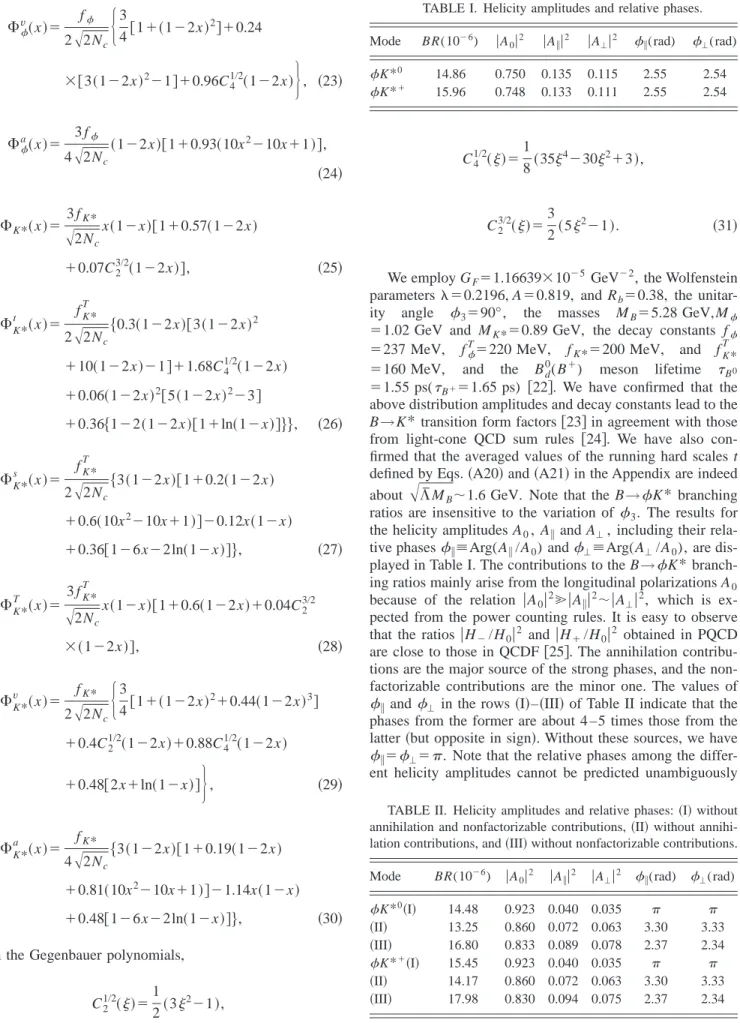
The and K*meson distribution amplitudes up to twist 3 are given by关21兴
⌽共x兲⫽ 3 f
冑2Nc
x共1⫺x兲, 共19兲
⌽t共x兲⫽ fT
2冑2Nc
再
3共1⫺2x兲2⫹1.68C41/2共1⫺2x兲⫹0.69
冋
1⫹共1⫺2x兲ln1⫺xx册冎
, 共20兲⌽s共x兲⫽ fT
4冑2Nc
冋
3共1⫺2x兲共4.5⫺11.2x⫹11.2x2兲⫹1.38ln x
1⫺x
册
, 共21兲⌽T共x兲⫽ 3 fT
冑2Nc
x共1⫺x兲关1⫹0.2C2
3/2共1⫺2x兲兴,
共22兲
⌽v共x兲⫽ f
2冑2Nc
再
34关1⫹共1⫺2x兲2兴⫹0.24⫻关3共1⫺2x兲2⫺1兴⫹0.96C4
1/2共1⫺2x兲
冎
, 共23兲⌽a共x兲⫽ 3 f 4冑2Nc
共1⫺2x兲关1⫹0.93共10x2⫺10x⫹1兲兴, 共24兲
⌽K*共x兲⫽3 fK*
冑2Nc
x共1⫺x兲关1⫹0.57共1⫺2x兲
⫹0.07C2
3/2共1⫺2x兲兴, 共25兲
⌽Kt*共x兲⫽ fK
*
T
2冑2Nc
兵0.3共1⫺2x兲关3共1⫺2x兲2
⫹10共1⫺2x兲⫺1兴⫹1.68C4
1/2共1⫺2x兲
⫹0.06共1⫺2x兲2关5共1⫺2x兲2⫺3兴
⫹0.36兵1⫺2共1⫺2x兲关1⫹ln共1⫺x兲兴其其, 共26兲
⌽Ks*共x兲⫽ fKT* 2冑2Nc
兵3共1⫺2x兲关1⫹0.2共1⫺2x兲
⫹0.6共10x2⫺10x⫹1兲兴⫺0.12x共1⫺x兲
⫹0.36关1⫺6x⫺2ln共1⫺x兲兴其, 共27兲
⌽KT*共x兲⫽3 fK
*
T
冑2Nc
x共1⫺x兲关1⫹0.6共1⫺2x兲⫹0.04C2 3/2
⫻共1⫺2x兲兴, 共28兲
⌽Kv*共x兲⫽ fK*
2冑2Nc
再
34关1⫹共1⫺2x兲2⫹0.44共1⫺2x兲3兴⫹0.4C2
1/2共1⫺2x兲⫹0.88C4
1/2共1⫺2x兲
⫹0.48关2x⫹ln共1⫺x兲兴
冎
, 共29兲⌽Ka*共x兲⫽ fK* 4冑2Nc
兵3共1⫺2x兲关1⫹0.19共1⫺2x兲
⫹0.81共10x2⫺10x⫹1兲兴⫺1.14x共1⫺x兲
⫹0.48关1⫺6x⫺2ln共1⫺x兲兴其, 共30兲 with the Gegenbauer polynomials,
C21/2共兲⫽1
2共32⫺1兲,
C41/2共兲⫽1
8共354⫺302⫹3兲,
C23/2共兲⫽3
2共52⫺1兲. 共31兲
We employ GF⫽1.16639⫻10⫺5 GeV⫺2, the Wolfenstein parameters ⫽0.2196, A⫽0.819, and Rb⫽0.38, the unitar- ity angle 3⫽90°, the masses MB⫽5.28 GeV,M
⫽1.02 GeV and MK*⫽0.89 GeV, the decay constants f
⫽237 MeV, fT⫽220 MeV, fK*⫽200 MeV, and fK*
T
⫽160 MeV, and the Bd
0(B⫹) meson lifetime B0
⫽1.55 ps(B⫹⫽1.65 ps) 关22兴. We have confirmed that the above distribution amplitudes and decay constants lead to the B→K* transition form factors关23兴 in agreement with those from light-cone QCD sum rules 关24兴. We have also con- firmed that the averaged values of the running hard scales t defined by Eqs.共A20兲 and 共A21兲 in the Appendix are indeed about 冑⌳¯ MB⬃1.6 GeV. Note that the B→K* branching ratios are insensitive to the variation of 3. The results for the helicity amplitudes A0, A储 and A⬜, including their rela- tive phases储⬅Arg(A储/A0) and⬜⬅Arg(A⬜/A0), are dis- played in Table I. The contributions to the B→K*branch- ing ratios mainly arise from the longitudinal polarizations A0 because of the relation 兩A0兩2Ⰷ兩A储兩2⬃兩A⬜兩2, which is ex- pected from the power counting rules. It is easy to observe that the ratios 兩H⫺/H0兩2 and兩H⫹/H0兩2 obtained in PQCD are close to those in QCDF关25兴. The annihilation contribu- tions are the major source of the strong phases, and the non- factorizable contributions are the minor one. The values of
储 and⬜ in the rows共I兲–共III兲 of Table II indicate that the phases from the former are about 4 –5 times those from the latter共but opposite in sign兲. Without these sources, we have
储⫽⬜⫽. Note that the relative phases among the differ- ent helicity amplitudes cannot be predicted unambiguously
TABLE I. Helicity amplitudes and relative phases.
Mode BR(10⫺6) 兩A0兩2 兩A储兩2 兩A⬜兩2 储(rad) ⬜(rad)
K*0 14.86 0.750 0.135 0.115 2.55 2.54
K*⫹ 15.96 0.748 0.133 0.111 2.55 2.54
TABLE II. Helicity amplitudes and relative phases:共I兲 without annihilation and nonfactorizable contributions,共II兲 without annihi- lation contributions, and共III兲 without nonfactorizable contributions.
Mode BR(10⫺6) 兩A0兩2 兩A储兩2 兩A⬜兩2 储(rad) ⬜(rad)
K*0共I兲 14.48 0.923 0.040 0.035 共II兲 13.25 0.860 0.072 0.063 3.30 3.33
共III兲 16.80 0.833 0.089 0.078 2.37 2.34
K*⫹共I兲 15.45 0.923 0.040 0.035 共II兲 14.17 0.860 0.072 0.063 3.30 3.33
共III兲 17.98 0.830 0.094 0.075 2.37 2.34
in QCDF due to the arbitrary complex cutoffs for the evalu- ation of the nonfactorizable and annihilation contributions.
We examine the theoretical uncertainty from the variation of the hard scales t, which are defined as the invariant masses of the internal particles and are required to be higher than the factorization scales 1/b, b being the transverse extents of the mesons. This examination estimates higher-order corrections to the hard amplitudes, which are the most important theo- retical uncertainty for penguin-dominated B meson decays.
The light meson distribution amplitudes have been deter- mined in QCD sum rules. The possible 30% variation of the coefficients of the Gegenbauer polynomials in these distribu- tion amplitudes lead only to little changes of our predictions.
We consider the hard scales t located between 0.75–1.25 times the invariant masses of the internal particles. The pre- dictions for the B→K branching ratios from the above range are consistent with the data with uncertainty 关7兴. We then obtain the B→K*branching ratios,
B共Bd
0→K*0兲⫽共14.86⫺3.36⫹4.88兲⫻10⫺6,
B共B⫾→K*⫾兲⫽共15.96⫺3.61⫹5.24兲⫻10⫺6. 共32兲 The relative phases 储 and⬜, and the magnitudes 兩A0兩2, 兩A储兩2 and 兩A⬜兩2 of the helicity amplitudes are quite stable under the variation of the hard scales t. They change within 0.05 rad and within 0.01, respectively. There is another mi- nor source of theoretical uncertainty from the light meson decay constants f(T) and fK
*
(T). If they reduce by 5%, the predicted branching ratios will decrease by 10%. The C P asymmetries of the B→K*modes are, as of B→K, van- ishingly small共less than 2%兲.
The above branching ratios are larger than those from QCDF关25兴,
B共Bd
0→K*0兲⫽8.71⫻10⫺6,
B共B⫾→K*⫾兲⫽9.30⫻10⫺6, 共33兲 due to the dynamical enhancement of penguin contributions.
We emphasize that the annihilation amplitudes, though not negligible, are not responsible for the large branching ratios in PQCD, since they are mainly imaginary. This is under- stood by comparing the branching ratios in Table I and in row 共II兲 of Table II. The nonfactorizable contributions are not shown either by the branching ratios in Table I or in the row共III兲 of Table II. However, the annihilation contributions, parametrized as being real, are important in QCDF in order to explain the large B→K branching ratios. With the al- most real annihilation contributions, the B→K branching ratios obtained in QCDF can increase from 4⫻10⫺6 to 7
⫻10⫺6关9兴. The values quoted in Eq. 共33兲 do not include the annihilation contributions. The current experimental data of B(B0→K*0),
CLEO关26兴: 共11.5⫺3.7⫺1.7⫹4.5⫹1.8兲⫻10⫺6, BELLE关27兴: 共15⫺6⫹8⫾3兲⫻10⫺6,
BABAR关28兴: 共8.6⫺2.4⫹2.8⫾1.1兲⫻10⫺6, 共34兲
and those of B(B⫾→K*⫾),
CLEO关26兴: 共10.6⫺4.9⫺1.6⫹6.4⫹1.8兲⫻10⫺6,
BELLE关27兴: ⬍36⫻10⫺6,
BABAR关28兴: 共9.7⫺3.4⫹4.2⫾1.7兲⫻10⫺6, 共35兲
are not yet precise enough to distinguish the two different approaches.
In this paper we have studied the first observed B→VV modes, the B→K* decays, using the PQCD formalism. It has been stressed that two-body heavy meson decays are characterized by a scale of O(⌳¯ MB) in PQCD, for which penguin contributions are dynamically enhanced. This en- hancement makes penguin-dominated decay modes acquire branching ratios larger than those in QCDF, even when the final-state particles are vector mesons. We have proposed the B→K(*) decays as the ideal modes to test the significance of this mechanism. If their branching ratios are as large as 10⫻10⫺6(15⫻10⫺6) 共independent of the unitarity angle
3), dynamical enhancement will be convincing. We have also emphasized that the relative importance and the relative strong phases among the different helicity amplitudes in the B→VV modes can be predicted unambiguously in PQCD, which are determined by the power counting rules and by the annihilation contributions, respectively. These predictions are insensitive to the variation of the hard scales. Therefore, the comparison of the results presented here with future ex- perimental data will provide a stringent confrontation of the PQCD approach.
ACKNOWLEDGMENTS
We thank H.Y. Cheng, K.C. Yang and the members in the PQCD Collaboration for helpful discussions. The work was supported in part by Grant-in Aid for Special Project Re- search 共Physics of CP Violation兲, and by Grant-in Aid for Scientific Research from the Ministry of Education, Science and Culture of Japan. The work of H.N.L. was supported in part by the National Science Council of R.O.C. under the Grant No. NSC-90-2112-M-001-077 and by National Center for Theoretical Sciences of R.O.C.
APPENDIX: FACTORIZATION FORMULAS In this appendix we present the explicit expressions of the factorizable and nonfactorizable amplitudes in Eq. 共9兲. The effective Hamiltonian for the flavor-changing b→s transition is given by
Heff⫽GF
冑2 q
兺
⫽u,cVq冋
C1共兲O1(q)共兲⫹C2共兲O2(q)共兲⫹i
兺
⫽3 10Ci共兲Oi共兲
册
, 共A1兲with the CKM matrix elements Vq⫽Vqs*Vqb and the opera- tors
O1(q)⫽共s¯iqj兲V⫺A共q¯jbi兲V⫺A, O2(q)⫽共s¯iqi兲V⫺A共q¯jbj兲V⫺A,
O3⫽共s¯ibi兲V⫺A
兺
q 共q¯jqj兲V⫺A,O4⫽共s¯ibj兲V⫺A
兺
q 共q¯jqi兲V⫺A,O5⫽共s¯ibi兲V⫺A
兺
q 共q¯jqj兲V⫹A,O6⫽共s¯ibj兲V⫺A
兺
q 共q¯jqi兲V⫹A,O7⫽3
2共s¯ibi兲V⫺A
兺
q eq共q¯jqj兲V⫹A,O8⫽3
2共s¯ibj兲V⫺A
兺
qeq共q¯jqi兲V⫹A,
O9⫽3
2共s¯ibi兲V⫺A
兺
q eq共q¯jqj兲V⫺A,O10⫽3
2共s¯ibj兲V⫺A
兺
q eq共q¯jqi兲V⫺A, 共A2兲i and j being the color indices. Using the unitarity condition, the CKM matrix elements for the penguin operators O3–O10 can also be expressed as Vu⫹Vc⫽⫺Vt. The unitarity angle
3 is defined via
Vub⫽兩Vub兩exp共⫺i3兲. 共A3兲
Here we adopt the Wolfenstein parametrization for the CKM matrix up to O(3),
冉
VVVudcdtd VVVuscsts VVVubcbtb冊
⫽冉
A31共1⫺⫺⫺2/2⫺i兲 1⫺A⫺2/22 A3共A1⫺i2 兲冊
, 共A4兲with the parameters关29兴,
⫽0.2196⫾0.0023, A⫽0.819⫾0.035,
Rb⬅冑2⫹2⫽0.41⫾0.07. 共A5兲
The factorizable amplitudes FHe(q) and FHa(q)⫽FHa4 (q) ⫹FHa6
(q) are written as
FLe(q)⫽8CFMB2
冕
0 1dx1dx3
冕
0⬁
b1db1b3db3⌽B共x1,b1兲兵关共1⫹x3兲⌽K*共x3兲⫹rK*共1⫺2x3兲„⌽K*
t 共x3兲
⫹⌽Ks*共x3兲…兴Ee (q)共te
(1)兲he共x1,x3,b1,b3兲⫹2rK*⌽Ks*共x3兲Ee (q)共te
(2)兲he共x3,x1,b3,b1兲其, 共A6兲
FNe(q)⫽8CFMB2
冕
01dx1dx3冕
0⬁b1db1b3db3⌽B共x1,b1兲r兵关⌽KT*共x3兲⫹2rK*⌽Kv*共x3兲⫹rK*x3„⌽Kv*共x3兲⫺⌽Ka*共x3兲…兴Ee (q)共te
(1)兲he共x1,x3,b1,b3兲⫹rK*关⌽Kv*共x3兲⫹⌽Ka*共x3兲兴Ee (q)共te
(2)兲he共x3,x1,b3,b1兲其, 共A7兲
FTe(q)⫽16CFMB2
冕
0 1dx1dx3
冕
0⬁
b1db1b3db3⌽B共x1,b1兲r兵关⌽K*
T 共x3兲⫹2rK*⌽Ka*共x3兲⫺rK*x3„⌽K*
v 共x3兲
⫺⌽Ka*共x3兲…兴Ee (q)共te
(1)兲he共x1,x3,b1,b3兲⫹rK*关⌽K*
v 共x3兲⫹⌽K*
a 共x3兲兴Ee (q)共te
(2)兲he共x3,x1,b3,b1兲其, 共A8兲