行政院國家科學委員會專題研究計畫成果報告
防曬成份對紫外線引起皮膚傷害的保護效果評估
Protective effect evaluation of sunscreen ingredients on ultraviolet induced skin damage 計畫編號:NSC 88-2314-B-041-008
執行期限:87年8月1日至88年7月31日
一、摘要:
紫外線對皮膚會造成許多嚴重的傷 害,包括皮膚紅腫、曬傷、色素沉積、
老化、失去彈性及產生皺紋等,甚至會 造成皮膚免疫系統受損及增加皮膚癌發 生機率。本計畫目的探討防曬成份對皮 膚 細 胞 保 護 效 果 。 方 法 是 在 B16 melanoma 細胞上方塗抹Octyl methoxy- cinnamate 及 Butyl methoxydibenzoyl methane 等防曬劑,再以紫外線照射細 胞,計算細胞死亡數目評估其保護效 果。結果顯示UVA及UVB對 B16 均會 引起細胞 apoptosis 現象,紫外線吸收 劑 Octyl methoxycinnamate可 避 免 UVB 引 起 之 apoptosis , 而 Butyl methoxy- dibenzoyl methane (Parsol 1789)則防止 UVA引起之細胞apoptosis,且SPF值與保 護效果呈現正相關。
關鍵詞:紫外線;防曬劑;計畫性死亡 Ultraviolet (UV) induces severe skin damage, including skin erythema, sun- burn, pigmentation, aging, loss of elasticity and wrinkle formation etc. It can also affect skin immune system and increase the risk of skin cancer. Aims of this project are to evaluate the efficiency of commonly used sunscreen ingredients.
We applied octyl methoxycinnamate and butyl methoxydibenzoyl methane to the B16 melanoma cell lines. After UV irradiation B16 cell survival rates were
examined. Results show that octyl methoxy-cinnamate could protect cells from UVB-induced apoptosis , whereas butyl methoxydibenzoyl methane protect cells from UVA-induced apoptosis.
Furthermore, SPF values are correlated with UV protection efficacy.
Key words: UV; sunscreen; apoptosis 二、緣由與目的
紫外線依波長長短分為紫外線A (UVA, 400~320 nm), 紫外線 B (UVB, 320~280 nm), 紫 外 線 C (UVC, 280 或 290~230 nm),其中UVB會引起皮膚曬傷 紅腫,所謂的防曬係數即是指防曬用品 延長皮膚曬傷的能力,因此一般的防曬 係數只考量對UVB的隔離效果;最近有 關UVA的防護也愈來愈受到重視,理由 是UVA可穿透皮膚真皮層而造成皮膚 變黑、老化、失去彈性以及容易產生皺 紋等問題。
紫外線會造成皮膚出現Sun burn cells,最近Baba等人(1996)的研究發現這 些可能屬於計畫性死亡細胞,因為這些 經 紫 外 線 照 射 的 細 胞 會 出 現 DNA ladders現象,本計畫主要針對市售防曬 化粧品中較常使用的防曬成份如octyl methoxy-cinnamate (UVB 吸 收 劑 ) 或 butyl methoxydibenzoyl methane(UVA吸 收劑)進行紫外線保護效果評估。
三、材料與方法:
細胞培養:
B16 melanoma 細胞株購自新竹食品工 業研究所,編號CCRC60030,細胞解凍後 以DMEM(含10 % FCS, penicillin and streptomycin, non essential amino acids) 培養於37 ℃, 5 % CO2之培養箱中。每隔 3-4 天繼代一次。
紫外線照射:
細胞於照射前一天繼代培養於6孔培養 盤中(約八分滿),隔天將待測防曬劑以 2 mg/cm2 均勻塗抹在6孔培養盤之蓋子 上 , 於 細 胞 上 方 約5cm處 以 UV光 源 (NBC co., Handisol, USA)包括UVA及 UVB兩種波段照射,未照射部位以錫箔 紙覆蓋,而紫外線照射強度以紫外線偵 測儀(Solar co., USA)測定之。
細胞計畫性死亡:
細 胞 計 畫 性 死 亡 以 TUNEL (TdT- mediated dUTP-floresein nick end labeling)方法測定,此方法是一種in situ apoptosis檢測試劑組(BM公司),其敏感 度 比 傳 統 的 apoptosis 檢 測 法 ( 如 DNA ladder)敏感,並且再現性高、操作簡單,
此方法可參考本實驗室之論文(Lin et al., 1996) 。 簡 述 之 , 將 細 胞 以 paraformaldehyde固定30分鐘後,再以0.1
% Triton X-100將細胞膜打洞,然後以 Terminal deoxynucleotidyl transferase將 含有螢光物質之 dUTP 接在有DNA斷 裂位置,使apoptotic細胞發出螢光,然 後利用螢光顯微鏡觀察及計算之。此方 法是利用酵素將細胞內的斷裂DNA加 上floresein,再利用alkaline phosphatase conjugated anti-floresein抗體反應後,以
四、結果與討論:
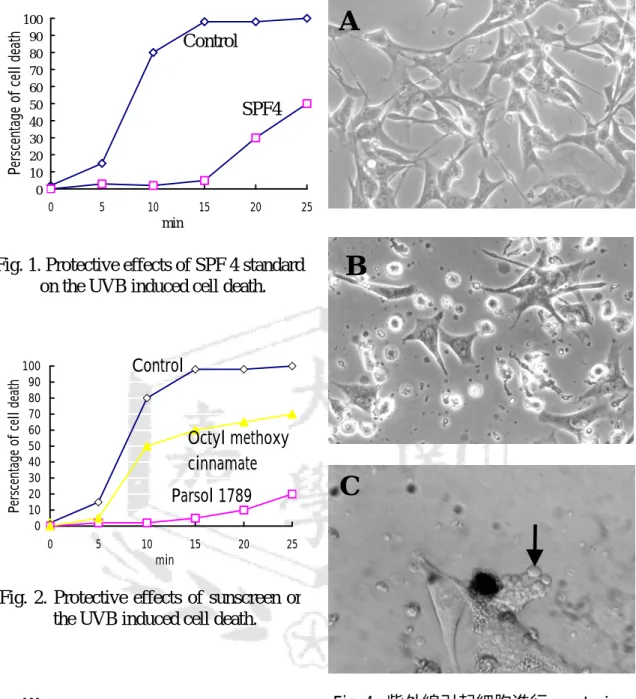
為了探討防曬劑對細胞照射紫外線 的保護效果,本計畫在B16 melanoma細 胞 培 養 盤 上 塗 抹 含 octyl methoxy- cinnamate 或 butyl methoxydibenzoyl methane 防曬劑後,利用UVB紫外燈分 別照射5, 10, 15, 20, 25分鐘,經過 16 小 時後以觀察細胞之死亡率,結果發現為 塗抹防曬劑之細胞在紫外線照射 5 分 鐘後細胞開始死亡,照射 15 分鐘後,
死亡率接近100 %,而培養盤上塗抹 SPF4 標 準 品 , 照 射 15 分 鐘 後 (189.08mJ/cm2),細胞並無明顯死亡(Fig.
1),顯示此防曬劑對 UVB 引起的細胞 死亡具有保護能力。含octyl methoxy- cinnamate 防曬劑具有UVB保護能力,
而 butyl methoxy-dibenzoyl methane 則 對UVB保護能力較差(Fig. 2)。紫外線光 源 改 為 UVA , 結 果 顯 示 butyl methoxydibenzoyl methane 防 曬 劑 具 有 UVA 保 護 能 力 , 而 octyl methoxy- cinnamate則無作用(Fig. 3)。
在觀察細胞死亡過程中,我們發現 紫外線照射的細胞與正常細胞的形態有 很明顯的差別 (Fig. 4a vs. b),在高倍顯 微鏡底下呈現細胞膜鼓起的構造(Fig.
4c),此現象類似 apoptosis,為了證實此 點,我們以 TUNEL 方法,進行細胞核 內斷裂DNA之染色,結果發現經過紫外 線照射的細胞有較多的apototic 細胞,
如果塗抹具保護力的防曬劑則apototic 細胞明顯減少(data not shown)。這些結 果可得知紫外線成份對細胞具有保護效 果,另一方面可得知UVA及UVB均會引 起apoptosis。
五、致謝:
六、參考文獻:
Baba, T., Hanada, K. and Hashimoto, I.
1996. The study of ultraviolet B- induced apoptosis in cultured mouse keratinocytes and in mouse skin. J Dermatol Sci. 12, 18-23.
Chatterjee, M. L. Agarwal R.
Mukhtar H. 1996. Ultraviolet B radiation-induced DNA lesions in mouse epidermis: an assessment using a novel 32P-postlabelling technique. Biochemical &
Biophysical Research Communications. 229(2):590-595.
Imokawa, G., Yada, Y. and Kimura, M.
1996. Signalling mechanisms of endothelin-induced mitogensis and melanogenesis in human melanocytes. Biochem J. 314, 305- 312.
Potten, C. S., Chadwick, C. A., Cohen, A. J., Nikaido, O., Matsunaga, T., Schipper, N. W., Young, A. R. 1993.
DNA damage in UV-irradiated human skin in vivo: automated direct measurement by image analysis (thymine dimers) compared with indirect measurement (unscheduled DNA synthesis) and protection by 5- methoxypsoralen. International Journal of Radiation Biology. 63, 313-324.
Lin, C.-G., Kao, Y.-T., Liu, W.-T., Huang, H.-H., Chen, K.-C. and Lin, H.-C. 1996. Cytotoxic effects of Bacillus anthracis lethal toxin on macrophage-like cell line. Current Microbiology 33, 224-227.
Romero-Graillet, C., Aberdam, E., Biagoli, N., Massabni, W., Ortonne, J. P., Ballotti, R. 1996. Ultraviolet B radiation acts through the nitric oxide and cGMP signal transduction pathway to stimulate melanogenesis in human melanoctes. J Biol Chem.
271, 28052-28056.
Romero-Graillet, C., Aberdam, E., Clement, M., Ortonne, J. P., Ballotti, R. 1997. Nitric oxide produced by ultraviolet-irradiated keratinocytes stimulates melanogenesis. J Clin Invest. 99, 635-642.
Sayre, R. M., Poh Agin, P., LeVee, G. J.
and Marlowe, E. 1979. A comparison of in vivo and in vitro testing of sunscreening formulae.
Photochem. Photobiol. 29, 559-566.
Sayre, R. M. and Agin, P. P.1984.
Comparison of human protection factors to predicted factors using different lamp spectra. J. Soc.
Cosmet. Chem. 35, 439-445.
Stockdale, M. 1987. A novel proposal for the assessment of sunscreen product efficacy against UVA.
International Journal of Cosmetic Science. 9, 85-98.
Taylor, J. T. 1990. DNA, sunlight and skin cancer. J. Chem. Educ. 67, 835- 841.
Walker, S. L. and Young, A. R. 1997.
Sunscreens offer the same UVB protection factors for inflammation and immunosuppression in the mouse. Journal of Investigative Dermatology. 108, 133-138.
0 10 20 30 40 50 60 70 80 90 100
0 5 10 15 20 25
min
Perscentage of cell death
0 10 20 30 40 50 60 70 80 90 100
0 5 10 15 20 25
min
Perscentage of cell death
0 10 20 30 40 50 60 70 80 90 100
0 5 10 15 20 25
Perscentage of cell death
Fig. 1. Protective effects of SPF 4 standard on the UVB induced cell death.
Fig. 2. Protective effects of sunscreen on the UVB induced cell death.
A
B
C
Fig. 4. 紫外線引起細胞進行apoptosis.
(A) 未照射紫外線之細胞 (B) 經過紫外線照射5分鐘之細胞 (C) 紫外線照射後細胞呈現細 胞膜鼓起現象(如箭頭所示) Control
SPF4
Control
Octyl methoxy cinnamate
Parsol 1789 Control
Octyl methoxycinnamate Parsol 1789