十一、Fatty acid or ester 類化合物
Fatty acid or ester 類化合物廣佈於植物體內,在石斛中分到 5 個 此類化合物:alkyl acetate (16)、linoleic acid (13)、methyl and ethyl linolenates (3)和 octacosanyl hexadecanoate (2);在臺灣金線連中,正 己烷的抽出物經 GC, GC/MS 檢測,結果如 Figure 4,主要以此類化 合物為主,在分離過程中,則有分離到化合物 linoleic acid (13)。
Alkyl acetate (16) 化學結構的決定
本化合物為白色油狀物,EIMS (Chart 226)顯示裂片有 m/z 336 [M-60]+,364 [M-60]+,392 [M-60]+和 420 [M-60]+,其它為直鏈烷基 的標準裂片。
Chart 226 EIMS (70 eV) spectrum of alkyl acetate (16)
氫譜(Chart 227)顯示δ0.68 (6H, t, J=6.4 Hz)為長鏈末端甲基之吸 收訊號,δ1.23 (br s)為長鏈 methylene 的吸收訊號,δ2.02 (3H, s)為 acetyl proton 的吸收訊號,δ4.03 (2H, t, J=7.6 Hz)為酯類(ester group) 旁 COOCH2質子的吸收訊號。
碳譜(Chart 228)顯示δ14.1 為長鏈末端甲基碳的吸收訊號,δ 21.0- 32.0 為長鏈 methylenes 的吸收訊號,δ64.7 為酯類(ester group) 旁 COOCH2的吸收訊號,而δ171.2 為 acetyl carbon (C=O)的吸收訊 號。
綜合上述資料,確認此化合物為 alkyl acetate 的混合物,包含 tetracosyl、hexacosyl、octacosyl 和 triaconyl acetate。
Chart 227
1H-NMR (CDCl3, 200 MHz) spectrum of alkyl acetate(16)
Chart 228
13C-NMR (CDCl3, 50 MHz) spectrum of alkyl acetate(16)
Linoleic acid (13) 化學結構的決定
本化合物為淡黃色油狀物,經由 EIMS 光譜(Chart 229)顯示分 子量為 280。
IR 光譜(Chart 230)顯示在 3010 ㎝-1為 C=C-H 的吸收 1712 為 carboxyl group (COOH)的吸收,2919 和 2856 為飽和碳氫(CH)的吸 收,1473、1445 和 1424 為雙鍵的吸收。
氫譜(Chart 232)顯示δ0.88 (3H, m)為末端甲基之吸收訊號,δ 1.25 (14H, br s)為 7 個 methylenes (CH2)的吸收訊號,δ1.64 (2H, m)、
2.05 (4H, m)、2.35 (2H, t, J=7.5 Hz)和 2.77 (2H, t, J=5.7 Hz)分別為 H-3、H-8、H-14、H-2 和 H-11 的吸收訊號,而δ5.35 (4H, m)為 olefinic protons (H-9、H-10、H-12 和 H-13)的吸收訊號。
碳譜(Chart 233)顯示δ14.1 為末端甲基(C-18)的吸收訊號,δ 22.7-33.7 為 12 個 methylenes (CH2)的吸收訊號,δ 127.9、128.1、130.0 和 130.2 為 olefinic carbons 的吸收訊號,而δ180.3 為 carboxyl carbon 的吸收訊號。
綜合上述資料與文獻值(196)比對,確認此化合物之結構為 9,12 (z,z)-octadecadienoic acid ,分子式為 C18H32O2,又名為 linoleic acid。
其結構如下:
COOH CH
33 1 7 5
9
12 14 16
18
Chart 229 EIMS (70 eV) spectrum of linoleic acid (13)
Chart 230 IR spectrum of linoleic acid
(13)Chart 231 UV spectrum of linoleic acid
(13)Chart 232
1H-NMR (CDCl3, 200 MHz) spectrum of linoleic acid (13)Chart 233
13C-NMR (CDCl3, 50 MHz) spectrum of linoleic acid (13)Methyl and ethyl linolenates (3) 化學結構的決定
本化合物為淡黃色油狀物,經由 EIMS 顯示[M]+為 292 和 306。
IR 光譜(Chart 234)顯示在 2926 和 2863 cm-1為飽和碳氫的吸收,
1710 cm-1為 carbonyl group (C=O)的吸收,而 1256 cm-1為醚基(C-O-C) 的吸收。
氫譜(Chart 235)顯示δ0.95 (t, J=7.5 Hz)為末端甲基之吸收訊 號,δ1.23 (t, J=7.2 Hz)和 4.10 (q, J=7.1 Hz)為 ethoxyl proton 的吸收 訊號,δ1.28 (br s)、1.60 (m)、2.02 (m)、2.26 (t, J=7.2, 7.6 Hz)和 2.28 (t, J=7.3, 7.7 Hz)為 methylenes (CH2)的吸收訊號,δ 3.64 (s)為 methoxyl proton 的吸收訊號,而δ5.33 (m)為 olefinic protons 的吸收 訊號。
碳譜(Chart 236) 和 DEPT(Chart 237)顯示δ14.3 為 methyl (CH3) 的吸收訊號,δ20.5-30.0 為 methylenes (CH2)的吸收訊號,δ34.1 為 OCH2 的吸收訊號,δ 51.4 為 methoxyl (OCH3)的吸收訊號,δ127.1、
127.7、128.3、128.3、130.3 和 132.0 為 olefinic carbons 的吸收訊號,
而δ174.3 為 carboxyl carbon 的吸收訊號。
綜合上述資料與文獻(197)比對,確認此化合物為 methyl linolenate 和 ethyl linolenate 的混合,分子式為 C19H32O2和 C20H34O2。其結構如 下:
COOR CH
33 1 7 5
9 12 15
18
R=CH3 methyl linolenate R=C2H5 ethyl linolenate
Chart 234 IR spectrum of methyl and ethyl linolenate (3)
Chart 235
1H-NMR (CDCl3, 200 MHz) spectrum of methyl and ethyl linolenate (3)COOR CH3 3 1
7 5
9 12 15
18
R=CH3 methyl linolenate R=C2H5 ethyl linolenate
Chart 236
13C-NMR (CDCl3, 50 MHz) spectrum of methyl and ethyl linolenate (3)Chart 237 DEPT135 spectrum of methyl and ethyl linolenate (3)
COOR CH
3 3 17 5
9 12 15
18
R=CH3 methyl linolenate R=C2H5 ethyl linolenate
Octacosanyl hexadecanoate (2) 化學結構的決定
本化合物為白色油狀物,經由 EIMS 光譜(Chart 238)顯示分子 量為 648。
IR 光譜(Chart 239)顯示在 2920 和 2851 ㎝-1為飽和碳氫的吸收,
1736 為酯類 carbonyl (C=O)的吸收,其它還有 1474、1187 和 716 等 吸收。
氫譜(Chart 240)顯示δ0.86 (6H, t, J=6.4 Hz)為 2 個末端甲基之吸 收訊號,δ1.23 (br s)為長鏈 methylenes (CH2)的吸收訊號,δ2.27 (2H, t, J=7.5 Hz)為 carbonyl group 旁 CH2COO 質子的吸收訊號,δ4.03 (2H, t, J=6.6 Hz)為酯類 ester group 旁 COOCH2質子的吸收訊號。
碳譜(Chart 241)顯示δ14.1 為末端甲基碳的吸收訊號,δ22.7- 64.4 為 methylenes (CH2) 的吸收訊號,其中δ34.4 為 carbonyl group 旁 CH2COO 的吸收訊號,δ64.4 為酯類 ester group 旁 COOCH2的吸 收訊號,而δ174.0 為 carboxyl carbon (C=O)的吸收訊號。顯示為長 鏈酯類化合物,利用皂化反應(5% KOH/乙醇溶液) 4 小時後,得到 M+ 256 與 410 的化合物為 hexadecanoic acid 與 n-octacosanol,推定此 化合物為 16 個碳的酸與 18 個碳的醇所形成的酯類。
綜 合 上 述 資 料 與 文 獻 值(198)比 對 , 確 認 此 化 合 物 之 結 構 為 octacosanyl hexadecanoate,分子式為 C44H88O2。其結構如下:
CH
3(CH
2)
13CH
2C O
OCH
2(CH
2)
26CH
3Chart 238 EIMS (70 eV) spectrum of octacosanyl hexadecanoate (2)
Chart 239 IR spectrum of octacosanyl hexadecanoate
(2)CH
3(CH
2)
13CH
2C
O
OCH
2(CH
2)
26CH
3CH
3(CH
2)
13CH
2C O
OCH
2(CH
2)
26CH
3Chart 240
1H-NMR (CDCl3, 200 MHz) spectrum of octacosanyl hexadecanoate (2)Chart 241
13C-NMR (CDCl3, 50 MHz) spectrum of octacosanyl hexadecanoate (2)CH
3(CH
2)
13CH
2C O
OCH
2(CH
2)
26CH
3CH3(CH2)13CH2 C O
OCH2(CH2)26CH3
十二、Pyrimidine 類化合物
在連珠石斛中分離得到一個 pyrimidine 類之核酸化合物 uracil (34),
這是首次於石斛屬植物中發現。
Uracil (34) 化學結構的決定
本化合物為無色針狀,經由 EIMS (Chart 242)顯示分子量為 m/z 112。
Chart 242 EIMS (70 eV) spectrum of uracil (34)
IR 光譜(Chart 243)在 3105 和 3040 cm-1為 NH 的吸收,1716 和 1670 為 carbonyl C=O 的吸收。UV 光譜(Chart 244)在 206 和 259 nm (log ε:3.58 和 3.58)有最大吸收波長。
氫譜(Chart 245)顯示有 1 對不飽和質子(olefinic protons)的吸收訊 號,δ5.60 和 7.38,耦合常數 J=7.6 Hz,為 H-5 和 H-6。
碳譜(Chart 246)顯示有 4 個碳存在,δ101.7、143.6、153.6 和 167.4,其中δ101.7 和 143.6 為不飽和雙鍵 C-5 和 C-6,δ153.6 和 167.4 為 carbonyl carbon (CO),C-2 和 C-4 的吸收訊號。
綜合上述資料,並與文獻(199)比對,確定此化合物結構為 uracil,
分子式為 C4H4N2O2。結構如下:
N N O
O H
H
2 4 5 6
Chart 243 IR spectrum of uracil (34)
Chart 244 UV spectrum of uracil (34)
Chart 245
1H-NMR (CDCl3, 200 MHz) spectrum of uracil(34)Chart 246
13C-NMR (CDCl3, 50 MHz) spectrum of uracil (34)十三、Sugar 類化合物
Ethyl â-D-glucopyranoside (44) 化學結構的決定
本 化 合 物 為 無 色 油 狀 物 ,positive FABMS (Chart 247) 顯 示 [M+Na]+在 m/z 231,[M+H]+在 m/z 209。
IR 光譜(Chart 248)在 3388 cm-1 (broad)為 hydroxyls 的吸收,1076 cm-1為醚基(C-O-C)的吸收。
氫譜(Chart 249)顯示在δ3.21-4.29 有吸收訊號,為類似糖(â-D- glucose)的吸收訊號,δ4.29 (1H, d, J=7.66 Hz)為糖上 H-1 的吸收訊 號,3.21 (1H, m)為 H-2 的吸收訊號,3.44 (2H, m)為 H-4 和 H-5 的吸 收訊號,3.65 (2H, m)和 3.93 (2H, m)為 H-6 和 H-7 的混合吸收訊號,
另外在δ1.25 (3H, t, J=7.10 Hz)為 1 甲基質子(H-8)的吸收訊號。COSY (Chart 250)顯示 H-1 和 H-2,H-5 和 H-6 以及 H-7 和 H-8 有相關。
碳譜(Chart 251)和 DEPT(Chart 252)及 HMQC(Chart 253)顯示有 8 個碳,包括 1 個 CH3 (δ15.4),2 個 OCH2 (δ62.5 和 66.1)和 5 個 CH (δ 71.3、74.7、77.5、77.7 和 103.7)。再由 HMBC(Chart 254)可知 H-1 和 H-8 均與 C-7 (δ66.2)有長距離的相關,這說明了 1 號位置有 1 個 ethoxyl group。此外 H-2 與 C-3,H-3 和 H-5 與 C-4 也有相關。
綜合上述資料,並與文獻(200)比對,確定此化合物為 ethyl â-D- glucopyranoside,分子式為 C8H16O6。結構如下:
O
OCH
2CH
3OH
HOH
2C HO
HO
17 8
3 2
4 5
6
Chart 247 positive FABMS spectrum of ethyl β-D-glucopyranoside (44)
Chart 248 IR spectrum of ethyl β-D-glucopyranoside
(44)[M+H]+ [M+Na]+
O
OCH2CH3 OH
HOH2C HO
HO 3 2 1 7 8
4 5
6
Chart 249
1H-NMR (CD3OD+CDCl3, 200 MHz) spectrum of ethyl β-D-glucopyranoside (44)Chart 250 COSY spectrum of ethyl β-D-glucopyranoside
(44)Chart 251
13C-NMR (CD3OD+CDCl3, 50 MHz) spectrum of ethyl β-D-glucopyranoside (44)Chart 252 DEPT spectrum of ethyl β-D-glucopyranoside (44)
Chart 253 HMQC spectrum of ethyl β-D-glucopyranoside (44)
Chart 254 HMBC spectrum of ethyl β-D-glucopyranoside (44)
十四、其它
Diethylene glycol (20) 化學結構的決定
本化合物為白色固體,氫譜(Chart 255)顯示在δ3.40 (br d, J=3.9 Hz)和 3.46 (br d, J=4.1 Hz)相互耦合,碳譜(Chart 256)顯示具有 2 支含 氧的吸收訊息δ60.7 和 72.5,經 DEPT(Chart 257)實驗顯示,此為 methylene group,而由 HMQC(Chart 258)顯示,可知此化合物碳氫的 關係。進一步的由文獻(201)證實,本化合物為 diethylene glycol,此為 石斛屬植物首次分離。結構如下:
HOCH2CH2OCH2CH2OH
Chart 255
1H-NMR (DMSO-d6, 200 MHz) spectrum of diethylene glycol(20)
HOCH2CH2OCH2CH2OH
Chart 256
13C-NMR (DMSO-d6, 50 MHz) spectrum of diethylene glycol(20)
Chart 257 DEPT spectrum of diethylene glycol (20)
HOCH2CH2OCH2CH2OH
HOCH2CH2OCH2CH2OH
Chart 258 HMQC spectrum of diethylene glycol (20)
HOCH2CH2OCH2CH2OH
Anoectolide A
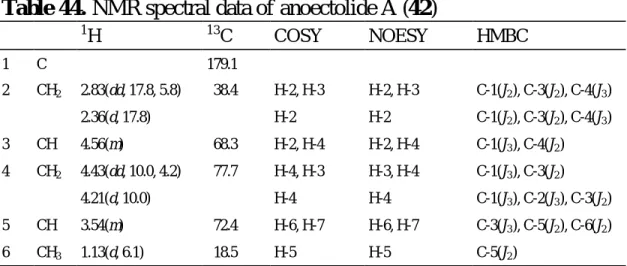
(42) 化學結構的決定本化合物為無色油狀物,與化合物 3-hydroxybutanolide (95)具有類 似的結構。氫譜(Chart 259)顯示具有 9 個氫質子,碳譜(Chart 260)與 DEPT 實驗(Chart 263)顯示有 1 個 methyl (δ18.5 和 18.5),2 個 methylenes (δ38.4 和 77.7),2 個 methines (δ68.3 和 72.4)和 1 個四級 碳 (δ 179.1), 其 中 δ 179.1 為 carbonyl 的 吸 收 訊 號 , 比 化 合 物 3-hydroxybutanolide 多 2 個碳,經由 HMQC (Chart 264)和 COSY (Chart 261)光譜可推定為-OCH(CH3)-的組合。HMBC (Chart 265)顯示 H-5 (δ 3.54)除了跟鄰位甲基的碳有長距離的關連外,並且與自己相對的碳有 關連,因此推定此化合物為雙體的結構。
FABMS 顯示本化合物具有 3-hydroxybutanolide 的離子裂片 m/z 103 (C4H7O3
+),而且[M+H]+為 259,綜合上述(Table 44)推定本化合物 為 bi(3-O-ethoxybutanolide),分子式為 C12H18O6,它是一個新的化合 物,命名為 anoectolide A。其結構如下:
O
O
O CH CH
3CH
O O
O CH
31 2 3 4
5 6
Table 44. NMR spectral data of anoectolide A (42)
1
H
13C COSY NOESY HMBC
1 C 179.1
2 CH2 2.83(dd, 17.8, 5.8) 2.36(d, 17.8)
38.4 H-2, H-3 H-2
H-2, H-3 H-2
C-1(J2), C-3(J2), C-4(J3) C-1(J2), C-3(J2), C-4(J3) 3 CH 4.56(m) 68.3 H-2, H-4 H-2, H-4 C-1(J3), C-4(J2) 4 CH2 4.43(dd, 10.0, 4.2)
4.21(d, 10.0)
77.7 H-4, H-3 H-4
H-3, H-4 H-4
C-1(J3), C-3(J2) C-1(J3), C-2(J3), C-3(J2) 5 CH 3.54(m) 72.4 H-6, H-7 H-6, H-7 C-3(J3), C-5(J2), C-6(J2)
6 CH3 1.13(d, 6.1) 18.5 H-5 H-5 C-5(J2)
Chart 259
1H-NMR (CD3OD+CDCl3, 200 MHz) spectrum of anoectolide A (42)Chart 260
1C-NMR (CD3OD+CDCl3, 50 MHz) spectrum of anoectolide A (42)O
O
O CH CH3
CH
O O
O CH3
1 2 3 4
5 6
O
O
O CH CH3
CH
O O
O CH3
1 2 3 4
5 6
O
O
O CH CH
3CH
O O
O CH
31 2 3 4
5 6
Chart 261 COSY spectrum of anoectolide A (42)
Chart 262 NOESY spectrum of anoectolide A (42)
Chart 263 DEPT spectrum of anoectolide A (42)
Chart 264 HMQC spectrum of anoectolide A
(42)O
O
O CH CH3
CH
O O
O CH3
1 2 3 4
5 6
Chart 265 HMBC spectrum of anoectolide A (42)
Anoectolide B
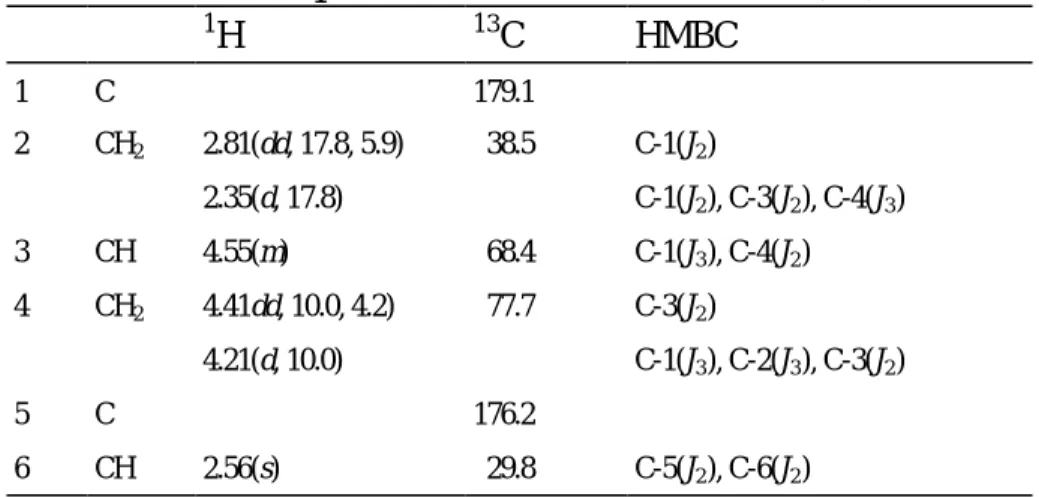
(43) 化學結構的決定本化合物為無色油狀物,與化合物 3-hydroxybutanolide (95)具有類 似的結構。氫譜(Chart 266)顯示具有 7 個氫質子,碳譜(Chart 267)顯 示有 6 個碳原子,3 個 methylenes (δ29.8、38.5 和 77.7),1 個 methines (δ68.4)和 2 個四級碳(δ176.2 和 179.1),其中δ179.1 為 butanolide 的 carbonyl 吸收訊號。本化合物比化合物 3-hydroxybutanolide 多 2 個 碳,包括 1 個 methylenes (δ29.8)和 1 個 carbonyl (δ176.2),初步推 定為-COCH2-的組合。HMBC (Chart 269)顯示 methylenes (δ29.8)除了 跟鄰位 carbonyl (δ176.2)的碳有長距離的關連外,並且與自己相對的 碳有關連,因此推定此化合物為雙體的結構。
FABMS 顯示本化合物具有 3-hydroxybutanolide 的離子裂片 m/z 103 (C4H7O3
+),而且[M+H]+為 287,綜合上述(Table 45)推定本化合物 為 bi(3-O-acetoxybutanolide),分子式為 C12H14O8,它是一個新的化合 物,命名為 anoectolide B。其結構如下:
1 2 3 4
5 6
O O
O O C CH
2O
CH
2O O
O C
Table 45. NMR spectral data of anoectolide B (43)
1
H
13C HMBC
1 C 179.1
2 CH2 2.81(dd, 17.8, 5.9) 2.35(d, 17.8)
38.5 C-1(J2)
C-1(J2), C-3(J2), C-4(J3) 3 CH 4.55(m) 68.4 C-1(J3), C-4(J2) 4 CH2 4.41dd, 10.0, 4.2)
4.21(d, 10.0)
77.7 C-3(J2)
C-1(J3), C-2(J3), C-3(J2)
5 C 176.2
6 CH 2.56(s) 29.8 C-5(J2), C-6(J2)
Chart 266
1H-NMR (CD3OD+CDCl3, 200 MHz) spectrum of anoectolide B(43)Chart 267
1C-NMR (CD3OD+CDCl3, 50 MHz) spectrum of anoectolide B (43)1 2 3 4
5 6
O O
O O C CH
2O
CH
2O O
O C
1 2 3 4
5 6
O O
O O C CH
2O
CH
2O O
O C
Chart 268 HMQC spectrum of anoectolide B (43)
Chart 269 HMBC spectrum of anoectolide B (43)
第二節 抗發炎及抗過敏之藥理活性
一、連珠石斛粗抽物之抗發炎及抗過敏試驗
1.嗜中性白血球去顆粒作用試驗
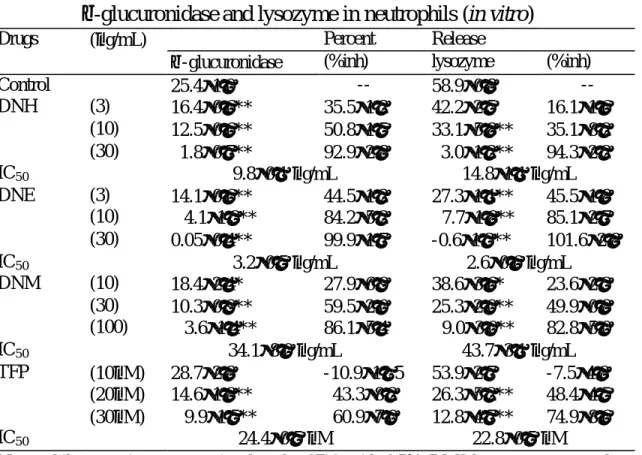
Table 46 顯示,連珠石斛正己烷粗抽物(DNH)、乙酸乙酯粗抽物 (DNE)和甲醇粗抽物(DNM),其濃度在 10 ìg/mL 下,對於 fMLP 引發 嗜中性白血球釋放 â-glucuronidase 和 lysozyme 的體外試驗,均有顯 著抑制作用(P<0.01),其中對嗜中性白血球釋放 â-glucuronidase 抑制 作用的 IC50 分別為 9.8、3.2 和 34.1 ìg/mL,對嗜中性白血球釋放 lysozyme 抑制作用的 IC50分別為 14.8、2.6 和 43.7 ìg/mL。由此試驗 顯示,連珠石斛 3 種粗抽物的抗發炎活性,其大小依次為:連珠石斛 乙酸乙酯粗抽物(DNE)>連珠石斛正己烷粗抽物(DNH)>連珠石斛甲 醇粗抽物(DNM)。
Table 46. Effect of extracts of D. nakaharai on the release of β
-glucuronidase and lysozyme in neutrophils (in vitro)Drugs ( µ g/mL) Percent Release
β -glucuronidase (%inh) lysozyme (%inh)
Control 25.4±1.0 -- 58.9±0.8 --
DNH (3) 16.4±0.6** 35.5±1.2 42.2±2.5 16.1±1.6
(10) 12.5 ± 0.6** 50.8 ± 1.5 33.1 ± 5.8** 35.1 ± 8.2 (30) 1.8±0.7** 92.9±2.8 3.0±1.2** 94.3±2.2
IC
509.8±0.1 µg/mL 14.8±1.1 µg/mL
DNE (3) 14.1±0.6** 44.5±1.2 27.3±1.1** 45.5±1.8 (10) 4.1±1.3** 84.2±5.2 7.7±1.8** 85.1±2.7 (30) 0.05±0.4** 99.9±1.7 -0.6±1.3** 101.6±2.8
IC
503.2±0.5 µg/mL 2.6±0.6 µg/mL
DNM (10) 18.4±2.4* 27.9±6.9 38.6±3.6* 23.6±2.3
(30) 10.3±0.9** 59.5±2.0 25.3±2.0** 49.9±0.8 (100) 3.6 ± 1.4** 86.1 ± 5.4 9.0 ± 3.0** 82.8 ± 5.0
IC
5034.1±8.0 µg/mL 43.7±3.1 µg/mL
TFP (10 µ M) 28.7 ± 2.8 -10.9 ± 12.5 53.9 ± 2.7 -7.5 ± 4.8 (20µM) 14.6±1.8** 43.3±8.2 26.3±5.2** 48.4±4.5 (30µM) 9.9±1.5** 60.9±7.0 12.8±4.7** 74.9±8.6
IC
5024.4±0.5 µM 22.8±0.5 µM
Neutrophil suspensions were preincubated at 37℃ with 0.5% DMSO or test compounds for 3 min in the presence of cytochalasin B (5 µg/ml). Forty-five minutes after the addition of formylmethionyl- leucyl-phenyl-alanine (fMLP) (1 µM), the amount of β-glucuronidase and lysozyme in the supernatant were determined. Values are presented as mean ± S. E., N=3, * P<0.05, ** P<0.01.DNH: n-Hexane extract of D. nakaharai, DNE: Ethyl acetate extract of D. nakaharai, DNM: Methanol extract of D. nakaharai;
Trifluoperazine (TFP) (as positive control).
2.肥滿細胞去顆粒作用試驗
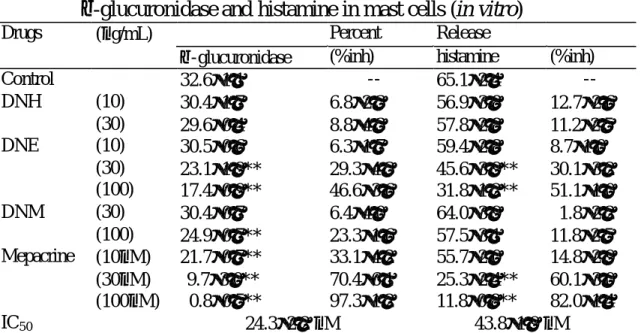
Table 47 顯示,連珠石斛正己烷粗抽物(DNH)對於 compound 48/80 引發肥滿細胞釋放 â-glucuronidase 和 histamine 的體外試驗,無 抑制作用,而連珠石斛乙酸乙酯粗抽物(DNE)在 30 ìg/mL 濃度下,
對於 compound 48/80 引發肥滿細胞釋放 â-glucuronidase 和 histamine 的體外試驗,有明顯抑制作用(P<0.01),但是連珠石斛甲醇粗抽物 (DNM)對於 compound 48/80 引發肥滿細胞釋放 â-glucuronidase 的體 外試驗,需在 100 ìg/mL 濃度下,才有明顯的抑制作用。
Table 47. Effect of extracts of D.nakaharai on the release of β
-glucuronidase and histamine in mast cells (in vitro)Drugs (µg/mL) Percent Release
β-glucuronidase (%inh) histamine (%inh)
Control 32.6±1.1 -- 65.1±2.4 --
DNH (10) 30.4±1.7 6.8±2.3 56.9±3.8 12.7±2.6
(30) 29.6±0.4 8.8±4.3 57.8±2.8 11.2±2.5
DNE (10) 30.5±0.6 6.3±1.7 59.4±2.8 8.7±1.0
(30) 23.1±1.9** 29.3±4.3 45.6±3.9** 30.1±3.2 (100) 17.4±0.9** 46.6±3.6 31.8±1.2** 51.1±1.0
DNM (30) 30.4±0.7 6.4±4.0 64.0±3.9 1.8±2.2
(100) 24.9±0.7** 23.3±1.6 57.5±3.1 11.8±2.5 Mepacrine (10µM) 21.7±0.7** 33.1±4.2 55.7±2.0 14.8±2.9 (30 µ M) 9.7 ± 3.0** 70.4 ± 6.1 25.3 ± 2.4** 60.1 ± 3.0 (100µM) 0.8±0.5** 97.3±1.2 11.8±0.8** 82.0±1.4
IC
5024.3±2.2 µM 43.8±1.9 µM
Mast cell suspensions were preincubated at 37℃ with 0.5% DMSO or test compounds
for 3 min. Fifteen minutes after the addition of compound 48/80, the amount of
β-glucuronidase and histamine in the supernatant were determined. Values are presented
as mean ± S. E., N=3, * P<0.05, ** P<0.01; Mepacrine (as positive control).
二、DNE-I~DNE-VI 之抗發炎及抗過敏試驗
經由上述實驗結果,得知連珠石斛乙酸乙酯粗抽物(DNE)對抗發 炎及抗過敏活性有較佳的作用,進一步對連珠石斛乙酸乙酯粗抽物 (DNE)再做分離。DNE 再經 Sephadex LH-20 管柱層析分離,利用薄 層層析(TLC)比較合併為 6 個部分 DNE-I~DNE-VI (Scheme 15),再進 行抗發炎及抗過敏活性試驗。
1.嗜中性白血球去顆粒作用試驗
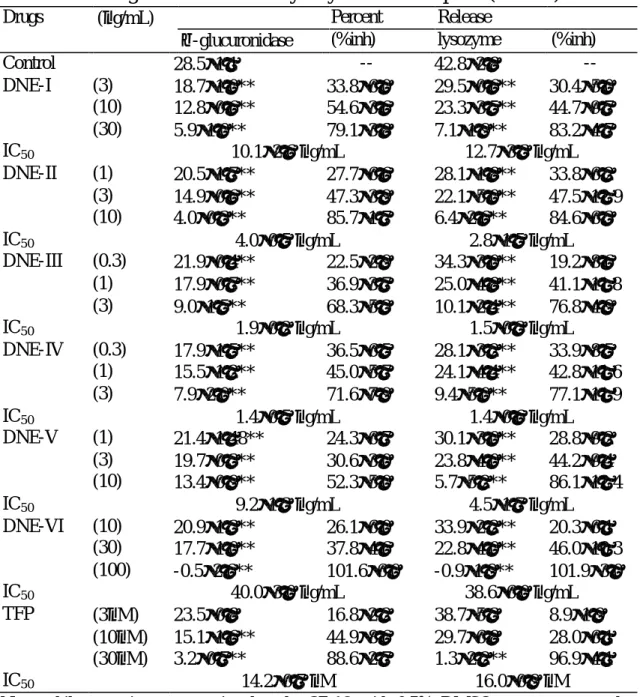
Table 48 顯示,DNE-I~DNE-VI 濃度在 10 ìg/mL 下,對於 fMLP 引發嗜中性白血球釋放 â-glucuronidase 和 lysozyme 的體外試驗,均 有顯著抑制作用(P<0.01),其中對嗜中性白血球釋放 â-glucuronidase 抑制作用的 IC50分別為 10.1、4.0、1.9、1.4、9.2 和 40.0 ìg/mL,對 嗜中性白血球釋放 lysozyme 抑制作用的 IC50分別為 12.7、2.8、1.5、
1.4、4.5 和 38.6 ìg/mL。由此試驗分別顯示其抗發炎活性。(對嗜中性 白血球釋放 â-glucu- ronidase 抑制作用的活性大小依次為:DNE-IV,
DNE-III,DNE-II DNE- V,DNE-I > DNE-VI;對嗜中性白血球釋放 lysozyme 抑制作用的活性大小依次為:DNE-IV,DNE-III,DNE-II,
DNE-V DNE-I > DNE-VI。) 2.肥滿細胞去顆粒作用試驗
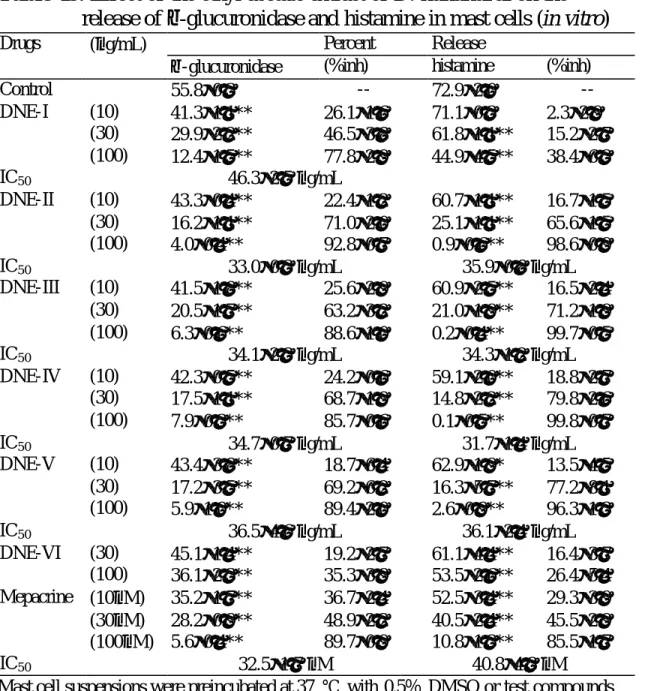
Table 49 顯示, DNE-I~DNE-VI 在 30 ìg/mL 濃度下,對於 compound 48/80 引發肥滿細胞釋放 â-glucuronidase 和 histamine 的體 外試驗,均有明顯抑制作用(P<0.01),其中 DNE-I~DNE-V 對肥滿細 胞釋放 â-glucuronidase 抑制作用的 IC50分別為 46.3、33.0、34.1、34.7 和 36.5 ìg/mL,而 DNE-II~DNE-V 對肥滿細胞釋放 histamine 抑制作 用的 IC50分別為 35.9、34.3、31.7 和 36.1 ìg/mL。由此試驗分別顯示 其抗過敏活性。(對肥滿細胞釋放 â-glucuronidase 和 histamine 抑制作 用的活性大小依次為:DNE-II,DNE-III,DNE-IV,DNE-V> DNE-I,
DNE-VI。)
Table 48. Effect of the ethyl acetate extract of D. nakaharai on the release
ofβ
-glucuronidase and lysozyme in neutrophils (in vitro)Drugs (µg/mL) Percent Release
β-glucuronidase (%inh) lysozyme (%inh)
Control 28.5±1.1 -- 42.8±2.8 --
DNE-I (3) 18.7±1.0** 33.8±6.0 29.5±0.6** 30.4±5.0 (10) 12.8±0.6** 54.6±3.6 23.3±3.5** 44.7±9.7 (30) 5.9±1.0** 79.1±3.8 7.1±1.9** 83.2±4.7
IC
5010.1±2.6 µg/mL 12.7±3.3 µg/mL
DNE-II (1) 20.5±1.7** 27.7±6.6 28.1±1.8** 33.8±6.2 (3) 14.9±0.6** 47.3±3.9 22.1±5.0** 47.5±12.9 (10) 4.0 ± 0.3** 85.7 ± 1.7 6.4 ± 2.6** 84.6 ± 6.3
IC
504.0±0.5 µg/mL 2.8±1.5 µg/mL
DNE-III (0.3) 21.9±0.4** 22.5±2.9 34.3±3.0** 19.2±8.6 (1) 17.9±0.7** 36.9±3.7 25.0±4.8** 41.1±11.8 (3) 9.0±1.5** 68.3±5.3 10.1±2.4** 76.8±4.9
IC
501.9±0.2 µg/mL 1.5±0.3 µg/mL
DNE-IV (0.3) 17.9±1.5** 36.5±6.5 28.1±3.2** 33.9±8.5 (1) 15.5±1.2** 45.0±5.7 24.1±4.4** 42.8±11.6 (3) 7.9±2.0** 71.6±7.9 9.4±5.0** 77.1±11.9
IC
501.4±0.5 µg/mL 1.4±0.6 µg/mL
DNE-V (1) 21.4±1.48** 24.3±6.7 30.1±3.0** 28.8±9.2 (3) 19.7 ± 0.3** 30.6 ± 3.0 23.8 ± 4.0** 44.2 ± 9.4 (10) 13.4±0.9** 52.3±5.0 5.7±5.2** 86.1±12.4
IC
509.2±1.3 µg/mL 4.5±1.7 µg/mL
DNE-VI (10) 20.9±1.3** 26.1±6.0 33.9±2.2** 20.3±6.1 (30) 17.7±1.0** 37.8±4.6 22.8±4.0** 46.0±10.3 (100) -0.5±2.6** 101.6±6.0 -0.9±1.9** 101.9±3.0
IC
5040.0±3.0 µg/mL 38.6±6.0 µg/mL
TFP (3µM) 23.5±0.8 16.8±2.2 38.7±5.3 8.9±1.9
(10µM) 15.1±1.6** 44.9±8.6 29.7±6.8 28.0±6.1 (30 µ M) 3.2 ± 0.7** 88.6 ± 2.7 1.3 ± 2.2** 96.9 ± 4.1
IC
5014.2±0.7 µM 16.0±0.9 µM
Neutrophil suspensions were preincubated at 37 ℃ with 0.5% DMSO or test compounds
for 3 min in the presence of cytochalasin B (5 µg/mL). Forty-five minutes after the addition
of formylmethionyl- leucyl-phenyl-alanine (fMLP) (1 µM), the amount of β -glucuronidase
and lysozyme in the supernatant were determined. Values are presented as mean ± S. E.,
N=3, * P<0.05, ** P<0.01; Trifluoperazine (TFP) (as positive control).
Table 49. Effect of the ethyl acetate extract of D. nakaharai on the
release ofβ
-glucuronidase and histamine in mast cells (in vitro)Drugs (µg/mL) Percent Release
β -glucuronidase (%inh) histamine (%inh)
Control 55.8±0.3 -- 72.9±2.0 --
DNE-I (10) 41.3±1.1** 26.1±1.6 71.1±0.3 2.3±2.9 (30) 29.9±2.2** 46.5±3.8 61.8±1.1** 15.2±2.7 (100) 12.4 ± 1.5** 77.8 ± 2.9 44.9 ± 4.5** 38.4 ± 6.3
IC
5046.3±2.5 µg/mL
DNE-II (10) 43.3±0.4** 22.4±1.2 60.7±1.1** 16.7±1.5 (30) 16.2±1.1** 71.0±2.0 25.1±1.1** 65.6±1.5 (100) 4.0±0.4** 92.8±0.7 0.9±0.6** 98.6±0.9
IC
5033.0±0.3 µg/mL 35.9±0.8 µg/mL
DNE-III (10) 41.5±1.8** 25.6±2.9 60.9±2.5** 16.5±2.4 (30) 20.5±1.7** 63.2±3.2 21.0±1.9** 71.2±1.9 (100) 6.3±0.6** 88.6±1.0 0.2±0.4** 99.7±0.5
IC
5034.1 ± 2.3 µ g/mL 34.3 ± 1.2 µ g/mL
DNE-IV (10) 42.3±0.5** 24.2±0.6 59.1±2.0** 18.8±2.7 (30) 17.5±1.1** 68.7±1.9 14.8±2.2** 79.8±2.6 (100) 7.9±0.3** 85.7±0.6 0.1±0.5** 99.8±0.7
IC
5034.7±0.7 µg/mL 31.7±1.4 µg/mL
DNE-V (10) 43.4±3.8** 18.7±6.4 62.9±1.9* 13.5±4.5 (30) 17.2±3.5** 69.2±6.2 16.3±5.7** 77.2±8.1 (100) 5.9±1.0** 89.4±2.0 2.6±0.9** 96.3±1.3
IC
5036.5±4.6 µg/mL 36.1±2.4 µg/mL
DNE-VI (30) 45.1±1.4** 19.2±2.7 61.1±4.4** 16.4±3.7 (100) 36.1±2.3** 35.3±3.9 53.5±2.6** 26.4±5.4 Mepacrine (10 µ M) 35.2 ± 1.7** 36.7 ± 2.4 52.5 ± 3.4** 29.3 ± 3.9 (30µM) 28.2±0.9** 48.9±2.2 40.5±2.4** 45.5±2.9 (100µM) 5.6±0.4** 89.7±0.9 10.8±1.3** 85.5±1.7
IC
5032.5±1.7 µM 40.8±4.3 µM
Mast cell suspensions were preincubated at 37 ℃ with 0.5% DMSO or test compounds
for 3 min. Fifteen minutes after the addition of compound 48/80, the amount of
β-glucuronidase and histamine in the supernatant were determined. Values are presented
as mean ± S. E., N=3, * P<0.05, ** P<0.01; Mepacrine (as positive control).
三、臺灣金線連粗抽物之抗發炎及抗過敏試驗
1.嗜中性白血球去顆粒作用試驗
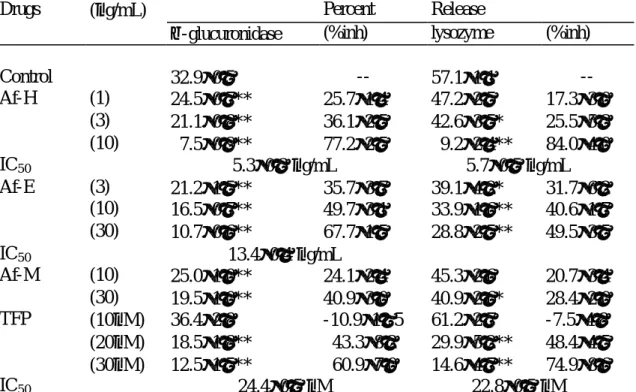
Table 50 顯示,臺灣金線連正己烷粗抽物(Af-H)和乙酸乙酯粗抽 物(Af-E),其濃度在 10 ìg/mL 之下,對於 fMLP 引發嗜中性白血球釋 放 â-glucuronidase 和 lysozyme 的體外試驗,均有顯著抑制作用 (P<0.01),其中臺灣金線連正己烷粗抽物(Af-H)對嗜中性白血球釋放 â-glucuroni- dase 抑制作用的 IC50為 5.3 ìg/mL,對嗜中性白血球釋放 lysozyme 抑制作用的 IC50分別為 5.7 ìg/mL;臺灣金線連乙酸乙酯粗 抽物(Af-E)對嗜中性白血球釋放 â-glucuronidase 抑制作用的 IC50 為 13.4 ìg/mL;而臺灣金線連甲醇粗抽物(Af-M)要在 30 ìg/mL 濃度下,
對 fMLP 引發嗜中性白血球釋放 â-glucuronidase 和 lysozyme 的體外 試驗,才有抑制作用。由此試驗顯示,臺灣金線連可能具有抗發炎活 性,以正己烷粗抽物(Af-H)最好,其次乙酸乙酯粗抽物(Af-E),而甲 醇粗抽物(Af-M)較差。
Table 50. Effect of extracts of A. formosanus on the release of β
-glucuro- nidase and lysozyme in neutrophils (in vitro)Drugs (µg/mL) Percent Release
β -glucuronidase (%inh) lysozyme (%inh)
Control 32.9±0.5 -- 57.1±1.1 --
Af-H (1) 24.5±0.7** 25.7±1.4 47.2±2.5 17.3±3.0
(3) 21.1±0.8** 36.1±2.5 42.6±3.5* 25.5±5.3 (10) 7.5±0.9** 77.2±2.5 9.2±2.4** 84.0±4.0
IC
505.3±0.3 µg/mL 5.7±0.5 µg/mL
Af-E (3) 21.2±1.5** 35.7±3.7 39.1±4.2* 31.7±6.2 (10) 16.5±0.7** 49.7±3.1 33.9±1.6** 40.6±1.7 (30) 10.7 ± 0.6** 67.7 ± 1.5 28.8 ± 2.5** 49.5 ± 3.5
IC
5013.4±0.4 µg/mL
Af-M (10) 25.0±1.0** 24.1±2.4 45.3±2.6 20.7±3.4 (30) 19.5±1.0** 40.9±3.0 40.9±2.6* 28.4±2.0 TFP (10µM) 36.4±2.8 -10.9±12.5 61.2±2.7 -7.5±4.8
(20µM) 18.5±1.8** 43.3±8.2 29.9±5.2** 48.4±4.5 (30µM) 12.5±1.5** 60.9±7.0 14.6±4.7** 74.9±8.6
IC
5024.4±0.5 µM 22.8±0.5 µM
Neutrophil suspensions were preincubated at 37 ℃ with 0.5% DMSO or test compounds
for 3 min in the presence of cytochalasin B (5 µg/mL). Forty-five minutes after the
addition of formylmethionyl- leucyl-phenyl-alanine (fMLP) (1 µM), the amount of
β-glucuronidase and lysozyme in the supernatant were determined. Values are presented
as mean ± S. E., N=3, * P<0.05, ** P<0.01.Af-H: n-Hexane extract of A. formosanus,
2.肥滿細胞去顆粒作用試驗
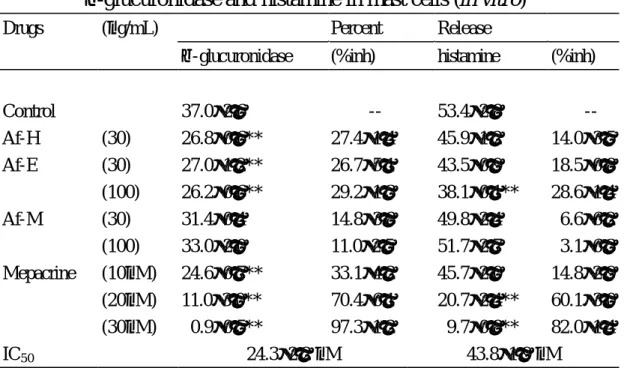
Table 51 顯示,臺灣金線連三種粗抽物對於 compound 48/80 引發 肥滿細胞釋放 â-glucuronidase 和 histamine 的體外試驗,抑制作用不 佳。
Table 51. Effect of extracts of A. formosanus on the Release of β
-glucuronidase and histamine in mast cells (in vitro)Drugs (µg/mL) Percent Release
β -glucuronidase (%inh) histamine (%inh)
Control 37.0±2.6 -- 53.4±2.8 --
Af-H (30) 26.8±0.6** 27.4±1.4 45.9±1.2 14.0±3.5 Af-E (30) 27.0±1.2** 26.7±5.1 43.5±0.9 18.5±0.8 (100) 26.2±0.6** 29.2±1.3 38.1±0.1** 28.6±1.4
Af-M (30) 31.4±0.4 14.8±3.8 49.8±2.4 6.6±6.2
(100) 33.0±2.0 11.0±2.5 51.7±2.7 3.1±6.3 Mepacrine (10µM) 24.6±0.7** 33.1±4.2 45.7±2.0 14.8±2.9 (20µM) 11.0±3.0** 70.4±6.1 20.7±2.4** 60.1±3.0 (30µM) 0.9±0.5** 97.3±1.2 9.7±0.8** 82.0±1.4
IC
5024.3±2.2 µM 43.8±1.9 µM
Mast cell suspensions were preincubated at 37 ℃ with 0.5 % DMSO or test compounds for 3 min. Fifteen minutes after the addition of compound 48/80, the amount β -glucuronidase and histamine in the supernatant were determined. Values are presented as mean ± S. E., N=3, * P<0.05, ** P<0.01; Mepacrine (as positive control).
四、化合物之抗發炎及抗過敏試驗
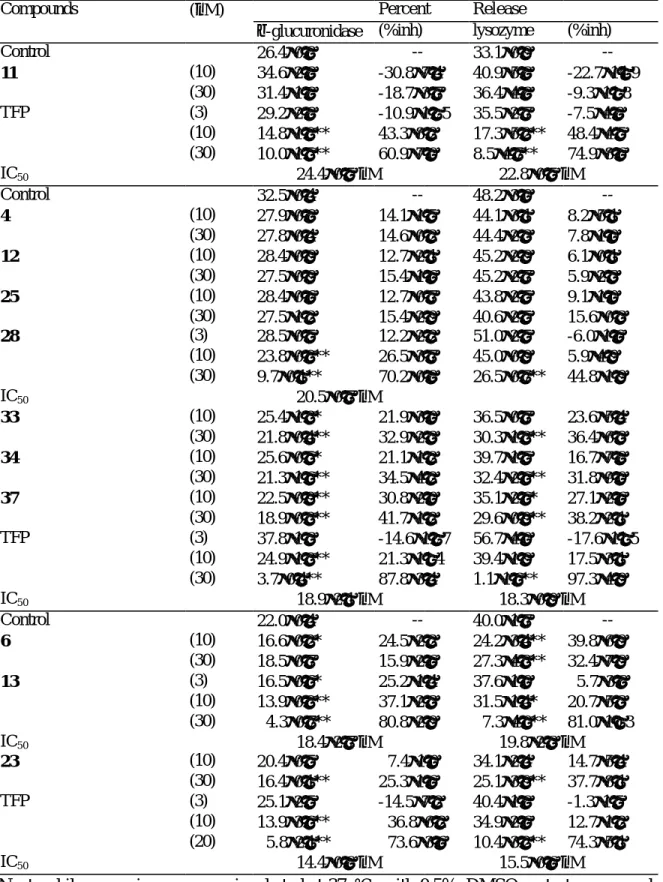
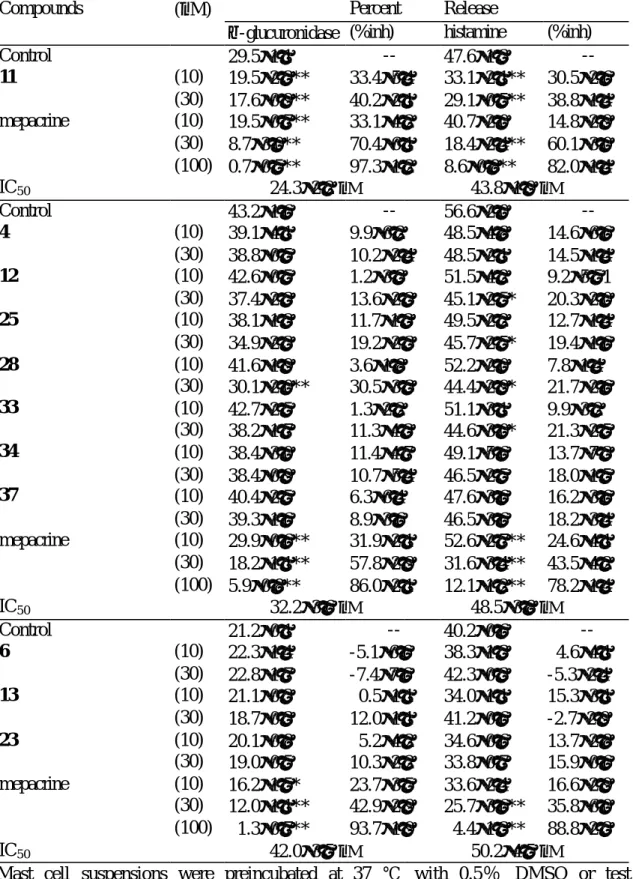
由石斛、連珠石斛與臺灣金線連分離得到的化合物,進行抗發炎 及抗過敏活性試驗,其結果顯示於 Table 52 至 Table 60.
1. Denbinobin (11)抗發炎及抗過敏試驗
Denbinobin (11)在 1 ìM 濃度下,對於 LPS 於刺激巨噬細胞株 RAW 264.7 釋放 TNF-á 和 PGE2 之抑制試驗,有顯著的抑制作用 (P<0.01),其抑制率分別為 62 和 43 %,但是在相同的條件下,對刺 激細胞釋放 NO 之抑制試驗,並無影響。而對於 LPS 及 IFN-ã 刺激小 神經膠總細胞株 N9 釋放 TNF-á 和 Nitrite 的作用,其抑制率分別為 70 和 44 %。此外,在 30 ìM 濃度下,對於 compound 48/80 引發肥滿 細胞釋放 â-glucuroni- dase 和 histamine 的體外試驗,亦有明顯抑制作 用(P<0.01),其抑制率分別為 40 和 39 %。
2. Vanillin (38)抗發炎及抗過敏試驗
Vanillin (38)在 30 ìM 濃度下,對於 fMLP 和 PMA 引發嗜中性白 血球釋放超氧自由基(superoxide anion)的抑制試驗,具有抑制作用,
其抑制率分別為 38 和 52 %,其中對 PMA 引發嗜中性白血球釋放超 氧自由基抑制效果較佳,IC50為 24.4 ìM。
3. p-Anisaldehyde (4)抗發炎及抗過敏試驗
p-Anisaldehyde (4)在 10-30 ìM 濃度下,對於 fMLP 引發嗜中性白 血球釋放超氧自由基的抑制試驗,有弱的抑制作用。
4. Nakaharain (25)抗發炎及抗過敏試驗
實驗顯示 nakaharain (25)無好的抗發炎和抗過敏活性。
5. 2,5-Dihydroxy-3,4-dimethoxyphenanthrene (28)抗發炎及抗 過敏試驗
2,5-Dihydroxy-3,4-dimethoxyphenanthrene (28)在 30 ìM 濃度下,
對於 fMLP 引發嗜中性白血球釋放 â-glucuronidase 和 lysozyme 的體 外試驗,均具有抑制作用,其中對於嗜中性白血球釋放 â-glucuronidase 的 IC50 為 20.5 ìM。 對 於 compound 48/80 引 發 肥 滿 細 胞 釋 放 â-glucuronidase 和 histamine 的體外試驗,有弱的抑制作用。對於 fMLP 引發嗜中性白血球釋放超氧自由基的抑制試驗,其 IC50為 20.7 ìM。
另外對於 LPS 於刺激巨噬細胞株 RAW 264.7 釋放 NO 之抑制試驗,
則較弱。此外在較低濃度 10 ìM 時,對於 PMA 引發嗜中性白血球釋 放超氧自由基的抑制試驗,有 38 %的抑制作用。而對於 LPS 及 IFN-ã 刺激小神經膠總細胞株 N9 釋放 TNF-á 之抑制試驗,則較弱。綜合上 述試驗得知,28 對嗜中性白血球有抑制效果。
6. Vitexin (37)抗發炎及抗過敏試驗
Vitexin (37)在 30 ìM 濃度下,對於 fMLP 引發嗜中性白血球釋放 â-glucuronidase 和 lysozyme 的體外試驗,均具有抑制作用,其抑制率 分別為 42 和 38 %。此外在低濃度 1 ìM 下,對於 fMLP 引發嗜中性 白血球釋放超氧自由基的抑制試驗,具顯著的抑制作用,其抑制率為 33 %。綜合上述試驗得知,37 對嗜中性白血球所引發的發炎可能有 抑制效果。
7. Protocatechuic acid (33)抗發炎及抗過敏試驗
Protocatechuic acid (33)在 30 ìM 濃度下,對於 fMLP 引發嗜中性 白血球釋放 â-glucuronidase 和 lysozyme 的體外試驗,均具有抑制作 用,其抑制率分別為 33 和 36 %。此外在 10 ìM 濃度下,對於 fMLP 引發嗜中性白血球釋放超氧自由基的抑制試驗,具顯著的抑制作用,
其抑制率為 44 %。綜合上述試驗得知,33 對嗜中性白血球所引發的 發炎可能有抑制效果。
8. Uracil (34)抗發炎及抗過敏試驗
Uracil (34)在 30 ìM 濃度下,對於 fMLP 引發嗜中性白血球釋放 â-glucuronidase 和 lysozyme 的體外試驗,均具有抑制作用,其抑制率 分別為 35 和 32 %。而對於 fMLP 引發嗜中性白血球釋放超氧自由基 的抑制試驗,在較低濃度 3 ìM 下,即具顯著的抑制作用,其 IC50為 21.3 ìM。綜合上述試驗得知,34 對嗜中性白血球所引發的發炎可能 有抑制效果。
9. trans-â-Carotene (23)抗發炎及抗過敏試驗
trans-â-Carotene (23)在 30 ìM 濃度下,對於 fMLP 引發嗜中性白 血球釋放 â-glucuronidase 和 lysozyme 的體外試驗,具有抑制作用,
其抑制率分別為 25 和 38 %。
10. Linoleic acid 抗發炎及抗過敏試驗
Linoleic acid (13) 對 於 fMLP 引 發 嗜 中 性 白 血 球 釋 放 â-glucuronidase 和 lysozyme 的體外試驗,均具顯著抑制作用,IC50分 別為 18.4 和 19.8 ìM。
11. Pheophytin a (6)抗發炎及抗過敏試驗
Pheophytin a (6)在低濃度 10 ìM 下,對於 fMLP 引發嗜中性白血 球釋放 â-glucuronidase 和 lysozyme 的體外試驗,均具有抑制作用,
其抑制率分別為 25 和 40 %,但是較高濃度 30 ìM 下,其抑制作用減 弱為 16 和 32 %。此外在 30 ìM 濃度下,對於 LPS 於刺激巨噬細胞 株 RAW 264.7 釋放 TNF-á 之抑制試驗,具有 26 %抑制作用。這說明
6 可能具有弱的抗發炎活性。
Table 52. Effect of compounds on the release of β
-glucuronidase and lysozyme in neutrophils (in vitro)Compounds (
µM) Percent Release
β-glucuronidase (%inh)
lysozyme (%inh)
Control 26.4
±0.8 -- 33.1
±0.9 --
11
(10) 34.6
±2.8 -30.8
±7.4 40.9
±5.8 -22.7
±14.9
(30) 31.4±1.8 -18.7±3.7 36.4±4.8 -9.3±11.8
TFP (3) 29.2±2.8 -10.9±12.5 35.5±2.7 -7.5±4.8
(10) 14.8
±1.8** 43.3
±8.2 17.3
±5.2** 48.4
±4.5 (30) 10.0
±1.5** 60.9
±7.0 8.5
±4.7** 74.9
±8.6
IC
5024.4±0.5 µM 22.8±0.5 µM
Control 32.5±0.4 -- 48.2±3.0 --
4
(10) 27.9
±0.8 14.1
±1.5 44.1
±3.1 8.2
±5.1
(30) 27.8
±0.4 14.6
±0.2 44.4
±2.3 7.8
±1.0
12
(10) 28.4±0.9 12.7±2.1 45.2±2.9 6.1±0.1
(30) 27.5±0.9 15.4±1.6 45.2±2.7 5.9±2.3
25
(10) 28.4
±0.6 12.7
±0.7 43.8
±2.5 9.1
±1.0
(30) 27.5
±1.2 15.4
±2.9 40.6
±2.5 15.6
±0.3
28
(3) 28.5±0.5 12.2±2.2 51.0±2.5 -6.0±1.6
(10) 23.8±0.8** 26.5±3.7 45.0±0.9 5.9±4.9 (30) 9.7
±0.1** 70.2
±0.8 26.5
±0.7** 44.8
±1.9
IC
5020.5
±0.7
µM
33
(10) 25.4±1.3* 21.9±3.0 36.5±0.7 23.6±5.4
(30) 21.8±0.4** 32.9±2.3 30.3±1.3** 36.4±6.3
34
(10) 25.6
±0.5* 21.1
±1.2 39.7
±1.5 16.7
±7.8
(30) 21.3
±1.6** 34.5
±4.2 32.4
±2.6** 31.8
±9.0
37
(10) 22.5±0.9** 30.8±2.0 35.1±2.6* 27.1±2.6
(30) 18.9±0.3** 41.7±1.2 29.6±0.9** 38.2±2.1 TFP (3) 37.8
±1.3 -14.6
±12.7 56.7
±4.0 -17.6
±11.5
(10) 24.9
±1.3** 21.3
±11.4 39.4
±1.9 17.5
±3.1 (30) 3.7±0.4** 87.8±3.4 1.1±1.6** 97.3±4.9
IC
5018.9±2.1 µM 18.3±0.9 µM
Control 22.0
±0.4 -- 40.0
±1.7 --
6
(10) 16.6
±0.2* 24.5
±2.2 24.2
±3.4** 39.8
±6.9
(30) 18.5±0.7 15.9±2.6 27.3±4.3** 32.4±7.9
13
(3) 16.5±0.6* 25.2±1.4 37.6±1.0 5.7±3.8
(10) 13.9
±0.8** 37.1
±2.3 31.5
±1.4* 20.7
±5.3 (30) 4.3
±0.7** 80.8
±2.9 7.3
±4.0** 81.0
±10.3
IC
5018.4±2.7 µM 19.8±2.3 µM
23
(10) 20.4±0.5 7.4±1.0 34.1±2.4 14.7±5.4
(30) 16.4
±0.1** 25.3
±1.6 25.1
±3.9** 37.7
±8.1
TFP (3) 25.1
±2.5 -14.5
±7.2 40.4
±1.8 -1.3
±1.5
(10) 13.9±3.6** 36.8±6.2 34.9±2.6 12.7±1.2 (20) 5.8±2.1** 73.6±3.6 10.4±3.2** 74.3±5.1
IC
5014.4
±0.8
µM 15.5
±0.6
µM
Neutrophil suspensions were preincubated at 37 ℃ with 0.5% DMSO or test compounds
for 3 min in the presence of cytochalasin B (5 µg/mL). Forty-five minutes after the addition
of formylmethionyl- leucyl-phenyl-alanine (fMLP) (1 µM), the amount of β-glucuronidase
Table 53. Effect of compounds on the release of β
-glucuronidase and histamine in mast cells (in vitro)Compounds (µM) Percent Release
β -glucuronidase (%inh) histamine (%inh)
Control 29.5±1.1 -- 47.6±1.3 --
11 (10) 19.5 ± 2.3** 33.4 ± 5.4 33.1 ± 2.1** 30.5 ± 2.6 (30) 17.6±0.9** 40.2±2.1 29.1±0.5** 38.8±1.4 mepacrine (10) 19.5±0.7** 33.1±4.2 40.7±2.0 14.8±2.9 (30) 8.7±3.0** 70.4±6.1 18.4±2.4** 60.1±3.0 (100) 0.7±0.5** 97.3±1.2 8.6±0.8** 82.0±1.4
IC
5024.3±2.2
µM 43.8±1.9
µM
Control 43.2±1.6 -- 56.6±2.0 --
4 (10) 39.1±4.1 9.9±6.2 48.5±4.8 14.6±6.6
(30) 38.8±0.5 10.2±2.4 48.5±2.1 14.5±1.4
12 (10) 42.6±0.5 1.2±3.3 51.5±4.2 9.2±5.51
(30) 37.4±2.3 13.6±2.3 45.1±2.5* 20.3±2.0 25 (10) 38.1 ± 1.3 11.7 ± 1.3 49.5 ± 2.2 12.7 ± 1.4 (30) 34.9±2.3 19.2±2.3 45.7±2.5* 19.4±1.6 28 (10) 41.6 ± 1.9 3.6 ± 1.8 52.2 ± 2.0 7.8 ± 1.4
(30) 30.1±2.0** 30.5±3.3 44.4±2.9* 21.7±2.6
33 (10) 42.7±2.5 1.3±2.2 51.1±3.1 9.9±3.2
(30) 38.2±1.7 11.3±4.3 44.6±3.0* 21.3±2.5
34 (10) 38.4±3.0 11.4±4.7 49.1±5.6 13.7±7.3
(30) 38.4±0.9 10.7±5.4 46.5±2.5 18.0±1.5
37 (10) 40.4±2.5 6.3±6.4 47.6±3.6 16.2±3.6
(30) 39.3±1.6 8.9±3.6 46.5±3.6 18.2±3.4 mepacrine (10) 29.9±0.6** 31.9±2.1 52.6±2.7** 24.6±4.1 (30) 18.2 ± 1.1** 57.8 ± 2.9 31.6 ± 3.4** 43.5 ± 4.2 (100) 5.9±0.8** 86.0±2.1 12.1±1.2** 78.2±1.4
IC
5032.2±3.6
µM 48.5±3.8
µM
Control 21.2±0.1 -- 40.2±0.6 --
6 (10) 22.3±1.4 -5.1±6.6 38.3±1.3 4.6±4.1
(30) 22.8±1.7 -7.4±7.6 42.3±0.3 -5.3±2.4
13 (10) 21.1±0.3 0.5±1.1 34.0±1.1 15.3±3.1
(30) 18.7±0.3 12.0±1.1 41.2±0.6 -2.7±2.9
23 (10) 20.1±0.8 5.2±4.2 34.6±0.6 13.7±2.8
(30) 19.0±0.5 10.3±2.2 33.8±0.7 15.9±0.6 mepacrine (10) 16.2±1.5* 23.7±3.5 33.6±2.4 16.6±2.9 (30) 12.0 ± 1.1** 42.9 ± 2.9 25.7 ± 3.6** 35.8 ± 6.0 (100) 1.3±0.7** 93.7±1.9 4.4±1.3** 88.8±2.3
IC
5042.0 ± 3.5
µM 50.2 ± 4.5
µM
Mast cell suspensions were preincubated at 37 ℃ with 0.5% DMSO or test compounds for 3 min. Fifteen minutes after the addition of compound 48/80, the amount of β-glucuronidase and histamine activities in the supernatant were determined.
Values are presented as mean ± S. E., N=3, * P<0.05, ** P<0.01; mepacrine (as
positive control).
Table 54. The inhibitory effect of compounds on the superoxide
formation in neutrophilsCompounds (
µM) Superoxide Formation
nmol/10
6cells/30 min (%inh) N
Control 2.39±0.28 -- 3
11 (3)
3.14
±0.39 -31.6
±9.8 3
(10) 3.42
±0.46* -43.5
±12.7 3
(30) 3.62±0.46** -52.7±17.8 3
TFP (3) 2.47±0.46 -3.2±5.9 3
(10) 0.72
±0.08** 68.6
±2.5 3
(30) 0.23
±0.01** 88.5
±3.3 3
IC
5014.0±0.4 µM
Control 1.83±0.05 3
4
(10) 1.33
±0.15* 27.7
±6.3 3
(30) 1.33
±0.14* 27.7
±5.5 3
12
(10) 1.31±0.20* 28.9±9.0 3
(30) 1.15±0.24** 37.6±11.3 3
25
(10) 1.55
±0.12 15.6
±4.2 3
(30) 1.79
±0.13 2.4
±4.5 3
28
(3) 1.48±0.14 18.7±9.3 3
(10) 1.08±0.12** 40.8±7.2 3
(30) 0.75
±0.08** 58.7
±5.2 3
IC
5020.7
±3.6
µM
33
(3) 1.15±0.18** 37.7±8.1 3
(10) 1.03±0.15** 43.9±6.5 3
34
(3) 1.15
±0.04** 37.2
±2.5 3
(10) 1.02
±0.03** 44.1
±3.2 3
(30) 0.82±0.06** 55.0±3.2 3
37
(1) 1.24±0.20** 32.7±8.7 3
(3) 1.06
±0.13** 42.5
±5.3 3
IC
5021.3
±4.3
µM
TFP (3) 2.50±0.42 -30.2±11.7 3
(10) 1.09±0.28 40.5±11.1 3
(30) 0.11
±0.06** 93.6
±3.3 3
IC
5012.9
±1.0
µM
Control 2.81±0.19 -- 3
6
(10) 2.46±0.13 11.8±6.6 3
(30) 2.47
±0.16 11.2
±8.2 3
13
(10) 2.83
±0.02 -1.5
±6.2 3
(30) 3.00±0.11 -7.4±3.3 3
23