行政院國家科學委員會專題研究計畫 成果報告
侵入型及非侵入型 Porphyromonas gingivalis 調控人類血 管內皮細胞介白質-6 及其接受器(IL-6, gp130)之表現及其
訊息傳遞之研究
計畫類別: 個別型計畫
計畫編號: NSC93-2314-B-038-039-
執行期間: 93 年 08 月 01 日至 94 年 07 月 31 日 執行單位: 臺北醫學大學牙醫學系
計畫主持人: 周幸華
共同主持人: 賴銘堂,何元順
報告類型: 精簡報告
處理方式: 本計畫可公開查詢
中 華 民 國 94 年 12 月 28 日
行政院國家科學委員會專題研究計畫成果報告
計畫編號:
NSC 93-2314-B-038-039執行期限:
93 年 08 月 01 日 至 94 年 07 月 31 日主持人:周幸華 台北醫學大學牙醫學系 共同主持人:賴銘堂 何元順
一、中文摘要
牙周病是經由 Porphyromonas gingivalis 感 染所引發的慢性發炎反應,近年來許多文 獻報導指出,牙周病會增加患者罹患心血 管疾病的機率,發炎反應的三個指標:
C-reactive protein (CRP) 、 fibrinogen(Fb) 、 interleukin-6 皆對於增加心衰竭與中風之 危險有相關聯性;其中 interleukin-6 又為 冠狀動脈疾病的獨立性危險因子。本研究 藉由探討人類臍靜脈內皮細胞在受到牙周 病主要致病菌 Porphyromonas gingivalis (以 下簡稱 381) 感染,誘發 interleukin-6 及其 接受器表現之訊息傳遞來討論牙周病增加 心血管疾病危險因子之機制。另外,利用 另ㄧ突變菌株insertionally inactivated fimA (fimA mutants,以下簡稱 DPG3),比較細胞 受到侵入型與非侵入型細菌感染後訊息傳 遞機制之差異。結果顯示, 細胞分別受到 兩菌株感染後皆可誘發interleukin-6 產生 及調控 IL-6 receptor complex (IL-6α、gp130) 的表現,但是兩者有程度上的差異。在我 們的結果顯示JAKs/STAT3 路徑只參與在 由 381 所調控的 receptor 表現。在我們的 實 驗 模 式 中 , 經 由 牙 周 病 致 病 菌 P.gingivalis 感染人類臍靜脈內皮細胞後誘 導 IL-6 的產生並且調控IL-6 receptor 的表 現造成訊息傳遞的迴路,使得細胞本身自 我調控產生 IL-6 的大量分泌;然而,過度 的刺激會讓免疫反應所造成的損害性大過 於修復性。因此,藉由探討牙周病菌對於 臍靜脈細胞的感染發炎機制,可進一步的
了解牙周病與心血管疾病間的相關聯性,
並期望在將來可由致病機轉中找出減低牙 周病患者罹患心血管疾病的危險
Keywords:Porphyromonas gingivalis, IL-6, IL-6 receptor, gp130
二、英文摘要
Porphyromonas gingivalis is an oral pathogen that causes a chronic local inflammatory disease, periodontal disease, which results in the destruction of the periodontal ligament and alveolar bone.
Recent studies have focused on the association of P. gingivalis-mediated periodontal infection and systemic diseases.
Several reports support a definite relationship between periodontal infections and certain systemic conditions including atherosclerosis and cardiovascular disease.
Therefore, markers of systemic inflammation, such as C-reactive protein (CRP), fibrinogen, different cytokines; especially interleukin-6 (IL-6) have been studied as potential new risk factors.
It has established that the periodontal pathogen Porphyromonas gingivalis is capable of invading aortic, heart, and human umbilical vein endothelial cells (HUVEC).Interactions of P. gingivalis with endothelial cells and the subsequent host cell response to infection may be important in the
pathogenesis of atherosclerosis. In this study, we coculture HUVEC with live P. gingivalis strain, 381, and insertionally inactivated fimA mutant, DPG3 respectively to compare the results. We demonstrated that P. gingivalis upregulated IL-6 and IL-6 receptor in HUVEC. The results showed that both P.
gingivalis strains can modulate IL-6 expression in endothelial cell, but there is difference in the expression level. Our data showed that STAT3 activation was only involved in 381-regulated IL-6 receptor expression. Our results revealed the signaling pathway involved in regulation of IL-6 receptor complex expression in HUVEC by invasive and non-invasive P. g. Our data showed an experimental link between P.
gingivalis infection and vein endothelial cells.
It would activate IL-6 signaling transduction and result in excess IL-6 production in HUVEC infected by P. g. The results suggested that P. gingivalis infection would induce inflammatory response in endothelial cells; therefore
accelerates atherosclerotic changes.
Keywords:Porphyromonas gingivalis, IL-6, IL-6 receptor, gp130
三、計畫緣由與目的
Porphyromonas gingivalis (P.
gingivalis) has been implicated as a major etiological agent in the development of adult periodontitis, which is a bacterially induced chronic inflammatory disease that leads to the inflammation of the gingiva, loss of alverolar bone with eventual loss of teeth (16). Recently, several epidemiological and pathological studies have demonstrated a role for Porphyromonas gingivalis infection
in atherosclerosis and human coronary heart disease (2, 4, 6, 8, 9, 12). In vitro experiments of cell culture had shown that bacterial components of P. gingivalis such as fimbriae, LPS and gingipains can induce IL-6 production in gingival fibroblasts, epithelial cells and KB cells, respectively (5, 7, 11, 13, 17). IL-6 is an important mediator of the acute phase response and can increase plasma levels of C-reactive protein (CRP) that are correlated with prognosis in patients with unstable angina (3, 10), and with the risk of myocardial infarction in healthy subjects (15). The results of in vitro studies also suggested the potential direct involvement of IL-6 in atherogenesis (18).
Ogawa et al reported that P. gingivalis fimbriae induced IL-6 production in human peripheral monocytes (13). Lourbakos et al reported that purified Arginine-specific protease of P. gingivalis induces IL-6 secretion in human oral epithelial cells (11), while Protempa’s group reported that purified P. gingivalis gingipain degrade IL-6 and IL-6R in a cell-free model (1, 14). These results indicated that purified molecule of P.
gingivalis gingipain can degrade IL-6 in a cell-free model, but the results from cell culture experiment is contrary and suggested that P. gingivalis gingipain stimulate IL-6 expression. In the past few years, studies had focused only on the effect of P. gingivalis bacterial components on IL-6, but whether this extends to the modulation of IL-6 and its receptor (IL-6R) and signaling subunit (gp130) expression in human endothelial cells following active invasion of live P.
gingivalis remained to be investigated.
In the present study, we investigated how active invasion of P.
gingivalis modulates IL-6R and gp130 expression and gp130 signaling in endothelial cells.
四、結果與討論
In this study, we demonstrated that P.
gingivalis upregulated IL-6 and IL-6 receptor in HUVEC. The results showed that both P.
gingivalis strains can modulate IL-6 expression in endothelial cell, but there is difference in the expression level (Fig.1). P.
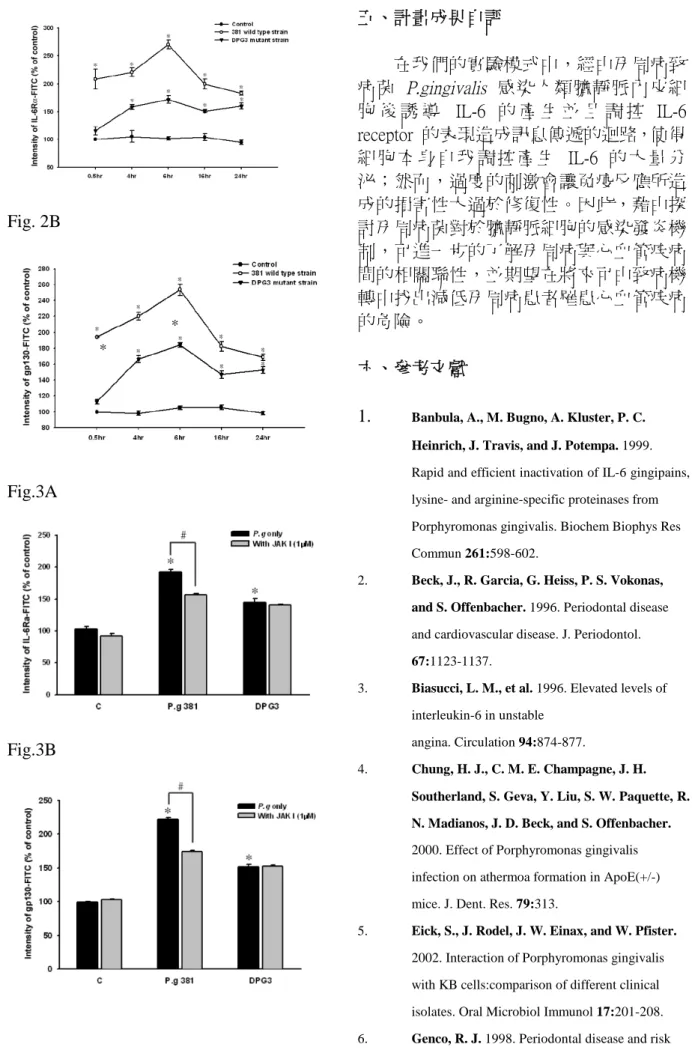
gingivalis381 upregulated IL-6 receptor (IL-6Rα, gp130) expression in HUVEC cells (Fig.2). The JAK1/STAT3 activation were involved in P. gingivalis induced IL-6 receptor (IL-6Rα, gp130) expression (Fig.3).
Our data showed that STAT3 activation was only involved in 381-regulated IL-6 receptor expression. Our results revealed the signaling pathway involved in regulation of IL-6 receptor complex expression in HUVEC by invasive and non-invasive P. g. Our data showed an experimental link between P.
gingivalis infection and vein endothelial cells.
It would activate IL-6 signaling transduction and result in excess IL-6 production in HUVEC infected by P. g. The results suggested that P. gingivalis infection would induce inflammatory response in endothelial cells; therefore
accelerates atherosclerotic changes.
Figures and Legends.
Figure 1
P. gingivalis upregulated IL-6 expression in HUVEC cells. ELISA analysis of the IL-6 secretion in HUVEC infected with P.
gingivalis 381 and DPG3. The HUVEC cells were treated with MOI = 100 of 381, DPG3 for 24 hour; then the culture medium supernatant was measured by ELISA. The relative level was calculated as ratio of
control level. Results were presented as mean
± S.E. *, p < 0.05 as compared with control.
Figure 2
P. gingivalis381 upregulated IL-6 receptor (IL-6Rα, gp130) expression in HUVEC cells.
The HUVEC cells were treated with MOI = 100 of 381, DPG3 for the indicated times (0.5, 4, 6, 16, 24 hour). The relative level was calculated as ratio of control level. Results of IL-6R and gp130 were presented as mean ± S.E. *, p < 0.05 as compared with control (A, B). One experiment representative of 3~6 different experiments is shown.
Figure 3
JAK1 inhibitor inhibitedP. gingivalis381 induced IL-6 receptor (IL-6Rα, gp130) expression in HUVEC cells. HUVEC cells were pretreated with 1μM JAK inbibitor 1 for 1 hour before incubated with MOI = 100 of 381, DPG3 for 6 hour. It was been
observed that both 381, DPG3 induce
shedding of IL-6Rαand gp130 from HUVEC cells at 6 hour, but only 381-induced IL-6 receptor expression could be reversed by JAK inhibitor 1 (A, B). The relative level was calculated as ratio of control level.
Results were presented as mean ± S.E. *, p <
0.05 as compared with control; # < 0.05 as compared with only P. g treated group. One experiment representative of 3~6
differentexperiments is shown.
Fig.1
Fig. 2A
Fig. 2B
Fig.3A
Fig.3B
五、計畫成果自評
在我們的實驗模式中,經由牙周病致
病菌 P.gingivalis 感染人類臍靜脈內皮細
胞 後 誘 導 IL-6 的 產 生 並 且 調 控 IL-6 receptor 的表現造成訊息傳遞的迴路,使得 細 胞 本 身 自 我 調 控 產 生 IL-6 的 大 量分 泌;然而,過度的刺激會讓免疫反應所造 成的損害性大過於修復性。因此,藉由探 討牙周病菌對於臍靜脈細胞的感染發炎機 制,可進一步的了解牙周病與心血管疾病 間的相關聯性,並期望在將來可由致病機 轉中找出減低牙周病患者罹患心血管疾病 的危險。
六、參考文獻
1. Banbula, A., M. Bugno, A. Kluster, P. C.
Heinrich, J. Travis, and J. Potempa. 1999.
Rapid and efficient inactivation of IL-6 gingipains, lysine- and arginine-specific proteinases from Porphyromonas gingivalis. Biochem Biophys Res Commun 261:598-602.
2. Beck, J., R. Garcia, G. Heiss, P. S. Vokonas, and S. Offenbacher. 1996. Periodontal disease and cardiovascular disease. J. Periodontol.
67:1123-1137.
3. Biasucci, L. M., et al. 1996. Elevated levels of interleukin-6 in unstable
angina. Circulation 94:874-877.
4. Chung, H. J., C. M. E. Champagne, J. H.
Southerland, S. Geva, Y. Liu, S. W. Paquette, R.
N. Madianos, J. D. Beck, and S. Offenbacher.
2000. Effect of Porphyromonas gingivalis infection on athermoa formation in ApoE(+/-) mice. J. Dent. Res. 79:313.
5. Eick, S., J. Rodel, J. W. Einax, and W. Pfister.
2002. Interaction of Porphyromonas gingivalis with KB cells:comparison of different clinical isolates. Oral Microbiol Immunol 17:201-208.
6. Genco, R. J. 1998. Periodontal disease and risk
*
*
for myocardial infarction and cardiovascular disease. Cardiovasc. Rev. Rep. 19:34-40.
7. Hamada, N., K. Watanabe, M. Arai, H.
Hiramine, and T. Umemoto. 2002. Cytokine production induced by a 67-kDa fimbrial protein from Porphyromonas gingivalis. Oral Microbiol Immunol. 17:197-200.
8. Haraszthy, V. I., J. J. Zambon, M. Trevisan, M.
Zeid, and R. J. Genco. 2000. Identification of periodontal pathogens in atheromatous plaques. J Periodonto. 71:1554-1560.
9. Hillier, S. L., R. P. Nugent, D. A. Eschenbach, M. A. Krohn, R. S. Gibbs, D. H. Martin, M. F.
Cotch, R. Edelman, J. G. I. Pastorek, A. V. Rao, D. McNellis, J. A. Regan, C. Carey, and M. A.
Klebanoff. 1995. Association between bacterial vaginosis and preterm delivery of a
low-birth-weight infant. N. Engl. J. Med.
333:1737-1742.
10. Liuzzo, G., et al. 1994. The prognostic value of C-reactive protein and serum amyloid A protein in severe unstable angina. N. Engl. J. Med.
331:417-424.
11. Lourbakos, A., J. Potempa, J. Travis, M. R.
D'andrea, P. Andrade-Gordon, S. R., E. J.
Mackie, and R. N. Pike. 2001. Arginine-Specific Protease from Porphyromonas gingivalisActivates Protease-Activated Receptors on Human Oral Epithelial Cells and Induces Interleukin-6 Secretion. Infect Immun 69:5121-5130.
12. Njoroge, T. G., R. J. Sojar, H. T. Hamada, N., and C. A. Genco. 1997. A role of fimbriae in Porphyromonas gingivalis invasion of oral epithelial cells. Infect. Immun 65:1980-1984.
13. Ogawa, T., Y. Asai, M. Hashimoto, and H.
Uchida. 2002. Bacterial fimbriae activate human peripheral blood monocytes utilizing TLR2, CD14 and CD11a/CD18 as cellular receptors. Eur J Immunol. 32:2543-50.
14. Oleksya, A., A. Banbulaa, M. Bugnob, J.
Travisb, and J. Potempab. 2002. Proteolysis of interleukin-6 receptor (IL-6R) by Porphyromonas gingivalis cysteine proteinases (gingipains) inhibits interleukin-6- mediated cell activation.
Microbial Pathogenesis 32:173-181.
15. Ridker, P. M., M. Cushman, M. J. Stampfer, R.
P. Tracy, and C. H. Hennekens. 1997.
Inflammation, aspirin and the risk of
cardiovascular diseasein apparently healthy men.
N. Engl. J. Med. 336:973-979.
16. Socransky, S. S., and H. A. D. 1992. The bacterial etiology of destructive periodontal disease. J. Periodontol. 63:322-331.
17. Steffen, M. J., H. S.C., and J. L. Ebersole. 2000.
Porphyromonas gingivalis induction of mediator and cytokine secretion by human gingival fibroblasts. Oral Microbiol Immunol 15:172-180.
18. Verma, S., S. H. Li, M. V. Badiwala, R. D.
Weisel, P. W. M. Fedak, R. K. Li, B. Dhillon, and D. A. G. Mickle. 2002. Endothelin Antagonism and Interleukin-6 Inhibition Attenuate the Proatherogenic Effects of C-Reactive Protein. Circulation. 105:1890-1896
6