Corresponding author: Dr. Da-Tian Bau and Dr. Chih-Yang Huang, Graduate Institute of Chinese Medical Science, China Medical University, 91 Hsueh-Shih Road, Taichung 40402, Taiwan, ROC. Tel: +886-4-22053366 ext. 3313, E-mail: [email protected];
*The authors contributed equally to this work.
Received: January 31, 2009; Revised: June 10, 2009; Accepted: August 21, 2009.
2010 by The Chinese Physiological Society. ISSN : 0304-4920. http://www.cps.org.tw
Significant Association of XPD Asp312Asn Polymorphism with Breast Cancer
in Taiwanese Patients
Hwei-Chung Wang1, 2, Chiu-Shong Liu2, Chung-Hsing Wang2, Ru-Yin Tsai2, Chia-Wen Tsai2, 3, Rou-Fen Wang2, Chao-Hsiang Chang2, Yueh-Sheng Chen3,
Chang-Fang Chiu1, 2, *, Da-Tian Bau2, 3, *, and Chih-Yang Huang3, 4, *
1Department of Surgery, China Medical University Hospital,
2Terry Fox Cancer Research Laboratory, China Medical University Hospital,
3Graduate Institute of Chinese Medical Science, China Medical University,
4Department of Health and Nutrition Biotechnology, Asia University, Taichung, Taiwan, ROC
Abstract
The DNA repair gene XPD, an important caretaker of the overall genome stability, is thought to play a major role in the development of human malignancy. Polymorphic variants of XPD, at Asp312Asn (rs1799793), Lys751Gln (rs13181), and promoter C-114G (rs3810366), were chosen to be studied of their association with breast cancer susceptibility in a central Taiwanese population. In this hospital-based case-control study, the associations of XPD Asp312Asn, Lys751Gln and promoter C-114G polymorphisms with breast cancer risk were investigated. In total, 1232 patients with breast cancer and 1433 healthy controls recruited from the China Medical Hospital in Central Taiwan were genotyped. We found a significant difference in the frequency of the XPD Asp312Asn genotype, but not the XPD Lys751Gln or promoter C-114G genotypes, between the breast cancer and control groups. Those who had G/A or A/A at XPD Asp312Asn showed a 1.78-fold (95% confidence interval = 1.53-2.08) increased risk of breast cancer compared to those with G/G. As for XPD Lys751Gln or promoter C-114G, there was no difference in distribution between the breast cancer and control groups. Our findings suggest that the heterozygous and homozygous A allele of the XPD Asp312Asn may be associated with the development of breast cancer and may be a useful marker for primary prevention and anticancer intervention.
Key Words: XPD, Asp312Asn, polymorphism, breast cancer Taiwanese
Introduction
Breast cancer is one of the most commonly diagnosed cancers all over the world (21). However, the etiology of breast cancer is still largely unknown.
Breast cancer predisposition genes identified to date (e.g., BRCA1 and BRCA2) are responsible for less than 5% of all breast cancer cases. Besides rare muta- tions, commonly occurring single nucleotide polymor- phisms (SNPs) have also been shown to incrementally
contribute to breast cancer risk (31, 40, 49). Poly- morphisms exist in several genes involved in nu- cleotide excision repair (NER), the pathway mainly removes bulky DNA lesions typically generated from exposure to polycyclic aromatic hydrocarbons in tobacco smoke. Benzo[a]pyrene diolepoxide (BPDE) primarily reacts with guanine at the N2 amino group to form bulky DNA adducts that distort the DNA double helix (32). Bulky BPDE-DNA adducts are repaired via either TCR or the global genome NER
130
pathway depending on the location of the lesions (14, 32). Cigarette smoking contains may also induce a lot of oxidative damage causing DNA oxidative adducts together with single- and double-strand breaks (48, 51), which should be removed by base excision repair and double strand break repair systems, respectively (16, 18). Human DNA repair mechanisms protect the genome from DNA damage caused by endogenous and environmental agents. Mutations or defects in the DNA repairing system are essential for tumori- genesis. It is therefore logical to suspect that some genetic variants of DNA repair genes might contribute to breast cancer pathogenesis.
Sequence variants in DNA repair genes also are thought to modulate DNA repair capacity and conse- quently may be associated with altered cancer risk (20). Xeroderma pigmentosum Group D (XPD) gene, also known as excision repair cross-complementing rodent repair deficiency Group 2 (ERCC2), is im- portant in environmentally induced cancer (17). The XPD gene product is a helicase that is a component of the TFIIH transcription factor complex. XPD plays a role in transcription and nucleotide excision repair (NER), which removes bulky adducts, such as those caused by environmental agents, UV-induced DNA damage, crosslinks and oxidative damage (35, 50).
Mutations in the XPD gene can diminish the helicase activity, resulting in a defect in NER, in transcription and in an abnormal response to apoptosis (46). SNPs have been identified in several exons of the XPD gene, among which one in codon 312 of exon 10 and the other in codon 751 of exon 23 are commonly studied and result in amino acid changes (Asp312Asn and Lys751Gln, respectively) (37). These polymor- phisms are associated with lower DNA repair capacity and a higher level of DNA adducts (28, 37). Some studies have reported significant associations be- tween the Asp312Asn or Lys751Gln variants and predisposition to many types of cancer, including lung cancer (52), squamous cell carcinoma of the head and neck (43), melanoma (47) and bladder cancer (42). There are a few findings reporting the XPD polymorphisms in breast cancer in recent years. But an investigation of XPD genotypes in breast cancer Taiwanese is still lacking. The Asn/Asn genotype at XPD Asp312Asn is associated with a 2.06-fold breast cancer risk in a German population (23). Subjects with an Asp/Asn or Asn/Asn polymorphic genotype in XPD Asp312Asn had elevated levels of PAH-DNA adducts compared to subjects with the Asp/Asp geno- type (45). The Lys/Lys and/or Lyn/Gln genotypes of XPD Lys751Gln is positively associated with breast cancer (33, 44), while other papers do not find any association (25, 29, 39). The association of the XPD Lys751Gln polymorphism with histological grade was also significant (15). In addition to to Asp312Asn
and Lys751Gln, our group has previously investigated a novel SNP of XPD, promoter C-114G, which may have regulatory effects on the expression level of XPD. However, there is no association between XPD promoter C-114G and human myoma and prostate cancer (6, 19).
Since DNA repair gene alterations have been shown to cause a reduction in DNA repair capacity, we hypothesized that DNA repair gene polymorphisms may be risk factors for breast cancer. To test this hypothesis, DNA samples from 1232 cases of breast cancer and 1433 age-matched healthy controls in a central Taiwan population were analyzed with a polymerase chain reaction-based restriction frag- ment length polymorphism method to determine the genotypic frequency of three polymorphisms of the XPD gene (Asp312Asn, Lys751Gln and promoter C-114G). To the best of our knowledge, this is the first study carried out to evaluate the XPD Asp312Asn, Lys751Gln and promoter C-114G polymorphisms at the same time and in a high prevalence Taiwanese population.
Materials and Methods Study Population and Sample Collection
A total of 1232 patients diagnosed with breast cancer were recruited at the outpatient clinics of general surgery between 1998-2008 at the China Medical University Hospital, Taichung, Taiwan, Republic of China. The mean age of the breast cancer patients and the controls were 58.64 (SD = 9.61) and 55.31 (SD = 8.83) years, respectively. All patients voluntarily participated, completed a self-adminis- tered questionnaire and provided peripheral blood samples. At the same time, 1433 non-cancer healthy people as controls were selected by matching for age and gender after initial random sampling from the Health Examination Cohort of the hospital. Our study was approved by the Institutional Review Board of the China Medical University Hospital and written- informed consent was obtained from all participants.
Genotyping Assays
Genomic DNA was prepared from peripheral blood leucocytes using a QIAamp Blood Mini Kit (Blossom, Taipei, Taiwan) and Genotyping assays for the XPD polymorphisms (rs1799793, Asp312Asn;
rs13181, Lys751Gln; rs3810366, 114 bp upstream of XPD) according to our previous paper (6). Briefly, the following primers were used for XPD Asp312Asn:
5'-TGGCCCCTGTCTGACTTGTCCC-3' and 5'- GACGGGGAGGCGGGAAAGGGACT-3'; for XPD Lys751Gln: 5'-ACTTCATAAGACCTTCTAGC-3'
and 5'-GATTATACGGACATCTCCAA-3'; and for XPD promoter C-114G, 5'-ATGAATATTCAGCGA- GAGGC-3' and 5'-CTGGGTTCGATCAATACTCA- AT-3'. The following cycling conditions were per- formed: one cycle at 94°C for 5 min; 35 cycles of 94°C for 30 sec, 55°C for 30 sec, and 72°C for 30 sec;
and a final extension at 72°C for 10 min. The PCR products were studied after digestion with Hpy99I, EarI, and Bme1580I, restriction enzymes for XPD Asp312Asn (cut from 250 bp A type into 188+62 bp G type), Lys751Gln (cut from 326 bp C type into 127+199 bp A type) and promoter C-114G (cut from 303 bp G type into 101+202 bp C type), respectively.
Statistical Analyses
To ensure that the controls used were represen- tative of the general population and to exclude the possibility of genotyping error, the deviation of the genotype frequencies of XPD SNPs in the control subjects from those expected under the Hardy- Weinberg equilibrium was assessed using the goodness-of-fit test. Pearson’s χ2 test or Fisher’s exact test (when the expected number in any cell was less than five) was used to compare the distribution of the XPD genotypes between cases and controls.
Cancer risk associated with the genotypes was estimated as odds ratio (ORs) and 95% confidence intervals (CIs) using unconditional logistic regression.
Data was recognized as significant when the statistical P-value was less than 0.05.
Results
The frequency of the alleles for the XPD Asp312Asn, Lys751Gln and promoter C-114G between breast cancer and control groups is shown in Table 1.
The Asn allele at XPD Asp312Asn was significantly associated with breast cancer risk (P = 2.32*10-13). In contrast, Lys or Gln at XPD Lys751Gln, or the C or G allele at XPD promoter C-114G, were not differently distributed in the breast cancer patient and control groups (P > 0.05).
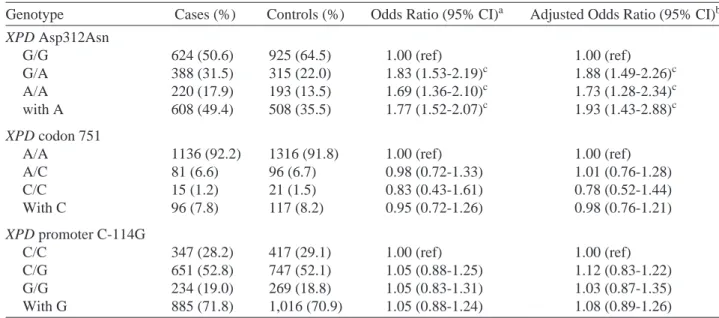
T h e f r e q u e n c y o f t h e g e n o t y p e o f X P D Asp312Asn, Lys751Gln and promoter C-114G poly- morphisms in the breast cancer and control groups is shown in Table 2. Using 312G as the reference group, there was an obvious association between the homozy- gotes and heterozygotes of 312A of XPD and breast cancer risk. A combination of the homozygotes and heterozygotes of A (with A) showed that the A allele at XPD Asp312Asn conferred a 1.78-fold risk factor for breast cancer (Table 2). Neither hetero- nor homozy- gotes of 751G of XPD seemed to be risky genotypes for breast cancer, as was also the case in promoter C-114G (Table 2).
Discussion
The XPD Asp312Asn Asn/Asn genotype is associated with prostate (34) and breast cancer risk (23). In this study, the genotype distribution of the A allele at XPD Asp312Asn (33.6%) was significantly higher in the breast cancer group than in the control group (24.5%) (Table 1). It was also found that participants homozygous Asn at XPD Asp312Asn had 1.69-fold higher risk of breast cancer (Table 2).
As for the Asp/Asn heterozygotes, the risk was almost the same level, a 1.83-fold increased risk. After com- bining the heterozygous and homozygous participants in both case and control groups, there was still an obvious increased risk of 1.78 fold (Table 2). The data from such a large population suggested that Asn at XPD Asp312Asn was a marker for breast cancer.
As long as 312Asn was detected, no matter whether is hetero- or homozygotes, the carriers were more sus- ceptible to breast cancer.
In regard of XPD Asp312Asn polymorphism in breast cancer, our findings are consistent with the previous reports investigating populations in China (53) and American (12, 38). On the contrary, a group in German which also reported that XPD Asp312Asn polymorphism was associated with breast cancer found that Asp/Asp was the risky genotype (23). There were also some null studies in Caucasian (41), France (7), Poland (13), Korean (24, 27), UK (26), American (22, 28, 30, 36, 45), African-American (30, 41) populations. Very possibly, the population we inves- tigated is more close to that in China, which is of much similar genetic origin and distributions of genotypic frequency, leading to the similar suscep- tibility to breast cancer. Apart from the potential involvement of genetic factors (e.g., differences in Table 1. Allele frequencies for XPD Asp312Asn, 751
and promoter C-114G polymorphisms in the breast cancer and control groups
Allele Cases (%) Controls (%) P-valuea
N = 2,464 N = 2,866 XPD Asp312Asn
Allele G (Asp) 1,636 (66.4) 2,165 (75.5) < 0.0001 Allele A (Asn) 828 (33.6) 701 (24.5)
XPD codon 751
Allele A (Lys) 2,353 (95.5) 2,728 (95.2) 0.6384 Allele C (Gln) 111 (4.5) 138 (4.8)
XPD promoter C-114G
Allele C 1,345 (54.6) 1,581 (55.2) 0.6927 Allele G 1,119 (45.4) 1,285 (44.8)
aP-value based on χ2 test.
allelic frequencies, or with extension of linkage disequilibrium in different populations, or both), different kinds of exposures to environmental carcino- gens could also differ among the populations, leading to inconsistent results concerning the role of XPD polymorphisms in breast cancer.
These results has added evidence showing that genetic variants involved in DNA repair pathways may also be involved in cancer etiology (1-6, 8-11).
We have reported that non-homologous end-joining DNA repair capacities of each person may associated with their susceptibility to breast cancer (2). There- fore, it is interesting for our team to provide evidence about the NER repair capacities of each person in the future to preclude chance findings, particularly those among subgroups, and clarify the detail mechanisms involved.
In conclusion, this is a large population study which focuses on the SNPs of XPD and breast cancer in Taiwan, and the presence of the A allele of Asp312Asn was associated with a higher risk of breast cancer. The A allele of Asp312Asn may be a useful marker in breast oncology for anticancer application, and early cancer detection.
Acknowledgments
We appreciate Yung-Shun Kuo, Hua-Hsiang Chen, Hsiu-Min Hsieh, Wen-Shin Chang, Yu-Shan Huang and TissueBank of China Medical University Hospital for their technical assistance. This study was supported by research grants from the Terry Fox Cancer research Foundation, China Medical Univer-
sity and Hospital (CMU97-328) and the National Science Council (NSC 98-2320-B-039-010-MY3).
References
1. Bau, D.T., Fu, Y.P., Chen, S.T., Cheng, T.C., Yu, J.C., Wu, P.E. and Shen C.Y. Breast cancer risk and the DNA double-strand break end-joining capacity of nonhomologous end-joining genes are affected by BRCA1. Cancer Res. 64: 5013-5019, 2004.
2. Bau, D.T., Mau, Y.C., Ding, S.L., Wu, P.E. and Shen, C.Y. DNA double-strand-break repair capacity and risk of breast cancer.
Carcinogenesis 28: 1726-1730, 2007.
3. Bau, D.T., Tsai, M.H., Huang, C.Y., Lee, C.C., Tseng, H.C., Lo, Y.L., Tsai, Y. and Tsai, F.J. Relationship between polymorphisms of nucleotide excision repair genes and oral cancer risk in Taiwan:
evidence for modification of smoking habit. Chinese J Physiol.
50: 294-300, 2007.
4. Bau, D.T., Tsai, M.H., Lo, Y.L., Hsu, C.M., Tsai, Y., Lee, C.C. and Tsai, F.J. Association of p53 and p21 (CDKN1A/WAF1/CIP1) polymorphisms with oral cancer in Taiwan patients. Anticancer Res. 27: 1559-1564, 2007.
5. Bau, D.T., Tseng, H.C., Wang, C.H., Chiu, C.F., Hua, C.H., Wu, C.N., Liang, S.Y., Wang, C.L., Tsai, C.W. and Tsai, M.H. Oral cancer and genetic polymorphism of DNA double strand break gene Ku70 in Taiwan. Oral Oncol. 44: 1047-1051, 2008.
6. Bau, D.T., Wu, H.C., Chiu, C.F., Lin, C.C., Hsu, C.M., Wang, C.L., Wang, R.F. and Tsai, F.J. Association of XPD polymorphisms with prostate cancer in Taiwanese patients. Anticancer Res. 27: 2893- 2896, 2007.
7. Bernard-Gallon, D., Bosviel, R., Delort, L., Fontana, L., Chamoux, A., Rabiau, N., Kwiatkowski, F., Chalabi, N., Satih, S. and Bignon, Y.J. DNA repair gene ERCC2 polymorphisms and associations with breast and ovarian cancer risk. Mol. Cancer 7: 36, 2008.
8. Chiu, C.F., Tsai, M.H., Tseng, H.C., Wang, C.L., Tsai, F.J., Lin, C.C. and Bau, D.T. A novel single nucleotide polymorphism in ERCC6 gene is associated with oral cancer susceptibility in Taiwan- ese patients. Oral Oncol. 44: 582-586, 2008.
9. Chiu, C.F., Tsai, M.H., Tseng, H.C., Wang, C.L., Wang, C.H., Wu, C.N., Lin, C.C. and Bau, D.T. A novel single nucleotide polymor-
Table 2. Association of XPD Asp312Asn, codon 751, promoter C-114G polymorphisms and breast cancer risk
Genotype Cases (%) Controls (%) Odds Ratio (95% CI)a Adjusted Odds Ratio (95% CI)b XPD Asp312Asn
G/G 624 (50.6) 925 (64.5) 1.00 (ref) 1.00 (ref)
G/A 388 (31.5) 315 (22.0) 1.83 (1.53-2.19)c 1.88 (1.49-2.26)c A/A 220 (17.9) 193 (13.5) 1.69 (1.36-2.10)c 1.73 (1.28-2.34)c with A 608 (49.4) 508 (35.5) 1.77 (1.52-2.07)c 1.93 (1.43-2.88)c XPD codon 751
A/A 1136 (92.2) 1316 (91.8) 1.00 (ref) 1.00 (ref)
A/C 81 (6.6) 96 (6.7) 0.98 (0.72-1.33) 1.01 (0.76-1.28)
C/C 15 (1.2) 21 (1.5) 0.83 (0.43-1.61) 0.78 (0.52-1.44)
With C 96 (7.8) 117 (8.2) 0.95 (0.72-1.26) 0.98 (0.76-1.21)
XPD promoter C-114G
C/C 347 (28.2) 417 (29.1) 1.00 (ref) 1.00 (ref)
C/G 651 (52.8) 747 (52.1) 1.05 (0.88-1.25) 1.12 (0.83-1.22)
G/G 234 (19.0) 269 (18.8) 1.05 (0.83-1.31) 1.03 (0.87-1.35)
With G 885 (71.8) 1,016 (70.9) 1.05 (0.88-1.24) 1.08 (0.89-1.26)
aCI, confidence interval; bAdjusted for age; cP < 0.05.
phism in XRCC4 gene is associated with oral cancer susceptibility in Taiwanese patients. Oral Oncol. 44: 898-902, 2008.
10. Chiu, C.F., Wang, C.H., Wang, C.L., Lin, C.C., Hsu, N.Y., Weng, J.R. and Bau, D.T. A novel single nucleotide polymorphism in XRCC4 gene is associated with gastric cancer susceptibility in Taiwan. Ann. Surg. Oncol. 15: 514-518, 2008.
11. Chiu, C.F., Wang, H.C., Wang, C.H., Wang, C.L., Lin, C.C., Shen, C.Y., Chiang, S.Y. and Bau, D.T. A new single nucleotide polymorphism in XRCC4 gene is associated with breast cancer susceptibility in Taiwanese patients. Anticancer Res. 28: 267-270, 2008.
12. Crew, K.D., Gammon, M.D., Terry, M.B., Zhang, F.F., Zablotska, L.B., Agrawal, M., Shen, J., Long, C.M., Eng, S.M., Sagiv, S.K., Teitelbaum, S.L., Neugut, A.I. and Santella, R.M. Polymorphisms in nucleotide excision repair genes, polycyclic aromatic hydrocar- bon-DNA adducts, and breast cancer risk. Cancer Epidemiol Biomarkers Prev. 16: 2033-2041, 2007.
13. Debniak, T., Scott, R.J., Huzarski, T., Byrski, T., Masojc, B., van de Wetering, T., Serrano-Fernandez, P., Gorski, B., Cybulski, C., Gronwald, J., Debniak, B., Maleszka, R., Kladny, J., Bieniek, A., Nagay, L., Haus, O., Grzybowska, E., Wandzel, P., Niepsuj, S., Narod, S.A. and Lubinski, J. XPD common variants and their association with melanoma and breast cancer risk. Breast Cancer Res. Treat. 98: 209-215, 2006.
14. Denissenko, M.F., Pao, A., Pfeifer, G.P. and Tang, M. Slow repair of bulky DNA adducts along the nontranscribed strand of the human p53 gene may explain the strand bias of transversion mutations in cancers. Oncogene 16: 1241-1247, 1998.
15. Dufloth, R.M., Arruda, A., Heinrich, J.K., Schmitt, F. and Zeferino, L.C. The investigation of DNA repair polymorphisms with histo- pathological characteristics and hormone receptors in a group of Brazilian women with breast cancer. Genet. Mol. Res. 7: 574-582, 2008.
16. Fleck, O. and Nielsen, O. DNA repair. J. Cell. Sci. 117: 515-517, 2004.
17. Goode, E.L., Ulrich, C.M. and Potter, J.D. Polymorphisms in DNA repair genes and associations with cancer risk. Cancer Epidemiol.
Biomarkers Prev. 11: 1513-1530, 2002.
18. Hoeijmakers, J.H. Genome maintenance mechanisms for prevent- ing cancer. Nature 411: 366-374, 2001.
19. Hsieh, Y.Y., Chang, C.C., Bau, D.T., Yeh, L.S., Tsai, F.J. and Tsai, C.H. X-ray repair cross-complementing group 4 (XRCC4) promoter -1394T-related genotype, but not XRCC4 codon 247/
intron 3 or xeroderma pigmentosum group D codon 312, 751/
promoter -114, polymorphisms are correlated with higher suscep- tibility to myoma. Fertil. Steril. 90: 1417-1423, 2008.
20. Hung, R.J., Hall, J., Brennan, P. and Boffetta, P. Genetic polymor- phisms in the base excision repair pathway and cancer risk: a HuGE review. Am. J. Epidemiol. 162: 925-942, 2005.
21. Jemal, A., Tiwari, R.C., Murray, T., Ghafoor, A., Samuels, A., Ward, E., Feuer, E.J. and Thun, M.J. Cancer statistics, 2004. CA Cancer J. Clin. 54: 8-29, 2004.
22. Jorgensen, T.J., Visvanathan, K., Ruczinski, I., Thuita, L., Hoffman, S. and Helzlsouer, K.J. Breast cancer risk is not associated with polymorphic forms of xeroderma pigmentosum genes in a cohort of women from Washington County, Maryland. Breast Cancer Res. Treat. 101: 65-71, 2007.
23. Justenhoven, C., Hamann, U., Pesch, B., Harth, V., Rabstein, S., Baisch, C., Vollmert, C., Illig, T., Ko, Y.D., Bruning, T. and Brauch, H. ERCC2 genotypes and a corresponding haplotype are linked with breast cancer risk in a German population. Cancer Epidemiol.
Biomarkers Prev. 13: 2059-2064, 2004.
24. Kang, D. Genetic polymorphisms and cancer susceptibility of breast cancer in Korean women. J. Biochem. Mol. Biol. 36: 28-34, 2003.
25. Kipikasova, L., Wolaschka, T., Bohus, P., Baumohlova, H., Bober, J., Blazejova J., Mirossay, L., Sarissky, M., Mirossay, A.,
Cizmarikova, M., Potocekova, D. and Mojzis, J. Polymorphisms of the XRCC1 and XPD genes and breast cancer risk: a case-control study. Pathol. Oncol. Res. 14: 131-135, 2008.
26. Kuschel, B., Chenevix-Trench, G., Spurdle, A.B., Chen, X., Hopper, J.L., Giles, G.G., McCredie, M., Chang-Claude, J., Gregory, C.S., Day, N.E., Easton, D.F., Ponder, B.A., Dunning, A.M. and Pharoah, P.D. Common polymorphisms in ERCC2 (Xeroderma pigmen- tosum D) are not associated with breast cancer risk. Cancer Epidemiol. Biomarkers Prev. 14: 1828-1831, 2005.
27. Lee, S.A., Lee, K.M., Park, W.Y., Kim, B., Nam, J., Yoo, K.Y., Noh, D.Y., Ahn, S.H., Hirvonen, A. and Kang, D. Obesity and genetic polymorphism of ERCC2 and ERCC4 as modifiers of risk of breast cancer. Exp. Mol. Med. 37: 86-90, 2005.
28. Lunn, R.M., Helzlsouer, K.J., Parshad, R., Umbach, D.M., Harris, E.L., Sanford, K.K. and Bell, D.A. XPD polymorphisms: effects on DNA repair proficiency. Carcinogenesis 21: 551-555, 2000.
29. Manuguerra, M., Saletta, F., Karagas, M.R., Berwick, M., Veglia, F., Vineis, P. and Matullo, G. XRCC3 and XPD/ERCC2 single nucleotide polymorphisms and the risk of cancer: a HuGE review.
Am. J. Epidemiol. 164: 297-302, 2006.
30. Mechanic, L.E., Millikan, R.C., Player, J., de Cotret, A.R., Winkel, S., Worley, K., Heard, K., Heard, K., Tse, C.K. and Keku, T.
Polymorphisms in nucleotide excision repair genes, smoking and breast cancer in African Americans and whites: a population-based case-control study. Carcinogenesis 27: 1377-1385, 2006.
31. Milne, R.L. and Benitez, J. Current strategies in the search for low penetrance genes in cancer. Histol. Histopathol. 23: 507-514, 2008.
32. Perlow, R.A., Kolbanovskii, A., Hingerty, B.E., Geacintov, N.E., Broyde, S. and Scicchitano, D.A. DNA adducts from a tumorigenic metabolite of benzo[a]pyrene block human RNA polymerase II elongation in a sequence- and stereochemistry-dependent manner.
J. Mol. Biol. 321: 29-47, 2002.
33. Romanowicz-Makowska, H., Sobczuk, A., Smolarz, B., Fiks, T.
and Kulig, A. XPD Lys751Gln polymorphism analysis in women with sporadic breast cancer. Pol. J. Pathol. 58: 245-249, 2007.
34. Rybicki, B.A., Conti, D.V., Moreira, A., Cicek, M., Casey, G. and Witte, J.S. DNA repair gene XRCC1 and XPD polymorphisms and risk of prostate cancer. Cancer Epidemiol. Biomarkers Prev.
13: 23-29, 2004.
35. Sancar, A. and Tang, M.S. Nucleotide excision repair. Photochem.
Photobiol. 57: 905-921, 1993.
36. Shen, J., Desai, M., Agrawal, M., Kennedy, D.O., Senie, R.T., Santella, R.M. and Terry, M.B. Polymorphisms in nucleotide excision repair genes and DNA repair capacity phenotype in sisters discordant for breast cancer. Cancer Epidemiol. Biomarkers Prev.
15: 1614-1619, 2006.
37. Shen M.R., Jones, I.M. and Mohrenweiser, H. Nonconservative amino acid substitution variants exist at polymorphic frequency in DNA repair genes in healthy humans. Cancer Res. 58: 604-608, 1998.
38. Shi, Q., Wang, L.E., Bondy, M.L., Brewster, A., Singletary, S.E.
and Wei, Q. Reduced DNA repair of benzo[a]pyrene diol epoxide- induced adducts and common XPD polymorphisms in breast cancer patients. Carcinogenesis 25: 1695-1700, 2004.
39. Shore, R.E., Zeleniuch-Jacquotte, A., Currie, D., Mohrenweiser, H., Afanasyeva, Y., Koenig, K.L., Arslan, A.A., Toniolo, P. and Wirgin, I. Polymorphisms in XPC and ERCC2 genes, smoking and breast cancer risk. Int. J. Cancer 122: 2101-2105, 2008.
40. Singh, V., Parmar, D., and Singh, M.P. Do single nucleotide polymorphisms in xenobiotic metabolizing genes determine breast cancer susceptibility and treatment outcomes? Cancer Invest. 26:
769-783, 2008.
41. Smith, T.R., Levine, E.A., Freimanis, R.I., Akman, S.A., Allen, G.O., Hoang, K.N., Liu-Mares, W. and Hu, J.J. Polygenic model of DNA repair genetic polymorphisms in human breast cancer risk. Carcinogenesis 29: 2132-2138, 2008.
42. Stern, M.C., Johnson, L.R., Bell, D.A. and Taylor, J.A. XPD codon 751 polymorphism, metabolism genes, smoking, and bladder cancer risk. Cancer Epidemiol. Biomarkers Prev. 11: 1004-1011, 2002.
43. Sturgis, E.M., Zheng, R., Li, L., Castillo, E.J., Eicher, S.A., Chen, M., Strom, S.S., Spitz, M.R. and Wei, Q. XPD/ERCC2 polymor- phisms and risk of head and neck cancer: a case-control analysis.
Carcinogenesis 21: 2219-2223, 2000.
44. Synowiec, E., Stefanska, J., Morawiec, Z., Blasiak, J. and Wozniak, K. Association between DNA damage, DNA repair genes variabil- ity and clinical characteristics in breast cancer patients. Mutat.
Res. 648: 65-72, 2008.
45. Tang, D., Cho, S., Rundle, A., Chen, S., Phillips, D., Zhou, J., Hsu, Y., Schnabel, F., Estabrook, A. and Perera, F.P. Polymorphisms in the DNA repair enzyme XPD are associated with increased levels of PAH-DNA adducts in a case-control study of breast cancer.
Breast Cancer Res. Treat. 75: 159-166, 2002.
46. Taylor, E.M., Broughton, B.C., Botta, E., Stefanini, M., Sarasin, A., Jaspers, N.G., Fawcett, H., Harcourt, S.A., Arlett, C.F. and Lehmann, A.R. Xeroderma pigmentosum and trichothiodystrophy are associated with different mutations in the XPD (ERCC2) repair/
transcription gene. Proc. Natl. Acad. Sci. USA 94: 8658-8663, 1997.
47. Tomescu, D., Kavanagh, G., Ha, T., Campbell, H. and Melton,
D.W. Nucleotide excision repair gene XPD polymorphisms and genetic predisposition to melanoma. Carcinogenesis 22: 403-408, 2001.
48. Wallner, B.C., Harreus, U.A., Gamarra, F., Sassen, A. and Kleinsasser, N.H. Genotoxicity studies in mini-organ cultures of human nasal mucosa. HNO 53: 1037-1046, 2005.
49. Wang, G.Y., Lu, C.Q., Zhang, R.M., Hu, X.H. and Luo, Z.W.
The E-cadherin gene polymorphism 160C->A and cancer risk: A HuGE review and meta-analysis of 26 case-control studies. Am. J.
Epidemiol. 167: 7-14, 2008.
50. Weeda, G. and Hoeijmakers, J.H. Genetic analysis of nucleotide excision repair in mammalian cells. Semin. Cancer Biol. 4: 105- 117, 1993.
51. Wolz, L., Krause, G. and Scherer, G. The comet assay with MCL- 5 cells as an indicator of genotoxic treatment with chemicals and cigarette smoke condensates. Altern. Lab. Anim. 30: 331-339, 2002.
52. Xing, D., Tan, W., Wei, Q. and Lin, D. Polymorphisms of the DNA repair gene XPD and risk of lung cancer in a Chinese population.
Lung Cancer 38: 123-129, 2002.
53. Zhang, L., Zhang, Z. and Yan, W. Single nucleotide polymor- phisms for DNA repair genes in breast cancer patients. Clin. Chim.
Acta 359: 150-155, 2005.