年報
Inland Revenue Department
The Government of the Hong Kong Special Administrative Region
Annual Report 2016-17
治稅以法
服務以誠
Tax by the Law
Service from the Heart
Vision, Mission and Values
Vision
We aim to be an excellent tax administration that plays an important part in promoting Hong Kong’s prosperity and stability.
Mission
We are committed to –
• collecting revenue efficiently and cost-effectively;
• providing courteous and effective service to the taxpaying public;
• promoting compliance through rigorous enforcement of law, education and publicity programmes;
and
• enabling staff to acquire the necessary knowledge, skills and attitude so that they can contribute their best to the achievement of our vision.
Values
Our core values are –
• Professionalism
• Efficiency
• Responsiveness
• Fairness
• Effectiveness
• Courtesy
• Teamwork
Contents
Chapter 1: Commissioner’s Foreword Chapter 2: Revenue
Chapter 3: Assessing Functions Profits Tax
Salaries Tax Property Tax
Personal Assessment Tax Treaty Network Advance Rulings
Advance Pricing Arrangement Objections
Appeals to the Board of Review Appeals to the Courts
Business Registration Stamp Duty
Estate Duty Betting Duty
Tax Reserve Certificates Chapter 4: Collection
Collection of Tax Refund of Tax
Recovery of Tax in Default Chapter 5: Field Audit and Investigation
Field Audit Investigation
Property Tax Compliance Check Chapter 6: Taxpayer Services
IRD Website
Electronic Enquiry Service Enquiry Service Centre
Tax-help Services for Completion of Tax Returns
Complaints and Compliments Performance Pledge
Chapter 7: Information Technology IT Environment
Electronic Services Chapter 8: Human Resources Organisation Chart Establishment
Staff Promotions and Turnover Training and Development Staff Relations and Welfare The IRD Sports Association Chapter 9: Legislative Amendments Chapter 10: Environmental Report
Green Management Policy Green Management and
Promotion of Green Awareness Environmental Protection
Performance in 2016-17 New Initiatives and Targets Chapter 11: Miscellaneous
Charitable Institutions General Inspection Internal Audit
Approval for Tax Return Forms and the Manner of Furnishing Tax Returns
Schedules
1 Commissioner’s Foreword
It is my pleasure to present the 2016-17 Annual Report to you. In this report, apart from the revenue statistics, you will have a glimpse of the on-going work that the IRD has been embarking upon.
The total revenue collection of the In land Revenue Department in 2016-17 was $290.2 billion, the third highest record over the years. It was $1.1 billion lower than the collection of last year, only a meagre drop of 0.4%. Due to the wavier of business registration fees for 2016-17, business registration fees decreased by $2.4 billion, representing a significant drop of 91% when compared to last year. The collections of different major tax types were similar to those of last year. Profits Tax decreased by 0.7%; Salaries Tax grew by 2.1% whilst Stamp Duty dropped by 1.2%.
To address the overheated residential property market, the Government announced on 4 November 2016 a new round of demand-side management measure, i.e. to raise the ad valorem stamp duty (AVD) rate of residential property transactions to a flat rate at 15%, in lieu of the existing AVD rates at scale 1 set out in the Stamp Duty Ordinance (commonly known as “doubled ad valorem stamp duty”), with effect from 5 November 2016. The Government introduced the Stamp Duty (Amendment) Bill 2017 (the Bill), which seeks to implement the new residential stamp duty (NRSD), into the Legislative Council in February 2017.
Subsequent to the introduction of the NRSD, some Hong Kong Permanent Resident (HKPR) buyers acquired multiple residential properties under a single instrument to avoid payment of NRSD, thereby undermining the intended effect of the measure. In view of this, the Government announced on 11 April 2017 the tightening of the prevailing exemption arrangement for HKPRs under the NRSD regime.
With effect from 12 April 2017, if a HKPR-buyer acquires more than one residential property under a single instrument, the transaction will no longer be exempted and will be subject to the NRSD rate of 15%. The Government introduced the Stamp Duty (Amendment) (No.2) Bill 2017 (the No.2 Bill) into the Legislative Council in June 2017. By the end of the 2016-17 legislative session, both the Bill and the No.2 Bill were still being scrutinised.
To prepare for the implementation of the new international standard for automatic exchange of financial account information in tax matters (AEOI) as promulgated by the Organisation for Economic Cooperation and Development (OECD), the Government amended the Inland Revenue Ordinance to provide relevant legislative framework. The Inland Revenue (Amendment) (No.3) Ordinance 2016 (the Amendment Ordinance) was gazetted on 30 June 2016, and came into effect on the same date.
Under the AEOI standard, a financial institution (FI) is required to identify financial accounts held by tax residents of reportable jurisdictions in accordance with the OECD due diligence procedures. FIs are required to collect the reportable information of these accounts and furnish such information to the Department. The Department will exchange the information with the tax authorities of the AEOI partner jurisdictions on an annual basis.
To help FIs fulfil their obligations, the Department provides an AEOI Portal for FIs to submit notifications and file financial account information returns electronically. In 2016-17, system development and user acceptance testing of the AEOI Portal were carried out. The Department invited FIs to participate in the trial run. The AEOI Portal was officially launched on 3 July 2017.
To implement AEOI more effectively, the Government introduced the Inland Revenue (Amendment) (No. 3) Bill in March 2017 to the Legislative Council to expand the list of “reportable jurisdictions” with effect from 1 July 2017. The No.3 Bill was passed in June 2017 and became the Inland Revenue (Amendment) (No.2) Ordinance 2017.
The international tax landscape evolves rapidly. The OECD released a package of 15 action plans in October 2015 to counter base erosion and profit shifting (BEPS) by multinational enterprises.
As a responsible member of the international community, Hong Kong indicated its commitment to implementing the BEPS package in June 2016. The Government conducted a consultation exercise from October to December 2016 on the legislative proposals to implement the BEPS package to collect views from stakeholders and released the consultation report in July 2017. Hong Kong will focus on the four minimum standards, i.e. countering harmful tax practices, preventing treaty abuse, imposing country-by-country reporting requirement and improving the cross-border dispute resolution regime, whilst maintaining our simple and low tax regime. The Government is pressing ahead with the preparatory work in relation to the legislative exercise. The target is to introduce an amendment bill into the Legislative Council by the end of 2017.
2016-17 was a busy and productive year. Besides making tax assessments and collecting taxes, colleagues of IRD were actively participating in various kinds of work relating to NRSD, AEOI and BEPS package. I am very grateful that colleagues had made an all-out effort to strive for meeting different targets. I am confident that we can work together to achieve satisfactory results in all aspects.
WONG Kuen-fai
Commissioner of Inland Revenue
2 Revenue
In 2016-17, the Inland Revenue Department collected $290.2 billion which represents a decrease of
$1.1 billion or 0.4% as compared with the previous year. Salaries tax collections increased by 2.1%
to $59.1 billion. Profits tax collections, on the other hand, slightly decreased by 0.7% to $139.2 billion.
Owing to the waiver of business registration fees, collection of business registration fees dropped by 91.3% to 228 million. An analysis of the revenue collected by tax type is provided in Figure 1.
Figure 1 Revenue collected by tax type Type of tax
2013-14 ($m)
2014-15 ($m)
2015-16 ($m)
2016-17 ($m) Profits tax -
Corporations 116,097.5 132,683.8 135,574.0 134,031.3
Unincorporated businesses 4,784.3 5,163.1 4,652.6 5,206.8
Salaries tax 55,620.3 59,346.8 57,867.8 59,077.5
Property tax 2,583.8 2,938.6 2,998.0 3,371.7
Personal assessment 4,420.0 4,817.2 4,790.0 5,220.0
Total earnings & profits tax 183,505.9 204,949.5 205,882.4 206,907.3
Estate duty 388.4 178.2 30.0 18.8
Stamp duty 41,514.7 74,844.9 62,680.3 61,899.0
Betting duty 18,066.4 19,479.3 20,127.2 21,119.0
Business registration fees 73.5 2,480.6 2,607.1 227.7
Total revenue collected 243,548.9 301,932.5 291,327.0 290,171.8
% change over previous year 0.6% 24.0% -3.5% -0.4%
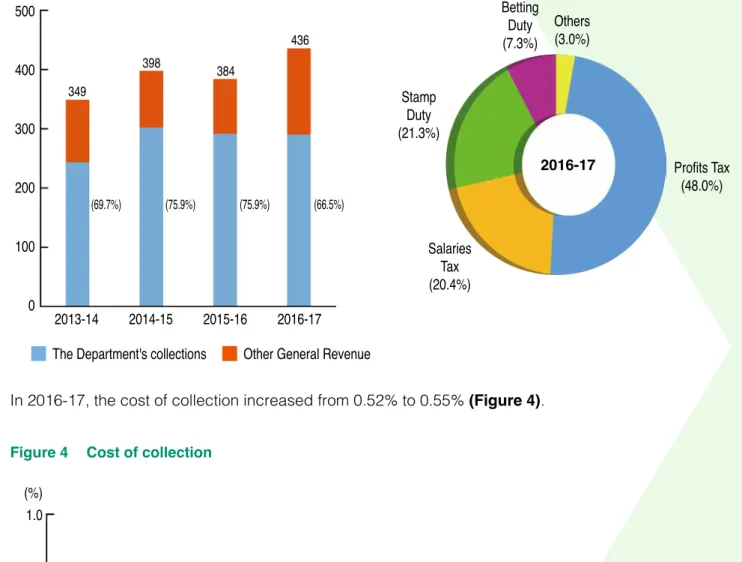
The revenue collected by the Department during 2016-17 accounted for 66.5% of the Government General Revenue (Figure 2). Profits tax and salaries tax contributed 68.4% of the total revenue collected while stamp duty made up a further 21.3% (Figure 3).
Figure 2 Government General Revenue ($b)
500
436
400 398 384
349 300
200 (69.7%) (75.9%) (75.9%) (66.5%)
100
0 2013-14 2014-15 2015-16 2016-17
The Department's collections Other General Revenue
Figure 3 Composition of the revenue collections
Betting
Duty Others (7.3%) (3.0%)
Stamp (21.3%) Duty
2016-17 Profits Tax (48.0%)
Salaries (20.4%) Tax
In 2016-17, the cost of collection increased from 0.52% to 0.55% (Figure 4).
Figure 4 Cost of collection (%)
1.0
0.56 0.49 0.52 0.55
0.5
0.0 2013-14 2014-15 2015-16 2016-17
3 Assessing Functions
The Department raises revenue through taxes, duties and fees in accordance with the relevant legislation. Earnings and profits tax are assessed by reference to the incomes / profits of the taxpayers in the previous year, whereas duties and fees are charged at the time the relevant activities occur. For 2016-17, earnings and profits tax assessed increased by $724 million (0.3%) (Schedule 2) as compared with the previous year. Yet, the total amount of duties and fees collected dropped by $2.2 billion (2.6%).
Profits Tax
Profits tax is levied on individuals, corporations, bodies of persons and partnerships, in respect of assessable profits arising in or derived from Hong Kong. For the year of assessment 2016-17, the tax rates for corporations and non-corporate persons remained unchanged at 16.5% and 15%
respectively.
The amount of profits tax assessed in 2016-17 was $138.2 billion, which was $0.8 billion (0.6%) less than that of the previous year, reflecting a modest decline in the Hong Kong economy (Figure 5).
The amounts of final tax assessed in respect of different business sectors are shown in Schedules 3 and 4. Of the total final tax assessed for the year of assessment 2015-16, the property, financial and banking sectors together contributed 46.6% and the distribution sector generated 21.7% (Figure 6).
Figure 5 Profits tax assessed ($b)
140 5
4.9 5.7
120 4.8
100 80
60 118.1 127.3 134 132.5
40 20
0 2013-14 2014-15 2015-16 2016-17 Corporations Unincorporated Business
Figure 6 Ratios of corporation profits tax assessed under 2015-16 final assessments by business sectors
Manufacturing
(4.3%) Public Utilities
Distribution (5.5%)
(21.7%)
Others (21.9%)
Banking (21.9%)
Property, Investment & Finance
(24.7%)
Salaries Tax
Salaries tax is charged on all incomes from any office (e.g. a directorship) or employment and pension arising in or derived from Hong Kong. The total amount of tax payable is restricted to the standard rate on the net total income (without allowances) of the individual concerned. For the year of assessment 2016-17, the standard rate remained unchanged at 15%.
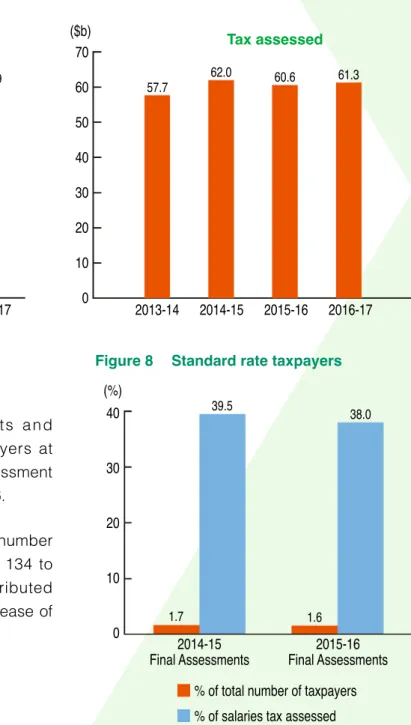
As compared with the previous year, the number of salaries tax assessments made during 2016-17 increased by 5.1%. However, there was only 1.2% increase in the total amount of tax assessed after implementing the salaries tax relief measures in the 2016-17 Budget (Figure 7).
Figure 7 Salaries tax assessments ('000)
3,000 Number
2,939 2,900
2,800
2,750
2,797
2,700 2,676
2,600
2013-14 2014-15 2015-16 2016-17
($b) 70
60 57.7
Tax assessed
62.0 60.6 61.3
50 40 30 20 10
0 2013-14 2014-15 2015-16 2016-17
Analyses of salaries tax assessments and allowances granted in respect of taxpayers at various income levels for the year of assessment 2015-16 are provided in Schedules 5 and 6.
For the year of assessment 2015-16, the number of standard rate taxpayers increased by 134 to 29,826. These taxpayers together contributed 38.0% of the salaries tax assessed, a decrease of 1.5% compared with last year (Figure 8).
Figure 8 Standard rate taxpayers
(%) 40 39.5 38.0
30
20
10
1.7 1.6
0 2014-15 2015-16
Final Assessments Final Assessments
% of total number of taxpayers
% of salaries tax assessed
Notification Requirements of Employers
Employers are required to notify the Department of commencements and cessations of employment as well as employees’ impending departure from Hong Kong for more than 1 month. Besides, employers are required to prepare annual employer’s returns to report the emoluments of each of their employees. During the year, 385,542 employers filed employer’s returns with the Department.
The Department provides e-Seminars and disseminates tax information to employers on the IRD website to help them understand the relevant statutory requirements. The contents cover completion of employer’s returns, employer’s obligations and answers to frequently asked questions. Employers can also obtain specimens of completed employer’s returns and notification through the Fax-A-Form service.
Property Tax
Property owners (including corporations) are subject to property tax which is charged at the standard rate in respect of the net assessable value of the property. For the year of assessment 2016-17, the standard rate remained unchanged at 15%. Rents received from properties solely owned by individuals should be declared in Tax Returns- Individuals (BIR60); whilst rents received from properties jointly owned or co-owned by individuals or properties held by corporations / bodies of persons should be declared in Property Tax Returns (BIR57 / BIR58). Property owners that pay property tax in respect of premises used for their businesses can have such payments set off against their profits tax liabilities. For corporations, income arising from properties owned by them is also subject to profits tax at the corporation rate. To obviate the need for yearly set-off of property tax against profits tax, a corporation can apply for exemption of property tax on the property concerned.
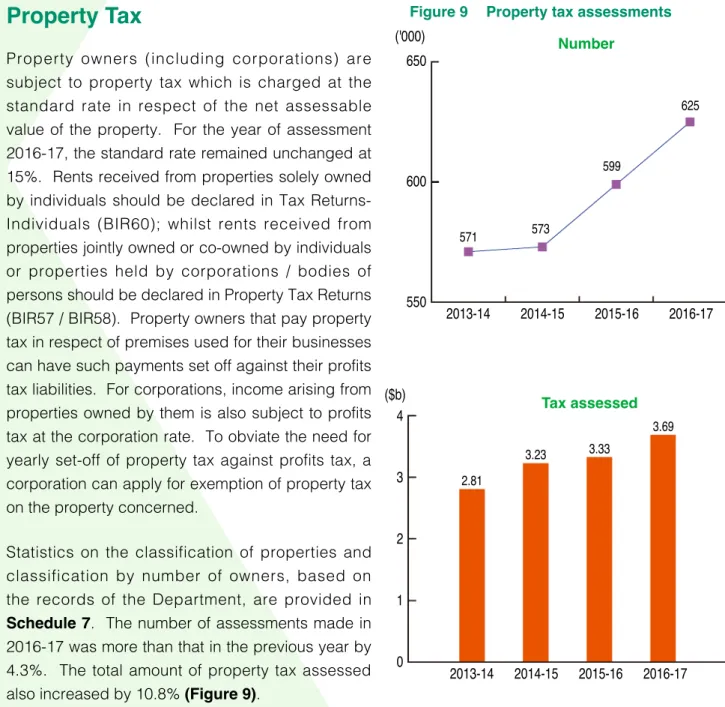
Statistics on the classification of properties and classification by number of owners, based on the records of the Department, are provided in Schedule 7. The number of assessments made in 2016-17 was more than that in the previous year by 4.3%. The total amount of property tax assessed also increased by 10.8% (Figure 9).
Figure 9 Property tax assessments
('000) Number
650
625 600 599
571 573
550 2013-14 2014-15 2015-16 2016-17
($b)
4 Tax assessed
3.69 3.23 3.33
3 2.81
2
1
0 2013-14 2014-15 2015-16 2016-17
Personal Assessment
If an individual has income chargeable to profits tax and /or property tax, he/she may elect for personal assessment. Under personal assessment, all the incomes of the taxpayer and his or her spouse (if married) are aggregated and, after deduction of all allowances, are assessed at the progressive tax rates applicable to salaries tax. In appropriate circumstances, this would reduce the total tax liability of the taxpayer and his or her spouse.
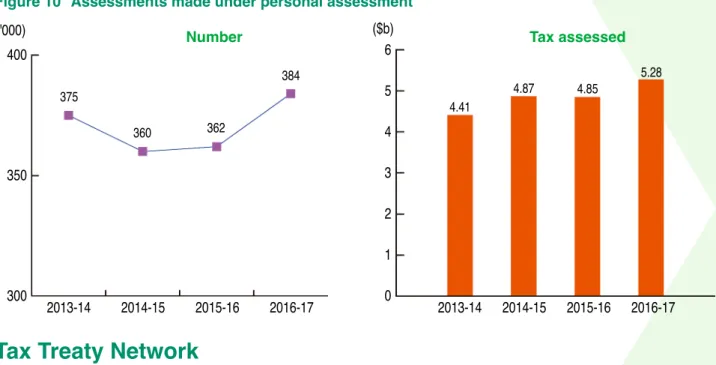
As compared with the previous year, the number of assessments made in 2016-17 increased by 6.1%
and the amount of tax assessed was 8.9% higher (Figure 10).
Figure 10 Assessments made under personal assessment
('000) Number
400
384 375
360 362 350
300 2013-14 2014-15 2015-16 2016-17
($b) Tax assessed
6
5.28
5 4.87 4.85
4.41 4
3 2 1
0 2013-14 2014-15 2015-16 2016-17
Tax Treaty Network
Double taxation arises where the same item of income or profit of a taxpayer is subject to tax in Hong Kong as well as in another tax jurisdiction. To establish a tax treaty network can help minimise exposure of Hong Kong residents and residents of the tax treaty partners to double taxation. It will also facilitate the flows of trade, investment and talent between Hong Kong and the rest of the world, and enhance Hong Kong’s competitiveness as an international financial, investment and commercial hub.
As at 31 March 2017, Hong Kong has signed comprehensive double taxation agreements (covering various types of income) with 37 jurisdictions. They are Austria, Belarus, Belgium, Brunei, Canada, the Czech Republic, France, Guernsey, Hungary, Indonesia, Ireland, Italy, Japan, Jersey, Korea, Kuwait, Latvia, Liechtenstein, Luxembourg, the Mainland of China, Malaysia, Malta, Mexico, the Netherlands, New Zealand, Pakistan, Portugal, Qatar, Romania, Russia, South Africa, Spain, Switzerland, Thailand, the United Arab Emirates, the United Kingdom and Vietnam.
Hong Kong, as a responsible member of the international community, is committed to enhancing tax transparency and preventing tax evasion. To comply with the latest international standard on exchange of information, Hong Kong entered into tax information exchange agreements with
appropriate partners since 2014. As at 31 March 2017, Hong Kong has signed tax information exchange agreements with 7 jurisdictions. They are Denmark, the Faroes, Greenland, Iceland, Norway, Sweden and the United States of America.
Advance Rulings
Taxpayers may apply for an advance ruling on how a provision of the Inland Revenue Ordinance applies in relation to a particular arrangement. A fee is charged for the service on a “cost recovery”
basis. The applicant is required to pay an initial application fee of $30,000 for a ruling concerning the application of the “Territorial Source Principle” in a profits tax case, or $10,000 for a ruling on any other matter. An additional fee is payable if the processing time exceeds the specified limit. The Department endeavours to respond within 6 weeks of the date of application, provided that all relevant information is supplied with the application and further information from the applicant is not required.
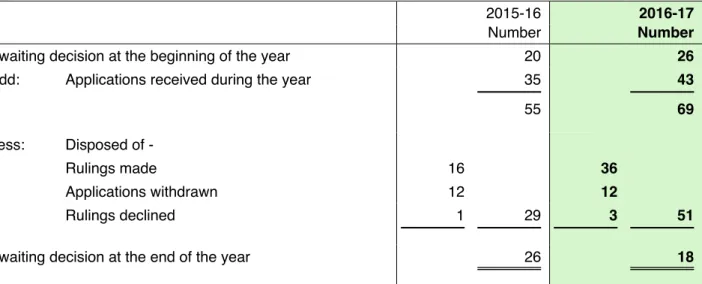
During 2016-17, the Department completed the processing of 51 advance ruling applications (Figure 11). Most of the applications were for rulings on profits tax matters.
Figure 11 Advance rulings
2015-16
Number 2016-17
Number
Awaiting decision at the beginning of the year 20 26
Add: Applications received during the year 35 43
55 69
Less: Disposed of -
Rulings made 16 36
Applications withdrawn 12 12
Rulings declined 1 29 3 51
Awaiting decision at the end of the year 26 18
Advance Pricing Arrangement
An Advance Pricing Arrangement (APA) is an arrangement that determines in advance an appropriate set of criteria for the determination of the transfer pricing of cross-border transactions between associated enterprises. The APA process gives enterprises the opportunity to reach agreements with tax administrations on the method of applying the arm’s length principle so that transfer pricing issues can be more efficiently dealt with in real time, thus avoiding the risk of transfer pricing audit later. This arrangement enables enterprises to better assess their tax exposure and facilitates their business operation.
A unilateral APA is an arrangement between the Commissioner and the enterprise concerning the
does not involve the agreement with a comprehensive avoidance of double taxation agreement (CDTA) partner, it does not guarantee the agreement of the CDTA partner to the arrangement made.
A bilateral APA is an arrangement between the Commissioner and a CDTA partner concerning the transfer pricing of the abovementioned cross-border transactions. It therefore provides certainty to enterprises that double taxation will not arise. The same also applies to a multilateral APA which is a similar arrangement involving the partners of two or more CDTAs.
The Department rolled out the APA programme in April 2012. At present, the Department will only consider bilateral or multilateral APA applications due to resource constraints and the deficiency of a unilateral APA. Up to 31 March 2017, the Department has received quite a number of applications in relation to CDTA with different partners including the Mainland of China, Japan, Malaysia, the Netherlands and Thailand. These cases are currently under different stages of the APA programme and a few of them have already been completed.
Objections
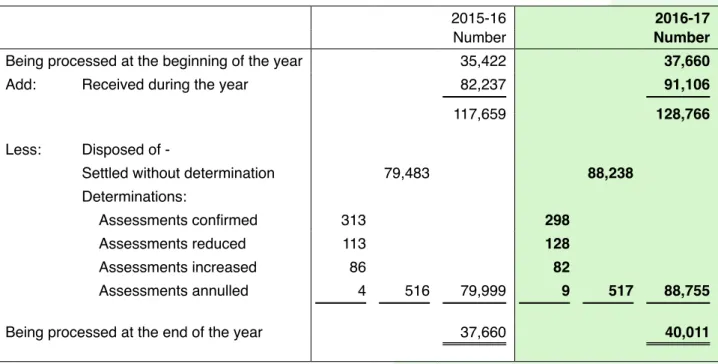
A taxpayer who is aggrieved by an assessment may lodge a notice of objection to the Commissioner within the prescribed time limit. If the objection is against an estimated assessment raised in the absence of a tax return, a properly completed return, together with the supporting accounts where applicable, must also be accompanied with the notice of objection. A significant proportion of the objections received each year arise from estimated assessments. Most of these objections are settled promptly by reference to the returns subsequently received. Many of the other types of objections are also settled by agreement between the taxpayers and the assessors concerned. Only relatively few objections are ultimately referred to the Commissioner for determination. During 2016-17, the Department completed the processing of 88,755 objections (Figure 12).
Figure 12 Objections
2015-16
Number 2016-17
Number
Being processed at the beginning of the year 35,422 37,660
Add: Received during the year 82,237 91,106
117,659 128,766
Less: Disposed of -
Settled without determination 79,483 88,238
Determinations:
Assessments confirmed 313 298
Assessments reduced 113 128
Assessments increased 86 82
Assessments annulled 4 516 79,999 9 517 88,755
Being processed at the end of the year 37,660 40,011
Appeals to the Board of Review
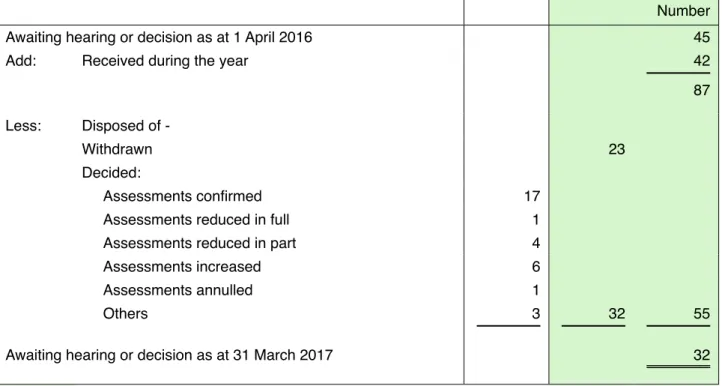
A taxpayer who is dissatisfied with the Commissioner’s determination of his objection may appeal to the Board of Review (Inland Revenue Ordinance) (the Board). The Board is an independent statutory body. As at 31 March 2017, the Board consisted of a chairman and 8 deputy chairmen, who have legal training and experience, as well as 68 members. During 2016-17, the Board settled 55 appeal cases (Figure 13).
Figure 13 Appeals to the Board of Review
Number
Awaiting hearing or decision as at 1 April 2016 45
Add: Received during the year 42
87 Less: Disposed of -
Withdrawn 23
Decided:
Assessments confirmed 17
Assessments reduced in full 1
Assessments reduced in part 4
Assessments increased 6
Assessments annulled 1
Others 3 32 55
Awaiting hearing or decision as at 31 March 2017 32
Appeals to the Courts
A decision of the Board is final, provided that either the taxpayer or the Commissioner may, pursuant to section 69 of the Inland Revenue Ordinance, appeal to the Court of First Instance against the Board’s decision on a question of law. Before 1 April 2016, taxpayers or the Commissioner may only appeal to the court by way of case stated from the Board. With effect from that date, the case stated procedure was abolished and no appeal may be made unless leave to appeal has been granted by the court, on the application of the taxpayer or the Commissioner.
During 2016-17, the Court of First Instance heard a tax appeal by way of case stated applied for by both the Commissioner and the taxpayer. The principal issue of that appeal was whether there had been a change of the taxpayer’s intention with respect to a piece of land.
During the year, the Court of Appeal received an appeal filed by a taxpayer against the judgment of the Court of First Instance. The subject of the appeal was the chargeability of benefits accrued upon termination of employment.
The Hong Kong Court of Final Appeal Ordinance provides that, a taxpayer or the Commissioner may, with the leave of the Court of Appeal or the Court of Final Appeal, appeal against the judgment of the Court of Appeal. During 2016-17, there was no tax appeal to the Court of Final Appeal.
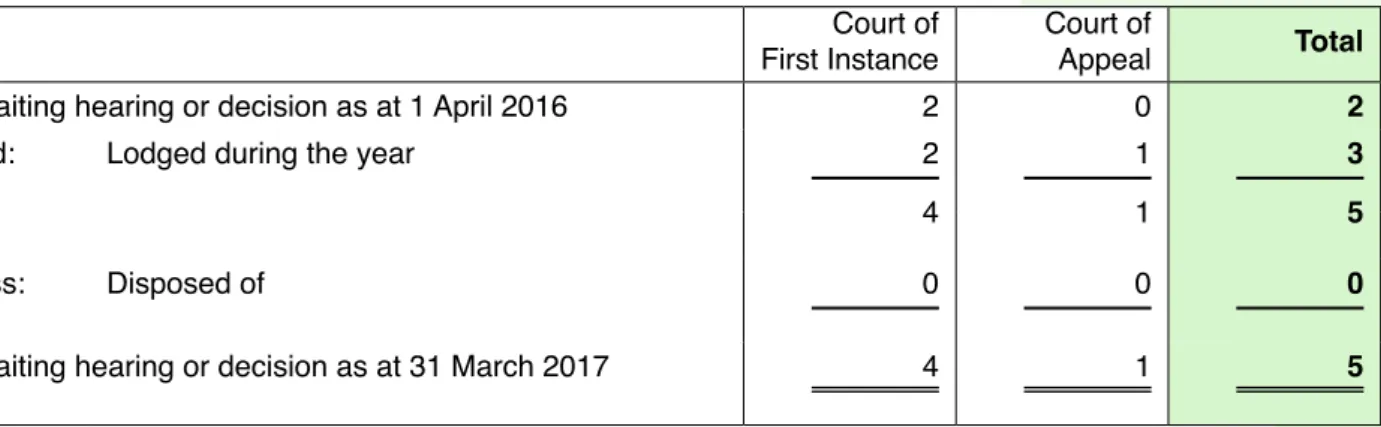
Figure 14 sets out the statistics concerning appeals to the Courts during 2016-17.
Figure 14 Appeals to the Courts
Court of
First Instance Court of
Appeal Total
Awaiting hearing or decision as at 1 April 2016 2 0 2
Add: Lodged during the year 2 1 3
4 1 5
Less: Disposed of 0 0 0
Awaiting hearing or decision as at 31 March 2017 4 1 5
Business Registration
The Department aims to maintain an efficient business registration system. A person carrying on a business in Hong Kong must register the business and pay the required fee and levy. The number of business registrations as at 31 March 2017 stood at 1,500,727, which was an all time high. It was 73,663 more than that as at 31 March 2016 (Figure 15).
Business registration certificates are generally valid for one year, but businesses may elect for 3-year certificates. As at 31 March 2017, 22,084 businesses held 3-year certificates.
To help business enterprises, the Government waived the business registration fees for 2016-17.
Businesses were still required to pay the levy on their business registration certificates. For a 1-year certificate, the levy was $250. For businesses electing for 3-year certificates, they were required to pay $3,200 for the business registration fees and
$750 for the levy.
Figure 15 Number of business registrations ('000)
1,600 1,400 1,200 1,000 800 600 400 200 0
1,427,064 1,500,727
250,844 265,366
1,176,220 1,235,361
31.3.2016 31.3.2017 Corporations Unincorporated Businesses
Businesses that were not required to renew their registration certificates in 2016-17 could apply for concessionary refunds if they had paid the registration fees for that year. Up to 31 March 2017, the Department had issued concessionary refunds to 14,774 businesses totaling $21.8 million.
Due to the waiver of business registration fees for the whole financial year 2016-17, the amount of business registration fees and penalties collected in 2016-17 was reduced to $228 million. It represents a significant decrease of 91.3% compared with last year, notwithstanding that 9.1% more certificates were paid (Figure 16). Business registration statistics are set out in Schedule 8.
Figure 16 Business registration statistics
2015-16 2016-17 Increase/Decrease Number of certificates paid (Main and Branch) 1,402,548 1,530,879 +9.1%
Fees (inclusive of penalties) collected ($m) 2,607 228 -91.3%
Under the Business Registration Ordinance, a small business with average monthly sales or receipts below a specified limit ($10,000 for businesses deriving profits mainly from the sale of services, and
$30,000 for other businesses) can apply for exemption from payment of the business registration fee and levy. Where an application for exemption is not allowed, the business operator may appeal to the Administrative Appeals Board. The number of exemptions granted during 2016-17 was 10,449, representing a decrease of 35.1% from the previous year. No appeal case was received by the Board during the last two years.
Stamp Duty
Stamp duty is charged on instruments effecting property transactions, stock transactions and leasing of property in Hong Kong (Figure 17).
Figure 17 Composition of stamp duty collections Leases etc.
(1%)
Shares (38%)
Immovable Properties
(61%)
2016-17
The increase in the number of immovable property transactions in 2016-17 led to a substantial increase in the amount of stamp duty collection from property transactions by 32% ($9 billion) when compared with that for 2015-16. On the other hand, the decrease in total turnover of the Hong Kong stock market in 2016-17 led to a significant drop in the total amount of stamp duty collection from Hong Kong stock transactions by 29% ($9.8 billion). The above factors resulted in a slight decrease of 1% in the overall stamp duty collection for the year 2016-17 (Figure 18 and Schedule 9).
Figure 18 Stamp duty collections
2015-16
($m) 2016-17
($m) Increase/Decrease
Immovable Properties 28,494 37,518 +32%
Shares 33,410 23,567 -29%
Leases and other documents 776 814 +5%
Total 62,680 61,899 -1%
Estate Duty
Estate duty is charged on a deceased person’s estate situated in Hong Kong. The threshold for levying duty is $7.5 million and the duty rates range from 5% to 15%, depending on the value of the estate.
The Revenue (Abolition of Estate Duty) Ordinance 2005 came into effect on 11 February 2006 abolishing estate duty in respect of persons passing away on or after that date. The estate duty chargeable in respect of estates of persons died between the period 15 July 2005 to 10 February 2006, with the principal value exceeding $7.5 million, is reduced to a nominal amount of $100. With the abolition of estate duty, the number of new cases reduced gradually to 586 in 2016-17, a drop of 24% from the last year (Figure 20).
Figures 19 and 20 show the composition of estates and cases processed for the past two years.
Figure 19 Composition of estates 10.4% 4.7%
10.6% 0.4% 73.9%
2015-16
2016-17
1.9% 34.1% 25.5% 33.2%
5.3%
Immovable Properties Quoted Shares Unquoted Shares Bank Deposits Others
Figure 20 Estate duty cases
2015-16 2016-17
Number Number
New cases 771 586
Cases finalised
- Dutiable 17 11
- Exempt 763 558
780 569
Estate duty of $19 million was collected during the year (Schedule 10), a decrease of $11 million (37%) compared with the previous year.
Estate duty is payable on delivery of an estate duty affidavit or account (or within 6 months from the date of the deceased’s death, whichever is the earlier). $0.2 million was received during the year in advance of the issue of formal assessments (Schedule 10).
Betting Duty
Betting duty is charged on the net stake receipts from betting on horse races and football matches and on the proceeds of Mark Six lotteries, all administered by the Hong Kong Jockey Club. In 2016- 17, the rates of betting duty on these betting activities remained unchanged (Figure 21).
Figure 21 Rates of betting duty in 2016-17
Rate Horse racing
Local bets on local horse races Net stake receipts
the first $11 billion 72.5%
the next $1 billion 73%
the next $1 billion 73.5%
the next $1 billion 74%
the next $1 billion 74.5%
the remainder 75%
Local bets on non-local horse races Net stake receipts 72.5%
Mark Six lotteries Proceeds 25%
Football betting Net stake receipts 50%
The total betting duty collected in 2016-17 was 4.9% higher than that of the previous year (Figure 22 and Schedule 11).
Figure 22 Betting duty collections
2015-16
($m) 2016-17
($m) Increase
Horse racing 12,316.5 12,757.9 +3.6%
Mark Six lotteries 2,032.2 2,126.9 +4.7%
Football betting 5,778.5 6,234.2 +7.9%
Total 20,127.2 21,119.0 +4.9%
Tax Reserve Certificates
Taxpayers may purchase Tax Reserve Certificates (TRCs) under two situations.
The first situation applies to taxpayers who wish to save for the payment of their future tax liabilities.
The Department has set up two schemes, namely the “Electronic Tax Reserve Certificates Scheme”
for all taxpayers and the “Save-As-You-Earn” (SAYE) Scheme for civil servants and civil service pensioners. With a Tax Reserve Certificate account, taxpayers may purchase TRCs by various channels, including bank auto-pay, telephone, the Internet and bank ATM. Under the “SAYE Scheme”, civil servants and civil service pensioners can purchase TRCs through monthly deductions from their salaries / pensions. Interest is payable on the TRCs when they are redeemed for settlement of tax liabilities, based on the interest rate prevailing at the time of purchase, for a maximum period of 36 months from the date of purchase.
In 2016-17, there was an increase of 2.6% and 8.8% respectively in the number and the amount of TRCs sold under the “Electronic Tax Reserve Certificates Scheme” but a slight decrease of 0.8% in the number and an increase of 2.1% in the amount of TRCs sold under the “SAYE Scheme” (Schedule 12). Overall, the total amount of TRCs sold increased by 7.8% (Figure 23).
Figure 23 Certificates sold
Number ('000)
100 90,299 91,138
80
60
40
20
0 1,812
2015-16
1,632 2016-17
Certificates relating to Objections and Appeals
Amount ($m)
3,500 3,186.5
3,000 2,500
2,000 2,106.1 1,500
1,000 500 0
513.3 2015-16
553.5
2016-17 Certificates other than for Objections and Appeals
The second situation applies to taxpayers who object to tax assessments and are required to purchase TRCs in respect of the tax in dispute. Such TRCs are used to settle any tax found payable upon the finalisation of the objection or appeal. Interest is only payable on the amount of the TRC, if any, subsequently required to be repaid to the taxpayer, and is computed at floating rates over the tenure of the TRC.
4 Collection
Revenue collected by the Department includes tax, additional tax, surcharge and fines. Schedules 13 and 14 provide details of additional tax, surcharge and fines imposed by the Department in respect of earnings and profits tax during 2016-17.
Collection of Tax
Taxpayers can conveniently settle their tax liabilities by various payment methods, including electronic payment (by phone, bank ATM or via the Internet), payment in person or payment by post. For earnings and profits tax, electronic payment remains most popular. 56% of the earnings and profits tax payment transactions in 2016-17 were made through electronic means. Figure 24 shows the respective percentages of the different payment methods used by taxpayers under earnings and profits tax and total revenue.
Figure 24 Payment methods Earnings & profits tax Number of transactions in 2016-17
By Post
(4%) In Person
By ATM (40%)
(7%)
By Phone (15%)
Via Internet (34%)
Total revenue (including other duties) Number of transactions in 2016-17
In Person (58%)
By Post (4%) By ATM
(4%)By Phone Via Internet (25%) (9%)
Refund of Tax
Tax refunds were made mainly due to two reasons, namely, overpayment of tax by taxpayers and revision of assessments. There were 774,452 refund cases in 2016-17, representing an increase of 26.4%. The total amount of refunds was $16.66 billion, representing an increase of $1.89 billion or 12.8% compared with the previous year (Figure 25).
Figure 25 Tax refunds
2015-16 2016-17
Type of tax Number Amount ($m) Number Amount ($m)
Profits tax 46,969 7,135.4 49,942 7,919.8
Salaries tax 495,074 3,906.6 635,828 4,654.8
Property tax 16,782 173.6 18,495 191.1
Personal assessment 29,051 348.6 31,498 387.7
Others 24,761 3,204.4 38,689 3,509.1
Total 612,637 14,768.6 774,452 16,662.5
Recovery of Tax in Default
Taxpayers should pay tax on or before the due date shown on the demand notes issued to them. The vast majority of taxpayers settle their tax liabilities in a timely manner.
A late payment surcharge of 5% will generally be imposed where tax is in default. If tax debts remain outstanding for more than six months after the due date, the Department may impose a further surcharge of 10% on the total unpaid amount.
Any tax in default is immediately recoverable. Recovery notices can be issued to employers, bankers, debtors and persons holding money on behalf of the defaulting taxpayers to effect collection. Actions may also be commenced in the District Court. Figure 26 summarises different types of recovery actions taken by the Department.
Figure 26 Recovery action
5% Surcharge Notice ('000) Number of notices
260
243,173 243,089 240
222,784 224,785
220
200
180 2013-14 2014-15 2015-16 2016-17
($m) Total amount
300
240 255 264
225 200
150
75
0 2013-14 2014-15 2015-16 2016-17
10% Surcharge Notice Number of notices
24,000
21,828
21,000 19,695
18,000 17,277
15,000 14,014
($m) Total amount
160 120 126
102 108 116
80
40
Recovery Notice ('000) Number of notices
150 142,708 141,004
140 135,654
130 125,131
120
110
100 2013-14 2014-15 2015-16 2016-17
($m) Total amount
12,000
10,595 9,000 8,277
7,532
6,954 6,000
3,000
0 2013-14 2014-15 2015-16 2016-17
Upon entry of judgment, a defaulting taxpayer becomes liable to legal costs and interest on judgment debt for the period from the date of commencement of proceedings to the date of full settlement in addition to the outstanding tax. Figure 27 shows the legal costs and judgment interest collected during 2016-17.
Figure 27 Legal costs and judgment interest collected in 2016-17
$ $
Court cost
Court fees 720,447
Execution fees 9,603 730,050
Fixed cost 309,636
Judgment interest
Pre-judgment interest 1,836,652
Post-judgment interest 18,520,975 20,357,627
Total costs and interest collected 21,397,313
Furthermore, the Commissioner may apply to a District Judge to prevent a person with tax in default from leaving Hong Kong. If the District Judge is satisfied that it is in the public interest to ensure that the person does not depart from Hong Kong, or if he returns, does not depart again, without first paying the tax or furnishing security to the satisfaction of the Inland Revenue Department for payment of that tax, he shall issue the “departure prevention direction”. The person concerned has the right to appeal to the Court of First Instance of the High Court against the District Judge’s decision.
5 Field Audit and Investigation
The Field Audit and Investigation Unit is responsible for conducting field audits and investigations on businesses and individuals with a view to combating tax evasion and avoidance. Back tax is assessed and penalties are generally imposed where discrepancies are detected.
During 2016-17, the Field Audit and Investigation Unit completed 1,801 cases (including tax avoidance cases) and assessed back tax and penalties of about $2.5 billion (Figure 28).
Figure 28 Results of the Field Audit and Investigation Unit
2013-14 2014-15 2015-16 2016-17
Number of cases completed 1,802 1,803 1,804 1,801
Understated earnings and profits ($m) 12,936.4 12,857.9 13,888.8 12,408.8
Average understatement per case ($m) 7.2 7.1 7.7 6.9
Back tax and penalties assessed ($m) 2,540.0 2,533.1 2,538.3 2,528.4 Back tax and penalties collected ($m) 2,158.7 2,861.4 1,824.2 2,386.8
Field Audit
In 2016-17, there were 17 Field Audit sections. Field audit is conducted on both corporations and unincorporated businesses. The work of field auditors entails site visits to business premises and examination of accounting records of taxpayers in order to ascertain whether correct returns of profits have been made.
Anti-tax Avoidance
Two of the 17 Field Audit sections concentrate on tackling tax avoidance schemes, whereas other investigation officers and field auditors handle avoidance cases on an operational need basis. During 2016-17, the Field Audit and Investigation Unit completed 214 tax avoidance cases and assessed back tax and penalties of about $1.12 billion (Figure 29).
Figure 29 Results of the audit on tax avoidance cases
2013-14 2014-15 2015-16 2016-17
Number of cases completed 219 217 215 214
Understated earnings and profits ($m) 5,124.9 6,027.7 6,826.2 6,201.8
Average understatement per case ($m) 23.4 27.8 31.7 29.0
Back tax and penalties assessed ($m) 909.3 1,155.6 1,000.4 1,120.2
Investigation
In 2016-17, there were 5 Investigation sections. Investigation officers are responsible for conducting in-depth investigations into suspected tax evasion, and taking penal action (including prosecution proceedings in appropriate cases) as a deterrent.
Prosecution
One of the 5 Investigation sections is the prosecution section focusing on criminal investigation of tax evasion. Tax evasion is a serious crime. A person convicted of tax evasion could be sentenced to imprisonment for up to 3 years and fined.
During the year, the Department successfully prosecuted 5 tax evasion cases. Two of them involved making false statements in connection with claims for deduction of expenses of self-education and claims for deduction of approved charitable donations. Two of them involved making false statements in connection with claims for deduction of home loan interest and expenses of self-education.
Another case involved making false statements in connection with claims for deduction of approved charitable donations. Among these 5 cases, the defendant of 1 case was sentenced to 8 weeks' imprisonment. The defendants of 2 cases were sentenced to immediate imprisonment of 10 weeks and 3 weeks respectively. The defendant of 1 case, after having been remanded in custody for 14 days, was sentenced to 6 weeks’ imprisonment and was fined $157,474 (equivalent to 200% of the tax evaded). The defendant of the remaining case, after having been remanded in custody for 21 days, was sentenced to 6 months’ imprisonment, suspended for 2 years and fined $60,000 ($5,000 for each charge). The Secretary for Justice applied for a review of sentence. In July 2016, the Magistrates’
Courts sentenced the defendant to 21 days’ imprisonment and a fine of $60,000 ($5,000 for each charge) plus a further fine of $132,852 (equivalent to 200% of the tax evaded).
Property Tax Compliance Check
In addition to conducting audits on businesses, the Department also carries out verification checks on the correctness of rental income reported by property owners. In 2016-17, the Department completed compliance check on 209,499 property tax cases (Figure 30).
Figure 30 Results of the property tax compliance checks
2013-14 2014-15 2015-16 2016-17
Number of cases completed 140,705 161,860 186,229 209,499
Understated rental income ($m) 553.3 635.0 749.2 850.8
Back tax and penalties assessed ($m) 66.4 76.2 89.9 102.1
6 Taxpayer Services
IRD Website
www.ird.gov.hk
The IRD website is a very effective channel for disseminating tax information and providing electronic services to the public. With continuous enrichment and updates, the website enables taxpayers to obtain the most current information about Hong Kong taxation in a fast and convenient manner.
Through the website, members of the public can:
• obtain information on tax law, tax returns, tax obligations and answers to frequently asked questions;
• download IRD software and tax forms;
• use the interactive program to calculate their liability under salaries tax and personal assessment;
and
• access to the personalised on-line tax services provided by the Department under eTAX.
To facilitate all sectors of the community to locate the relevant tax information, there are thematic content pages for individuals, businesses, employers, tax representatives, etc.
The IRD website conforms to web accessibility guidelines and there is also a mobile version to enable all users to have quick and convenient access to tax information.
Electronic Enquiry Service
Electronic enquiry services are provided to eTAX users at <www.gov.hk/etax>. They can view their tax position in relation to their returns, assessments and payments, etc. at any time.
Enquiry Service Centre
The Department’s Enquiry Service Centre handles telephone and counter enquiries. The Centre is equipped with a computer network linked to the Department’s Knowledge Database to enable our staff to provide, as far as possible, an immediate “one-stop” service.
Telephone Enquiry Service
The Centre operates an Interactive Telephone Enquiry System (ITES) with 144 telephone lines. Callers can have access on a 24-hour basis to a wide range of tax information by listening to recorded messages. Besides, callers can obtain facsimile copies of information sheets and forms through the system. A “Leave-and-call-back” facility, for recording information requests, and a “Fax-in enquiry”
service are also available. The telephones are manned during office hours by staff who would readily serve the callers. The Centre also provides an eTAX help desk hotline to handle enquiries on eTAX services and provide technical support.
The statistics of services provided through ITES during 2016-17 are shown in Figure 31.
Figure 31 Statistics of services provided through ITES
2015-16
Number 2016-17
Number Increase / Decrease
Calls answered by staff 728,196 736,701 +1.17%
Calls answered by system 661,940 770,107 +16.34%
Leave-and-call-back messages 32,851 33,211 +1.10%
Documents supplied by fax 2,813 2,685 -4.55%
Counter Enquiry Service
Generally, the counter staff of the Centre is able to handle enquiries, collects mail items and issues forms on the spot without the need of referring callers to other sections in the Department for attention.
The number of counter enquiries handled and forms issued during 2016-17 was about 0.62 million (Figure 32).
Information leaflets on topics of general interest are available for collection at the form stand located on the first floor of Revenue Tower. The public may also obtain general tax information and download forms from the IRD website and GovHK <www.gov.hk>.
Figure 32 Counter enquiries ('000)
800
622,213
600 565,598
400
243,078 231,852
200
0 2015-16 2016-17
No. of callers No. of enquiries
Tax-help Services for Completion of Tax Returns
On the IRD website, e-Seminars are provided for employers, property owners and individual taxpayers. Information on how to complete tax returns, fulfil tax obligations and overcome difficulties in compliance is uploaded to the website. After reading the information, taxpayers can raise enquiries electronically at the “Q&A Corner”. The Department will reply the questions on a regular basis.
The Department issued 2.54 million Individuals Tax Returns for the year of assessment 2015-16 on 3 May 2016. To assist the taxpaying public in completing tax returns, the Department extended the service hours of telephone enquiry services in May 2016. Service hours from Monday to Friday were extended by one and a half hours till 7:00 pm and additional service was also provided on Saturday from 9:00 am till 1:00 pm. During peak periods, the Department also redeployed manpower resources and employed part-time staff to strengthen daytime telephone enquiry services.
Complaints and Compliments
If taxpayers are dissatisfied with the services provided by the Department or their problems cannot be solved satisfactorily through normal channels, the Complaints Officer may be approached for assistance. The complaint channel provides taxpayers with the means of having individual grievances dealt with independently at a senior level. This ensures that such cases are properly handled in a fair and impartial manner. During 2016-17, 254 complaints cases were received (Figure 33). This represents an increase of 9%, as compared with the previous year.
If taxpayers are dissatisfied with any administrative action taken by the Department, they may refer the matter to the Ombudsman. During 2016-17, the Ombudsman sought written comments from the Department in respect of 22 cases. In the light of these cases, the Department has reviewed relevant operations with a view to improving them.
Taxpayers may compliment the service of the Department. During the year, 154 Letters of Compliments were received.
Figure 33 Complaint cases 300
250 233
21
254 20
200
150 75
85
100
50 137 149
0 2015-16 2016-17
Not Substantiated Partially Substantiated Substantiated
Performance Pledge
The service standards a taxpayer can expect from the Department are set out in the performance pledges. The Department has achieved all the targets of performance pledges and excelled in some of the targeted performance with remarkable results during 2016-17.
7 Information Technology
The Department has been making extensive use of information technology to enhance operational efficiency and provide quality services to the public.
IT Environment
The Department has built up a comprehensive and integrated IT infrastructure with different types of computer application systems and platforms. The Department’s network connects the computer system and workstations of staff on different floors. Assessment process is automated by the “Assess- First-Audit-Later” system. Tax audit and investigation work is facilitated by the use of data mining and advanced analytical tools. The Document Management System and Workflow Management System enhance the control and monitoring of documents, files and workflow, facilitate the tracking of case progress, and thus enable the Department to improve overall service quality. A wide range of information is stored in the Department’s Intranet and General Enquiry Knowledge Database for convenient access by our staff at work. Moreover, e-mail and Internet facilities provide an efficient and environment-friendly communication platform for our staff.
In 2016-17, we continued to implement the system infrastructure enhancement project. System development and user acceptance testing for migration of mainframe tax applications to the midrange platform are at their final stage. The new system will be implemented by phases starting from mid- April 2017 with target completion date in early-2018.
Electronic Services
eTAX
The Department continues to provide a wide range of online tax services to the public, including internet filing of tax returns, e-stamping of property documents, business registration e-services, electronic notices, electronic payments and lodgement of applications, etc.
eTAX services are widely used by the public. As at 31 March 2017, there were some 736,000 registered eTAX users. The take-up rate increased year after year (Figure 34).
Figure 34 eTAX Usage Statistics
2015-16
Number 2016-17
Number Increase Internet filing of tax returns
- Tax Return-Individuals, Property Tax Return and Profits Tax
Return 525,670 567,583 +8.0%
- Employer’s Return of Remuneration and Pensions
BIR56A 12,162 13,517 +11.1%
IR56B 86,828 107,580 +23.9%
- Employer’s Notifications of Commencement of Employment, Cessation of Employment and Employee’s Departure from
Hong Kong 17,486 19,145 +9.5%
Stamping of Property Document 262,705 292,224 +11.2%
Business Registration Number Enquiry 2,007,895 2,049,465 +2.1%
Application for Supply of Information on the Business Register
- Requisition 135,548 141,998 +4.8%
- Business registrations involved 329,239 440,471 +33.8%
Other Electronic Services
During 2016-17, some 42,800 employers furnished annual returns for 2,847,300 employees in total by diskettes, DVDs or USB storage devices. About 69% of these employers used the free software provided by the Department.
8 Human Resources
Organisation Chart of the Inland Revenue Department as at 31.3.2017
Commissioner
Deputy Commissioner (Technical)
Commissioner's Unit Appeals Technical Research Tax Treaty Charitable Donations Complaints Internal Audit Special Duties Forms & General
Support
Unit 1 Assessment and Review (Profits Tax - Corporations and Partnerships)
Unit 2 Assessment (Salaries Tax,
Profits Tax - Sole proprietorships,
Property Tax - Sole Owners and Personal Assessment)
Deputy Commissioner (Operations) Departmental
Administration Division
Unit 3 Collection Inspection Estate Duty Stamp Duty Business Registration
Unit 4 Field Audit
and Investigation
Headquarters Unit Information
Systems Training Enquiry Services
Document Processing Output Despatch
Tax Records Assessment (Property Tax - Joint Owners and
Corporations) and Review (Profits Tax -
Sole proprietorships,
Property Tax and Personal Assessment) Overall Establishment
No. of Staff
Commissioner's Office 82
Commissioner's Unit 80
Headquarters Unit 702
Unit 1 360
Unit 2 766
Unit 3 611
Unit 4 240
Total 2,841
Establishment
The Commissioner, the two Deputy Commissioners and the five Assistant Commissioners, together with the Departmental Secretary, form the top management of the Inland Revenue Department.
Members of the Top Management of the Inland Revenue Department (as at 31.3.2017)
Mr CHIU Sai-ming Assistant Commissioner (Headquarters Unit)
Mr TAM Tai-pang Deputy Commissioner
(Operations)
Mr WONG Kuen-fai
Commissioner Mr CHIU Kwok-kit Deputy Commissioner
(Technical)
Miss LEUNG Shun-chee, Evelyn
Departmental Secretary
Mr YIM Kwok-cheong Assistant Commissioner
(Unit 1)
Miss TSUI Siu-fong, Maria Assistant Commissioner
(Unit 2)
Ms TSE Yuk-yip Assistant Commissioner
(Unit 3)
Ms CHAN Fung-kuen Assistant Commissioner
(Unit 4)
As at 31 March 2017, the Department had an establishment of 2,841 permanent posts (including 27 directorate posts) in the Commissioner’s Office and the 6 Units of the Department. Of the total, 1,929 posts were in departmental grades (namely Assessor, Tax Inspector and Taxation Officer grades), performing duties directly concerned with taxation. The remaining 912 posts were in common / general grades, providing administrative, information technology and clerical support services (Figure 35).
Figure 35 Staff establishment
105
0
3,000 2,826 2,832 2,833 2,841
707 712 712 720
105 105 105
2,000
Assesors (Professional)
1,079 1,089 1,102 1,104
Tax Inspectors 1,000
Taxation Officers
935 926 914 912 Common / general grade officers
2013-14 2014-15 2015-16 2016-17
Most of the professional officers serving in the Department were below the age of 45 (Figure 36). The ratio of male to female professional officers was 1:1.6.
Figure 36 Age and gender profiles of professional staff (on strength basis)
Age Group Male Female Total
Below 25 13 (5%) 21 (5%) 34 (5%)
25 to below 35 60 (22%) 149 (33%) 209 (29%)
35 to below 45 48 (18%) 96 (22%) 144 (20%)
45 to below 55 110 (40%) 140 (31%) 250 (35%)
55 and over 41 (15%) 40 (9%) 81 (11%)
Total 272 (100%) 446 (100%) 718 (100%)
Staff Promotions and Turnover
In 2016-17, a total of 43 departmental grade officers and 21 common / general grade officers were promoted. 154 officers joined the Department, of which 96 were new appointees and 58 were officers transferred from other grades / departments. A total of 175 officers (including 43 transferred to other departments) left the Department.
Training and Development
Staff are the Department’s valuable assets. We recognise the importance of providing opportunities of continuous learning to our staff to keep them abreast of the changing environment and to acquire the necessary knowledge to perform their duties. A variety of training courses in taxation, accounting,
interpersonal skills, management, languages, computer, etc. are offered to staff members. In 2016-17, our staff received training for a total of 9,862 man-days, which was equivalent to about 3.47 man-days per officer.
The major training activities conducted for our staff during 2016-17 were as below:
Training Courses
• Induction courses for all grades of staff upon joining the Department
• Two-year taxation law and practice course for newly appointed Assistant Assessors
• Briefing sessions on legislative amendments and new services
• Refresher courses on professional knowledge
• Courses on Hong Kong Accounting Standards
• Written and spoken English courses
• Putonghua courses
• Computer courses
Workshops
• Leadership and teamwork workshop
• Mentorship workshop
• Performance appraisal workshops on English writing and interviewing skills
• Workshop on bringing out the best in people
• Workshop on customer service skills on the telephone
• Workshop on effective communication in the workplace
• Workshop on emotional wellness
• Workshop on essential supervisory skills
• Workshop on foreign enterprises in the Mainland – legal and regulatory requirements
• Workshop on how to handle difficult taxpayers
• Workshop on interviewing and negotiation skills
• Workshop on leading innovation and change
• Workshop on problem solving and decision making
• Workshop on turning challenges to opportunities – resolving customer complaints
Continuing Professional Education
14 seminars were held by the Training Committee under the in-house Continuing Professional Education (CPE) Programme on the following subjects for professional officers:
• The Way Ahead for Hong Kong – Implementation of the G20 BEPS Project and Modernisation of the Tax Legislation
• Liquidation Procedures and Process
• The Legislative Process in Hong Kong
• Avoidance and anti-avoidance under the Mainland’s Corporate Income Tax Law
• Mediation
• Tax investigation on the Mainland
• HKFRS Update – HKFRS 15 and 16
• International Tax Update
• Forensic Accounting – the Investigative Methodologies
• Inland Revenue (Amendment) (No. 2) Ordinance 2015 – Taxation of Private Equity Fund
• Inland Revenue (Amendment) (No. 2) Ordinance 2016 – Taxation of Corporate Treasury Activity
• Implementation of Common Reporting Standard on Automatic Exchange of Information in Hong Kong
• BEPS Updates
• Annual Update of Appeal Cases
Speakers for 5 of the seminars were staff members and others were experts from various fields. A total of 1,392 staff members attended these seminars. The video files of the CPE seminars were uploaded onto the Department’s Intranet and a total of 688 staff members had viewed these video files.
Overseas and China Training
In order that our professional officers may broaden their horizons and acquire the necessary knowledge to cope with new and complex global issues, they are sent to participate in overseas training programmes. In 2016-17, 32 officers went to China, Korea, Malaysia, Philippines and Singapore to attend training courses on different issues and 12 to universities in China for national studies courses.
Continuous Learning
Besides the conventional classroom training, the Department employs various means to promote continuous self-learning. These include encouraging staff to take the web courses provided by
the CLC Plus of CSTDI and providing financial support to officers to attend seminars and courses organised by academic and professional institutes. In 2016-17, 17 officers were sponsored by the Department to attend the relevant courses. Training materials and information are uploaded onto our Intranet for officers to study in their own time and at their own pace. This provides an effective way for the staff to acquire new knowledge and refresh what they have learnt.
Mentorship Scheme
A Mentorship Scheme for Assistant Assessors has been set up since 2008. Under this scheme, experienced officers (the mentors) will guide newly recruited Assistant Assessors (the mentees) to broaden their perception about the Department such as the organisation structure, work, connection and culture, and help them integrate into the civil service.
Staff Relations and Welfare
The Department attaches great importance to staff relations and welfare. We strive to maintain effective communication, and promote co-operation and mutual trust between the management and staff at all levels which help enhance the Department’s operational efficiency and productivity.
The Departmental Consultative Committee
The Departmental Consultative Committee provides a formal and effective platform for the management and staff to exchange views on matters of mutual concern such as recruitment, promotion, career posting, training, working environment, staff welfare, office security and safety. The Committee is chaired by the Deputy Commissioner (Operations) and composed of representatives from all staff unions / associations and staff groups in the Department.
The General Grades Consultative Committee
The General Grades Consultative Committee, chaired by the Departmental Secretary and composed of representatives from the clerical and secretarial grades, allows the general grades staff members to discuss with the management issues of specific interest to their grades.
The “Meet-the-Staff Programme”
First launched in 1996-97, the “Meet-the-Staff Programme” enables the senior management of each Unit and staff of different sections / groups to exchange ideas face to face on departmental and service-wide issues in an open and relaxed manner. It serves to supplement the formal consultative channel and effectively enhances communication between staff and the management.