行政院國家科學委員會專題研究計畫成果報告
用於減肥治療之 norepinephrine 經皮輸移系統的研究 Investigation of norepinephrine transdermal delivery systems for
anti-obesity therapy
計畫編號:NSC 90-2320-B-041-004 執行期限:90 年 8 月 1 日至 91 年 7 月 31 日 主持人:林恆弘 嘉南藥理科技大學 藥學系 共同主持人:許立人 嘉南藥理科技大學 藥學系 計畫參與人員:王俊傑 嘉南藥理科技大學 生科所
一、中文摘要
無數奈米微粒組成之軟膏用以作為新 副腎素之經皮輸移系統;奈米微粒包覆新 副腎素是以固體凍膠粉碎技術來製備,新
副腎素-親水膠體奈米微粒的粒子大小是
以鐳射粒徑分析儀來檢測,至於該微粒之 藥物負載與體外藥物釋離則是以高效液相
層析儀來檢測,軟膏的流變性質是以Cone
and Plate 黏度計來描述,另外,藥物與 聚合物間的交互作用是採用熱卡式分析儀 來評估。結果顯示,以固體凍膠粉碎技術
製備之新副腎素-親水膠體奈米微粒的粒
子大小介於40 奈米至 2000 奈米之間,奈 米微粒的粒徑與藥物包埋率受膠體種類與 含 量 的 影 響 , 基 於 藥 物 釋 離 結 果 與 Higuchi 作圖得知,新副腎素是包埋於親 水膠體基質中,隨著最初30% 至 40%新
副腎素快速突釋後,可維持24 小時的持續
釋放效果。軟膏含高濃度細小親水膠體奈 米微粒所展現與時間有關的性質,可歸納 為擴張性與搖變稠的特性,為了長期的安 定性,本研究結果建議,含新副腎素-親水 膠體奈米微粒之製劑應以凍晶粉末於低溫 下貯存,使用前加二次蒸餾水還原。熱分 析的結果指出,各組成分之間不論是在製 造過程亦或凍晶粉末加水還原,均未有化 學交互作用產生。上述結果對爾後發展其 他減重藥物經皮輸移系統將有所助益,
關鍵詞:新副腎素,軟膏,奈米微粒,釋 離,體外實驗
Abstract
Ointments composed of numberless nanoparticles were used for norepinephrine (NE) transdermal delivery. Nanoparticles encapsulating NE were prepared using the solid jelly pulverization technique. The size of the NE- hydrogel nanoparticles was assessed using a LS Particle Size Analyzer. For these nanoparticles, drug loading and in vitro drug release was quantified using a HPLC assay. The rheological properties of ointments are characterized by Cone and Plate Viscometer. In addition, any drug-polymer interactions were assessed using a differential scanning calorimeter (DSC). The results show that solid jelly pulverization technique yielded NE hydrogel nanoparticles with a mean diameter of 40 nm to 2000 nm. The particle size and encapsulation efficiency of nanoparticles were affected by the hydrogels and their amount. Based on our release profiles and Higuchi plots, it appears that NE is trapped in the hydrogel matrix. Following an initial burst release of 30% to 40% NE, the release was sustained over the 24-hours study period. The time-dependent behaviour of ointments including a high
concentration of small hydrogel nanoparticles is referred to as dilatant and exhibit shear thickening.
For the long term stability, the results suggested that the product containing NE nanoparticles should be stored in the state of lyophilized powder at lower temperature and reconstituted by adding double distilled water before used. The DSC measurements indicated that the chemical interaction does not occur among the components during manufacturing processes and reconstituting lyophilized powder.
The above results will be helpful to possible development of the other anti-obesity drug transdermal delivery systems.
Keywords: Norepinephrine,
Ointment, Nanoparticles, Release, in vitro studies 二、Introduction
Obesity is rapidly becoming a worldwide epidemic, with significant consequences in terms of clinical burden and economic costs in treating its complications, (1-3) however, the long term safety data of drugs which were used to treat obesity are not yet available and the use of these drugs may be limited by seriously adverse effects. (4-9) So effective new approaches are urgently needed. Norepinephrine induced lipolysis that has been proved in a cell-free system consisting of the lipid droplets and hormone-sensitive lipase (HSL), but it rapidly metabolized before reaching the systemic circulation and therefore ineffective after oral administration. (10-16) In order to achieve and maintain an adequate concentration of drug at the side of action for a prolonged period of time
so as to improve the therapeutic efficacy, in the work, we attempt to develop a transdermal delivery system by the use of ointment dosage forms. The major part of the ointment is a gel-like structure composed of hydrogel with nanoparticles encapsulating norepinephrine. Compared to the free drug, nanoparticles have advantage of minimal irritation. The study will last for two years. In the first year, we investigate the effect of variation in the composition and preparation condition of nanoparticles on the viscosity, adhesive of products and drug release. The physicochemical properties of ointments will be determined by Cone and Plate viscometer, texture analyser and differential calorimetry. The effect of ointment physicochemical properties on the release of norepinephrine from ointment base will be discussed by in vitro studies. The above results will be to design further in vivo studies and helpful to possible development of anti-obesity drug transdermal delivery systems.
三、Results and discussion
The formulations used in the experiments are shown in Table 1.
When preparing, add a definite amount of water, heat up to melt, then cool to coagulate into jelly. The jelly strength is 25 g/cm. The nanoparticles were obtained by using a solid phase pulverization technique.
The distribution of particle size was measured by LS Particle Size Analyzer, and was controlled within a range of 40 nm to 2000 nm. Assay of entrapped norepinephrine was determined by filtering the nanoparticles dispersion under
vacuum through a 0.025μm filter.
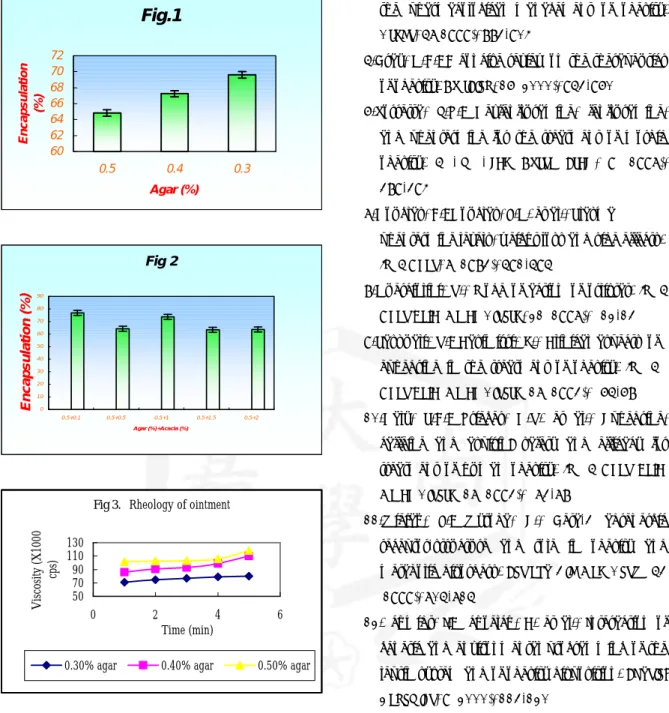
The filtrate containing free drug was estimated by HPLC. The % encapsulation efficiency of norepinephrine in nanoparticles of various formulations was calculated using the following expression and shown in Fig 1 and 2.
% Encapsulation efficiency = (Total drug – drug in aqueous phase ) X 100 / Total drug
Agar and gelatin gels are termed thermal gels. Gels often contract spontaneously and exude some of the fluid medium. The increased amount of agar or gelatin resulted in a significant in the effect that is known as syneresis. This might be the reason for the decreased efficiency of encapsulation of higher agar or gelatin content in nanoparticles. On the other hand lyophilic sols form gels in a different manner. The macromolecules may form a network simply by entanglement. e.g. Acacia and Tragacanth. There were no significant difference within encapsulation efficiency of nanoparticles by adding Acacia or Tragacanth.
The rheological properties of ointments including a high concentration of small hydrogel nanoparticles are characterized by Cone and Plate Viscometer. As shown in Fig 3, the viscosity increases with increase in shear rate and time. The time-dependent behaviour of ointments is referred to as dilatant and exhibit shear thickening. The results are different from the similar materials are most usually typified by aqueous dispersions of hydrocolloids.
Moreover, the viscosity of ointments will increase as agar content of nanoparticles increase.
The in vitro release of norepinephrine from the hydrogel nanoparticles was carried out in a way similar to apparatus of the 15-ml vertical Franz diffusion assembly. The apparatus was maintained at 37 ±0.5 ° C with a water jacket. An aliquot of the sample was taken at appropriated times, and the concentration was determined by HPLC method. The results show that following an initial burst release of 30% to 40%
norepinephrine, the release was sustained over the 24-hours study period. A Higuchi plot was approximately linear for all the formulations, indicating that norepinephrine is entrapped within the hydrogel matrix.
Differential scanning calorimeter was used to establish physical-chemical properties of hydrogel nanoparticles. The DSC measurements indicated that the chemical interaction does not occur among the components during manufacturing processes and reconstituting lyophilized powder.
Table 1 Formulation of jelly-like hydrogel nanoparticles
Component Content ( w/w % )
Agar 0.1∼0.5
Acacia 0∼0.05
Tragacanth 0∼0.05
Gelatin 5∼25
Water Add to 100
Fig.1
60 62 64 66 68 70 72
0.5 0.4 0.3
Agar (%) Encapsulation (%)
Fig 2
0 10 20 30 40 50 60 70 80 90
0.5+0.1 0.5+0.5 0.5+1 0.5+1.5 0.5+2
Agar (%)+Acacia (%)
Encapsulation (%)
Fig 3. Rheology of ointment
50 70 90 110 130
0 2 4 6
Time (min) Viscosity (X1000 cps)
0.30% agar 0.40% agar 0.50% agar
五、References:
1.Wilding, J.; The future of obesity treatment.
EXS, 89 (2000), 181-191
2.Miwa, K.; Nakagawa, K.; Risk factors that discriminate ‘high-risk’ from ’low-risk’ Japanese patients with coronary artery disease. Jpn Circ J., 64 (2000), 825-830
3.Haffner, S.M.; Sex hormones, obesity, fat distribution, type 2 diabetes and insulin resistance: epidemiological and clinical correlation. Int. J Obes Relat Metab Disord, 24 (2000), 56-58
4.Carek, P.J.; Dickerson, L.M.; Current concepts in
the pharmacological management of obesity.
Drugs, 57(1999), 883-904
5.Bray, G.A.; A concise review on the therapeutics of obesity. Nutrition, 16 (2000), 953-960
6.Torretta, L.K.; Dexfenfluramine, fenfluramine, and phentermine for the treatment of morbid obesity. J Am Acad Nurse Pract, 9 (1997), 389-394
7.Douglas, A.; Douglas, J.G. et al., Plasma phentermine levels, weight loss and side effects.
Int J Obes, 7 (1983), 591-595
8.Guerciolini, R., Mode of action of orlistat. Int J Obes Relat Metab Disord, 21 (1997), S12-13
9.Pasquali, R.; Casimirri, F., Clinical aspects of ephedrine in the treatment of obesity. Int. J Obes Relat Metab Disord, 17 (1993), S65-68
10.Daly, P.A.; Krieger, D.R. et al., Ephedrine, caffeine and aspirin: safety and efficacy for treatment of human obesity. Int. J Obes Relat Metab Disord, 17 (1993), S73-78
11.Wiejak, J.; Wyroba, E., Beta-3 adrenergic receptor-structure and role in obesity and metabolic disorders. Postepy Hig Med Dosw, 53 (1999), 705-715
12.Schmidt, I.; Schoelch, C. et al., Interaction of genetic and environmental programming of the leptin system and of obesity disposition. Physiol Genomics, 9 (2000), 113-120
13.Morimoto, C.; Sumiyoshi, M. et al., Relationship between hormone-sensitive lipolysis and lipase activity in rat fat cells. J Biochem, 125 (1999), 976-981
14.Morimoto, C.; Tsujita, T.; Sumida, M.; Okuda, H., Biochem Biophys Res Commun, 274 (2000), 631-634
15.Morimoto, C.; Tsujita, T.; Okuda, H., Norepinephrine-induced lipolysis in rat fat cells from visceral and subcutaneous sites: role of hormone-sensitive lipoase and lipid droplets. J Lipid Res, 38 (1997), 132-138
16.Best, J.D.; Halter, J.B., Release and clearance rates of epinephrine in man: importance of
arterial measurements. J Clin Endocrinol Metab, 55 (1982) 263-268
行政院國家科學委員會補助專題研究計畫成果報告
※※※※※※※※※※※※※※※※※※※※※※※※※※
※ ※
※
用於減肥治療之 norepinephrine 經皮輸移系統的研究※
※ ※
※※※※※※※※※※※※※※※※※※※※※※※※※※
計畫類別:▓個別型計畫 □整合型計畫 計畫編號:NSC 90-2320-B-041-004-
執行期間: 90 年 8 月 1 日至 91 年 7 月 31 日
計畫主持人:林恆弘 共同主持人:許立人 計畫參與人員:王俊傑
本成果報告包括以下應繳交之附件:
□赴國外出差或研習心得報告一份
□赴大陸地區出差或研習心得報告一份
□出席國際學術會議心得報告及發表之論文各一份
□國際合作研究計畫國外研究報告書一份
執行單位:嘉南藥理科技大學 藥學系
中 華 民 國 91 年 10 月 25 日