Knowledge-based Expansion for Image Indexing
R.C.F. Wong and C.H.C. Leung
Dept. of Computer Science, Hong Kong Baptist University,
{cfwong,clement}@comp.hkbu.edu.hk
Abstract- The number of images available in online repositories is growing dramatically and image retrieval has been become one of the most popular activities on Inter-net. The effectiveness of image retrieval depends on mean-ingful indexing. In this paper, we propose an extension of image annotation models which are using knowledge-based expansion and contextual feature-knowledge-based index expan-sion. Our system is evaluated quantitatively using more than 100,000 web images and around 1,000,000 tags. Ex-perimental results indicate that this approach is able to de-liver highly competent performance.
1
Introduction
Since the past decade, image retrieval has been become one of the most popular activities on Internet. As the num-ber of images available in online repositories is growing dramatically, exploring the frontier between image and lan-guage is an interesting and challenging task. Research in image retrieval has reflected the dichotomy inherent in the semantic gap, and is divided between two main categories: concept-based image retrieval and content-based image re-trieval. The former focuses on retrieval by objects and high-level concepts, while the latter focuses on the low-high-level vi-sual features of the image.
Low-level visual features are indicated by visual con-tent descriptors in order to support users in accessing the knowledge embedded in images. These methods aim at cap-turing image similarity by relying on some specific char-acteristic of images; typically, these models are based on color, texture and shape [4, 6, 9, 11, 14, 23, 30, 32]. As dis-cussed in [31], in order to compute these descriptors, the image often has to be segmented into parts, which aims to determine image objects. Current methods of image seg-mentation include [8, 12, 16, 17, 24, 29]: partitions, sign de-tection, region segmentation. They compute general simi-larity between images based on statistical image properties [1–3,18,22,26, 27]. Some studies [12,20] include users in a search loop with a relevance feedback mechanism to adapt the search parameters based on user feedback. Semantic annotation of the image database combined with a region based image decomposition is used, which aims to extract semantic properties of images based on spatial distribution
of color and texture properties [9,11,14,15,23,30,32]. How-ever, an advantage of using low-level features is that, unlike high-level concepts, they do not incur any indexing cost as they can be extracted by automatic algorithms. In contrast, direct extraction of high-level semantic content automati-cally is beyond the capability of current technology. Some research [5] focuses on implicit image annotation which in-volve an implicit and, in consequence, augments the origi-nal indexes with additioorigi-nal concepts that are related to the query.
With the advent of Semantic Web technology, edge is playing a key role as the core element of knowl-edge representation architecture in Semantic Web. Some effort [7, 13, 19, 25, 28] has been made for image retrieval using Semantic Web techniques.
Our work is related to generative modelling approaches. In [31], a semantic annotation technique named Automatic Semantic Annotation (ASA) approach is developed which is based on the use of image parametric dimensions and metadata . Using decision trees and rule induction, a rule-based approach to formulate explicit annotations for images fully automatically is developed, so that, semantic query such as ”sunset by the sea in autumn in New York” can be answered and indexed purely by machine. In this pa-per, we propose an extension of such image annotation models by using knowledge-based expansion and contex-tual feature-based index expansion. Our system is evalu-ated quantitatively using more than 100,000 web images and over 990,000 tags. Experimental results indicate that this approach is able to deliver highly competent perfor-mance.
2
Expansion algorithms
2.1
Knowledge-based expansion
In certain applications, the presence of particular objects in an image often implies the occurrence of other objects. The application of such inferences will allow the index of an image to be automatically expanded.
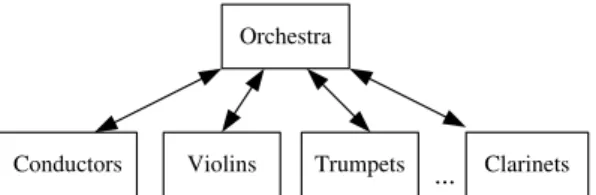
Aggregation hierarchical expansion is a particularly use-ful technique, which relates to the aggregation hierarchy of sub-objects that constitute an object. The objects can be classified as:
... Orchestra
Conductors Violins Trumpets Clarinets
Figure 1. Hierarchical expansion
(a) concrete, where the relevant objects are well-defined (e.g. an ”orchestra” expanded to violins, trumpets, clarinets etc, see Fig. 1)
(b) abstract, where the objects are not concretely defined (e.g. although ”conflict” is not a definite visual object, it contains certain common characteristics).
2.2
Contextual feature-based index expansion
Here, we shall establish associations between low-level features with high-level concepts, and such associations will take the following forms.
The presence of certain low-level features F may sug-gest a finite number of m object possibilities. Sometimes, a combination of basic features may be used to infer the pres-ence of high-level concepts for inclusion in the semantic index.
Basic features alone may not be sufficient to infer the presence of specific objects, but such features if augmented by additional information may lead to meaningful infer-ences. When a particularly context is known, a concept may be indexed more precisely. Such contextual informa-tion will typically be provided through knowledge-based expansion, which may lead to the creation of a new index term, or a revision of the score of an existing index term. This will give rise to an iterative feedback loop where the determination of new objects will lead to new meaningful feature-object combinations, where further objects may be determined.
2.3
Annotation measure
The reliability of a given annotation will given rise to a numerical measure, which signifies how good the anno-tation is. For annoanno-tations with a low measure, this would mean that the annotation is not very occurrence, or in ex-treme cases, what is being annotated is absent from an im-age. A high annotation measure indicates that the chance of finding the corresponding object or content in the given im-age is high. In addition, apart from measuring the likelihood of of whether something is present or not, it can be used to indicate the importance of an object in the image. For ex-ample, an object which is very prominently present in the foreground of an image would have a much large value than an object of small size in the remote background. Hence the annotation measure is used to signify two aspects.
Low
High probability of finding on object in the image and/or Object, if present, would play a dominant role in the image
High
Low probability of finding the giving object, and/or Object of low significance in the image
Figure 2. Annotation measure
(a) the likelihood of finding the object in the given image (b) the prominence of the object in the given image (Fig. 2).
3
Experimental evaluation
Our main purpose in introducing knowledge-based ex-pansion into the image retrieval problem and using the sub-objects as surrogate terms for general queries is to improve the precision in the image sets. In this evaluation, we mainly focus on the knowledge-based expansion and contextual feature-based index expansion.
The index elements are organized and used to build the basic content index within a relational database. The rela-tional database is designed for maximum query effective-ness by distributing the semantic elements across different relations. A further index is built on top of these relations to support rapid discovery.
The effectiveness of our approach is evaluated experi-mentally. A set of standard evaluation queries are used for experimentation. Comparison is made between base-level indexing and the expanded level indexing, and the widely accepted measures of retrieval performance of precision and recall are used to assess system performance.
To numerically assess the accuracy and effectiveness of our annotation approach, we have retrieved 103,521 sets of images with 991,074 associated tags from flickr.com which are a popular photo sharing web site and online community platform offering a fairly comprehensive web-service API that allows developers to create applications that can per-form almost any function on images.
The quality assessment of the machine-inferred bound-aries between parts of the depicted scenes is based on the precision. In our evaluation, we decide that a relevant im-age must include a representation of the category in such a manner that a human should be able to immediately asso-ciate it with the assessed concept.
3.1
Results
In relation to image acquisition, many images may be broken down to few basic scenes, such as nature and wildlife, portrait, landscape and sports. In the case of aggre-gation hierarchical expansion, we decided to test our system using the aggregation hierarchy of basic categories ”night scenes” and extend the image hierarchy to find a sub-scene
300 320 340 360 380 400 0 10 20 30 40 50 60 index distribution no. of index night bridge downtown highway architecture hotel road
Figure 3. Index distribution associated with night scene images
0% 10% 20% 30% 40% 50% 60% 70% 80% 90% 100% high way arch itect ure road hote l city dow ntow n p re c is io n r a te
Figure 4. Experimental results on aggregation hierarchical expansion
”night scene of downtown”, ”downtown” can be expanded to ”business district”, ”commercial district”, ”city center” and ”city district”, while ”city district” can be expanded to ”road”, ”building”, ”architecture”, ”highway” and ”hotel”.
In [31] by using decision trees and rule induction, a rule-based approach to formulate explicit annotations for images fully automatically has been developed. To extend the ap-proach, firstly, we annotate night scenes based on the prior rule-based approach to extract 422 out of 103,527 images. We also gather 1108 tags associated with those images and totally 417 unique terms are formed. We list the top 117 out of 417 unique terms list in Fig. 3. We present the results of the evaluation in Fig. 4.
To establish associations between low-level features with high-level concepts, associating basic features with seman-tic concepts may be applied to arbitrary images for inclusion
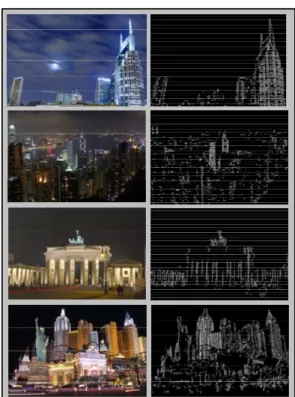
Figure 5. Contextual feature-based index ex-pansion with edge detection algorithms
in the semantic index. Edge detection is a methodology in image processing and computer vision, particularly in the areas of feature detection and feature extraction, to refer to algorithms which aim at identifying points in a digital im-age at which the imim-age brightness changes sharply or more formally has discontinuities. Here, we adapt edge detection algorithms [10, 21] to extract high-level concepts from low-level features.
From [10], the framework near-circular Gaussian-based image derivative operators have been developed via the use of a virtual mesh and are proven to reduce angular error when detecting edges over a range of orientations. The edge detection operators are based on first and second derivative approximations, corresponding to a first directional deriva-tive ∂u/∂b ≡ b · ∇u and a second directional derivaderiva-tive −∇ · (B∇u) , and are defined by the functionals [10]
Eδ i(U ) = Z Ω bi· ∇U ζδ idΩ (1) and Zδ i(U ) = Z Ω ∇U · (Bi∇U ζδ i)dΩ (2)
direc-0% 10% 20% 30% 40% 50% 60% 70% 80% 90% 100% ASA appr oach prop osed appr oach tags by hum an p re c is io n r a te
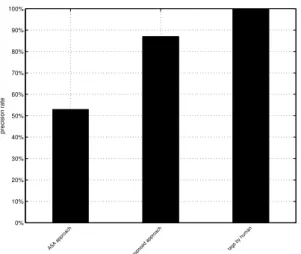
Figure 6. Experimental results on contextual feature-based index expansion
tion. The special case of the Laplacian operator is repre-sented by Ziδwith B taken to be the identity matrix [10].
Here, we select one ”downtown” image manually from the image set. We have carried out evaluation (shown in Fig. 6 by comparing the original Automatic Semantic An-notation (ASA) approach) with our approach which com-bines the original ASA approach with vertical edge detec-tion algorithms (see Fig. 5) and the use of human tags. Our experiment indicates that tags by human deliver excel-lent precision rate with 100% precision but this tagging ap-proach relies heavily on human involvement. For the ASA Approach combining with edge detection algorithms, the precision rate grows to 87.1%. Clearly, compared to an-notation without the contextual feature-based index expan-sion enabled, the performance is around 52.8%. From the joint application of these, we can formulate semantic an-notations for specific image fully automatically and index images purely by machine without any human involvement.
4
Conclusion and future works
In this paper, we propose an extension of image anno-tation models which uses knowledge-based expansion and contextual feature-based index expansion. Our system is evaluated quantitatively, and experimental results indicate that this approach is able to deliver highly competent per-formance. Our approach, not only demonstrates the appli-cability of knowledge-based expansion to the image anno-tation problem, but also using the sub-objects as surrogate terms for general queries is to improve the precision in the image sets.
[1] G. Amato and C. Meghini. Combining features for image
retrieval by concept lattice querying and navigation.
In-ternational Conference on Image Analysis and Processing Workshops, 0:107–112, 2007.
[2] J. Amores, N. Sebe, and P. Radeva. Context-based object-class recognition and retrieval by generalised correlograms.
IEEE Transactions on Pattern Analysis and Machine Intelli-gence, 29(10):1818–1833, October 2007.
[3] V. Athitsos, J. Alon, S. Sclaroff, and G. Kollios. Boost-map: A method for efficient approximate similarity rank-ings. IEEE Computer Society Conference on Computer
Vi-sion and Pattern Recognition, 02:268–275, 2004.
[4] I. Azzam, A. G. Charlapally, C. H. C. Leung, and J. F. Hor-wood. Content-based image indexing and retrieval with xml representations. Proceedings of the International
Sympo-sium on Intelligent Multimedia, Video and Speech Process-ing, Hong Kong, pages 181–185, 2004.
[5] I. A. Azzam, C. H. C. Leung, and J. F. Horwood. Implicit concept-based image indexing and retrieval. In Proceedings
of the IEEE International Conference on Multi-media Mod-eling, pages 354–359, Brisbane, Australia, January 2004.
[6] I. A. Azzam, C. H. C. Leung, and J. F. Horwood. A fuzzy ex-pert system for concept-based image indexing and retrieval.
International Conference on Multimedia Modeling Confer-ence, 0:452–457, 2005.
[7] K. Barnard, P. Duygulu, N. de Freitas, D. Forsyth, D. Blei, and M. Jordan. Matching words and pictures. Journal of
Machine Learning Research, 3:1107–1135, 2003.
[8] Y. Chen, J. Z. Wang, and R. Krovetz. Content-based im-age retrieval by clustering. In MIR’03: Proceedings of the
5th ACM SIGMM international workshop on Multimedia in-formation retrieval, pages 193–200, New York, NY, USA,
2003. ACM.
[9] J. S. Cho and J. Choi. Contour-based partial object recogni-tion using symmetry in image databases. In SAC’05:
Pro-ceedings of the 2005 ACM symposium on Applied comput-ing, pages 1190–1194, New York, NY, USA, 2005. ACM
Press.
[10] S. Coleman, B. Scotney, and D. Kerr. Integrated edge and corner detection. International Conference on Image
Anal-ysis and Processing, 0:653–658, 2007.
[11] D. Cremers, M. Rousson, and R. Deriche. A review of statis-tical approaches to level set segmentation: Integrating color, texture, motion and shape. International Journal of
Com-puter Vision, 72(2):195–215, 2007.
[12] R. Datta, J. Li, and J. Z. Wang. Content-based image re-trieval: approaches and trends of the new age. In MIR’05:
Proceedings of the 7th ACM SIGMM international work-shop on Multimedia information retrieval, pages 253–262,
New York, NY, USA, 2005. ACM.
[13] L. Fan and B. Li. A hybrid model of image retrieval based on ontology technology and probabilistic ranking. Web
In-telligence, 0:477–480, 2006.
[14] J. Gausemeier, J. Fruend, C. Matysczok, B. Bruederlin, and D. Beier. Development of a real time image based object recognition method for mobile ar-devices. In International
conference on Computer graphics, virtual Reality, visuali-sation and interaction in Africa, pages 133–139, New York,
[15] K. Hornsby. Retrieving event-based semantics from images.
International Symposium on Multimedia Software Engineer-ing, 00:529–536, 2004.
[16] M. Jian, J. Dong, and R. Tang. Combining color, texture and region with objects of user’s interest for content-based image retrieval. International Conference on Software
En-gineering, Artificial Intelligence, Networking, and Paral-lel/Distributed Computing, 01:764–769, 2007.
[17] R. Krishnapuram, S. Medasani, S. H. Jung, Y. S. Choi, and R. Balasubramaniam. Content-based image retrieval based on a fuzzy approach. IEEE Transactions on Knowledge and
Data Engineering, 16(10):1185–1199, 2004.
[18] J. Li and J. Z. Wang. Automatic linguistic indexing of pic-tures by a statistical modeling approach. IEEE Transactions
on Pattern Analysis and Machine Intelligence, 25(9):1075–
1088, 2003.
[19] H. Lieberman and H. Liu. Adaptive linking between text and photos using common sense reasoning. Adaptive
Hy-permedia and Adaptive Web-Based Systems, Second Inter-national Conference, AH 2002, Malaga, Spain, pages 2–11,
May 2002.
[20] D. Liu and T. Chen. Content-free image retrieval using
bayesian product rule. IEEE International Conference on
Multimedia and Expo, 0:89–92, 2006.
[21] J. Manikandan, B. Venkataramani, and M. Jayachandran. Evaluation of edge detection techniques towards implemen-tation of automatic target recognition. International
Confer-ence on Computational IntelligConfer-ence and Multimedia Appli-cations, 2:441–445, 2007.
[22] A. P. Natsev, A. Haubold, J. Teˇsi´c, L. Xie, and R. Yan. Se-mantic concept-based query expansion and re-ranking for multimedia retrieval. In International conference on
Multi-media, pages 991–1000, New York, NY, USA, 2007. ACM.
[23] R. Pawlicki, I. K´okai, J. Finger, R. Smith, and T. Vetter. Nav-igating in a shape space of registered models. IEEE
Transac-tions on Visualization and Computer Graphics, 13(6):1552–
1559, 2007.
[24] A. Perina, M. Cristani, and V. Murino. Natural scenes cat-egorization by hierarchical extraction of typicality patterns.
International Conference on Image Analysis and Process-ing, pages 801–806, 2007.
[25] A. Popescu, G. Grefenstette, and P. A. Moellic. Using se-mantic commonsense resources in image retrieval. In
In-ternational Workshop on Semantic Media Adaptation and Personalization, pages 31–36, Washington, DC, USA, 2006.
IEEE Computer Society.
[26] K. Stevenson and C. H. C. Leung. Comparative evaluation of web image search engines for multimedia applications.
IEEE International Conference on Multimedia and Expo,
0:4 pp., 2005.
[27] Y. Sun, S. Shimada, and M. Morimoto. Visual pattern dis-covery using web images. MIR’06: Proceedings of the 8th
ACM international workshop on Multimedia information re-trieval, pages 127–136, 2006.
[28] A. M. Tam and C. H. C. Leung. Semantic content
retrieval and structured annotation: Beyond keywords.
ISO/IEC JTC1/SC29/WG11 MPEG00/M5738, Noordwijker-hout, Netherlands, March 2000.
[29] N. Vasconcelos. From pixels to semantic spaces: Advances in content-based image retrieval. IEEE Computer, 40(7):20– 26, 2007.
[30] J. Vogel, A. Schwaninger, C. Wallraven, and H. H. B¨ulthoff. Categorization of natural scenes: Local versus global infor-mation and the role of color. ACM Transactions on Applied
Perception, 4(3):19, 2007.
[31] R. C. F. Wong and C. H. C. Leung. Automatic semantic annotation of real-world web images. IEEE Transactions
on Pattern Analysis and Machine Intelligence, 30(11):1933–
1944, November 2008.
[32] T. Z¨oller and J. M. Buhmann. Robust image segmentation using resampling and shape constraints. IEEE Transactions
on Pattern Analysis and Machine Intelligence, 29(7):1147–