研究根管充填劑誘發發炎反應的機轉
計畫類別: 個別型計畫
計畫編號: NSC93-2314-B-040-020-
執行期間: 93 年 08 月 01 日至 94 年 07 月 31 日 執行單位: 中山醫學大學牙醫學系
計畫主持人: 黃富美 共同主持人: 張育超
報告類型: 精簡報告
報告附件: 出席國際會議研究心得報告及發表論文 處理方式: 本計畫可公開查詢
中 華 民 國 94 年 10 月 27 日
Induction of Interleukin-6 and Interleukin-8 Gene Expression by Root Canal Sealers in Human
Osteoblastic Cells
Fu-Mei Huang, DDS, MS, Chung-Hung Tsai, DDS, MPH,
†Shun-Fa Yang, MS,
‡and Yu-Chao Chang, DDS, MS, PhD
§Abstract
Histological investigations have demonstrated that root canal sealers can induce mild to severe inflammatory alternations. However, there is little information on the precise mechanisms about root canal sealers-induced inflammatory reaction. Dysregulated cytokine produc- tions at local disease sites have been considered to be major contributors to the development of inflammatory diseases. Interleukin (IL)-6 and IL-8 released have been reported to play an important role in the pathogenesis of inflammation. The aim of this study was to investi- gate the effects of root canal sealers N2 (zinc-oxide eugenol based) and AH Plus (epoxy resin based) on the expression of IL-6 and IL-8 mRNA gene in human osteoblastic cell line U2OS cells. The levels of mRNAs were measured by the semi-quantitative reverse-tran- scriptase polymerase chain reaction analysis. The ex- posure of quiescent U2OS cells to N2 and AH Plus resulted in the induction of IL-6 and IL-8 mRNA gene expression (p⬍ 0.05). The intensity of IL-8 mRNA gene was found to be significant higher than IL-6 mRNA gene (p⬍ 0.05). Taken together, the activation of IL-6 and IL-8 mRNA gene expression may be one of the pathogenesis of zinc oxide-eugenol based and epoxy resin based root canal sealers-induced periapical in- flammation.
Key Words
Root canal sealers, inflammation, interleukin-6, interleukin-8
From the Department of Dentistry,†Department of Pathol- ogy,‡Institute of Biochemistry, and§Institute of Stomatology, College of Oral Medicine, Chung Shan Medical University Hospital, Chung Shan Medical University Hospital, Taichung, Taiwan.
Address requests for reprint to Dr. Yu-Chao Chang, Insti- tute of Stomatology, College of Oral Medicine, Chung Shan Medical University, 110, Sec. 1, Chien-Kuo N. Rd., Taichung, Taiwan. E-mail address: [email protected].
Copyright © 2005 by the American Association of Endodontists
A
n important requirement for dental materials is biocompatibility because the toxic components present in these materials could produce irritation or even degener- ation of the surrounding tissues. Good tissue compatibility is decisive for root canal sealers because they may come into direct contact, especially when extruded, with the periapical tissues.The use of root canal sealers in clinical cases with apical lesions requires special attention to avoid possible interference and/or delay of the healing processes. Unfor- tunately, several studies have shown that most commercially available root canal sealers can induce mild to severe inflammatory alternation within apical tissues (1–7). Re- cently, our studies have shown the activation of cycloxygenase-2 expression is one of the important pathways of root canal sealers-induced periapical inflammation (8, 9). How- ever, there is little information about the cytokine expression in root canal sealers- induced periapical inflammatory reaction.
Cytokines released in periapical lesion have been reported to play an important role in the process of inflammation. The cytokine IL-6 is a major mediator of the host response to tissue injury and infection (10, 11). IL-6 plays a major role in B cell differentiation in the immune system. It is also accepted that IL-6 has multiple biological activities, such as the acceleration of bone resorption (12). It is, therefore, generally recognized that IL-6 is involved in the pathogenesis of pulpal inflammation (13, 14).
IL-8 is a chemokine produced by a variety of tissue and blood cells and is a potent inducer of neutrophil chemotaxis and activation (15). Aberrant and persistent produc- tion of IL-8 has been demonstrated in various inflammatory diseases, including pulpal inflammation (16 –19). Moreover, several reports have suggested a relationship be- tween the progression of periapical lesions and expression of IL-6 and IL-8 in periapical tissues (20 –23).
In this study, we evaluated IL-6 and IL-8 mRNA gene expression in human osteo- blastic cells stimulated with epoxy resin based and zinc oxide-eugenol based root canal sealer by the semi-quantitative reverse-transcriptase polymerase chain reaction (RT- PCR) assay.
Materials and Methods
Sample Preparation
The test materials, product names, manufacturers, and ingredients are listed in Table 1. Under aseptic condition, the sealers were mixed according to the manufactur- er’s instructions. Samples were prepared as described previously (18). Briefly, freshly mixed materials were filled in glass rings (4-mm height and 10 mm in diameter) and set for 24 h at 37°C in a humidified chamber. Each test specimen was eluted in 10 ml of culture medium at 37°C for 7 days in a 5% CO2air atmosphere. The extraction media were then collected into sterile syringes at the end of this period and passed through a 0.22m filter. Subsequently, N2 (final dilution: 1:8) and AH Plus (final dilution: 1:4) of these extraction media were prepared to be used in this study.
Cell Culture
U2OS cells (American Tissue Type Collection HTB 96) were cultured in Dulbec- co’s modified Eagle’s medium (DMEM) (Gibco, Grand Island, NY) supplemented with 10% fetal calf serum (FCS) (Sigma Chemical Co., St. Louis, MO), 100g/ml of strep-
tomycin, 100 mg/ml of penicillin at 37°C in humidified incubator under ambient pressure air atmosphere containing 5% CO2. Confluent cells were detached with 0.25% trypsin and 0.05% EDTA for 5 min, and aliquots of separated cells were subcultured. The cells were subcul- tured at 1:4 splits every third day.
Treatments
Cells arrested in G0 by serum deprivation (0.5% FCS; 48 h) were used in the experiments. Before treatment, the cells were washed with serum-free DMEM and immediately thereafter exposed to the elutes of N2 and AH Plus for the indicated incubation times. The viability of cells exposed to these elutes were in general cytoatatic to U2OS cells during 24-h culture period (24). Total RNA was isolated at 1, 3, 6, 8, and 24 h, respectively. In addition, cultures without FCS were used as negative control.
RNA Isolation
Total RNA was prepared using TRIzol reagent (Gibco) following the manufacturer’s instructions. The concentration of RNA solution was quantified by spectrophotometry with an absorbance wavelength of 260 nm, and the purity was assessed by the OD260/OD280ratio.
Reverse-Transcriptase Polymerase Chain Reaction
Complementary DNA was synthesized from RNA in a 15l reaction mixture containing 100-mg random hexamer and 200 units of Moloney murine leukemia virus reverse transcriptase (Gibco). The reaction mix- ture was diluted with 20l of water and 3 l of the diluted reaction mixture was used for polymerase chain reaction (PCR). PCR reaction mixture contains 10 pmol of forward and reverse primers and two units of Tag DNA polymerase. Amplification was performed at 25 cycles for GAPDH and 30 cycles for IL-6 or IL-8 in a thermal cycle. Each cycle consisted of 1 min of denaturation at 94°C, 1 min of annealing at 57°C, and 1 min of extension at 72°C. The sequences of primers used were as follows:
A) GAPDH Forward: 5⬘-TCCTCTGACTTCAACAGCGACACC-3⬘
Reverse: 5⬘-TCTCTCTTCCTCTTGTGCTCTTGG-3⬘
B) IL-6 Forward: 5⬘- ATGAACTCCTTCTCCACAAGCGC-3⬘
Reverse: 5⬘- GAAGAGCCCTCAGGCTGGACTG -3⬘
C) IL-8 Forward: 5⬘- CGATGTCAGTGCATAAAGACA-3⬘
Reverse: 5⬘- TGAATTCTCAGCCCTCTTCAAAAA -3⬘
When the cells were probed for IL-6 and IL-8 mRNA production by RT-PCR, a 628 bp band for IL-6 and a 225 bp band for IL-8 were noted.
These bands were consistent with the size as designed by primers. When the band densities were measured and compared with the density of the band obtained for the housekeeping gene GAPDH, relative proportions of mRNA synthesis could be determined within each experiment. The intensity of each band after normalization with GAPDH mRNA was quan- tified by the photographed gels with a densitometer (AlphaImager 2000;
Alpha Innotech, San Leandro, CA). Each densitometric value was ex- pressed as the mean⫾ SD.
Statistical Analysis
Triplicate or more experiments were performed throughout this study. All assays were repeated three times to ensure reproducibility.
Statistical analysis was conducted by one-way ANOVA. Tests of differ- ences of the treatments were analyzed by Duncan’s test and a value of p⬍ 0.05 was considered statistically significant.
Results
As shown in Fig. 1A, IL-6 mRNA gene was found to be induced by N2.
Investigations of the time dependence of IL-6 mRNA gene expression in N2-treated cells revealed a significant signal first detectable after 6 h of exposure and diminished to control level after 24 h (Fig. 1A). The quanti- tative measurement was made by the AlphaImager 2000. The levels of the IL-6 mRNA gene increased about 1.1-, 2.3-, and 1.9-fold after exposure to N2 for 3, 6, and 8 h, respectively (Fig. 1C). However, cells resting without FCS did not express any detectable levels of IL-6 mRNA gene. Investigations of the time dependence of IL-6 mRNA gene expression in AH Plus-treated cells revealed a significant signal first detectable after 3 h of exposure and diminished to control level after 24 h (Fig. 1B). The quantitative measure- ment was made by the AlphaImager 2000. The levels of the IL-6 mRNA gene
Paste A
AH Plus Epoxy resin-based De Trey Dentsply, Switerland Epoxy resin
Calcium tungstate Zirconium oxide Aerosil
Iron oxide Paste B
Adamantane amine
N,N`-Dibenzoyl-5-oxanonane -diamine-1,9-TCD-diamine Calcium tungstate
Zirconium oxide Silicone oil Aerosil Powder
N2 Zinc xide-eugenol Indrag-Agsa, Losone, ZnO
based Switzerland Bismuth nitrate
Bismuth carbonate Paraformaldehyde TiO
Liquid Eugenol Peanut oil Rose oil Lavender oil
increased about 1.6-, 2.2-, and 1.5-fold after exposure to AH Plus for 3, 6, and 8 h, respectively (Fig. 1C).
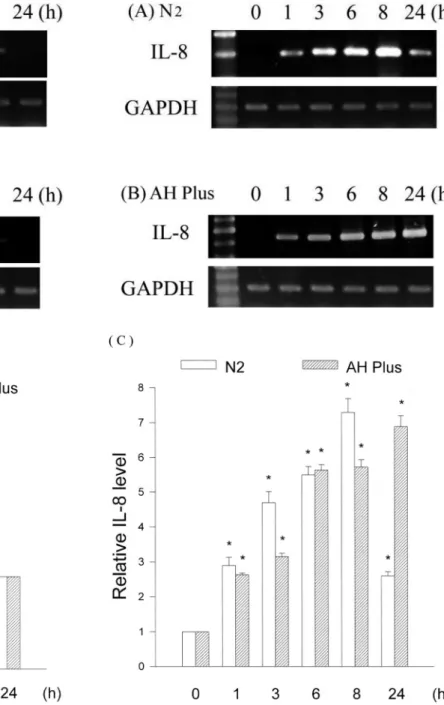
As shown in Fig. 2A, the kinetics of this response showed that IL-8 mRNA gene was detectable as early as 1 h post-N2 challenge and re- mained elevated throughout the 24-h incubation period. The quantita- tive measurement was made by the AlphaImager 2000. The levels of the IL-8 mRNA gene increased about 2.9, 4.7, 5.5, 7.3, and 2.6-fold after exposure to N2 for 1, 3, 6, 8, and 24 h, respectively (Fig. 2C). However, cells resting without FCS did not express detectable levels of IL-8 mRNA
gene. The same induction pattern was found in AH Plus-induced IL-8 mRNA gene expression (Fig. 2B). The quantitative measurement was made by the AlphaImager 2000. The levels of the IL-8 mRNA gene increased about 2.6-, 3.2-, 5.7-, and 6.9-fold after exposure to AH Plus for 1, 3, 6, 8, and 24 h, respectively (Fig. 2C).
Discussion
Osteoblasts are considered as cells primarily concerned with pro- viding physical barriers and structural components in periapical tissues Figure 1. IL-6 expression by (A) N2 or (B) AH Plus-treated human osteoblastic
cells for 0, 1, 3, 6, 8, and 24 h incubation periods by RT-PCR assay. A DNA ladder of known base pairs was used for identification of PCR products. GAPDH gene was performed to monitor equal RNA loading. (C) Levels of IL-6 mRNA gene treated with N2 and AH Plus were measured by AlphaImager 2000. The relative level of IL-6 mRNA gene expression was normalized against GAPDH mRNA signal and the control was set as 1.0. Optical density values represent the mean⫾ SD. The asterisk represents significant differences from control values with p⬍ 0.05.
Figure 2. IL-8 expression by (A) N2 or (B) AH Plus-treated human osteoblastic cells for 0, 1, 3, 6, 8, and 24 h incubation periods by RT-PCR assay. A DNA ladder of known base pairs was used for identification of PCR products. GAPDH gene was performed to monitor equal RNA loading. (C) Levels of IL-8 mRNA gene treated with N2 and AH Plus were measured by AlphaImager 2000. The relative level of IL-8 mRNA gene expression was normalized against GAPDH mRNA signal and the control was set as 1.0. Optical density values represent the mean⫾ SD. The asterisk represents significant differences from control values with p⬍ 0.05.
This is the reason why we chose this type cells in this study.
In vivo acute toxicity is usually not associated with the clinical use of a dental material. In this study, we chose the cytoatatic concentrations of root canal sealers in U2OS cells for evaluating IL-6 and IL-8 mRNA gene expression. Higher concentrations were not studied because they would rapidly cause cell death, making a change in secretion of inflam- matory mediators unlikely. This is the reason why subtoxic concentra- tions were chosen to determine by RT-PCR assay for IL-6 and IL-8 mRNA gene expression according to our previous study (24).
Cytokine research has become one of the most important parts in the clinical research. Measurements of cytokine production capability are expected to become new markers for diagnosis or treatment in clinical practice. RT-PCR assay for analyzing cytokine expression in- volves the detection of cytokine mRNA gene (26, 27). It becomes a routine laboratory examination method for new immunological mark- ers. Quantitative measurement of cytokine mRNA gene expression is now as a useful tool for analyzing cytokine networks.
Dysregulated cytokine productions at local disease sites have been considered to be major contributors to the development of inflamma- tory diseases. Human periapical lesion is an inflammation disease evoked by bacterial infection in root canal system and give rise to bone destruction at the periapical tissue as the result of host-microbial inter- play. Previous studies have been shown IL-6 and IL-8 expression in periapical lesions (20 –23). In this study, we first found that N2 and AH Plus were capable of inducing IL-6 and IL-8 mRNA gene expression.
Thus, IL-6 as well as IL-8 may play a critical role in zinc oxide-eugenol based and epoxy resin based root canal sealers-induced periapical in- flammation.
At the site where inflammation and tissue destruction have oc- curred, cells might communicate with one another through the inter- action of cytokines, Thus, it is important to elucidate completely the complex cytokine cascade flow associated with inflammation-mediated tissue destruction at the molecular level. The present study demon- strated that IL-6 and IL-8 mRNA gene expression by U2OS cells was enhanced by N2 and AH Plus. However, the induction pattern between IL-6 and IL-8 mRNA gene was different. The intensity of IL-8 mRNA gene was found to be significant higher than IL-6 mRNA gene. The difference in the specific activity could be related either to the type of receptor- molecule interactions or to a different intracellular distribution of sec- ond messenger molecules as have been suggested previously (28, 29).
The mechanism responsible for the activation of IL-6 and IL-8 mRNA gene expression by N2 and AH Plus contributes to inflammatory responses is not clear. These may be because of N2 and AH Plus were found to release formaldehyde (30, 31). Formaldehyde has been shown found to induce nonneoplastic responses, such as epithelial degenera- tion and a mixed inflammatory cell infiltration (32). This might be the reason why N2 and AH Plus can induce IL-6 and IL-8 mRNA gene ex- pression. Zinc oxide-eugenol root canal sealers were attributable to free eugenol liberated from the set material (33). Eugenol is a tissue irritant that has been found to induce inflammatory reaction on oral mucosal membrane (34). This may the possible mechanism that Zinc oxide- eugenol root canal sealers can induce inflammatory reaction in vivo.
As for as we known, this is the first attempt to evaluate the role of IL-6 and IL-8 mRNA gene expression in human osteoblastic cells stim- ulated with N2 and AH Plus. Data from our in vitro experiments showed that N2 and AH Plus was capable of stimulating IL-6 and IL-8 mRNA gene expression in human osteoblastic cells. This suggests that one of the pathogenic mechanisms of periapical tissue inflammation induced by
human pulp cell cultures (35). The possibility of using IL-10 to protect cells against the adverse effects of root canal sealers should be considered. In addition, the advantage of RT-PCR assay is simplicity, sensitivity, rapidity, and cheapness. This experimental system may be useful for cytokine expression profile screening of various dental materials in vitro.
Dysregulated cytokine productions at local disease sites have been considered to be major contributors to the development of inflamma- tory diseases. IL-6 and IL-8 released have been reported to play an important role in the pathogenesis of periapical inflammation. The re- sults showed that both IL-6 and IL-8 mRNA gene expression were found to be induced by N2 and AH Plus in human osteoblastic cells. The activation of IL-6 and IL-8 mRNA gene expression may be one of the pathogenesis of zinc oxide-eugenol based and epoxy resin based root canal sealers-induced periapical inflammation. However, care should be taken to reduce the possibility of periapical irritations from inadver- tent extrusion of the root canal sealers in clinical treatment until their side effects are more thoroughly studied.
Acknowledgment
This study was supported by a research grant from the National Science Council, Taiwan (NSC 93-2314-B-040-020).
References
1. Zmener O, Guglielmotli MB, Cabrini RL. Biocompatibility of two calcium hydroxide- based endodontic sealers: a quantitative study in the subcutaneous connective tissue of the rat. J Endod 1988;14:299 –305.
2. Molloy D, Goldman M, White RR, Kabani S. Comparative tissue tolerance of a new endodontic sealer. Oral Surg Oral Med Oral Pathol 1992;73:490 –3.
3. Economides N, Kotsaki-Kovatsi VP, Poulopoulos A, Kolokuris I, Rozos G, Shore R.
Experimental study of the biocompatibility of four root canal sealers and their influ- ence on the zinc and calcium content of several tissues. J Endod 1995;21:122–7.
4. Holland R, de Souza V. Ability of a new calcium hydroxide root canal filling material to induced hard tissue formation. J Endod 1985;11:535– 43.
5. Lambjerg-Hansen H. Vital pulpectomy and root filling with N2 or Endomethasone. Int Endod J 1987;20:194 –204.
6. Tagger M, Tagger E. Periapical reactions to calcium hydroxide-containing sealers and AH26 in monkeys. Endod Dent Traumatol 1989;5:139 – 46.
7. Tepel J, Darwisch M, Hoppe W. Reaction of inflamed periapical tissue to intracanal medicament and root canal sealers. Endod Dent Traumatol 1994;10:233– 8.
8. Huang FM, Chou MY, Chang YC. Induction of cyclooxygenase-2 mRNA and protein expression by epoxy resin and zinc oxide-eugenol based root canal sealers in human osteoblastic cells. Biomaterials 2003;24:1869 –75.
9. Huang FM, Chang. Prevention of the epoxy resin based root canal sealers-induced cyclooxygenase-2 expression and cytotoxicity of human osteoblastic cells by various antioxidants. Biomaterials 2005;26:1847–53.
10. Kishimoto T. The biology of interleukin-6. Blood 1989;74:1–10.
11. Hirano T, Akira S, Taga T, Kishimoto T. Biological and clinical aspects of interleu- kin-6. Immunol Today 1990;11:443–9.
12. Ishimi Y, Miyaura C, Jin CH, et al. IL-6 is produced by osteoblasts and induce bone resorption. J Immuol 1990;145:3897–903.
13. Yang LC, Tsai CH, Huang FM, Liu CM, Lai CC, Chang YC. Induction of interleukin-6 gene expression by pro-inflammatory cytokines and black-pigmented Bacteroides in human pulp cell cultures. Int Endod J 2003;36:352–7.
14. Coil J, Tam E, Waterfield JD. Proinflammatory cytokines profiles in pulp fibroblasts stimulated with lipopolysccharide and methyl mercaptan. J Endod 2004;30:88 –91.
15. Baggiolini M, Dewald B, Moser B. Interleukin-8 and related chemotactic cytokines- CXC and CC chemokines. Adv Immunol 1994;55:97–179.
16. Nagaoka S, Tokuda M, Sakuta T, et al. Interleukin-8 gene expression by human dental pulp fibroblast in cultures stimulated with prevotella intermedia lipopolysacchoride.
J Endod 1996;22:9 –12.
17. Huang GTJ, Potente AP, Kim JW, Chugal N, Zhang X. Increased interleukin-8 expres- sion in inflamed human dental pulps. Oral Surg Oral Med Oral Pathol Oral Radiol Endod 1999;88:214 –20.
18. Isett J, Reader A, Gallatin E, et al. Effect of an intraosseous injection of depo-medrol on pulpal concentrations of PGE2 and IL-8 in untreated irreversible pulpitis. J Endod 2003;29:268 –71.
19. Yang LC, Huang FM, Lin CS, Liu CM, Lai CC, Chang YC. Induction of interleukin-8 gene expression by black-pigmented Bacteroides in human pulp fibroblasts and osteo- blasts. Int Endod J 2003;36:774 –9.
20. Euler GJ, Miller GA, Hutter JW, et al. Interleukin-6 in neutrophils from peripheral blood and inflammatory periradicular tissue. J Endod 1998;24:480 – 4.
21. Shimauchi H, Takayama SI, Narikawa-Kiji M, Shimabukuro Y, Okada H. Production of interleukin-8 and nitric oxide in human periapical lesions. J Endod 2001;27:749 –52.
22. Bando Y, Henderson B, Meghji S, Poole S, Harris M. Immunocytochemical localiza- tion of inflammatory cytokines and vascular adhesion receptors in radicular cysts.
J Oral Pathol Med 1993;22:221–7.
23. Honma M, Hayakawa Y, Kosugi H, Koizumi F. Localization of mRNA for inflammatory cytokines in radicular cyst tissue by in situ hybridization, and induction of inflam- matory cytokines by human gingival fibroblasts in response to radicular cyst contents.
J Oral Pathol Med 1998;27:399 – 404.
24. Huang FM, Hsieh YS, Tai KW, Chou MY, Chang YC. Induction of c-fos and c-jun protooncogenes expression by formaldehyde-releasing and epoxy resin based root canal sealers in human osteoblastic cells. J Biomed Mater Res 2002;59:460 –5.
25. Harrison JW, Jurosky KA. Wound healing in the tissues of the periodontium following periradicular surgery. III. The osseous excisional wound. J Endod 1992;18:76 – 81.
26. Kotake S, Sehumacher HR Jr, Wilder RL. A simple nested RT-PCR method for quan- titation of the relative amounts of multiple cytokine mRNAs in small tissues samples.
J Immunol Methods 1996;199:193–203.
27. Soslau G, Morgan DA, Jaffe JS, Brodsky I, Wang YH. Cytokine mRNA expression in
human platelets and a megakaryocytic cell line and cytokine modulation of platelet function. Cytokine 1997;9:405–11.
28. Bauer J, Ganter U, Geiger T, et al. Regulation of interleukin-6 expression in cultured human blood monocytes and monocyte-derived macrophage. Blood 1988;72:1134 – 40.
29. Katz Y, Strunk RC. Interleukin-1 and tumor necrosis factor: similarities and differ- ences in stimulation of expression of alternative pathway of complement and IFN-B2/
IL-6 genes in human fibroblasts. J Immunol 1989;142:3862–7.
30. Cohen BI, Pagnillo MK, Musikant BL, Dentsch AS. Evaluation of the release of form- aldehyde for three endodontic filling materials. Oral Health 1998;88:37–9.
31. Leonardo MR, de Silva LAB, Filho MT, de Silva RS. Release of formaldehyde by 4 endodontic sealers. Oral Surg Oral Med Oral Pathol Oral Radiol Endod 1999;88:
221–5.
32. Morgan KT, Gross EA, Patterson DL. Distribution, progression, and recovery of acute formaldehyde-induced inhibition of nasal mucociliary function in F-344 rats. Toxicol Appl Pharmacol 1983;86:161–76.
33. Lindqvist L, Otteskog O. Eugenol: liberation from dental materials and effect on human diploid fibroblast cells. Scand J Dent Res 1981;89:552– 6.
34. Kozam G, Mantell GM. The effect of eugenol on oral mucous membranes. J Dent Res 1978;57:954 –7.
35. Tokuda M, Nagaoka S, Torii M. Interleukin-10 inhibits expression of interleukin-6 and -8 mRNA in human dental pulp cell cultures via nuclear factor kappaB deactiva- tion. J Endod 2002;28:177– 80.