For Peer Review
Journal Name: http://mc.manuscriptcentral.com/photomedicine
Study on Autonomic Nervous Activities of the Night Shift Workers Treated by Laser Acupuncture
Journal: Photomedicine and Laser Surgery Manuscript ID: PHO-2007-2235
Manuscript Type: Original Research Date Submitted by the
Author: 29-Dec-2007
Complete List of Authors: Wu, Jih-Huah; Ming Chuan University, Department of Biomedical Engineering
Chen, Hsin-Yang; National Central University, Department of Life Science
Chang, Yu-Ju; China Medical University, Graduate Institute of Acupuncture Science
Wu, Hung-Chien; Chung-Ho Memorial Hospital, The Department of Traditional Chinese Medicine
Chang, Wen-Dien; Da Chien General Hospital, Department of Rehabilitation Medicine; National Taiwan University, Department of Bio-Industrial Mechatronics Engineering
Chu, Yi-Jing; National Taiwan University, Department of Bio- Industrial Mechatronics Engineering
Jiang, Joe-Air; National Taiwan University, Department of Bio- Industrial Mechatronics Engineering
Keyword: Laser and Acupuncture
For Peer Review
Study on Autonomic Nervous Activities of the Night Shift Workers Treated by Laser Acupuncture
Jih-Huah Wu
1, Hsin-Yang Chen
2, Yu-Ju Chang
3, Hung-Chien Wu
4, Wen-Dien Chang
5,6, Yi-Jing Chu
5, and Joe-Air Jiang
5,*
1
Department of Biomedical Engineering, Ming Chuan University
2
Department of Life Science, National Central University
3
Graduate Institute of Acupuncture Science, China Medical University
4
The Department of Traditional Chinese Medicine, Chung-Ho Memorial Hospital, Kaohsiung Medical University
5
Department of Bio-Industrial Mechatronics Engineering, National Taiwan University
6
Department of Rehabilitation Medicine, Da Chien General Hospital
Running title: Laser acupuncture at Neiguan Point (PC6)
Correspondence author:
Joe-Air Jiang, Ph.D.
Associate Professor
1
Department of Bio-Industrial Mechatronics Engineering, National Taiwan University
No. 1, Sec. 4, Roosevelt Road, Taipei 10617, Taiwan TEL: (886)-2-3366-5341
FAX: (886)-2-2362-7620 E-mailዊ[email protected]
3
4
5
6
7
8
9
10
11
12
13
14
15
16
17
18
19
20
21
22
23
24
25
26
27
28
29
30
31
32
33
34
35
36
37
38
39
40
41
42
43
44
45
46
47
48
49
50
51
52
53
54
55
56
57
58
59
60
For Peer Review
ABSTRACT
Objective: The aim of this study was to evaluate the impact of laser acupuncture on the autonomic nervous system (ANS) of night shift workers. Background Data: Many literatures have demonstrated that the affective disorders and stress increase significantly in night shift workers. We placed laser on Neiguan point (PC6) to examine the impact of laser acupuncture on the ANS and evaluated the heart rate variability (HRV) in 45 healthy young males. Methods: The laser group (n = 15) received laser acupuncture (9.7 J/cm
2, 830 nm) for 10 minutes, oppositely the placebo group (n = 15) received sham laser and the control group (n = 15) did not receive any treatment. The effects of before and after intervention on the HRV of tested subjects were assessed, and also for that of after 30-min lying.
Results: After intervention, the ANOVA showed statistically significant difference of three groups (p
< 0.05). The laser group had adjusted to HF (high frequency) more and LF (low frequency) fewer than another two groups. But, there were no significant differences of three groups after re-rest.
Conclusions: Laser acupuncture stimulation applied to the Neiguan point (PC6) increased vagal activity and suppression of the cardiac sympathetic nerve and maintained the condition for 40 min.
This kind of experimental effect was positive and could be used to help the patients who have the autonomic nervous system disorders.
Key word: Autonomic nervous system, Heart rate variability, Laser acupuncture, Night shift workers.
3
4
5
6
7
8
9
10
11
12
13
14
15
16
17
18
19
20
21
22
23
24
25
26
27
28
29
30
31
32
33
34
35
36
37
38
39
40
41
42
43
44
45
46
47
48
49
50
51
52
53
54
55
56
57
58
59
60
For Peer Review
INTRODUCTION
A report by the Swiss International Institute for Management Development in 2004 had revealed that the average working hours per year for a worker in Taiwan was up to 2327 hours and the 3
rdmost in the world
1. Another survey on the social trend in Taiwan showed that 82.18% of population goes to bed during 11 to 12 p.m. and others after midnight
2. Therefore, people have become used to late activity during a day. They may be physically affected because of late working time and its conflict with their body clock. The diseases which are often seen are gastric diseases, cardiac diseases, cancers, diabetes mellitus, low fertility and sleeping disorders, etc.
3Some articles have suggested the causal relation between shift work and cardiovascular disease in male workers
4and female nurses
5.
Heart rhyme is mainly controlled by autonomic nervous system (ANS) derived from the brain.
The terminal of sympathetic nervous system (SNS) releases norepinephrine to activate the activity of sino-atrial (SA) node while the parasympathetic nervous system (PNS) releases the inhibitory acetylcholine
6. In the past, the focus of electrocardiogram (ECG) reading has been only on changes in the wave shape and the wavelength. Not until recently that the interval between heart beats, i.e., heart rate variability (HRV), was studied and considered clinically meaningful
7. HRV was determined by measuring the changes in the distance between two wave peaks in ECG record and could be used as a reflection in the tension of SNS and PNS, and their balance
6. HRV in normal people could be influenced by several factors, such as age
8, 9, gender
9, race
8, body fat
9, and posture
10. The analysis of HRV has been developed for more than 20 years and many different methods have been proposed for data analysis. These methods could be roughly classified as liner time zone analysis and spectral analysis
11. The time zone analysis is obtained by calculating the R-R intervals in a 24-hours dynamic ECG record and should be represented as normal-to-normal (NN) interval in time zone analysis. Then statistics shall be calculated for standard deviation of the NN intervals (SDNN), SDNN index, the root mean squares of successive differences (RMSSD) and the
3
4
5
6
7
8
9
10
11
12
13
14
15
16
17
18
19
20
21
22
23
24
25
26
27
28
29
30
31
32
33
34
35
36
37
38
39
40
41
42
43
44
45
46
47
48
49
50
51
52
53
54
55
56
57
58
59
60
For Peer Review
percentage of NN intervals, which are over 50 ms (pNN50). As for the spectral analysis, especially its short-time recording type, a complex heart beat signal is calculated by Fourier transform. Three values should be obtained that includes high frequency (HF) representing PNS activity, low frequency (LF) representing the co-influence of SNS, and PNS and very low frequency (VLF) that has not been defined
12. On the other hand, in terms of duration of recording, long-time recording type has been seldom used in the spectral analysis as it’s been used in the time zone analysis. This is mainly because short-time recording type is more appropriate for observing immediate changes and, therefore, this study adopted this type.
This study adopted low energy laser acupuncture that is non-invasive and painless. Needle acupuncture usually causes psychological effects and pain on skin and would interfere with the ANS regulation. Although there had been some studies in this area and HRV could be changed during needle acupuncture
13, 14, 15, 16, 17, the influence of laser acupuncture on changes in HRV has been seldom studied. Compared with needle acupuncture, laser acupuncture has strength in painless, sterile, safe without invasion, no broken needles, no needle sickness, and controllable dosage and easy to conduct
18. It is, therefore, provided with relative advantages of safety and measurability. The aim of this study was to apply laser acupuncture to point Neiguan (PC6) of right hands, and to investigate its influences on ANS regulation and changes in long-term night shift workers.
METHOD
This study recruited forty-five healthy young males. Thirty young males worked on the night shift, and they were randomly assigned into laser and placebo groups. Besides, fifteen young men having normal sleeping time were recruited in the control group. All voluntaries were recruited in China Medical University Hospital, and the Institutional Review Board on Human Subjects Research of Chung Shan Medical University Hospital approved this study. Inclusive criteria were young males,
3
4
5
6
7
8
9
10
11
12
13
14
15
16
17
18
19
20
21
22
23
24
25
26
27
28
29
30
31
32
33
34
35
36
37
38
39
40
41
42
43
44
45
46
47
48
49
50
51
52
53
54
55
56
57
58
59
60
For Peer Review
age between 18-30 years old, BMI between 19-25 m/kg
2, and night shift workers. Night shift workers are defined as working until 3 in the morning for more than three times a week, while healthy subjects with normal sleeping hours were defined as going to bed before midnight. Exclusive criteria were having cardiopulmonary diseases, diseases relating to endocrine, having any medicine, having smoking history, and having coffined or alcohol beverages within 24 hours before testing.
Study design
The experiments were conducted in a quiet, closed and air-conditioned (27 degrees Celsius) room between 7 and 10 p.m. Subjects in the laser group (see Fig. 1) lied flat for 8 minutes and were positioned on left wrist above radial pulse by a non-invasive HRV analyzer. The 7 minutes of HRV were recorded just before the acupuncture treatment. Then laser was applied to point Neiguan (PC6) of right hands for 10 minutes continuously. After treatment, HRV was tested immediately for 7 minutes. Then the subjects followed by 30-min lying and relaxed in supine position. Finally, HRV was tested for another 7 minutes. For the placebo group and the control group, subjects were provided with the same procedure as the laser group. The placebo group was performed with 10-min placebo laser irradiation (the power supply being cut off while the indication light still on). On the other hand, subjects in the control group didn’t receive any laser acupuncture. All recordings were saved inside the HRV analyzer and then transformed into data in computer.
Assessment
Heart Rate Variability analyzer
Heart Rate Variability analyzer (ANS WATCH, Taiwan Scientific Corp., Taiwan) was used to measure ANS variability. According to a Task Force of the European Society of Cardiology and the North American Society of Pacing and Electrophysiology in 1996, relevant indices and signals were defined and obtained as follows
8:
3
4
5
6
7
8
9
10
11
12
13
14
15
16
17
18
19
20
21
22
23
24
25
26
27
28
29
30
31
32
33
34
35
36
37
38
39
40
41
42
43
44
45
46
47
48
49
50
51
52
53
54
55
56
57
58
59
60
For Peer Review
(1) HF: the frequency band of 0.15-0.4 Hz, shown as percentage.
HF (%) = HF power/(HF power + LF power)
(2) LF: the frequency band of 0.04-0.15 Hz, shown as percentage.
LF (%) = LF power/(HF power + LF power) (3) LF/HF ratio: the ratio of LF and HF.
(4) SDDN (ms): standard deviation of R-R intervals in ECG recording.
(5) Physiological signals: systolic blood pressure (SBP) (mmHg), Diastolic blood pressure (DBP) (mmHg) and heart rate (HR) (bmp).
Treatment procedure
Low energy laser device (Painless Light PL-830, Advanced Chips & Products Crop., USA) consisting of two infrared diode lasers was used to be fixed on the skin. This device emitted light at a wavelength of 830 nm, output frequency 10 Hz with an output power of 60 mW (2 ዊ 30 mW), and duty cycle of 50% resulting in a treatment dose of 9.7 J/cm
2. The irradiation was emitted in two band-shape laser with a distance of 2.5 cm between them. The stimulations were all given by the same physician who also located Pericardium 6-Neiguan (PC6). Neiguan (PC6) point was located 2 cm proximal to the middle point of the carpal fold between the tendons of flexor carpi radialis muscle and palmaris longus muscle.
Statistical analysis
The SPSS 11 software was used to conduct data analysis. Mann-Whitney U test was used to check for the differences among the three groups in the basic data, such as age, height, weight, and BMI values. Before treatment, after treatment and after 30-min lying, the SBP, DBP, HR, HRV, HF, LF, and LF/HF ratio of three groups were calculated for multiple comparisons by using one-way ANOVA and post hoc. The differences between groups with regard to the changes after treatment
3
4
5
6
7
8
9
10
11
12
13
14
15
16
17
18
19
20
21
22
23
24
25
26
27
28
29
30
31
32
33
34
35
36
37
38
39
40
41
42
43
44
45
46
47
48
49
50
51
52
53
54
55
56
57
58
59
60
For Peer Review
and after 30-min lying rest were tested with one-way ANOVA and post hoc. All the statistical tests were two-tailed with ! = 0.05.
RESULTS
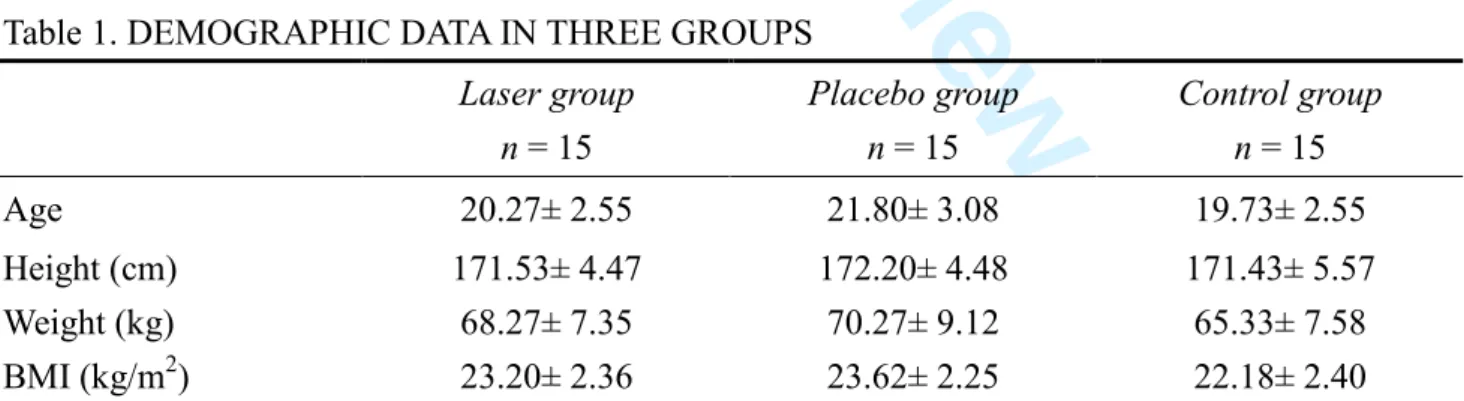
Basic data of 45 subjects were shown in Table1. There were no significant differences between height, weight, BMI index, and age (p > 0.05). Baseline measurements (before treatments) of SBP, DBP, HR, HRV, HF, LF and LF/HF ratio showed that there were no significant differences among three groups (p > 0.05, Table 2). Comparing the placebo treatment group with the control group and the acupuncture group with the control group gives similar results. The values of SBP, HR, and LF in the placebo group and the laser group were all significantly higher than those in the control group (p
< 0.05). Similarly, the values of HF and LF/HF ratio in the placebo group and the laser group were all significantly lower than in the control group (p < 0.05). However, values of HRV were significantly lower in the placebo group than in the control group (p < 0.05) while the laser group showed no differences from the control group.
Table 1. DEMOGRAPHIC DATA IN THREE GROUPS Laser group
n = 15
Placebo group n = 15
Control group n = 15
Age 20.27± 2.55 21.80± 3.08 19.73± 2.55
Height (cm) 171.53± 4.47 172.20± 4.48 171.43± 5.57
Weight (kg) 68.27± 7.35 70.27± 9.12 65.33± 7.58
BMI (kg/m
2) 23.20± 2.36 23.62± 2.25 22.18± 2.40
3
4
5
6
7
8
9
10
11
12
13
14
15
16
17
18
19
20
21
22
23
24
25
26
27
28
29
30
31
32
33
34
35
36
37
38
39
40
41
42
43
44
45
46
47
48
49
50
51
52
53
54
55
56
57
58
59
60
For Peer Review
Table 2. BASELINE RESULT OF HRV AND PHYSICAL EXAMINATION IN ALL GROUPS Laser group
n = 15
Placebo group n = 15
Control group n = 15
SBP (mmHg) 122.07 ± 16.07 121.13 ± 9.43 120.87 ± 9.64
Diastolic pressure (mmHg) 76.66 ± 3.24 75.13 ± 2.62 * 71.67 ± 4.47**
HR (bmp) 71.67 ± 11.91 74.07 ± 9.22 * 60.13 ± 7.16**
SDDN (ms) 56.27 ± 23.65 47.00 ± 19.39 * 72.80 ± 34.99
HF (%) 40.73 ± 15.99 34.47 ± 12.80 * 54.00 ± 16.08**
LF (%) 59.27 ± 15.99 65.53 ± 12.80 * 46.00 ± 16.08**
LF/HF ratio 2.15 ± 2.14 2.28 ± 1.30 * 1.01 ± 0.60**
Data are expressed as mean ± standard deviation.
One-way ANOVA:
* Placebo group vs. Control group, p < 0.05; ** Control group vs. Laser group, p < 0.05.
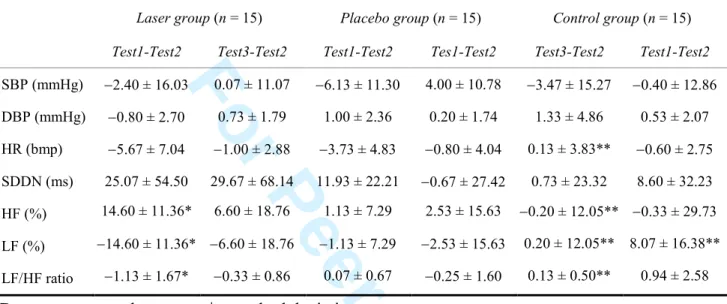
The changes over treatment time and after rest could be reflected by the changes between three time points (before treatments, after treatments and after lying rest). Minus means decreasing while plus means increasing (Table 3). When compare the laser group with the placebo group, the changes over treatment were all significant in terms of HF, LF, and LF/HF ratio (p < 0.05). But all measurements showed no significant differences (p > 0.05) before and after lying rest between these two groups. All the comparisons between the placebo group and the control group of the changes over treatment time and after rest showed no significant differences (p > 0.05). On the other hand, when compare the laser group with the control group, there were significant differences in the changes in HR, HRV, HF, and LF/HF ratio (p < 0.05). Other differences between these two groups were not significant (p > 0.05) in terms of changes over treatment time. Among all the changes after lying rest, these two groups showed significant differences only in the changes of LF (p < 0.05).
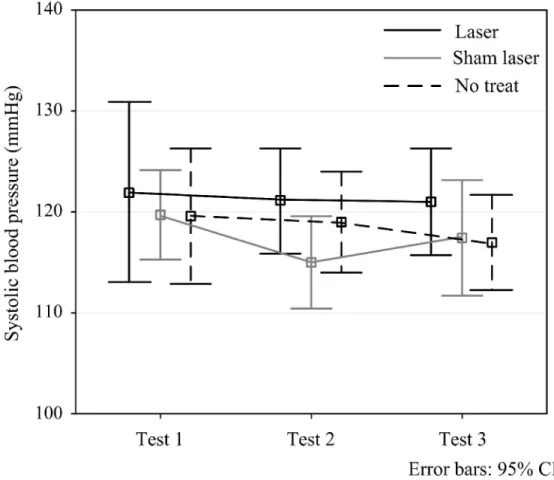
The comparisons of SBP in the three groups were shown in Table 3 and Figure 2. There were no significant findings among these groups in all the values at three time points and in the changes over
3
4
5
6
7
8
9
10
11
12
13
14
15
16
17
18
19
20
21
22
23
24
25
26
27
28
29
30
31
32
33
34
35
36
37
38
39
40
41
42
43
44
45
46
47
48
49
50
51
52
53
54
55
56
57
58
59
60
For Peer Review
treatment or after lying rest (p > 0.05). For the comparisons of DBP shown in Table 3 and Figure 3, there were significant differences between both the laser group and the placebo group and the control group (p < 0.05). However, there were not any significant differences in DBP between the laser group and the placebo group (p > 0.05).
Table 3. THE DIFFERENCES IN BLOOD PRESSURE, HR, AND HRV IN THREE GROUPS.
Laser group (n = 15) Placebo group (n = 15) Control group
(n = 15)
Test1-Test2 Test3-Test2 Test1-Test2 Tes1-Test2 Test3-Test2 Test1-Test2SBP (mmHg) 2.40 ± 16.03 0.07 ± 11.07 6.13 ± 11.30 4.00 ± 10.78 3.47 ± 15.27 0.40 ± 12.86 DBP (mmHg) 0.80 ± 2.70 0.73 ± 1.79 1.00 ± 2.36 0.20 ± 1.74 1.33 ± 4.86 0.53 ± 2.07 HR (bmp) 5.67 ± 7.04 1.00 ± 2.88 3.73 ± 4.83 0.80 ± 4.04 0.13 ± 3.83** 0.60 ± 2.75 SDDN (ms) 25.07 ± 54.50 29.67 ± 68.14 11.93 ± 22.21 0.67 ± 27.42 0.73 ± 23.32 8.60 ± 32.23 HF (%) 14.60 ± 11.36* 6.60 ± 18.76 1.13 ± 7.29 2.53 ± 15.63 0.20 ± 12.05** 0.33 ± 29.73 LF (%) 14.60 ± 11.36* 6.60 ± 18.76 1.13 ± 7.29 2.53 ± 15.63 0.20 ± 12.05** 8.07 ± 16.38**
LF/HF ratio 1.13 ± 1.67* 0.33 ± 0.86 0.07 ± 0.67 0.25 ± 1.60 0.13 ± 0.50** 0.94 ± 2.58
Data are expressed as mean ዊ standard deviation.
Post-hoc analysis:
* Laser group vs. Placebo group, p < 0.05; ** Control group vs. Laser group, p < 0.05.
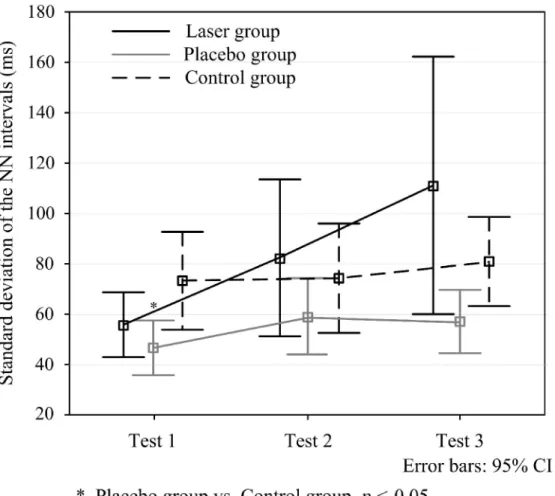
For the HR changes at the three different time points shown in Table 3 and Figure 4, there were no significant differences in the comparisons of the laser group and the placebo group (p > 0.05). In the comparisons between the placebo group and the control group, significant differences were noted at the three time points (p < 0.05). However, the comparisons between the laser group and control group showed significant differences in HR only before treatment (p < 0.05) but not after treatment and after rest (p > 0.05). The comparisons among three groups in HRV were shown in Table 3 and Figure 5. The only significant finding was noted between the placebo group and the control group before treatment (p < 0.05).
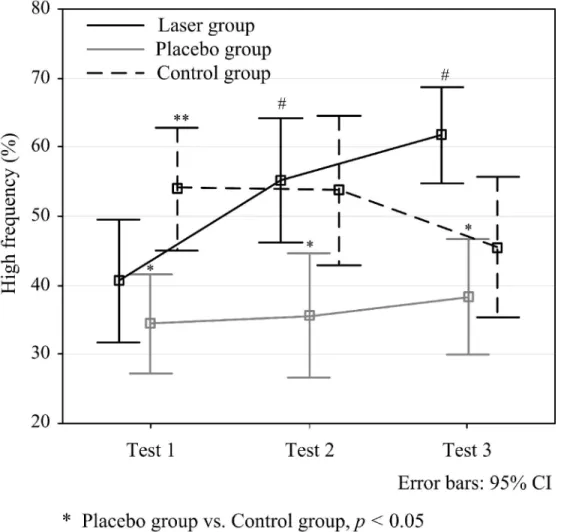
As regard to the HF changes (shown in Table 3 and Figure 6), the comparisons between the laser group and the placebo group showed significant differences after treatment and after lying rest (p <
3
4
5
6
7
8
9
10
11
12
13
14
15
16
17
18
19
20
21
22
23
24
25
26
27
28
29
30
31
32
33
34
35
36
37
38
39
40
41
42
43
44
45
46
47
48
49
50
51
52
53
54
55
56
57
58
59
60
For Peer Review
0.05) but not before treatment (p > 0.05). In the comparisons of HF between the placebo group and the control group, there were significant differences at all the three time points (p < 0.05). The comparisons between the laser group and the control group also showed significant differences before treatment (p < 0.05) but not after treatment and after lying rest (p > 0.05).
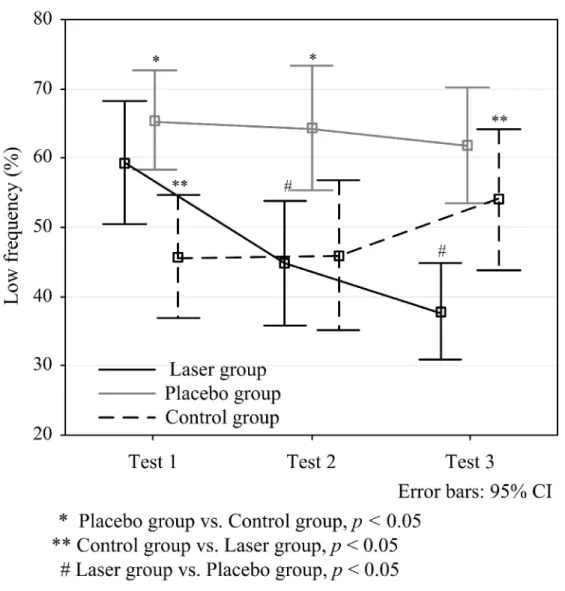
The LF changes were summarized in Table 3 and Figure 7. The comparisons between the laser group and the placebo group showed no significant differences before treatment (p > 0.05). But their differences were significant after treatment and after lying rest (p < 0.05). As for the comparisons between the placebo group and the control group, there were significant differences before and after treatment (p < 0.05) but not after lying rest (p > 0.05). The comparisons between the laser group and the control group showed significant differences before treatment (p < 0.05), but not after treatment (p > 0.05). Another significant difference between them was noted again after lying rest (p < 0.05).
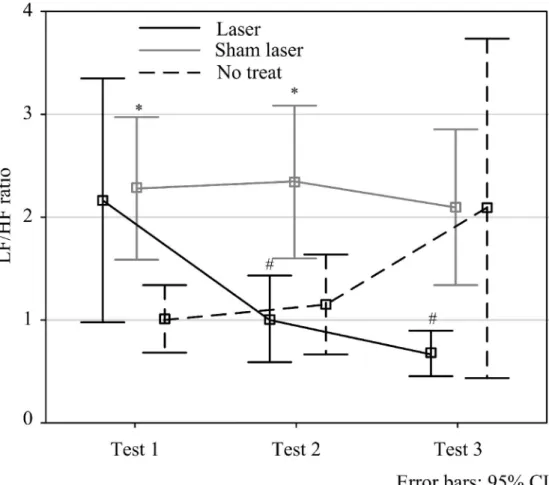
In the changes of LF/HF ratio as shown in Table 3 and Figure 8, the laser group and the placebo group were not significant different before treatment (p > 0.05). But their differences were significant after treatment and after lying rest (p < 0.05). In the comparisons between the placebo group and the control group, there were significant differences before and after treatment (p < 0.05) but not after lying rest (p > 0.05). As for the laser group and the control group, there were no significant differences at all three times (p > 0.05).
DISCUSSION
This study adopted laser acupuncture instead of traditional needle acupuncture to observe its effects on the changes in HRV of long-term night shift workers. The results suggest that night shift workers who work at night time need to regulate biological clock by ANS. Compared with healthy subjects in the control group, subjects in the laser and the placebo groups had obviously higher values of DBP, HR, LF, LF/HF ratio, and lower values of HF before treatments. These findings were
3
4
5
6
7
8
9
10
11
12
13
14
15
16
17
18
19
20
21
22
23
24
25
26
27
28
29
30
31
32
33
34
35
36
37
38
39
40
41
42
43
44
45
46
47
48
49
50
51
52
53
54
55
56
57
58
59
60
For Peer Review
consistent with the research of Schlager et al.
19and indicate that night shift workers have more activated SNS and PNS and higher HR. Night shift workers need more control and alternative regulation with excited ANS to accommodate different environments during day and night. However, the excited ANS could be a risk factor for cardiovascular diseases.
Acupuncture is a physical stimulation for distal nerve in the skin and muscles to excite AP and AQ nerve fibers
14. Plog et al. (1973) had used laser beams to stimulate acupuncture points to treat hypertension and asthma, etc.
20. Afterwards low energy laser without feeling heat was invented to apply in the acupuncture treatment, which is called laser acupuncture
18. Later studies revealed that the laser spectrum from violet to orange, i.e., from 400 to 600 nm is more easily absorbed by the hemoglobin and melanin underneath the skin, while wavelength over 1400 nm is more easily absorbed by water molecules in the skin. As a result, red to infrared light (about 600-1400 nm) is most adopted for laser acupuncture in order to penetrate 2-5 mm through the skin. What’s more, the penetrating ability of radiation in muscles is 4 times as it in the skin and, therefore, laser could reach almost 1 cm underneath the skin to stimulate the acupuncture points
18. So far, the neural pathway for laser acupuncture is still unknown, but the neural regulation of blood flow in the brain by laser acupuncture has been proved
21. HRV is a handy tool for clinical evaluation that includes HF as an indicator for PNS activity, LF for the combination of SNS and PNS activity and LF/HF ratio for SNS activity. Nishijo et al. (1991) had investigated the relationship of needle acupuncture with the changes in HR and found that acupuncture could decrease HR, increase vagal nerve activity, and decrease SNS activity, which means increased HF, decreased LF and LF/HF ratio
22. Subjects in this study also had higher HF, lower LF and LF/HF ratio after laser acupuncture, which suggests that laser acupuncture may have the same effect as needle acupuncture.
Nishijo et al. (1997) found that healthy volunteers receiving acupuncture needle at the Sen-Men point (HT7) had decreased HR
23. This again indicated that needle acupuncture could regulate ANS by activating PNS and inhibiting SNS. A study by Haker et al. (2000) using needle acupuncture at
3
4
5
6
7
8
9
10
11
12
13
14
15
16
17
18
19
20
21
22
23
24
25
26
27
28
29
30
31
32
33
34
35
36
37
38
39
40
41
42
43
44
45
46
47
48
49
50
51
52
53
54
55
56
57
58
59
60
For Peer Review
Hegu point (LI4) on healthy volunteers found activated PNS and SNS. But they found that only PNS was activated on acupuncture at lung point of ear
13. Liou et al. (2002) found that HRV was not obviously different on placebo needling at Neiguan point (PC6)
24. Huang et al. (2005) observed that PNS was obviously excited when twirling of the needle during acupuncture at Neiguan point (PC6), while SNS not. Chang et al. (2005) found that electrical needling Zusanli point (ST36) could activate SNS
15. Li et al. (2005) found that both PNS and SNS were activated when acupuncture needling at Hegu and Neiguan points (PC6), no matter the subjects were tired or not
16. Hsu et al. (2006) observed that PNS was excited but SNS was inhibited when subjects receiving acupuncture needling at Xinshu point (BL15) and, therefore, suggested the possible relaxing effect of stimulating Xinshu point (BL15)
17. In this study, we found that, after laser acupuncture at Neiguan point (PC6) of night shift worker’ right hand, PNS was excited and SNS inhibited; after lying rest, the excitation of PNS and inhibition of SNS were still maintained. Besides, the HRV was activated; these results indicated that laser acupuncture at Neiguan point (PC6) of night shift worker’s right hand could induce a new balance of the ANS which could maintain for at least 40 minutes. On the other hand, all the subjects had obvious decreased HR and increased values of HRV activity after lying rest for nearly 1 hour, no matter receiving laser acupuncture or not. This suggested that lying rest for 1 hour might be the reason for slower HR and activated HRV, which was also observed in the control group.
CONCLUSION
Working at night would cause autonomic dysfunction, such as excitation of SNS, inhibition of PNS, and rapid of HR. Long-term imbalanced ANS might lead to various cardiovascular and other chronic diseases. This study found that using laser acupuncture at Neiguan point (PC6) could excite PNS and inhibit SNS of night shift workers to reach a new balance, which could be maintained for at least 40 minutes. Therefore, laser stimulation at Neiguan point (PC6) seems to have some effect on
3
4
5
6
7
8
9
10
11
12
13
14
15
16
17
18
19
20
21
22
23
24
25
26
27
28
29
30
31
32
33
34
35
36
37
38
39
40
41
42
43
44
45
46
47
48
49
50
51
52
53
54
55
56
57
58
59
60
For Peer Review
the imbalanced ANS. However, certain answer needs to be further investigated.
ACKNOWLEDGEMENTS
The authors greatly appreciate Delta Electronics, Inc. for sponsoring this work. The authors are also grateful to the National Science Council of the Republic of China for financially supporting this research under contract no.: NSC 95-2218-E-002-073, NSC 96-2218-E-002-015, and NSC 96-2628- E-002-252-MY3.
3
4
5
6
7
8
9
10
11
12
13
14
15
16
17
18
19
20
21
22
23
24
25
26
27
28
29
30
31
32
33
34
35
36
37
38
39
40
41
42
43
44
45
46
47
48
49
50
51
52
53
54
55
56
57
58
59
60
For Peer Review
REFERENCES
1. IMD world competitiveness yearbook. (2004). International Institute for management and development. Lausanne: Author.
2. Institute of Occupational Safety and Health. (2007). Shift workers in Taiwan. Retrieved December 12, 1995, from http://www.ninds.nih.gov.
3. Moreno, C.R.C., Louzada, F.M. (2004). What happens to the body when one works at night?
Cadernos de Saude Publica, 20, 1739-1745.
4. Harrington, J.M., (1994). Shift work and health: a critical review of the literature on working hours. Ann. Acad. Med. Singap. 23, 699 – 705.
5. Kawachi, I., Colditz, G.A., Stampfer, M.J.,et al. (1995). Prospective study of shift work and risk of coronary heart disease in women. Circulation. 92, 3178 – 3182.
6. Task Force of the European Society of Cardiology and the North American Society of Pacing and Electrophysiology. (1996). Heart rate variability: Standards of measurement, physiological interpretation, and clinical use. Eur Heart J, 17: 354-381.
7. Wolf, M.M., Varigos, G.A., Hunt, D.,et al. (1978). Sinus arrhythmia in acute myocardial infarction. Med J Australia, 2: 52–53.
8. Choi, J.B., Hong, S., Nelesen, R.,et al. (2006). Age and Ethnicity Differences in Short-Term Heart-Rate Variability. Psychosom Med, 68: 421-426.
9. Antelmi, I., de Paula, R.S., Shinzato, A.R.,et al. (2004). Influence of age, gender, body mass index, and functional capacity on heart rate variability in a cohort of subjects without heart disease. Am J Cardiol, 93: 381-385.
10. Vuksanovic, V., Gal, V. (2005). Nonlinear and chaos characteristics of heart period time series:
healthy aging and postural change. Auton Neurosci, 121: 94-100.
3
4
5
6
7
8
9
10
11
12
13
14
15
16
17
18
19
20
21
22
23
24
25
26
27
28
29
30
31
32
33
34
35
36
37
38
39
40
41
42
43
44
45
46
47
48
49
50
51
52
53
54
55
56
57
58
59
60
For Peer Review
11. Sayers, B.M. (1973). Analysis of heart rate variability. Ergonomics, 16: 17–32.
12. Akselrod, S., Gordon, D., Ubel, F.A.,et al. (1981) Power spectrum analysis of heart rate fluctuation: a quantitative probe of beat to beat cardiovascular control. Science, 213: 220–222.
13. Haker, E., Egekvist, H., and Bjerring, P. (2000). Effect of sensory stimulation (acupuncture) on sympathetic and parasympathetic activities in healthy subjects. J Auton Nerv Syst, 79: 52–59.
14. Huang, S.T., Chen, G.Y., Lo, H.M.,et al. (2005). Increase in the Vagal Modulation by Acupuncture at Neiguan Point in the Healthy Subjects. Am J Chin Med, 33: 157–164.
15. Chang, C.H., Huang, J.L., Ting, C.T.,et al. (2005). Atropine-Induced HRV Alteration is Not Amended by Electroacupuncture on Zusanli. Am J Chin Med, 33: 307–314.
16. Li, Z., Wang, C., Mak, A.F.,et al. (2005). Effects of acupuncture on heart rate variability in normal subjects under fatigue and non-fatigue state. Eur J Appl Physiol, 94: 633–640.
17. Hsu, C.C., Weng, C.S., Liu, T.S.,et al. (2006). Effects of electrical acupuncture on acupoint BL15 evaluated in terms of heart rate variability, pulse rate variability and skin conductance response.
Am J Chin Med, 34: 23-36.
18. Schjelderup, V. (1984). The use of laser therapy in acupuncture. Acupuncture in med, 2: 22-27.
19. Schlager, A., Ishii, N., Dakeishi, M., et al. (2005). Cardiac autonomic imbalance in female nurses with shift work. Auton Neurosci, 122: 94-99.
20. Plog, F.M.W. (1980). In: Laser in medicine, Koebner HK(ed), Biophysical application of the laser beam (pp21-37). Wiley Chichester.
21. Siedentopf, C.M., Golaszewski, S.M., Mottaghy, F.M.,et al. (2002). Functional magnetic resonance imaging detects activation of the visual association cortex during laser acupuncture of the foot in humans. Neurosci Lett, 327: 53-56.
22. Nishijo, K., Mori, H., Yosikawa, K., et al. (1997). Decreased heart rate by acupuncture stimulation in humans via facilitation of cardiac vagal activity and suppression of cardiac sympathetic nerve. Neurosci Lett, 227: 165-168.
3
4
5
6
7
8
9
10
11
12
13
14
15
16
17
18
19
20
21
22
23
24
25
26
27
28
29
30
31
32
33
34
35
36
37
38
39
40
41
42
43
44
45
46
47
48
49
50
51
52
53
54
55
56
57
58
59
60
For Peer Review
23. Nishijo, K., Mori, H., Yosikawa, K.,et al. (1997). Decreased heart rate by acupuncture stimulation in human via facilitation of cardiac vagal activity and suppression of cardiac sympathetic nerve. Neurosci Lett, 227: 165-168.
24. Liou, D.M., Chang, Y.H., Lin, J.G., et al. (2002). The relationship between non-acupoint acupuncture and autonomic activity by using heart rate variability analysis. J Chin Med, 13: 1-9.
3
4
5
6
7
8
9
10
11
12
13
14
15
16
17
18
19
20
21
22
23
24
25
26
27
28
29
30
31
32
33
34
35
36
37
38
39
40
41
42
43
44
45
46
47
48
49
50
51
52
53
54
55
56
57
58
59
60
For Peer Review
Fig 1. Measuring process and HRV, SBP, DBP and HR analysis segments during three tests.
150x21mm (600 x 600 DPI)
3
4
5
6
7
8
9
10
11
12
13
14
15
16
17
18
19
20
21
22
23
24
25
26
27
28
29
30
31
32
33
34
35
36
37
38
39
40
41
42
43
44
45
46
47
48
49
50
51
52
53
54
55
56
57
58
For Peer Review
Fig. 2. SBP (mmHg) before and after intervention, and after 30-min lying for three test sessions.
121x104mm (600 x 600 DPI)
3
4
5
6
7
8
9
10
11
12
13
14
15
16
17
18
19
20
21
22
23
24
25
26
27
28
29
30
31
32
33
34
35
36
37
38
39
40
41
42
43
44
45
46
47
48
49
50
51
52
53
54
55
56
57
58
For Peer Review
Fig. 3. DBP (mmHg) before and after intervention, and after 30-min lying for three test sessions.
117x116mm (600 x 600 DPI)
3
4
5
6
7
8
9
10
11
12
13
14
15
16
17
18
19
20
21
22
23
24
25
26
27
28
29
30
31
32
33
34
35
36
37
38
39
40
41
42
43
44
45
46
47
48
49
50
51
52
53
54
55
56
57
58
For Peer Review
117x117mm (600 x 600 DPI)
3
4
5
6
7
8
9
10
11
12
13
14
15
16
17
18
19
20
21
22
23
24
25
26
27
28
29
30
31
32
33
34
35
36
37
38
39
40
41
42
43
44
45
46
47
48
49
50
51
52
53
54
55
56
57
58
For Peer Review
Fig. 5. SDNN (ms) before and after intervention, and after 30-min lying for three test sessions.
120x109mm (600 x 600 DPI)
3
4
5
6
7
8
9
10
11
12
13
14
15
16
17
18
19
20
21
22
23
24
25
26
27
28
29
30
31
32
33
34
35
36
37
38
39
40
41
42
43
44
45
46
47
48
49
50
51
52
53
54
55
56
57
58
For Peer Review
Fig. 6. HF (%) before and after intervention, and after 30-min lying for three test sessions.
117x123mm (600 x 600 DPI)
3
4
5
6
7
8
9
10
11
12
13
14
15
16
17
18
19
20
21
22
23
24
25
26
27
28
29
30
31
32
33
34
35
36
37
38
39
40
41
42
43
44
45
46
47
48
49
50
51
52
53
54
55
56
57
58
For Peer Review
Fig. 7. LF (%) before and after intervention, and after 30-min lying for three test sessions.
117x120mm (600 x 600 DPI)
3
4
5
6
7
8
9
10
11
12
13
14
15
16
17
18
19
20
21
22
23
24
25
26
27
28
29
30
31
32
33
34
35
36
37
38
39
40
41
42
43
44
45
46
47
48
49
50
51
52
53
54
55
56
57
58
For Peer Review
Fig. 8. LF/HF ratio before and after intervention, and after 30-min lying for three test sessions.
118x105mm (600 x 600 DPI)