國立交通大學
電子工程學系 電子研究所碩士班
碩 士 論 文
對於合作式網路通訊的最大概度序列估測等化器
與多個同步錯誤
An MLSE Equalizer for Cooperative
Communication with Multiple Synchronous Errors
研 究 生 : 連 哲 聖
指導老師 : 桑 梓 賢 教授
對於合作式網路通訊的最大概度序列估測等化器與
多個同步錯誤
An MLSE Equalizer for Cooperative Communication with
Multiple Synchronous Errors
研 究 生 : 連哲聖 Student : Che-Sheng Lian
指導教授 : 桑梓賢 教授 Advisor : Tzu-Hsien Sang
國 立 交 通 大 學
電子工程學系 電子研究所碩士班
碩 士 論 文
A Thesis
Submitted to Department of Electronics Engineering & Institute of Electronics College of Electrical and Computer Engineering
National Chiao Tung University in Partial Fulfillment of the Requirements
for the Degree of Master
in
Electronics Engineering March 2010
Hsinchu, Taiwan, Republic of China
對於合作式網路通訊的最大概度序列估測等化器與
多個同步錯誤
研究生:連哲聖 指導教授:桑梓賢 教授
國立交通大學
電子工程研究所碩士班
摘要
在位元交錯調變碼正交分頻多工-合作式網路系統下,由於每個中繼站的本地 震盪器精準度不同以及在無線的環境中受到都普勒效應的影響,使得多個載波頻 率受到位移,因此造成彼此間載波互相影響干擾導致每個載波並未正交,而然效 能大大的降低。在此因為系統為線性關係,所以我們可以推導出等效的通道環境, 以格子碼的架構為基礎以及考慮附近影響載波能量較大的載波,我們利用且結合 MLSE等效器及turbo等效器對此做載波干擾補償,經由模擬後我們得到全部的多 樣性,並且消除載波及都普勒效應的干擾。 關鍵字: 多載波頻率位移、都普勒效應、正交分頻多工、多樣性、位元交錯調變 碼An MLSE Equalizer for Cooperative Communication with
Multiple Synchronous Errors
Student:Che-Sheng Lian Advisor:Tzu-Hsien Sang
Department of Electronics Engineering & Institute of
Electronics National Chiao Tung University
ABSTRACT
In cooperative communication systems, multiple carrier frequency offsets (MCFOs) due to the varying accuracies of each node’s oscillators and different Doppler spreads may result in severe Inter-Carrier Interference (ICI), which drastically degrades the performance of BICM-OFDM systems. With proper approximation of the transmission environment, it is straightforward to obtain an equivalent channel matrix taking ICI into account. Based on the trellis structure and the fact that ICI energy is concentrated in adjacent subcarriers, we incorporate an MLSE equalizer into a turbo decoder to eliminate ICI caused by MCFOs and the Doppler effect; henceforth the full diversity is achieved, as shown in computer simulations.
誌 謝
首先感謝恩師 桑梓賢教授在交通大學研究所求學兩年半的細心指導,對於我的研 究方向給予很多的建議讓我可以順利完成這篇論文。同時也很感謝欣德、正煌博 班學長在這段時間,非常有耐心的教導我們有關專業領域,也分享很多他在研究 上的經驗,使得在這兩年半中學會許多。當然也要感謝同學忠達、譯賢,以及學 弟旭謙、俊育、耀賢,有問題可以與你們討論找出自己的盲點,互相砥礪。Contents
Chapter 1 Introduction ... 1
Chapter 2 System Model ... 5
2.1 Cooperative communication system protocol ... 5
2.2 Transmission model ... 6
2.3 Receiver Model ... 7
Chapter 3 The Property of ICI Due To CFO and Doppler Effect ... 10
Chapter 4 MLSE Based Equalizers ... 13
Chapter 5 Simulation Results ... 17
Chapter 6 Conclusions ... 21
Appendix ... 22
List of Figures
Fig. 1. The two phases in cooperative communication systems with three nodes. .... 6 Fig. 2. The block diagram of the proposed scheme for asynchronous cooperative communications. ... 9 Fig. 3. Structure of approximated ICI matrix. The Blank parts are zeros. ... 11 Fig. 4. (a) Show the trellis diagram for 2γ allowable transitions from a state sk and terminate at 2γ different states sk+1. (b) The cost of the i-th transition between sk and
sk+1 exists transition probabilities is called a branch metric only the one connected.15 Fig. 5. BER comparison between MMSE equalizer, 1-tap equalizer and MLSE equalizer in the cooperative communication. ... 19 Fig. 6. The BER curves compared with difference number of relay nodes ... 20 Fig. 7. The BER for cooperative communication under time error = [0 3],
Chapter 1
Introduction
Diversity is an attractive way to combat fading in wireless communications because it consumes neither time nor frequency resources. However, to implement diversity schemes, in single-user point-to-point communication systems, multiple antennas should be equipped in the transmitter and/or receiver, which increase the cost as well as the size of the equipment. This is extremely difficult for a mobile station or a sensor terminal because of their limited size and low-cost requirement; therefore, cooperative communication has attracted much attention in the wireless communication filed in recent years due to its potentials in the enhancement of diversity, achievable rates and coverage range. The advantages of cooperative communication have been proved by Sendonaris who has employed it as a diversity theory in uplink communication channels [1], [2]. Although both multiple antenna systems and user cooperative communications can achieve spatial diversity, there is a major difference between these two, which is the issue of synchronization. For conventional multiple antenna systems, synchronization is not a problem since all the antennas in the transmitter or receiver are controlled by on oscillator. However, in cooperative communications, each relay has its own oscillator. Thus, synchronization parameters may be different for each relay node and difficult to synchronize or compensate simultaneously at the destination node.
Several methods of achieving cooperative diversity in asynchronous communication systems have been considered. For timing errors, distributed space-time code (STCs) to achieve full cooperative diversity without the requirement of time synchronization have been studied in [3]-[6]. Frequency synchronization is another important issue to be addressed. The compensation of multiple carrier frequency offsets (MCFOs) in cooperative systems appears to be a challenging problem. Conventional equalization techniques are proposed to combat the MCFOs [7]-[10]. However, the time-varying channels make the direct equalization computationally complex [8], [10]. Based on [6], low complexity recursive MMSE and MMSE-DFE equalizers are designed in [9] to achieve the cooperative diversity for flat fading channels with both timing errors and MCFOs. However the full diversity may not be maintained after the equalizations. For orthogonal frequency-division multiplexing (OFDM) systems, another approach to deal with the MCFOs is combining space-frequency code (SFCs) with subcarrier precoding. In [11], a cooperative transmission scheme combining intercarrier-interference (ICI) self-cancellation precoding, which is first proposed in [12] for the conventional OFDM systems, with Alamouti STC for two relay nodes was proposed, where only half of the subcarriers can be used for data. In [13], another OFDM technique is proposed for overcoming both time and frequency offsets, where longer than OFDM FFT size cyclic prefix (CP) is exploited to mitigate the CFO. Apparently, both methods are not bandwidth efficient. In [14], a frequency shift SFC is shown to be effective for large MCFOs, but is only applicable to frequency nonselective fading channels. Aside from the afore-mentioned asynchronicity, to the authors’ knowledge, multiple Doppler effects have not been considered in literature for OFDM systems which are very sensitive to synchronous errors. It is clear that residual MCFOs and mixed types of
Doppler spreads will induce severe ICI and irreducible error floors in bit error rate (BER) performance.
In this Thesis, we study cooperative (virtual) MIMO OFDM systems with extensive synchronous errors including multiple timing errors, MCFOs, and Doppler effects. The synchronous errors, with careful receiver design, can actually improve diversity gain. MCFOs, in a way similar to the phase roll scheme [15] but without the requirements of meticulous phase offset design, helps converting space diversity to time diversity. Similarly the timing error converts space diversity to frequency diversity, and deep Doppler effects may provide extra time diversity when the channel undergoes rapid changes. Bit-interleaved coded modulation (BICM) [16] is chosen as the baseline system due to its excellent capability of exploiting the diversity gain in fast fading channels.
Our transmitting scheme is adopted from [17], while the receiver is further modified. An MLSE equalizer is incorporated into the turbo receiver to compensate the asynchronous effects in cooperative scenarios. Comparison is made to show improved performance of the modified system over the original one in [17] equipped with an MMSE equalizer.
The rest of the Thesis is organized as follows: In chapter 2, we first give the system model of decode and forward (DF) protocol based cooperative communication systems, we then describe that transmission and receiver model in time/frequency domain. In chapter 3 the properties of ICI channel due to MCFOs and Doppler effects are described. The modified turbo receiver with MLSE equalization is proposed in
chapter 4. Simulation results are presented in chapter 5. Finally, conclusions are drawn in chapter 6.
Notations: superscripts (·)T, (·)H, represent transpose and Hermitian, respectively. |(·)|, E[(·)] denote the norm and the expectation of (·), respectively. diag(·) is diagonal matrix with main diagonal (·), the denote [(·)]r,s is the element in r-th row and s-th
Chapter 2
System Model
In this section, we will give the system model considered in this Thesis. The cooperative communication model is adopted from [17]. Then the transmission model in frequency domain with MCFOs and Doppler effects is given. Note that BICM-OFDM is considered throughout the Thesis and perfect channel estimation is assumed..
2.1 Cooperative communication system protocol
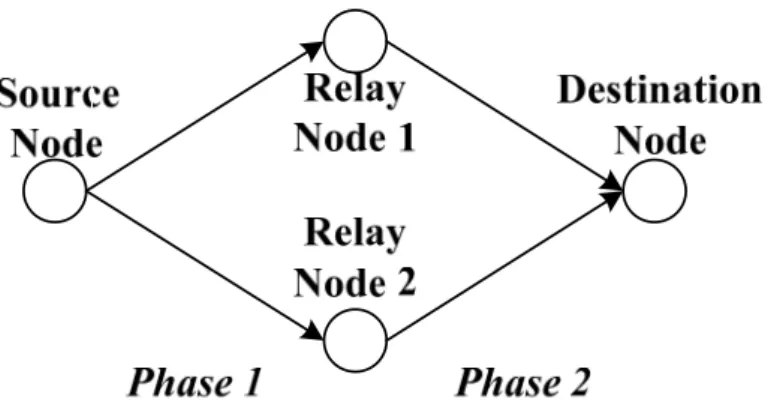
In [18], various cooperative diversity schemes are developed for a pair of terminals with relays amplifying the received signals or decoding and repeating information. They are referred to these as amplify-and forward (AF) and decode-and-forward (DF) scheme respectively. Both classes of algorithms consist of two transmission phases. Fig. 1 illustrates these two phases. In the first phase, the source node broadcasts to the potential relays. The relays either decode and forward the received data or simply amplify the received signal to the destination. With the simplified model commonly used in asynchronous cooperative communications, we focus on the second phase in this Thesis. Consider an asynchronous cooperative communication system formed with M relays transmitting the same data stream to the destination. It is further assumed that each node has only one transmit/receive antenna.
Fig. 1. The two phases in cooperative communication systems with three nodes.
2.2
Transmission model
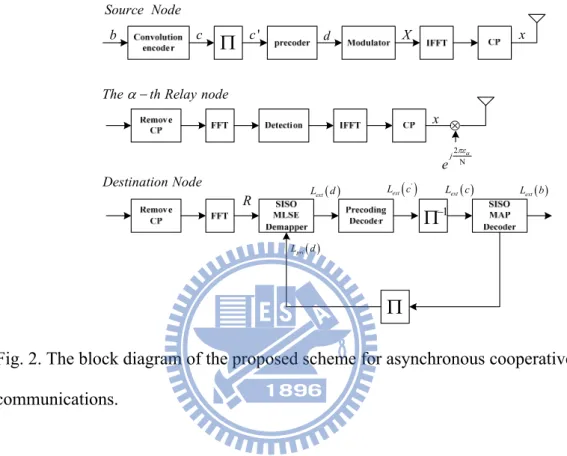
In this Thesis, decode-and-forward protocol and BICM-OFDM system model are adopted. Fig. 2, show a generic block diagram of a system employing BICM-OFDM, at the source side the information bits denoted b are first encoded by the outer convolutional encoder and the encoded bits are denoted by c C, C being the codeword set. The interleaver ∏ operates on K OFDM symbols of encoded bits with the output denoted by c’, then the inner differential precoder with recursive structure [19] is deployed to enhance overall performance and its output is denoted by d. The resulting bits are mapped into QAM or PSK symbols. The set of constellation points is denoted by χ, as γ bits are mapped into one of 2γ constellation points according to the mapping rule. After loading the modulated symbols onto active subcarriers, OFDM signal x is generated via N-point IFFT and CP is inserted. The performance depends on the size of interleaver that is γKN bits. Note that the encoded bits are interleaved across several OFDM systems and it is called time-frequency interleaving. The time-domain transmitted signal at Relay Node α can be written as
2 1 0 1 , - -1 nk N j N g n x k n e N k N N
X (1)where Xα(n) is the modulated symbol at the n-th subcarrier, N is the OFDM
symbol length, Ng is the length of CP, k is the sampling index, α {1,2,..,M} is the
relay node index, and M is the number of relays. Assume the CP is longer than the largest channel delay spread plus timing error so that ISI can be ignored.
2.3
Receiver Model
In this subsection, time varying multipath Rayleigh fading channels are considered, and the discrete time baseband equivalent received signal at the k-th sampling time can be expressed as
2 1
1 0 , k M j L N l y k e h k l x k l Z k
(2) where εα and τα represents the normalize CFO and the timing error betweendestination node and the α-th relay node. Let hα(k,l) represents the l-th path gain of the
multipath Raleigh fading channel from the α-th relay to the destination. The wide-sense stationary uncorrelated scattering (WSSUS) channel[20] is assumedwith
2 [ H , , ' ] ( ) ( ') h E h k l h m l r q l l (3) where 2 h denotes the variance of the l-th tap gain with normalized average power
21 2
1 1 1
[ M lL h h l , ] Mh 1
normalized tap autocorrelation ( r(0)=1 ), and δ(l-l’) is the Kronecker delta function. Moreover, assume the paths are subject to Rayleigh fading, so that [7]
0
( ) (2 ( ) )
r q J f k m T (4)
where J0(.) denotes the zero-order Bessel function of the first kind and f is the
Doppler frequency of the α-th relay node, T represents one OFDM symbol time, xα(k)
is the transmitted signal of the α-th relay node, and z(k) is additive noise, which is independently and identically distributed (i.i.d.) complex Gaussian random variable with zero mean and variance 2
Z
. Consider the model in frequency domain by taking
the N-point DFT to y(k) in (2). The p-th OFDM symbol in the frequency received signal can be written be
, , 1 , , 1 , 1 ( ) , 1, 2..., H p M H p p p p M p p p p M p p p y k p K
R F F E H FX Z T G X Z G X Z (5) where [ , 1,..., 1] p p p T p N N N NR R R R is an N×1 frequency domain receiver vector,
Np=(p-1)N denotes the starting index of each OFDM symbol, F1 / Nexp{ 2j nk N/ }
is N×N the IDFT matrix with (n,k), the entry [ ]F n k, 1/ Nexp{ 2 (j k1)(n1) / }N ,
n = 1, 2, …, N, Xp = FHx(k) and Zp = FHz(k) are the frequency domain transmitted data
unitary, the entries of Zp are still white complex Gaussian variables with mean zero and variance 2 z .
b c c' d X x Source NodeTheth Relay node
x Destination Node 1
pri L d ext L d ' ext L c Lext c Lext b R 2 N j e Fig. 2. The block diagram of the proposed scheme for asynchronous cooperative communications.
Chapter 3
The Property of ICI Due To CFO
and Doppler Effect
With static channels, H is circulant. Hence Gα,p=FHHα,pF, where Gα,p is diagonal.
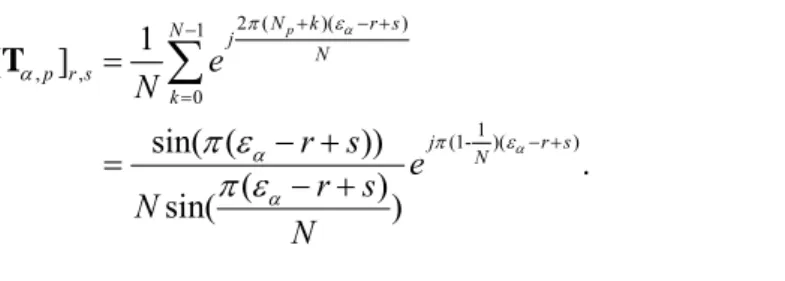
For typical OFDM systems, the received signals are equalized by the one-tap equalizer per subcarrier. However, for time-varying channels, H shown in (7) is no longer a circulant matrix, thus G is no longer diagonal. The off-diagonal entries of G can be written as [17] 2 ( ) 2 1 1 , , 0 0 1 [ ] ( , ) k s r sl N L j j N N p r s p k l h N k l e e N
G (8)The off-diagonal elements of G represent the ICI coefficients caused by Doppler effect.
Next we consider MCFOs. Tα,p is defined as FHEα,pF, where
2 2 ( 1) 2 ( N-1) , ( , ,..., ) p p p N N N j j j N N N p diag e e e E is an N×N diagonal matrix
representing MCFOs. Tα,p can be called as an ICI matrix due to MCFOs since when
εα≠0, the off-diagonal elements of Tα,p represent ICI coefficients and can be expressed
2 ( )( ) 1 , , 0 1 (1- )( ) 1 [ ] sin( ( )) . ( ) sin( ) p N k r s N j N p r s k j r s N e N r s e r s N N
T (9)The overall ICI matrix as G,p T G,p ,p. ICI can destroy orthogonality between
subcarriers and OFDM systems in time-varying channels tend to suffer from severe performance degradation. This problem ranks as our top priority to be solved.
It is common to approximate G as a banded matrix with the most significant
elements around the main diagonal, and all elements elsewhere are close to zero. In other words, choose D as the bandwidth and ignore the entries outside the band, the approximate matrix G is then (see Fig. 3):
, , 0, D<|r-s|<(N-D), [ ] [ ] , elsewhere. r s r s G G (10)
, ,0 0 , 2 ,1 1,1 1,0 1,3 1, 2 2,1 1, 1 0 , 1 0 0 0 0 0 1,1 1,0 p p p p p p p p p p p p p h N h N h N h N h N h N h N h N h N L L H h N L L h N N h N N (7)Intuitively, ICI terms due to MCFOs and Doppler effects are mainly caused by adjacent several subcarriers. For a given N, the approximation error depends on the value of normalized CFO εα and D. The smaller the εα is, and the larger the D is, the
smaller the approximation error is. Besides the banded structure of ICI matrix, we will also take advantage of the fact that G is a Toeplitz matrix, and the residual ICI is
modeled as equivalent Gaussian noise.
From the perspective of frequency-domain, the received data vector in the absence of noise comes from the circular convolution of the transmitted data vector with the ICI channel caused by the MCFOs and Doppler effects, and the channel length is Q=2D+1. This observation implies that an MLSE equalizer in the frequency domain may be able to compensate for the performance loss caused by ICI. As a result, a turbo decoder incorporated with such equalizer shown in Fig. 2 is proposed. More details will be presented in the next section.
Chapter 4
MLSE Based Equalizers
In this section, we explain the design of the MLSE equalizer in the frequency domain and the overall receiver. The iterative receiver consists of a Soft-Input Soft-Output (SISO) MLSE demapper/equalizer and Maximum A Posterior (MAP) decoders for both the precoder and the convolutional encoder. The soft outputs are typically represented by the log-likelihood ratio (LLRs). The signal detection in the demapper/equalizer is carried out with MLSE.
The task of the equalizer is to estimate the transmitted X based on the received observations R. more specifically, the maximum likelihood sequence estimation is to choose that sequence of symbols X={x1,x2,…,xK} that maximizes the likelihood of the
received sequence of observation R={R1,R2,…,RK}, i.e., maximizes the joint
conditional probability the P(R|X). the obtained sequence is the optimal solution and procedure is referred to as MLSE. There exist basic approaches to implement an MLSE equalizer in [21].
The states at the k-th stage of the associated trellis diagram are related to the Q-1 most recent transmitted symbols, i.e.,
1 1
( , ,..., ,..., )
N N N
k D k D k k D k
Thus, each state corresponds to one of the 2γ(Q-1) possible vectors that can be formed from Q-1 symbols. There are 2γ allowable transitions that emerge from a state
sk and terminate at 2γ different states sk+1, leading to a total of 2γQ transition branches
connecting two successive states (sk→sk+1). Each transition is associated with a cost,
contributing to the total cost of a path along the states. The cost of the i-th transition between sk and sk+1 exists transition probabilities is called a branch metric, connecting
two specific consecutive states (sk→sk+1), is given by
2 1 2 1 ( ) | | 2 i k k k z s s R GX (12)
Note that each state has 2γ incoming branches except a few stages in the beginning and in the end. Each incoming branch is due to the advent of a new symbol. Of the 2γ incoming branches, only the one connected, and the new symbol metric Γ(sk) is
calculated that formulation represent
' ' 1 1 ' 1 ( ) ( )+ ( ) pri ( n) n( ) k k i k k MLSE k n s s s s L d x
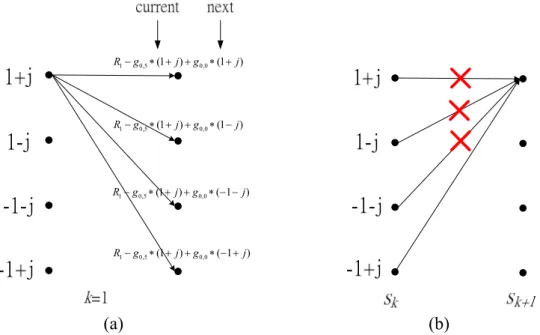
(13) where pri ( ) MLSEL is priori bit LLRs by the SISO outer decoder and λn’(x) is represent the constellation point x of the value at the n’-th bit. That retained path is referred to as survivor path. After all states of the trellis have been gone through, the smallest state metric be found and trace back that the ˆx is obtained. Fig. 4 shows the trellis diagram for two-tap complex channel in frequency domain when the 4-QAM signaling scheme and Q=2 is adopted.
1 0,5 (1 ) 0,0 (1 ) Rg j g j 1 0,5 (1 ) 0,0 (1 ) Rg j g j 1 0,5 (1 ) 0,0 ( 1 ) Rg j g j 1 0,5 (1 ) 0,0 ( 1 ) Rg j g j (a) (b)
Fig. 4. (a) Show the trellis diagram for 2γ allowable transitions from a state sk and
terminate at 2γ different states sk+1. (b) The cost of the i-th transition between sk and sk+1 exists transition probabilities is called a branch metric only the one connected.
The LLR of a bit d is defined as
( ) ln( ( 1)) ( 0) P d L d P d (14)
Thus MLSE output bit LLRs is transformed by symbol metric.
1 0 ( ) ln ( ( ) | , ) ln ( ( ) | , ) ( ) n n n MLSE k pri n MLSE k L d P k P k L d
X X R G X R G X , (15) where n kd represent n-th bit at k-th transmit subcarrier is mapped, n b
represent constellation point set of n-th bit is b {0,1}.The inner and outer decoder are adopting
a maximum a posterior probability (MAP), output are the bit log likelihood ratio and log-MAX algorithm is usually applied for lower computational complexity. A trade-off between complex and performance can be achieved by different choices of D, K, and γ.
The complexity is concerned in the receiver, the computational complexity of MLSE is (IN2γ(Q-1)) where I is number of iteration and MMSE is (N3) in one OFDM symbol, the MLSE is over the MMSE when using high order modulation or choosing large D.
Chapter 5
Simulation Results
To demonstrate the effectiveness of the MLSE equalizer approach for cooperative communication system with 105 Monte Carlo simulations, we compare the Bit Error Rate (BER) performance between the MLSE equalizer and MMSE equalizer.
We consider a BICM-OFDM system with N = 64, CP length = 8, and 4-QAM modulation. A two-path wide-sense stationary uncorrelated scattering (WSSUS) Rayleigh fading channel (generated using Jakes Model) between any relay nodes and each relay are equal power, the convotional code uses G(D)=(1+D2,1+D+D2) as the generator polynomial, and G(D)=1/(1+D2) is the generator polynomial for the precoder. One frame consists of 10 OFDM symbols. Furthermore, perfect estimations of MCFOs and channel matrices are assumed. The diversity order of BICM-OFDM for cooperative communication is addressed in [17].
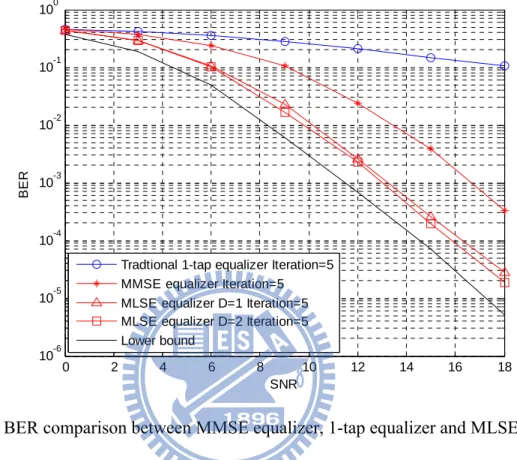
Fig. 5 shows the BER performance versus SNR for the comparison between conventional MMSE equalizer, traditional 1-tap equalizer and the MLSE equalizer in synchronous impairments.
For the simulation, normalized Doppler frequency fd=0.001 is employed at both relays, the normalized MCFOs are 0.2 and -0.2. With the large MCFOs, the 1-tap equalizer suffers an obvious error floor. In [17], the author use an MMSE equalizer to combat ICI, but an SNR loss occurred. On contrast, the MLSE equalizer not only successfully compensates for the ICI but also obtain an SNR gain about 3dB. The benefits of SNR gain, we can via SINR to explicit explanation and the derivation in appendix. The optimal solution is joint processing of demodulation and decoding is considered, which lead to approach low bound. The low bound is ideal cancel intercarrier-interference is obtained. Notice that with both equalizers the system achieves full diversity.
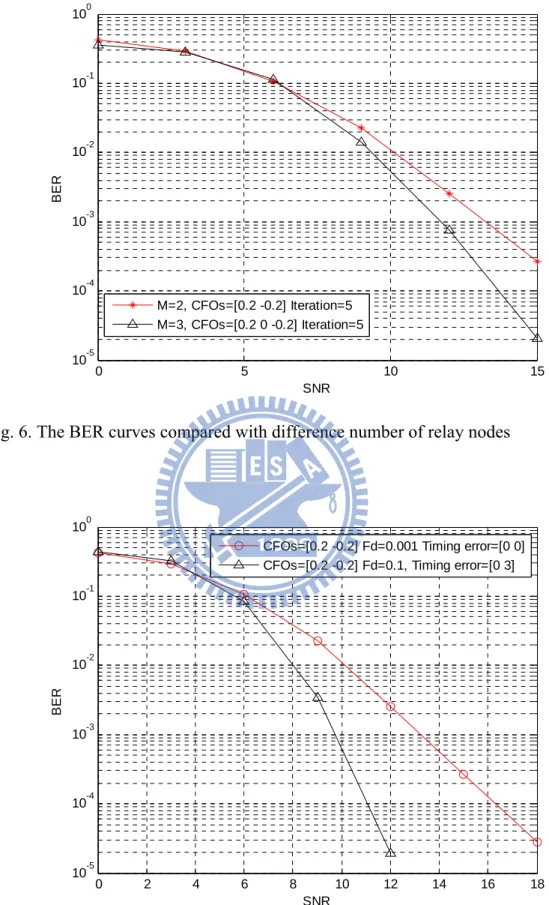
Fig 6 shows the results for the two relay nodes and three relay nodes. It can be seen from the figure that as the number of relay increases in the systems, the diversity order of distributed BICM-OFDM increases up to the maximum diversity of min{M rT L,dfree}, where rT is rank of E[HH
H
]. is addressed in [17]. It can be observed that the tree relays case has a diversity order of 5 and the BER curve is steep.
In Fig. 7, all the realistic synchronous impairments are considered. The timing errors is [0 3], normalized Doppler frequency is 0.1 for both relays and MCFOs is [0.2 -0.2]. In our proposed the performance show efficiently collects the diversity form time diversity due to the Doppler effect, frequency diversity due to timing error and special
diversity converted to time diversity due to MCFOs. It observed that the diversity is more than four.
Fig. 5. BER comparison between MMSE equalizer, 1-tap equalizer and MLSE equalizer in the cooperative communication.
0 2 4 6 8 10 12 14 16 18 10-6 10-5 10-4 10-3 10-2 10-1 100 SNR BER
Tradtional 1-tap equalizer Iteration=5 MMSE equalizer Iteration=5 MLSE equalizer D=1 Iteration=5 MLSE equalizer D=2 Iteration=5 Lower bound
Fig. 6. The BER curves compared with difference number of relay nodes
Fig. 7. The BER for cooperative communication under time error = [0 3], normalize Doppler frequency = 0.1, MCFOs = [0.2 -0.2].
0 5 10 15 10-5 10-4 10-3 10-2 10-1 100 SNR BER M=2, CFOs=[0.2 -0.2] Iteration=5 M=3, CFOs=[0.2 0 -0.2] Iteration=5 0 2 4 6 8 10 12 14 16 18 10-5 10-4 10-3 10-2 10-1 100 SNR BER
CFOs=[0.2 -0.2] Fd=0.001 Timing error=[0 0] CFOs=[0.2 -0.2] Fd=0.1, Timing error=[0 3]
Chapter 6
Conclusions
BICM has the potential to improve performance with relatively ease in many OFDM wireless communication systems. In this Thesis, it is shown that, with proper receiver design, the BICM-OFDM can be effective to combat synchronous errors as well as harvest potential diversity gain in cooperative communications. Typical BICM-OFDM systems suffer error floors due to ICI caused by MCFOs and Doppler effects. To deal with such a problem, we propose an MLSE-based frequency domain equalizer combined with a turbo decoder to break the error floor. The proposed
approach has BER approaching the performance bound, and it is flexible in a way that extension to more relays for improvement in diversity gain is straightforward. The complexity is a big problem in the receiver if D is greater than three, and future research in the complexity reduction will be considered.
Appendix
The received signal in frequency domain can be written
R GX Z (16)
As the derivation in [22], it is derive the MMSE equalizer as
1
( 1/ )
H H
w SNR
G GG (17)
After the MMSE equalizer we can rewritten as
signal power noise power
' w w
R R X Z (18) The SNR of MMSE equalizer is obtained form (18) in high SNR
SNRMMSE ≈ 2 2 E[ ] x H z ww ≈ 2 2 4 x z (19) The received signal can be decomposed signal part and interference & noise part for MLSE case
signal power interference and noise power
( )
R GX G - G X Z (20)
The SNR of MLSE equalizer is obtained form (20) SINRMLSE≈ 2 2 E[ ] [( )( ) ] H x H z E GG G - G G - G ≈ 2 2 0.95 0.05 x z (21)
Bibliography
[1] A. Sendonaris, E. Erkip, and B. Aazhang, “User cooperation diversity-part I: system description,” IEEE Trans. Commun., Vol. 51, pp. 1927-1-38, Nov 2003.
[2] A. Sendonaris and E. Erkip , “User cooperation diversity-part II: implementation aspects and performance analysis,” IEEE Trans. Commun., vol. 51, pp. 1939-1948, Nov 2003.
[3] S. Wei, D. Goeckel and M. Valenti, “Asynchronous cooperative diversity,” IEEE
Trans. Wireless Commun., vol. 5, pp. 1547-1557, June 2006.
[4] X. Li, “Space-time coded multi-transmission among distributed transmitters without perfect synchronization,” IEEE Signal Processing Lett., vol. 11, pp. 948-957, Dec 2004.
[5] Y. Mei, Y. Hua, A. Swami, and B. Daneshrad, “Combating synchronization errors in cooperative relays,” in Proc. IEEE ICASSP’05, vol. 3, pp. 369-372, Mar 2005.
[6] X. Guo and X.-G, “Distributed linear convolutive space-time codes for asynchronous cooperative communication networks,” IEEE Trans. Wireless Commun., vol. 7, no. 5, part 2, pp. 1857-1861, May 2008..
[7] Z. Li, D. Qu, and G. Zhu, “An equalization technique for distributed STBC-OFDM system with multiple carrier frequency offsets,” in Proc. IEEE
WCNC’06, vol. 2, pp. 839-843, Apr 2006.
[8] D. Veronesi and D. L. Goeckel, “Multple frequency offset compensation in cooperative wireless systems,” in Proc. IEEE Globecom’06, San Francisco, USA, pp. 1-5, Nov 2006.
[9] H. Wang, X,-G. Xia, and Q. Yin, “Computationally efficient MMSE and MMSE-DFE equalizations for asynchronous cooperative communications with multiple frequency offsets,” in Proc. IEEE ISIT’08, Toronto, Canada, July 2008.
[10] N. Benvenuto, S. Tomasin, and D. Veronesi, “Multiple frequency offsets estimation and compensation for cooperative networks,” in Proc. IEEE WCNC’07, Hong Kong, pp. 892-896, Mar 2007.
[11] Z. Li and X.-G Xia, “An Alamouti coded OFDM transmission for cooperative systems robust to both timing errors and frequency offses,” IEEE Trans. Wireless
Commun., vol. 7, no. 5, part 2 , pp. 1839-1844, May 2008.
[12] Y. Zhao and S.G. Haggman, “Intercarrier interference self-cancellatioon scheme for OFDM mobile communication systems,” IEEE Trans. Commun., col. 49, pp. 1185-1191, July 2001.
[13] X. Li, F. Ng, and T. Han, “Carrier frequency offset mitigation in asynchronous cooperative OFDM transmissions,” IEEE Trans. Signal Processing, vol. 56, pp. 675-685, Feb 2008.
[14] H. Wang, X. G. Xia, and Q. Yin, “Distributed space-frequency codes for cooperative communication systems with multiple carrier frequency offsets,” IEEE
Trans. Wireless Commun., vol. 8, no. 2, pp. 1045-1055, Feb 2009.
[15] A. Paulraj, R. Nabar, and D. Gore, Introduction to space-time wireless communications. Cambridge University Press, 2003.
[16] G. Caire, G. Taricco, and E. Biglieri, “Bit-interleaved coed modulation,” IEEE
Trans. Inf. Theory, vol. 44, no. 3, pp. 927-946, May 1998.
[17] Hsin-De Lin and Tzu-Hsien Sang, “BICM-OFDM for asynchronous cooperative communications,”
[18] J. N. Laneman and W. Wormell, “Distributed space-time coded protocols for exploiting cooperative diversity in wireless networks,” IEEE Trans. Inf. Theory, vol. 49, pp. 2415-2425, Oct 2003.
[19] I. Lee, “The effect of a precoder on serially concatenated coding systems with an ISI channel,” IEEE Trans. Commun., vol.49, no. 7, pp. 1168-1175, Jul 2001.
[20] W. C. Jakes, Microwave Mobile Communications. New York: wiley, 1974.
[21] G. E. Bottomley and S. CHennakeshu, “Unification of MLSE receivers and extension to time-varying channels,” IEEE Trans. Commun., vol. 46, pp. 464-472, Apr 1998.
[22] L. Rugini, P. Banelli, and G. Leus, “Simple equalization of time-vaying channels for ofdm” IEEE Commun. Lett., vol. 9, no. 7,Jul 2005.