DOI: 10.1007/s00340-004-1526-2 Appl. Phys. B 79, 29–31 (2004)
Lasers and Optics
Applied Physics B
y.f. chenu y.p. lan
Diode-pumped passively Q-switched
Nd : YAG laser at 1123 nm
Department of Electrophysics, National Chiao Tung University, Hsinchu, Taiwan
Received: 11 December 2003/Revised version: 5 March 2004 Published online: 12 May 2004 • © Springer-Verlag 2004 ABSTRACT A diode-pumped Nd : YAG laser at 1123 nm is passively Q-switched by using a low doping concentration Cr4+: YAG crystal as a saturable absorber. When pumped by a 1.5-W laser diode, the laser produces pulses of 50-ns duration with a pulse energy of as much as 15µJ and a peak power of 300 W at a pulse-repetition rate of 10 kHz.
PACS42.60.Gd; 42.55.Rz; 42.55.Xi
1 Introduction
The development of diode pumping has widely expanded the technical applications of all-solid-state lasers in various fields. The Nd : YAG crystal is one of the most greatly used materials for diode pumping because of its excellent output characteristics. In addition to the frequen-cies of the commonly used laser transitions (946, 1064, 1319, and 1444 nm [1–4]), another particular interest is that Nd: YAG lasers can operate in various Stark components of the 4F
3/2→4 I11/2 transition [3, 5, 6]. For example, the 1123-nmline can be used as a pump source for thulium upcon-version fiber lasers to generate blue-light emission [7, 8].
Since the stimulated emission cross section for the 1123-nm transition is approximately 15 times smaller than that for the 1064-nm line [2], the operation of a Nd : YAG laser at 1123 nm not only requires a low-loss resonator but also needs the suppression of the competing transition chan-nels (e.g. 1064 and 1319 nm). Previously, Moore et al. [5] have demonstrated a continuous-wave (cw) diode-pumped Nd: YAG laser at 1123 nm. Here we report, to our know-ledge, the first passively Q-switched diode-pumped 1123-nm Nd: YAG laser by use of a Cr4+: YAG saturable absorber with low Cr4+ doping concentration (0.2 at. %). With 1.5 W of incident pump power, the compact cavity produces a max-imum average power of 150 mW and a highest peak power of 300 Wat 1123 nm.
2 Experiments
Figure 1 is a schematic of the passively Q-switched Nd: YAG/Cr4+: YAG laser on the low-gain 1123-nm line.
u Fax: +886/35-729134, E-mail: [email protected]
The active medium was a 1.0 at. % Nd3+, 10-mm-long Nd: YAG crystal. The laser crystal was wrapped with indium foil and mounted in a water-cooled copper block. The water temperature was maintained at 25◦C. Both sides of the laser crystal were coated for antireflection at 1123 nm (R< 0.2%). The pump source was a 1.5-W, 808-nm fiber-coupled laser diode with a core diameter of 200µm and a numerical aper-ture of 0.2. A focusing lens with 16.5-mm focal length and 95% coupling efficiency was used to re-image the pump beam into the laser crystal. The pump spot radius was around 100µm. The input mirror was a 50-mm radius-of-curvature concave mirror with an antireflection coating at the pump wavelength (∼ 808 nm) on the entrance face (R < 0.2%) and a high-reflection coating at 1123 nm (R> 99.8%) and a high transmission coating at the pump wavelength on the other face (T> 95%).
Since the gain of the Nd : YAG crystal at 1123 nm is extremely low, a low-output coupler and a high initial-transmission saturable absorber are vital for passive Q-switching [9, 10]. In our experiment, a flat output coupler of Toc= 1.0% and a Cr4+: YAG crystal with an initial transmis-sion of T0= 98% were employed to get the low-gain passively Q-switched 1123-nm emission. As shown in Fig. 2, the ab-sorption coefficient of the conventional 1.0 at. % Cr4+: YAG crystal is about 1.5 cm−1at 1123 nm. For T0= 98%, the thick-ness needs to be as thin as 0.13 mm with the conventional 1.0 at. % Cr4+: YAG crystal. With the plane-stress approx-imation [11], the maximum absorbed power at the thermal
FIGURE 1 Schematic of a diode-pumped passively Q-switched Nd : YAG/ Cr4+: YAG laser at 1123 nm
30 Applied Physics B – Lasers and Optics
FIGURE 2 Absorption spectrum of the conventional 1.0 at. % Cr4+: YAG crystal
fracture limit is inversely proportional to the thickness of the saturable absorber for a given initial transmission. Therefore, such a thin Cr4+: YAG crystal is not only hard to manufacture but also liable to thermal fracture. To overcome this tech-nical issue, it is necessary to use a Cr4+: YAG crystal with sufficiently low Cr4+doping concentration. Here we utilized a 0.2 at. %, 0.65-mm-thick Cr4+: YAG crystal to be a sat-urable absorber with T0= 98%. Both sides of the Cr4+: YAG crystal were coated for antireflection at 1123 nm (R< 0.2%). The overall laser cavity length was approximately 30 mm. This cavity length was chosen here just for mode-matching reasons.
3 Results
To begin with, cw operation at 1123 nm was inves-tigated. Figure 3 shows the experimental results. The max-imum output power of 452 mW was obtained with the 2% output coupler at an incident pump power of 1.5 W, corres-ponding to a slope efficiency of 34.6% and a threshold power of 200 mW. The beam-quality factor M2 was found to be less than 1.2 for all pump powers. When the output coupler with 1% transmission was used, the maximum output power was approximately half of the result for the 2% output cou-pler. Even so, the 1% output coupler was used in the pas-sively Q-switched operation because of the threshold. Note that all the coatings of the output couplers were characterized by high losses at wavelengths corresponding to the stronger Nd3+transitions (transmission> 90% at 1064 nm and > 60% at 1319 nm). Our experimental results reveal that the resonator mirrors only need to suppress parasitic oscillations on lines in the 1064-nm region for cw operation, as indicated in [5]. For passive Q-switching, however, another requirement on the mirror coatings is to suppress the lasing channel at 1319 nm. As seen in Fig. 3, the highest average output power of 150 mW in a Q-switch regime was measured with 1% output
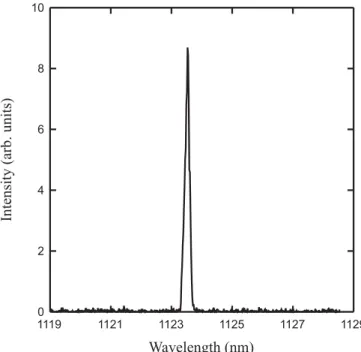
coup-ling at 1.5 W of incident pump power. An optical spectrum analyzer (Advantest Q8381A) was used to monitor the spec-tral information of the laser and to make sure that no other wavelength starts to oscillate. The present spectrum analyzer employing a diffraction lattice monochromator can be used for high-speed measurement of pulse light with the resolution of 0.1 nm. The measurement of the optical spectrum for the laser beam is depicted in Fig. 4. From Fig. 3, it can be seen that the output power of Q-switched operation is not linear with respect to the input pump power. Therefore, an analysis of the slope efficiency for Q-switched operation does not make sense. On the other hand, the laser threshold for Q-switched
FIGURE 3 Average output power versus incident pump power in passively Q-switching and cw operations at 1123 nm
FIGURE 4 Measured spectral output of the diode-pumped passively Q-switched Nd : YAG laser at 1123 nm
CHENet al. Diode-pumped passively Q-switched Nd : YAG laser at 1123 nm 31
FIGURE 5 Dependence of pulse-repetition rate and single-pulse energy on the incident pump power at 1123 nm
operation was estimated to be eight times higher than that for cw operation. The nonlinear input–output characteristic and the anomalous high threshold indicate that there are additional losses introduced in the passively Q-switched operation. The additional losses may be the reason why there was no laser operation for the mirror transmission of 2%. Even so, the pos-sible mechanism for the additional losses is still unclear.
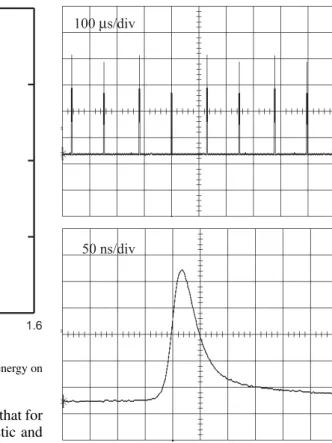
Figure 5 shows the pulse energy and the pulse-repetition rate versus the incident pump power. Like typical passively Q-switched lasers, the repetition rate increases linearly with the pump power; the pulse energy is basically insensitive to the pumping rate. On the whole, the pulse width remains con-stant at about 50 ns, as shown in Fig. 6. With the measured pulse energy and pulse width, the peak power was found to be 300 W. The significant peak power achievable with the present laser might allow for interesting applications in other fields, such as second-harmonic generation into yellow light. A typical oscilloscope trace of a train of output pulses is also presented in Fig. 6. The pulse-to-pulse amplitude fluctu-ation of the Q-switched pulse train was measured to be less than±10%.
4 Conclusions
In summary, a diode-pumped passively Q-switched Nd: YAG/Cr4+: YAG laser at 1123 nm has been demon-strated. A Cr4+: YAG crystal with low doping concentration was employed for the prevention of thermally induced
frac-FIGURE 6 A typical oscilloscope trace of a train of pulses; lower trace is an expanded shape of a single pulse
ture. It is found that 15-µJ pulses of 50-ns duration at a pulse-repetition rate of 10 kHz can be obtained at an incident pump power of 1.5 W. These preliminary results of the passively Q-switched laser allow us to foresee an average power scaling to 1 W and a peak power higher than 1 kW, which should be interesting for many practical applications.
REFERENCES
1 R.G. Smith: IEEE J. Quantum Electron. QE-4, 505 (1968) 2 S. Singh, R.G. Smith, L.G. Van Uitert: Phys. Rev. B 10, 2566 (1974) 3 J. Marling: IEEE J. Quantum Electron. QE-14, 56 (1978)
4 W. Koechner: Solid-State Laser Engineering, Vol. 1, Optical Sciences, 4th edn. (Springer, Berlin 1996)
5 N. Moore, W.A. Clarkson, D.C. Hanna, S. Lehmann, J. Bösenberg: Appl. Opt. 38, 5761 (1999)
6 N.V. Kravtsov, V.V. Firsov, P.P. Pashinin: Quantum Electron. 29, 778 (1999)
7 S.G. Grubb, K.W. Benett, R.S. Cannon, W.F. Humer: Electron. Lett. 28, 1243 (1992)
8 I.J. Booth, J.L. Archambault, B.F. Ventrudo: Opt. Lett. 21, 348 (1996) 9 J.J. Degnan: IEEE J. Quantum Electron. QE-31, 1890 (1995)
10 Y.F. Chen, Y.P. Lan, H.L. Chang: IEEE J. Quantum Electron. QE-37, 462 (2001)