Differential gain and buildup dynamics of
self-starting Kerr lens mode-locked
Ti:sapphire laser without an internal aperture
D.-G. Juang, Y.-C. Chen, S.-H. Hsu, K.-H. Lin,*and W.-F. HsiehInstitute of Electro-Optical Engineering, National Chiao Tung University, Ta-Hsueh Road 1001, Hsin Chu, Taiwan 30050
Received July 24, 1996; revised manuscript received November 1, 1996
The small-signal differential gain was calculated from the measured average cw and Kerr lens mode-locked (KLM) output powers over the least-misalignment-sensitive region of a completely soft-aperturing, self-starting KLM Ti:sapphire laser. The results indicate that the self-starting condition is reached with this laser operating near the center of the stable range. The simulated location of maximum differential gain and pulse buildup process show good agreement with the experimental results. © 1997 Optical Society of America [S0740-3224(97)05007-8]
1. INTRODUCTION
Recently great emphasis has been placed on the use of self-starting Kerr lens mode-locked (KLM) Ti:sapphire la-sers without external perturbation elements to achieve broadly tunable short pulses for spectroscopic applica-tions. Using a quantum-well nonlinear reflector in a weakly coupled cavity generated controlled continuously self-starting mode-locked pulses as short as 70 fs in the TEM0,0mode, and the tuning range over which the laser
is continuously self-starting is ;30 nm.1 Constructing
an asymmetrical cavity with a slit as a bandwidth-controlling and wavelength-tuning element2 yielded a self-starting KLM Ti:sapphire laser of pulse width 85 fs at 840 nm; however, self-starting became more and more dif-ficult and was impossible with a wavelength shorter than 815 nm. The self-starting mechanism was attributed to the so-called positive gain-saturation lensing for a laser wavelength longer than the maximum of the gain spectrum.2 With optimization of the small-signal rela-tive spot size variation due to self-focusing at a hard slit, a self-starting KLM Ti:sapphire laser at 800 nm was dem-onstrated only in the symmetrical four-mirror confocal cavity configuration.3,4 However, the maximum value of the hard-aperturing self-starting condition of the laser system is lower than the required theoretical self-starting condition.3 Thus the self-starting mechanism of KLM solid-state lasers is still a puzzle for ultrashort pulse gen-eration.
We recently demonstrated a self-starting tunable KLM Ti:sapphire laser based on an asymmetrical configura-tion. This laser can self-start without an internal hard slit and can be tuned over a wavelength range of 780–840 nm while the group-velocity dispersion (GVD) compensa-tion prisms are translated to keep a constant pulse width.5 The results indicate that gain-saturation lensing is not an essential starting mechanism because KLM can occur with wavelengths shorter than 815 nm, in contrast with Ref. 2. In the present paper, by measuring the
av-erage powers of both cw and KLM output, we confirmed not only that the small-signal differential gain estimated from the experimental data indicates that the self-starting condition can be reached but also that the con-tinuously tunable self-starting KLM laser is operated near the center of the low-misalignment-sensitivity (LMS) region,4 which coincides with the calculated loca-tion of maximum saturated differential gain. The opti-mal cavity design can be achieved to overlap cavity and pump fields by accurate calculation of the astigmatism compensation angle, the position and angle of the pump-ing lens,6,7 and GVD compensation.8 Using iterative simulation, we analyze the buildup process of the KLM Ti:sapphire laser. We find that the pulse is shortened al-most monotonically to a few picoseconds, resulting from proper GVD compensation with material dispersion of the rod and not much increase in pulse energy. Then the pulse is further shortened; this is accompanied with in-crease in pulse energy due to the action of self-phase modulation and the positive saturated differential gain via self-focusing until the laser transits into steady-state mode locking and the pulse width has reduced to the fem-tosecond regime. The free-running period takes 0.48 ms, which is close to the experimental result of 0.5 ms. How-ever, in the absence of GVD compensation prisms, the pulse-shortening force is weaker, and the KLM pulse is gradually shortened with a continuous increase in pulse energy and takes a longer time to reach steady state, with a final pulse width of 2 ps.
2. EXPERIMENT
Consider an asymmetrical and astigmatism-compensated resonator configuration shown as Fig. 1(a), in which a 2-cm Ti:sapphire rod simultaneously acts as a Kerr me-dium and a gain meme-dium. To take into account the astig-matism of the Brewster-cut Ti:sapphire rod, the focusing mirrors with radii of curvature of 100 mm were tilted at
incidence angles 15° to yield a round TEM0,0mode at 5%
output coupler M1. The focusing-mirror separation is z15 117.8 mm, and the distance from one end face of the
crystal rod to the focusing mirror M3 is r25 47.8 mm.
This cavity corresponds to the configuration located at the center of LMS region.4 To match both tangential and sagittal KLM beam waists to those of the pump field, this laser is pumped by an all-line Ar-ion laser set at 5-W out-put power with a pump lens tilted 9° with respect to the incident beam and at a distance of 79 mm from M3as in
theoretical calculation.8 Neither a hard-aperture nor a slit was inserted into the cavity. After the GVD compen-sation SF10 prism pair, was fine tuned,5 self-starting mode locking was achieved in this soft-aperturing system. With a mechanical chopper inserted into the cavity, the observed buildup time exhibits wide statistical fluctua-tion as in Ref. 3. By raising the pump power to 8 W and slightly adjusting prism separation, we obtain the quite reproducible temporal behavior3,5of optical pulses shown in Fig. 1(b). The output laser power shows a normal re-laxation oscillation followed by short noisy cw steady-state and then turns to KLM pulses once the cavity beam
is unblocked. The measured buildup time and pulse du-ration at M1are;0.5 ms and 150 fs, respectively.5
Figure 2 shows the measured cw (solid curve) and KLM (dots) average output powers while the mirror M2is
con-tinuously moved from r15 46.5 to r15 49.5 mm. As we
change r1, we do not optimize the rest of the cavity. The
solid curve indicates that the cw output power first in-creases as the mirror M2moves closer to M1from the far
end of LMS (i.e., r15 49.5 mm, reaches a maximum at r1' 48.5 mm, then decreases to a minimum at r1
' 47.75 mm). It increases again to a maximum and monotonically decreases until the near end of the LMS re-gion is reached. The dotted data represent the output power and range of KLM operation. The self-starting KLM output is located only near r15 48.0 mm, which is
at the center of the LMS region, and the tunable range is about 300mm (same as in Ref. 2). The output cw mode is a combination of TEM0,0and the higher-order transverse
modes; for instance, the mode pattern at maximum out-put, where r1' 48.5 mm, consists of 60% TEM0,0 and
0.2° off axis 40% TEM0,1modes,5whereas the KLM
out-put is a pure TEM0,0 mode. Because we have designed
Fig. 1. (a) Experimental setup for the KLM Ti:sapphire laser. (b) Self-starting self-mode-locked pulse trains monitored by a fast photo diode from M1.
the cavity with proper mirror separation, the beam profile of the KLM mode within the gain medium is always smaller than that of the cw mode, and we have optimized the overlap of beam waists of cavity and pump beams by properly adjusting the tilt angle and distance of the pump lens.6,7 The minimum cw output power at r
1
' 47.75 mm is a result of less overlapping between pump and cw TEM0,0modes.
By using a high-Q approximation, which is quite ad-equate in this laser cavity, one can estimate the small-signal gain g0 for cw ( gc) and KLM ( gk) modes from the
measured output power according to the following equation9: Iout5 TbIs 2
F
T2S
g0 L1 T 21DG
, (1)where Iout is the measured output intensity, the
satura-tion intensity Is5 300 kW, the transmittance of crystal
end faces Tb is set to 1, the transmittance of M4 is T2
5 2%, and the total loss L 1 T is equal to threshold gain. We estimated the small-signal gain difference to be Dg 5 gk2 gc5 2 3 1023. To see whether this laser
can reach KLM self-starting conditions,10,11 we set (1) k/g.bstp, where k is the differential gain with respect
to initial photon flux10 without taking into account the
gain saturation, g is the saturated gain, b 5 0.75 for a Gaussian pulse, the emission cross section s is 2.7 3 10219cm2, and t
p is the pulse width; and (2) gP
. Tr/@ln(mi)tc#, whereg is KLM strength11
correspond-ing to differential gain for soft aperturcorrespond-ing and P is the peak power of the most intensive fluctuation. Assuming that the ratio of the peak power of the most intense fluc-tuation to the average intracavity power 12 W for round-trip time Tr5 12.5 ns, the cavity has ln(mi)' 5–10, and
the measured noise bandwidth12is 500 Hz for our system, the resulting correlation time is tc5 0.65 ms. The
re-sult does satisfy both conditions, with, for example, k/g ' 5 3 10229. 1.5– 3.0 3 10230. An overestimation
may be due to using the small-signal differential gain in the calculation instead of the already saturated differen-tial gain, which is for the case when a cw output is reached before KLM.5 In Ref. 13 Herrmann derived a
necessary and sufficient self-starting criterion from the fluctuation model of the pulse evolution process in mode-locked solid-state lasers. With this criterion the self-starting mode-locking threshold is calculated to be
Pml/PTH> 4 for our Ti:sapphire laser, where Pml is the
pumping and PTHis the lasing threshold. This is fulfilled
by either of our experimental setups with Pml/PTH
ap-proximately 5 and 8.
3. THEORETICAL ANALYSIS
Because KLM self-starting depends most critically on the separation of curved mirrors, we are interested in finding the optimal cavity arrangement for mode locking by cal-culating the saturated differential gain as functions of mirror separation and the buildup process of the KLM la-ser by seeding an initial pulse train in the cavity after the laser has reached steady-state cw operation. Because the Ti:sapphire crystal is as long as 2 cm, it cannot be treated as a thin medium as in Ref. 14; that is, the spot size and the curvature of phase front varies as functions of position along the optical axis. Thus, the crystal is considered to consist of N slices with thickness dz 5 Lc/N. Each slice can be regarded as a Gaussian
duct.15 Inside each slice the beam radius w, curvature
R, and laser power are treated as constants.
The cavity is divided into three regions (as in Ref. 14). Region 1 is a linear propagation from flat mirror M1to the
crystal surface, and only spatial effects would be consid-ered here; region 2 contains the nonlinear Ti:sapphire crystal with radially varying gain as in Ref. 14, self-focusing, self-phase modulation, and positive dispersion; and region 3 includes elements along the optical path from the crystal surface to the flat mirror M4, in which
both spatial propagation and temporal dispersion com-pensation were considered.
For a Gaussian pulse the electric field can be expressed as E5
S
U w2sD
1/2 expS
2jkx 2 2qx 2 jky 2 2qyD
expS
jct 2 2pD
, (2) with the spatial q parameter,1 q 5 1 R2 j l npw2, (3)
and the temporal p parameter, 1 p 5 2r c 1 i 2 cs2, (4)
where R is the phase-front radius of curvature, w is the beam spot size, l is the central wavelength, n is the re-fractive index,r is the chirping, c is the speed of light, s is the pulse width, and U is the pulse energy. The trans-formations of q and p parameters through cavity compo-nents can be related by spatial and temporal ABCD matrices8as
Fig. 2. Measured cw (solid curve) and KLM (dots) average out-put powers while the mirror M2is continuously moved from r1 5 46.5 to r15 49.5 mm.
qout5 Aqin1 B Cqin1 D , (5) pout5 Atpin1 Bt Ctpin1 Dt . (6)
Furthermore, the laser gain equation for time-averaged power in the gain medium is16
d^P&
dz 5 g^P&, (7) where the single-pass power gain is
g5 4s0taplpPinexp~2apz! hcp2wpxwpywcxwcy
Q~z! 2ac, (8)
wheres0,t, ap, andacare the stimulated emission cross
section, the excited-state lifetime, the absorption coeffi-cient at pump wavelength lp, and the total cavity loss,
respectively. Here wpxand wpy(wcxand wcy) are radii of
the pump beam (cavity beam) in the x and y directions. The overlap integral in Eq. (8) is written as
Q~z! 5 2p
E
2` `E
2` ` exp~2Axx22 Ayy2! 1 1 B exp~2Dxx22 Dyy2! dxdy, (9) with Ax5 2~wpx21 wcx2! wpx2wcx2 , Ay5 2~wpy21 wcy2! wpy2wcy2 , (10) B5 2^P1& pwcx1wcy1Is 1 2^P2& pwcx2wcy2Is , (11) Dx5 2 wcx2 , Dy5 2 wcy2 , (12)where1 and 2 stand for cavity beam propagation in 1z and2z directions, respectively. The output power at the
ith slice is related to the input power^Pi&by
^Pi11&5^Pi&exp~gdz!. (13)
In the previous experiment5we had observed that the laser underwent transition from relaxation oscillation through a free-running period to Kerr lens mode locking as the pumping beam was turned on. During this period the cw and the KLM modes compete intensively. Finally the laser cavity makes the KLM mode outdo the cw and break into mode-locking operation. The duration of the free-running period and self-starting depends strongly on the alignment and intracavity power. Thus, we calcu-lated the saturated differential gain by seeding a small pulse of intracavity power,;1026 W, in the already satu-rated free-running laser, rather than calculating the small-signal differential gain, to determine the optimal self-starting cavity configuration. Furthermore, to study the buildup process of the KLM laser, we share some of the cw energy with the pulse mode after the laser has reached steady-state cw, allowing both modes to oscillate
simultaneously. An initial pulse is seeded into the cavity at the flat mirror M4. After a certain round-trip time,
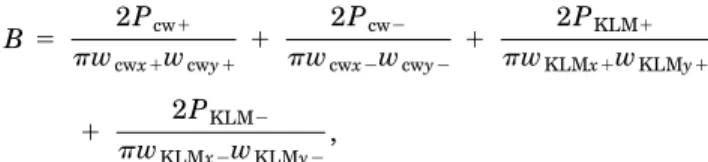
one mode will build up to extinguish the other. The prin-cipal competition between cw and KLM modes result from gain saturation. The gain saturation term B in Eq. (11) is then modified as B5 2Pcw1 pwcwx1wcwy1 1 2Pcw2 pwcwx2wcwy2 1 2PKLM1 pwKLMx1wKLMy1 1 pw 2PKLM2 KLMx2wKLMy2,
where the pumping energy is shared by both modes and
wcw and wKLM are beam radii of the cw and the KLM
modes, respectively.
We found that the saturated differential gain has less influence on the gain-guiding effect than the small-signal differential gain does (see Ref. 17). Fig. 3(a) shows the saturated differential gain versus the normalized power
K 5 P/Pc (with Pc the self-trapping critical power) for
pulses propagating in positive and negative directions, re-spectively. The resultant differential gain is shown in
Fig. 3. (a) Differential gain with respect to normalized power K versus mirror separation for pulses propagating in positive and negative directions, respectively. (b) Resultant differential gain. We notice that the largest differential gain for both stable ranges is located near the center of each region.
Fig. 3(b). Note that the largest differential gain for both LMS and high-misalignment-sensitive regions is located near the center of each region and is quite different from hard-aperturing KLM in which the laser operates near the edge of the stable range.3,4,17 In our calculation we considered only the radially averaged gain. A more pre-cise calculation must consider the power-dependent ra-diation redistribution, which gives a much stronger differ-ential gain.18
Figure 4(a) shows the pulse width and intracavity pulse energy at M1 versus cavity round-trip time with
compensation prisms. Assume that the initial seeding pulse has a pulse width of 10 ps and a peak power 10 times cw average power.11 We note that the pulse is shortened almost monotonically to 2 ps, resulting from proper GVD compensation with material dispersion of the rod (indeed, it may be accompanied by wavelength shifting5,19) until a turning point at approximately the 13000th round-trip where the shortening rate slows down. During this period the pulse energy has not
in-creased much because of a peak power still too low for ef-fective self-focusing to increase pulse gain. Further shortening accompanied by an increase in pulse energy continues owing to the action of self-phase modulation and positive saturated differential gain by self-focusing. Until the 40000th round trip the laser undergoes a tran-sition into steady-state mode locking, and the pulse width is reduced to the femtosecond regime ('150 fs). The free-running period takes 40000 round trips in our simu-lation, corresponding to 0.48 ms, which is very close to the experimental result of 0.5 ms. Without the dispersion-compensation prisms as shown in Fig. 4(b), however, ow-ing to a weaker pulse-shortenow-ing force in the absence of GVD compensation, the KLM pulse is gradually short-ened with a continuous increase of pulse energy and takes ;43000 round trips to reach steady state, when the final pulse width is 2 ps. This result also agrees with our pre-vious result.12
4. CONCLUSIONS
By measuring the average cw and KLM output powers, we have demonstrated that continuously tunable, self-starting, soft-aperturing KLM laser operates at the center of the LMS region. The small-signal differential gain es-timated from the experimental data indicates that the self-starting condition can be reached. The simulated re-sult indicates that the largest saturated differential gain for both stable ranges is located near the center of each region and has less influence on the gain-guiding effect. Therefore soft-aperturing KLM is most efficient at this position, consistent with our experimental results. In the buildup studies of this laser, however, we find that the pulse is shortened almost monotonically to a few pi-coseconds, resulting from proper GVD compensation with material dispersion of the rod with not much increase in pulse energy. Then the pulse is further shortened, companied with an increase in pulse energy due to the ac-tion of self-phase modulaac-tion and positive saturated dif-ferential gain by self-focusing until the laser transits into steady-state mode locking and the pulse width has re-duced to the femtosecond regime. Without dispersion-compensation prisms, however, due to the weaker pulse-shortening force at the absence of GVD compensation, the KLM pulse is gradually shortened with a continuous in-crease in pulse energy and takes a longer time to reach steady state. The simulated results agree well with the femtosecond and picosecond experiments.
ACKNOWLEDGMENT
K.-H. Lin is grateful to the National Science Council (NSC) of the Republic of China for providing a fellowship. The research was partially supported by NSC under grant NSC-85-2112-M-009-027.
Correspondence should be addressed to W.-F. Hsieh (e-mail: [email protected]).
*Present address: Precision Instrument Development Center, National Science Council, Hsinchu 300, Taiwan.
Fig. 4. (a) Pulse width and pulse energy versus cavity round-trip time with compensation prisms; the initial seeding pulse is 10 ps in duration and 1/40 of the cw energy. (b) The buildup of KLM pulses in the Ti:sapphire cavity without dispersion-compensation prisms.
REFERENCES AND NOTES
1. U. Keller, G. W. ’t Hooft, W. H. Knox, and J. E. Cunning-ham, ‘‘Femtosecond pulses from a continuously self-starting passively mode-locked Ti:sapphire laser,’’ Opt. Lett. 16, 1022 (1991).
2. M. Lai, ‘‘Self-starting, self-mode-locked Ti:sapphire laser,’’ Opt. Lett. 19, 722 (1994).
3. G. Cerullo, S. De Silvestri, and V. Magni, ‘‘Self-starting Kerr-lens mode locking of a Ti:sapphire laser,’’ Opt. Lett.
19, 1040 (1994).
4. G. Cerullo, S. De Silvestri, V. Magni, and L. Pallaro, ‘‘Reso-nators for Kerr-lens mode-locked femtosecond Ti:sapphire lasers,’’ Opt. Lett. 19, 807 (1994).
5. J.-G. Lai, K.-H. Lin, D.-G. Juang, and W.-F. Hsieh, ‘‘Con-struction of a wavelength-tunable self-starting Kerr lens mode-locked Ti:sapphire laser system,’’ Chin. J. Phys. 34, 111 (1996).
6. K.-H. Lin and W.-F. Hsieh, ‘‘Analytical design of symmetri-cal Kerr-lens mode-locking laser cavities,’’ J. Opt. Soc. Am. B 11, 737 (1994).
7. K.-H. Lin, Y.-C. Lai, and W.-F. Hsieh, ‘‘A simple analytical method of cavity design for astigmatism compensated Kerr lens mode-locked ring lasers and its applications,’’ J. Opt. Soc. Am. B 12, 468 (1995).
8. K.-H. Lin and W.-F. Hsieh, ‘‘Analytical spatio-temporal de-sign of Kerr lens mode-locked laser resonators,’’ J. Opt. Soc. Am. B 13, 1786 (1996). Typographical errors were found on p. 1790. In the paragraph below Eq. (33), ‘‘s1at output coupler...’’ should be ‘‘s1at M4...’’; in Eq. (35), ‘‘s15 ...’’ should be ‘‘s125 ... .’’
9. J. T. Verdeyen, Laser Electronics, 3rd ed. (Prentice-Hall, Englewood Cliffs, N.J., 1995), p. 267.
10. E. P. Ippen, I. Y. Liu, and H. A. Haus, ‘‘Self-starting condi-tion for additive-pulse mode-locked lasers,’’ Opt. Lett. 15, 183 (1990).
11. F. Krausz, T. Brabec, and Ch. Spielmann, ‘‘Self-starting passive mode locking,’’ Opt. Lett. 16, 235 (1991).
12. J.-M. Sheih, F. Ganikhanov, K.-H. Lin, W.-F. Hsieh, and C.-L. Pan, ‘‘Completely self-starting picosecond and femto-second Kerr-lens mode-locked Ti:sapphire laser,’’ J. Opt. Soc. Am. B 12, 945 (1995).
13. J. Herrmann, ‘‘Starting dynamic, self-starting condition and mode-locking threshold in passive, coupled cavity or Kerr-lens mode-locked solid-state lasers,’’ Opt. Commun.
98, 111 (1993).
14. J. L. A. Chilla and O. E. Martı´nez, ‘‘Spatial-temporal analy-sis of the self-mode-locked Ti:sapphire laser,’’ J. Opt. Soc. Am. B 10, 638 (1993).
15. A. E. Siegman, Lasers (University Science, Mill Valley, Calif., 1986).
16. L. W. Caperson, ‘‘Laser power calculations: sources of er-ror,’’ Appl. Opt. 19, 422 (1980).
17. T. Brabec, Ch. Spielmann, P. E. Curley, and F. Krausz, ‘‘Kerr lens mode locking,’’ Opt. Lett. 17, 1292 (1992). 18. J. Herrmann, ‘‘Theory of Kerr-lens mode-locking: role of
self-focusing and radially varying gain,’’ J. Opt. Soc. Am. B
11, 498 (1994).
19. J. Herrmann and M. Muller, ‘‘Operating principle, satu-rable loss, and self-frequency shift in Kerr-shift mode-locked lasers,’’ Opt. Lett. 20, 22 (1995).