
Twin-bit based Fast IP Lookup and Update Algorithm
6
0
0
全文
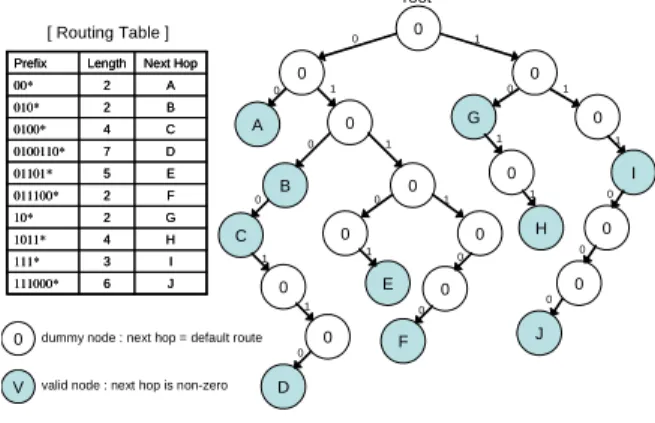
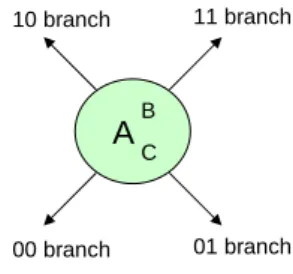
(2) partial unnecessary dummy nodes, but which needs more memory storage to record the skip information. Berger proposed a prefix tree structure [9], which removes all of dummy nodes and has the least memory storage in IP address lookup. In contrast to the previous concepts, the Wu proposed LPFST scheme [10], which utilizes the heap concept to reduce the table lookup time. LPFST endeavors to place the longest prefix on the upper level of the tree, and thus has the fastest lookup time. However, LPFST incurs more memory access in routing entry update operations.. branch, or 11 branch, to find the associated output port number. For example if the prefix value is Curr_prefix × 22, then the lookup operation visits the 00 branch to find the associated output port number. node type next hop valid bits. nt=0. w−8 ). 2. The rest of this study is organized as follows. Section 2 first defines the Twin-bit based tree’s node and data structure. Section 3 introduces the proposed Fast Twin-bit Tree (FTBT) algorithm. Section 4 compares the performance of the FTBT IP lookup with other IP lookup schemes. Conclusions are finally in Section 5.. 2: TWIN-BIT BASED TREE NODE In contrast with the other tree-based IP lookup schemes [7]-[10], the proposed scheme adopts two bits to define a tree node to reduce the height of the lookup tree, and thus can minimize the number of memory accesses in an IP address lookup.. vb[4]. sp[4]. (a) node type 0 node type next hop expanded expanded. As discussed above up until now, all of the tree-based IP lookup schemes perform the lookup operation bit by bit. The complexity of the IP lookup and routing table update operation is O ( w) , where w is the prefix length. In contrast with the current tree-based scheme, the proposed Fast Twin-bit Tree (FTBT) IP lookup algorithm is based on a Twin-bit based tree structure. Each node in this tree structure represents two bits of an IP address. The FTBT algorithm can reduce the order of the memory access in an IP lookup and routing entry update operation to O (. h. Sub pointers. next hop 0 next hop 1. nt=1. h. eh0. eh1. valid bits. Sub pointers. vb[4]. sp[4]. (b) node type 1. Figure 3. FTBT Node Formats. The FTBT node structure is defined in Fig. 3. Each node is in one of two node formats. All fields are defined below. Node type (nt): 0 or 1. Stands for the node type 0 or node type 1. Next hop (h): the output port number of curr_prefix. Valid bits (vb[4]): indicates whether the field of the Sub pointers have valid values. Sub pointers (sp[4]): a pointer that points to the 00 branch, 01 branch, 10 branch, or 11 branch. Expanded next hop 0 (eh0): the output port number of the prefix value curr_prefix × 21. Expanded next hop 1 (eh1): the output port number of the prefix value curr_prefix × 21+1. The node type is 0 when the routing table contains no routing entry mapped to the eh0 field or mapped to the eh1 field.. 3: FAST TWIN-BIT TREE (FTBT) IP LOOKUP ALGORITHM. 11 branch. 10 branch. Some terms used in the FTBT algorithm are defined below. B. •. AC 00 branch. •. 01 branch. Figure 2. FTBT Tree Node. Figure 2 shows the FTBT tree node, where A is the output port number of the prefix value Curr_Prefix, and B and C represent the output port numbers of the prefix value Curr_prefix × 21 and Curr_prefix × 21 + 1, respectively. This study refers to B and C as expanded next hop0 and expanded next hop1, respectively. When the length of the lookup prefix is more than the 1-bit length of Curr_prefix, the lookup operation visits one of the sub pointers, 00 branch, 01 branch, 10. PosVal(prefix A, i, j): returns the value of the bits i to j of prefix A, bit 0 is the MSB of prefix A. For example: PosVal(1101*, 0, 2) = 110. Prefix match: consider two prefixes, A = a0a1a2…an and B = b0b1b2b3…bm. If n<m and A = PosVal(B, 0, n), then prefixes A and B match.. In real operations, the prefix length in the routing table is greater than 8. A range table (RTB) is created to reduce the number of memory accesses in the lookup tree search. The RTB has 28 entries, each with a pointer to the root node of the FTBT tree. Figure 4 shows the routing table and the associated FTBT tree. In this example, the first eight bits of prefixes are used as the index of the range table. Thus, a large routing table is divided into. - 520 -.
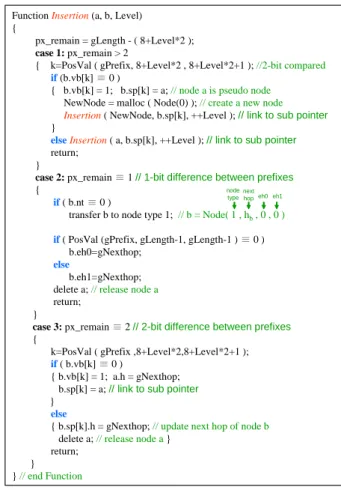
(3) multiple FTBT trees. In FTBT tree construction, if an FTBT node with no entry in the routing map is called a pseudo-node. The next-hop field of a pseudo node always has a value of zero. RTB. [ Routing Table ] Prefix. Length. Next Hop. 00000001*. 8. A. 10001000 11*. 10. B. 11111111*. 8. C. 11111111 0*. 9. D. 11111111 0101*. 12. E. 11111111 0110*. 12. F. 11111111 0111*. 12. G. 11111111 1*. 9. H. Ⅰ. pointer. 00000000 00000001. A . . .. . . .. Ⅱ. 10001000. Node Ⅳ. 1. C. sp[3] Ⅲ. expanded next hop 0. expanded next hop 1. D. H. Ⅳ D. Sub valid bits pointers. 0,1,0, 0. 0. 0. 0,1,1, 1. B. CH. Node Ⅴ. Ⅵ. sp[1]. 0. Pseudo Node (11111111 01*). sp[2] Ⅶ. 0Node. E sp[1]. Sub node type next hop valid bits pointers. Node Ⅴ. Function Insertion (a, b, Level) { px_remain = gLength - ( 8+Level*2 ); case 1: px_remain > 2 { k=PosVal ( gPrefix, 8+Level*2 , 8+Level*2+1 ); //2-bit compared if (b.vb[k] ≣ 0 ) { b.vb[k] = 1; b.sp[k] = a; // node a is pseudo node NewNode = malloc ( Node(0) ); // create a new node Insertion ( NewNode, b.sp[k], ++Level ); // link to sub pointer } else Insertion ( a, b.sp[k], ++Level ); // link to sub pointer return; } case 2: px_remain ≣ 1 // 1-bit difference between prefixes node next { type hop eh0 eh1 if ( b.nt ≣ 0 ) transfer b to node type 1; // b = Node( 1 , hb , 0 , 0 ). Pseudo Node (10001000*). 0 . . .. . . . 11111111. node type next hop. p. If the associated RTB bank points to the null address, then the associated FTBT tree is empty, and a new FTBT tree has to be constructed. Otherwise, the Insertion() function is called to insert the routing entry into the associated FTBT tree. If a tree node in a constructed FTBT tree has no correspondence routing entry, then a pseudo node is inserted.. Ⅵ, Ⅶ, Ⅷ. Ⅴ. F. sp[3]. G. Ⅷ. Figure 4. FTBT Example. if ( PosVal (gPrefix, gLength-1, gLength-1 ) ≣ 0 ) b.eh0=gNexthop; else b.eh1=gNexthop; delete a; // release node a return;. Function Construction (routing table) { /* P = {P0, P1,..., Pn-1} are the routing table prefixes ( unsorted ). li and hi are the length and the next hop of a route prefix Pi respectively.. } case 3: px_remain ≣ 2 // 2-bit difference between prefixes { k=PosVal ( gPrefix ,8+Level*2,8+Level*2+1 ); if ( b.vb[k] ≣ 0 ) { b.vb[k] = 1; a.h = gNexthop; b.sp[k] = a; // link to sub pointer } else { b.sp[k].h = gNexthop; // update next hop of node b delete a; // release node a } return; } } // end Function. 28. RTB is the Range Table which has entries, each entry has a pointer to map a corresponding node. */ while (more entry in routing table) { read one entry ( Pi , li , hi ) from routing table; gPrefix = Pi ; gLength = li ; gNexthop = hi ; //global variables index = PosVal ( gPrefixes , 0 , 7 ); NewNode = malloc ( Node(0) ); //memory allocated node type 0 /* NewNode.nt = 0 , NewNode.h = gNexthop , NewNode.vb = 0 , NewNode.sp = NULL */ if ( RTB[index] ≣ NULL ) { if ( gLength ≣ 8 ) { NewNode.h = gNexthop; RTB[index] = NewNode; } else { PseudoNode = malloc ( Node(0) ); /* PseudoNode.nt = 0 , PseudoNode.h = 0 , PseudoNode.vb = 0 , PseudoNode.sp = NULL */ RTB[index] = PseudoNode; Insertion (NewNode , RTB[index] , 0 ); } }else Insertion (NewNode , RTB[index] , 0 ); }// end while } // end Function. Figure 6. FTBT Insertion Algorithm. Figure 6 shows the FTBT node insertion algorithm Insertion(a, b, level), where variable a represents the desired inserted node, variable b represents insertion location, and level is the level of node b in the tree. The root node is at level zero. Since one FTBT node represents two-bit length of prefix, the prefix length of the current node is given by 8+level*2.. Figure 5. FTBT Construction Algorithm. Figure 5 illustrate the FTBT tree construction algorithm. Initially, the whole RTB points to NULL values. In the CIDR, a routing entry is represented by the (p, l, h) format, where p denotes the route prefix, l is the length of prefix p, and h is the output port number of prefix p. The proposed algorithm does not have to sort the routing table before constructing the FTBT tree.. In the insertion algorithm, the px_remain parameter denotes the number of bits in the prefix that have not yet been processed, up to the current level of the FTBT tree. If px_remain is greater than 2-bit, then the routing entry a must be inserted in the b-node’s branch according to the value k in Fig. 6. If px_remain = 1, then the routing entry is inserted in eh0 or eh1, depending on whether the remained value is 0 or 1. Finally, If px_remain = 2, then the routing entry is also inserted in the branch of node b based on the value k in Fig. 6.. First, the first 8-bit value of the prefix p is extracted and used as the index of RTB. Thus, the first 8-bit value of prefix 8 determines the FTBT tree related to the prefix. - 521 -.
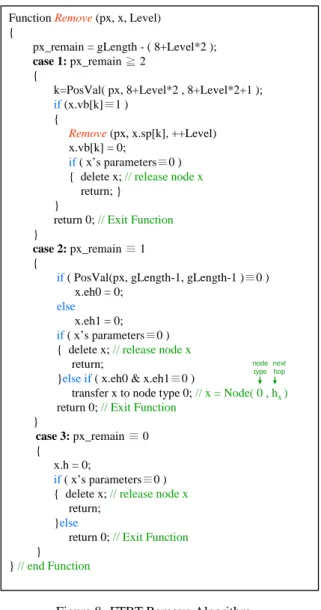
(4) Function Lookup (IP, x, Level) { if ( x.h≠0 ) next_hop = x.h; if ( PosVal ( IP, 8+Level*2, 8+Level*2 )≣0 & x.nt≣1 & x.eh0≠0 ) next_hop = x.eh0; if ( PosVal ( IP, 8+Level*2, 8+Level*2 )≣1 & x.nt≣1 & x.eh1≠0 ) next_hop = x.eh1; k = PosVal ( IP, 8+Level*2, 8+Level*2+1 ) if ( x.vb[k] = = 1 ) // link to sub pointer Lookup (IP, x.sp[k], ++Level ) return next_hop; } // end Function. Figure 7. FTBT Lookup Algorithm. Figure 7 shows the lookup algorithm Lookup(IP, x, Level), where IP is the destination address (DA) of the incoming packet, and x is the current node of the FTBT tree. Using the FTBT tree in Fig. 4, the IP address “11111111010100…0” is now looked up. The first 8-bit value of the IP address is extracted as the index of the RTB. A root node whose next hop is C is then obtained. To reach the LPM (longest prefix matching), the next hop E is finally obtained. The routing table update algorithm in FTBT is implemented by the remove algorithm, Remove(px, x, Level) as depicted in Fig. 8 to avoid reconstructing the FTBT tree. As shown in Fig. 8 shows, px is a prefix value of the desired removal routing entry, x is the current traced location in FTBT tree, and x’s parameters denotes information related to x, such as whether x has an expanded next hop or sub-pointer to another branch. For instance, in Fig. 9, if consider the removal of a routing entry with prefix value “10001111 0001* and a prefix length of 12. The root node is determined via RTB as shown in Fig. 9 (a), and then the FTBT tree is searched until the current location x is node K, as in Fig. 9 (b). Then the x.h is then set to zero. Furthermore, the x’s parameters must be checked to decide whether node K can be removed directly. When the node is removed, x returns to the previous node, as shown in Fig. 9 (c). The x’s parameters is checked continually until the current location x stops at node J, as shown in Fig. 9(d).. Function Remove (px, x, Level) { px_remain = gLength - ( 8+Level*2 ); case 1: px_remain ≧ 2 { k=PosVal( px, 8+Level*2 , 8+Level*2+1 ); if (x.vb[k]≣1 ) { Remove (px, x.sp[k], ++Level) x.vb[k] = 0; if ( x’s parameters≣0 ) { delete x; // release node x return; } } return 0; // Exit Function } case 2: px_remain ≣ 1 { if ( PosVal(px, gLength-1, gLength-1 )≣0 ) x.eh0 = 0; else x.eh1 = 0; if ( x’s parameters≣0 ) { delete x; // release node x node next return; type hop }else if ( x.eh0 & x.eh1≣0 ) transfer x to node type 0; // x = Node( 0 , hx ) return 0; // Exit Function } case 3: px_remain ≣ 0 { x.h = 0; if ( x’s parameters≣0 ) { delete x; // release node x return; }else return 0; // Exit Function } } // end Function. Figure 8. FTBT Remove Algorithm. [ Routing Table ] Prefix. Length. Next Hop. 10001111*. 8. J. 10001111 0001*. 12. K. (a). (b). x. RTB 10001111. RTB 10001111. J. J. (10001111*). (10001111*) sp[0]. sp[0]. 0. 0. (10001111 00*). sp[1]. K. K. (10001111 00 01*). (c). (10001111 00 01*). (d) RTB. x. RTB. 10001111. 10001111. J. x. (10001111*). J (10001111*). sp[0]. 0 (10001111 00*). Figure 9. FTBT Remove Example1. - 522 -. x. (10001111 00*) sp[1].
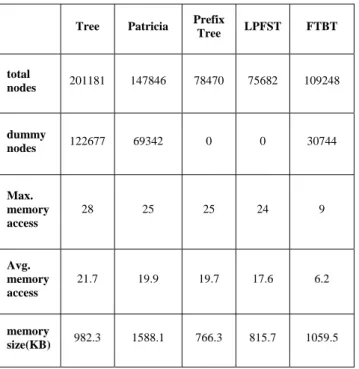
(5) Figure 10 illustrated another example of routing entry removal. In this case, two routing entries are matched and the prefix length differs by one-bit. Figure 10 (a) reveals that the root node must be found via RTB remove the prefix value “11110000 1*”. In this case, px_remain = 1. Since the 9th bit of the prefix value is “1”, the x.eh1 of the current location must be removed. Once the x.eh1 field is clear, the current node x’s parameters is checked, and the node x is changed to node type 0. The associated information of node x at this time is shown in Fig. 10 (b). [ Routing Table ] Prefix. Length. Next Hop. 11110000*. 8. L. 11110000 1*. 9. M. (b). x RTB. L. 11110000 M. (11110000*). (11110000 *). Sub expanded expanded node type next hop next hop 0 next hop 1 valid bits pointers. 0. M. Figure 10.. 0. Sub node type next hop valid bits pointers. NULL. 0. L. 0. O( w) to O(. w−8 ) 2. with a range table size of 28. As shown in Table I, the average number of memory access times for one IP address lookup in a routing table with 78504 entries environment is six. FTBT has a significant performance improvement, but has a larger memory size requirement than other schemes.. RTB. L. 11110000. L. Comparing the average and maximum memory access times reveals that the proposed FTBT performs better than the other schemes. The use of the range table, and the two-bit node representation, both significantly reduce the height of the FTBT tree. For N number of prefix table, the proposed FTBT can reduce the number of memory access times from. (a). 1. Table I presents the simulation results, which indicate the Tree [7], Patricia [8], and proposed FTBT schemes require extra memory space to maintain the dummy nodes. Because an FTBT node is two bits long, and to reduce the routing table update complexity (i.e., require extra dummy nodes), FTBT has a larger memory requirement than other schemes, as shown in Table I.. NULL 0. FTBT Remove Example2. 5: CONCLUSION. 4: PERFORMANCE ANALYSIS Performance of the proposed FTBT scheme is evaluated. The number of total nodes, number of dummy nodes, maximum memory access times, average memory access times and required memory size of the proposed FTBT scheme are simulated and compared with Tree [7], Patricia [8], Prefix Tree [9], LPFST [10] based on the AS3303 routing table, which has 78504 routing entries [11].. This study has proposed a practical software-based scheme called Fast Twin-bit Tree (FTBT) for IP address lookup. The proposed scheme adopts three routing entries to represent one FTBT node, thus reducing the tree height effectively. A range table is adopted to divide a large routing table into a multiple FTBT tree, and to reduce the search space. The height of each FTBT tree in the IPv4 environment is only 12 in the worst cast. The FTBT IP lookup algorithm can effectively reduce the number of memory access times and provide fast routing table update operations. Performance simulation reveals that the FTBT algorithm requires an average of only six memory accesses when applied to a routing table with 78504 entries.. Table I: Performance Comparison Tree. Patricia. Prefix Tree. LPFST. FTBT. total nodes. 201181. 147846. 78470. 75682. 109248. dummy nodes. 122677. 69342. 0. 0. 30744. Max. memory access. 28. 25. 25. 24. 9. Avg. memory access. 21.7. 19.9. 19.7. 17.6. 6.2. memory size(KB). 982.3. 1588.1. 766.3. 815.7. 1059.5. REFERENCES [1] Y. Rekhter and T. Li, “An Architecture for IP Address Allocation. with CIDR,” RFC 1518, 1993. [2] P.Gupta, S. Lin, and N. McKeown, “Routing Lookups in Hardware at Memory Access Speeds,” in Proc. IEEE HPSR2004, pp. 1240-1247, 1998. [3] A. McAuley and P. Francis, “Fast routing table lookup using CAMs,” in Proc. IEEE INFOCOM, pp. 1382-1391, 1993. [4] Ravikumar, V.C.; Mahapatra, R.N.; “TCAM architecture for IP lookup using prefix properties,” IEEE Journal on Micro, pp 60-69, 2004. [5] D. Yu, B. C. Smith, and B. Wei, “Forwarding engine for fast routing lookups and updates,” in Proc. IEEE GLOBECOM, pp. 1556-1564, 1999. [6] H. Lim and Y. Jung, “A Parallel Multiple Hashing Architecture for IP Address Lookup”, in Proc. IEEE HPSR2004, pp. 91-95, 2004.. - 523 -.
(6) [7] Sklower, K., “A Tree-Based Routing Table for Berkeley Unix,” in Proc. USENIX Conf., pp. 93-99., 1991. [8] D.Morrison, “PATRICIA- Practical Algorithm To Retrieve Information Coded in Alphanumeric,” Journal of the ACM, pp.514-534, 1968. [9] M. Berger, “IP lookup with low memory requirement and fast update,” IEEE Conf. on High Performance Switching and Routing, pp. 287-291, 2003. [10] Lih-Chyau W., Kuo-Ming C., Tzong-Jye L., “A Longest Prefix First Search Tree for IP Lookup,” in Proc. IEEE INFOCOM, pp. 989-993, 2005. [11] BGP Table, http://bgp.potaroo.net/ [12] The Routing Arbiter Project, Internet routing and network statistic, http://www.re.net/statistics/ [13] Huang, N.-F., and Zhao, S.-M., “A Novel IP-Routing Lookup Scheme and Hardware Architecture for Multigigabit Switching Routers,” IEEE Journal on Selected Areas in Communications, pp. 1093-1104, 1999. [14] Yazdani, N., Min, and P.S., “Fast and scalable schemes for the IP address lookup problem, ”IEEE Conf. on High Performance Switching and Routing, pp.83-92, 2000. [15] Sharma, S., Panigrahy, R., “Sorting and Searching using Ternary CAMs, ” IEEE Conf. on High Performance Interconnects, pp.101-106, 2002. [16] Chang, R.C., Lim, B.H., “Efficient IP routing table lookup scheme, ” in Proc. IEE on Communications, pp. 77-82, 2002. [17] Zhen Xu, Damm, G., Lambadaris, I., Zhao and Y.Q., “IP packet forwarding based on comb extraction scheme,” in Proc. IEEE INFOCOM, pp. 1065-1069, 2004.. - 524 -.
(7)
數據
+2
相關文件
– Taking any node in the tree as the current state induces a binomial interest rate tree and, again, a term structure.... Binomial Interest Rate
Let us consider the numbers of sectors read and written over flash memory when n records are inserted: Because BFTL adopts the node translation table to collect index units of a
• Definition: A max tree is a tree in which the key v alue in each node is no smaller (larger) than the k ey values in its children (if any). • Definition: A max heap is a
Establish the start node of the state graph as the root of the search tree and record its heuristic value.. while (the goal node has not
The min-max and the max-min k-split problem are defined similarly except that the objectives are to minimize the maximum subgraph, and to maximize the minimum subgraph respectively..
Given a graph and a set of p sources, the problem of finding the minimum routing cost spanning tree (MRCT) is NP-hard for any constant p > 1 [9].. When p = 1, i.e., there is only
• Grow the binomial tree from these three nodes until time T to obtain a binomial-trinomial tree with..
Since the FP-tree reduces the number of database scans and uses less memory to represent the necessary information, many frequent pattern mining algorithms are based on its
