國立高雄大學國際企業管理碩士學位學程
碩士論文
消費價值與文化價值對台灣的韓國流行文化消費行為
之影響:韓語能力的調節效果
Effects of Consumption Value on Korean Pop Culture
Contents Consumption Behavior in Taiwan: The
Moderating Role of Korean Language Ability
研究生(Student):LEE SUNMI撰
指導教授(Advisor):吳建興 博士
I
Acknowledgment
Last two years in the International Master of Business Administration (IMBA) program at NUK in Taiwan feels like a dream that I could never imagine before. During that time, I learned and studied ways to understand Taiwan, South Korea, my country, and the world with wider perspective.
I would like to express my sincere gratitude to those who have been with me during this wonderful academic journey and helped me to have a nice finish.
First of all, I would like to thank Professor ChienHsing Wu, my advisor. He helped me to find out the best solutions by timely advice whenever I face difficulties. I dare to say that he is the best advisor that a student can have. I also want to express my gratitude to committee members, Professor Chuan-Chun Wu and Professor Jian-Xiong Zhao. They read my thesis thoroughly and gave my research wonderful final touches.
I want to thank all members of the faculty in IMBA program. I experienced and learned many things through their great lectures. All of those has helped a lot in my research. I cannot express enough thanks to Joanne, an administrative staff who has always been kind and attentive.
I would like to thank my students at Dajen University and friends at Zion Church for helping me with the interview. Although all of your interviews could not be presented due to space limit, please note that I have done my best to bring academic insights in your interviews into my research.
Last but not least, I want to say many thanks to my husband, John who has always been supportive and helped to handle my other duties than research. Special thanks to my two children 燦 and 琳 who showed great endurance not to interrupt mom’s study.
In unforgettable moments, Sunmi June 2018, Kaohsiung City
II
Effects of Consumption and Cultural Value on Korean Pop
Culture Contents Consumption Behavior in Taiwan:
The Moderating Role of Korean Language Ability
Advisor: Dr. ChienHsing Wu
Department of International Master of Business Administration National University of Kaohsiung
Student: LEE SUNMI
International Master of Business Administration National University of Kaohsiung
Abstract
Despite Korean Pop Culture Contents (KPCC) are gaining popularity in Taiwan for past decades, previous literature has paid a limited attention to revealing why Taiwanese consume KPCC for manufacturers, retailers, or even traders. Using qualitative study, this research thesis proposes and examines a research model that describes association of consumption values and cultural value on KPCC consumption behavior. The consumption value theory advocates that consumption behavior comes generally from functional value, epistemic value, social value, conditional value, and/or social value. Moderation effect of Korean language ability on the model is also investigated. Based on data analysis from interviews of 26 subjects, research findings are obtained showing that (1) functional, epistemic, social and conditional values have strong associations with consumption behavior, (2) emotional and cultural value reveal weak associations with consumption behavior, and (3) language ability partially moderates relationships between consumption behaviors and consumption values. Implications and suggestions are also addressed.
Keywords: Consumption value, Cultural value, Consumption behavior, Korean pop culture contents, Korean language ability
III
Table of Contents
Chapter One: Introduction ... 1
1.1 Research Background ... 1
1.2 Motivation and Objective ... 2
1.3 Research Procedure ... 4
1.4 Thesis Overview ... 5
Chapter Two: Literature Review and Propositions Development ... 7
2.1 KPCC consumption in Taiwan ... 7
2.2 Consumption Value Theory ... 14
2.3 Cultural Value Theory ... 18
2.4 Language ability ... 20
Chapter Three: Research Method ... 23
3.1 Research Model ... 23
3.2 Interview Plan and Subjects ... 23
3.3 Interview Questionnaire ... 24
3.4 Data Collection and Analysis ... 27
Chapter Four: Result and Discussion ... 29
4.1 Descriptive Statistics ... 29
4.2 Reliability and Validity ... 31
4.3 Coding Analysis ... 32
4.4 Propositions Test ... 36
4.5 Discussion and Implications... 41
Chapter Five: Conclusion ... 46
5.1 Research Findings ... 46
5.2 Research Suggestions ... 47
5.3 Limitations and Future Studies ... 48
References ... 50
Appendix ... 52
Appendix A: Formal Interview Questionnaire ... 52
IV
List of Tables
Table 1.1: Research Focus for Past Decade ... 1
Table 2.1: Consumption Contact Routes by Content Type ... 8
Table 2.2: Prototypes by Cultural Orientation ... 19
Table 3.1: Interview Questionnaire Design ... 25
Table 3.2: ACTFL Global Can-Do Benchmarks ... 26
Table 4.1: Overall Demographic Statistics ... 29
Table 4.2: Consumption Behavior Statistics ... 30
Table 4.3: Language Ability and Willingness ... 31
Table 4.4: Example of Text Dividing into Information Segment ... 33
Table 4.5: Example of Code Labelling ... 33
Table 4.6: Key Concepts and Definition List ... 34
Table 4.7: Key Concepts Table for Analysis ... 35
Table 4.8: Proposition Test of P1, P2 and P3 ... 37
Table 4.9: Sub-Proposition Test of P1 and P2 ... 37
Table 4.10: Proposition Test of P4 with High Level of Language... 39
Table 4.11: Proposition Test of P4 with Low Level of Language ... 39
Table 4.12: Sub-proposition Test of P4 with High Level of Language ... 40
Table 4.13: Sub-proposition Test of P4 with Low Level of Language ... 40
V
List of Figures
Figure 1.1: Research Procedure ... 5
Figure 2.1: Consumption of KPCC ... 7
Figure 2.2: Korean Pop Culture Contents Popularity ... 8
Figure 2.3: Popularity Factors of Korean TV drama ... 9
Figure 2.4: Popularity Factors of Korean Reality shows ... 10
Figure 2.5: Popularity Factors of Korean Movies ... 11
Figure 2.6: Popularity Factors of Korean Songs ... 11
Figure 2.7: Popularity Factors of Korean Animations ... 12
Figure 2.8: Popularity Factors of Korean Online Games ... 13
Figure 2.9: Popularity Factors of Korean Books ... 13
Figure 2.10: Consumption Value ... 15
Figure 2.11: Profile of a Country on Seven Cultural Orientations (Schwartz, 2006) ... 19
Figure 3.1: Research Model ... 23
Figure 3.2: Interview Plan ... 24
Figure 3.3: Data Collection and Analysis ... 27
Figure 4.1: Coding Analysis Process ... 32
Figure 4.2: Evidence of Test of Proposition 1, 2, and 3 (first level)... 41
Figure 4.3: Evidence of Test for Five Consumption Values (second level)... 41
Figure 4.4: Evidence for Test of Proposition 4 (first level) ... 42
1
Chapter One: Introduction
1.1 Research Background
Korean Pop Culture Contents (KPCC) have been one of popular cultural products for past few decades. It covers such contents as Korean TV Drama, Korean variety shows, Korean movies, Korean songs, Korean animation, Korean online games, Korean books, and among others. Importantly, consumption of Korean Pop Culture Contents (KPCC),which started in the early 1990s, has been spreading all over the world beyond Asian countries which are close to Korea. It can be said that KPCC has a great business potential because they lead to consumption of other products as well as their own consumption. According to a study on economic effects of KPCC, consumption of KPCC is correlated with the increase of tourists, purchasing of consumer goods such as clothing, household appliances, electronic devices and cosmetics (KOFICE & KOTRA, 2016). There are also reports that KPCC lead to trend of Korean language education in various countries (Jung, 2011; Oh, 2013; Li, 2014). This is a universal phenomenon that appears equally in Taiwan, China, Thailand, and Vietnam. Based on this phenomenon, there have been many studies examining relationship between consumption of KPCC and consumption in other areas of expansion not only in Taiwan but also in other countries (See Table 1.1).
Table 1.1: Research Focus for Past Decade
Author Main Topic
Chen (2012) Relationships among Korean wave, national image, tourism image and revisit intention on the base of Taiwanese tourist.
Lim (2013) The Korean Wave and mention of different variables that influence the consumer purchase intention and investigate the relationship of variables and Taiwanese consumer purchase intention based on the Korean Wave. He (2014) How the Korean wave image and preference of Korean Wave affects
Chinese tourist's consumption value and purchase intentions of made-in Korean products, and how the different kinds of consumption value affects the purchase intentions
Sutida (2015) The Korean Wave different variables that influence on the consumer purchase intention in Thailand.
Previous studies have examined consumption behaviors of consumers consuming KPCC in Taiwan, China, and Thailand by dividing them into purchase intention and
2
repurchase intention (Chen, 2012; Lim, 2013; He, 2014; Sutida, 2015). It can be seen that effect of KPCC on consumption behavior is not a phenomenon only in particular countries and that KPCC influence on consumption behavior related to various consumption types.
According to one research, Taiwan is the third largest consumer of KPCC after China and Japan (Wu, 2015). Based on this consumption scale, the study of Taiwanese consumers is of academic significance. However, there have been little studies for why Taiwanese consume KPCC. Furthermore, research on consumption value and cultural value which affect KPCC consumption are needed of deeper understanding for consumers’ behaviors. Therefore, this study aims to examine consumption values and cultural value of consumers who consume KPCC in Taiwan and how consumer behaviors are affected. In addition, what moderating effect of Korean language ability has in relationship will be examined.
1.2 Motivation and Objective
Occupying market of a country with simple export of consumer goods requires much efforts. However, when cultural elements such as traditional culture, modern culture and arts, and lifestyle are transmitted through cultural contents such as movies, music, cartoons, books, etc., consumers embody the culture in them and reduce psychological distance feeling. Culture is at the core of soft power, and positively influences formation of national brand. In this respect, proliferation of KPCC has more significance not only in terms of cultural influence but also in political and economic aspects. A research reported that consumer goods increase by $ 412 USD when cultural contents exports increase by $ 100 USD because of high effect of trade creation that drives consumer goods exports (KERI, 2012).
Taiwan has a preference for existing products of Europe, United States, and Japan. Therefore, market share of Korean consumer goods in Taiwan is small. However, after Korean wave craze was created a few years ago, awareness of Korean products has been rising and imports are on the rise. In particular, consumer demand in cosmetics and food is growing strongly with local interest in KPCC. Consumers did not hesitate to put their name on the waiting list to purchase indirect advertising products due to fast
3
exhaustion of inventory. Since certain brands were so popular with Taiwanese consumers due to Korean dramas, Korean companies held separate launch events in Taiwan. In addition to consumer goods, particular foods representing Korean pop culture (e.g., fried chicken) are also greatly welcomed locally, and some restaurants have been subject to reservations with high popularity. Main reasons why consumers consume Korean goods or KPCCs are related with satisfaction with quality or price, introduction or recommendation of friend or family, favoritism or trust in Korea (Lim, 2013).
National Communications Commission (NCC) in Taiwan has asked broadcasting stations to reduce quota of Korean dramas (China Times, 2016). As a result, at least 50% in golden time zone between 8 pm and 10 pm was not allowed to broadcast dramas produced overseas. This regulation was according to the data presented by a member of National Assembly of Taiwan in 2011 claiming that broadcasting ratio of Taiwanese production programs is extremely low (Epoch Times, 2011). Although this regulation was supposed to lead to a decline in KPCC or consumption of Korean consumer goods, there is a finding that this is not the case. According to survey, overall interest on Korean products, including fashion, cosmetics, and food, as well as consumer spending intentions increased in Taiwan compared to survey in 2015 (KOFICE, 2016). Compared to a year ago, more and more people are more interested in KPCC than their own. Respondents also expect that more Taiwan consumers will have higher interest on KPCC a year later.
Moreover, another phenomenon worth of paying attention is intention of learning Korean for more active KPPC consumption. Popular trend in Korean language education is shown in status of Test Of Proficiency In Korean(TOPIK) which been practicing since 2005. After the first test in 2005, applicants number has continuously increased from 3,285 in 2011, 4,341 in 2012, 4,026 in 2013, 5,319 in 2014 to 6,184 in 2015 (Jung, 2011). There are many studies on learners who became interested in Korean language due to own KPCC consumption experience or felt need for Korean language education (Im, 2005; Chung et al, 2007; Sinnenart, 2012).
Why do these consumption behaviors appear? Does Korea language ability have something to do with these consumption behaviors? To address those issues, this research thesis aims to propose and qualitatively examine a research model that
4
describes effects of consumption and cultural value on KPCC consumption behavior. Korean language ability is also examined to reveal its moderation effect on research model. The research objectives are defined as follows;
(1) To disclose KPCC consumption behavior in Taiwan.
(2) To explore how consumption and cultural value influences KPCC consumption behavior.
(3) To disclose how language ability moderates the effects of consumption and cultural value on KPCC consumption behavior.
1.3 Research Procedure
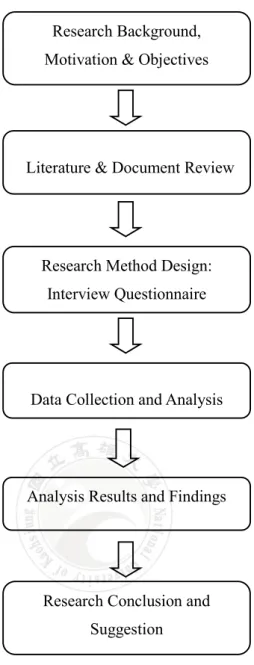
Purpose of this study is to investigate relationship between consumption and cultural values and consumption behavior of KPCC consumers in Taiwan. Moreover, moderating role that Korean language ability in the proposed model is examined. After determining research topic and objectives, next step is to collect and analyze literature which can provide understanding of KPCC consumption in Taiwan. Through this step, area of this study is confirmed and research problem is defined. Research method is a qualitative approach that collects data from subjects by using interview questionnaire. Results are derived upon analysis of collected data and suggestions are made for related industries. The research procedure is show in Figure 1.1.
5
1.4 Thesis Overview
There are five main chapters in this study to complete the research. Further detailed illustrations are stated as follow:
Chapter 1: Introduction - This chapter includes general background about this study and then explains research motivation and objectives, with overview of research procedure and structure of this study.
Chapter 2: Literature Review and Propositions Development - First part of this chapter takes a close look at KPCC consumption in Taiwan. Second part discusses
Research Conclusion and Suggestion
Analysis Results and Findings Data Collection and Analysis
Research Background, Motivation & Objectives
Literature & Document Review
Research Method Design: Interview Questionnaire
6
theories of consumption and cultural values. Lastly language ability is discussed. With slight adjustment and modification, research propositions of this study are proposed.
Chapter 3: Research Method - This chapter explains research methodology conducted in this study, which includes interview plan, questionnaire measuring concept, and collections and analysis of data, with an overall conceptual research model introduced at the beginning of this chapter.
Chapter 4: Results and Discussion – Qualitative analysis is conducted to analyze collected data.
Chapter 5: Conclusion – This chapter represents a short summary of this study and illustrates research findings and suggestions for correlated businesses and industries, and then proposes some directions for future studies.
7
Chapter Two: Literature Review and Propositions Development
2.1 KPCC consumption in Taiwan
Every country has its own cultural, economic, and political characteristics that affect its acceptance of foreign culture. This is also the reason why KPCC entering procedure is various by countries. With colonialism experiences with Spain, Netherlands and Japan in history, Taiwan is relatively familiar with foreign culture. Taiwan does not feel a sense of heterogeneity when accepting foreign cultures. This may explain the reason why KPCC consumption in Taiwan became a hot topic in short period of time. Various research on KPCC in Taiwan found that Taiwan was the first overseas development place of KPCC and KPCC flow, which started with a trend of Korean songs, led to Korean dramas and movies. This flow of KPCC has spread to electronic products, fashion, make-up, Korean education demand, and so on (Wu, 2015).
In the 7th Global Survey on KPCC conducted by KOFICE during October 30th to
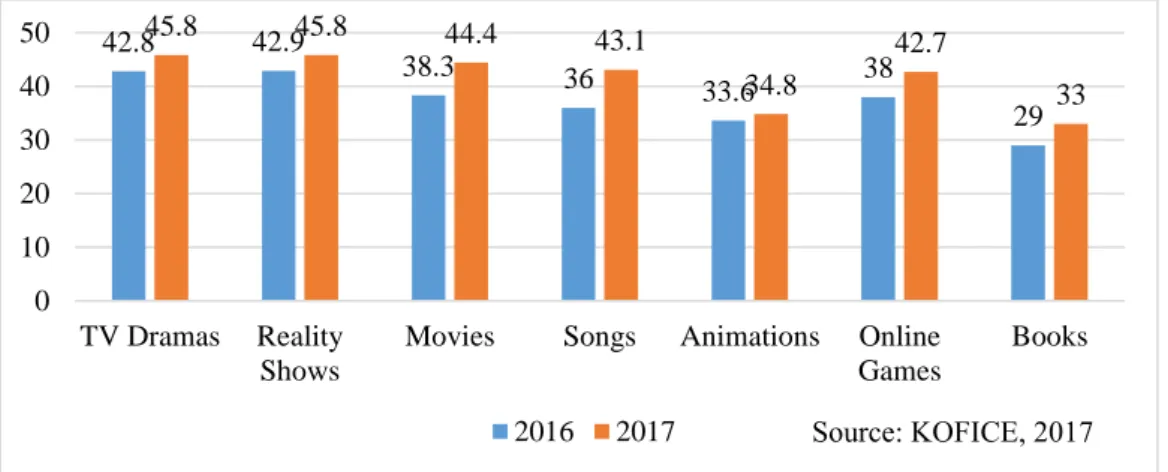
November 13th 2017, 400 Taiwanese respondents participated the survey (Figure 2.1).
For Taiwan's KPCC consumers, 45.8% of consumption of KPCC is in TV dramas and reality shows. In particular, consumption of Korean movies and songs increased by 6.1% and 7.1% each comparing with previous survey results. This implies that in cultural contents consumed by Taiwanese consumers, Korean products account for at least one-third to one-half of the total by contents type, and this proportion is increasing overall.
Figure 2.1: Consumption of KPCC 42.8 42.9 38.3 36 33.6 38 29 45.8 45.8 44.4 43.1 34.8 42.7 33 0 10 20 30 40 50 TV Dramas Reality Shows
Movies Songs Animations Online Games
Books 2016 2017 Source: KOFICE, 2017
8
In Taiwan, most popular KPCC consumption areas are TV dramas, variety shows, music and movies. Respondents answered to a question “How popular do you think KPCC is in your country at this moment?” According to the survey results, it can be seen that consumers in Taiwan think TV drama, variety shows, movies and songs are gaining broad popularity and other three of animations, online games and books are not as that much popular. An element of popularity can be used through interviews to see how it relates to consumers' emotional or social consumption values. The interview questionnaire can be designed to verify whether consumers of more popular content are more likely to show emotional or social consumption values than consumers of less popular contents (Figure 2.2).
Figure 2.2: Korean Pop Culture Contents Popularity
Consumption contact routes are not very various by KPCC type though. Most KPCC are contacted and consumed through TV or online and/or mobile without need of spend money except online games and books which basically require money to consume (Table 2.1). No need for money in KPCC consumption, which is related with functional value of consumers, may have significant effect on consumer behavior.
Table 2.1: Consumption Contact Routes by Content Type
55.3 44.3 43.3 53 22.8 39.8 16.5 28.3 33.5 36.5 28 32.8 28 25.5 10.3 17.8 14.3 15.3 36.5 28.3 36.8 0 10 20 30 40 50 60 70 80 90 100 TV Drama Variety Show Movies Songs Animations Online Game Books
High popularity General popularity Minority fanatic popularity Little popularity
9
Rank TV drama
Reality shows
Movies Songs Animations Online
games Books 1st TV TV TV TV Online& Mobile streaming Mobile Domestic Online market 77.3 % 75.7 % 73.8 % 73.7 % 58.1 % 57.8 % 45.3 % 2nd Online& Mobile streaming Online& Mobile streaming Online& Mobile streaming Online& Mobile streaming TV Online Exhibition 66.7 % 58 % 62.7 % 63.7 % 52 % 52.3 % 34.3 % (Source: KOFICE, 2017)
Answers to the question "What do you think popular factors in Korean dramas are?" are shown in Figure 2.3 below. The results can provide grounds for examining whether the preference for a particular actor is a factor leading to watching the drama. Also, relatively high percentage of respondents, whose answers are drama plot (20.5%) or interesting topics (10.3%), shows expectation or demand of consumer's on the drama content, which is related with functional consumption value. This can be confirmed through interview if functional consumption value plays an important role in drama consumption (Figure 2.3).
Figure 2.3: Popularity Factors of Korean TV drama
26 20.5 10.3 8.8 7.8 7.3 5.8 5 5 3.8 0 5 10 15 20 25 30
Actor's attractive appearance Stylish and elaborate plot Interesting topics in various fields
Unique Korean culture High quality with visual beauty and directing
Korea's latest fashion & beauty trend Indirect living experience in Korea Appearing of favorite star Actor's performance
10
Korean reality show is a cultural product genre introduced relatively late compared to movies and dramas. Nevertheless, it is gaining such high popularity as TV dramas recently. Interestingly, analysis of answers to the popularity factor of variety shows indicates that the second highest factor is star or MC who is preferred by audience (14.5%). This is not directly related with quality of variety shows. Of course, respondents are showing that they have a lot of expectations about quality of contents itself, including the material (22.3%), character (14%), concept or format (9.3%) of variety shows (Figure 2.4).
Figure 2.4: Popularity Factors of Korean Reality shows
A movie is a cultural genre, such as a TV drama, whose plot and theme are important factors to consider. Factors of TV drama are presented similarly in survey results of movies, but ranking of factors is different from the results of TV drama. Stylish and elaborate plot is the highest factor for Korean movies’ popularity in Taiwan (23.5%). Taiwan consumers also like movie actor’s attractive appearance (19%) and interesting movie topics in various fields (10.8%) (Figure 2.5).
22.3 14.5 14 9.3 9 8.5 8 7.3 7.3 0 5 10 15 20 25
Adopting interesting games or materials Appearing of favorite star or MC Personality of character and role of cast Preference on program concept or format Unique Korean culture Korea's latest fashion & beauty trend
Teamwork among cast Indirect living experience in Korea
11
Figure 2.5: Popularity Factors of Korean Movies
Popularity of Korean songs was the first starting point of KPCC fashion in Taiwan. It is also an area that forms a lot of fandom (Wu, 2015). Preference for own favorite singer is at the top (19%). However, many of factors in popularity of Korean songs seem to be related to lyrics, reflecting characteristics of short and simple song lyrics such as addictive lyrics and rhythm (18%), unique pronunciation of Korean lyrics (13.5%) and easy-to-follow lyrics and rhythm (11.3%). This is basis for examining attitudes of consumers who spend songs on Korean language rather than factors related to epistemic function or cultural values related to acquiring knowledge about Korean culture itself (Figure 2.6).
Figure 2.6: Popularity Factors of Korean Songs
23.5 19 10.8 9.3 8.8 8.3 6.8 5.8 4.3 3.8 0 5 10 15 20 25
Stylish and elaborate plot Actor's attractive appearance Interesting topics in various fields High quality with visual beauty and…
Actor's performance Unique Korean culture Indirect living experience in Korea Korea's latest fashion & beauty trend Appearing of favorite star Combination of traditional and modern…
19 18 13.5 11.3 10.5 10.3 6.8 5.5 5.3 0 5 10 15 20
Attractive appearance & style of singers Addictive lyrics and rhythm Korean lyrics with unique pronunciation
Easy-to-follow lyrics and rhythm Outstanding performance of singers Korea's latest fashion & beauty trend
Fan management of the singers Differentiated concept of singers Combination of Korean and English lyrics
Source: KOFICE, 2017
12
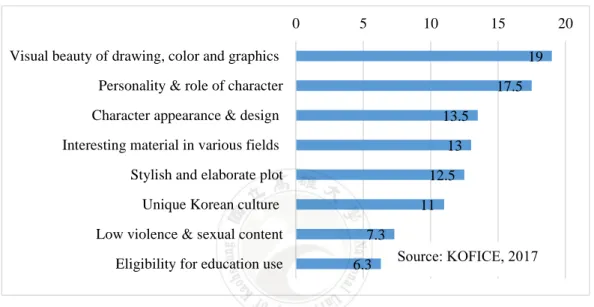
As shown in figure 2.2, Korean animation is a popular among minority fanatics rather than general population. Consumers of animations consider visual beauty of drawing, color and graphics most (19%) followed by personality and role of character (17.5%), character appearance and design (13.5%) and interesting material in various fields (13%). Eligibility for education is also taken into consideration as a factor for popularity (6.3%) (Figure 2.7).
Figure 2.7: Popularity Factors of Korean Animations
Online games also belong to recent cultural content consumption area. In particular, Korean online game Lineage is becoming popular (China Post, 2017). The most important reason why Korean online games are popular in Taiwan is game play method and composition (23.5%). Interestingly, many respondents (17.3%) answered that Korean stars' advertising and promotions are important factors. Perhaps this is in common context that the same factor appears in popularity factor survey results of TV dramas, movies, and variety shows as well. Preference for game graphics and pictures (17%) and satisfaction with character and role of game character (16.3%) are followed thereafter (Figure 2.8). 19 17.5 13.5 13 12.5 11 7.3 6.3 0 5 10 15 20
Visual beauty of drawing, color and graphics Personality & role of character Character appearance & design Interesting material in various fields Stylish and elaborate plot
Unique Korean culture Low violence & sexual content
13
Figure 2.8: Popularity Factors of Korean Online Games
Korean books belong to the least popular cultural content area. At the same time, however, it is also with the highest fanatic popularity. Especially, for those who started as KPCC consumers and became interested in learning Korean language, Korean books provide an important tool to help understanding Korean culture. The most important factors for those consumers are uniqueness of Korean culture (21.3%) and interest and learning demand for Korean language (20.8%). Also, the reason that those books are the original work of famous Korean dramas and movies is also an important factor for Korean book consumption (12.5%) (Figure 2.9).
Figure 2.9: Popularity Factors of Korean Books
23.5 17.3 17 16.3 11.5 9.5 5 0 5 10 15 20 25
Game play method & structure Advertising & promotion by Korean Star
Preference on graphics & pictures Character's personality & role Networking with other gamers Stylish and elaborate plot Low violence & sexual content
21.3 20.8 17.8 12.5 10.3 10.3 7.3 0 5 10 15 20 25
Unique Korean culture Interest and learning demand for Korean… Original work of popular drama & movies
Interesting material in various fields Indirect experience of living in Korea
Composed and detailed content Latest trend in Korea
Source: KOFICE, 2017
14
In 2.1, the survey data of KOFICE in 2017 was reviewed to examine KPCC consumption in Taiwan. Consumption and popularity by KPCC type were presented firstly, and then reasons why consumers like each type were followed. KPCC consumption is caused by functional elements such as plot, theme, and visual effect, but it is also caused by the unique Korean culture or latest fashion and beauty trends of Korea. In addition, the fact that favorite entertainers appearing is an important reason for consumption of TV dramas, movies, and variety shows. In the following parts, consumption value theory and cultural value theory will be reviewed as a basis for analyzing behaviors of consumption of these various consumers.
2.2 Consumption Value Theory
This study tries to examine values that consumers have when consuming Korean pop culture contents in Taiwan. Therefore, Consumption Value introduced by Sheth, Newman and Gross (1991a, 1991b) will be the most relevant model to apply.
Interest in and relevance to human values has been developed not only in personal psychology domain, but also in academic field of behavioral studies, marketing, and social structure. After Rokeach (1973) first introduced 18 items of terminal value and 18 items of instrumental value as a measure of human value system, the following studies continued to investigate and evaluate people’s dominant values (Kahel et al., 1986; Munson & MacQuarrie, 1988)
Sheth et al (1991) pointed out that Rokeach value scale has limitations in explaining consumption behavior of consumers, and extracted values related to human consumption behavior, and tried to explain reasons for choosing purchase / non-purchase of a specific product or use / non-use of a particular product, and reason for selection of trademark or brand. Sheth et al. (1991) proposed five values that are closely related to human life and behavior, using the term consumption value. They also argued that consumption value is the biggest influence on market choice.
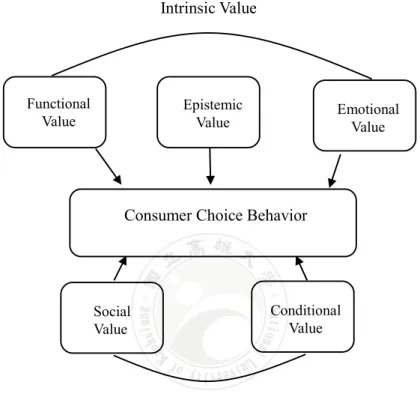
Sheth et al. (1991a, 1991b) identified five values in their theory, which are functional value, social value, emotional value, epistemic value, and conditional value that lead to affect consumer choice behavior, and also suggested three fundamental propositions to the theory:
15
1. Consumer choice is a function of multiple consumption values.
2. Consumption values make differential contributions in any given choice situation.
3. Consumption values are independent.
Figure 2.10: Consumption Value
Five consumption values can be grouped into two categories according to the characteristics of each value; intrinsic value and an extrinsic value (Figure 2.10). Intrinsic value is inseparable since it is close to the object and essential. Among the five consumption values, functional, epistemic, and emotional values are included in this group. Extrinsic values are those related externally to the nature of the object and are separable from the object. This includes social and conditional values.
2.2.1 Intrinsic Consumption Value 2.2.1.1 Functional Value
Functional
Value Epistemic Value Emotional Value
Social Value
Conditional Value
Consumer Choice Behavior Intrinsic Value
16
Functional value is the most important value of consumers in choosing a brand. Traditionally, consumers are more aware of practical and physical functions such as product quality, function, price and service. Consumers who value practical and physical properties seek functional value and choose alternatives that satisfy them. For example, it can be said those related to product attributes such as price, function, and durability, which consumers consider when purchasing a mobile phone, fall within the scope of functional value.
In the case of Korean pop culture contents, fun, price, and accessibility may belong to functional value. An important point in sustaining consumption of cultural contents is consumer satisfaction. If consumer satisfaction is not acquired or sustained, his or her consumption behavior ends in a one-off process. Quality, price, and accessibility included in functional value not only determine the first impression of a specific cultural product entry, but also can be a factor affecting continuous consumption. Even if consumers satisfy their epistemic or emotional needs through consumption of KPCC, consumption behavior cannot be sustained unless consumers are satisfied with quality, price and accessibility.
2.2.1.2 Epistemic Value
Epistemic value is related to curiosity seeking, novelty seeking, pursuit of exploratory behavior, and intellectual desire. Purchasing behavior of a consumer pursuing a rarity can result in product purchase without any need for other values (Sheth et al, 1991). Products with a value for a customer who pursues a desire for curiosity, knowledge, or novelty must be new and different in consumer experience through uniqueness or innovations.
In KPCC consumption, consumers may consume KPCC because they can acquire new knowledge and new indirect experience without cliché. Effects of epistemic value on consumption of KPCC can be shown through interviews about cultural difference that Taiwanese consumers feel in KPCC consumption. Being aware of differences between other cultural contents that they were originally consuming and KPCC that they are currently consuming can explain how epistemic value affects KPCC consumption behavior of consumers.
17
2.2.1.3 Emotional Value
Emotional value is perceived utility of a consumer to their ability to cause a particular feeling or emotional state by purchasing products. Consumers can associate specific emotions with positive or negative emotions in product consumption It can be said that when you are there, you get emotional value. Emotional value is understood as a concept involving aesthetic value with more importance to consumers’ empirical viewpoint, and playing an influential role in many purchasing situations.
Thus, emotional value refers to a particular emotion or feeling that a consumer perceives when purchasing a particular product, which has a comprehensive impact and causes unexpected behavior or purchase to appear in a large number of consumer choice situations. In this study, subjects will be asked what kind of feeling they feel during KPCC consumption. In personal experiences of KPCC consumption, those feelings will be specified and studied if those feelings have either positive or negative effects on consumption behavior. Accordingly, the research defined the first propositions and its sub-propositions as follows;
P 1: Intrinsic consumption value is associated with KPCC consumption behavior P 1-1: Functional value is associated with KPCC consumption behavior P 1-2: Epistemic value is associated with KPCC consumption behavior P 1-3: Emotional value is associated with KPCC consumption behavior
2.2.2 Extrinsic Consumption Value 2.2.2.1 Social Value
Social value is consumption value associated with social hierarchical group that consumes products. The value that can express belonging sense and belonging to typical demographic characteristic groups, socioeconomic discrimination groups. Sheth et al. (1991a) reported that products can be obtained by contacting one or more social groups, which are defined on the basis of demographic, socio-economic, ethno-cultural characteristics, and positive or negative concepts are tended to be defined by consumers.
18
of social value on KPCC consumption may be able to be searched by asking subjects whether there are any social groups sharing a common topic among the subjects, what images those groups have, and how relationships with the groups are set. Senses of belonging to peer group or feelings of alienation owing to not consuming KPCC can be seen as social values.
2.2.2.2 Conditional Value
Conditional value refers to perceived value of choice alternatives differently by the consumer (Sheth et al. 1991). Conditional values include social values and functional values. Situational social value is caused by situations where consumers temporarily change his or her desire to associate with certain social groups, and situational functional value has the importance of the consumer. It occurs in a situation where the evaluation criteria for beliefs is temporarily changed.
It is possible to understand KPCC consumption behavior related to conditional values by asking subjects ‘What special occasion makes you consume KPCC?’ Accordingly, the research defined propositions as follows;
P 2: Extrinsic consumption value is associated with KPCC consumption behavior P 2-1: Social value is associated with KPCC consumption behavior
P 2-2: Conditional value is associated with KPCC consumption behavior
2.3Cultural Value Theory
Schwartz (2006) summarized seven cultural value orientations that form three cultural value dimensions through data analysis from 76 countries (see Figure 2.11). This gives us a closer insight into characteristics of culture. Culture is rich complex of meanings, benefits, practices, symbols, norms and values prevalent among people in a society. Culture also joins with social structure, history, demography, and ecology in complex reciprocal relations that influence every aspect of how people live (Table 2.2).
19
Figure 2.11: Profile of a Country on Seven Cultural Orientations (Schwartz, 2006) Table 2.2: Prototypes by Cultural Orientation
Orientation Prototypes
Autonomy Intellectual broadmindedness, curiosity
Affective pleasure
Embeddedness social order, obedience, respect for tradition
Egalitarianism social justice, equality
Hierarchy authority, humble
Harmony unity with nature, world at peace
Mastery ambition, daring
In autonomy cultures, people are viewed as autonomous, bounded entities. The autonomy consists of two types: Intellectual autonomy which encourages individuals to pursue their own ideas and intellectual directions independently. Affective autonomy encourages individuals to pursue affectively positive experience for themselves. Important values include pleasure, exciting life, and varied life. However, in culture with an emphasis on embeddedness, people are viewed as entities embedded in collectivity. Meaning in life comes largely through social relationships, through identifying with groups, participating in its shared way of life, and striving toward its shared goals. Embedded cultures emphasize maintaining any current status and restraining actions that might disrupt in-group solidarity or traditional orders. Important values in such cultures are social order, respect for tradition, security, obedience, and
20
wisdom.
In the culture of egalitarianism, people seek to recognize one another as moral equals who share basic interests as human beings. People are socialized to internalize a commitment to cooperate and to feel concern for everyone's welfare. They are expected to act for benefits of others as a matter of choice. Important values in such cultures include equality, social justice, responsibility, help, and honesty. However, in the culture of hierarchy, people rely on hierarchical systems of ascribed roles to insure responsible, productive behavior. It defines unequal distributions of power, roles, and resources as legitimate. People are socialized to take hierarchical distributions of roles for granted and to comply with obligations and rules attached to their roles. Values like social power, authority, humility, and wealth are highly important in hierarchical cultures.
Important values in harmony cultures include world at peace, unity with the nature, and protecting the environment. Mastery encourages active self-assertion in order to master, direct, and change natural and social environments to attain group or personal goals. Values such as ambition, success, daring, and competence are especially important in mastery cultures.
As shown in Figure 2.11, Taiwan and South Korea are in similar position in cultural profile on seven cultural orientations, especially embeddedness and autonomy orientations are almost same. However, Taiwan is slightly higher than South Korea in egalitarianism and in harmony. South Korea is slightly higher than Taiwan in hierarchy and mastery. How consumers perceive those trivial differences between harmony and mastery or egalitarianism and hierarchy and how their perceptions are related to KPCC consumption may be seen through interviews. Accordingly, the research defined propositions as follows;
P 3: Cultural value is associated with KPCC consumption behavior
2.4 Language ability
There have been many studies that cultural closeness coming from Korean popular culture contents improves images of Korea and leads to the enjoyment of Korean culture (Im, 2005; Chung et al., 2007; Shon & Jeon, 2011; Sinneenart, 2012). Shon & Jeon (2011), which studied 797 Korean language learners for learning maintenance and
21
motivation, shows that language learning motivation is higher when learners’ interest in popular culture is higher, which can be deduced that language learning has a relationship with cultural contents.
Direct relationship between development of Korean pop culture contents and Korean language are found in many research (Im , 2005; Chung et al., 2007; Sineenart, 2012). Im (2005) analyzed results of questionnaires of 266 learners who are studying Korean language at Korean educational institutes in Korea, and reported that popular culture appears to be the second place among the motivations of interest in Korean language learning. Chung et al. (2007) also pointed out the correlation between KPCC and Korean language learning. In Japan, more than 70% of Korean learners have presented influences of popular culture on motivation of learning Korean, and more than 80% of learners learn Korean through popular culture. In the study of Sineenart (2012), 60% of survey respondents reported that interests in Korean drama, film, and music, which are components of Korean culture in Thailand, are linked to the learning of Hangul, Korean characters.
In addition to the findings that consumption of popular culture is motivated by language learning, there are also interesting research findings that the level of foreign language acquisition is related to consumption of cultural contents. Toyoshima (2013) examines two hypotheses that exposure to Japanese cultural products induces Japanese learning and vice versa, that means learning Japanese results in consumption of another Japanese cultural product. Also, unlike English or Japanese language lessons, which have more practical and multidimensional purposes, Korean learning is due to interest and affection for Korean popular culture. Therefore, looking at the Korean language ability is a good measure of attitudes toward Korean culture consumption, because it is more important to have a function as a 'culture language' in which learners can enjoy Korean culture.
Results of those studies suggest that Taiwanese consumers will also have a learning demand for Korean language while consuming cultural products and that Korean language ability will have impact on consumption of Korean cultural products. In this study, language ability is assumed as another variable. It will be investigated whether Taiwan consumers have Korean language ability and how this ability relates to consumption of Korean cultural products.
22
Accordingly, the research defined propositions as follows:
P4: Language ability moderates the effects of consumption value on KPCC consumption behavior
P 4-1: Language ability moderates the effects of intrinsic consumption value on KPCC consumption behavior
P 4-2: Language ability moderates the effects of extrinsic consumption value on KPCC consumption behavior
P 4-3: Language ability moderates the effects of cultural value on KPCC consumption behavior
23
Chapter Three: Research Method
3.1 Research Model
In this chapter, a research model for studying how consumption values and cultural values are related to consumption behavior of Taiwan KPCC consumers and moderating role of language ability in the process is presented. The research method, contents of the questionnaire, plan, and analysis method of the questionnaire answers are presented. With all the derived research propositions, Figure 3.1 is the research model of this study. It contains three independent variables and one moderator, and dependent variable as well, consumption behaviors which are shown among consumers.
Figure 3.1: Research Model
3.2 Interview Plan and Subjects
Since the purpose of this study is to investigate consumption value and cultural value related to KPCC consumption behavior, Taiwanese consumers who have experienced KPCC consumption are set as subjects. With consideration of the study purpose about the Korean language ability’s moderating role, the language communication ability level is not screened out when choosing interview subjects. Considering demographic distributions, both men and women are selected as interview subjects, age and residential areas are also considered to be evenly distributed.
The method of interview is to conduct in a face-to-face manner and the interview is recorded using electric device. All interview protocols and non-verbal reactions are
Cultural Value Intrinsic Consumption Value
Extrinsic Consumption Value
Language Ability P1
P2 P3
P4
Korean Pop Culture Contents Consumption
24
written in memos. Collected data may be supplemented by follow-up interviews whenever it is necessary. However, in order to obtain sufficient number of subjects for the qualitative approach of this study and to achieve a demographically even distribution, the subjects may be contacted online. The expected number of subjects will be around 25. A rolling sample may be used if the number of invited subjects are not enough.
Rapport formation (Creswell 2005), the psychological consensus of the researcher and the subjects, is a necessary factor in successful research in the case of qualitative research that needs to understand insiders' perspectives and their ideas. Therefore, both face-to-face interviews and online interviews will achieve rapport formation through a couple of conversations at first rather than one-off interviews. After formation of rapport, the interviews are conducted on an uninterrupted quest for interview guides and endless questions and information to facilitate discussing issues in a semi-structured or unsemi-structured way. Interview is conducted in-depth style with enough time. Design of interview plan is as follow (Figure 3.2).
Figure 3.2: Interview Plan
3.3 Interview Questionnaire
Through reviews of related literature and previous studies, the overall goals of interview questionnaire design by categories is shown in Table 3.1 and details are presented in Appendix A.
• Identify subjects • Interview arrangement Before
• Rapport formation
• Interview (Audio recording) During
• Transcription • Subject checking
• Follow-up interview(if necessary) After
25
Table 3.1: Interview Questionnaire Design
Category Subcategory Questionnaire design goal
Personal information
Gender Age Residency
To understand consumers’ basic background and find any meaningful relation with consumption behavior KPCC Content type Period Frequency Expenditure Activeness
To understand consumers’ consumption behavior in Korean Pop Culture Contents
Consumption value Functional Epistemic Emotional Social Conditional
To understand consumers’ consumption value by each subcategory (Sheth, Newman, and Gross, 1991a)
Cultural value To understand consumers’ attitude toward cultural difference between Korea and Taiwan appearing in KPCC (Schwartz, S. H., 2006; Pan Yetao, 2013) Language Ability
Ability
Learning period Motivation Willingness
To understand consumers’ attitude toward Korean language, which will be used to find any moderating role between independent variables and dependent variables (Oh, 2013; Toyoshima, 2013)
In order to understanding the subjects’ experiences, opinions, comments, and expectation about KPCC consumption and relation with consumption behavior, the interview questionnaire is designed into four parts; background, KPCC, consumption value and cultural value, and language ability. Each question has open-ended structure to draw out unconstrained experiences and opinions from subjects.
The first part of the questionnaire asks personal information of subjects, which are gender, age, and residency. And the next part asks questions designed to understand consumption behavior of subjects on content type, period, frequency, expenditure and activeness. Results of this part will be dependent variables in analysis. The following parts of consumption value and cultural value ask subjects attitude toward each value, results of which will be independent variables in analysis. Lastly, the questionnaire asks about language ability and attitude of subjects to confirm moderating role of language between dependent variables and independent variables.
26
Guidelines will be used in this study. ACTFL Proficiency Guidelines are created by the American Council on the Teaching of Foreign Languages in order to provide a means of assessing the proficiency of a foreign language speaker. The guidelines are divided into different proficiency levels: novice, intermediate, advanced, superior, and distinguished. Additionally, each of these (except superior and distinguished) is further subdivided into low, mid and high. These proficiency levels are defined separately for ability to listen, speak, read and write (Table 3.2).
Subjects can answer their language skills in one of ten steps from 1 to 10, and the contents of the language ability at each stage are shown in Table 2.2. If a subject answer that he or she has the ability to speak Korean, the level corresponding to the Korean language ability of the respondent will be verified in Table 2.2 and recorded in the questionnaire. Language ability will be analyzed if it has any moderating role on relationship between consumption value and KPCC consumption behavior.
Table 3.2: ACTFL Global Can-Do Benchmarks
Number Language level Can-do statements
1 Novice low I can communicate on some very familiar topics using single words and phrases that I have practiced and memorized. 2 Novice mid I can communicate on very familiar topics using a variety of
words and phrases that I have practiced and memorized. 3 Novice high I can communicate and exchange information about familiar
topics using phrases and simple sentences, sometimes supported by memorized language. I can usually handle short social interactions in everyday situations by asking and answering simple questions.
4 Intermediate
low
I can participate in conversations on a number of familiar topics using simple sentences. I can handle short social interactions in everyday situations by asking and answering simple questions.
5 Intermediate
mid
I can participate in conversations on familiar topics using sentences and series of sentences. I can handle short social interactions in everyday situations by asking and answering a variety of questions. I can usually say what I want to say about myself and my everyday life.
6 Intermediate
high
I can participate with ease and confidence in conversations on familiar topics. I can usually talk about events and experiences in various time frames. I can usually describe people, places, and things. I can handle social interactions in everyday situations, sometimes even when there is an unexpected complication. 7 Advanced I can participate in conversations about familiar topics that go
27
low beyond my everyday life. I can talk in an organized way and
with some detail about events and experiences in various time frames. I can describe people, places, and things in an organized way and with some detail. I can handle a familiar situation with an unexpected complication.
8 Advanced
mid
I can express myself fully not only on familiar topics but also on some concrete social, academic, and professional topics. I can talk in detail and in an organized way about events and experiences in various time frames. I can confidently handle routine situations with an unexpected complication. I can share my point of view in discussions on some complex issues.
9 Advanced
high
I can express myself freely and spontaneously, and for the most part accurately, on concrete topics and on most complex issues. I can usually support my opinion and develop hypotheses on topics of particular interest or personal expertise.
10 Superior I can communicate with ease, accuracy, and fluency. I can participate fully and effectively in discussions on a variety of topics in formal and informal settings. I can discuss at length complex issues by structuring arguments and developing hypotheses.
3.4 Data Collection and Analysis
After the researcher completes data collection through interviews, voice recording and memos are produced. The researcher prepares this raw data for analysis. The voice recording is typed and documented, and the memos are organized separately. The researcher repeatedly reads the documented data slowly and acquires the concepts contained therein. The researcher then codes the data and finds keywords to be used in the study (Figure 3.3).
Figure 3.3: Data Collection and Analysis
For data organizing, subject number is used. Each subject has own number based on the interview date and order. Voice recording file, documented file after typing and memos are organized by subject number in order to help accurate preparing. In data
28
preparing phase, transcription, which is the process of converting audio data into text data, is the most important task. During transcription, enough margins on both sides of paper and extra spaces between lines are left for the following analysis phase. In data reading phase, highlighters and pens are used to capture general concepts in the data text. Data coding is done by hands since sample size is not big and analysis by hands is easy to keep track of files and locate text passages.
29
Chapter Four: Result and Discussion
4.1 Descriptive Statistics
Data was collected in Taiwan in January to March 2018 through in-depth interviews, each about one-hour-long. Research subjects mainly consisted of two groups 1) Korean language learning students of the researcher, 2) participants recruited through advertisements seeking interviewees in local community. 26 subjects were interviewed in ono-to-one interview setting which allowed inquiring for further information on consumer behavior, which uncovered and mapped consumer experiences in KPCC. The overall distribution of demographic statistics and consumption behaviors are seen as follows (Tables 4.1 and 4.2). Details for demographic information of subjects are presented in Appendix B.
Table 4.1: Overall Demographic Statistics
Gender Number of subject Percentage
Male 5 19.2% Female 21 80.8% Age Under 20 2 7.7% 21-30 21 80.8% 31-40 2 7.7% 41-50 1 3.8% Residency Northern 2 7.7% Middle 3 11.6% Southern 20 76.9% Eastern 1 3.8%
The location of the institution where the researcher worked and the research site results in tendency of the subject's residential area to the south. However, gender and age distribution is reflected with current KPCC consumer distribution in Taiwan or overseas, which can be verified in previous studies on KPCC consumers(Jung, 2011; Jin, 2012; Lim, 2013).
30
Table 4.2: Consumption Behavior Statistics
Content type (top preference) Number of subject Percentage
Songs 13 50%
TV drama 11 42.3%
Variety show 2 7.7%
Content type (multiple choice)
TV drama 25 25.8% Variety show 20 20.6% Movies 19 19.6% Songs 16 16.5% Animations 5 5.2% Online games 9 9.3% Books 3 3.1% Period (Year)
Less than 5 years 7 26.9%
5-10 years 15 57.7%
More than 10 years 4 15.4%
Frequency (%) Less than 50% 5 19.2% More than 50% 14 53.8% 100% 7 26.9% Expenditure(Unit: NTD) None 11 42.3% Under 1000 12 46.2% More than 1000 3 11.5% Activeness (Rank) 1 2 7.7% 2 3 11.5% 3 2 7.7% 4 11 42.3% 5 8 30.8%
Korean song is the top priority based on subjects’ respondents. 13 subjects out of 26 subjects answered that they prefer consuming songs in all KPCC, which counts for 50%. Followed by drama (42.3%) and variety (7.7%). However, TV drama seems to be the content that subjects consume most in KPCC, followed by variety shows and movies when multiple choice is allowed. The difference between the top preference and the most consumed contents is the basis for confirming the consumption patterns spread from one type of KPCC to another.
Average KPCC consumption period of subjects is about 7 years. Frequency of consumption varies from half of all to all. Almost half of subjects spend no money on
31
KPCC consumption since they consume KPCC through internet streaming service on Youtube, which costs them no money. Consumers with top preference on songs are more likely willing to spend money on KPCC for buying CDs or concert watching. Average activeness of subjects is 3.8.
Language ability of subjects, which is another factor in this study is presented in Table 4.3 with actual level of language ability according to Can-do Benchmarks in Table 3.2 and their willingness to learn for KPCC consumption purpose is also presented.
Table 4.3: Language Ability and Willingness
Language ability level Number of subject Percentage
1 15 57.7% 2 6 23.1% 3 2 7.7% 4 3 11.5% Learning willingness No 4 15.4%
Yes, for KPCC purpose 9 34.6%
Yes, but for other purpose than KPCC 13 50.0%
4.2 Reliability and Validity
The researcher took necessary measures from the beginning to ensure reliability and validity of this study. During the questionnaire design phase, a focus group was observed for the reliability. Three subjects who learned Korean from the researcher were observed while they were sharing of experiences and thoughts on KPCC consumption. This focus group observation was conducted twice and the researcher did not ask specific questionnaire questions during observations. This helped to gain detailed concepts of the interview questionnaire design.
After the questionnaire was designed, the researcher conducted individual discussion with one peer researcher so that the researcher could not be buried in subjective insights of oneself. The peer researcher has been teaching Korean language to Chinese learners who have high interest in KPCC consumption in China. This was helpful to find out whether there is a logical weakness of the questionnaire design of this study.
32
During the interview, the researcher tried not to direct, guide or elaborate subjects’ answers to avoid deep involvement, unless when there was need for mutual communications or term explanation. All question items in the questionnaire were read and answered.
After each interview, the audio data was transcribed and the finalized transcript was presented to subjects again to ensure the contents are exactly what subjects want to express. The researcher reviewed the literature several times and tried to maintain the sensitivity to the topic to be analyzed between interviews and coding phases. In addition, transcripts, coding results, and notes were repeatedly examined with time lag so that they may not be sunken in one viewpoint.
4.3 Coding Analysis 4.3.1 Coding Process
Process of coding analysis in this study is designed with four phases and those phases are not straight but interactive (Creswell, 2006). First two stages can be done again in the third and fourth stages by repetitive analysis (Figure 4.1).
Figure 4.1: Coding Analysis Process
The researcher read the completed text data slowly and thoroughly, and marked it with a highlighter in the areas where general idea can be obtained. After acquisition of
Reading through text
data
Dividing text into segments of information Label the segments with codes Reduce overlap and redundancy of codes
33
general idea, the researcher read the text data again, found information segments, placed parentheses, and recorded ideas or keywords related at the extra space or margins (Table 4.4).
Table 4.4: Example of Text Dividing into Information Segment Subject Number :18012702
Questionnaire items:
On subject’s KPCC consumption experience
I like listening to songs. Although I can’t understand Korean, the music is very good. And Chinese subtitle is provided and I like melody itself. I originally like to listening to songs. Except IU who is my favorite Korean singer, I also like Wuyuetian (Mayday), Taiwanese music band. Time amount of listening Korean songs counts for 50% I guess. I like IU herself as well as her songs and melody since I think she is very talented. She can sing, compose, write lyrics and act as well. And she looks very cute. I set big picture of her on my laptop screen. I not only listen to her songs but also search any movies, drama or variety shows she is appearing for watching on the web. She appeared in “Dream High” with Kim Soo Hyun and also acted in “Producer” with Cha Tae Hyun who recently appeared in the movie titled “Yu Shen Tong Xing”, She also appeared on Korean version of “Scarlet Heart (Bubu Jingxin)”.
During dividing texts into information segments, the researcher not only got answers that fit intentions of the questionnaire, but also gained insight into factors or relationships that could be helpful in further research, which can be developed deeper in the following interviews. Those insights are results of natural observation obtained through interviews, not intentions in this study or questionnaire.
After text dividing phase, the researcher labelled segments of information with codes for analysis. Those codes were tailored to the keywords and sub - keywords that fit the independent variable classification for ease of analyzing relationships between independent and dependent variable (Table 4.5).
Table 4.5: Example of Code Labelling Subject Number :18012702 Questionnaire items: Language ability’s role in KPCC consumption Consumption proliferation into different contents type Consumption frequency
34
Experience about most impressive culture of Korea
Korean food, I think. Those foods that Korean people eat such as Soju, Korean barbecue, or Sea weed soup on birthdays. Actually when I saw Korean food that I haven’t experienced on TV drama or movies, I usually go to Korean restaurant to try that by myself. I think food is very impressive culture. Usually I go to Korean restaurant with my friends who like to try new food. I like eating and hot dishes. I found in dramas that when eating Korean barbecue, drinking Soju is better. So I bought Soju when I went to eat barbecue. I think Jinro brand is better than the other one.
During code labelling phase, the researcher sought to find keywords that could reveal common phenomena or relationships found in subjects, beyond the values and subcategories set by the previous literature review. Just like the previous two phases, code labeling phase is not performed once but repeatedly over time so that as much coding as possible is achieved.
Last phase of coding process is to reduce overlap and redundancy of codes. After code labelling phase is processed several times, the twelve labelled codes are organized and prepared by table for analysis (Table 4.6).
Table 4.6: Key Concepts and Definition List
No. Key Concepts Definition
1 Quality satisfaction Consumer’s satisfaction on any traits of KPCC
2 Cost effectiveness Consumer’s satisfaction on price over quality of KPCC
3 Real time accessibility Access to KPCC without obstacles in language and time
4 New knowledge acquisition Korean culture practiced in consumer’s life style
5 Indirect experience Understanding Korean culture
6 Sense of belonging Sense of belonging to a major community of consumer
7 Pride Pride as a KPCC consumer
8 Group with similar interest Contact with consumer groups with similar interests
9 Particular activity Experience of activity with needs on KPCC
10 Particular purpose Experience of situation with needs on KPCC
11 Perceived hierarchy Perception of higher hierarchy in Korean culture
12 Perceived mastery Perception of higher mastery in Korean culture
4.3.2 Coding Results
Based on key concepts derived from coding process, the researcher counted
Indirect experience (Epistemic value) New knowledge (Epistemic value) Consumption proliferation into different product type
35
occurrence frequencies of corresponding key concepts in each subject's text document (Table 4.7).
Table 4.7: Key Concepts Table for Analysis Independent Variables Key Concepts Number of Subject Percentage Category Subcategory Consumption value Intrinsic Functional Quality satisfaction 24 92.3% Cost effectiveness 9 34.6%
Real time accessibility 13 50.0%
Epistemic New knowledge 9 34.6%
Indirect experience 25 96.2%
Emotional Sense of belonging 9 34.6%
Pride 3 11.5%
Extrinsic
Social Group with similar
interest 15 57.7%
Conditional Particular activity 15 57.7%
Particular purpose 5 19.2%
Cultural value Perceived hierarchy 13 50.0%
Perceived mastery 1 3.8%
Quality of KPCC includes many factors. In addition to direct elements of KPCC such as speedy plot development, song lyrics, and art design in games, also include consumer’s satisfaction on producers of KPCC such as singers. In the cases of drama or song, there is no specific answer to price over quality because there are routes that consumers can consume for free. Consumers of movies or games, and active consumers of song made comments on price. The positive response of real time accessibility is caused by translation work that takes place almost simultaneously with release of KPCC in Korea and convenience of Internet environment through electronic devices such as smart phones.
In the case of Korean culture embodied by consumer’s life style or habits, manners and food culture are main issues, but there are also a few subjects mentioning about acquisition of indirect knowledge of social structure or politics or hierarchical conflicts in Korea. Rate in sense of belonging or pride is not high in subject responses, which can be said to be due to the universality that KPCC consumption is leading trend in Taiwan society at present. In the case of KPCC, since consumption is generalized to a high level, consumers do not perceive a sense of belonging or pride that can arise from those consumption areas rarely consumed.
36
Consumers contact to groups of the same KPCC producers like fan community or groups that consume the same type of KPCC for the purpose of exchanging information for better consumption. Specific activities for consumers to consume KPCC include discussion with their friends or for gathering. KPCC consumption for specific purposes include change of moods, listening ability practice, or relieving stress.
In cultural value, hierarchy is more perceived that mastery by subjects. High percentage of subjects say that they would directly implement hierarchy perceived through consumption of KPCC, such as manners culture. This can be attributed to the fact that hierarchy in Korean culture, which has specificities of authority and humble, is embodied in a distinctive or visual ways such as a high honorific use of Korean language, waist bowing when greeting the elders, and order of starting a meal according to positions or ages.
4.4 Propositions Test
Tests on propositions of this study are done to examine relationships between dependent variables, which is consumption behavior of subjects, and independent variables, which is frequency of each values based on previous coding results. To derive relationships between dependent variables and independent variables, whether or not accept each propositions and their sub-propositions, the researcher counted subject’s coding one-by-one.
At first, data collected from coding results is made into tables to test propositions of this study, which are on association between three independent variables, which are intrinsic, extrinsic and cultural value, and dependent variables of KPCC consumption behavior. Moreover, different from the quantitative approach that relies totally on numerical analysis, the scenario used for the qualitative approach is comparison of strength of relationship to assess associations toward proposition acceptance between independent variables (i.e., five consumption value and cultural value) and dependent one (i.e., KPCC consumption behavior).
In the first level test, proposition 1 that implicit consumption value is associated with KPCC consumption behavior is strongly accepted. Whereas propositions on association of extrinsic consumption value and cultural value with KPCC consumption