
將台灣1950年代至1980年代的成長經驗運用在宏都拉斯的發展策略上 - 政大學術集成
101
0
0
全文
(2) 將台灣1950年代至1980年代的成長經驗運用在宏都拉斯的發 展策略上 Applying Taiwan’s Competitive Advantage during the 1950’s to 1980’s to Honduras Development Strategy 研究生:黎希娜. Student: Ilcy Dixiana Mejia Rivera. 指導教授:周行一. Advisor: Edward Chow. 國立政治大學. 學. 商學院國際經營管理碩士學程. ‧. 碩士論文. sit. y. Nat. A Thesis. io. er. ‧ 國. 立. 政 治 大. Submitted to International MBA Program. n. al. iv. n National C Chengchi University hengchi U. in partial fulfillment of the Requirements for the degree of Master in Business Administration. 中華民國九十九年七月 July 2010.
(3) This work is dedicated to almighty God, who has given me the strength and courage to finish this program and to my mom, who gave me the guidance to become the person who I am.. 立. 政 治 大. ‧. ‧ 國. 學. n. er. io. sit. y. Nat. al. Ch. engchi. i Un. v.
(4) ACKNOWLEDMENTS I would like to show my gratitude to Professor Eduard Chow for his encouragement, guidance and support through the process of writing this thesis. I also thank The International Cooperation and Development Fund for giving me the opportunity of being part of the IMBA program and the Office of International Program especially Lichi Ho for their unconditional support and friendship. Moreover, I offer my regards and blessings to all of those who supported me in any aspect during the completion of the project.. 政 治 大. Finally, my biggest gratitude is to my mom for supporting me throughout all my studies. I love. 立. you mom.. ‧. ‧ 國. 學. n. er. io. sit. y. Nat. al. Ch. engchi. i Un. v. i .
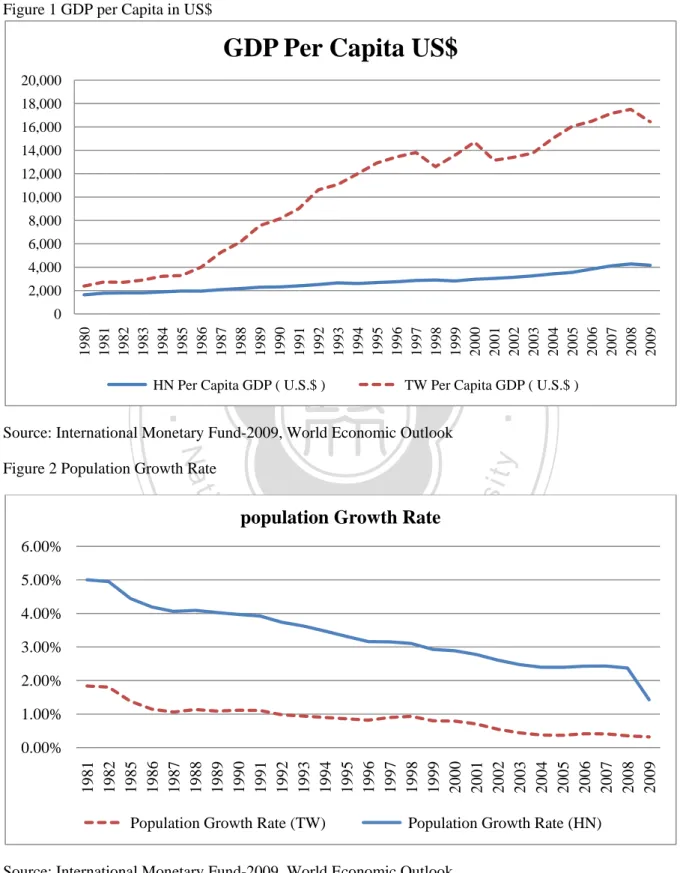
(5) ABSTRACT At the end of 2009 Honduras was facing the biggest political crisis in its history, it will be remember as the worst year of any Central American Country, as it was predicted by economists the impact was huge not only politically but socially and economically, hopefully after several months of turbulence, signs of stability began to rise from the ashes, the new President elections brought new hopes to Honduras society. This thesis is written as a basis analysis to the current situation and prospective of Honduras growth with a comparison to Taiwan strategic development during the 1950’s until the 1980’s which represents its transition from an agricultural to an industrialized based economy; Taiwan miraculous development and growth has. 治 政 大 it would be said that a country could rise as Taiwan did. Considering this two countries scenarios 立 with such abundance of resources its meant to be a develop one, while the other will face. been admired for many, it is really impressive to see how a country with so many limitations. ‧ 國. 學. troubles to survive, however, Taiwan has shown that the scarce of resources and other external factors are not limitations to achieve economic development therefore growth. Can Honduras. ‧. learn from Taiwan experiences and change its economical situation? Considering Honduras holistic situation, are those Taiwan’s strategies still applicable?. y. Nat. io. sit. The answers of these questions are promising, it is feasible to reach economic development and. n. al. er. growth, the limitations involved in an agricultural based economy can be overcome and nation’s. i Un. v. competitiveness can be achieved, it is not an easy task, several changes need to be done.. Ch. engchi. Finally, to achieve a nation’s competitive advantage mostly requires the government and citizenship engagement, working in sync as the engine of the process, Taiwan is an example of what the nation’s population is able to do.. ii .
(6) TABLE OF CONTENTS ACKNOWLEDGMENT. i. ABSTRACT. ii. LIST OF FIGURES AND TABLES. v. Chapter I Introduction. 1. Chapter II Data Collection 2.1 Objectives. 2. 2.2 Research Questions. 2. 政 治 大. 2.3 Hypothesis. 立. 2.4 Methodology. 2 2. ‧ 國. 學. Chapter III Presentation of Findings. 3.1 Honduras Development and Economic Situation. ‧. 3.1.1. Honduras Brief. 3.1.2 Analysis of the Main Economic Indicators. n. al 3.2.1 Taiwan Brief. er. io. 3.2 Taiwan Development and Economic Situation. sit. y. Nat. 3.1.3 Honduras Industries. Ch. i Un. v. 4 4 6 11 12 12. e nEconomic 3.2.2 Analysis of the Main g c h i Indicators. 14. 3.2.3 Taiwan Industries. 19. Chapter IV Taiwan Development Strategy period 1952-1980 4.1 Taiwan Diamond Analysis. 23. 4.2 Taiwan’s Diamond Dynamism. 38. 4.3 Unforeseen Aspects of Taiwan Development. 39. 4.4 Taiwan in Perspective. 40. Chapter V Honduras Development Analysis Current Situation 5.1 Honduras Diamond Analysis. 42 iii . .
(7) 5.2 Honduras Dynamism. 55. 5.3 Honduras in Perspective. 56. Chapter VI Conclusions. 58. Chapter VII References. 59. Chapter VIII Appendix. 65. 立. 政 治 大. ‧. ‧ 國. 學. n. er. io. sit. y. Nat. al. Ch. engchi. i Un. v. iv .
(8) LIST OF FIGURES AND TABLES. 65-92. FIGURES Figure 1 GDP per Capita in US$ Figure 2 Population Growth Rate Figure 3 Population Figure 4 Exchange Rate Figure 5 Inflation Average Consumer Prices 1980-2008 Figure 6 Unemployment Rate 1980-2008. 政 治 大. Figure 7 Taiwan Unemployment Rate 1980-2008. 立. Figure 8 Current Account Balance/GDP, 1980-2009. ‧ 國. 學. Figure 9 Current Account Balance 1980-2009 Figure 10 Educational Systems in Taiwan 2010. ‧. Figure 11 Educational Systems in Taiwan 1919. Nat. sit. y. Figure 12 Educational Systems in Taiwan 1922. n. al. er. io. Figure 13 Educational Systems in Taiwan 1987. i n C U h e n gPattern Figure 15 Taiwan's Net Government Expenditure chi. v. Figure 14 Taiwan's Structure of production (% of GDP by Sector). Figure 16 Taiwan Imports and Exports Figure 17 Taiwan's Export Composition Figure 18 Taiwan Imports Composition Figure 19 Honduras Imports and Exports Figure 20 Number of Factories registered in Taiwan by year Figure 21 Honduras Education System Structure. v .
(9) TABLES Table 1 Number of Colleges graduates until 1942 by Institution and Ethnic groups Table 2 Taiwan Number of Tertiary Institutions Table 3 Taiwan Enrollment at the Tertiary Institutions Table 4 Ratio of College Students graduates in different fields to total enrollment (%) Table 5 Honduras main Export partners 2009 Table 6 Honduras main Import Partners 2009 Table 7 Honduras main Imported Products (2009). 政 治 大. Table 8 Honduras main Exported Products (2009). 立. Table 9 Number of Factories registered in Taiwan at the end of the year. ‧ 國. 學. Table 10 Taiwan's Track length and number of railway stations Table 11 Taiwan's Net Government Expenditures. ‧. Table 12 Taiwan Net Government Expenditure (%). sit. y. Nat. Table 13 US Aid in relation to Taiwan's GDP, GNI and Imports 1951-1968. io. al. Table 15 Number of Taiwan Educational Institutions. er. Table 14 Taiwan's number of schools, personnel, classes and students per year. n. iv n C Table 16 Average Capital Investment perhFarm in Taiwan 1965-1980 engchi U Table 17 Damaged caused by the Hurricane Mitch Table 18 Honduras Net Enrolment rate by level of Education. . vi .
(10) CHAPTER I: INTRODUCTION Honduras, located in the north-central part of Central America, has a Caribbean as well as pacific coastline. Geographically is the second largest country in Central America. Honduras is considered the heart of Central America due to its geographical location. The country is marked by the uniqueness of its natural resources, for instance, it’s consider a Biodiversity spot due to its numerous plant and animal species. Honduras contains vast biological resources which can be properly used to promote country’s development.. 政 治 大 heavily indebted poor countries in the world (World Bank), this disadvantaged economic 立. Despite the vast amount of resources, its economy has continued to grow slowly. It is one of the. condition fomented by disparity in the wealth distribution, corruption, political scandals, crime. ‧ 國. 學. and natural disasters among other factors, has affected the quality of leaving of every Honduras citizen.. ‧. Meanwhile, Taiwan, located east of the Taiwan Strait off the southeastern coast of mainland. Nat. sit. y. china it has been admired by its rapid economic growth after World War II, known as “The. io. er. Taiwan Miracle”. With a history characterized by long standing tension with mainland china, military threat, and diplomatic isolation besides its scarce of resources, Taiwan has found the. n. al. Ch. ways to impulse its economic development and growth.. engchi. i Un. v. For decades the island was under an authoritarian one party state ruled, however, after made the transition to democracy, Taiwan surged from the ashes and became one of the Asia four tigers. Looking at these two countries at a first glance, can be said that a country with such abundance of resources its meant to be a developed one, while the other will face troubles to survive, surprisingly, reality is more complex, Taiwan has shown that the scarce of resources and other external factors are not limitations to achieve economic development therefore growth. Can Honduras learn from Taiwan experiences and change its economical situation? Considering Honduras holistic situation, are those Taiwan’s strategies still applicable?. 1 .
(11) CHAPTER II DATA COLLECTION 2.1 Objective Honduras and Taiwan’s economy will be exhaustively analyzed, to determine the critical factors that have contributed to Taiwan’s development. This study will be limited to the period where Taiwan was facing similar economic condition as the one currently faced by Honduras economy; then, after this main objective is to find out the feasibility of applying those factors to the Honduras economical environment in order to gain competitive advantage hence reach economic growth.. 立. 政 治 大. ‧ 國. 學. 2.2 Research Questions. ‧. Is it feasible to adopt Taiwan’s economic development strategy used during the period from “1950 to 1980” to develop Honduras economy, considering current country’s conditions in order. y. Nat. n. er. io. al. 2.3 Hypothesis. sit. to gain competitive advantage hence reach economic growth?. Ch. engchi. i Un. v. It is feasible to adopt Taiwan’s economic development strategy used during the period of “1950 to 1980” to develop Honduras economy, considering current country’s conditions in order to gain competitive advantage hence reach economic growth?. 2.4 Methodology Observation, record searching and existing documentation are the methods that will be implemented to test the hypothesis. Since the term economic development is to broad is important to limit the extent of this research; therefore the first part of this research will be focus 2 .
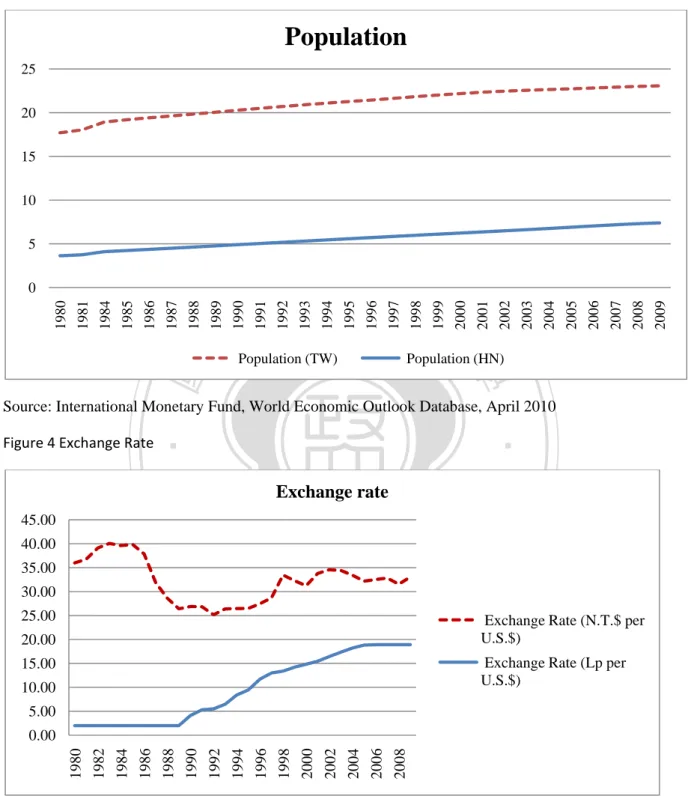
(12) on the analysis of the main economic development indicators: GDP, Exchange Rate, Inflation, Unemployment Rates, Imports and Exports and Current Account Balance. The Second part refers to Taiwan development conditions, will be limited to analyze the period when Taiwan was experimenting similar economic conditions as the ones currently faced by Honduras. Finally, in order to proceed whit this analysis, the structure of the competitive advantage of nations analysis designed by Porter will be implemented.. 立. 政 治 大. ‧. ‧ 國. 學. n. er. io. sit. y. Nat. al. Ch. engchi. i Un. v. 3 .
(13) Chapter III Presentation of Findings 3.1 Honduras Development and Economic Situation 3.1.1 Honduras Economy Brief Over the years Honduras economy has been characterized by political and economical instability. Honduras held its first election back in 1981, the winner was the liberal party; Roberto Suazo Cordoba assumed the presidency in January 1982, this was the result of the implementation of a. 政 治 大 stable in Honduras political environment; however, this cycle was broken down in June of 2009, 立 democratic system based on the execution of elections every four years. Everything seemed to be. when the president elected Jose Manuel Zelaya Rosales was removed from his office by force. ‧ 國. 學. leading Honduras to a new era of instability.. ‧. Regards to Honduras economic development, the export sector has presented a really weak performance; banana was the main product to export until 1950, after this period, Honduras. Nat. sit. y. government with the attempt to promote diversification, started to export coffee and another. io. er. agricultural products, later on, as a result of the creation of the Central American Common Market (CACM) some other products were exported to other Central American Countries;. n. al. Ch. i Un. v. however, after the Honduras and Salvador war in 1969 Honduras decided to leave the CACM.. engchi. Despite the several efforts to promote economic development, the most important change reflected in the economy has been the creation of Export Processing Zone System in 1987, due to the inexpensive labor forced cost and close ties to the US Government, Honduras was transformed into a desirable place for multinational firms to establish their production facilities, meanly textiles; this lead to a transformation of the production structure that over years was local, based on hand made products, and somehow opened the doors to the international economy however, it didn’t bring changes to the Honduran society and the country remains among the poorest countries in Latin America. According to the World Bank, Honduras the third poorest country in the western hemisphere, after Haiti and Nicaragua, has been affected by a dual economy over the years, which according 4 .
(14) with The Dual Economy theory (.H. Boeke, Economics and Economic Policy of Dual Societies, Institute of Pacific Relations, New York 1953) is the existence of two separate economic systems within one country; on one side is the local economy, near-subsistence and little industrialized satisfying, badly, the needs of the population, and on the other side a developed economy, export-oriented, but based on agricultural products with fluctuating prices in the international market. Moreover, the precarious economic situation made Honduras government to take a difficult debt to pay. The unemployment rate is around 30% of the population, the labor force is about 1.7 million employees, of which 41.18% is engaged over agriculture, 11.76% over industry and 47.06% in. 政 治 大 The most important economic sector is agriculture, as mentioned before Bananas and coffee are 立 the two main exported products of Honduras, but are subject to strong competition. The other the services sector.. ‧ 國. 學. major productions are sugar cane and palm oil. Corn, dry beans and rice are the main agricultural products for local consumption. Wood is also an important resource, particularly high-quality. ‧. woods: pine, mahogany, ebony and rosewood.. sit. y. Nat. The manufacturing sector is really low due to several problems like high population growth, high unemployment, inflation, lack of basic services, inefficient public sector and the dependence on. io. n. al. er. agricultural base exports sector that is subject to large price changes.. Ch. i Un. v. Honduras has a vast amount of natural resources like gold, silver, copper, lead, zinc, iron,. engchi. antimony and coal but only the zinc and lead has been fully developed. Another really relevant resource is the generation of electricity by hydroelectric facilities, it is an abundant and inexpensive industry, but the biggest problem for the launching of it, is the low power consumption of the country. The Honduran trade is dominated by imports, creating a balance of payments clearly insufficient, situation encourage by Honduras high imports of oil and most of the manufactured goods. Finally regards to the administrative government performance, Honduras has faced week governance, limited administrative capacity and violence.. 5 .
(15) 3.1.2 Analysis of the Main Economic Indicators GDP per Capita Over the years the Honduras GDP per capita has shown a really static trend, (See Figure 1), The GDP and the population growth rate (See Figures 2 and 3) have a opposite correlation, as higher the population growth rate is, the lower the GDP can become if some other factors remain constant. From 1980 through 1987 the GDP was very low remaining less than 2,000US$ from 1987 until 2000 the GDP per Capita was less than 3,000US$ in 2001 it reached 3,041, by 2008 Honduras reached its highest GDP per Capita of 4,275US$ but in 2009 slightly decreased to 4,168US$.. 政 治 大. The GDP per capita has a direct correlation with unemployment rate, despite the fact that over. 立. the years this indicator has been diminishing (See Figures 1 and 6), the GDP per capita grows at. ‧ 國. 學. a really slow path, first of all due to the Honduras exports dependency to the US economy, placing Honduras in a really vulnerable and dependable position to US economy performance.. ‧. Furthermore, the fact that Honduras economy is heavily relying on The Primary Sector place. y. Nat. Honduras economy in a very vulnerable position, considering its relatively low industrialization. sit. and really high exports of agricultural goods, Honduras faced serious problems when natural. n. al. er. io. phenomena hit its territory, for instance, in 2008 when Honduras territory was beaten by the. iv n C 70% h due to the production e n g c h i U losses. Hurricane Mitch, Honduras accounted two billion dollars in losses, the aggregated value of the Primary sector drop by 45% to 1. infrastructural damages.. generated by flops and. The secondary sector is also relatively important to the Honduras economy accounting a 31% of the GDP during 2007. The manufacturing industry is one of the weakest of the region; it can by classified within three categories: 1. The traditional industry focused on the processed food, beverage and clothing supplying the domestic demand. 1. According to Central Bank of Honduras. . 6 .
(16) 2. The processing industry related to export agro products, dominated by US Multinationals, Chiquita and Dole, which supply both domestic and international demand. 3. The Maquila, this has surged during the 1990’s due to the Honduras labor force characteristics, the geographical location and the creation of laws and regulations to stimulate the establishment of industrial parks in the territory. In 2001 The Maquila became the most important sector for Honduras economy due to its relevant participation in the GDP. Since 2007 the tertiary sector has become a crucial component in Honduras economy during this. 政 治 大 stronger, due to the Honduras Natural Resources; the income captured from this sector has 立 significantly increased since 1990’s, however, there are so many factors like infrastructure and year its accountability in the GDP per capita was around 55.5%. The tourism industry is getting. ‧ 國. 學. telecommunications that have stopped this sector to be fully developed.. ‧. Exchange Rate. y. Nat. Since the foundation of the Central Bank of Honduras during the 1950’s until 1989, Honduras. sit. maintained a fixed exchange rate policy against US$, during this period in order to finance the. al. er. io. budgetary deficit, the government adopted the monetary emission policy, however since 1990. v. n. when The CBH took the administrator of the money supply role, this policy was changed, the. Ch. i Un. interest was liberalized, the reserve was adjusted according to the market liquidity conditions,. engchi. open market transactions were able to be executed and other monetary policy instruments were modified. Therefore, since 1990’s the exchange rate has shown a sliding trend, to stimulate the exports sector and attract foreign investment. (See Figure 4). Inflation Rate The inflation has remained to be one of the serious problems to be treated by the Honduras Government, during the period where the exchange rate was fixed and while the CBH hasn’t assumed the administration of the monetary policy yet, Honduras presented moderate inflation. 7 .
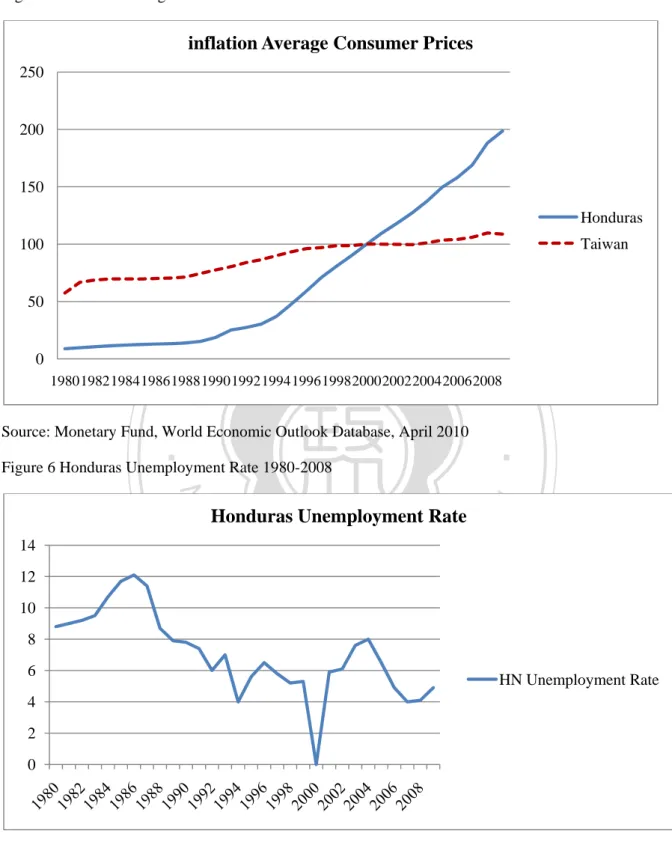
(17) rates, but since 1990 according to the values presented by the Monetary Fund, the inflation rate has worsened. During the period of 1984 trough 1988 the Honduras Government adopted a stabilization measure, reason why the inflation is relatively low, compare to the following years. During this period Honduras was receiving foreign exchange transfers due to its participation in the “Guerra Fria”, these transfers where coming from the AID, and somehow strengthened the international reserve, additionally Honduras was receiving foreign exchange from the US$ military forced located in Honduras territory.. 政 治 大 by the establishment of the devaluation policy applied to the exchange rate to promote exports 立 and attract foreign investment. The inflation rate upward trend presented since the end of the 1980’s was in some extend caused. ‧ 國. 學. The national currency was affected by the decrease in the International reserves, due to the AID. ‧. transfer reduction as a punishment to the Honduran government for the support showed to The Central American initiative aimed at the pacification of the region as a part of the Contadora and. io. sit. y. Nat. Esquipulas agreements.. al. er. This situation lead Honduras to increase its external debt due to non-payments; in the aimed of. n. iv n C h ehigher these policies produced the inflation to get n gduring c h itheU1990’s.. improving the situation, the government applied structural adjustment policies; unfortunately,. The increase in the inflation rate has been also stimulated by the currency devaluation; since the domestic product is in a big part conformed by imported products, as a result of the beneficiary elite that keeps buying imported goods, the levels of consumption based on prices not in accordance with the income of the average Honduran citizen are generated. During the 1999’s the Hurricane Mitch struck Honduras territory, causing a significant increase in the inflation rate due to the losses in the production that was meant to supply the domestic demand.. 8 .
(18) Meanwhile, a new phenomenon that has contributed to the increase in the inflation rates is the dollarization; this has significantly affected the economy, because the goods and services valuation is based on US$, despite the fact that the wages and salaries are established based on the devaluated local currency. Finally, regards to the inflation rate reported in 2009 was product of the international recession, especially in the US economy, along with the internal political crisis that has affected the Honduras economy. (See Figure 5). Unemployment Rate. 政 治 大 which contributed to increase the unemployment rate, during the 1970’s due to the war between 立 During the 1970’s until the 1980’s the biggest Honduras concern was the political instability,. Honduras and El Salvador, a considerable number of Salvadorian moved to Honduras territory to. ‧ 國. 學. settle down; this produced the unemployment rate to rise.. ‧. During the 1980’s the unemployment rate reached its peak due to the suppression executed by the military force, during this period the military force controlled the Honduras political situation,. y. Nat. sit. Honduras became the US military operation’s central base as well as for the anti-Sandinista. al. n. Honduras resources were allocated to support these matters.. Ch. engchi. er. io. guerrilla, who fought against Nicaragua’s Sandinista government. During this period, most of the. i Un. v. In the 1990’s Honduras was under the governance of Rafael Leonardo Callejas, even though it was a more conservative party, its government period was characterized by strikes and political clashes. Its national plan was focused on reducing the military force influence in the political life of Honduras, reason that explain the reduction in the Defense budget. Unfortunately, at the end of 1998 and beginning of 1999 Honduras economy was damaged by the hurricane Mitch, and the employment rate rose due to the fact that a considerable part of the active working population is contained in the agricultural sector. This natural disaster accounted over five thousand dead, one million five hundred thousand victims, more than eight thousand missing and two hundred seventy thousand homeless families.. 9 .
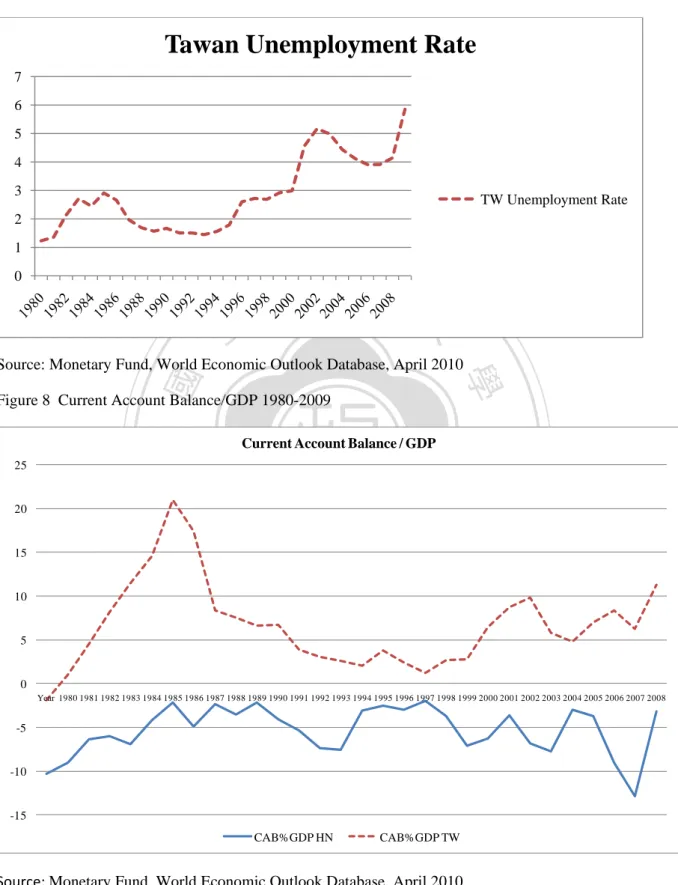
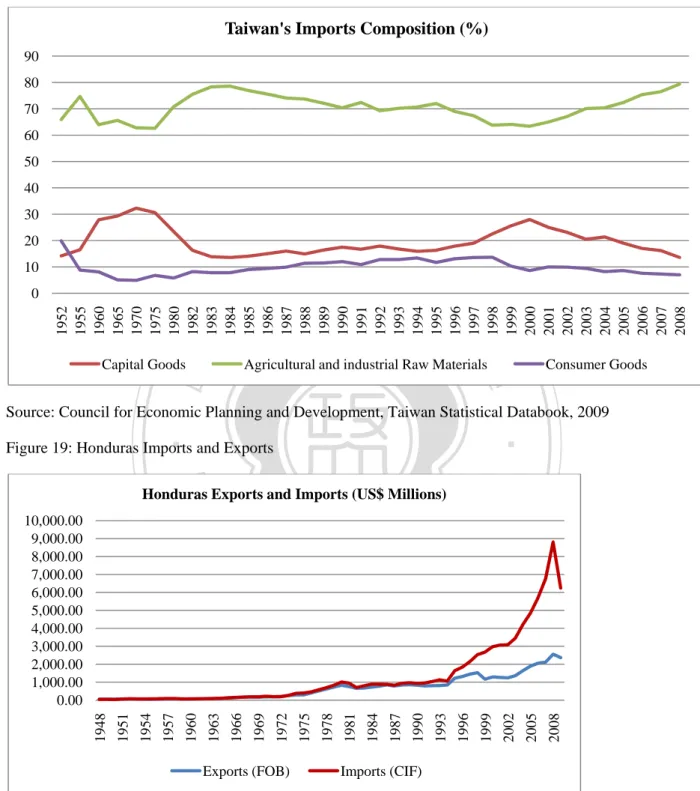
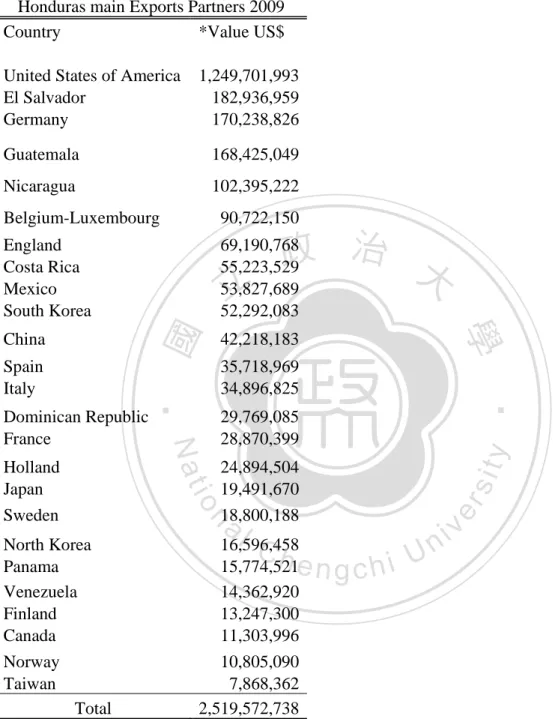
(19) According with William Handal appointed president: "For Honduras, this is worse than a hundred coups. This is devastating and it means a reconstruction effort of 30 to 40 years" Despite the critical situation that Honduras was facing, the political stability remained until Manuel Zelaya Rosales Government. The former president aimed to fight against corruption and supply more job opportunities to the unprivileged ones, unfortunately, by the end of the second month of its government the first corruption case raised and continued growing trough its complete government. It was until June 2009, when the former president was dismissed and appointed in his place the holder of the legislative branch, Roberto Micheletti, producing a hostile uncertain atmosphere. (See Figure 6). Current Account Balance/GDP. 立. 政 治 大. Since over the years Honduras principal exports product has been agricultural until the end of the. ‧ 國. 學. 1990’s when the “Maquiladora” became a relevant exports component, but the current account balance in terms of Honduras GDP reflects what has been discussed earlier its low exports, high. ‧. imports and high inflation rates. Hence the proxy is negative. (See Figures 8 and 9). er. io. sit. y. Nat. Imports and Exports. Over the years Honduras has shown an insufficient trade of balance as a result of the weak. n. al. i Un. v. import sector and the strong reliance on the US market, making the export sector really. Ch. engchi. vulnerable to changes in the US economy (See figure 19).. The Honduras exports are conformed by raw materials and non processed products, for instance the greatest exported product in 2009 was Coffee, accounting for 518,112,128 US$, followed by books, coconuts and fish (See Table 8), in the other hand, the import sector is dominated by processed products, representing almost the 100% of Honduras exports. (See Table 7) As mention before the Honduras most important trade partner is United States of America, Honduras imports from US during 2009 accounted 2,131,428,386 US$, it represents the 38% of the total imported products compare to Taiwan, imports from this country only represented the 1% of the total of the imported products. (See Table 6) 10 .
(20) Regards to exports, United States of America is as well, the Honduras leading partner accounting the 50% of the Honduras exported products, this situation affects the Honduras economy performance drastically, especially when US faces economical constraint.(See Table 5) To stimulate the export sector, Honduras government has signed several commercial agreements with other countries, those agreements included: CAFTA, Central American Common Market and the Northern Triangle, (Honduras, Guatemala and El Salvador), Caribbean Basin Initiative, The European Generalized System of Preference (SGP Plus) and textile program 9802, the three of them with USA.. 3.1.3 Honduras Industries. 政 治 大 Over the 2009 the Honduras National Production reflects a significant reduction compare to 立 commercial sector and the political uncertainty.. 學. ‧ 國. 2008, as a result of the International Financial Crisis, external demand contraction, losses in the. ‧. Agriculture, livestock and fisheries decreased 2.9% a trend that has been facing since 2008, the production of basic grains also reported decreased (-7.2%) produced by natural phenomenon “El. Nat. sit. io. al. er. Paraiso.. y. Niño” which damaged corn, beans and sorghum crops in Olancho, Francisco Morazán and El. n. iv n C performance, as a result of a plague thathaffected the wholeUproduction and also due to a drop in engchi the international prices, meanwhile the coffee production also reflected a considerable decreased furthermore, during 2009 Palm production diminished by 10% compared to 2008 economic. about 6.7% compare to 2008, this as a reaction of the maintenance and fertilization practices reduction, the banana production was contracted by 16.9%. Contrary to the declining trend of the agricultural activity there were some activities that reflected positive results as, cultured shrimp production and sugar cane 18.3 and 3.8% respectively. The manufacturing industry became less dynamic, reporting a reduction of 7.1% produced by reduction of both, internal and external demand, the production of textiles and shoes manufacturing reported -13.8% of growth, contrary to the level growth produced by the beverages and snuff sector which reported 0.4%. 11 .
(21) The real state sector faced a decrease of 8.9% mainly affected by the execution of few projects and the political uncertainty. Consequently, the commerce activity also reflected a reduction, (8.9%) which is directly related with the other sectors performances. Meanwhile the economical sectors that helped to overcome the economic contraction during 2009 were the other services sector that reflected a 4.8% of growth, this sector included telecommunications 11%, public administration and defense 6.9%, education 6.8% social and health services 7% and financial intermediation services with 5.5% of growth.2. 政 治 大. 3.2 Taiwan Development and Economic Situation. 立. 3.2.1 Taiwan Brief. ‧ 國. 學. Over the years many economists have seen Taiwan development and rapid growth as a miracle, hence the term: “Taiwan miracle”.. ‧. The economy development of Taiwan reflects Taiwan’s people efforts to make the island strong. Nat. sit. y. military and economically.. n. al. i Un. Formosa” which became its name for the next four centuries.. Ch. engchi. er. io. The modern history of Taiwan is dated since 1590 when a Dutch navigator exclaimed “Ilha. v. During the period of Dutch occupation from 1624-1662, there was no sign that Taiwan was under China’s government, hence The Dutch brought Chinese workers to work on the sugar plantation and rice fields, and a new race was born: The Taiwanese; however, in 1662 Dutch were defeated by a Chinese pirate from the Ming dynasty. For over 200 years since 1680 to 1880’s Taiwan remained a loose lying area. During the 19th century, in 1887 the authorities under Manchu Imperial declared Taiwan a province of China with the purpose of control the Japanese expansion over the island, but in 1895 China ceded Taiwan to Japan in perpetuity and from here the Japanese period started. 2. Central Bank of Honduras Annual Report . 12 .
(22) During this period the educational system was built up as the same level as in Japan and some areas started to be developed, like industry, roads, trains, and infrastructure. The next important event that affected Taiwan not only politically but also economically was The World War II from 1943 until 1945, however, it was until 1951-952 when the Japanese formally concluded World War II and the San Francisco Peace Treaty was implemented, the importance of this Treaty relies on the sovereignty that was granted to Taiwan. Taiwanese people had the right to determine their future status of the island based on the principle of selfdetermination, this was the first and the last international treaty of the 20th Century which deal with the Taiwan status.. 政 治 大 agricultural, the land reform program 立 sponsored by Kuomintang during this period was a. From 1952 to 1972 Kuomintang was able to build up Taiwan economy, which was entirely. ‧ 國. 學. remarkable success and it was during the 1960’s when the economic miracle began, however, during the 1980’s the Taiwan’s economic progress was bigger than the 1970’s The per capita income was really high and put Taiwan in the same category as Spain and Israel, its international. ‧. currency reserves were the second largest in the world and in 1987 it was the 13th biggest trading. sit. y. Nat. country in the world and the 11th biggest exporter.. al. er. io. Also, during the 1980’s there was a sense of political liberalization; in 1987 The Martial Law. v. n. was lifted and the island changed from a repressive authoritarian system to a much more open society.. Ch. engchi. i Un. During the 1990’s Taiwan was looking to be in it own rights, and was requesting for membership in organization as UN and WHO. Taiwan culminated its transition to democracy in 2000, since then, Taiwan has made big efforts to build up a fully democratic political system.. 3.2.2 Analysis of the Main Economic Indicators GDP per Capita. 13 .
(23) Taiwan being as industrialized country had a GDP per capita of US$16,442 in 2009, the average growth rate of GDP since 1980 has been 7% per year, and this positive trend is the evidence of high production, employment, consumption and exports, economic factors that will be analyzed further in this paper. A research done by professor Toshiyuki Mizoguchi confirmed that the average GDP growth rate from 1902 to 1940 was 1.73% and 6.21% in 1950-2000, also mentioned that during the 20th century Taiwan GDP expands by almost 30 times, this is really related with the increase in national income.3 At the beginning of the 20th century Taiwan economy was a traditional agricultural based. 政 治 大. economy, which is a very underdeveloped economy, which often depends on agriculture as its. 立. main base (See Figure 14).. ‧ 國. 學. Regards to GDP there are two general Characteristics of a traditional agriculture economy one is the lower level of GDP per capita and the other is near zero growth rate.. ‧. Since 1592 and after world war II Taiwan was under de Japanese administration a period characterized by a colonial economy, with understanding of colonial economy the one that is. y. Nat. sit. based on the export of agricultural products and the import of manufactured goods; the Taiwan. al. er. io. resources were allocated to support Japan development, the sugar industry dominated the export. v. n. sector before 1920’s; however, from 1920 to 1930 rice became the principal exported product;. Ch. i Un. after 1930 and because of the war the need for industrialization surged, the primary goal trough. engchi. all this period was increasing Taiwan’s productivity with the aim of supporting Japan economy, unfortunately the declining factors of this period were related to the repatriation of Japanese technicians, dismantling of industrial plants and lack of fertilizer for agriculture. Taiwan political situation was stabilized in the 1950’s however, the economy was really affected by the World War II, the hyperinflation faced by China during 1940’s and the increase in population due to the mainland Chinese migrants.. 3. Comments on estimates of Long Run Economic Growth of Taiwan Based on revised SNA (1901‐2000) Statistics, September 2005 . 14 .
(24) Since Taiwan was facing economic pressure, the Government allocated its efforts into education to promote long term growth; starting from Kuomintang regimen who established several regimens and policies to pursue this ultimate goal. When Kuomintang took over The Taiwan economy, this one was entirely agricultural, a land reform program was indeed needed, this reform sponsored by Kuomintang during the 1950’s was hugely successful; it is important to mention that during this period the TND were successfully issue. During this period the government also applied a new import substitution policy, which consisted of trading agricultural product exports for foreign currency to import industrial machinery, and in. 政 治 大 already saturated and some factories moved to another countries with lower labor cost; to face 立 these problems Taiwan government changed its strategy to pursue Export expansion. With this this sense develop the industrial sector; unfortunately by the 1960’s the domestic market was. ‧ 國. 學. aim the Economic miracle, as some economist called, started in the 1960’s.. ‧. A major turning point in Taiwan’s economy took place in 1970 when the Republic of china was removed from the United Nations and the oil crisis in 1973, two factors that heavily affected. sit. y. Nat. Taiwan’s economy.. al. er. io. The second stage of development in Taiwan began after 1980’s, its economy began to stabilize. v. n. and it became one of the four Asians tigers as a Dynamic Capitalist Economy. During this period,. Ch. i Un. Taiwan’s economy shift from the agricultural sector to the service sector. Since 1980’s Taiwan. engchi. GDP has presented a growing trend until 2009 when presented a diminution of 3% compare to 2008 as a reflection of the world’s financial crisis. The decade from 1970-1980, saw the development of capital intense industries. A factor that played a critical role during this era was the government investment in the country’s infrastructure, such as improvements in roads, railroads, ports and electricity. In the 1980’s Taiwan was focused on high technology industries, placing Taiwan in a competitive position compare with other countries, position that was affected in the 2000 by the burst of dot.com bubble, the global slowdown in 2001 and the terrorist attack to US that affected the 2001 GDP per Capita with a growth rate of -11% compare with the previous year (See Figure 1) 15 .
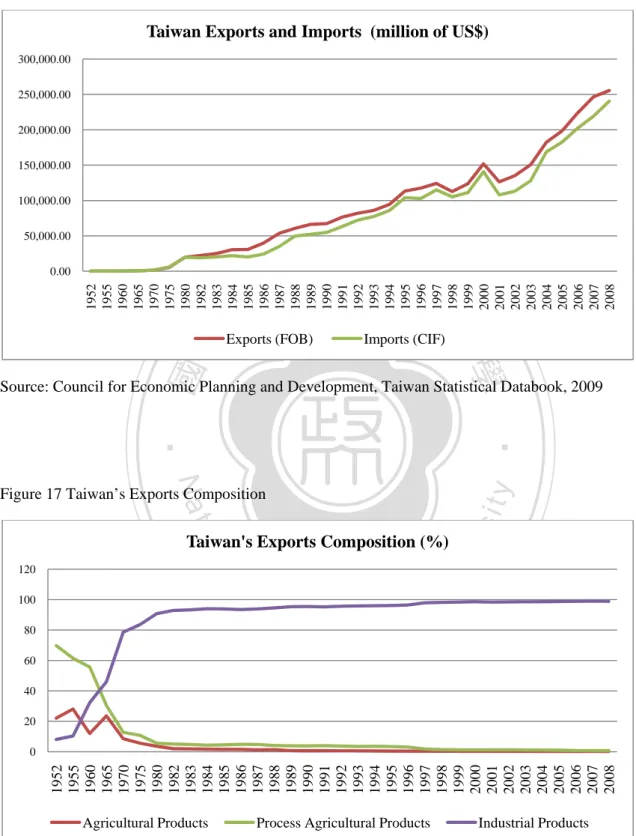
(25) As well as in 2008 the GDP was affected presenting a GDP per capita growth rate of -6% as a result of the global financial crisis. Generally the GDP per capita has shown a positive trend for this nation, which could be considered an indicator of growth with value instead of just a simple increase in prices.. Exchange Rate For a country strongly dependent on trade, exchange rate and currency are really important and they have a positive direct correlation. From 1987 until 1990, New Taiwan Dollar appreciated against the dollar, during this period of. 政 治 大 Taiwan’s benchmark stock index was really high, the highest in Taiwan history, from 621 to 立 12,054, reason why the New Taiwan Dollar (NTD) appreciated about 51% against the US Dollar; time and according to the Asian Times article about The NT Dollar and Taiwan stocks, the. ‧ 國. 學. after the 1990’s the NTD started to depreciate against US Dollar affected by the Taifex collapse, then from 1997 to 1999 the currency was affected by the Asian financial crisis, also from 2000 to. ‧. 2003 the NTD continued to depreciate as a result of the creation of multiple restrictions to. sit. y. Nat. foreign investors, this trend continues over the years.. io. er. Theoretically and based on the impact in the stock market related to currency, indicates that stronger currencies over the long run could have a negative impact on the exports, thus,. n. al. i Un. v. corporate revenues and domestic share prices will be affected. The effect on the real economy. Ch. engchi. trough exports is determined by two factors: The competitor’s currency performance and the magnitude of the currency appreciation. Finally, this depreciation trend is also part of Taiwan Government strategy to control its economy, and to balance its import and exports, considering that Taiwan exporters are manufacturing in China already which currency is already pegged to US Dollar, if Taiwan’s currency appreciates, it would make domestic import cheaper and it would lead Taiwan into a deflationary period. (See Figure 4). Inflation Rate. 16 .
(26) Inflation has always been a matter of concerned for any country in the world, not only for its impact in the country competitiveness but also for its negative effect in the standards of living. Over the years since 1980’s Taiwan inflation has been moderate (See Figure 5) During the early stages of Taiwan's economic development, the relocation of the central government, the aftermath of several wars and an overall lack of basic necessities drove the inflation rate up very high. Afterward, though, with the exception of two energy crises from 1973 to 1974 and from 1979 to 1980, inflation in Taiwan has been moderate. For instance, between 1953 and 1980, the. 政 治 大. consumer price index rose at an annual rate of 7.95 percent, whereas the wholesale price index averaged an annual increase of only 7.14 percent. If the four years of energy crisis are excluded,. 立. the consumer price index rose only 5.39 percent annually, and the wholesale price index. ‧ 國. 學. increased by a mere 4.3 percent per year.. From 1980 to 1995, the inflation rate in Taiwan was low, During this time the consumer price. ‧. index averaged an annual increase of 3.35 percent, and the wholesale price index averaged an. y. Nat. annual increase of a mere 0.24 percent. On average, from 1952 through 1995, the consumer price. al. er. io. sit. index went up annually by 6.34 percent and the wholesale price index by 4.79 percent.. n. Another factor related with inflation is the unemployment rates, fortunately for Taiwan, this rate. Ch. i Un. v. has not shown a serious problem over the years, this due to the strong export sector; labor. engchi. Intensive enterprises have produced jobs to a considerable number of employees, in fact in the late 1980’s the unemployment rate dropped below 2% forcing Taiwan to employed foreign laborers.. Unemployment Rate From 1970 to 1989, the unemployment rate drop to less than 2%, forcing Taiwan to employ foreign labor force, this produced by the existence of labor intensive enterprises, however, since 1990 this rate started to raise until reach 5.85% in 2009 (See Figure 6).. 17 .
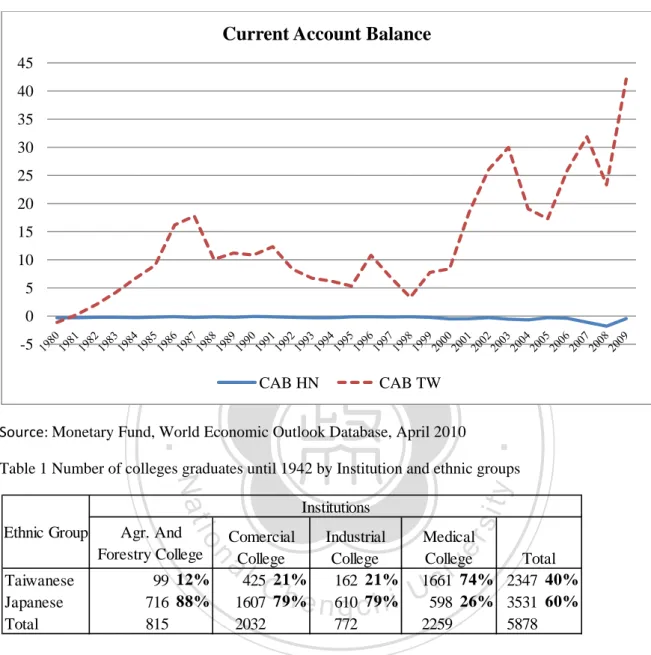
(27) 2001 unemployment rate was really high, one reason of this behavior is attributed to the damaged caused by the earthquake in September 21st, which damaged several industries especially tourism, in 2002 the increase in this rate was due to the economic downturn, that forced some companies to cut production and close some factories down. The following year Taiwan got into the World trade Organization, one reason for the Unemployment rate to slow down. Regards to 2009 performance, the unemployment rate rose due to business downsizing (See Figure 7).. Current Account Balance/GDP The current account balance according with the Worlds Bank definition is “The sum of net. 政 治 大. exports of goods and services, net income and net current transfers” according with economy. 立. dictionary “a positive current account balance indicates that a country is exporting a higher value. ‧ 國. 學. of goods, services and assets than it imports.. Goods have been a source of strength for Taiwan economy, which basically have been built over. ‧. the exports of these products, that is why its normal to see the surplus in the current account. y. Nat. balance, which reflects the exports are greater than the imports, this effect proved that Taiwan is. al. er. io. sit. really good at selling its export products and gaining income from overseas investments.. n. The Taiwan case reflects its high exports and low imports (See figure 16). The export sector. Ch. i Un. v. reached its peak in 1986, with 20.98% however, in 1987 started to decrease and in 1988. engchi. presented a reduction of almost 100% compare to 1987, after reaching its peak it started to go down until got the lowest in 1998 about 1. 25%, after this period started to go up until 1995 when it fell down, accounting just 4.81% (See Figures 8 and 9).. Imports and Exports The import and exports performance since the early 1950’s is the result of the import substitution strategy implemented by the government during those days; Import substitution is a development strategy involving domestically manufacturing consumer products that have been imported,4 the foreign exchange generated is used to import consumer and capital goods and raw materials as 4. Taiwan’s Application to GATT/WTO, Significance for an unrecognized State. . 18 .
(28) inputs for the new import substitution industries. Since the employment increase there is a need of shifting from agricultural to industrial labor force. There were four ways of substitution strategy implementation: 1. Multiple exchange rate system, which offered a lower rate for imports by the public sector or imports of raw materials, however higher rate for import of other goods, 2. A tariff system that charged high protective tariffs on imports of consumer goods, while import duties on capital goods or raw materials were low, 3 raw materials and financial funds were allocated to the textile industry 4 Imports were strictly controlled to stimulate domestic production.. 政 治 大 1966, by the 1980’s there was a shift in the exports of the agricultural products like prawns and 立 eels and livestock products such as hogs, poultry and chicken eggs the majority of this products The total share of exports of industrial products was greater than the agricultural products in. ‧ 國. 學. were exported to Japan (See figures 17 and 18).. ‧. 3.2.3 Taiwan Industries. y. Nat. Since 1950’s Taiwan industries have been composed by small and medium enterprises, and the. sit. government focus has been to promote and sustain the export activities of these firms, however. n. al. er. io. an important factor that has contributed to Taiwan development is the industry clustering.. i Un. v. In the Competitive Advantage of Nations, Michael E. Porter indicates that industrial clustering is. Ch. engchi. one of the most important factors that affect nation’s competitive advantage, in his study probed that National Advantage is increasingly concentrated in particular industries and even industry segments, reflecting their specific and differing sources of competitive advantage. A nation’s successful industries are usually linked through vertical or horizontal integration, also in its study indicates that one competitive industry helps to create another in a mutually reinforcing process. Clustering is basically the relationship among different companies within an industry, collaborating with each other, promoting the specialization since every firm is a component of the production process.. 19 .
(29) The Taiwan most prominent cluster is the Hsinchu Science Park during the 1980’s, its the home of Taiwan’s world known semiconductor and computer firms, including TSMC and UMC; furthermore, is the home of Taiwan’s IC design, manufacturing and packaging industries. The Hsinchu Sciences Park also developed successfully large screen LCD monitors, laptop, desktop computers, motherboards, servers and optical storage devices. Due to the success of Hsinchu Industrial Park more clusters were developed, The Central Taiwan Science Park established in 2000, responsible for the Taiwan Machinery Cluster, also the Southern Taiwan Science Park (STSP) conformed by Tainan Science Park, Kaohsiung Science Park and. Kaohsiung Biotechnology Park; it promotes precision machinery, optoelectronics,. 政 治 大 Also, Taipei Technology Corridor was established focus on the software industry, contained 立 three parks, which are Neihu Technology Park, Nangang Software Park and Beitou Shilin integrated circuit, telecommunications, biotechnology and computer and peripheral industries.. ‧ 國. 學. Technology Park; the first one focuses on computer, communication and consumer electronics, the second dedicated to IC design, biotechnology and digital content and the third one focuses on. ‧. biotechnology, media communication and information technology.. sit. y. Nat. Taiwan also has other industrial projects focus on different areas such as biotech and. io. al. er. pharmaceutical technologies and environmental science.. v. n. According with the World Economic Forum’s 2007-2008 Global Competitiveness Report,. Ch. i Un. Taiwan has the first place in the State Cluster Development Index, this as a result of the. engchi. government strategy of Two Innovation and Two Highs, which means High tech intensive and high value added, the competitiveness of Taiwan’s industrial clusters has continuously strengthened. Taiwan is a probe that clustering can be achieved not only in the high tech industries but also in traditional industries such as handicrafts, flower industry and art, Taipei, for instance, has digital content and ceramics clusters; Hsinchu has optical disk, automobile, and glass clusters; Taichung has bicycle, precision machinery, and musical instrument clusters; Changhua has knitted hosiery and bicycle clusters, and Tainan has TFT-LCD, IC, and knitted sweater clusters.5 5. Taiwan Council for Economic Planning and development . 20 .
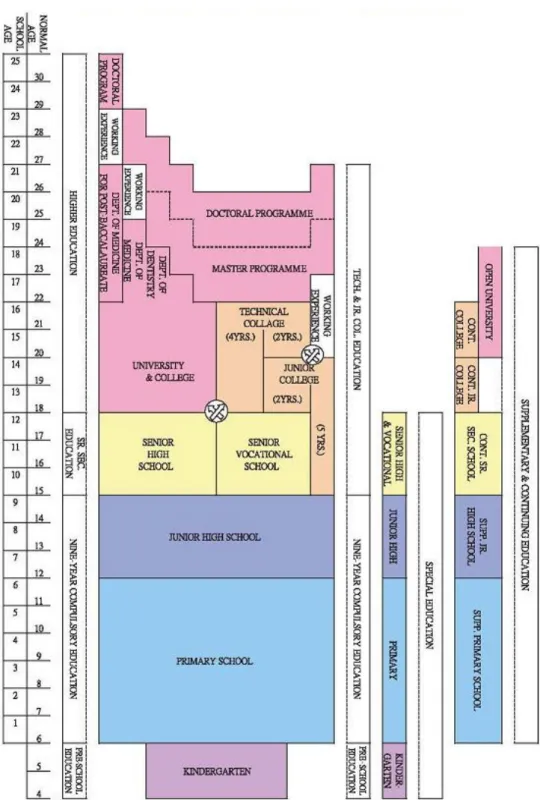
(30) WEF Ranking of the Competitiveness of Industrial Clusters 2007-2008 Score. 2006-2007 Global. Score. Ranking. 2005-2006 Global. Score. Ranking. Global Ranking. Taiwan. 5.7. 1. 5.52. 1. 5.39. 2. United. 5.3. 2. 5.22. 2. 5.19. 4. 5.1. 3. 4.19. 31. 4.38. 21. Singapore. 5.1. 4. 5.15. 6. England. 4.8. 9. 4.63. 14. Germany. 4.8. Finland. 4.8. Japan. States South Korea. 4.45. 17. 11. 5.07. 3. 5.33. 3. 4.7. 12. 4.33. 27. 5.46. 1. Switzerland 4.7. 13. 4.67. 15. 4.31. 23. Hong Kong 4.7. 14. 4.75. 12. 4.68. 11. 21. 3.19. 85. sit. 5. y. 5.16. io. er. 4.5. Nat. Italy. ‧ 國. 8. ‧. 4.90. 學. 立 10. 治7 政4.92 5.06 4 大. Source: WEF; compiled by the Council for Economic Planning and Development. n. al. Ch. i Un. v. The Taiwan clusters have been really successful, accounting for more than seventy industry. engchi. clusters; their downstream and upstream structures along with efficiency and flexibility have made them the most competitive clusters in the world. The clustering of upstream and downstream segment are essential, the small size of Taiwan stimulate these patterns of integration, due to the relatively proximity of the integrated companies, problems can be resolve quickly. Taiwan’s cluster also attributes it success to the learning curve effect and economies of scale due to process standardization, the government support, specialization, the entrepreneurial spirit, innovation, the creation of value added products and precision.. 21 .
(31) Finally, the integrated upstream and downstream processes formed a strong economic unit, which with the flows of information and Human Talent stimulates Innovation and new technology. Taiwan Clusters Dynamism: Integrated Upstream Processes. Integrated Downstream Processes. Information. Human Talent. 政 治 大. 立 Strong Economic. ‧. ‧ 國. 學. Units. Stimulate. sit. y. Nat. New Technologies. io. n. al. er. Innovation. Ch. i Un. v. Source: The Story of Taiwan Industry Clusters, retrieved from: http://www.taiwan.gov.tw/mp.asp?mp=1001 . engchi. To meet global trends in competition and changes in Asia’s industrial division of labor, Taiwan will not only continue cultivating technology industry clusters but it will also speed up the development of traditional local industry clusters so as to enhance regional economic growth and create job opportunities.. 22 .
(32) Chapter IV Taiwan Development Strategy 1952-1980 4.1 Taiwan Diamond Analysis Factor conditions The explanation of Taiwan success during this period begins with the analysis of its factor conditions. Taiwan is located about ninety miles off the southeast coast of mainland china, with a total area. 政 治 大. about 35,980 sq km.6 Taiwan has a northern coast on the East China Sea, an eastern coast on the Pacific Ocean, and southern and southwestern coasts on the South China Sea, with 55% of the. 立. island as forest and woodland 15% as mountains, and 5% as permanent pasture only 25% is. ‧ 國. 學. arable.7. Taiwan has been endowed with scarce natural resources, which includes small deposits of coal,. ‧. natural gas, limestone, marble and asbestos. Considering the limitation of natural factors of. sit. y. Nat. production, Taiwan’s government has been focus on the development of mechanisms that create. io. al. er. and upgrade these resources.. v. n. Since The vast resource that Taiwan posses is its population which during 1960 was about 8. Ch. i Un. 10,792,000 inhabitants ; education became one factor to be developed, it can be said that Taiwan. engchi. miracle is not only economic but also human, because its economic growth is closely linked to its human resource development. This section of this analysis will be focused not only on the tangible factors as quantity and quality of capital, natural resources, infrastructure, investment on education among others, but also on the intangible, refer as intangible those that cannot be easily measure, like nation’s culture and traditions.. 6. CIA‐The World Fact book‐‐Taiwan Taiwan’s applications to GATT/WTO 8 Taiwan Statistical Data Book 2009 7. 23 .
(33) As Shih Cheng Liu former Chairman of the board of Bank of Taiwan mention in its article Economic Growth in Taiwan: “Invisible Factors Contributing to Economic Development in the Republic of China, Invisible factors are those attitudes and conditions that must grow within a society itself; take time, depend upon the nation’s culture and traditions and cannot be produced in or imported from a foreign country. Hence, for an under-developed country the provision of these invisible contributing factors to economic development is much more difficult than those visible factors”. Taiwan under The Japanese regimen cannot be considered entirely negative, despite the fact that Taiwan was supporting the Japanese policies of colonization and expansion, a lot of. 政 治 大. improvements in railways and infrastructure were done during this period, one example of these advantages was the establishment of a large Hydroelectric plants for cheap energy, a significant. 立. project that involved the utilization of Sun Moon Lake and the Choshui River was completed in. ‧ 國. 學. 1937, this power plant had a really great impact in Taiwan’s economy. Besides improving the infrastructure and the economy, the Japanese left an important intangible asset on Taiwan; by the. ‧. end of the war, 81% of the Taiwanese boys and 61% of the girls among Taiwanese school-age children were enrolled in elementary school, furthermore there were about 25,000 graduates of. Nat. sit. y. two and three year lower-level vocational schools. After the war these graduates emerged as the. io. was established during this period.. al. er. foundation of private small-and medium size enterprise in Taiwan. Taiwan’s higher education. n. iv n C h eandnsoldiers As well, large number of Chinese civilians i U to Taiwan from 1945 to 1951, g c himmigrated Taiwan’s population increased from 6.1 million to 8.5 million, some of these immigrants were some loyal Chiang followers who were western educated, English speaking, engineer turned economist technocrats, they were able to communicate with and learned from American experts and they contributed greatly to Taiwan’s economic development. The development of higher education in Taiwan can be divided into two phases, the period of Japanese occupation 1895-1945, the period after World War II starting since 1945. Its evolution can be observed in Taiwan Educational System structure changes over the years (See Figures 1012). 24 .
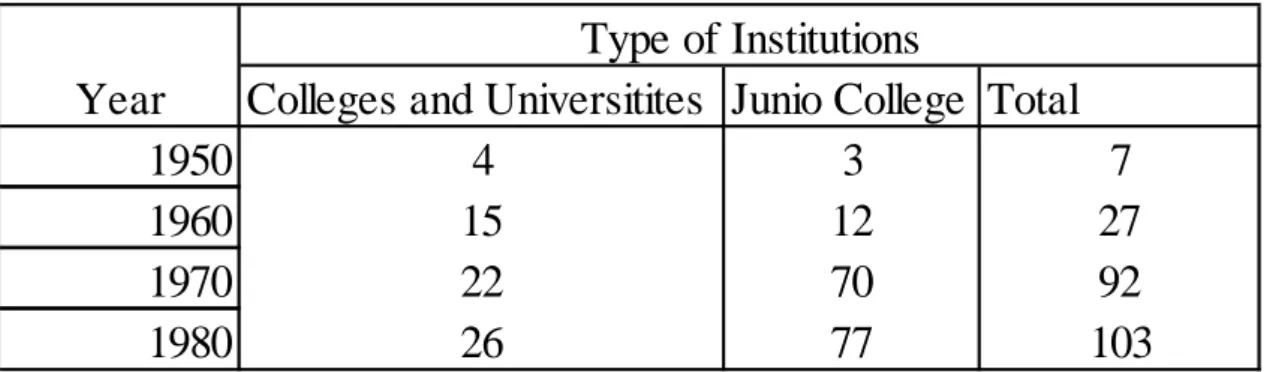
(34) The period under the Japanese occupation was unique due to its special purpose, as seen in the limited number of tertiary institutions and research orientation; furthermore, the opportunities for Taiwanese to reach higher education were scarce since the ones that were available were taken by the Japanese students. (See Table 1) However, in order to trace the development of Taiwan’s higher education, it is necessary to start with this period which was characterized by a western style system of education, and unfortunately discrimination. At the end of World War II Taiwan was restored to China, furthermore, each Taiwan system was adjusted to China’s system, including the education. This period can be decomposed into two. 政 治 大 had the right to obtain education, 立 meanwhile the six tertiary. phases, the first through 1945-1949; based on the Chinese constitution, every Taiwanese citizen 9. institution were reformed, for. ‧ 國. 學. instance the Tiahoku Imperial University was transformed into Taiwan National University with six colleges, and became specialized each in its area, because of the superior research conditions established since the Japanese period these institutions remained with high prestige in Taiwan.. ‧. y. Nat. During the second phase after 1949, the government was focused on the industry development, it. sit. was until 1963 that Taiwan economy shifted from agricultural based to an economy focused on. al. er. io. the industry and agriculture, reason why the encouragement for the government to pursue the. v. n. elementary and lower secondary level was an important policy during the following two decades. Ch. i Un. after 1949. The success in education is also related to the enthusiasm of the schooling which was. engchi. a key component, using as a main statement an old Chinese saying “the pursuit of knowledge is superior to all the other occupations”10. Higher education expanded rapidly during the 1960’s due to the growth of the secondary level and the establishment of junior colleges as a response to the need of medium level manpower needed by industries and business. The number of tertiary institution increase as well as the number of the students enrolled (See tables 2 and 3).. 9. Tertiary institutions term refers to Junior colleges Confucius . 10. 25 .
(35) Education at a graduate level developed after 1970, specialization is a main factor for any country development, in Taiwan case, the significant number of students executing their studies on engineering and business fields became the geared of Taiwan development (See tables 4). To ensure the quality of higher level of education, the ministry of education initiated in 1975 a quality control in order to get the United States accreditation. Meanwhile one important factor that needs to be mention is the study abroad program, between 1950 and 1980 from 63,061 students that studied abroad just 7,240 returned11, this became a Taiwan’s government big concerned, the percentage of brain drain was really high, however, in 1986, one portion of the 1583 students that returned to Taiwan were employed in educational. 政 治 大 acquired from study abroad, at 立 the institutional level this kind of students were influential, a institutions, to promote knowledge transfer, these students brought back new ideas, ideas. ‧ 國. 學. significant number worked as college professors, to exemplified in 1986, 28% of all the faculty members at the four year institutions were students returned from US 5% from Europe and 8% from other part of Asia. Taiwan higher education received a great influence from foreign. ‧. institutions, mainly from US and Japan. Taiwan is progressing trough massive higher education,. sit. y. Nat. trough government initiatives as development of graduate programs at local institutions, improvement of research facilities, increase of research funds, in order to make Taiwan more. io. n. al. er. attractive to highly trained scholars.. Ch. i Un. v. The most significant project undertaken by Taiwan during the 1980’s was the inauguration of the. engchi. Science based Industrial Park in Hsinchu, designed to house high tech industries and capitalize on the return of high skill human resources from US and other advance industrial countries; since its located near two top science universities and the industrial Technology Research Institute, it provides a perfect research environment. The emphasis placed on technical education by Taiwan has been linked to its industrialization strategies, investing planning and manpower, forecasting have been based on comparisons with. 11. Wen Hsing Wu, Shun Fen Chen and Chen Tsou Wu, The development of higher education in Taiwan Article . 26 .
(36) Japan, the US and Germany with the purpose of reaching the skill composition of these countries by the second half of the 1990’s.12 The Taiwan’s government commitment to education can be tangible measure through its relatively high investment on it (See figure 15); the participation that this factor has on the public expenditure is significantly high (Table 11 and 12); as well as, trough the increase in the number of Taiwan’s educational institutions yearly (See Tables 14 and 15) Regards to infrastructure the investment on it has been dated since the Japanese regimen. The economy planners first concentrated Taiwan industrialization strategies on labor intense goods for export markets while working to improve infrastructure, extending its transport and. 政 治 大. communications system and constructing an environment favorable to investment.. 立. To stimulate the manufacturing sector during 1960’s until 1970’s Taiwan financed a large scale. ‧ 國. 學. of infrastructure development projects and offered subsidies to heavy industries such as steel and petrochemicals, some of these important projects are; the Ten, Twelve, and Fourteen Major. ‧. Construction Projects; the Six-Year National Development Plan; and the Twelve Economic. y. Nat. Construction Projects. These projects have primarily involved the construction of the ROC's. n. al. er. io. 10). sit. infrastructure, such as airports, railways, highways, ports, and new cities and towns. (See Table. Ch. i Un. v. One important factor condition that affected Taiwan development was the capital requirements,. engchi. especially during the era when the economy was agricultural based, because of the land is the most scarce resource in Taiwan, this resource was overvalued, during 1965 the investment in land was about 79% of the total amount to be invested, by 1980 this figure represented more than 80% of the rice region (see Table 16). Regards to capital infusion, Taiwan received a great support from the US government, in 1949 was facing a difficult economical conditions due to PRC invasion, US saw Taiwan as a strategic base on the Pacific front line against the communist aggression, reason why US changed its policy toward Taiwan radically, from 1949 to 1965 Taiwan received US$ 1,465 Million, from 12. Promotion of investment on education, The Benefits of Free trade: East Asia and Latin America. . 27 .
(37) 1961 to 1961 US aid was on average 6% of Taiwan’s GNP, 37% of Taiwan’s gross national investment, and 34% of imports of goods and services (See Table 13). The US aid it was important to control inflation during this period, furthermore this aid helped Taiwan to proceed with structural land reform and institutional foreign exchange reform, key components of Taiwan’s self sustained economic growth, for several years US has been the largest source of foreign investment in Taiwan. Taiwan attracted foreign investment through the electronic and electrical industries, as well as banking and insurance services, chemicals, trade and basic metals.. 政 治 大 domestic conditions, regards to these conditions Taiwan posses a stable society; the correct 立 development of strategies and measures; and a responsible government. Finally, not only the external environment is important to reach economic growth but also the. ‧ 國. 學. Demand Conditions. ‧. Regards to the Domestic Sector, one invisible factor was the engine that stimulate the domestic. sit. y. Nat. consumption; this factor was the attitude of Taiwanese people to support Taiwan development,. io. al. er. which not only stimulated the domestic demand of goods but also promoted domestic investment.. n. iv n C pursuit survival and development, despite strait situation that the country was facing h ethencross hi U c g during this period, all citizen were willing to work cooperatively to promote the development of. Political stability came to Taiwan during 1950’s, every Taiwan citizen had the responsibility to. the nation, one of the determinants factors needed to obtain the reconstruction of any nation is a stable society that promotes so. A society needs to be determine to be willing to make some sacrifices in order to save money to use it for investment, unfortunately this has been really difficult task for most of the nations, luckily Taiwanese society has been characterized for being hardworking, before 1980’s in order to improve their quality of life, a lot of Taiwanese people were executing two factory jobs as well as working during weekends and holidays to earn more money.. 28 .
(38) It was this invisible force that promoted the increase of local products consumption; with the government’s support trough the 1950’s, Taiwan’s agricultural sector not only supplied the local demand, but also the surplus that was generated was used as a raw material to the food processing industry, both actions contributed to its export earnings. This lead Taiwan to invest in better irrigation techniques, fertilizers and improve crop varieties, hence promote the exports of sugar, rice and bananas which were the main agricultural products. The low rice price became the basis of Taiwan’s low wage labor intensive industrialization during the 1960s and 1970s. During the 1960’s, Taiwan was focused on switching its long term strategy to an export-led industrialization, with this aim, the government promoted the exports of labor intensive products.. 政 治 大. Between 1952 and 1961 Japan was Taiwan’s biggest export market and US its greatest import market, the most important products to export were sugar, rice, tea, bananas, and textiles. Cane. 立. sugar alone accounted for 62.37 percent of the total exports of 1957.. ‧ 國. 學. During the 1970’s and 1980’s the first oil price shock occurred and with this some changes in the demand were made, this crisis contributed to slow down the economy development. In order to. ‧. continue whit the plans of the country’s development, the labor-intensive strategy was turned. sit. y. Nat. into a more capital and R&D intensive strategy to create more value added exported products, during this time the government involvement was crucial; establishing expansionary fiscal and. io. n. al. er. monetary policies and pushing up export prices faster than import prices.. Ch. i Un. v. Despite the fact that during this period there was a shift in agricultural exports to fishery products;. engchi. Japan continued to be a great export partner.. In the meantime the government launched the Second Stage Import Substitution strategy to develop the heavy industry; barriers to domestic competition were set to protect the industry, the coexistence of export promotion incentives and protection of the domestic market let the private enterprises to dominate the export activity and the domestic market.. Related and supporting Industries Due to the implementation of the Import Substitution policies, the Taiwanese industries were interconnected to each other. 29 .
(39) Once the World War two was finished, the reorganization of The Electric Power industry was executed, transforming twenty four Japanese hydroelectric power plants and nine Japanese thermoelectric power plants along with the Taiwan State-owned Taiwan Power Corporation (Taipower). With the US aid support, Taipower was able to complete nine extra hydroelectric plants, this electricity development has a strong linkage with other industries, since electric power was inexpensive, many large scale industries were benefited, such as fertilizers, iron and steel, aluminum, textiles, cement, paper and caustic soda. The development of the fertilizer industry was executed following the pattern of import substitution. During the 1950 a considerable amount of fertilizer was imported, reason why local. 政 治 大. production could only fill the 16% of the domestic demand; however, due to the execution of this policy by 1964 this percentage rose reaching 79 percent, the fertilizer industry is not only. 立. relevant because of its contribution to de agricultural sector, but also stimulated the machinery. ‧ 國. 學. industries development.. The sugar industry, “Taisugar” was already export oriented by the end of the war, this industry. ‧. was really relevant for Taiwan during this period however, due to the execution of the export promotion policy in the late 1950’s exports from other industries soon accelerated, and the. y. Nat. n. al. er. io. 0.1% of the total exports.. sit. proportion of sugar in Taiwan exports decreased, by 1985 sugar exports accounted less than. i Un. v. During the import substitution period the government major industries were Electric Power,. Ch. engchi. sugar and fertilizer. Transportation, communication and the banking sector were under government control as well. Since 1950’s Taiwan was receiving US aid, this was also allocated in the textile sector, the imports, which basically were raw materials, were financed by the aid. Over the years textile has been a key component of the Taiwan exports and industrialization in the post war period. During 1958 textile exports represented 3.26% of the total exported products, however, by 1962 grew to 20.15% reaching its peek by 1971 with a 35.43% of the total exports; despite its decreased afterward the value of this industry continued to grow and by the 1990’s Taiwan was the sixth largest textile exporting country in the world. (Taiwan’s Application to GATT/WTO) 30 .
(40) The American wholesalers, importers and large scale retailers play a key Taiwan’s stimulator role to produce footwear, wood and other miscellaneous consumer products. The electric and electronic industry surged until the late 1950’s but it became significantly important by 1968, more than 39% of foreign investment captured during 1952-1970 was allocated into this industry. Due to the Taiwan massive human capital investment, this industry developed into Taiwan’s most technologically advanced industry in the late 1980’s, placing Taiwan in a new different type of economy, an economy where cheap labor force was not the main source of comparative advantage. During the period of 1974-1979, the Taiwan government launched “The Second Stage Import-. 政 治 大 shipbuilding, however, this strategy took resources from the exports away; since this enterprises 立 were oriented to the local market; its impact on the exports was really low. Substitution Strategy” in order to develop the heavy industries, such as petrochemical, steel and. ‧ 國. 學. Firm strategy, Structure and Rivalry. ‧. Under the Japanese regimen the majority of the industrial enterprises established in Taiwan were. y. Nat. owned by the government or by Japanese corporations; but since 1945 the ROC took over these. er. io. sit. enterprises, some were sold to private owners and the rest became state owned enterprises. The Taiwanese companies have been characterized by its diligent labor force; over the years the. n. al. i Un. v. Taiwanese industries have been integrated by small and medium-sized enterprises; using its own. Ch. engchi. capabilities they have been able to enter in the international market. The reason why Taiwan’s small and medium size enterprises boosted Taiwan development is closely linked to the government economic, social and educational policies. The land reform in 1953, the Statute for the Encouragement of investment in 1960, the Nine year compulsory education Program in 1968, and the Ten Major Construction Projects launched in 1973 created a comfortable environment to develop small and medium size enterprises. (See Table 9). Likewise, factors related with the culture played a significant role in developing these companies, most people preferred to start their own business and commit their talents and capabilities on it, since this kind of companies are characterized by the decision making power relying on the owner, they possess an entrepreneurial spirit. 31 .
數據
+7
相關文件
You are given the wavelength and total energy of a light pulse and asked to find the number of photons it
Reading Task 6: Genre Structure and Language Features. • Now let’s look at how language features (e.g. sentence patterns) are connected to the structure
◦ The Statue of Liberty is a gift that France presented to America to celebrate its one hundred years of independence from the United Kingdom.. The full height of the monument is
好了既然 Z[x] 中的 ideal 不一定是 principle ideal 那麼我們就不能學 Proposition 7.2.11 的方法得到 Z[x] 中的 irreducible element 就是 prime element 了..
volume suppressed mass: (TeV) 2 /M P ∼ 10 −4 eV → mm range can be experimentally tested for any number of extra dimensions - Light U(1) gauge bosons: no derivative couplings. =>
For pedagogical purposes, let us start consideration from a simple one-dimensional (1D) system, where electrons are confined to a chain parallel to the x axis. As it is well known
The observed small neutrino masses strongly suggest the presence of super heavy Majorana neutrinos N. Out-of-thermal equilibrium processes may be easily realized around the
incapable to extract any quantities from QCD, nor to tackle the most interesting physics, namely, the spontaneously chiral symmetry breaking and the color confinement..
