國
立
交
通
大
學
電子物理系
博
士
論
文
以高功率摻釹晶體雷射實現有效非線性轉換:
從人眼安全波段至紫外及深紫外波段
High-Power Nd-doped Crystal Lasers with Nonlinear Frequency
Conversion from Eye-Safe to UV and DUV Regimes
學 生:黃郁仁
指導老師:陳永富 教授
從人眼安全波段至紫外及深紫外波段
High-Power Nd-doped Crystal Lasers with Nonlinear Frequency
Conversion from Eye-Safe to UV and DUV Regimes
研 究 生:黃郁仁 Student:Yu-Jen Huang
指導老師:陳永富 教授 Advisor:Prof. Yung-Fu Chen
國 立 交 通 大 學
電 子 物 理 系
博 士 論 文
A Dissertation
Submitted to Department of Electrophyscis College of Science
National Chiao Tung University in partial Fulfillment of the Requirements
for the Degree of Doctor of Philosophy
in Electrophysics
April 2013
Hsinchu, Taiwan, Republic of China
i
以高功率摻釹晶體雷射實現有效非線性轉換:
從人眼安全波段至紫外及深紫外波段
學生:黃郁仁 指導老師:陳永富 教授
國立交通大學電子物理學系博士班
摘 要
本博士論文旨在以簡單的線性共振腔發展輕巧且穩定的高功率摻釹晶體雷 射,同時利用非線性轉換的技術進一步產生波長範圍涵蓋人眼安全至紫外以及深 紫外波段的雷射光源。我們考慮了熱透鏡效應,被動式 Q 開關準則以及寄生雷射 效應優化了被動式以及主動式 Q 開關摻釹釩酸釔晶體雷射的輸出尖峰功率。我們 也針對摻釹氟化釔鋰晶體雷射提出了數個新穎且簡便的方法來實現高功率且高能 量的被動式 Q 開關雷射。利用脈衝式激發以及聲光晶體,我們更進一步在摻釹氟 化釔鋰晶體雷射實現重複率可調的Q 開關動作。 接著,我們設計了一個能夠針對腔內光學參數震盪器單獨優化且不影響基頻 光光路的新穎共振腔,同時輔以被動式 Q 開關摻釹釩酸釔晶體雷射作為基頻光來 大幅提升人眼安全雷射的輸出特性。運用相同的設計理念,我們也以摻釹氟化釔 鋰晶體設計了輕巧且高效率的高能量人眼安全雷射;同時發現熱引起的雙折射效 應是使等向性增益介質能夠實現有效腔內非線性轉換的主要機制。 利用優化過後的摻釹晶體近紅外雷射搭配腔外諧波產生的技術,我們也進一 步產生波長範圍落在綠光、紫外光、以及深紫外波段的雷射光源。在相同的環境 條件下,我們比較了腔外以及腔內架構在產生二倍頻綠光時的轉換效率。我們接 著以腔外三倍頻以及四倍頻的方法有效地產生瓦級的紫外以及深紫外波段的高功 率光源。本論文所完成的高效率非線性轉換不只讓我們可以產生波長範圍涵蓋人眼安全至紫外以及深紫外波段的雷射光源,同時並驗證了我們在優化高功率摻釹 晶體雷射所設計的理念。
iii
High-Power Nd-doped Crystal Lasers with Nonlinear Frequency
Conversion from Eye-Safe to UV and DUV Regimes
Student:Yu-Jen Huang Advisor:Prof. Yung-Fu Chen
Department of Electrophysics
National Chiao Tung University
ABSTRACT
The aim of this thesis is focused on developing compact reliable Nd-doped crystal lasers near 1 μm based on linear cavity configuration, and these optimized near infrared lasers are subsequently applied for several nonlinear frequency conversions to effectively extend the spectrum from eye-safe to deep ultraviolet regimes. First of all, we take into account of the thermal-lensing effect, second threshold condition, and parasitic lasing effect to optimize high-peak-power Nd:YVO4 lasers at 1064 nm in the
passively and actively Q-switched operations. We also propose practical and unique methods to successfully accomplish power scale-up of high-energy passively Q-switched 1053-nm laser with either a-cut or c-cut Nd:YLF crystals. Pulsed operations with continuously adjustable pulse repetition rate are further realized with pulsed pumped passively Q-switched and continuously pumped actively Q-switched Nd:YLF lasers.
Then, we develop a separable monolithic cavity for intracavity optical parametric oscillator to remarkably improve the performance of the Nd:YVO4/Cr4+:YAG/KTP
eye-safe laser at 1572 nm. The same design concept is also employed for achieving a compact and efficient high-energy Nd:YLF eye-safe laser at 1552 nm. Besides, we experimentally find that the thermally induced birefringence can lead the mutually orthogonal polarization states of the fundamental pulses to be effectively switched for accomplishing an efficient nonlinear frequency conversion without any additional polarization control.
Finally, the optimized Q-switched Nd-doped crystal lasers are employed to produce green, ultraviolet, and deep ultraviolet radiations via extracavity harmonic generations. We first compare the output performance between the extracavity and intracavity second harmonic generations at 532 nm under a similar operated condition. We further perform extracavity third and fourth harmonic generations to effectually produce ultraviolet waves at 355 and 351 nm as well as deep ultraviolet radiation at 266 nm with output powers up to several watts. Efficient nonlinear frequency conversions not only enable us to produce the emission wavelengths from eye-safe to deep ultraviolet regions, but also confirm the usefulness of our cavity design for Q-switched lasers at 1 μm.
v
誌謝
時光匆匆,還記得剛進實驗室就陸續在看過去實驗室學長姐的碩博士論文來 學習東西,每次在翻他們的論文,總是會想多看看誌謝在寫些甚麼東西,沒想到, 多年後的今天,我也開始在撰誌謝的稿要怎麼寫,哈哈。想當初,在高中畢業的 時候其實對於大學科系不是那麼的了解,幾番考量後想要好好加強自己基礎學科 的能力而進入了電物系,也在大一的普物課遇到了現在的指導老師陳永富教授。 記得那時候只覺得陳老師每次都教蠻多東西的,因此上課我都要趕快去搶前面的 座位來好好專心聽講,對於有些真的難以理解的內容有時也只能將疑惑擱在心 裡,期待哪一天我能有天外飛來一筆的靈光飛進我腦海裡。隨著日子過去,上過 許多老師的課程,感覺陳老師整體的學識風範著實令我著迷,再加上我本來就對 光電科學有興趣,所以就在大三跟著陳老師做專題研究直到現在完成了博士學 位。這麼多年過去了,心中一直很感謝陳老師願意擔任我的指導教授,親自帶著 我做實驗、觀察每一個實驗現象、解決我課業研究上的疑惑、訂正我所寫的每一 篇論文、願意分享他所經歷過的事情、以及待人處事之道等等。陳老師對於我, 不只是帶著我做研究的指導教授,就某些層面來說,更像是我的爸爸,關心我的 日常生活。我想,這份刻骨銘心的恩情是怎麼還也還不完的,不過還是要在這裡 誠心的跟陳老師說一聲”謝謝您”!也要謝謝黃凱風老師,施宙聰老師,賴暎杰老 師,蔡宗祐老師,林志平博士,陳彥宏老師,以及謝文峰老師撥空來擔任我的博 士資格考以及畢業口試委員,並給予了我相當多的建議與寶貴意見。 能順利完成我的博士學位,也要感謝固態雷射實驗室眾多學長姐弟妹的幫 忙。感謝蘇老大能幫忙解決許多我不是那麼清楚的研究問題;感謝建誠和興弛學 長帶我踏入實驗室所研究的物理及固態雷射的世界,跟你們討論研究和一起打球 總是非常的快樂愉悅;感謝依萍學姊這幾年來的照顧,在我們還不是那麼熟的時 候願意幫我爭取到專班工讀生的打工機會,也願意一同討論並分享研究上的心得 以及生活上的點點滴滴;感謝亭樺學姊、雅婷學姊、仕璋學長、哲彥學長、漢龍 學長、鈺婷學姊以及彥廷學長所給予的照顧與幫忙;感謝今年一起畢業的威哲學 長、毅帆學長、柏毅學長、文政學長、毓捷以及建至平常相互之間的切磋與鼓勵, 尤其要封給威哲學長一個”實驗室最快的男人”稱號 XD;感謝易純、映舜、政猷、必輝、俊佑、家翰、承曄、昱辰、啟平、國維、威霖、凱勝、茗婷、容辰、泰緯、 昕翰、育廷、純甫等眾多學弟妹們的支持與愛戴,為我實驗室的生活添加了許多 歡樂;感謝我所指導及認識的專班學生:榮輝、士瑋、瑋倫、昇晁、淑雅、玉楓、 鳳蘭等等,我們之間的教學相長,也讓我受益良多;還要謝謝我求學路上所有給 予我幫助的老師及朋友;當然更不能忘了總是在背後支持我的媽媽、姊姊以及阿 姨等家人,感謝您們極大的寬容與細心的呵護,讓我能無憂無慮的完成我的博士 學位;感謝懿萱這六年來的包容與照顧,讓我的身邊永遠都有一個人陪伴,接下 來的日子裡,就換我照顧妳們嚕;我也要感謝一下我自己,能夠咬緊牙關克服許 多大大小小的身心問題,不過也因為經歷了這些風風雨雨,讓我心智成熟了許多, 但是身體卻要好好來保養照顧一下了,哈哈。 仔細回想起過去,說來也真奇妙,我高中時所做的專題題目就是”雷射”,而我 現在的專長也恰好是固態”雷射”。會遇到甚麼樣的人、碰到怎麼樣的事,真的是很 多都是冥冥中注定,回憶起來真的是不禁讓人莞爾而笑,呵。我想,拿到博士學 位只是一個短暫的里程碑,未來還有許多值得我要去努力加油的地方,我會好好 利用接下來三年研發替代役的時間繼續磨練自己,補強自己的不足,繼續燃燒我 對學術研究的熱情,朝我的目標邁進,不辜負大家對我的期望與恩情!
vii
Contents
摘要 i
ABSTRACT iii
誌謝 v
Contents vii
List of Figures ix
List of Tables xv
List of Abbreviations xvii
List of Symbols xix
Chapter 1... 1
Background and General Introduction 1.1 Diode-Pumped Solid-State Laser...2
1.2 Q-Switching ...6
1.3 Nonlinear Frequency Conversion ...9
1.4 Overview of Thesis ...12
References ...14
Chapter 2... 19
Fundamental IR Lasers with Nd-doped Crystals 2.1 Properties of Nd:YVO4 Crystal...20
2.2 Passively Q-Switched Nd:YVO4 Laser at 1064 nm...22
2.3 Actively Q-Switched Nd:YVO4 Laser at 1064 nm...32
2.4 Properties of Nd:YLF Crystal ...43
2.5 Continuously Pumped Passively Q-Switched a-cut Nd:YLF Laser at 1053 nm...45
2.6 Continuously Pumped Passively Q-Switched c-cut Nd:YLF Laser at 1053 nm...55
2.7 Pulsed Pumped Passively Q-Switched c-cut Nd:YLF Laser at 1053 nm...67
2.8 Actively Q-Switched Nd:YLF Laser at 1053 nm ... 76
2.9 Conclusion ... 84
References ... 86
Chapter 3 ...93
Nonlinear Frequency Conversion based on Optical Parametric Oscillations 3.1 Intracavity Optical Parametric Oscillator ... 94
3.2 Q-Switched Nd:YVO4 Eye-Safe Laser at 1572 nm ... 96
3.3 Q-Switched Nd:YLF Eye-Safe Laser at 1552 nm ... 107
3.4 Conclusion ... 117
References ... 118
Chapter 4 ...123
Nonlinear Frequency Conversion based on Harmonic Generations 4.1 Second Harmonic Generation at 532 nm ... 124
4.2 Third Harmonic Generation at 355 and 351 nm ... 132
4.3 Fourth Harmonic Generation at 266 nm ... 142
4.4 Conclusion ... 148
References ... 150
Chapter 5 ...155
Summary and Future Works 5.1 Summary ... 156
5.2 Future Works ... 163
References ... 167
Curriculum Vitae ...171
ix
List of Figures
Chapter 1
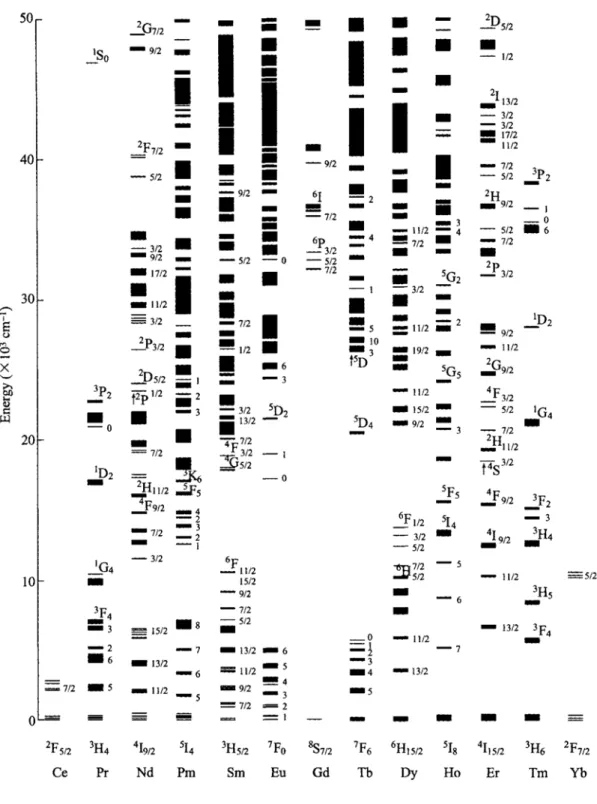
Fig. 1.1.1. Electronic structures of energy levels for various trivalent rare earth ions.
4 Fig. 1.1.2. Detailed energy level diagram for the Nd:YVO4 crystal with
indications of the possible excitation wavelengths as well as the potential emission lines.
5
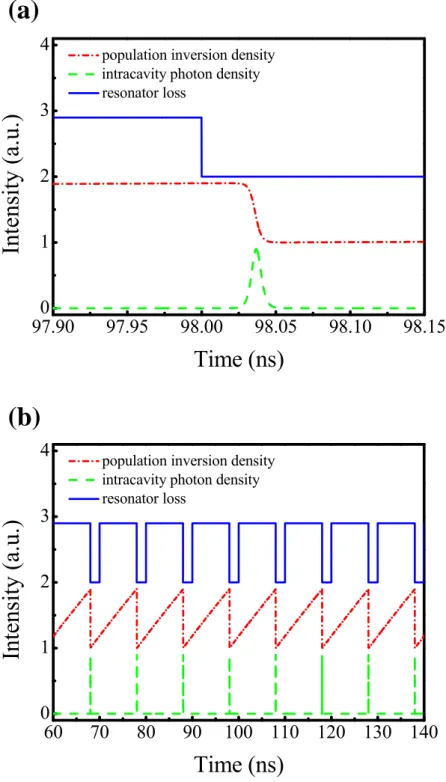
Fig. 1.2.1. Population inversion density, intracavity photon density, and resonator loss as a function of time for continuously pumped Q-switched operation.
8
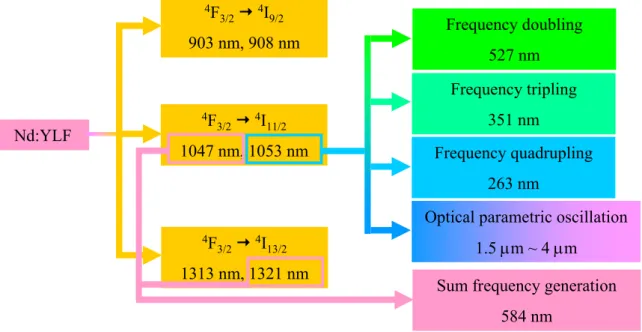
Fig. 1.3.1. Feasible fundamental emissions and possible wavelength extensions for the Nd:YLF crystal via several nonlinear frequency conversion processes.
11
Chapter 2
Fig. 2.1.1. Basic properties of the Nd:YVO4 crystal. 21
Fig. 2.2.1. (a) The configuration for a simple plano-concave cavity with the thermal lensing effect; (b) Calculated results for the ratio of the cavity mode size in the gain medium to that in the saturable absorber as a function of the incident pump power for the cases of
Lcav = 90, 80, 70, 60, and 50 mm when the ROC of the input
mirror is chosen to be R1 = 100 mm.
26
Fig. 2.2.2. Schematic of the cavity setup for a diode-pumped PQS Nd:YVO4
laser with the Cr4+:YAG saturable absorber.
28 Fig. 2.2.3. (a) Output powers in CW (red curve) and PQS (green curve)
operations as a function of the incident pump power; (b) Dependences of the pulse repetition rate (red curve) and pulse width (green curve) on the incident pump power; (c) Dependences of the pulse energy (red curve) and peak power (green curve) on the incident pump power.
30
Fig. 2.2.4. Typical oscilloscope traces of the output pulses at 1064 nm under an incident pump power of 16.3 W with the time span of (a) 200 and (b) 2 μs.
31
Fig. 2.3.1. Schematic of the cavity setup for a diode-pumped AO Q-switched Nd:YVO4 laser.
34 Fig. 2.3.2. Experimental results for the relationship between the critical 37
cavity length and the incident pump power.
Fig. 2.3.2. Experimental results for the relationship between the critical cavity length and the incident pump power.
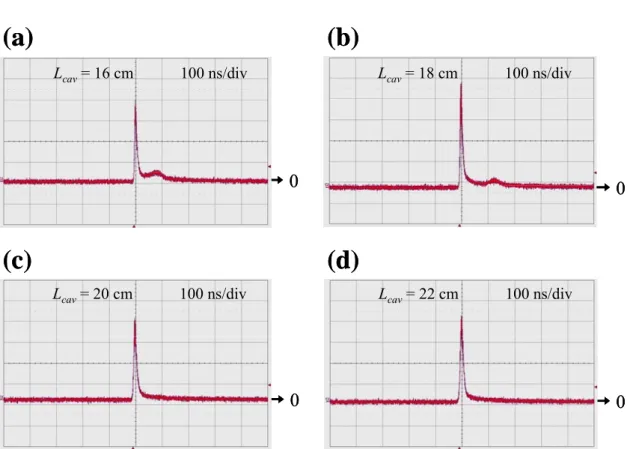
37 Fig. 2.3.3. Temporal behaviors of the Q-switched pulses with different cavity
lengths Lcav: (a) Lcav = 16 cm; (b) Lcav = 18 cm; (c) Lcav = 20 cm;
(d) Lcav = 22 cm.
38
Fig. 2.3.4. Calculated results for the thermal focal length as a function of the Nd dopant concentration of laser crystal at a pump power of 44 W.
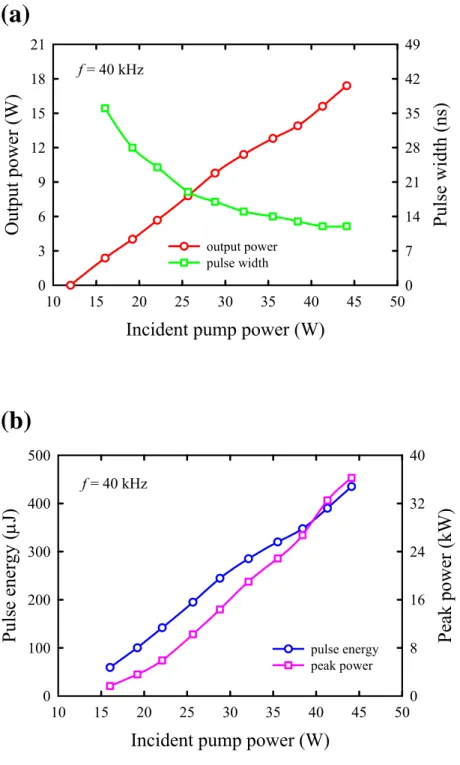
39 Fig. 2.3.5. Output power (red), pulse width (green), pulse energy (blue) and
peak power (pink) versus the incident pump power at a pulse repetition rate of 40 kHz.
41
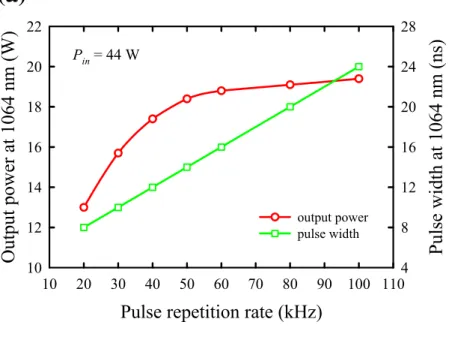
Fig. 2.3.6. (a) Dependences of the average output power (red) and the pulse width (green) on the pulse repetition rate at a pump power of 44 W; (b) Dependences of the pulse energy (blue) and the peak power (pink) on the pulse repetition rate at a pump power of 44 W.
42
Fig. 2.4.1. Basic properties of the Nd:YLF crystal. 44 Fig. 2.5.1. Schematic of the cavity setup for a diode-pumped PQS
Nd:YLF/Cr4+:YAG laser.
47 Fig. 2.5.2. (a) The angle tuning characteristics of the 3˚-wedged a-cut
Nd:YLF laser for the σ- and π-polarizations in the CW operation; (b) The two-dimensional spatial distributions for the σ-polarization under the maximum output power, indicating a near-diffraction-limited TEM00 transverse mode.
50
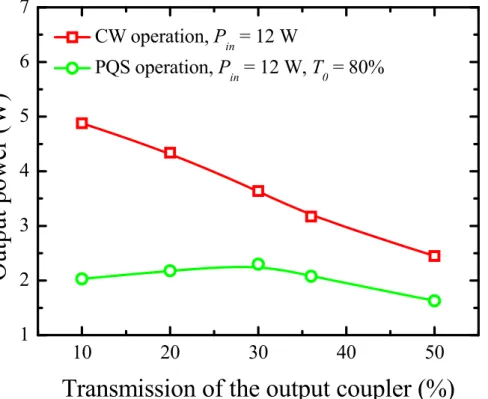
Fig. 2.5.3. The maximum output powers at 1053 nm in the CW and PQS operations as a function of the output coupling.
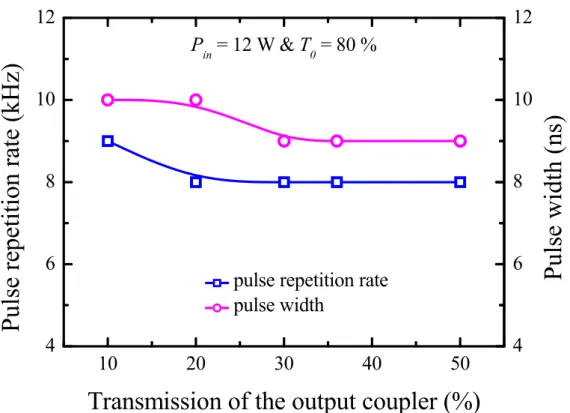
51 Fig. 2.5.4. Dependences of the pulse repetition rate and pulse width on the
output coupling.
52 Fig. 2.5.5. Dependences of the pulse energy and peak power on the output
coupling.
53 Fig. 2.5.6. Typical temporal behaviors at 1053 nm with: (a) time span of 2
ms, and (b) time span of 200 ns, which were recorded with the output coupling of 30 % under an incident pump power of 12 W.
54
Fig. 2.6.1. Calculated results for the mode-to-pump size ratio as a function of the thermal focal length for the cases of R1 = 50, 100, 200, and 500
mm: (a) positive thermal-lensing effect; (b) negative thermal-lensing effect.
57
Fig. 2.6.2. Configuration of the cavity setup for a diode-pumped PQS Nd:YLF/Cr4+:YAG laser.
xi
Fig. 2.6.3. Output power as a function of the incident pump power for the cases of R1 = 50, 100, 200, and 500 mm: (a) in the CW operation;
(b) in the PQS operation.
63
Fig. 2.6.4. Numerical calculations of the thermal focal length versus the incident pump power for the CW and PQS cases.
64 Fig. 2.6.5. Dependences of (a) the pulse width, pulse repetition rate, (b) pulse
energy, and peak power on the incident pump power in the PQS operation with R1 = 100 mm.
65
Fig. 2.6.6. Typical temporal behaviors at 1053 nm with: (a) time span of 2 ms, and (b) time span of 100 ns.
66 Fig. 2.7.1. Experimental arrangement of the pulsed pumped PQS Nd:YLF
laser with the Cr4+:YAG saturable absorber.
69 Fig. 2.7.2. Dependences of the laser mode radius inside the gain medium on
the cavity length for R1 = 50, 100, and 150 mm in a concave-plano
cavity, where vertical dotted lines indicate the constraint of Lcav =
0.97R1.
71
Fig. 2.7.3. Pulse energies at 1053 nm as a function of the pulse repetition rate.
74 Fig. 2.7.4. (a) Typical temporal behavior at a pulse repetition rate of 500 Hz
for R1 = 100 mm; (b) Variation of the beam quality factors versus
the ROC of the input mirror.
75
Fig. 2.8.1. Experimental setup for the AQS Nd:YLF laser. 78 Fig. 2.8.2. (a) Output powers at 1053 nm with and without an intracavity
polarizer versus the incident pump power at 806 nm in the CW operation; (b) The polarization ratios Phorizontal/Pvertical with respect
to the incident pump power at a pulse repetition rate of 5, 8, 10, 20, and 40 kHz, where Phorizontal and Pvertical represent the output
powers with the oscillated polarization to be parallel and perpendicular to the base of the AO Q-switch, respectively.
81
Fig. 2.8.3. Dependences of the (a) output power, pulse width, (b) pulse energy and peak power at 1053 nm on the pulse repetition rate at an incident pump power of 12.7 W.
82
Fig. 2.8.4. Pulse trains of the Q-switched Nd:YLF laser at a pulse repetition rate of (a) 5 kHz, (b) 40 kHz, (c) 50 kHz, and (d) 100 kHz. The dashed circle in Fig. 4(d) indicates the phenomena of the pulse missing.
Chapter 3
Fig. 3.1.1. Transmission of the human eye from the cornea to the retina and the absorption of the retina pigment epithelium as a function of the wavelength.
95
Fig. 3.2.1. Experimental setup for the diode-pumped Nd:YVO4/Cr4+:YAG/KTP eye-safe laser.
98 Fig. 3.2.2. Dependence of the output powers at 1572 nm on the incident
pump power.
101 Fig. 3.2.3. Dependence of the pulse repetition rates at 1572 nm on the
incident pump power.
102 Fig. 3.2.4. Dependence of the pulse energies at 1572 nm on the incident
pump power.
103 Fig. 3.2.5. Typical oscilloscope traces of the Q-switched pulse trains at 1572
nm.
104 Fig. 3.2.6. Oscilloscope traces of a single pulse of fundamental (1064 nm)
and signal (1572 nm) waves at various pump powers for (a) Rs =
80 % and (b) Rs = 50 %, respectively.
105
Fig. 3.2.7. Hour-long average power stabilities of the signal powers for Rs =
80 % and Rs = 50 % at the maximum incident pump power.
106 Fig. 3.3.1. Schematic of the cavity setup for a KTP-based IOPO pumped by
an AO Q-switched c-cut Nd:YLF laser.
110 Fig. 3.3.2. Output powers at 1552 nm as a function of the incident pump
power at 806 nm under a pulse repetition rate of 5, 8, 10, 20 and 40 kHz, respectively; Inset: Optical spectrum of the Nd:YLF/KTP eye-safe laser.
113
Fig. 3.3.3. Temporal behaviors of the originally input fundamental pulses with the mutually orthogonal polarizations at a pulse repetition rate of 5 kHz.
114
Fig. 3.3.4. Temporal behaviors of the mutually orthogonal polarization components of the depleted fundamental pulses at a pulse repetition rate of 5 kHz and an incident pump power of (a) 5.9 W, (b) 7.7 W, (c) 10.4 W, and (d) 12.7 W, respectively.
115
Fig. 3.3.5. Typical temporal behaviors of the eye-safe pulses at an incident pump power of 12.7 W and a pulse repetition rate of 5 kHz with: (a) the time span of 1 μs, and (b) the time span of 1.5 ms.
xiii
Chapter 4
Fig. 4.1.1. Schemes of the cavity setup for the diode-pumped AQS Nd:YVO4
lasers configured with the (a) ESHG and (b) ISHG.
127 Fig. 4.1.2. Dependences of the (a) output power, (b) pulse energy, and (c)
pulse width at 532 nm on the pulse repetition rate.
130 Fig. 4.1.3. Typical temporal behaviors for the (a) ESHG and (b) ISHG under
an incident pump power of 26 W at 808 nm and a pulse repetition rate of 40 kHz; (c) Dependences of the peak power at 532 nm on the pulse repetition rate.
131
Fig. 4.2.1. Schematic of the experimental setup for the ESHG and ETHG. 136 Fig. 4.2.2. Dependences of the output power at 532 nm (green curve) and 355
nm (blue curve) on the incident pump power at 1064 nm.
137 Fig. 4.2.3. Dependences of (a) the output powers, (b) the pulse energies, and
(c) the peak powers at 532 and 355 nm on the pulse repetition rate at an incident pump power of 44 W.
139
Fig. 4.2.4. Pulse energies as a function of the pulse repetition rate at (a) 527 nm and (b) 351 nm.
141 Fig. 4.3.1. Arrangement of the experimental setup for the EFHG. 144 Fig. 4.3.2. Dependences of the (a) output power, (b) pulse energy, and (c)
peak power at 266 nm on the pulse repetition rate.
xv
List of Tables
Chapter 5
Table 5.1.1. Summary for Q-switched Nd-doped crystal IR lasers. 160 Table 5.1.2. Summary for Q-switched Nd-doped crystal eye-safe lasers. 161 Table 5.1.3. Summary for harmonic generations performed by Q-switched
Nd-doped crystal IR lasers.
xvii
List of Abbreviations
IR infraredNd neodymium UV ultraviolet
SHG second harmonic generation THG third harmonic generation
DUV deep ultraviolet
PQS passively Q-switched
AQS actively Q-switched
IOPO intracavity optical parametric oscillator ESHG extracavity second harmonic generation ISHG intracavity second harmonic generation EFHG extracavity fourth harmonic generation ROC radius of curvature
AR antireflection CW continuous-wave AO acousto-optic
ETU energy-transfer upconversion FWHM full width at half maximum
xix
List of Symbols
N population inversion density inside the gain medium
r pumping rate
c light speed
σ stimulated emission cross section of the gain medium
ϕp intracavity photon density
τ upper-state lifetime of the gain medium
lcry crystal length Lcav cavity length
Ω fraction of spontaneous emission contributing to the laser emission
tr round trip time
t time
τcav decay time for photon in the resonator ROC reflectivity of the output coupler
Ls cavity loss
P induced polarization for a given optical material E applied electric field
ε0 permittivity of free space χ(i) ith-order nonlinearities
T0 initial transmission of the saturable absorber σgsa ground-state absorption of the saturable absorber
A, As laser mode area in the laser crystal and that in the saturable
absorber
γ population inversion reduction factor,
β the ratio of the excite excited-state absorption cross section to the ground-state absorption cross section of the saturable absorber
g* equivalent g-parameters
Lcav* equivalent cavity length fth effective thermal focal length
d1, d2 the optical path lengths from the center of the gain medium to the
input mirror and output coupler
ξ fraction of the incident pump power that results in heat
Pin incident pump power Kc thermal conductivity α absorption coefficient
λp pump wavelength
dn/dT thermal-optic coefficient
n refractive index
αT thermal expansion coefficient M2 pump beam quality factor
ωp(z) variation of the pump radius
ωpo pump beam waist
z0 distance from the entrance of the laser crystal ϕb average photon density caused by parasitic lasing
θω wedged angle
ϕt tilting angle
nσ, nπ refractive indices for the σ- and π-polarizations
ω1, ω2 cavity mode radii at the input mirror and at the output coupler
C proportional constant representing the extent of the thermal-lensing effect
f pulse repetition rate
Phorizontal, Pvertical output power with the oscillated polarization to be parallel and
perpendicular to the base of the AO Q-switch
Rs reflectivity at signal wavelength
N population inversion density inside the gain medium
r pumping rate
1
Chapter 1
1.1 Diode-Pumped Solid-State Laser
Diode-pumped solid-state laser is a laser made by pumping a solid gain medium with a semiconductor laser diode. The first experimental realization of diode-pumped solid-state laser was in 1964, where the U:CaF2 crystal was pumped by the GaAs diode
laser at a temperature of 4 K [1]. It was not until 1972 that the first diode-pumped solid-state laser at room temperature was achieved with the Nd:YAG crystal [2]. However, diode-pumped solid-state laser was still under relatively slow development until 1980-1990s, where the rapid advance and growing maturity of high-power, efficient, reliable laser diode and diode laser array lead to a renaissance of diode-pumped solid-state laser [3]. Since then, diode-pumped solid-state laser has made significant progress, and many excellent reviews have been given to comprehensively discuss the contemporary development and status of diode-pumped solid-state laser [4-14].
Compared with the traditionally lamp-pumped systems, the major advantages of the diode-pumping include:
1. Increased component lifetime (20000 hrs vs. 500 hrs or 109 shots vs. 107 shots).
2. Increased overall system efficiency (wall-plug efficiency: 10 % vs. 1 %). 3. Improved beam quality.
4. Enabling technology for compact, reliable, robust and versatile laser system. 5. Enabling technology for new laser materials.
6. Benign operating features of the laser diode such as good amplitude and spectral stability, low voltage operation, and so on.
7. Increased pulse repetition rate.
Although the laser diode can itself be used in a number of applications, the solid-state laser have several advantages over the laser diode. For example, the solid-state laser can operate in wavelength ranges via nonlinear frequency conversion where the laser diode neither is available nor has good performance. In addition, the radiation from high-power diode laser array is only partially coherent, while the output from the solid-state laser pumped by high-power laser diode can potentially achieve a nearly diffraction-limited beam with higher radiance and singly coherent emission. The
3
solid-state laser can store energy in the upper-state level to efficiently generate high-energy and high-peak-power giant pulses which can not be attained from the laser diode. The solid-state laser can also have a narrower linewidth than the laser diode with the same output power. Another feature is the insensitivity of output performance of solid-state laser to the temperature, while the laser diode has strong dependence (0.3 nm/K) between the emission wavelength and temperature.
The gain medium for diode-pumped solid-state laser consists of two parts, one is the host material, the other is the active ion [15]. To date, a large number of host materials have been investigated including glasses, oxides, sapphire, garnets, aluminate, oxysulfide, phosphates, silicates, tunstates, molybdates, vanadates, beryllates, fluorides, and ceramics etc. Generally speaking, the host material must have good optical, mechanical, and thermal properties to endure severe operating conditions for practical applications. On the other hand, the electron transition in the active ion determines the spectroscopic properties of the specific laser crystal, such as the output wavelength, upper-state lifetime, stimulated emission cross section, gain bandwidth and so on.
The rare earth ions are natural candidates to act as active ions in the solid-state laser because they exhibit a wealth of sharp fluorescent transitions covering the spectrum from visible to infrared (IR) regimes. Electronic structures of energy levels for various trivalent rare earth ions are illustrated in Fig. 1.1.1 [16]. Neodymium (Nd) is the first of the trivalent rare earth ions to be used in the solid-state laser [17], and it remains by far the most important element to achieve a highly efficient laser operation among all of active ions. The detailed energy level diagram for the Nd:YVO4 crystal is depicted in
Fig. 1.1.2 with indications of the possible excitation wavelengths as well as the potential emission lines. Note that the actual positions of individual Stark levels depend on the host materials due to different crystal field interactions. It can be found that the AlGaAs laser diodes with emission lines at 808 and 880 nm are suitable to be used as pump sources for the Nd-doped crystals, corresponding to the conventional pumping (4I9/2 → 4F
5/2) and direct in-band pumping (4I9/2 → 4F3/2) [18-25]. On the other hand, the
stimulated emission in the Nd-doped crystal can be categorized into three different groups with output wavelengths centered around 0.9, 1.06, and 1.3 μm, corresponding to the transition levels from 4F3/2 to 4I9/2, 4I11/2, 4I13/2, respectively. In this thesis, we will
focus on the studies of two of widely used Nd-doped laser crystals; that is to say, the Nd:YVO4 and Nd:YLF crystals.
5
Fig. 1.1.2. Detailed energy level diagram for the Nd:YVO4 crystal with indications of
the possible excitation wavelengths as well as the potential emission lines.
cm-1 12362 0 110 173 228 437 1966 1987 2046 2067 2157 2180 3908 3931 3977 4042 4087 4157 4159 11368 11386 1342nm 1064nm 914nm 808nm 880nm Z1 Z5 Y1 Y6 X1 X7 R1 R2 4
I
13/2 4I
11/2 4I
9/2 4F
3/2 4F
5/2+
4H
9/2 cm-1 12362 0 110 173 228 437 1966 1987 2046 2067 2157 2180 3908 3931 3977 4042 4087 4157 4159 11368 11386 1342nm 1064nm 914nm 808nm 880nm Z1 Z5 Y1 Y6 X1 X7 R1 R2 4I
13/2 4I
11/2 4I
9/2 4F
3/2 4F
5/2+
4H
9/21.2 Q-Switching
By periodically modulating the cavity loss, the generation of high-energy giant pulses with durations of a few nanoseconds can be achieved [26,27]. This method is called Q-switching. In the technique of Q-switching, the energy is initially stored in the gain medium with the prevention of laser emission by keeping the resonator loss high. That is, the cavity Q is maintained at a low value. Note that the word “Q” means the quality factor, which is defined as the ratio of the energy stored in the cavity to the energy loss per round trip. When the resonator loss is suddenly reduced, the accumulated gain is considerably higher than the threshold value. As a result, the stored energy is quickly released in the form of a very intense and short light pulse until the gain is saturated and the intracavity power decreases again. Figure 1.2.1(a) depicts the population inversion density, intracavity photon density, and resonator loss as a function of time during the development of a Q-switched laser pulse.
The temporal behaviors for the population inversion density, intracavity photon density, and resonator loss can be readily simulated with the conventional coupled rate equations as follows: N N c r dt dN p , (1.1) N L l N c dt d cav p cav cry p p , (1.2) s OC r cav L R t 1 ln , (1.3)
where N is the population inversion density inside the gain medium, t is the time, r is
the pumping rate, c is the light speed, σ and τ are the stimulated emission cross section
and upper-state lifetime of the gain medium, ϕp is the intracavity photon density, lcry and Lcav are the crystal and cavity lengths, τcav is the decay time for photon in the resonator, tr is the round trip time, ROC is the reflectivity of the output coupler, Ls is the cavity loss,
and Ω accounts for the fraction of spontaneous emission contributing to the laser emission. By numerically solving the Eqs. (1.1)-(1.3) with a periodically step function for the cavity loss, the temporal dynamics for the population inversion density and intracavity photon density during the continuously pumped, repetitively Q-switched
7
process can be sketched. Figure 1.2.1(a) illustrates the relationship among the population inversion density, intracavity photon density, resonator loss and time for the generation of a single Q-switched laser pulse, while a train of giant pulses is displayed in Fig. 1.2.1(b).
For producing large pulse energy, a high energy capability of the gain medium is highly desirable. One of the promising characteristics for the solid-state laser over other types of light sources is the long upper-state lifetimes for bulk crystals. Therefore, a solid-state laser can store the energy from the pump source for several hundred microseconds, and subsequently emits an intense pulse with a peak power nearly four orders of magnitude greater than the pump power. After the first demonstration of the Q-switched operation with the Ruby crystal [28], high-energy and high-peak-power Q-switched pulsed lasers with a large variety of solid-state crystals have been widely investigated and realized with active or passive approaches.
Fig. 1.2.1. Population inversion density, intracavity photon density, and resonator loss as a function of time for continuously pumped Q-switched operation.
60 70 80 90 100 110 120 130 140 0 1 2 3 4
Intensity (a.u.
)
Time (ns)
population inversion density intracavity photon density resonator loss 97.900 97.95 98.00 98.05 98.10 98.15 1 2 3 4
Int
ensity (a
.u
.)
Time (ns)
population inversion density intracavity photon density resonator loss
(b)
(a)
9
1.3 Nonlinear Frequency Conversion
Since the unexpected ultraviolet (UV) light at twice the frequency of the Ruby laser was observed in 1961 [29], a large number of investigations on the nonlinear optical response of the optical medium have been extensively made. In general, the induced polarization P for a given optical material depends on the applied electric field E, which can be expanded in a power series of electric field strength as [30,31]:
(3) (1) (2) (3) 0 ) 2 ( 0 ) 1 ( 0 E EE EEE P P P P (1.4)
where ε0 is the permittivity of free space, χ(1) is the linear susceptibility representing the
linear response of the material, χ(2) and χ(3) are the second- and third-order nonlinearities
accounting for the nonlinear responses of the material. From the wave equation, a time-varying polarization can act as the source of new components of the electric field:
2 2 2 0 2 2 2 2 1 1 t P c t E c E (1.5)
with the expression of Eq. (1.4), linear and several nonlinear responses can be described. For example, P(1) describes the propagation of a wave in a linear medium rather than a
vacuum. P(2) is responsible for the optical rectification, second harmonic generation
(SHG), sum and difference frequency generations, and optical parametric amplification.
) 3 (
P explains the phenomena of third harmonic generation (THG), optical Kerr effect, stimulated Raman scattering, and stimulated Brillouin scattering.
Lasers with different wavelengths can find their unique usefulness in scientific research and industrial fields [32-36]. Nonlinear frequency conversion provides an useful means for extending the spectral range of available solid-state laser sources when the polarization state and the direction of the beam propagation are specifically designed to satisfy the phase matching condition. Figure 1.3.1 conceptually illustrates the feasible fundamental emissions and possible wavelength extensions for the Nd:YLF crystal via several nonlinear frequency conversion processes. With the improved quality of the nonlinear crystal as well as the great advance of the laser engineering, a number of light sources from eye-safe to UV and deep UV (DUV) regimes based on the combination of the nonlinear frequency conversion and diode-pumped solid-state laser are well developed and are becoming commercially available. For example, AVIA-series lasers manufactured by Coherent Inc. can supply the maximum output power of 45 W at 532
nm and 28 W at 355 nm with the pulse repetition rate ranging from 30 to 300 kHz [37]. Another well-known laser supplier, JDSU Inc., designs Q-series products for meeting a wide variety of industrial applications. Depending on the slightly different operating conditions, the Q-series products at 355 nm can work in the range 10-130 kHz with the maximum output power of 12 W, while the ones at 532 nm can operate in the range 5-60 kHz with the maximum output power of approximately 16 W [38].
11
Fig. 1.3.1. Feasible fundamental emissions and possible wavelength extensions for the Nd:YLF crystal via several nonlinear frequency conversion processes.
Nd:YLF 4F 3/24I9/2 903 nm, 908 nm 4F 3/24I11/2 1047 nm, 1053 nm 4F 3/24I13/2 1313 nm, 1321 nm Frequency doubling 527 nm Frequency tripling 351 nm Frequency quadrupling 263 nm
Optical parametric oscillation 1.5 m ~ 4 m Sum frequency generation
1.4 Overview of Thesis
This thesis is organized as follows. Chapter 1 gives the general introduction to the property and development of diode-pumped solid-state laser. Operation principles for Q-switching and nonlinear frequency conversion are also addressed.
Then, the features of commonly used Nd:YVO4 and Nd:YLF crystals are briefly
discussed in 2.1 and 2.4, respectively. For the Nd:YVO4 crystal, we take into account of
the thermal-lensing effect and second threshold condition to design a high-peak-power passively Q-switched (PQS) laser at 1064 nm with the Cr4+:YAG crystal as a saturable absorber. We also consider the parasitic lasing effect and thermal-lensing effect to optimize a high-peak-power actively Q-switched (AQS) Nd:YVO4 laser at 1064 nm. As
for the Nd:YLF crystal, a novel method is proposed to efficiently select the σ-polarization at 1053 nm in the a-cut crystal, and the PQS performance with the Cr4+:YAG crystal is systematically investigated for various output couplings. We further present a practical tactic to scale up the pulse energy of the continuously pumped PQS laser at the 4F3/2 → 4I11/2 transition with the c-cut Nd:YLF crystal. Pulsed pumping
is subsequently utilized to reduce the thermal effect and improve the timing jitter of a mJ- and ns-level PQS Nd:YLF/Cr4+:YAG laser. AQS operation in the Nd:YLF crystal is also realized to provide a sequence of giant pulses with continuously adjustable pulse repetition rate. It is worthwhile to mention that all of above-mentioned achievements are optimized on the basis of extremely simple and compact linear cavity configurations.
In previous studies on the eye-safe radiations obtained from the Nd-doped crystal lasers, shared and coupled cavity configurations for intracavity optical parametric oscillator (IOPO) are adopted. However, the fundamental IR and eye-safe cavities can not be optimized independently, which in turn restricts the optical conversion efficiency and long-term stability. In Chap. 3, we develop a separable monolithic IOPO cavity to remarkably improve the performance of the PQS Nd:YVO4/Cr4+:YAG/KTP eye-safe
laser at 1572 nm. With the same concept, we demonstrate a compact and efficient high-energy AQS Nd:YLF eye-safe laser at 1552 nm. In addition, it is found that the thermally induced birefringence can lead the mutually orthogonal polarization states of the fundamental IR pulses to be effectively switched for accomplishing an efficient IOPO operation without any extra polarization control.
13
In Chap. 4, the optimized Q-switched Nd-doped crystal lasers designed in Chap. 2 are employed to produce green, UV, and DUV radiations via extracavity harmonic generations. Firstly, the output performance between the extracavity and intracavity SHGs (ESHG and ISHG) at 532 nm under a similar operated condition is thoroughly explored with the type-I LBO crystal as a frequency doubler. Secondly, with the type-I and type-II LBO crystals as a frequency doubler and a frequency tripler, highly efficient UV emissions at 355 and 351 nm are obtained from the high-power Nd:YVO4 lasers
and high-energy Nd:YLF laser, respectively. Thirdly, the green lasers based on ESHG and ISHG are utilized as pump sources to make a comparison of the conversion efficiencies for producing 266-nm radiations, where the BBO crystal is exploited in the process of extracavity fourth harmonic generation (EFHG). Efficient nonlinear frequency conversions demonstrated in Chaps. 3 and 4 not only enable us to extend the emission lines from IR to eye-safe, green, UV, and DUV regimes, but also validate the usefulness of our cavity design for Q-switched IR lasers developed in Chap. 2.
Finally, a summary is given in Chap. 5 to conclude this thesis. Future plans and prospects are also described in this chapter with the aim for completing this doctoral thesis.
References
[1] R. L. Keyes and T. M. Quist, “Injection luminescent pumping of CaF2:U3+ with
GaAs diode lasers,” Appl. Phys. Lett. 4, 50-52 (1964).
[2] H. G. Danielmeyer and F. W. Ostermayer, “Diode-pumped-modulated Nd:YAG laser,” J. Appl. Phys. 43, 2911-2913 (1972).
[3] W. Streifer, D. R. Scifres, G. L. Harnagel, D. F. Welch, J. Berger, and M. Sakamoto, “Advances in diode laser pumps,” IEEE J. Quantum Electron. 24, 883-894 (1988).
[4] R. L. Byer, “Diode laser-pumped solid-state lasers,” Science 239, 742-747 (1988).
[5] T. Y. Fan and R. L. Byer, “Diode laser-pumped solid-state lasers,” IEEE J. Quantum Electron. 24, 895-912 (1988).
[6] T. Y. Fan, “Diode-pumped solid state lasers,” The Lincoln Laboratory Journal 3, 413-426 (1990).
[7] B. D. Sinclair and M. H. Dunn, “All-solid-state lasers,” Phys. Educ. 29, 146-150 (1994).
[8] K. L. Schepler, “Trends in solid-state lasers,” Opt. Photon. News 8, 38-41 (1997).
[9] A. Leuzinger, “The evolution of diode-pumped solid-state lasers,” Opt. Photon. News 10, 37-40 (1999).
[10] Z. Jankiewicz and K. Kopczynski, “Diode-pumped solid-state lasers,” Opto-Electron. Rev. 9, 19-33 (2001).
[11] D. C. Brown and J. W. Kuper, “Solid-state lasers: steady progress through the decades,” Opt. Photon. News 20, 36-41 (2009).
[12] B. Davarcioglu, “An overview of diode pumped solid state (DPSS) lasers,” Int. Arch. Appl. Sci. Technol. 1, 1-12 (2010).
[13] G. Huber, C. Kränkel, and K. Petermann, “Solid-state lasers: status and future,” J. Opt. Soc. Am. B 27, B93-B105 (2010).
[14] W. Koechner, Solid-State Laser Engineering, 6th edn. (Springer, Berlin, 2006). [15] W. Koechner, Solid-State Laser Engineering, 6th edn. (Springer, Berlin, 2006),
Chap. 2.
15
Berlin, 2005), Chap. 1.
[17] J. E. Geusic, H. M. Marcos, and L. G. Van Uitert, “Laser oscillations in Nd-doped yttrium aluminum, yttrium gallium and gadolinium garnets,” Appl. Phys. Lett. 4, 182-184 (1964).
[18] V. Lupei, N. Pavel, and T. Taira, “Highly efficient laser emission in concentrated Nd:YVO4 components under direct pumping into the emitting
level,” Opt. Commun. 201, 431-435 (2002).
[19] Y. Sato, T. Taira, N. Pavel, and V. Lupei, “Laser operation with near quantum-defect slope efficiency in Nd:YVO4 under direct pumping into the
emitting level,” Appl. Phys. Lett. 82, 844-846 (2003).
[20] P. Zhu, D. Li, P. Hu, A. Schell, P. Shi, C. R. Haas, N. Wu, and K. Du, “High efficiency 165 W near-diffraction-limited Nd:YVO4 slab oscillator pumped at
880 nm,” Opt. Lett. 33, 1930-1932 (2008).
[21] N. Pavel, T. Dascalu, N. Vasile, and V. Lupei, “Efficient 1.34-μm laser emission of Nd-doped vanadates under in-band pumping with diode lasers,” Laser Phys. Lett. 6, 38-43 (2009).
[22] X. Ding, R. Wang, H. Zhang, X. Y. Yu, W. Q. Wen, P. Wang, and J. Q. Yao, “High-efficiency Nd:YVO4 laser emission under direct pumping at 880 nm,”
Opt. Commun. 282, 981-984 (2009).
[23] J. Gao, X. Yu, B. Wei, and X. D. Wu, “Quasi-three-level Nd:YVO4 laser
operation at 914 nm under 879 nm diode laser pumping,” Laser Phys. 20, 1590-1593 (2010).
[24] Y. F. Lü, X. H. Zhang, X. D. Yin, J. Xia, A. F. Zhang, and J. Q. Lin, “Highly efficient continuous-wave intracavity frequency-doubled Nd:YVO4-LBO laser
at 457 nm under diode pumping into the emitting level 4F3/2,” Appl. Phys. B 99,
115-119 (2010).
[25] L. Cui, H. L. Zhang, L. Xu, J. Li, Y. Yan, P. F. Sha, L. P. Fang, H. J. Zhang, J. L. He, and J. G. Xin, “880 nm laser-diode end-pumped Nd:YVO4 slab laser at 1342
nm,” Laser Phys. 21, 105-107 (2011).
[26] W. Koechner, Solid-State Laser Engineering, 6th edn. (Springer, Berlin, 2006), Chap. 8.
[27] R. Paschotta, Field Guide to Lasers, (SPIE, Bellingham, Washington, 2007).
[28] F. J. McClung and R. W. Hellwarth, “Giant optical pulsations from Ruby,” Appl. Opt. 1, 103-105 (1962).
[29] P. A. Franken, A. E. Hill, C. W. Peters, and G. Weinreich, “Generation of optical harmonics,” Phys. Rev. Lett. 7, 118-119 (1961).
[30] W. Koechner, Solid-State Laser Engineering, 6th edn. (Springer, Berlin, 2006), Chap. 10.
[31] R. W. Boyd, Nonlinear optics, 3rd edn. (Elsevier, London, 2008). [32] M. J. Weber, Handbook of laser wavelengths, (CRC, New York, 1999).
[33] http://en.wikipedia.org/wiki/List_of_laser_types [34] http://www.laserfest.org/lasers/innovations.cfm [35] http://www.rp-photonics.com/laser_applications.html [36] http://www.photonics.com/LinearCharts/Default.aspx?ChartID=1 [37] http://www.coherent.com/Products/index.cfm?868/AVIA-Family-of-DPSS-Lase rs [38] http://www.jdsu.com/en-us/Lasers/Products/A-Z-Product-List/Pages/laser-solid-state-q-switched-355-532-q-series.aspx
19
Chapter 2
2.1 Properties of Nd:YVO
4Crystal
Nd-doped yttrium vanadate (Nd:YVO4) is an important laser material which was
first recognized in 1966 [1], and efficient diode-pumped Nd:YVO4 laser was
successfully demonstrated in 1987 [2]. Basic properties of the Nd:YVO4 crystal are
illustrated in Fig. 2.1.1, which is obtained from CASTECH [3]. The Nd:YVO4 crystal
belongs to the tetragonal group in crystal structure. The natural birefringence of this uniaxial crystal dominates the thermally induced birefringence, and subsequently the linearly polarized output can eliminate the undesirable thermal depolarization loss in the high-power operation, which is frequently observed in optically isotropic laser crystals such as the Nd:YAG crystal. Optical properties of the Nd:YVO4 crystal are strongly
polarization dependent, which can be classified as π-polarization (extraordinary beam) and σ-polarization (ordinary beam). The π- and σ-polarizations are defined as the oscillated polarizations of the light to be parallel and perpendicular to the crystallographic c axis, respectively. Unlike the Nd:YAG crystal, the Stark splitting in the Nd:YVO4 crystal is small and the multiple transitions are more compact. These lead
the Nd:YVO4 crystal to possess the outstanding features over other Nd-doped crystals;
that is, the large absorption coefficient around 808 nm and high stimulated emission cross section at 1064 nm. The former property allows the use of short crystal to efficiently absorb the incident pump light for the construction of a compact microchip laser, while the latter one is inherently suitable for developing a high-repetition-rate pulsed laser.
21
2.2 Passively Q-Switched Nd:YVO
4Laser at 1064 nm
I. Introduction
Passive Q-switching of a solid-state laser with a saturable absorber is a convenient way to provide a reliable pulsed operation with the benefits of high stability, inherent compactness, and low cost. As a promising saturable absorber near the IR region, the Cr4+:YAG crystal has been widely investigated on the PQS performance thanks to its good chemical and mechanical stability, long lifetime, excellent optical quality, high damage threshold, high thermal conductivity, and large absorption cross section [4-12]. However, the stimulated emission cross section of the Nd:YVO4 crystal at 1064
nm is too large to achieve a good PQS operation when the Cr4+:YAG crystal is used as a saturable absorber. Several methods have been proposed to overcome the well-known condition for good passive Q-switching, including the intracavity focusing obtained from the three-element resonator [13-15] and the employment of a c-cut crystal as a gain medium [16-18]. Nevertheless, the peak powers with the above-mentioned reports are not high enough for some practical applications, especially for efficient extracavity nonlinear frequency conversion. Therefore, it is highly desirable to develop a high-peak-power PQS Nd:YVO4 laser with the Cr4+:YAG saturable absorber.
In this section, we take into account the second threshold and thermal-lensing effect to design and realize a compact reliable PQS Nd:YVO4 laser with the Cr4+:YAG
crystal as a saturable absorber. At an incident pump power of 16.3 W, the output power at 1064 nm reaches 6.16 W with a pulse width of 7 ns and a pulse repetition rate of 56 kHz. The corresponding pulse energy and peak power are evaluated to be 111 μJ and 16 kW, respectively.
23
II. Cavity analysis
It is well known that the absorption saturation in the saturable absorber should occur before the gain saturation in the laser crystal for good PQS operation. The so-called second threshold condition has been analytically derived from the coupled rate equation, which can be mathematically expressed as [13,19]:
ln(1 ) 1 ) 1 ln( ) 1 ln( 2 0 2 0 s gsa s OC A A L R T T , (2.1) where T0 is the initial transmission of the saturable absorber, ROC is the reflectivity of
the output coupler, Ls is the nonsaturable round trip dissipative loss of the resonator, σgsa
is the ground-state absorption of the saturable absorber, σ is the emission cross section
of the laser crystal, A/As is the ratio of the laser mode area in the laser crystal to that in
the saturable absorber, γ is the population inversion reduction factor, which is equal to
one for the ideal four-level laser and two for the three-level laser, and β = σesa/σgsa is the
ratio of the excite excited-state absorption cross section to the ground-state absorption cross section of the saturable absorber. With the following parameters: T0 = 0.7, ROC =
0.5, Ls = 0.03, σgsa = 2 × 10-18 cm2 [12], σ = 2.5 × 10⁻¹⁸ cm2, γ = 1, and β = 0.06 [12], the
second threshold condition can be deduced to be A/As > 2.68 in the case of the
Nd:YVO4 and Cr4+:YAG crystals as a gain medium and a saturable absorber,
respectively. As a consequence, the ratio of the laser mode radius in the laser crystal to that in the saturable absorber needs to be larger than 1.64 for achieving a high-quality PQS operation.
The configuration for a simple plano-concave resonator with the thermal-lensing effect is schematically shown in Fig. 2.2.1(a). In the present experiment, the laser crystal and saturable absorber are aimed to be as close as possible to the input concave mirror and flat output coupler, respectively. An optical resonator with an internal thermal lens between the resonator mirrors can be replaced by an empty cavity with the equivalent g-parameters g* and the equivalent cavity length L
cav*, which are given by
[20]: i i j th i i R d d f g g* 1 1 , (2.2) i i R d d g 1 1 2 , (2.3)
i, j = 1, 2; i ≠ j, * 1 2 1 d1d2 f d d L th cav , (2.4)
where fth is the effective thermal focal length, d1 and d2 are the optical path lengths from
the center of the gain medium to the input mirror and output coupler, R1 and R2 are the
radius of curvature (ROC) of the input mirror and output coupler. In terms of the equivalent cavity parameters, the cavity mode radii at the input mirror (ω1) and at the
output coupler (ω2) are given by [20]:
) 1 ( * 2 * 1 * * * g g g g L i j cav i , i, j = 1, 2; i ≠ j, (2.5) As a result, we can calculate the variations of the cavity mode radius ω1 and ω2 with
respect to the effective thermal focal length. The effective focal length of thermal lens in the end-pumped laser crystal can be estimated with the following equation [21]:
dz l z n dT dn z e e K P f cry p T p l z l c in th cry cry
( 1) ( ) 2 1 ) ( 1 1 1 2 0 , (2.6)
2 0 2 2 1 ) ( z z n M z po p po p , (2.7) where ξ is the fraction of the incident pump power that results in heat, Pin is the incidentpump power, Kc is the thermal conductivity, α is the absorption coefficient at the pump
wavelength λp, lcry is the crystal length, dn/dT is the thermal-optic coefficient, n is the
refractive index, and αT is the thermal expansion coefficient, M2 is the pump beam
quality factor, and ωp(z) is the variation of the pump radius, where the pump beam waist ωpo is assumed a distance z0 from the entrance of the laser crystal. With the following
parameters: ξ = 0.24, Kc = 5.23 W/m K, α = 0.2 mm-1, λp = 808 nm, lcry = 12 mm, dn/dT
= 3 × 10⁻⁶ K-1, n = 2.1652, αT = 4.43 × 10⁻⁶ K-1, M2 = 230, ωpo = 300 μm, and z0 = 1 mm,
the effective thermal focal length can be calculated as a function of the incident pump power. To be brief, the dependence of the ratio ω1/ω2 on the incident pump power can
be generated to design and realize a high-quality PQS laser. Figure 2.2.1(b) depicts the calculated results for the cases of Lcav = 90, 80, 70, 60 and 50 mm, where the Lcav stands
for the cavity length and the other parameters used in calculation are as follows: R1 =
100 mm, R2 → ∞, d1 = 6 mm, d2 = (Lcav – 6) mm. From the Fig. 2.2.1(b), it is obvious
25
length is too long; whereas the PQS laser can not well operate in a high-quality state when the cavity length is too short. Comparative speaking, we chose a resonator with
Lcav = 70 mm to simultaneously satisfy the second threshold criterion and cavity
Fig. 2.2.1. (a) The configuration for a simple plano-concave cavity with the thermal lensing effect; (b) Calculated results for the ratio of the cavity mode size in the gain medium to that in the saturable absorber as a function of the incident pump power for the cases of Lcav = 90, 80, 70, 60, and 50 mm when the ROC of the input mirror is
chosen to be R1 = 100 mm.
Incident pump power at 808 nm (W)
0 2 4 6 8 10 12 14 16 18
Ratio of mode radius
1 / 2 1 2 3 4 5 6 7 Lcav = 80 mm Lcav = 60 mm Lcav = 70 mm Lcav = 50 mm Lcav = 90 mm Lcav fth
(b)
(a)
27
III. Experimental setup
The experimental setup is schematically shown in Fig. 2.2.2. The input mirror was a concave mirror with the ROC of 100 mm. It was antireflection (AR) coated at 808 nm on the entrance face, and was coated at 808 nm for high transmission as well as 1064 nm for high reflection on the second surface. The gain medium was a 0.1 at. % a-cut Nd:YVO4 crystal with dimensions of 3 × 3 × 12 mm3, and it was placed as close as
possible to the input mirror. Both facets of the laser crystal were AR coated at 808 and 1064 nm. The Cr4+:YAG saturable absorber with an initial transmission of 70 % was AR coated at 1064 nm on both surfaces, and it was placed near to the output coupler. The laser crystal and saturable absorber were wrapped with indium foil and mounted in water-cooled copper heat sinks at 20 °C. The pump source was an 18-W 808-nm fiber-coupled laser diode with a core diameter of 600 μm and a numerical aperture of 0.2. The pump beam was reimaged into the laser crystal with a lens set that has a focal length of 25 mm with a magnification of unity and a coupling efficiency of 91 %. Therefore, the maximum incident pump power in our experiment was approximately 16.3 W. The flat output coupler with 50-% transmission was employed during the experiment. As designed in subsection II, the cavity length was set to be 70 mm for the construction of a compact high-power PQS laser. The pulse temporal behaviors were recorded by a LeCroy digital oscilloscope (Wavepro 7100, 10 G samples/s, 1 GHz bandwidth) with a fast Si photodiode.
Fig. 2.2.2. Schematic of the cavity setup for a diode-pumped PQS Nd:YVO4 laser
with the Cr4+:YAG saturable absorber.
Lcav Laser diode p= 808 nm, = 600 m 0.1 % Nd:YVO4 Cr4+:YAG, T 0= 70 % Output coupler ROC= 50 % @ 1064nm Input mirror R1= 100 mm
29
IV. Performance of CW and PQS operations
First of all, the continuous-wave (CW) operation without the saturable absorber is studied. The output power as a function of the incident pump power is presented by the red curve in Fig. 2.2.3(a). The pump threshold and slope efficiency are determined to be 2.1 W and 62 %, respectively. At the maximum incident pump power of 16.3 W, the output power of 8.8 W is obtained, corresponding to the optical conversion efficiency from 808 to 1064 nm up to 54 %.
We then inserted the Cr4+:YAG saturable absorber into the laser cavity to investigate the PQS performance in detail. The dependence of the output power on the incident pump power in the PQS operation is illustrated by the green curve in Fig. 2.2.3(a). The pump threshold and slope efficiency are found to be 3.3 W and 47.4 %, respectively. At the maximum incident pump power of 16.3 W, the output power as high as 6.16 W is obtained, corresponding to the optical conversion efficiency up to 37.8 %. Figures 2.2.3(b) and (c) show the pulse width, pulse repetition rate, pulse energy, and peak power as a function of the incident pump power. When the incident pump power increases from 5 to 16.3 W, the pulse repetition rate varies from 15.5 to 56 kHz and the pulse width changes from 20 to 7 ns, as shown in Fig. 2.2.3(b). Accordingly, it can be seen that the pulse energy increases from 27 to 111 μJ and the peak power increases from 1.3 to 16 kW by increasing the incident pump power from 5 to 16.3 W, as revealed in Fig. 2.2.3(c). Figures 2.2.4(a) and (b) show the typical oscilloscope traces of the output pulses at 1064 nm under an incident pump power of 16.3 W with the time span of 200 and 2 μs, respectively. Note that the appearance of the satellite pulses following the main Q-switched pulse was frequently observed in the past research [22-25]. This phenomenon inevitably degrades the Q-switched performance, leading to the restriction of the maximum achievable Q-switched pulse energy and peak power. However, we didn’t observe any satellite pulses during the present experiment, indicating the validness of our cavity optimization.
Fig. 2.2.3. (a) Output powers in CW (red curve) and PQS (green curve) operations as a function of the incident pump power; (b) Dependences of the pulse repetition rate (red curve) and pulse width (green curve) on the incident pump power; (c) Dependences of the pulse energy (red curve) and peak power (green curve) on the incident pump power.
Incident pump power at 808 nm (W)
4 6 8 10 12 14 16 18 Pulse energy ( J) 0 20 40 60 80 100 120 Pe ak power (kW ) 0 3 6 9 12 15 18 pulse energy peak power Incident pump power at 808 nm (W)
0 2 4 6 8 10 12 14 16 18
A
verage output pow
er (W) 0 2 4 6 8 10 CW operation PQS operation
Incident pump power at 808 nm (W)
4 6 8 10 12 14 16 18 Pul se r epe titi on r ate ( kHz) 10 20 30 40 50 60 Pul se wi dth (ns) 4 8 12 16 20 24
pulse repetition rate pulse width
(a)
31
Fig. 2.2.4. Typical oscilloscope traces of the output pulses at 1064 nm under an incident pump power of 16.3 W with the time span of (a) 200 and (b) 2 μs.
20 s/div 20 s/div 200 ns/div 200 ns/div
(b)
(a)
2.3 Actively Q-Switched Nd:YVO
4Laser at 1064 nm
I. Introduction
Compared with the PQS laser, AQS solid-state laser can provide a high-stability, low timing jitter and high-peak-power pulsed operation with a continuously adjustable pulse repetition rate. The acousto-optic (AO) Q-switch, which is characterized by its low-insertion loss, is one of promising methods to achieve AQS operation. It can exceptionally offer the convenience of converting from repetitively Q-switched to CW operations simply by removing the RF drive power [26-31].
Nevertheless, it is observed that the parasitic lasing effect is a critical issue for scaling up the output peak powers of the AQS lasers [26,32,33], and this detrimental effect usually leads to a significant reduction of the peak power of the AO Q-switched laser that inevitably deteriorates the performance of extracavity nonlinear frequency conversion. Note that the parasitic lasing means that there is residual lasing in the low-Q stage. Although lengthening the cavity length can effectively assist the diffraction loss of the AO device to suppress the parasitic lasing in the low-Q stage [34,35], a long cavity length usually needs an intricate design to obtain a stable resonator under the thermal lensing effect. More importantly, longer cavity lengths always lead to longer pulse widths that also reduce the output peak powers. Therefore, it is practically valuable to optimize the peak power by designing the shortest cavity length for the AO Q-switched laser without the parasitic lasing effect.
In this section, we investigate the parasitic lasing effect in the high-power AQS laser with a flat-flat resonator. The parasitic lasing effect in the low-Q stage is found to lead to long tails in the output pulses, corresponding to the peak-power reduction. We experimentally determine the shortest cavity length without the parasitic lasing effect to optimize the performance of the high-power AQS laser with a flat-flat cavity. At an incident pump power of 44 W, the maximum output power of 19.4 W at 100 kHz and the highest peak power of 81.5 kW at 20 kHz are accomplished, respectively.
33
II. Experimental setup
The experimental setup is schematically shown in Fig. 2.3.1. The flat input mirror was AR coated at 808 nm on the entrance face, and was coated at 808 nm for high transmission as well as 1064 nm for high reflection on the second surface for light with normal incidence. The flat folded mirror had the same coated characteristics as the flat input mirror except that the angle of the incident light was 45°. The gain medium was a 0.1 at. % Nd:YVO4 crystal with dimensions of 3 × 3 × 14 mm3. Both facets of the laser
crystal were AR coated at 808 and 1064 nm. The laser crystal was wrapped with indium foil and mounted in a water-cooled copper heat sink at 20 °C. A 20-mm-long AO Q-switch (Gooch & Housego) with AR coating at 1064 nm on both faces was placed in the center of the cavity, and was driven at a central frequency of 41 MHz with a RF power of 25 W. The pump sources were two 25-W 808-nm fiber-coupled laser diodes with a core diameter of 800 μm and a numerical aperture of 0.16. The pump beam was reimaged into the laser crystal with a lens set that has a focal length of 25 mm with a magnification of unity and a coupling efficiency of 88 %. As a result, the maximum pump power in our experiment was approximately 44 W. The flat output coupler with 50 % transmission was employed during the experiment. The relatively low reflectivity of the output coupler is practically helpful for the effective hold-off in the low-Q stage. The pulse temporal behaviors were recorded by a LeCroy digital oscilloscope (Wavepro 7100, 10 G samples/s, 1 GHz bandwidth) with a fast Si photodiode.
Fig. 2.3.1. Schematic of the cavity setup for a diode-pumped AO Q-switched Nd:YVO4 laser. Input mirror AO Q-switch Folded mirror Output coupler ROC = 50 % @ 1064nm Laser diode