1066 IEEE PHOTONICS TECHNOLOGY LETTERS, VOL. 11, NO. 8, AUGUST 1999
Three-Wavelength-Division-Multiplexed
Multichannel Subcarrier-Multiplexing
Transmission Over Multimode Fiber
with Potential Capacity of 12 Gb/s
C. C. Lee and S. Chi
Abstract— We investigate the feasibility of 10-Gb/s delivery
over multimode-fiber (MMF) local area networks by using the externally modulated multiple-wavelength-division-multiplexed subcarrier-multiplexed technique. In a system experiment, three externally modulated distributed-feedback lasers with different wavelength (1551.1, 1553.6, and 1556.1 nm) are used to carry a total of 300 random-phased continuous-wave carriers for simulating 300 channels of 256-QAM signals. The transport of a potential capacity of 12 Gb/s (=40 Mb/s 2 300 channels) over a 4-km MMF link is demonstrated and analyzed.
Index Terms—Multimode fiber, SCM, WDM. I. INTRODUCTION
T
HE MULTICHANNEL -ary quadrature amplitude modulation ( -QAM) subcarrier-multiplexed (SCM) lightwave transmission systems are considered as a promising technology for delivery of digital data services. Within the 50–750-MHz bandwidth, such systems can carry as many as 110 channels of -QAM digital signals using a single laser transmitter. If the system requirement of the QAM channel’s signal-to-noise ratio (SNR) is 36 dB, then each AM channel with 6-MHz bandwidth is expected to deliver a 256-QAM (for BER 10 ) at 40-Mb/s rate without forward error correction (FEC) [1], [2]. It means that a capacity of 40 Mb/s -Gb/s capacity data can be transported by a single AM-SCM optical channel. Recently, local area networks (LAN’s) are driven to provide the gigabit transportation due to the popular multimedia services. The upgrade of the existing multimode-fiber (MMF) local data networks to transport gigabit service may become very attractive and desirable. Although the bandwidth of MMF is limited by the intermodal and intramodal dispersion, recent study has shown that a MMF link based on the SCM technique is capable of transmitting data at carrier frequencies of more than 20 times the fiber modal bandwidth. Although the frequency response of MMF at low frequencies is approximately Gaussian, the response at the higher frequencies is within a level of 6–10 dB below the low- frequency regime. This SCM technique can allowManuscript received December 21, 1998; revised May 3, 1999.
C. C. Lee is with Chunghwa Telecom Laboratories, Yang-Mei, 326 Taoyuan, Taiwan. He is also with the Institute of Electro-Optical Engineering, National Chiao-Tung University, Hsinchu, Taiwan
S. Chi is with the Institute of Electro-Optical Engineering, National Chiao-Tung University, Hsinchu, Taiwan.
Publisher Item Identifier S 1041-1135(99)05919-4.
the upgrading of installed MMF links gigabit systems [3]. Furthermore, by using dense wavelength-division multiplexing (WDM) techniques, the capacity of multigigabit is expected to be transported over the MMF LAN’s.
In this letter, we investigate the feasibility of 10-Gb delivery over MMF LAN’s by using the external modulated multiple-WDM-SCM technique. A system experiment of 300 SCM channels over a 4-km MMF link with a potential capacity of 12 Gb/s is demonstrated and analyzed.
II. ANALYSIS
When the light of a laser is launched into an MMF, the excited modes may interfere with one another yielding a speckle pattern at the fiber endface. If mode-selective losses induced by splices or connectors are present in the fiber-optic link, any change of the speckle pattern also yields a change of the coupling efficiency, which is known as modal noise. The modal noise in Gigabit Ethernet link models has been investigated in [4]. Considering a single-mode laser with finite spectral linewidth modulated with a subcarrier signal, the modal noise at high frequency is caused mainly by phase noise, which is transformed to intensity noise after a fiber connector. According to [5], the carrier-to-noise ratio (C/N) due to the phase noise is obtained as
(1)
where is the optical modulation index, is
the coherence time, is the spectral width of the laser source, is the noise bandwidth, is the variance of the coupling efficiency BW denotes the
root-mean-square (rms) pulse broadening, and BW are the length and bandwidth-length product of the MMF, respec-tively. is determined by the fiber parameter and . The C/N will decrease with larger connector or splice loss (the lower coupling efficiency). In a typical LAN, multiple connections are expected, and there can easily be 1 to 2 dB of loss due to connectors, therefore the proper loss control of the fiber connectors is necessary. Also it should be noted that the C/N might be improved by either using laser diodes of higher or lower coherence according to [5]. However, the use of low coherence sources is advantageous since then not only the relative intensity noise is reduced but also the . 1041–1135/99$10.00 1999 IEEE
LEE AND CHI: THREE-WDM MULTICHANNEL SCM TRANSMISSION 1067
Fig. 1. Experimental setup.
Nonlinear distortions occur due to FM–AM conversion of mode-selective connector or splice accompanied with direct modulation of a semiconductor laser in the MMF link. The coupling efficiency, changed with the laser emission fre-quency, will be modulated by the chirp frequency induced by a current-modulated semiconductor laser, therefore gener-ating high-order harmonics. According to the analysis in [6], the second-order harmonic distortion (SHD) increases with the chirp frequency, and SHD is larger than the third-order harmonic distortion (THD). Therefore, the nonlinear distortion will be severely degraded by using the direct-modulated (DM) transmitter carrying the subcarrier signal over the MMF link. On the contrary, the nonlinear distortion could be negligible when compared with the C/N degradation by using an EM transmitter over the MMF link.
Therefore, C/N degradation dominates in the EM-WDM-SCM transmission. Although the transmission span is limited by the C/N in each optical channel, the delivery capacity can be expanded with low penalty by dense WDM techniques. For example, a laser source with MHz externally modulated by a subcarrier signal using , an
MMF with BW MHz-km and with (core
diameter m, ), a fiber connector or
splice with ( dB) in the fiber link, the C/N for a bandwidth MHz is about 51.4 and 45.4 dB for the 2- and 4-km fiber span, respectively. The averaged digital C/N of 5-MHz noise bandwidth for QAM systems will be 6 dB lower than the analogue C/N of 4 MHz [7]. Therefore, the analogue C/N in the above example can convert to the averaged digital C/N of 45.4 and 39.4 dB for the 2- and 4-km fiber span, respectively. Without FEC, the 256-QAM and 64-QAM transmissions require averaged C/N of 36 and 30 dB for BER [8]. Therefore, the EM transmitter is expected to delivery 256-QAM and 64-QAM signals in each 6-MHz AM-VSB channel over 5.8- and 11.4-km MMF span.
III. EXPERIMENTS AND RESULTS
Fig. 1 shows the experimental setup. Three commercial EM distributed-feedback (DFB) laser transmitters (EM-TX’s) with different wavelength (1551.1, 1553.6, and 1556.1 nm) are used to carry multiple SCM channels. Each DFB laser has a built-in isolator to avoid the back-reflection built-instabilities. Only one multimode connector is used in the MMF link, and the loss
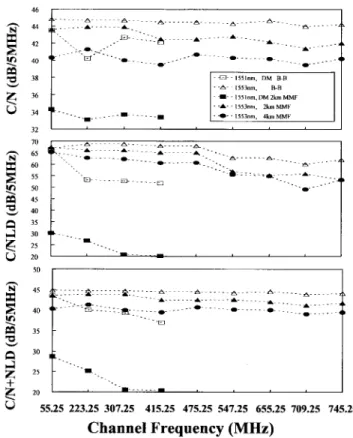
Fig. 2. Measured C/N,C=hboxNLD, and C=(N + NLD) versus channel frequencies for the 1551-nm-DM-transmission of B-B, and 2-km MMF cases, and for the 1553.6-nm EM transmission of B-B, 2- and 4-km MMF cases.
of connection is kept below 0.5 dB. A total of 300 random-phased continuous-wave (CW) carriers from three different multicarrier generators, separated into three groups from 55.25 to 559.25 or 745.25 MHz with 6-MHz spacing, are used to sim-ulate 80, 110, and 110 channels of 256-QAM signals [9]. The stimulated-Brillouin-scattering (SBS) suppression capability of EM-TX is about 16 dBm and the optical modulation index is about 4.5% or 3.8% for the 80- or 110-channel loading. Each EM-TX is connected with a polarization controller and an erbium-doped fiber amplifier (EDFA) with 17 dBm saturated power. After passing through the corresponding optical band-pass filter (OBPF), these three WDM channels are multiplexed through a 4 1 coupler with 7-dB insertion loss, launched into the MMF with a length of 2 or 4 km, then demultiplexed by a fiber Bragg grating (FBG), which has 0.92-nm bandwidth and reflectivity of 99% for corresponding wavelength, combined with optical circulator or OBPF at the receiving end. The optical power of each WDM channel at the output of the 4 1 coupler is about 7 dBm. The connection loss between SMF and MMF is about 0.1 dB at point A and 1.6 dB at point B for all optical channels. The core/cladding diameter, N.A. and bandwidth-distance product of the Corning MMF are 65/125-m, 0.275 and 600 MHz km at 1300 nm. The attenuation of MMF is 0.28 dB at 1.55 m. Because the cascaded FBG’s and OBPF are used to select each optical channel, the variation of the insertion losses for different channels is about 2.6 dB. For the better performance of the AM optical receivers we used in this experiment, the received powers need to be kept between 1.5 to 1.5 dBm. Therefore, the received power at C, D,
1068 IEEE PHOTONICS TECHNOLOGY LETTERS, VOL. 11, NO. 8, AUGUST 1999
(a) (b)
(c) (d)
Fig. 3. Measured optical spectra of the WDM at positions of (a) “A,” (b) “C,” (c) “D,” (d) “E” in the system link shown in Fig. 2.
and E are kept at 1.2, 0.8, 1.4 dBm, respectively, for both without/with 2- and 4-km systems.
We first measure the performance of a DM system carrying 40-channel without/with 2-km MMF at 1551 nm, and then the performance of an EM system carrying 110 channel without/with 2- or 4-km MMF at 1553.6 nm. As can be seen in Fig. 2, in DM system for a 2-km MMF inserted, the C/N (av-eraged digital) decreases from 40 to 33 dB, NLD drastically worsens from 52 to 20 dB. But, in EM system for 2-km MMF span, the C/N (averaged digital) decreases from 44 to 41.4 dB, NLD deteriorates from 60 to 53.3 dB. Obviously, the DM-technique can not carry the QAM signal even over only 2-km MMF due to the nonlinear distortion. Furthermore, the worst C/N’s at subcarrier frequency of 415.25 MHz are 44.5, 42.5, and 39.5 dB for B-B, 2-, and 4-km MMF in EM system at 1553.6 nm. By considering the transmitter performance, the corresponding C/N due to the MMF degradation can be derived as 46.8 and 41.1 dB for 2- and 4-km MMF link. That means that it is about 5.7-dB degradation for the MMF link extended from 2 to 4 km, this meets the 6 dB expected degradation value by using (1). Compared with the calculated example in the above analysis, the measured C/N due to modal noise agrees with the analysis result.
The measured optical spectra of the WDM channels at po-sitions “A”, “C”, “D”, “E” in the system link shown in Fig. 1 are shown in Fig. 3(a)–(d). The adjacent channel isolation is 35 dB as shown in Fig. 3(b)–(d). Fig. 4 shows the measured of the 4-km MMF system versus channel frequencies for all the optical channels (1551.1,1553.6, and 1556.1 nm). For turning the modulation signal on/off in the other two optical channels, the difference is 1.5 dB at 1553.6 nm wavelength. The fiber nonlinear effects of SRS, XPM or FWM are not observed. The worst in all subcarriers are 36, 39.4, and 36.8 dB for 1551.1, 1553.6, and 1556.1 nm optical channels, respectively. They all meet the required 36 dB for the 256-QAM system
with . Thus this WDM-SCM system has the
Fig. 4. MeasuredC=(N+NLD) versus channel frequencies for the 1551.1-, 1553.6-, and 1556.1-nm optical channels of 4-km MMF span, and for the 1553.6 nm when other channels without modulated signals in the WDM-SCM system.
capacity of 12 Gb/s ( Mb/s channels) over 4-km
MMF link with .
IV. CONCLUSION
In summary, we have analyzed and experimentally demonstrated the transport of a potential capacity of 12 Gb/s ( Mb/s channels) over a 4-km MMF link by using EM-WDM-SCM technique with simulated CW carriers.
ACKNOWLEDGMENT
The authors would like to thank Dr. Y. K. Tu, Prof. Y. K. Chen, and C. H. Chang for their useful discussions.
REFERENCES
[1] S. Ovadia, H. Dai, and C. Lin, “Performance of hybrid multichannel AM/256-QAM video lightwave transmission systems,” IEEE Photon. Technol. Lett., vol. 7, pp. 1351–1353, 1995.
[2] S. Ovadia, H. Dai, and C. Lin, “Performance characteristics and ap-plications of hybrid multichannel AM-VSB/M-QAM video lightwave transmission systems,” J. Lightwave Technol., vol. 16, pp. 1171–1185, 1998.
[3] L. Raddatz, D. Hardacre, I. H. White, F. V. Penty, D. G. Cunningham, M. R. T. Tan, and S. Y. Wang, “High bandwidth data transmission in multimode fiber links using subcarrier multiplexing with VCSEL’s,” Electron. Lett., vol. 34, pp. 686–688, 1998.
[4] R. J. S. Bates, D. M. Kuchta, and K. P. Jackson, “Improved multimode fiber link BER calculations due to modal noise and nonself-pulsating laser diodes,” Opt. Quantum Electron., vol. 27, pp. 203–224, 1995. [5] K. Petermann, Laser Diode Modulation and Noise, 1st ed. New York:
Kluwer, 1988, pp. 214–245.
[6] K. Petermann, “Nonlinear distortions and noise in optical communica-tion systems due to fiber connectors,” IEEE J. Quantum Electron., vol. QE-16, pp. 761–770, 1980.
[7] J. Hamilton, Z. Huang, and D. Sutorius, “Adigital compressed video transmission system with simulation results of echoes in 64-QAM transmission,” in NCTA Tech. Papers, 1992, pp. 256–263.
[8] K. Feher, “Modulation and coding techniques for high capacity coaxial cable and SCM fiber digital TV-HDTV distribution,” in NCTA Tech. Papers, 1992, pp. 303–313.
[9] C. Tai, S. L. Tzeng, H. C. Chang, and W. I. Way, “Reduction of nonlinear distortion in MQW semiconductor optical amplifier using light injection and its application in multichannelM-QAM signal trans-mission systems,” IEEE Photon. Technol. Lett., vol. 10, pp. 609–611, 1998.