
威廉.布雷克詩作中對基督教原型的再現與修正 - 政大學術集成
137
0
0
全文
(2) THE RE-PRESENTATIONS AND REVISIONS OF CHRISTIAN ARCHETYPES IN WILLIAM BLAK’S POETRY. A Master Thesis Presented to. 立. 治 Department of English, 政 大. ‧ 國. 學 National Chengchi University. ‧. n. er. io. sit. y. Nat. al. Ch. engchi. i n U. v. In Partial Fulfillment of the Requirements for the Degree of Master of Arts. by Kang-Po Chen June, 2013.
(3) Acknowledgements The completion of this thesis owes much to many people around me. First, my most sincere gratitude goes to my parents and my lovely sister. They have always been supporting me in my life. Moreover, they not only understand my choice to study literature but also encourage me to go further in this field.. 政 治 大 was impossible for me to finish my thesis. And I appreciate her tolerance and patience 立 I am also very grateful to my advisor, Professor Yang. Without her guidance, it. in understanding many of my immature interpretations of such a great poet.. ‧ 國. 學. I would like to thank the committee members of my defense, Professor Tom. sit. y. Nat. patient during my defense and eased my nervousness.. ‧. Sellari and Professor Ya-feng Wu, for their insightful suggestions. They were kind and. io. er. Many teachers in the Department of English contributed much to my MA study. I would like to thank Professor Chin-hsin Lin. I took her course on Spenser last year,. al. n. v i n C h Blake. I would U which inspired me a lot in reading like to thank Professor Tsui-fen engchi. Jiang, who encouraged me in my study and gave me many suggestions during the oral examination of my proposal. I would like to thank Professor Jonathan White for his encouragements during his lecture on city and literature. Chapter Two of my thesis is in fact an extended version of the final paper of that course. Special thanks go to Professor Yen-Bin Chiou, who not only allowed me to study in his research room but also, most importantly, introduced me to Gustav Mahler, whose nine symphonies are the best company in this year of writing. I would like to thank my best friends in college, Jerry, Frank, and Chris, and many friends in the NCCU table tennis club. iii.
(4) At last, my deepest gratitude goes to Mr. Chuan Chao Wu, who was my mentor in high school. Without his teaching and inspiration, I would not develop my interest and love in English at the very beginning. He led me when I could not even write a grammatically correct sentence in English. Without him, all that followed, including writing this thesis, were not likely to happen.. 立. 政 治 大. ‧. ‧ 國. 學. n. er. io. sit. y. Nat. al. Ch. engchi. iv. i n U. v.
(5) Table of Contents Acknowledgements………………………………………………………………………….. iii Chinese Abstract………………………………………………………………………..........vii English Abstract………………………………………………………………………...... ...viii Chapter One: Introduction……………………………………………………………..............1 Critical Background…………………………………………………………………...…… 1 Revisionism and Archetypes………………………………………………………………..8 The Subject-Object Relationship: Archetypes…………………………………………….13 Chapter Two: the Multi-Layered Structure in the Songs of Innocence and the Songs of. 政 治 大 The Context of the Innocence: Christian Pastoral Tradition…………………………...….21 立. Experience…………………………………………………………………………………....21. ‧ 國. 學. Blake’s De-sexualized/Domesticated Innocence……………………………………….....27 The Re-inclusion of Sex in the Experience…………………………………………….. . .44. ‧. “Tirzah” Mispalced?......................................................................................................... ..65. sit. y. Nat. Chapter Three: Blake’s Revision of the Divine Familial Archetypes in America and Europe..................................................................................................................................... 67. io. n. al. er. Arche-typological Antithesis……………………………………………………………...70. Ch. i n U. v. The Mythical Background of Blake’s System…………………………………………… 80. engchi. Blake’s Revised Antithesis in America…………………………………………………...88 Blake’s Revised Antithesis in Europe…………………………………………………...104 Chapter Four: Conclusion…………………………………………………………………..115 Works Cited………………………………………………………………………………...125.
(6) 國立政治大學英國語文學系碩士班 碩士論文題要 論文名稱:威廉.布雷克詩作中對基督教原型的再現與修正 指導教授:楊麗敏 研究生:陳岡伯 論文題要內容: 、 《阿美利加:一個預 本論文檢視威廉.布雷克詩作《天真與經驗之歌》 言》與《歐羅巴:一個預言》中的基督教原型,並試圖討論詩人如何以性慾做為 方法來再現與修正這些原型。第一章提出「修正」與「原型」的基本定義。並討. 立. 政 治 大. ‧ 國. 學. 論傳統基督教神話中,神/父親、自然/母親以及人類/孩子所組成的神聖家庭關 係,進而指出性慾在該神話建構中所扮演的重要角色。第二章探討《天真與經驗 之歌》的多層次結構:在《天真之歌》中,自然的原型被馴化/去性化為一個虛. ‧. 幻的伊甸園,並被挪用為壓迫個人慾望的宗教手段。而在《經驗之歌》中,詩人 企圖重新召喚自然並賦予她性活力,以警示世人宗教對於性慾的扭曲與汙名化。 第三章透過基督教類型學(typology)的角度閱讀布雷克兩部早期的預言書《阿美 利加》與《歐羅巴》中耶穌與上帝的父子對立。布雷克以神話角色傲克(Orc)和 尤力臣(Urizen)做為耶穌和上帝的原型修正,並以他們之間的衝突象徵性解放與 性壓迫之間的永恆鬥爭。而自然/母親的原型則由傲克的母親依妮薩萌 (Enitharmon)呈現,以批判傳統基督教中童貞聖母形象所代表的禁慾主義。第四 章總結前述,指出布雷克再現與修正傳統基督教神話中的原型,並藉由將性慾重 新納入基督教神話中,創造出一個更自由且更有活力的新基督信仰。. n. er. io. sit. y. Nat. al. Ch. engchi. i n U. v. 關鍵詞:威廉.布雷克、 《天真與經驗之歌》 、 《阿美利加:一個預言》 、 《歐羅巴: 一個預言》、基督教原型、性修正. vii.
(7) Abstract This thesis aims to examine the Christian archetypes in William Blake’s Songs of Innocence, Songs of Experience, America: a Prophecy, and Europe: a Prophecy, and to discuss how Blake re-presents and revises them through an approach concerning sex as a form of human desire. Chapter One provides the basic definitions for. 政 治 大 father, Nature the mother, and 立 human beings the children in orthodox Christianity.. “revision” and “archetype,” and illustrates the divine familial relationship of God the. ‧ 國. 學. This chapter also shows how sex functions in the forming of this relationship, on which the orthodox Christian mythology is constructed. In Chapter Two, I discuss the. ‧. multi-layered structure of the Songs. In the Songs of Innocence, the archetype of. sit. y. Nat. Nature is domesticated/desexualized as an illusionary Eden, employed as a religious. n. al. er. io. device to oppress human individuals, especially about sexual prohibition. In the Songs. i n U. v. of Experience, Nature is re-called and sexualized by the poet to warn human beings of. Ch. engchi. the religious distortion and blackening of sex. Chapter Three focuses on two early prophetic books of Blake, America and Europe, through the scope of “arche-typological” antithesis between God/the father and Jesus/the son. The Christian archetypes of God and Jesus are respectively reified by Blake’s mythical characters Urizen and Orc, and their war signifies the eternal strife between sexual liberation and oppression. The Nature /mother archetype is presented as Enitharmon to criticize the sexual prohibition represented by the image of Virgin Mary. Chapter Four concludes that Blake’s own unique version of Christianity is embodied by his re-presentations and revisions of the archetypes in the orthodox Christian mythology.. viii.
(8) By re-including sexual desire into such a mythology, Blake presents a new and more liberal Christian belief.. 立. 政 治 大. ‧. ‧ 國. 學. n. er. io. sit. y. Nat. al. Ch. engchi. i n U. v. Keywords: William Blake, Songs of Innocence, Songs of Experience, America: a Prophecy, Europe: a Prophecy, Christian archetypes, sexual revision ix.
(9) Chapter One Introduction Critical Background The modern studies of William Blake’s poetry owe much to three major critics: Northrop Frye, S. Foster Damon, and David Erdman. The former two contribute enormously to basic explanations of Blake’s massive and mythical poetic corpus in Fearful Symmetry and A Blake Dictionary, especially his later prophetic books. Erdman, adopting a historicist approach, constructs a bridge between Blake’s works and contemporary English history in Blake, Prophet against Empire. Considering. 政 治 大. their giant-like influence upon Blake studies, W. J. T. Mitchell divides Blake studies. 立. into three historical phases,1 the third one being the canonization of the once derided. ‧ 國. 學. and ignored poet and his lunatic poetry. Blake, according to Mitchell, is elevated and replaced in the inheriting line of “mainstream English literature” of “the grand. ‧. national style along with Chaucer, Spenser, and Milton (410). The canonization of. y. Nat. io. sit. Blake is largely attributed to the three major critics I mention above. The trend of. n. al. er. literary criticism resembles the trend of literature itself. When Blake has been. i n U. v. institutionalized in the academia of English literature as one of the greatest poets. Ch. engchi. among the Big Six of English High Romanticism, representing the revolutionary spirit of the epoch to expose social injustice imposed by national and religious institutions upon oppressed individuals, many modern critics begin to doubt the essence of such canonization. Thus, Mitchell claims that “we are about to rediscover the dangerous. 1. Mitchell explains the three phrase thus: The first period was that of preservation of basic documents, a period of biographical and archival interest, often rather private or amateur, in which Blake was treated as something between a household god and a familiar spirit. The second phase was that of appropriation and interpretation, Blake’s employment by writers like Joyce, Yeats, and Lawrence as a precursor for modernism, a progenitor in an avant garde canon of unjustly neglected works. The third phase, which we are still in, has been the professionalization of Blake studies, the disinterested, technical justification of his work, his assimilation into the canon of mainstream English literature. (410) 1.
(10) Blake, the angry, flawed Blake” and “Blake the ingrate, the sexist, the madman, the religious fanatic, the tyrannical husband, the second-rate draughtsman” (411). Helen P. Bruder also condemns Blake’s canonization as a sort of “institutional canonization” that submerges and distorts “a whole set of Blake’s meanings, politically important and historically specific meanings” (Bruder 1). Among the perspectives to dig out Blake’s seemingly “improperness” Mitchell lists above, the one about sexuality is the most significant and fervently-debated, especially by modern female or feminist critics. They tend to focus on Blake’s negative depictions of women, as presented in. 政 治 大 The discourse of sexuality in Blake’s poetry is altogether metaphorical and 立. the following section.. political. Metaphorically as most interpretations indicate, sex is the personal. ‧ 國. 學. enlightenment to the unknown mystery in The Book of Thel. The unknown mystery, in. ‧. Frye’s reading, is “our world of Generation,” and Thel’s retreat from the indicative. y. Nat. fleshly lust in the end of the poem represents the failure to enter the “world of. er. io. sit. Generation” (Fearful Symmetry 232) and “to take the state of innocence into the state of experience” (238). Damon, likewise, treats sex in Thel as a key to renounce. al. n. v i n C hlife of self-sacrifice” self-centeredness and to “learn the great (401). Sex is also the engchi U. personal liberation from the unhappy and fruitless marriage in Visions of the. Daughters of Albion. Such a union, as Frye remarks, “so easily turns into a jealous possessiveness rationalized by a priggish morality” (Fearful Symmetry 239). Damon, following Frye, further reckons that the suggestive promiscuous sex near the end of the poem is the representation of “the freedom of true love” to transcend “the loveless marriage” (438). Politically, sex is the symbol of revolutionary movements in America: a Prophecy and Europe: a Prophecy. Orc, the embodiment of sexual energy in these two prophetic poems, is interpreted by Frye as “the power of the human desire to achieve a better world which produces revolution and foreshadows the apocalypse” 2.
(11) (Fearful Symmetry 206). Damon defines Orc in a rather more direct way, saying that “Orc is Revolution in the material world” (Damon 309). Moreover, literarily and poetically, sex is the key factor in his late prophetic book Milton: a Poem for Blake to amend and revise his great precursor’s errors made in Paradise Lost (276). Most general interpretations of Blake’s poetry derive from the authoritative readings presented above. In sum, Frye’s and Damon’s readings center largely on a key concept: the allegorization of sex, which means to give sex symbolic meanings. However, it is exactly such allegorization of sex and sexuality that provokes. 政 治 大 Susan Fox’s important and frequently-cited essay “The Female as Metaphor in 立. objections from feminist critics.. William Blake’s Poetry” is regarded as the one of the earliest feminist readings of. ‧ 國. 學. Blake. In this essay, she points out that under the influence of those authoritative. ‧. Blakean critics, sexuality in Blake’s poetry is transformed into “sexless abstraction of. sit. y. Nat. a universal human mentality” (508). With such abstraction of sexuality, Blake’s. io. er. representations of women in his lyrics and the female characters in his mythical system are ignored by critics who, as Fox argues, “apologize for what seems like. al. n. v i n C h such an ideaUas ‘Female Will’ by sterilizing the Blake’s antifeminism in promulgating engchi conception of its sexual connotation” (508). Her reading initiates a great branch of. Blakean criticism that aims at the so-called “antifeminism” or misogyny in Blake’s poetry, and also invites the debate over whether Blake can be regarded as a sexist poet. Anne K. Mellor is another feminist critic significant for her focus on Blake’s sexist perspective. In her article “Blake’s Portrayal of Women,” she sharply claims that in Blake’s poetry, “women are not only represented as weak or power-hungry, they come to represent weakness and power hunger” and “in Blake’s apocalyptic human form divine, the female elements continue to function in subordination to the male elements” (“Blake’s Portrayal of Women” 148). According to Mellor, the female 3.
(12) subordination and inferiority to men is mostly highlighted in human artistic creation, as she points out that in Jerusalem, Blake’s last great prophetic book, “ Males―or the masculine dimension of the psyche―create ideas, forms, design; females―or the feminine states of mind―can desire (and thus inspire) these forms but not create them” (149). David Aers also observes that “Blake’s females tend to represent the receptive, the derivative, the soft, the passive qualities whose fulfillment is in supporting the active, creative, male qualities” (Aers 36). Also, countering Damon’s “true love” interpretation of the ending of Visions of the Daughters of Albion, Aers. 政 治 大 shows the gratification of “male fantasy and even violence” and Blake’s protest 立. argues that despite the poem’s advocacy of sexual liberation, Oothoon’s final speech. against sexual repression “actually reinforces the traditional culture of male. ‧ 國. 學. discourse” (38). Thus, we can see that not only is Blake’s poetry re-examined under. ‧. this new scope of feminist reading, traditional interpretations also face a similar. y. Nat. investigation. Elizabeth Langland, in her article “Blake’s Feminist Revision of. er. io. sit. Literary Tradition in ‘The Sick Rose,’” dismisses the orthodox readings of the famous poem “The Sick Rose” led by Harold Bloom, another authoritative Blakean critic who. al. n. v i n C hrather than the Worm’s blames the Rose’s inherited lustfulness violation. engchi U. 2. She. condemns and defines such a reading as “certain interpretations” which are “canonized to support patriarchy” (232). Another orthodox reading of Blake heavily chastised by feminist critics is the taken-for-granted association between women and the Blakean Nature, which is a senseless and brutal chaos in Blake’s poetry. The association, as Bruder asserts, by and large results from Frye’s dominating authoritative interpretations (Bruder 18).3 2. Bloom’s interpretation of “The Sick Rose” is based on his reading of the Rose’s “Bed of crimson joy” as the indication that the Rose is not innocent at the first place before she is deflowered by the Worm. Please see the introduction of his edition of Modern Critical Interpretations on Songs of Innocence and of Experience, p. 19. 3 Blake’s conceptualization of Nature and how it is different from other Romantic poets such as 4.
(13) There are some feminist critics who take an apologetic standpoint. Magnus Ankarsjö argues that despite Blake’s condescending attitude toward women, in his late prophetic books he still “presents a gender utopia with a vision of complete equality between the sexes” (Ankarsjö 2). Unlike Mellor, Ankarsjö thinks that in the promised human perfection in Blake’s ideological system, men and women occupy positions of exactly equal importance, and such perfection can only be achieved with the interactivity and reconciliation between men and women. The major method through which Ankarsjö builds up her statement, to some extent, echoes Fox’s. 政 治 大 Blake’s negative portrayal of women by asking: “must a strong female character be, 立 accusation of “sexless abstraction of a universal human mentality.” She defends. as most commentators so reassuringly insist, a negation? Does that strength not rather. ‧ 國. 學. come with the enhanced life-experience as we grow older and respond to increasingly. ‧. complex situations in an often negative everyday environment?” (Ankarsjö 5). In. sit. y. Nat. other words, she maintains that the negative characterizations of women in Blake’s. io. er. poetry, manipulation and power-hunger, are only metaphorical, representing the human conditions everyone, regardless of gender, may be possessed by in everyday. al. n. v i n Cand life. Taking also an approving position considering sexuality in Blake’s h eadulatory ngchi U poetry, Christopher Z. Hobson examines the homosexual elements in it. From his reading, we can observe that modern homosexual studies derive largely from feminism. Still the two are strongly allied, for homosexuality and feminism battle the same adversary of traditional patriarchal hierarchy. In his book Blake and Homosexuality, Hobson acknowledges that Blake “ends by rejecting and criticizing his own narrowness, embracing love’s forbidden forms, and finding in them tokens of humanity’s unity and possible redemption” (xi). In Hobson’s reading, homosexual love, along with other forms of “perversity,” is included in what Blake promotes as Wordsworth and Christian ideology will be one of my focuses in the second chapter of my thesis. 5.
(14) “free love.” Human beings embracing such free love are oppressed by institutionalized religion and patriarchal society. As I have shown above, critics concerned with issues of sexuality often fall into a sort of dichotomized choice of position: some condemn Blake’s misogyny as an enemy against feminism, while some ally with Blake, taking him as a Romantic vanguard for modern feminism. Both approaches, after their accusatory or apologetic readings, most often return to a commonplace reconciling conclusion that Blake is limited by his own epoch. That is, even though Blake intends to transcend the. 政 治 大 unable to be free from the traditional bias against women that derives from the 立. oppression imposed by religious and social norms upon human beings, he is still. patriarchism of his culture and society. For example, Mellor notes that by “continuing. ‧ 國. 學. to use the sexist language of the patriarchal culture into which he was born, Blake. ‧. failed to develop an image of human perfection that was completely gender-free”. y. Nat. (“Blake’s Portrayal of Women” 153). She concludes that Blake is not to blame for. er. io. sit. “his failure to escape the linguistic prisons of gender-identified metaphors inherent in the literary and religious culture in which he lived” but at the same time we should not. al. n. v i n C hor sexual equality U “hail him as an advocate of androgyny to whom contemporary engchi. feminists might look for guidance” (154). Aers also affirms in the similar way that “Blake’s treatment downgrades the female and affirms many facets of the dominant male supremacist traditions, despite his revolutionary critique of the inherited culture” (41). Bruder, in her anti-patriarchal reading of The Book of Thel, likewise concludes that “Blake has reached some kind of historically specific imaginative limit in his thought about women’s rights and roles” (54). To me, these critics reach only predictable conclusions, though I do acknowledge and admire their textual analysis. Feminist critics accuse Blake for his negative portrayals of women to show that his poetic status is no more than another product of patriarchal canonization. At the same 6.
(15) time, however, they seek to draw him to the feminist side as an official speaker for women’s rights. For instance, in the same article criticizing Blake’s “dominant male supremacist traditions,” Aers also concludes that Blake presents “human emancipation which transcends the sexual antagonisms” (36). Such a critical phenomenon exposes the political nature of feminist criticism; that is, a literary text is taken as a tool to support a certain ideology, no matter whether it is antagonized as an enemy or allied with as a comrade. Due to such a political purpose, these critics’ perspectives are apt to be directed to the predictable conclusions aforementioned. The political nature of. 政 治 大 along with other fashionable literary theories as the so-called “School of 立. such a reading is probably the greatest reason Harold Bloom labels feminist criticism. Resentment.”4 These theoretical approaches, as Bloom maintains, continue doing. ‧ 國. 學. “exercise in contexualization” (The Western Canon 487). By “contexualization”. ‧. Bloom means the detached pursuit of meanings outside the literary text itself.. y. Nat. Bloom’s desperate wrath against these theories is ignited by a large number of literary. er. io. sit. works springing out in recent years which the critics of “School of resentment” seek to canonize, as they deem the orthodox canonization the biased product of patriarchal. al. n. v i n C h centralism. I am U hierarchy and the Western White not able to judge here whether these engchi works by female, African, or Asian writers are worth being canonized or, as Bloom maintains, have no aesthetic merits at all. Bloom’s accusation is clearly too narrow and biased. Nevertheless, by raising Bloom’s polemic arguments against literary theories including feminism that is concerned about sexuality, I thus point out that I exert myself to make my approach free from the “contextual” political ideologies. What I aim to accomplish in this thesis is to revive an approach of close reading into Blake’s poetry, despite the fact that my target issue is sexuality, a highly “political” 4. Bloom coins the term “School of Resentment” in his provocative The Western Canon, and includes Feminist criticism, African American Studies, Lacanian criticism, Deconstructionism, New Historicism, and Marxist literary criticism into this catalogue (The Western Canon 487). 7.
(16) one that is, if I put it in a somewhat Bloomian expression, apt to deviate from Blake’s text and fall into some fruitless “contextual” disputes. Revisionism and Archetypes My argument is that modern feminist approaches, both the accusatory and apologetic ones, fail to see the key role sex plays in Blake’s poetic works. I would argue that with the discourse of sex as a form of human desire, Blake executes his poetic revisionism upon the interrelationship of the archetypes of God, Nature, and the human being in Christian ideology. Sexuality in Blake, as a concept including. 政 治 大 Bible and Christian theology. The 立poetic works of Blake I will scrutinize mainly in. sexual differences and sex as a human desire, is in fact an alternative reading of the. ‧ 國. 學. my thesis include the Songs of Innocence, the Songs of Experience, America a Prophecy, and Europe a Prophecy, while for comparative and explanative purposes, I. ‧. will also draw upon other poems such as The Book of Thel, Visions of the Daughters. y. sit. n. al. er. io. Zoas.5. Nat. of Albion, The Marriage of Heaven and Hell, The Book of Urizen, and The Four. i n U. v. My methodology will be a combination of close reading into my target texts of. Ch. engchi. Blake and a tracing of the Christian ideology about sexuality in order to show how Blake revises the Christian archetypes. As my thesis topic directly shows, my textual analysis focuses on the so-called Christian archetypes in Blake’s poetry. The word “Christian” indicates that my discussion concerns the Christian religion, and further it may raise doubts against my previous assertion that the usage of certain literary theories produces only external readings: if the feminist reading of Blake is external and deviatory, why is the religious reading an exception? To do away the possibility. 5. The edition of Blake’s texts I use in my thesis is The Complete Poetry and Prose of William Blake edited by David E. Erdman. This edition, including commentaries by Harold Bloom which I would occasionally refer to, would be noted as the abbreviation CPWB in my citations. 8.
(17) that it might sound self-contradictory, I shall clarify the nature of “religious reading” here. In his keen account on the spirit of English Romanticism, M. H. Abrams differentiates English Romantic poets of the age from their French counterparts who “were anticlerical or downright atheists” (Abrams 95). Conversely, the Romantic impetus of English poets, as Abrams maintains, lies overwhelmingly in their firm and fervent belief in biblical prophecy; in other words, the perfect world they seek to build through revolution is a new Jerusalem, a city of Christianity. Among them, Blake is the most manifest poet in such conception. Therefore, to examine his poetry, a. 政 治 大 contempt “contextualization,” for Blake’s poetry is by nature Christian. 立. religious, or a Christian approach is necessary, and it is not what Bloom would call in. To justify my seemingly religious approach, I shall start from two passages. ‧ 國. 學. from Blake’s poems:. ‧. The moral Christian is the cause. sit. y. Nat. Of the unbeliever and his laws.. io. Take Jesus’s and Jehovah’s name.. n. al. Ch. i n U. (“The Everlasting Gospel,” CPWB 877 ). engchi. er. The Roman virtues, warlike fame,. v. God appears, and God is light To those poor souls who dwell in night; But does a human form display To those who dwell in realms of day. (“Auguries of Innocence,” CPWB 493) By maintaining that Blake’s poetry is essentially Christian, I do not resort to a simplified idea that the poet is a believer of contemporary Christianity in England, nor, of course, by “Christian poetry” do I mean that his works are doctrinal and preaching. 9.
(18) lines that aim to convert people to Christianity. Blake is indeed a pious Christian, but his faith lies in an alternative Christian philosophy in his ideal, not in institutionalized Christian religion. And this alternative Christianity is the revised version of the Christianity considered orthodox and represented by the Established Church in the late eighteenth century England. As Marilyn Butler points out, Blake supported the claim of Joseph Priestley, a famous Dissenter, that the Established Church was “essentially decadent” and it is “the agent of an elite caste of governors and priests whose interest was always to exclude and manage the mass of mankind” (46). So to. 政 治 大 contemporary institutionalized Christianity. In the first quote from “The Everlasting 立. speak, Blake’s poetry is Christian because it deals with the problems begotten by the. Gospel,” what is abhorred by Blake is the Christianity distorted by “the Moral Laws”. ‧ 國. 學. and appropriated to serve oppression’s end. In the lines from “Auguries of. ‧. Innocence,” Blake shows that the wretched men who live in ignorance seek constantly. y. Nat. an exterior and alienated God, while the enlightened men acknowledge an interior. er. io. sit. “human form divine” (“The Divine Image,” Songs of Innocence, CPWB 12). “The Everlasting Gospel” tells about the social and political aspects of religious distortion,. al. n. v i n and “Auguries of Innocence” deals C with the intrinsic falsehood h e n g c h i U in religious belief and points to a real God that does “reside in the human breast” (The Marriage of Heaven. and Hell, CPWB 38). Thus, we should observe that in Blake’s poetry, what he seeks to revise is the distorted Christianity, and what he seeks to re-vision is his own alternative and ideal Christian philosophy. My usage of revision and re-vision comes partly from Harold Bloom’s conceptualization of the so-called “creative misreading” (Poetry and Repression 4) or “poetic misprision” (7). Bloom denies the notion that every literary work is independent and self-contained. Rather, great writers whom he calls as “strong poets” all undergo their artistic careers under the “anxiety of influence” (Anxiety of Influence 10.
(19) xix). The influence comes from other great poets preceding them, and every strong poet suffers from this feeling of “belatedness” to his/her forerunners. To be free from the anxiety of influence, they struggle to shoulder through a narrow chasm between the older writers and themselves, and it is in this small space where strong misreadings take place. According to Bloom, every strong poet “misreads” his/her precursors, intentionally or unintentionally with the approach of “textual usurpation.” All these endeavors result in the poetic writing as “re-writing” or the so-called “revision:” “When the human ignorance is the trespass of a poetic repression of. 政 治 大 rewriting or an act of revision” (Poetry and Repression 8). Bloom’s expression here is 立 anteriority, and the transforming movement is a new poem, then the ration measures a. clearly tinged with some psychoanalytical undertone, because poetic revisionism for. ‧ 國. 學. him is a form of resistant consciousness against the influence imposed by the. ‧. precursors, those great “fathers.” In other words, it is also a reflection of the anxiety. y. Nat. caused by the flowing of time, of the ever-rolling wheel of history, and of death.. er. io. sit. In my thesis, the terms “revision” and “re-vision,” as I have said before, partly derive from the Bloomian revisionism. My revision/re-vision denotes its basic and. al. n. v i n C h I reckon that it shares literal meaning; that is, to correct. similarity with Bloom’s engchi U. “textual usurpation,” because in my reading of Blake, it initiates itself first with denial against his greatest precedent source: the Bible, upon which Christian religious ideology is based. After denial, comes the second meaning of re-vision, which is to re-present a primary vision of Christian philosophy in Blake’s ideal. I would argue that all these processes of revision/re-vision Blake does not present in a dialectical manner, but they are embodied by the traditional archetypes in Christian mythology: God, Mother Nature, and human beings represented by Jesus Christ. It is the divine familial relationship he is going to revise and re-vision, and his ideas about sexuality serve as the key element in his poetic revision/re-vision. 11.
(20) The term archetype comes from Frye’s study in Anatomy of Criticism. Concerning the nature of poetry, Frye shares similar views with Bloom, as he remarks that “any poem may be examined, not only as an imitation of nature, but as an imitation of other poems” (Anatomy of Criticism 96). Bloom’s anxiety of influence is also perceived here, while Frye not only acknowledges such influences between great poets and their works, but also considers the study of their interrelationship the foundation of literary criticism. Thus, his emphasis of criticism is laid upon the study of convention, a word that contains certain negative meanings in common Romantic. 政 治 大 “The notion that convention shows a lack of feeling, and that a poet attains ‘sincerity’ 立 thinking, but serves as an immovable truth in Frye’s definition of poetic creation:. by disregarding it, is opposed to all the facts of literary experience and history” (97).. ‧ 國. 學. Convention exists when a poet embarks on his creative endeavor and it is manifested. ‧. by his communication with other poets. This phenomenon is what Frye calls as “the. sit. y. Nat. social aspect of poetry,” which, not about human society, means the fact that poetry is. io. er. a whole of community of mutual influences. The basic units that construct this poetic community are archetypes, “typical or recurring” images (99). But of course, the. al. n. v i n C hpoets hover over modern conventions set up by the anterior great poets, who, in order engchi U to highlight their individuality, deliberately decrease or conceal direct adoptions of archetypes. No matter under what disguise, archetypes are still there. What strong poets produce is still a sort of “completely conventionalized art.” But because of the countermeasures taken, the deliberate attempt of concealment, the archetypes in such conventionalized art “were essentially a set of esoteric signs” (102). The abstruse mythical system in Blake’s poetry is accordingly filled with these esoteric signs transformed from the archetypes in the Bible and other Christian writings, both orthodox and heretical. My discussion of Christian archetypes in Blake’s poetry focuses on the divine 12.
(21) familial relationship between God the father, Nature the mother, and human beings the children. To further clarify my point, I would argue that such a relationship is about affinity and antagonism between the father and the son, while the mother, representing sexual vitality, plays a key role in determining the human condition as the result of the conflicting father-son relationship. In the following section I shall present my own understanding of Christian archetypes and give an account of how such an archetypal relationship is constructed in traditional Christianity to show on what ground Blake executes his revisionism, and of how sex as a form of human. 政 治 大 ideology. This analysis will shed light upon how Blake adopts it as an approach to 立 desire (both its presence and absence) holds a significant position in Christian. revise (or to misread and usurp, in Bloomian terms) the Christian archetypes in his. ‧. ‧ 國. 學. poetry.. The Subject-Object Relationship: Archetypes. y. Nat. sit. In the preface of Milton, Blake sharply dismisses Greco-Roman influences. n. al. er. io. upon English literature and aspires to restore the rightful status of the Bible: “The. i n U. v. Stolen and Perverted Writings of Homer & Ovid: of Plato & Cicero, which all Men. Ch. engchi. ought to contemn: are set up by artifice against the Sublime of the Bible” (CPWB 95). What differentiates the Bible from the Greco-Roman classics in this preface is that human beings obtain from the former “inspiration,” while from the latter only “memory.” Memory is confined by the lineal axis of time and space, and is doomed to die in what Blake terms “the Mundane Egg,” the material world. Inspiration, on the other hand, is what transcends these mortal boundaries. In Blake’s eyes, even his great precursors, Shakespeare and Milton, are “curbd by the general malady & infection from the silly Greek & Latin slaves of the Sword” (95). The Greco-Roman “Sword” stands against the biblical “Sword” in the famous poem following this preface: “I will 13.
(22) not cease from Mental Fight, / Nor shall my Sword sleep in my hand.”6 One is of the external battlefield where Achilles and Hector wield their arms; the other is of the internal spiritual struggle of faith in the biblical prophetic tradition. Blake’s reverence of the Bible and abhorrence of the classics, his dichotomy of inspiration and memory, eternality and temporality, interiority and exteriority, as I would argue, can be traced back to the differences of the mythical background of the Bible and that of non-Christian mythologies. Mythology is a word with heretical undertones in Christianity, so a term such as. 政 治 大 confusion. By saying Christian mythology I am talking about the narrative in the 立. “Christian mythology” may sound a bit paradoxical and generate some unwanted. Bible that accounts for the cosmological order: the creation of the world and things. ‧ 國. 學. created there. That is, I do not confine such a mythology within the boundary of. sit. y. Nat. its literary merits.. ‧. religion. Rather, I shall tackle it as a literary device, a narrative that is scrutinized for. io. er. Back to the discussion before, obviously, the major disparity between Christian and classical mythologies is that there is only one God in the former and there are. al. n. v i n C h difference between plenty in the latter. The often over-simplified monotheism and engchi U polytheism must be re-elaborated in the scope of subject-object relationship. My usage of the terms “subject” and “object” does not come from any specific philosophical or psychoanalytical theories. The term “subject” is adopted to signify a figure of self-consciousness and superior intelligence. The former enables him to recognize his own existence and the circumstance around him and the latter empowers him to create or to rule. These two elements constitute the concept of Christian. 6. This poem, which was latter set into music and became one of the most famous English hymns “Jerusalem,” alludes to Elijah in the Books of Kings (“Chariot of fire”) and the city-building in the Book of Nehemiah: “For the builders, every one had his sword girded by his side, and so builded” (4:18). 14.
(23) divinity. “Objects,” on the other hand, means the things, living or lifeless, which are passively created and ruled. In Christianity, God is the primary and supreme subject: that is, he is the existence before all other existences. Human beings and the world are “objects created.” God is the existing being before all other existing beings, and he is the first one with self-consciousness to perceive his own existence and the non-existence around him, the most primitive nothingness. After his creation of the world, which includes the primitive human being, Adam, in order to elevate him to the state resembling God above other objects created,. 政 治 大 thus is the secondary subject, who has no power to create but has the right to rule. In 立. God shares with him his divinity that differentiates him from the world, Nature. Adam. other words, in Christianity, human beings can directly identify with God and thus. ‧ 國. 學. become, in Blake’s term, the “human form divine.” Being given the divine breath of. ‧. God, Adam the first man becomes a subject with consciousness to perceive himself. sit. y. Nat. and the world and with the superior intelligence to rule. With these gifts, he can thus. io. er. manage and reign over the world as God does. As in the Bible, to manifest his power transited directly from God, Adam participates in God’s divine work of creation by. al. n. v i n Ccreated: giving names to other objects AdamU gave names to all cattle, and to the h e n“And i h gc fowl of the air, and to every beast of the field” (Gen. 2: 20). The divine subjectivity the human being shares with God raises him to the level of the existence not only before but also beyond any other existences. That is, in Blake’s terms, he “past, present, and future sees” (“Introduction,” Songs of Experience, CPWB 18) just like God. Furthermore, it signifies his primitive capability to transcend the limitation of time: death. However, in classical and other non-Christian mythologies, human beings worship deities embodied by Nature: sky, sea, river, and forest. They reduce themselves to the level of the inferior “objects created” which are circumscribed by 15.
(24) time and space and doomed to perish, furthermore depriving themselves of the divine potential to transcend the material world. Under the Christian scope, the inferior objects created are often unified and personified as one deity, who is genderized as a female, the “Mother Earth,” such as Gaia in Greek mythology and Jörð in Norse mythology. She is obliged to brood and nourish all living things in the world,7 while such nurturing divine mother figure is absent in Christianity. In the Bible, only God handles all these matters of creation ex nihilo. The female genderization of Mother Earth further accentuates human superiority over natural inferiority. It is a process. 政 治 大 men/God/spirituality. The creation of the world can be viewed as an original version 立 constructing the traditional Christian dichotomy of women/nature/corporeality and. of childbirth, and the archetypes of God, Nature, and Adam form the divine familial. ‧ 國. 學. relationship I have coined before. What must be noticed is the transformation of the. ‧. archetype of the mother: her degrading objectification into Nature, the combination of. y. Nat. inferior objects created in Christian mythology, and her elevating divinization in. er. io. sit. paganism. In Blake’s alternative mythical system, the role of Mother Nature oscillates between these two sorts of rendering, which shall be discussed extensively in later. n. al. chapters.. Ch. engchi. i n U. v. Human beings’ shared divinity with God in fact partially resounds with Renaissance humanism, in which each human individual’s significance on his way to salvation is emphasized. Human identification with God, as I have shown above, is based upon superiority over Mother Nature, who is often portrayed as a fallen female deity expelled in the Renaissance Christian context. In Christianity, the God-Nature relationship is rendered into a sort of dichotomized division in the Renaissance. 7. For example, in Greek mythology, gods hold no supreme divinity as God in Christianity. They are created by the universe, namely, heaven and earth (Hamilton 24). The creation is accomplished cooperatively by Uranus, the sky-god and Gaia the Mother Earth, unlike God in the Bible, who creates singlehandedly. 16.
(25) literature, as Edward William Tayler points out: “Renaissance writers customarily divided their ordered world into two main areas, variously labeled matter and spirit, human and divine, corporeal and noncorporeal, Nature and Grace” (23). Moreover, the female deity is domesticated and appropriated into Christian context, as Frye states: “Christianity replaced the earth-goddess and her dying god with a Queen of Heaven receiving her crown from the son whom she had nursed and whose death she had lamented” (A Study of Romanticism 7). The original natural goddess symbolizing fertility is replaced by a virgin who gives birth to Jesus Christ through a sexless. 政 治 大 distorted. For instance, in Book II of The Faerie Queene, Nature is labeled by 立. pregnancy. In addition to domestication, the image of Nature is also blackened and. Edmund Spenser as the evil matriarch breeding evil sea monsters: “Most vgly shapes,. ‧ 國. 學. and horrible aspects, / Such as Dame Nature selfe mote feare to see, / Or shame, that. ‧. euer should so fowle defects / From her most cunning hand escaped bee” (2.7.23).. sit. y. Nat. Moreover, she is condemned for her sexual vitality, objectified as the sexually. io. er. seductive earthly paradise of the Bower of Bliss and personified as the source that empowers Radigund, the sexually excessive Amazon queen: “A miracle of natures. al. n. v i n C h voide of ornament, goodly grace, / In her faire visage / But bath’d in bloud and sweat engchi U together ment” (5.5.12). Radigund serves as the embodiment of pagan Nature who sexually exploits Artegall, the knight of justice. She is in contrast to Britomart, the female knight of chastity, a virtue stemming from the Virgin Mary, who is the domesticated and Christianized Nature deprived of sexuality. Domestication and condemnation are the measures employed in Christian ideology to tame and recruit Nature. Spenser, a standard Christian poet who wrote a standard Christian allegory, re-presents the Christian archetype of Nature by following this principle with a clear moral judgment. This poetic tradition with a strong religious end is overthrown in Blake’s poetry, in which we shall see in the second chapter how the archetype of 17.
(26) Nature is revised and re-envisioned in his multi-layered poetic structure in the Songs of Innocence and the Songs of Experience. The human being plays the role of the Son in the divine familial relationship. Adam is its first representative archetype before the Fall, and Jesus Christ is the second. In his third essay on the theory of myth in Anatomy of Criticism, Frye presents a pattern of “the apocalyptic world of the Bible” (141), in which he divides the biblical sphere into five worlds: divine, human, animal, vegetable, and mineral world.8 Each world has its own representation and generalizing symbol. Worlds. 政 治 大 sheepfold, garden, and city. Jesus Christ, according to Frye, “unites all these 立. originally belonging to Nature, Mother Earth, are transmuted into human civilization:. categories in identity,” for through him, the human being identifies with God. He “is. ‧ 國. 學. both the one God and the one Man, the Lamb of God, the tree of life, or vine of which. ‧. we are branches, the stone, which the builders rejected, and the rebuilt temple which. sit. y. Nat. is identical with his risen body” (142). To sum up, we can note that in the orthodox. io. er. Christian mythical context, Man, the human being embodied in the concept of Christ, and the whole human civilization are elevated and divinized above Nature at the price. al. n. v i n C h forest of Pan and of the loss of sexual vitality. The revelrous Satyr is Christianized engchi U into a garden of a divine couple of sexless innocence.. On the level of mythology, the absence of sex is only a symbolic outcome of the symbolic procedure of human divinization. However, throughout the institutionalization of Christian mythology into Christian religion and the establishment of the church, the absence of sex has gradually become a necessary factor on the path to have divine contact with God. In other words, the symbolic 8. The pattern is presented in five lines of equation: divine world = society of gods = One God human world = society of men = One Man animal world = sheepfold = One Lamb vegetable world = garden or park = One Tree (of Life) mineral world = city = One Building, Temple, Stone 18.
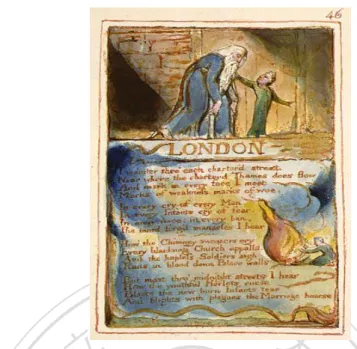
(27) absence of sex is regulated into the practical prohibition of sex in the process of institutionalization of Christian mythology. Christian denial of sex is what Blake encounters in his life in the English society so subject to the religious establishment. And to counter it, Blake resorts to its very origin at the mythological level to revise the primal divine familial relationship constituted by archetypes of God, Nature, and human beings. His poetry aims to revise the orthodox Christian teachings about sex by revising Christian archetypes with the awakening of sexual vitality.. 政 治 大 Concerning the critical purpose of Blake’s sexual revisionism, I thus divide the 立. Chapter Organization. bulk of my discussion of Blake’s poetry into two chapters. The second chapter deals. ‧ 國. 學. with the Songs of Innocence and the Songs of Experience. By approaching Blake’s. ‧. alternative Christian pastoral tradition,9 I shall highlight the multi-layered structure of. sit. y. Nat. this poetic collection. In Songs of Innocence, the archetype of Nature is domesticated. io. er. as an illusionary Eden, the origin of Christian pastoral, employed as a religious device for oppression upon individuals, especially about sexual prohibition. In Songs of. al. n. v i n C by Experience, Nature is recalled to manifest such dreary state (as in U h ethenpoet i h gc. “Introduction” and “Earth’s Answer”), and her condemnation as a harlot sharply exposes the religious distortion of sex (as in “London”). In the third chapter I focus on two early prophetic books of Blake: America and Europe through the scope of arche-typological antithesis between the Old and the New Testaments.10 In America, the Christian archetypes of God and Jesus are respectively reified by Blake’s mythical characters Urizen and Orc, and their war signifies the incompatibility between the 9. The pastoral tradition in this thesis refers to the so-call Christianized pastoral, which includes the tradition originated from Theocritus and Virgil into Christian context and generates a literary theme of the nostalgia to the Garden of Eden, the paradise once lost by the human ancestors. Its specific definition and my usage of it is discussed in the beginning of Chapter 2. 10 For specific definition and my usage of the term “arche-typological antithesis,” please see the footnote in Chapter Three, p. 70. 19.
(28) father and the son in the divine familial relationship. In Europe, Nature as the mother is presented as Enitharmon, the counterpart of Virgin Mary in Blake’s mythical system, and her role and function in the father-son conflict manifests the sexual struggle human beings face in Christianity. Through my critical discussion, I hope I can shed light upon how sexuality is employed in Blake’s poetry as a poetic device for his revisionism and re-visionism.. 立. 政 治 大. ‧. ‧ 國. 學. n. er. io. sit. y. Nat. al. Ch. engchi. 20. i n U. v.
(29) Chapter Two Blake’s Revision of Mother Nature: The Multi-layered Structure in the Songs of Innocence and the Songs of Experience The Context of the Innocence: Christian Pastoral Tradition The Songs of Innocence is set in a pastoral frame from the very beginning of “Introduction,” in which a traditional idyllic character, the Piper, is presented. Such a setting is already well-recognized by critics.1 Harold Bloom states that “Songs of Innocence is Blake’s closest approach to pure pastoral” but he also notes satirical elements hidden in this seemingly carefree sphere.2 Jennifer Davis Michael argues. 政 治 大 city, “a disturbing world立 of social difference and injustice” (39). Bloom seems to. that the Songs of Innocence is an “urban pastoral” essentially confined in the frame of. ‧ 國. 學. explore the hidden layer of meaning with a psychoanalytical approach by arguing that “innocence” is an “unsundered state,” in which individuals are unaware of the. ‧. difference between the subject and the object, thus having no self-consciousness.. sit. y. Nat. Michael, with her focus on urban discourse, stresses the implicative irony of the. n. al. er. io. human drive to re-create natural scenes within cities. Both critics grasp the two-fold. i n U. v. reading of the Songs of Innocence, and indicate that it is no traditional pastoral. I too. Ch. engchi. observe the multi-layered structure of the pastoral in the Songs of Innocence, but such a structure I would discuss with my archetypal approach. The pastoral tradition is significant because it is one of the human renderings of Nature, the archetypal mother in the divine familial relationship. My focus will be on Blake’s revision of traditional pastoral through the scope of Christian mythology with the concern of sex in both the Innocence and the Experience. I have already mentioned Frye’s pattern of Christian archetypal world. Here I 1. Scrutinizing Blake’s artistic designs in the Songs of Innocence, Anne K. Mellor also observes that they are “portrayed as a pastoral arcadia, as heaven on earth” (Blake’s Human Form Divine 8). 2 Please see Bloom’s introduction to his Modern Critical Interpretations: William Blake’s Songs of Innocence and of Experience, p. 1. 21.
(30) present two of the equations again: “animal world = sheepfold = One Lamb” and “vegetable world = garden or park = One Tree” (Anatomy of Criticism 141). What we can perceive is that pastoral tradition is a process to Christianize Nature, as Frye further explains: “The conventional honors accorded the sheep in the animal world provide us with the central archetype of pastoral imagery, as well as with such metaphors as ‘pastor’ and ‘flock’ in religion” (143). Pastoral tradition in the process of Christianization is thus constructed to aspire to the prelapsarian Garden of Eden, and as Susan Snyder points out in her discussion on the development of pastoral tradition,. 政 治 大 paradise in the orthodox Christian mythology is obviously attributed to the Fall of 立. “it has to do with paradise once possessed and then lost” (3). The very loss of primary. Adam and Eve. How is Eden, the paradise of our very first ancestors, differentiated. ‧ 國. 學. from Nature, who is the generalizing female personification of “objects created?” It is. ‧. highly relevant to the aforementioned shared divinity between God and human beings.. y. Nat. Let us once again consider carefully Frye’s pattern. “Animal world” and. er. io. sit. “vegetable world” stand for the first level: the original natural world. From “animal world” to “sheepfold” and from “vegetable world” to “garden” what we see is the. al. n. v i n C h of wild livesUinto human use. domestication of Nature and the employment engchi. Domestication includes humanization to personify Nature and to grant it human features. Therefore, sheep are taken care of by shepherds as children are taken care of by their parents; natural meadow and forest are re-constructed and become well-protected and well-trimmed garden. Thus, the untamed and wild aspects of Nature are excluded in this process of humanization. The Christianized/humanized Nature is symbolized by Eden inhabited and reigned over by our primitive ancestors. This is the second level of the domesticated natural world. Both of Frye’s equations end with an ultimate mythical symbol. “One Lamb” not only signifies the human being under God’s divine protection, but also symbolizes 22.
(31) Jesus’ feature of mildness and obedience to God, conveying the Christian idea of primary harmony between God and the human being. Interpreting God’s divine will of creation in Genesis: “And God saw every thing that he had made, and, behold, it was very good” (1: 31), John Bowker argues that it is “a creation in which harmony prevails” but it is gradually sundered by “progressive disintegration which follows from the first acts of disobedience” (46). Thus “One Lamb” stands for the divine attachment of human beings to God before the Fall that initiates disintegration. In the transformation from a “vegetable world” into a “garden,” we can notice. 政 治 大 within a boundary excluding the original Nature. In other words, the Garden is at the 立 that the latter is not only an enjoyable paradise but also a certain place confined. same time a paradise, a protected realm, but also a limited prison (in a typical. ‧ 國. 學. Romantic tone) in which Adam and Eve are isolated from the rest of the world. The. ‧. symbol of “One Tree” is undoubtedly the tree of knowledge, representing the. sit. y. Nat. threshold from Eden to untamed Nature. By eating the forbidden fruit on the tree,. io. er. Adam and Eve are instilled the knowledge of good and evil, which in this context is the concept of shame that teaches them to cover their genitals. In Genesis, the sexual. al. n. v i n C hEve is completely unmentioned, interaction between Adam and but still the Fall is engchi U. subtly connected to sexuality because of the symbolic gesture of covering. 3 In the Christian ideology stemming from the Fall, bodily sex is thus viewed either the cause of the Fall or the inferior product after the Fall, symbolizing the disintegration and detachment from God and initiating further alienations in the future.4 As a literary device of nostalgia to re-envision the lost paradise, poetic works of the pastoral tradition aim to depict a Christianized Nature that is opposite to the. 3. As I would argue later on p. 45, the gesture of covering also symbolizes the real Fall in Blake’s concept, the sense of shame about sex. 4 A.D. Nuttall sums up theologian interpretations by Thomas Aquinas and St. Augustine: “The orthodox view was that Adam and Eve were virgins at the time of their expulsion” (197). 23.
(32) original Nature, as the latter generalizes the “objects created” other than human beings. What distinguishes these two aspects of Nature is the existence of death. All living beings in the material world that do not share God’s divinity are doomed to die, and so are human beings after the Fall. Because bodily sex is regarded as either the cause or the product of the Fall, the pastoral poets, while imagining the prelapsarian Eden, must set their shepherds and lovers in an untainted realm, where bodily sex is unseen even in love relationships. Only by doing away with sex, can fallen human beings participate in the final Resurrection with the sacrifice of Jesus. This. 政 治 大 the Gospel of Luke: “If any man come to me, and hate not his father, and mother, and 立. conceptualization corresponds to Jesus’ demand of renunciation of all earthly bonds in. wife, and children, and brethren, and sisters, yea, and his own life also, he cannot be. ‧ 國. 學. my disciple” (14: 26). All these bonds of familial identities are originated from sex,. ‧. the bodily union between a man and a woman, in the first place. Thus Spenser, in his. y. Nat. general argument of The Shepheardes Calender, a standard Renaissance pastoral, does. er. io. sit. state that it is “our mighty Sauiour and eternall redeemer the L. Christ,” who amends the Fall, “renewing the state of the decayed world, and returning the compasse of. al. n. v i n C hfirst commencement” expired years to theyr former date and (Spenser 420). “The engchi U. decayed world” and “expired years” all emphasize the spatial and temporal limitations caused by the inevitable death after the Fall. Following Spenser, Milton presents a sharper dualism between God and Nature in his “On the Morning of Christ’s Nativity.”5 This poem is a hymn mixed with pastoral features, celebrating Jesus’ virginal birth. Milton begins this poem with his foretelling of the forthcoming Redemption which shall be brought unto human beings by Jesus: “That he our deadly forfeit should release, / And with his Father work us a perpetual peace” (6-7). The triumph over death resounds with Spenser’s words above, 5. This poem is cited from the 8th edition of The Norton Anthology of English Literature, p. 1789-1796. 24.
(33) and Milton furthermore draws a border that divides this earthly world and the divine transcendental world, for Jesus “Forsook the courts of everlasting day, / And chose with us a darksome house of mortal clay” (13-14). In Milton, the earthly world inhabited by human beings is a world reigned over by Nature, who is personified again as a woman of sexual excessiveness. Jesus’ coming is going to expel her unholy powers: “It was no season then for her / To wanton with the sun, her lusty paramour” (35-36). Corresponding to Christian ideology, Nature’s sexual vitality is accordingly accused with the implication of the original sin and the Fall; she “on her naked. 政 治 大. shame” does “pollute with sinful blame, / The saintly veil of maiden white to throw” (40-42).. 立. To amend Nature’s degeneration, the process of Christianization will work in. ‧ 國. 學. the following stanza, in which God “Sent down the meek-eyed Peace” and Nature will. ‧. be “crowned with olive green” and “strike[s] a universal peace through see and land”. y. Nat. (45-52). The olive crown means the Peace, the harmony, the divine attachment to God,. er. io. sit. so Nature is thus Christianized, domesticated, and purged of her “naked shame” and “sinful blame” which altogether indicate her sexual vitality. Milton also adopts his. al. n. v i n Cdepictions adept measure of the detailed deities, which will be seen again in h e n gofcpagan hi U. Book I of Paradise Lost, in sharp opposition to Christian divinity. For instance, in the seventh stanza, the sun, the worshipped symbol of Apollo, “hid his head for shame / As his inferior flame / The new-enlightened world no more should need” because “He saw a greater Sun appear / Than his bright throne or burning axletree could bear” (80-84). The “Sun” is obviously a pun on “Son,” signifying Jesus Christ’s birth and his position in the Holy Trinity in contrast to the pagan “sun.” It is clear that Milton maintains a Christian pastoral tradition in his early poetry. However, when he advances on the destined path of a great poet, from pastoral to epic poetry, he shows stunning alternations as he depicts the very source of pastoral 25.
(34) tradition in Paradise Lost: the Garden of Eden. At this point Milton re-defines the context of primary innocence, a redefinition that would be followed by Blake a hundred and twenty years later: So spake our general mother, and with eyes Of conjugal attraction unreproved, And meek surrender, half her swelling breast Naked met his under the flowing gold Of her loose tresses hid: he in delight. 政 治 大 Smiled with superior love, as Jupiter 立. Both of her beauty and submissive charms. That shed May flowers; and pressed her matron lip. ‧. With kisses pure…. 學. ‧ 國. On Juno smiles, when he impregns the clouds. sit. y. Nat. (4.492-502). io. er. When the pastoral tradition is put into the mythical context of an epic poetry, it becomes a paradise of sexual pleasure.6 Sexual desire does flow in the Garden and. al. n. v i n love is passionately made by AdamC and Eve who share God’s h e n g c h i U divinity. In addition,. such sexual love tortures Satan with agonizing envy when he peers at the couple who “shall enjoy their fill / Of bliss on bliss” (4.507-508), while his own desire can never be gratified but “still unfulfilled with pain of longing pines” (4.511). Satan’s anger is triggered by God’s unfair grace given to the human beings, and such grace certainly includes sexual delight. Blake’s conceptualization of the states of “innocence” and of “experience” and the deliberately problematic dualism in between derives from 6. As Frank Kermode notes, there are two gardens in the Renaissance poetry: a garden of innocence and the garden of sex. The former is Eden and the latter is a lustful clime such as Spenser’s the Bower of Bliss (Shakespeare, Spenser, Donne. London: Routledge, 1971. p. 286). Nuttall argues that Milton, “with conscious elevation of mind, sought to merge the two, by arguing for a sexual paradise” (196). My reading of Milton agrees with Nuttall’s idea. 26.
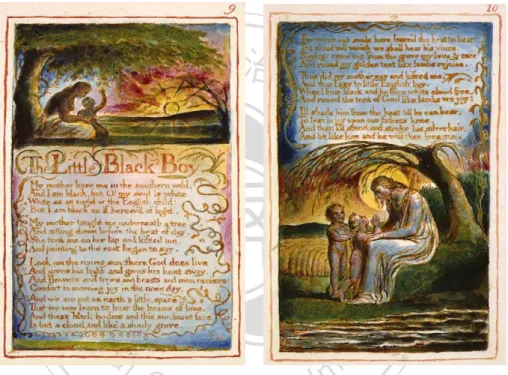
(35) Milton’s Eden, which is not a holy shrine unknown to sex, but a sensual paradise of sexual union. Blake’s De-sexualized/Domesticated Innocence What must be recognized first in reading the Songs is its multi-layered structure. Frye divides human consciousness in Blake into four states: Eden, Beulah, Generation, and Ulro. Beulah is the state of innocence, “the potentially creative world of dreams and childhood” (“Blake’s Treatment of Archetypes” 527). Generation is the state of experience, where “the innocent vision…is subject to so much distortion, repression,. 政 治 大 misled to apply Beulah/innocence 立 to the Songs of Innocence and. and censorship” (527). Reading this passage of Frye’s criticism, a reader will easily be. ‧ 國. 學. Generation/experience to the Song of Experience, as a reader of this poetic collection will easily be misled by its subtitle: “Showing the Two Contrary States of the Human. ‧. Soul” and thus treats the Innocence and the Experience as pairs of dichotomy. What I. sit. y. Nat. am arguing here is that Frye’s division of the four states flows freely in each of. al. er. io. Blake’s poetic work; the “innocence” of the Innocence is not the true “innocence” in. v. n. Blake’s ideal. What we see in the Innocence is indeed a world of “dreams and. Ch. engchi. i n U. childhood,” but is it a “potentially creative world”? Partly it is, but partly it is not. “Introduction” (CPWB 7) sets the tone for the following poems in the Innocence: the carefree and harmonious pastoral mood. It presents a process of poetic creativity, from pure voice (“Piping songs of pleasant glee”), speaking language (“Pipe a song about a Lamb”), to written words (“Piper sit thee down and write/ In a book that all may read”). In this simple poem a subtle multi-layered structure can be observed. The initial song is “of” pleasant glee; in other words, it is a sheer expression of individual emotion, undistorted, unrepressed, and totally intact of the influences from exterior circumstances. When it is articulated as a song “about” a Lamb, what. 27.
(36) Bloom calls subject-object relationship appears. The human individual acknowledges the outer world and others that exist beside him, and the outer world interferes with one’s individual feelings: “So I piped, he wept to hear.” What comes next is the compilation of language into a “book,” which indicates that at this final stage, poetry is constructed by written words. Written words further signify the establishment of law and the limitation it will carry upon human individuals. In my view, his seemingly bizarre word choice foreshadows the consequence of this process. It is the verb “stain’d” in the final stanza I am stressing here: “So I made a rural pen, / And I stain’d. 政 治 大 purity, “the water clear.” Blake’s usage of this word seems to be a misplacement or a 立. the water clear” (CPWB 7). To stain means to pollute and to alter the primary state of. we see poems in the collection as a wholesome unity.. 學. ‧ 國. poor word choice in the context of “Introduction,” but it will make perfect sense when. ‧. What is the world of innocence the Piper introduces? Is it the “water clear” or. y. Nat. “water stained”? As I have argued before, the “innocence” in the Songs of Innocence. er. io. sit. is not the true innocence in Blake’s ideal. What is presented in this collection is a water both clear and stained. Diana Hume George calls the Innocence/Experience. al. n. v i n Cand collection a “family romance” (Blake 98). Indeed, on the literal level, the h eFreud ngchi U. Songs of Innocence is centered on the new birth of children and the parental cares,. mostly emphasized in “A Cradle Song” and “Infant Joy.” When they become youths, they seem to carry on the pastoral tradition, as they sing, play, and tend their sheep on pleasant meadows in poems such as “The Shepherd,” “Laughing Song,” “Spring,” and “Nurse’s Song.” They are of the first layer of the collection: the “water clear.” In this first layer, the love-relationship is of full-hearted care and sympathy; each individual gives his/her love freely without asking for rewards. Such a love-relationship in the first layer of the structure is summarized in the end of the Innocence in “On Anothers Sorrow.” As he perceives that this “love” is 28.
(37) problematic, Blake, through the voice of a first-person narrator, introduces the second layer of the “water stained” in a subtle and indicative manner: Can I see anothers woe, And not be in sorrow too. Can I see anothers grief, And not seek for kind relief.. Can I see a falling tear,. 政 治 大 Can a father see his child, 立 And not feel my sorrows share.. Weep, nor be with sorrow fill’d.. ‧ 國. 學 ‧. Can a mother sit and hear. sit. y. Nat. An infant groan an infant fear―. io. er. No no never can it be. Never never can it be.. n. al. (CPWB 17 ). Ch. engchi. i n U. v. In the first stanza, the individual speaker is talking about perceiving others’ feelings which objectively have nothing to do with himself/herself. Others’ sufferings trigger the same distressed emotion in his/her heart. From the speaker’s point of view, the ultimate form of sympathy is parental love, as he reinforces his argument here by placing a father and a mother in the second and the third stanza. At the first reading of this poem, the reader is easily pleased by its neat rhythm and rhyme, and is unconsciously allured to take for granted Blake’s bridging between his argument and examples. But is it not weird to take parents’ love for their children as an example of sympathy? In my reasoning, sympathy occurs among individuals who have no 29.
(38) familial tie with each other, as it is unlikely for us to say: “I sympathize with my son,” but with higher possibility we would say directly: “I love my son.” Blake’s equating love with sympathy seems to be indicatively problematic. In the context of this poem, especially in the first two stanzas, sympathy works when others’ woes afflict ourselves, arousing fear in our heart that we might end up like those wretched and miserable people. Therefore, Blake seems to insinuate that in “On Anothers Sorrow,” sympathy has its pre-existing condition, which, to some extent, has something to do with self-interest, but parental love is unconditional and spontaneous. Parental love. 政 治 大 Blake’s belief and system. Thus, in the last three stanzas, Blake directs this poem back 立. can be traced back to its divine source, the love from Jesus Christ, the only God in. to such a mythical context:. ‧ 國. 學. He doth give his joy to all,. ‧. He becomes an infant small.. sit. y. Nat. He becomes a man of woe. io. n. al. er. He doth feel the sorrow too.. Ch. Think not, thou canst sigh a sigh, And thy maker is not by.. engchi. Think not, thou canst weep a tear, And thy maker is not near.. O! he gives to us his joy, That our grief he may destroy Till our grief is fled & gone He doth sit by us and moan. (CPWB 17) 30. i n U. v.
數據
+3


Outline
Experience this theme about the remorseful consequence of continence has already been implied, but in America, Blake chastises this twisted Christian virtue in an overt
5 CPWB 35) such as the maiden in “Angel” and the Youth and Virgin in
Milton is a poem written to respond to Milton the poet and his Paradise Lost, and a study of archetypes might be a promising method to approach the poem. What I
相關文件
This project aims to cover a range of learning targets and objectives in the Knowledge, Interpersonal and Experience Strands/Dimensions, language development strategies and
As with all poetry, is-poems are a little more complicated than it looks. You need to write down all your associations and ideas and then just select a few, adding the
The Seed project, Coding to Learn – Enabling Primary Students to Experience a New Approach to English Learning (C2L), aims to explore ways to use coding as a means of motivating
A limited section of a reading text (usually a short paragraph) is used for students to practice stress and intonation of a previously read passage.. With limited use, students
grep - print lines matching a pattern. $ grep [OPTIONS]
Visit the following page and select video #3 (How warrant works) to show students a video introducing derivative warrant, then discuss with them the difference of a call and a
To convert a string containing floating-point digits to its floating-point value, use the static parseDouble method of the Double class..
The aims of this study are: (1) to provide a repository for collecting ECG files, (2) to decode SCP-ECG files and store the results in a database for data management and further
