國 立 交 通 大 學
環 境 工 程 研 究 所
博 士 論 文
兩條平行河川間自由水層因抽水所引起的三維地下水
流通解
A General Analytical Solution for Three-Dimensional
Groundwater Flow Induced by Pumping in Unconfined Aquifers
Bounded by Two Parallel Streams
研 究 生:黃 璟 勝
指導教授:葉 弘 德
兩條平行河川間自由水層因抽水所引起的三維地下水
流通解
A General Analytical Solution for Three-Dimensional
Groundwater Flow Induced by Pumping in Unconfined Aquifers
Bounded by Two Parallel Streams
研 究 生 : 黃璟勝 (
Ching-Sheng Huang)
指導教授:葉弘德 (
Hund-Der Yeh)
國 立 交 通 大 學
環 境 工 程 研 究 所
博 士 論 文
A Dissertation
Submitted to Institute of Environmental Engineering
College of Engineering
National Chiao Tung University
in Partial Fulfillment of the Requirements
for the Degree of
Doctor of Philosophy
in
Environmental Engineering
January, 2013
Hsinchu, Taiwan
中 華 民 國 一 百 零 二 年 二 月
兩條平行河川間自由水層因抽水所引起的三維地下水
流通解
研究生:黃璟勝 指導教授:葉弘德
國立交通大學環境工程研究所
摘要
本研究發展一個數學模式,用以描述在兩條平行河川之間的自由含水層,因 抽水井所引起的三維地下水流之解析解。所建構的數學模式,包含一個新的地下 水流控制方程式,使所發展的解析解可適用於三種抽水井,包含垂直井、水平井、 及輻射收集井;接著採用自由液面方程式,描述液面因抽水而產生的洩降,並以 第三類邊界條件代表兩條平行河川的低透水性河床。應用積分轉換的方法,推導 出此數學模式的水力水頭解析解,此解由含特徵函數的三階無限級數所組成,其 特徵值的計算需用到尋根法;我們提出一個解析公式用來求適當的初始猜值,配 合牛頓法可有效率地求出特徵值。依據達西定律和水頭解析解,可導出描述河川 滲入率(stream depletion rate, SDR)的解析解,此解析解對現地的水平井或輻射收 集井的預測,可與現地問題量測的結果相吻合。依據解析解的模擬結果,我們得 到以下的結論:未受壓含水層中的重力排水對 SDR 有顯著的影響,在抽水中期, SDR 不隨抽水時間增加而增加,若忽略水頭垂直方向的變化,會顯著地高估SDR,此結論和紐西蘭 Doyleston 附近的現地實驗結果一致。此外,輻射收集井 的側臂分布對於洩降有顯著的影響,在河川滲入行為發生之前,最大洩降位於在
輻射井的中心;當河水開始滲入含水層,最大洩降開始遠離井中心並往內陸方向 移動。
關鍵字: 垂直井、水平井、輻射收集井、受壓含水層、自由液面方程式、河川 滲入率(SDR)、二重積分轉換、有限複立葉餘弦轉換、拉普拉斯轉換
A General Analytical Solution for Three-Dimensional Groundwater
Flow Induced by Pumping in Unconfined Aquifers Bounded by Two
Parallel Streams
Student:Ching-Sheng Huang Adviser:Hund-Der Yeh Institute of Environmental Engineering
National Chiao Tung University
ABSTRACT
This thesis develops a mathematical model for describing three-dimensional groundwater flow induced from a vertical well, horizontal well or radial collector well (RC well) in an unconfined aquifer bounded by two parallel streams. A new governing equation with a sink term standing for the well is presented. A simplified free surface equation is used to describe the depletion of water table in the aquifer. The third-type boundary condition is employed for the boundary condition at the interface where a low-permeability streambed is connected to the aquifer. The aquifer we concern is of finite extent; therefore, the head solution of the model, derived by integral transforms, can be expressed in terms of an infinite series with eigenvalues requiring a root-finding scheme such as Newton method. An analytical expression is developed to give initial guesses for the eigenvalues. The solution for stream depletion rate (SDR) describing filtration rate from the streams is acquired based on Darcy’s law and the head solution. The present solution is applied to predict the hydraulic head near a horizontal well or a RC well for the real-world cases. The predicted results are reasonable when compared with the field observed data. With the aid of the present solution, we have found that the gravity drainage of an unconfined aquifer has
significant effects on temporal SDR. The curve of temporal SDR tends to be flat due to the gravity drainage during the middle period of pumping time. The vertical groundwater flow described by the free surface equation should be used even for the case of a fully-penetrating well. The SDR will be overestimated if neglecting the vertical flow in the model. Such a result is confirmed by the comparison of SDR predicted from the present solution with that taken from a field SDR experiment executed near Doyleston in New Zealand. Additionally, lateral configurations of a RC well have significant effects on spatial drawdown distributions. The largest drawdown occurs right at the center of a RC well before the filtration and moves landward once the filtration starts to recharge the aquifer.
KEYWORDS: vertical well, horizontal well, radial collector well, confined aquifer,
free surface equation, stream depletion/filtration rate (SDR), double-integral transform, finite Fourier cosine transform, Laplace transform
誌謝
本論文承蒙葉弘德教授的細心指導,才能順利完成,在此對我的恩師葉老師 致上最深的謝意。口試期間,中央大學的葉高次教授及陳瑞昇教授、逢甲大學的 馮秋霞教授、萬能科技大學的楊紹洋教授和交通大學的傅武雄教授給予的建議, 使本論文內容更加充實完備,在此一併致謝。 博士班期間,葉弘德教授除了將專業知識傾囊相授之外,對於研究應有的態 度和行為,更以身作則。葉老師對於目標努力不懈的毅力,讓我深感佩服。感謝 葉老師和國科會提供參加國外研討會的機會,讓我確認自己的努力方向並拓展視 野;感謝語言中心的吳思葦老師,教導我英語報告的技巧;感謝學姐張雅琪,在 我剛踏入研究領域時,提供適時的協助;感謝學長李珖儀,幫助我完成資格考和 口試;此外,感謝同屆的同學陳庚轅、鄒佩蓉和學弟妹們,讓我的研究生涯更多 采多姿。 最後,感謝父母親的支持,讓我能專心於學業上;感謝弟弟在家中的幫忙, 讓我能更專注於學業;此外,感謝台灣社會的人們,默默地提供我每天的需求, 便利了我在學校的生活。TABLE OF CONTENTS
摘要 ... II ABSTRACT ... IV 致謝 ... VI TABLE OF CONTENTS ... VII LIST OF TABLES ... IX LIST OF FIGURES ... X NOTATION ... XII
CHAPTER 1 INTRODUCTION ... 1
1.1.BACKGROUND ... 1
1.2.RADIAL COLLECTOR WELL (RCWELL) ... 3
1.3.REVIEW OF PREVIOUS SOLUTIONS ... 4
1.3.1. Two-Dimensional Flow ... 4
1.3.2. Quasi Three-Dimensional Flow ... 7
1.3.3. Three-Dimensional Flow ... 8
1.4.OBJECTIVE ... 10
CHAPTER 2 METHODOLOGY ... 12
2.1.MATHEMATICAL MODEL ... 12
2.2.SOLUTIONS FOR HYDRAULIC HEAD AND STREAM FILTRATION RATE (SDR) ... 15
2.2.1. Hydraulic Head for Vertical Well ... 16
2.2.2. SDR Induced from Vertical Well ... 17
2.2.3. Hydraulic Head for RC Well ... 18
2.2.4. SDR Induced from RC Well ... 20
2.3.CALCULATION ... 20
2.3.1. Initial Guesses for αi ... 21
2.3.2. Initial Guesses for β0 and βk ... 22
CHAPTER 3 RESULTS AND DISCUSSION ... 24
3.1.EFFECTS OF FREE SURFACE ON VERTICAL FLOW ... 24
3.2.HEAD DISTRIBUTION INDUCED FROM HORIZONTAL WELL ... 25
3.2.1. Spatial Distribution in Vertical Dimension ... 25
3.2.2. Comparison of Predicted Head with Observed Field Data ... 26
3.3.2. Comparison of Predicted Head with Observed Field Data ... 28
3.4.EFFECTS OF LOW-PERMEABILITY STREAMBED ON SDR ... 30
3.4.1. Steady-State SDR ... 30
3.4.2. Temporal SDR ... 31
3.5.EFFECTS OF VERTICAL HYDRAULIC CONDUCTIVITY ON SDR ... 32
3.6.EFFECTS OF LATERAL CONFIGURATIONS ON SDR ... 33
3.7.COMPARISON OF PREDICTED SDR WITH MEASURED FIELD DATA ... 33
3.7.1. SDR Field Experiment ... 33
3.7.2. Hydraulic Parameters for Aquifer and Streambed ... 34
3.7.3. SDR Prediction from Analytical Solutions ... 35
CHAPTER 4 CONCLUDING REMARKS ... 38
REFERENCES ... 41
APPENDIX A DEVELOPMENTOF EQUATIONS (10) AND (29) ... 44
VITA (作者簡歷) ... 70
榮譽事蹟 ... 71
LIST OF TABLES
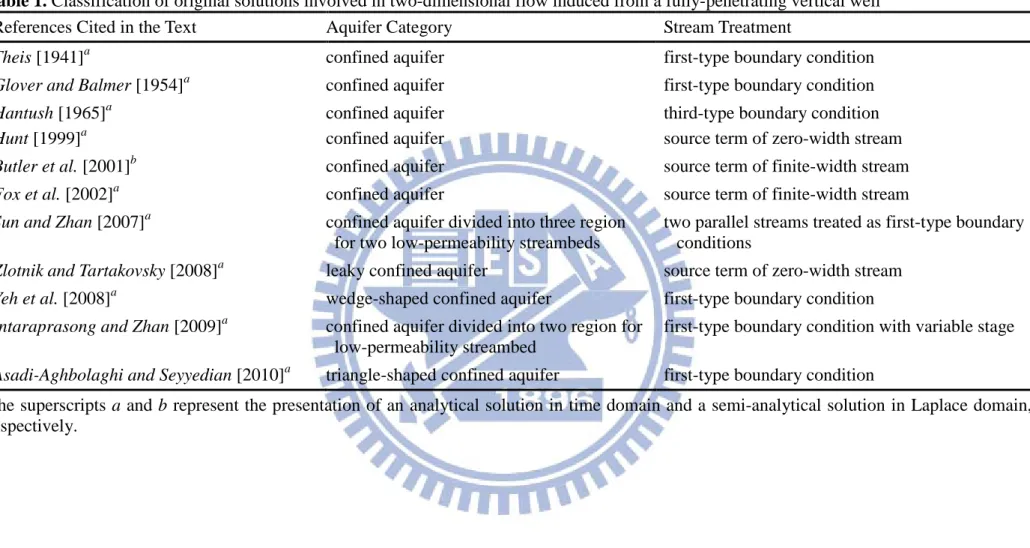
Table 1. Classification of original solutions involved in two-dimensional flow induced
from a fully-penetrating vertical well………51
Table 2. Classification of original solutions involved in quasi three-dimensional and
three-dimensional flow………..52
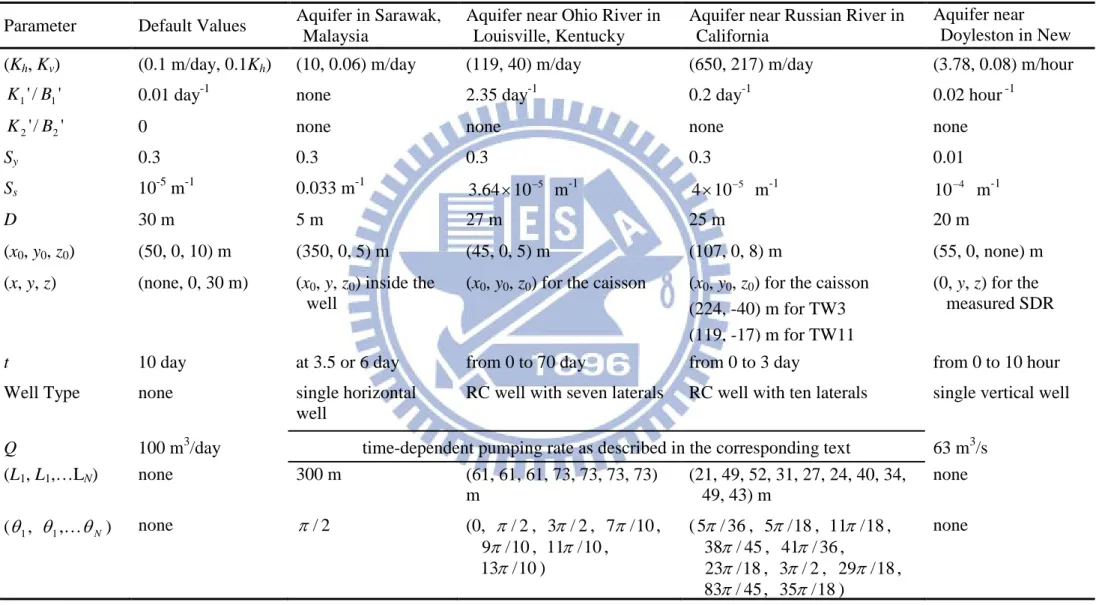
Table 3. The default values and field data for aquifer parameters and well
LIST OF FIGURES
Figure 1. Schematic diagram of an unconfined aquifer with a vertical well or a radial
collector well; (a) and (c) top view; (b) and (d) cross section view………...54
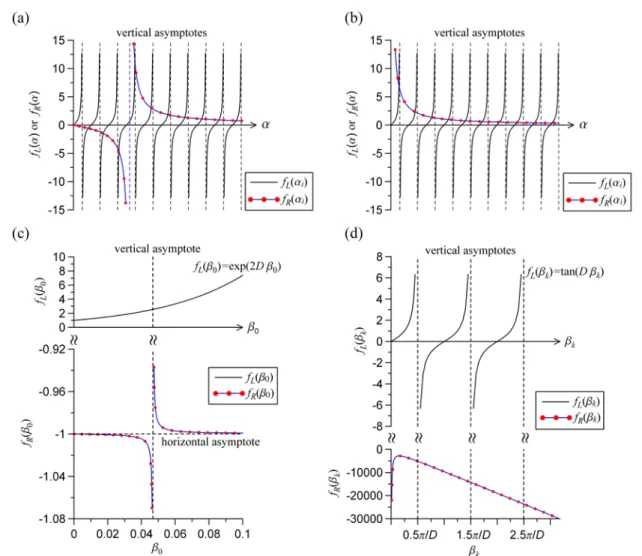
Figure 2. The patterns of the LHS and RHS functions from equation (20) for (a)
0 '
2 ≠
K and (b) K2'=0 as well as from (c) equation (21) and (d) equation (22)...55
Figure 3. Contours of spatial head distributions induced from a fully-penetrating
vertical well for various Sy/Kv when t=10 m/day………56
Figure 4. The spatial head distributions induced from a horizontal well for (a) 3D view
and (b) top view………...57
Figure 5. The predicted drawdown from the present solution and observed drawdown
from Mohamed and Rushton [2006]………...58
Figure 6. The contours of transient water table due to pumping in a radial collector well
with three symmetrical laterals for various times………...59
Figure 7. The contours of steady-state water table due to pumping in a radial collector
well with four different configurations. (a) symmetry (b) non-symmetry (c) laterals toward stream (d) laterals landward………60
Figure 8. Temporal distribution curves of SDR for four different lateral configurations
61
Figure 9. Water levels predicted by the present solution and the observed field data from
Schafer [2006]……….62
Figure 10. Water levels predicted by the present solution and the observed field data from
Figure 12. Steady-state water table distributions at y=0 for various K /1' Kh………...65
Figure 13. Temporal distribution curves of SDR for the LHS stream for various
h
K
K /1' ………..66
Figure 14. Temporal distribution curves of SDR due to pumping in a radial collector
well with three symmetrical laterals for various K /v Kh……….67
Figure 15. Temporal distribution curves of SDR for various lateral number and length
68
Figure 16. Comparison of temporal SDR predicted from the present solution, Theis’
solution [1941] and Hantush’s solution [1965] with field data taken from a field SDR experiment executed by Hunt et al. [2001]………69
NOTATION
h : hydraulic head in an aquifer
(x, y, z) : variables of Cartesian coordinate where x axis is perpendicular to streams
t : time (Kh, Kv)
: hydraulic conductivity in the horizontal and vertical direction, respectively
Sy : specific yield
Ss : specific storage
(Wx, Wy) : aquifer width in x and y direction, respectively
D : aquifer thickness
T : transmissivity (Kh D)
S : storage coefficient (Ss D)
(K , 1' B ) 1' : streambed hydraulic conductivity and its thickness, respectively, on the
left hand side of an aquifer
1
c : K1'/(KhB1')
(K , 2' B ) : streambed hydraulic conductivity and its thickness, respectively, on the 2' right hand side of an aquifer
2
c : K2'/(KhB2')
Q : pumping rate
N : the number of laterals
(x0, y0) : location of vertical well or the center of radial collector well
z0 : elevation of horizontal well or radial collector well
(Ln, θ ) n : length and counterclockwise angle from x axis, respectively, for the n-th
lateral )
, ,
CHAPTER 1 INTRODUCTION 1.1. Background
Groundwater depletion, a key issue associated with groundwater supplies, has been
increasing rapidly and inevitably as a result of industrial development and growing
population since the past haft century [e.g., Konikow and Kendy, 2005; Zume and
Tarhule, 2008; Kim, 2010; Ravazzani et al., 2011]. The average rate of groundwater
consumption is estimated in the range of 750-800 km3/year in the whole world [Shah et
al., 2000]. Groundwater withdrawals will induce a considerable amount of filtration
from a reservoir to its adjacent aquifer if an abstraction well is installed near the
reservoir. Therefore, it is worthy to review the effects of groundwater withdrawals on
some issues such as aquatic ecosystem near streams, water quality for agricultural
irrigation, distributions of water rights, and utilization for households and industries.
Aquatic ecosystem near a stream will be damaged if the stream stage declines
excessively due to a large quantity of filtration [Wen and Chen, 2006]. The balance of
food chain could be destroyed if a specific species is removed. Some hydrophytes are,
for example, not survival in the absence of a high-level stream stage, and herbivores are
jointly not, either.
Groundwater abstractions for agricultural irrigation could become contaminated
amount of groundwater is withdrawn, and the contaminants enter the aquifer through
filtration. During rainy seasons, the contaminants are remained in the aquifer even when
pumping from wells ceases. After several alternations between drought and rainy
seasons, the contaminants may eventually reach the abstraction wells, and in turn
degrade the quality of pumped groundwater.
Groundwater recharge from two different surfaces sources such as streams is
involved in distribution of water from surfaces sources regulated by water rights. The
contribution to groundwater abstraction for a well comes from two streams. Generally
speaking, most of the groundwater is contributed from the neighboring stream. However,
under some conditions, all of the groundwater may be extracted almost from the other
stream far away from the abstraction well. Accordingly, an accurate estimate of
filtration rate plays an important role for hydrologists in the managements of water
resources.
In the past, to meet the water demand for domestic and industrial, dams had been
used for storage of surface water in providing more consistent supplies. However, a
suitable site for dam construction is scanty. Recently, awareness of environmental and
ecological consciousness has resulted in dam removals. Groundwater utilization
therefore becomes inevitable.
land subsidence. During the early period of pumping time, the filtration recharges the
adjacent aquifer with parts of the groundwater extraction. The drawdown increases with
time due to the loss of the groundwater. During the late period, the stream water
filtration balances the groundwater withdrawal, and the drawdown becomes stabilized.
1.2. Radial Collector Well (RC Well)
Radial collector wells (RC wells) have been commonly designed and used to
collect water from a nearby stream. The RC well designed by Ranney Leo was
developed from horizontal wells in 1930s [Hunt, 2006]. A RC well generally comprises
a central reinforced concrete caisson and several laterals under the ground surface. The
central caisson is drilled downward with an inside diameter ranging from 3 to 6 m or
larger, and the laterals horizontally extend from the central caisson at a proper depth in
an aquifer. The advances in well-drilling techniques provide more practical guidance on
well installations in aquifers. The groundwater moves through the laterals to the caisson
if the RC well starts pumping.
The magnitude of drawdown can be controlled artificially by adopting a RC well
with several laterals. Compared with a traditional vertical well, for the same pumping
rate, the RC well extracts groundwater from a wider range by extended horizontal
laterals. The drawdown can thus be minimized as small as possible. However, the length
accordingly determined based on the natural situation of aquifer thickness.
1.3. Review of Previous Solutions
A variety of analytical and semi-analytical solutions have been developed to assess
stream filtration induced from pumping under the condition of a fully-penetrating
stream. They can be classified according to the dimensions of groundwater flow, namely,
two-dimensional (2-D) flow, quasi three-dimensional (quasi 3-D) flow, and
three-dimensional (3-D) flow, as shown in the following three sections, respectively.
1.3.1. Two-Dimensional Flow
Most of the solutions have been developed considering 2-D groundwater flow
induced by a fully-penetrating well in a confined aquifer or a leaky confined aquifer
with a nearby stream. Theis [1941] was the first to propose an analytical solution for
stream filtration in a confined aquifer. The aquifer extends infinitely in the horizontal
direction, and the stream generated without a low-permeability streambed by
image-well theory is actually subject to a first-type boundary condition. The solution is
expressed in terms of an improper integration. Glover and Balmer [1954] simplified
Theis’ solution [1941] to a concise expression in terms of a complementary error
function. Hantush [1965] considered the same situations as Theis [1941] but under a
third-type stream boundary condition with a low-permeability streambed, and developed
The stream is commonly regarded as a source term in the governing equation. The
source term is expressed in terms of the Dirac delta function, representing a zero width
stream. Those solutions to the equation with a source term are applicable to the case of a
low-permeability streambed. On the other hand, the stream is treated as a line source for
the fully-penetrating stream under Dupuit assumption [Sun and Zhan, 2007]. Hunt’s
solution [1999] might be the first analytical solution derived by treating the stream as
the line source for a confined aquifer and was shown to be exactly the same as
Hantush’s solution [1965] according to Sun and Zhan [2007]. His solution is valid for
the whole domain of the aquifer divided by the stream because of the treatment of a
stream as a source term. In contrast, based on the treatment of the stream as a boundary,
Hantush’ solution [1965] is limited to the case of the side where a well is installed.
Additionally, Zlotnik and Tartakovsky [2008] also treated a stream as the line source but
considered a leaky confined aquifer. They presented an analytical solution for hydraulic
head and stream filtration.
To account for the effect of stream width on the model, some researchers divide an
aquifer into three zones with different governing equations. The middle zone has a
width equaling the stream width. Only the side zone has a fully-penetrating well treated
as a sink term in the governing equation. Those three governing equations are coupled
middle zone and side zones. Butler et al. [2001] used this approach to derive a
semi-analytical solution in Laplace domain for a confined aquifer and analyzed the
effect of stream width on stream filtration. Fox et al. [2002] considered the same model
as Butler et al. [2001] and derived an analytical solution in time domain.
Some articles are proposed to treat a stream as a first-type boundary condition for a
wedge-shaped aquifer or a triangle confined aquifer. Yeh et al. [2008] developed an
analytical solution for describing temporal head distribution and stream filtration for a
wedge-shaped aquifer bounded by a stream. For the triangle aquifer, Asadi-Aghbolaghi
and Seyyedian [2010] derived an analytical solution for steady-state head distributions
in the finite aquifer where two of the sides are a first-type stream boundary and the other
side is either a first-type boundary or a no-flow boundary.
Most of the articles adopted a third-type stream boundary as a stream boundary in
which the streambed permeability is considered but its storage is neglected. To account
for the storage effects, some articles considered the role of a streambed in the different
way. The streambed is treated as parts of an aquifer rather than parts of the boundary
and has different permeability and storage from the adjacent aquifer. One-dimensional
(1-D) groundwater flow which is perpendicular to the stream is considered in the
streambed. Under this situation, Sun and Zhan [2007] considered two parallel streams
the distributions of stream filtration from these two streams with different hydraulic
parameters. Intaraprasong and Zhan [2009] considered a temporal and spatial variation
in stream stage and derived a semi-analytical solution for quantifying the effect of the
variable stage on stream filtration.
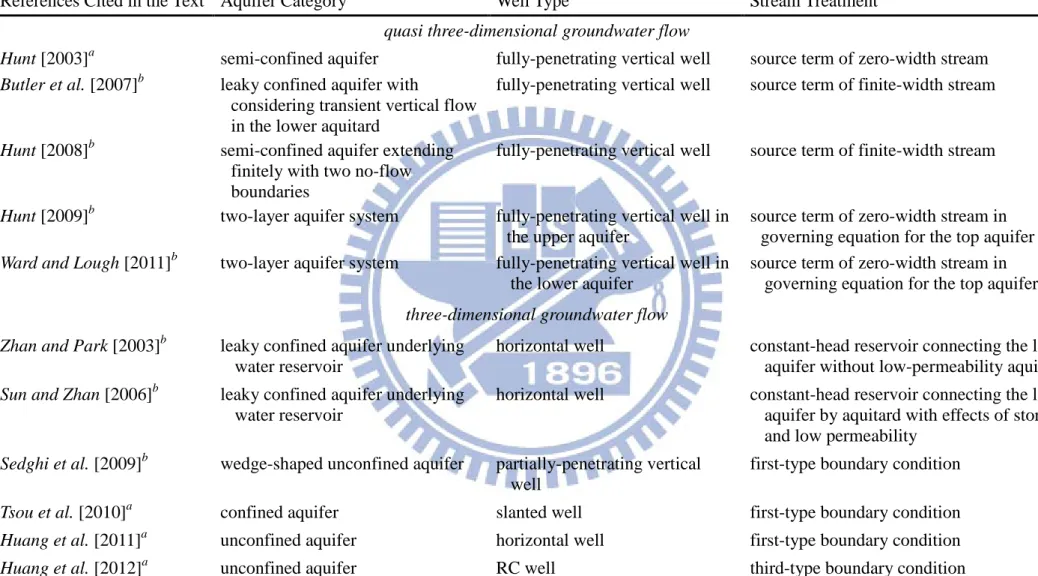
The solutions mentioned above are summarized in Table 1. All of these solutions
account for the effect of 2-D flow induced by a fully-penetrating vertical well and can
be categorized based on the aquifer types and stream treatments.
1.3.2. Quasi Three-Dimensional Flow
Quasi 3-D flow model represents a multiple-layered aquifer system in which the
flow in the aquifer is horizontal and in the aquitard is vertical. The flow in the aquifer
system is coupled through the leakage term in their governing equations. The aquifer
system is classified herein into a semi-confined aquifer, leaky confined aquifer, and
two-layer aquifer system. Firstly, a semi-confined aquifer consists of a main aquifer and
a semi-permeable confining unit on the top. The groundwater flow in the unit is treated
to be vertical as a result of its thin thickness. Hunt [2003] developed an analytical
solution for head and stream filtration in such a semi-confined aquifer. The stream is
treated as the source term of zero width. Hunt [2008] also considered a semi-confined
aquifer but considered the stream as the source term of finite width. The aquifer extends
perpendicular to the stream. He developed a semi-analytical solution for hydraulic head
and stream filtration. Secondly, a leaky confined aquifer herein contains a main aquifer
and the aquitard at the bottom. The aquitard has only vertical flow due to its thin
thickness. Butler et al. [2007] derived a semi-analytical solution describing hydraulic
head and stream filtration for such an aquifer. Thirdly, a two-layer aquifer system
represents that each aquifer has horizontal flow and is coupled with the other one by the
leakage term in the governing equation. Hunt [2009] developed a semi-analytical
solution for such a aquifer system. The stream is treated as a source term of zero width,
and the vertical well fully penetrates the upper aquifer. Ward and Lough [2011]
considered the same situations but the well is installed in the lower aquifer. They
derived a semi-analytical solution in Fourier and Laplace domain for hydraulic head and
in Laplace domain for stream filtration.
1.3.3. Three-Dimensional Flow
The analytical solutions involved in predicting the stream filtration induced by
pumping from a partially-penetrating vertical well, slanted well, horizontal well and RC
well are reviewed herein. These solutions take account of the vertical component of
groundwater flow even in a confined aquifer. Based on a 3-D groundwater flow
equation, Sedghi et al. [2009] presented a semi-analytical solution for groundwater flow
well. Tsou et al. [2010] derived an analytical solution for temporal stream filtration
induced from a slanted well in a confined aquifer. They found that the temporal
filtration from a fully-penetrating stream toward a horizontal well parallel to the stream
will reach its steady-state quickly. Huang et al. [2011] used 3-D groundwater flow
equation along with a simplified free surface equation to represent the upper boundary
of an unconfined aquifer and developed an analytical solution for describing temporal
stream filtration induced from a horizontal well. Their solution can be applied to
investigate the effect of specific yield on temporal distributions of stream filtration.
Those two solutions regarded the stream as a first-type boundary without considering
the presence of a streambed. Recently, Huang et al. [2012] used a third-type boundary
condition to represent the condition at a stream with a low-permeability streambed and
presented an analytical solution to describe temporal stream filtration induced from a
RC well in unconfined aquifers. Those three solutions mentioned above are expressed in
terms of a multiple integral and thus need a root search scheme and numerical
integration to compute the solutions.
Some semi-analytical solutions were presented to deal with the problem with a
horizontal well in a leaky confined aquifer underlying a water reservoir. The reservoir
was of an infinite extent in the horizontal direction and treated as a constant-head
solution under such a situation. The aquifer is directly connected to the overlying
reservoir without a low-permeability aquitard in between. Sun and Zhan [2006]
developed a semi-analytical solution under the same situation but took account for the
presence of the aquitard with elastic storage and low permeability.
The solutions reviewed in the previous two sections are summarized in Table 2.
These solutions involved in quasi 3-D flow and 3-D flow are categorized based on the
aquifer categories, well types, and stream treatments.
1.4. Objective
In this thesis, a general mathematical model is developed for 3-D groundwater
flow induced by pumping in a vertical well, horizontal well or RC well in an unconfined
aquifer near two parallel streams. The variation of water table of the aquifer is
characterized by a simplified free surface equation. A third-type boundary condition is
adopted at both streambeds with different permeability. The aquifer is of finite extents
in x, y and z directions for simplifying the calculation of the solution to the model. The
head solution is derived by double-integral transform, finite Fourier cosine transform
and Laplace transform, and expressed in terms of series with sequences requiring a
root-searching scheme. The appropriate initial guesses are explained graphically and
then formulated as analytical results. Based on Darcy’s law and the head solution, the
The behaviors of hydraulic head and SDR have been investigated by the developed
solutions. The effect of the vertical component of groundwater flow on spatial head
distributions is examined under the condition of fully-penetrating vertical wells. Spatial
head distributions induced by a horizontal well for various elevations are displayed
graphically, and the predicted hydraulic head inside the horizontal well is compared
with the observed field data of Mohamed and Rushton [2006]. The effects of the
configuration of the laterals of the RC well on the SDR and variation in water table are
investigated, and the predicted water levels are compared with observed field data of
Schafer [2006] and Jasperse [2009]. Moreover, the effects of the streambed
permeability on the SDR and variation in water table are examined. The patterns of
temporal SDR distributions for various vertical hydraulic conductivities of an
unconfined aquifer are demonstrated. The temporal SDR predicted from the present
solution is compared with that observed from a field SDR experiment conducted by
CHAPTER 2 METHODOLOGY
A 3-D mathematical groundwater flow model describing spatial and temporal
hydraulic head distribution with appropriate boundary conditions is built in this chapter.
Then, the solution of the model is derived based on techniques of integral transforms.
2.1. Mathematical Model
Consider an unconfined aquifer bounded by two parallel streams with a
fully-penetrating vertical well and a RC well with several laterals as shown in Figures
1(a) and 1(c), respectively. In order to avoid the solution being expressed in terms of a
multiple integral, we consider the aquifer of the finite extents in x-, y-, and z-directions.
The aquifer has finite widths Wx and Wy in x- and y-directions, respectively, as shown in
Figure 1(a) and a finite thickness D in z-direction as shown in Figure 1(b). The aquifer
can be regarded as a semi-infinite one if Wx and Wy are a large value. As such, the
hydraulic gradient near x=Wx and/or y=±Wy/2 maintains zero during the pumping
period. The streambed on the left hand side (LHS) and right hand side (RHS) has a
width B and 1' B , respectively, as shown in Figure 1 (a). The vertical well is located 2'
at (x0, y0) shown in Figure 1(a), while the bottom of the collector well is located at (x0,
y0, z0) demonstrated in Figure 1(d). Each of laterals of the collector well has a length Ln
and counterclockwise angle �n from positive x axis, and the subscript n represents the
The governing equation describing spatial and temporal hydraulic head h(x, y, z, t)
in response to the pumping from a fully-penetrating vertical well can be expressed as
) ( ) ( 0 0 2 2 2 2 2 2 y y x x D Q t h S z h K y h K x h Kh h v s + − − ∂ ∂ = ∂ ∂ + ∂ ∂ + ∂ ∂ δ δ (1)
where δ is Dirac delta function; K() h and Kv are hydraulic conductivities in the
horizontal and vertical directions, respectively; Ss is specific storage; Q/D is the
constant discharge intensity along the well; t is time. On the other hand, the equation
describing hydraulic head due to pumping at a RC well is given as [e.g., Sun and Zhan,
2006; Sedghi et al., 2009; Tsou et al., 2010; Huang et al., 2012] ) ( ) ( ) ( 0 0 0 2 2 2 2 2 2 z z y y x x Q t h S z h K y h K x h Kh h v s + − − − ∂ ∂ = ∂ ∂ + ∂ ∂ + ∂ ∂ δ δ δ . (2)
Combining through the sink terms of these two equations yields a general equation
for a fully-penetrating vertical well and RC well as
− + − − + ∂ ∂ = ∂ ∂ + ∂ ∂ + ∂ ∂ D v z z r y y x x Q t h S z h K y h K x h Kh h v 2 s ( 0) ( 0) ( 0) 2 2 2 2 2 δ δ δ (3)
where both r and v are a constant of either 1 or 0. Equation (3) reduces to equation (1)
for a fully-penetrating vertical well if r=0 and v=1. On the other hand, equation (3)
reduces to equation (2) for a RC well if r=1 and v=0.
The value of hydraulic head depends on the location of a reference datum where
the elevation head is set as zero. The level of water table serves as the reference datum
and maintains static before pumping. The initial condition is therefore written as
0 0 = = at t
A partially-penetrating stream can be considered as a fully-penetrating one if the
distance measured from the stream to the well is larger than 1.5 times aquifer thickness
[e.g., Jacob, 1950; Todd and Mays, 2005]. The streams with the low-permeability
streambed are therefore regarded as full penetration and treated as a third-type boundary
condition as [e.g., Hantush, 1965; Huang et al., 2012]
0 0 ' ' 1 1 = = − ∂ ∂ x at h B K K x h h (5) x h W x at h B K K x h+ = = ∂ ∂ 0 ' ' 2 2 (6)
where K and 1' K are the hydraulic conductivity of the streambed on the LHS and 2'
RHS of the finite aquifer, respectively.
Consideration of the aquifer extending infinitely or semi-infinitely leads to an
expression of a multiple integral for SDR solutions [e.g., Butler et al., 2007; Tsou et al.,
2010; Huang et al., 2012], which may have difficulty in numerical evaluations. For
example, the recent solution developed by Huang et al. [2012] involves an infinite
series expanded by sequences and quadruple integral with three improper integrals and
one finite integral. Moreover, the integration variables depend on the sequences which
are the roots of nonlinear equations. For avoiding the multiple integral, we therefore
consider the no-flow boundary condition at y-direction of the finite aquifer as
2 / 0 / y at y Wy h ∂ = =± ∂ . (7)
SDR derived based on equation (7) should be equal to those obtained from the solutions
with considering a remote boundary condition of lim ∂ /∂ =0
∞ ±
→ h y
y , if the half width
Wy/2 is larger than the radius of influence due to pumping.
Consider the unconfined aquifer underlain by an impermeable medium which is
treated as a no-flow boundary condition and written as
0 0
/∂ = =
∂h z at z . (8) The decline of water table due to pumping from a well is described by a first-order free
surface equation as [e.g. Sedghi et al., 2009; Yeh et al., 2010; Huang et al., 2011; Huang
et al., 2012] D z at t h K S z h v y = ∂ ∂ − = ∂ ∂ (9)
where Sy is specific yield. When Sy=0, equation (9) reduces to ∂h/∂z=0 at z=D.
Under such a condition, the unconfined aquifer turns into a confined aquifer with two
no-flow boundaries at the top and bottom of the flow domain.
2.2. Solutions for Hydraulic Head and Stream Filtration Rate (SDR)
A general solution of the model is developed by applying double-integral transform,
finite Fourier sine transform and Laplace transform. The detailed development is given
in Appendix A. When r=0 and v=1, the general solution reduces to a solution for a
vertical well as shown in sections 2.2.1 and 2.2.2. When r=1 and v=0, the general
2.2.1. Hydraulic Head for Vertical Well
The solution describing spatial and temporal hydraulic head distribution induced
by pumping at a fully-penetrating vertical well is presented as
+ + =
∑
∞∑
= ∞ = ) , ( )] 2 1 ( cos[ ) / , , , ( 2 ) 0 , , , ( ) , , , ( 1 1 i i j y y i i y x S W y j W j t z F t z F W Q t z y x h α π π α α (10) with h h x B K K c K B K c c c W c c x c x x S ' ' ; ' ' ; )] /( )[ ( ) sin( ) cos( 2 ) , ( 2 2 2 1 1 1 2 2 2 2 2 1 2 1 1 = = + + + + + = α α α α α α (11) + + =∑
∞ = ) cos( ) , , , ( ) cosh( ) , , ( 2 ) , ( ) , ( ) , , , ( 1 0 0 t z t z D S V t z F k k k k y s α ω φ α ω β φ α ω β β φ ω α ω α (12) D K T T V h s =− + ; = ) ( ) , ( ) , ( 2 2 ω α ω α ω α φ (13) ] ) , ( exp[ ) , ( ) , ( ) , , ( 0 0 0 0 t V t λ α ω ω α η β ω α ω α φ = − (14) ] ) , , ( exp[ ) , , ( ) , ( ) , , , (t V k t k k βη α ω β λ α ω β ω α β ω α φ = − − (15) where )] sin( ) cos( )[ cos( ) , ( y0 x0 c1 x0 V α ω = ω α α + α (16) ) sinh( )] , ( [ ) cosh( ) 2 ( ) , ( 0 0 0 0 0 α ω β β λ α ω β η =Kv DSs + Sy D +Ss Kv+DSy D (17) ) sin( )] , , ( [ ) cos( ) 2 ( ) , , (α ω β β β λ α ω β β ηk =Kv DSs + Sy D +Ss Kv+DSy k D (18) ] ) ( [ 1 ) , , ( ; ] ) ( [ 1 ) , ( 2 2 02 2 2 2 0 α ω α ω β λ α ω β α ω β λ h v s k v h s K K S K K S + − = + + = (19)The solution contains a triple series in terms of α , j, as well as i β and 0 β . The first k
series is expanded in terms of α which are eigenvalues of the following equation i
2 1 2 2 1 ) ( ) tan( c c c c W i i i x × − + = α α α . (20)
The second series is expanded in terms of integers j from j=1, 2…∞. The third series contains β , which is the positive root of the following equation: 0
2 2 2 2 0 2 0 0 2 0 0 ; ; ; ( , ) ) , ( ) , ( ) exp( i y i v h s y i i W j j K K S S j j D τ κ ε α π α α ε κ τ β β τ α ε κ τ β β τ β = = = + − + + + − = (21)
and β , positive roots of the following equation: k
+ − = k i k k j D β α ε κ τ β τ β ) ( , ) tan( . (22)
The method to obtain numerical results of α , i β , and 0 β is discussed in section 2.3. k
Those three terms on the RHS of equation (12) represent different physical
phenomena. The first term, independent of time t and elevation z, describes the
steady-state head distribution. On the contrary, the second and third terms, which
depend on time t and elevation z, reflect the effect of specific yield Sy on vertical flow
and the influences of Ss and Sy on the transient groundwater flow.
2.2.2. SDR Induced from Vertical Well
Based on Darcy’s law and equation (10), the solution for SDR describing filtration
induced from a fully-penetrating vertical well can be written as 0 ) ( ) ( 0 2 / 2 / 1 1 ⋅ ⋅ = ∂ ∂ − = =
∫ ∫
= = = − = x dy dz at x h Q K Q t q t SDR z D z W y W y h y y (23) x D z z W y W y h W x at dz dy x h Q K Q t q t SDR y y = ⋅ ⋅ ∂ ∂ = =∫ ∫
= = = − = 0 2 / 2 / 2 2 ) ( ) ( (24)y and z yields SDR solution for the LHS and RHS streams, respectively, as ) , 0 ( ' ) 0 , , ( ) ( 1 1 i i i h F t S K t SDR
∑
α α ∞ = − = (25) ) , ( ' ) 0 , , ( ) ( 1 2 x i i i h F t S W K t SDR∑
α α ∞ = = (26) where )] /( )[ ( ) cos( ) sin( 2 ) , ( ' 2 2 2 2 2 1 2 1 1 2 c c W c c x c x x S x+ + + + + − = α α α α α α α (27) + + =∑
∞ = ) sin( ) , , , ( 1 ) sinh( ) , , ( 1 2 ) , ( ) , , ( 1 0 0 0 D t D t D S D t F k k k k k y s α ω β φ α ω β β φ α ω β β φ ω α (28)Notice that the series in terms of integer j in equation (10) reduces to zero because of the integration to y. The SDR solution therefore contains a double series in terms of α i
as well as β and 0 β . Such reduction improves the efficiency of calculation and is k
available only by considering no-flow boundary conditions at the two ends of the finite
aquifer in y direction.
2.2.3. Hydraulic Head for RC Well
The solution describing hydraulic head distributions due to pumping at a RC well
with N laterals can be expressed as
∑ ∑
∑
= ∞ = ∞ = + + × + + = N n i i j y y i i N y x S W y j n W j t z F n t z F L L W Q t z y x h 1 1 1 1 ) , ( )] 2 1 ( cos[ ) , / , , , ( 2 ) , 0 , , , ( ) ... ( ) , , , ( α π π α α (29) with + + =∑
∞ =1 0( , , , ) ( , , , , ) ) , , ( ) , , ( ) , , , , ( k k k s z z t z t n R n t z F α ω α ω ϕ α ω ϕ α ω ϕ α ω β (30)where )] , ( sinh[ ) , ( 2 )] ( ) , ( cosh[ )] ( ) , ( cosh[ ) , , ( 0 0 ω α λ ω α λ ω α λ ω α λ ω α ϕ s s v s s s D K z z D z z D z =− − − + − − (31) ) ( ) , (α ω α2 ω2 λ = + v h s K K (31a) ) , , , ( ) , , , ( ) , , , ( 1 2 0 α ω ϕ α ω ϕ α ω ϕ z t = z t − z t (32)
{
cosh[ ( )] cosh[ ( )]}
) , ( ) , ( ] ) , ( exp[ ) , ( 0 0 0 0 0 0 0 0 1 D z z D z z t K t z = v − β − − + β − − ω α η ω α λ ω α λ β ϕ (32a){
sinh[ ( )] sinh[ ( )]}
) , ( ) ) , ( exp( ) , ( 0 0 0 0 0 0 2 b z z b z z t S t z = y − β − − + β − − ω α η ω α λ ϕ (32b) ) , , , , ( ) , , , , ( ) , , , , ( α ω β ϕ3 α ω β ϕ4 α ω β ϕk z t = z t − z t (33){
cos[ ( )] cos[ ( )]}
) , , ( ) , , ( ) ) , , ( exp( ) , , , , ( 0 0 3 D z z D z z t K t z k k k v − − − + − − = β β β ω α η β ω α λ β ω α λ β β ω α ϕ (33a){
sin[ ( )] sin[ ( )]}
) , , ( ) ) , , ( exp( ) , , , , ( 0 0 4 D z z D z z t S t z k k y − − − + − − = β β β ω α η β ω α λ β ω α ϕ (33b) n n n n R n R n L R n L n R n R θ ω θ α ω α ω α ω α ω α ω α 1 1 2 2 22 2 2 sin cos ) 0 , , , ( ) , , , ( ) 0 , , , ( ) , , , ( ) , , ( − − + − = (34){
cos[ '( , )] sin[ '( , )]}
)] , ( ' cos[ cos ) , , , ( 0 1 0 0 1 nl y n l c x n l x n l R α ω =α θn ω α +α α (34a){
sin[ '( , )] cos[ '( , )]}
)] , ( ' sin[ sin ) , , , ( 0 1 0 0 2 n l y nl c x n l x nl R α ω =ω θn ω α −α α (34b) n l x l n x0'( , )= 0+ cosθ (34c) n l y l n y0'( , )= 0 + sinθ (34d)The head solution is in fact the sum of the head solution for each of laterals (n-th lateral)
based on superposition. The head solution for a specific lateral is also expanded in a triple series in terms of α , j, as well as i β and 0 β . Note that an aquifer with a single k
horizontal well is a special case of that with a RC well when N=1.
The behaviour of steady-state flow in an aquifer produced by pumping from a RC
s
ϕ on the RHS of equation (30) is independent of time t but depends on elevation z, implying that vertical flow will happen even for a very long period of pumping time.
2.2.4. SDR Induced from RC Well
According to equations (23)-(24) and (29), SDR solution for filtration induced
from a RC well is expressed as
∑∑
= ∞ = + + − = N n i i i N h S n t F L L K t SDR 1 1 1 1 ( , ,0, ) '(0, ) ... ) ( α α (35)∑∑
= ∞ = + + = N n i x i i N h W S n t F L L K t SDR 1 1 1 2 ( , ,0, ) '( , ) ... ) ( α α (36) where + + =∑
∞ =1 0( , , ) ( , , , ) ) , ( ) , , ( ) , , , ( k k k s t t n R n t F α ω α ω ϕ α ω ϕ α ω ϕ α ω β (37) ) ( 1 ) , ( 2 2 ω α ω α ϕ + − = h s K (37a)[
]
− − −= sinh( ) cosh( ) cosh( )
) , ( ) , ( ) ) , ( exp( 2 ) , , ( 0 0 0 0 0 0 0 0 0 η α ω λ α ω β β β β ω α λ ω α ϕ t t Kv D Sy D z (37b)
[
]
− + −= sin( ) cos( ) cos( )
) , , ( ) , , ( ] ) , , ( exp[ 2 ) , , , ( k 0 k k y k k v k k k D z S D K t t β β β β β ω α λ β ω α η β ω α λ β ω α ϕ (37c) The SDR solution is also the sum of the SDR solution for each lateral (n-th lateral)
based on superposition. The SDR solution for a specific lateral is expanded in a double series in terms of α as well as i β and 0 β . k
2.3. Calculation
By applying Newton’s method with appropriate initial guesses, the eigenvalues, α , β and β , can be obtained as consecutive positive roots from equations (20), (21)
and (22), respectively. Based on the patterns of the LHS function fL and RHS function fR
in these three equations, the initial guesses can be determined analytically as
demonstrated in the following two sections.
2.3.1. Initial Guesses for α i
In fact, the eigenvalue α lies in the intersection of the LHS and RHS functions i
of equation (20) as shown in Figure 2(a) when K2'≠0 and in Figure 2(b) when 0
'
2 =
K (i.e., c2 =0). These intersection points seem near the vertical asymptotes of the periodical function tan(Wxα . When i) K2 =0, the initial guesses for α are i
considered as (2i−1)π/(2Wx)−δ where δ is a small value, say 10−8, to prevent the initial guesses located right at vertical asymptotes. When K2 ≠0, there is an additional
vertical asymptote located at α = κ1×κ2 derived from letting the denominator of the RHS function of equation (20) to be zero. The initial guesses for α are chosen as i
δ π + −1) /(2 ) 2 ( i Wx when (2i−1)π/(2Wx)< κ1×κ2 and as (2i−1)π/(2Wx)−δ when (2i−1)π/(2Wx)> κ1×κ2 .
Equation (20) has analytical roots under the specific permeability condition for the
both streambeds. The permeability is reflected by the values of c and 1 c which have 2
been defined as K1'/(KhB1') and K2'/(KhB2'), respectively, in equation (11). When ∞
→
1
c and c2 →∞ (i.e., B1'=0 and B2'=0), both streambeds do not exist. This
regarded as a constant-head boundary. Under such a condition (B1'=0 and B2'=0), )
tan(Wxα in equation (20) reduces to zero (i.e.,i tan(Wxαi)=0), and the root α can i be obtained analytically as α =i i /π Wx. On the other hand, if c1→∞ and c2 →0
(i.e., B1'=0 and K2'=0), the LHS streambed does not exist, and the RHS streambed
is impermeable. The LHS stream can be regarded as a constant-head boundary while RHS boundary becomes a no-flow one. Under this a circumstance, tan(Wxα in i) equation (20) approaches to infinity (i.e.,tan(Wxαi)=∞). The root α is equal to i
) 2 /( ) 1 2 ( i− π Wx .
2.3.2. Initial Guesses for β and 0 β k
The eigenvalues β and 0 β also lie in the intersections of the LHS and RHS k
functions of equation (21) shown in Figure 2(c) and equation (22) shown in Figure 2(d), respectively. In Figure 2(c), the root β is close to the vertical asymptote. Note that 0
equation (21) has only one positive root β and one vertical asymptote lying in the 0
positive x-axis. The location of the vertical asymptote can be determined analytically by
letting the denominator of the RHS of equation (21) to be zero. The initial guess for the
root of β is considered to be 0 (−1+ 1+4κετ2)/(2τ)+δ in which the first term represents the location of the vertical asymptote. Figure 2(d) shows that the roots of β k
are also close to the asymptotes of the periodical function tan(Dβ . Similarly, the k) initial guesses for its roots are chosen as (2k−1)π/(2D)+δ.
The values of the eigenvalues β and 0 β depend on Sk y. If Sy ≠0, these two
eigenvalues require a search algorithm to determine their numerical results. In contrast, if Sy=0, the top boundary becomes a no-flow condition, and exp(2Dβ0) and
)
tan(Dβ in equations (21) and (22) reduce to one and zero, respectively (i.e., k
1 ) 2
exp( Dβ0 = and tan(Dβk)=0). Under the circumstance of Sy=0, the analytical
expression for the roots of β and 0 β is obtained as k β0 =0 and β =k kπ/D,
CHAPTER 3 RESULTS AND DISCUSSION
In this chapter, we demonstrate spatial head distributions calculated from equation
(10) for a fully-penetrating vertical well and from equation (29) for a horizontal well or
RC well with different configurations of laterals. Temporal SDR distributions calculated
from equation (25) or (26) for the vertical well and from equation (35) or (36) for the
RC well are also demonstrated. The default values of parameters for calculation are
given in the second column of Table 3. In addition, the results predicted by the present
solution are compared with field observation data.
3.1. Effects of Free Surface on Vertical Flow
Vertical groundwater flow may be induced in an unconfined aquifer due to gravity
drainage from the decline of water table even if adopting a fully-penetrating vertical
well. According to equation (9), the value of Sy/Kv dominates whether or not there is a
vertical flow. The spatial head distributions predicted from the present solution,
equation (10), are shown in Figure 3 for various Sy/Kv of 10, 1, 0.1 and 0.01 day/m and
Kv=0.01 m/day. For Sy/Kv =10 day/m, the contours near z=30 m are almost
horizontal, indicating that a large quantity of vertical flow is produced from gravity drainage. For Sy/Kv =1 day/m, the contours near z=30 m are slanted. A large amount
of vertical flow still takes place in the unconfined aquifer. In contrast, the contours start to be vertical for Sy/Kv =0.1 day/m. The groundwater flow thus has a small amount
of vertical component. For Sy/Kv =0.01 day/m, the contours are almost vertical, and
accordingly the groundwater flows along the horizontal direction. Under such a
condition, the present exact solution gives almost the same values of head as Hantush’s
solution [1965] without considering the effect from the existing vertical flow. The
unconfined aquifer can be regarded as a confined aquifer if adopting a fully-penetrating
vertical well. The vertical component of groundwater flow can therefore be neglected.
Otherwise, neglecting the vertical component of groundwater flow consequently leads
to an underestimated hydraulic head.
3.2. Head Distribution Induced from Horizontal Well
In this section, we consider a single horizontal well which is located close and
parallel to the LHS stream. Equation (29) is employed accordingly with N=1, θ =1 π/2
and L1=50 m.
3.2.1. Spatial Distribution in Vertical Dimension
Figure 4 demonstrates spatial head distributions induced from the horizontal well
for different elevations of z=z0 and z=D. For a fixed x and y, the head at z=D is larger
than that at z=z0, indicating that downward flow is induced from a pumping horizontal
well in the aquifer. The minimum head occurs at the center of the horizontal well (x=40
m, y=0, z=z0). It is interesting to note that the head distribution shown in Figure 4
3.2.2. Comparison of Predicted Head with Observed Field Data
Mohamed and Rushton [2006] conducted a field experiment from a horizontal well
in a shallow aquifer in Sarawak, Malaysia. The aquifer can be considered to extend
infinitely in the horizontal direction because the drawdown cone never reaches the
boundary of the aquifer during early pumping period. The measured pumping rates are
230 m3/day at 1.25 day, 160 m3/day at 3.875 day, and 280 m3/day at 4.5 day. In fact, the
designed pumping rate is 240 m3/day for long-term water requirement. The other field
data and aquifer parameters are listed in the third column of Table 3. Figure 5 shows the
observed field data taken from Sarawak [Mohamed and Rushton, 2006] and the
predicted drawdown from the present solution based on the designed pumping rate (240
m3/day) and data given in Table 3. Note that the spatial distributions of the observed
head are inside the well. The figure shows that the predicted drawdown from present
solution has a good agreement with the observed drawdown at t = 6 days except at the
middle and ends of the well (y=-150, 0, 150 m). This discrepancy may mainly arise
from the energy loss at the caisson (middle) and the entrance loss at the ends of the field
well. However, the predicted drawdown from present solution is obviously smaller than
the observed drawdown at t = 3.5 days. The differences may come from the fact that the
present solution is computed based on the designed pumping rate of 240m3/day which is
3.3. Head Distribution Induced from RC Well
In this section, we discuss the effects of lateral configurations of a RC well on the
spatial distributions of water table. All of the laterals have the same length of 10 m.
Equation (29) is used with N=3 for Figure 6 and with N=5 for Figure 7. In both figures,
the thicker lines represent the laterals of the RC well.
3.3.1. Effects of Lateral Configurations on Water Table
The position of the lowest water table depends on the period of time over which
filtration is from a stream to an aquifer. Figure 6 displays the contours of temporal water
table distributions induced from pumping in three symmetrical laterals for various times
at 0.001, 0.01, 1 and 100 days. The contours distribute over 10≤ x≤30 and
10 10≤ ≤
− y at t=0.001 day shown in Figure 6(a), indicating that the drawdown cone has not yet reached the stream, and thus filtration has not started. The lowest water table
appears exactly at the center of the well (i.e., x=20 m and y=0), and the contours reflects
the lateral configuration. The drawdown cone has reached the stream at t=0.01 day
indicated in Figure 6(b) and the lowest head is still near the center of the well. As the
time elapses, the filtration from the stream recharges the adjacent aquifer and
consequently the lowest head moves away from the stream. The profile of the contours
moves landward and turns into a circle as displayed in Figure 6(c) at t=1 day and in
pumped by the laterals A and B comes mainly from filtration for the aquifer near the
stream (i.e., 0≤ x≤20) and the drawdown in this area is therefore small. On the other hand, the water pumped by the lateral C comes mainly from groundwater in the inland
area for x≥20 and the drawdown in this region is therefore large.
Figure 7 shows the contours of steady-state water table due to the pumping from a
RC well in four cases with different lateral configurations. Case (a) is designed for the
scenario with symmetrical laterals to the center of the well, case (b) for
non-symmetrical laterals, case (c) for the laterals toward a stream, and case (d) for the
laterals landward. Among these four cases, case (c) has the least drawdown contour
because its laterals are closer to the stream and collect more water from the stream.
Therefore, it can be expected that the highest SDR occurs in case (c) as demonstrated in
Figure 8. On the other hand, case (d) has the lowest SDR because its laterals are
landward. In addition, case (b) has a smaller drawdown contour and larger SDR in
comparison with case (a) because the laterals A and B in case (b) are slightly closer to
the stream than those in case (a) as shown in Figure 7.
3.3.2. Comparison of Predicted Head with Observed Field Data
A constant-rate pumping test was conducted by Schafer [2006] from a collector
well with 7 laterals near Ohio River in Louisville, Kentucky. The data for the aquifer
the pumping period of 70 days, the pumping rate Q1 was maintained about 73440
m3/day except in the middle period from 26 to 31 days during which the pumping rate
Q2 was increased to about 81010 m3/day as shown in Figure 9. This figure shows that
the water level predicted by the present solution based on the pumping rate 73440
m3/day has a good agreement with the water level observed in the caisson over the
whole pumping period except in the middle period. This discrepancy reflects that there
is an increase in pumping rate in that period. The slight difference at early pumping
period may result from a larger hydraulic conductivity of the aquifer near Ohio River
than that away from the river.
Jasperse [2009] also executed a constant-rate pumping test from a collector well
with 10 laterals near Russian River in California. Figure 10 reveals the water level
predicted by the present solution with a pumping rate of 67390 m3/day and the observed
water level measured from the caisson and two monitoring wells: TW3 and TW11. The
data for the aquifer parameters and the well configuration are given in the fifth column
of Table 3. The distances measured from the caisson to TW3 and TW11 are 124 and 20
m, respectively. The well water level predicted by the present solution fairly agrees with
the observed water level for the cases of Caisson and TW11. However, the predicted
water level by the present solution slightly differs from the observed one for the case of
between the caisson and TW3 is large.
3.4. Effects of Low-Permeability Streambed on SDR
Consider that the distance Wx between the two parallel streams is 10 km and the
distance x0 between a vertical well and the LHS stream is 50 m. The LHS stream
connects the aquifer with a low-permeability streambed while the RHS stream is
directly connected to the aquifer without a streambed. The RHS stream is therefore regarded as a constant-head boundary condition. Under the situation, tan(Wxα in i)1 equation (20) leads to tan(Wxαi)=−αi/c1 as c2 →∞.
3.4.1. Steady-State SDR
Steady-state SDR from the LHS stream depends only on the ratio of streambed
permeability K over aquifer permeability K1' h. Substituting the first terms of the RHS
of equation (28) into equation (25) yields steady-state SDR which is independent of time. The type curve of steady-state SDR versus the ratio of K /1' Kh is shown in
Figure 11. When K1'/Kh ≥10−2, the value of the steady-state SDR is one, indicating that the filtration from the RHS stream to the aquifer is equal to the discharge extracted
from the well. The large drawdown therefore happens in a small area in the range of
200
0≤ x≤ m as shown in Figure 12 for the cases of K1'/Kh ≥10−2 and Kh=1 m/day.
Note that there is no discontinuity in water table between the aquifer and stream as shown in Figure 12 for the case of K1'/Kh =1, and the streambed can be regarded as a
part of the aquifer. Under such a condition, the boundary condition (5) can be replaced
by a constant-head boundary condition, h=0. When K1'/Kh <10−2, the value of the
steady-state SDR is less than one, indicating that the filtration from the LHS stream
supplies parts of the well extraction, and the filtration from the RHS stream replenishes
the residual one. This introduces deep and wide drawdown cones as shown in Figure 12
for K1'/Kh <10−2. When K1'/Kh <10−7, the value of the steady-state SDR is zero.
The filtration does not happen for the entire period of pumping time, and the streambed
is indeed a no-flow boundary. The filtration from the RHS stream supplies all of the
well extraction. Under such a circumstance, ∂ /h ∂x in equation (5) can be replaced by
0 /∂ = ∂h x .
3.4.2. Temporal SDR
The permeability of the streambed affects the value of SDR. Figure 13 shows the curves of temporal SDR from the LHS stream for various K /1' Kh and Kh=1 m/day.
The curve with a smaller K /1' Kh has a smaller value of SDR than those with a larger
one. The low permeability of the streambed material therefore results in a small
filtration rate at a fixed time. For each of curves, the SDR increases with time and then
reaches steady state at different values as expected in Figure 11. It is worth noting that
the difference in K1'/Kh =1 and K1'/Kh =10−1 between the curves is very small. This is because the permeability of the streambed material is close to that of the aquifer.
3.5. Effects of Vertical Hydraulic Conductivity on SDR
The vertical hydraulic conductivity of an aquifer is generally smaller than the
horizontal one. Consider a RC well with three symmetrical laterals, and equation (35) is
thus employed with N=3, and L1=L2=L3=10 m. The temporal distribution curves of SDR
induced by the well for various K /v Kh and Kh=1 m/day are shown in Figure 14 which
exhibits two different patterns of the curves. One has five stages for the cases of 05
. 0 / h ≤
v K
K ; this has a period of zero SDR at beginning, a rapid increase at early
time, a flat during the middle period of time, a marked increase again at late time, and
an equilibrium state reached finally. During the first stage, water extracted by a well
comes entirely from elastic release due to the compression of the aquifer and the
expansion of water. The hydraulic gradient at the stream boundary maintains zero, and
thus the SDR is zero. In the second stage, the elastic release slows or stops, and a
drawdown cone reaches the stream boundary. The SDR therefore increases with time.
During the third stage, gravity drainage from a decline of water table starts to supply the
well extraction. The SDR curve therefore becomes flat. During the fourth stage, the
gravity drainage diminishes and the SDR increases again. Finally, the groundwater flow
reaches steady state and all the water extracted from the well is from the stream in the equilibrium state. For the cases of Kv/Kh >0.05, there are three stages as shown in