CHINESE JOURNAL OF PHYSICS VOL. 34, NO. 2-11 APRIL 1996
The Optical Conductivity of Gauge Field Model+
David M. T. Kuo and C. D. HuDepadment
of
Physics, National Taiwan Universiiy, Taipei, Taiwan 107, R.O.C. (Received zptember 1, 1995; revised manuscript received October 5, 1995)The thermal G:een’s function method has been used to calculate the real part of the optical conductivir:; in the gauge-field model. The gauge invariant response functions were considered to the second order of the gauge field. We found that there is a structure in the frequecy rarge of a fraction of the Fermi energy. It is due to the excitation of particle-hole pair ad a gauge field by a photon. In the small-frequency region, the optical conductivi::; is sensitive to temperature because’of boson excitations. In the intermediate and -igh frequency region it is not sensitive because fermion excitations dominates.
PACS. 74.25.G~ - r3?tical.properties.
In the past few y-;=_rs the gauge field model has been studied extensively [1,2]. Lee and Nagoasa [l] showed thz it can be derived from the t-J model using the slave-boson method. The temperature depertonce of the resistivity can be explained by this model though there is problem in the Hall :cfiEcient. The infrared reflection spectrum of the normal state of high temperature supe::2nductors (HTCS) hs ows a non-Drude behavior [3] which may be an indication that the% _Tateri& are not conventional Fermi liquid. Kim et al. [4] studied the optical conductivi;: qf fermions interacting with gauge fields and found thit the gauge field has a profound <zt on the optical conductivity. In our system there are fermions and bosons and the gzrze field is related to both of them. However, the behavior of the gauge field is similar. <us it is interesting to see if the gauge field model can produce a - result which is in accr< with expermental results. Our work is an attempt to clarify if it can give a correct ds:ription to HTSC. Since we are concerned with the normal state properties, we do the <elation at finite temperature.
In the continuw Imit, the gauge field model has the Lagrangian density
L = f -8, f +
b’Z__i - b’v’b+1(1)
’ Refereed version of th- zntributed paper presented at the 1995 Taiwan Inteinational Conference on Superconductivity,~rgust 8-11, 1995, Hualien, Taiwan, R.O.C.
642 @ 1996 THE PHYSICAL SOCIETY OF THE REPUBLIC OF CHINA
VOL. 34 DAVID M. T. KU0 AND C. D.
HU
643f and
bare fermion and boson operators and A’ and a’ denote external and gauge field
respectively. Here the Coulomb gauge had been chosen. We started with Eq. (1) and
derived the form of the polarization function to the second order in gauge field.
The Fourier transform of the propagator of gauge field < T[aF(r)aj(O)] > has the
expression
[ 1,3]D(q,w) = (6.. -
’ 91Q’Q’)d(q
q2
,W)
1
q2 l-Iof(q+J) + &+PJ)
(3)
in the level of the random phase approximation. IIy(bl is the current-current polarization
of free fermion (boson) shown in the Fig. 1. Since the real part of the optical conductivity
is physically more interesting, we shall concentrate our attention to the imaginary part of
polarization II(n, Q +
0),which is related to the real part of optical conductivity as
Rea,,(R, Q + 0) = ~imn,,(~, Q ---) 0). (4)
The photon momentum is very small compared to those of electrons so we shall consider
only the polarization in the long wave-length limit. In the gauge field model the electron
polarization function has the form:
WwbW
n(n) =
n,(n) t
I-I&-q’
6)
Eq. (5) was obtained first by L. B. Ioffe and A. I. Larkian (31. The current-current
po-larization of fermions and bosons have similar forms. The imaginary part of free fermion
polarization, II”/, vanishes in the frequency region !J > u~Q, where uf is the Fermi
ve-locity, because energy and momentum conservations can not be simultaneously satisfied.
(For finite temperature it is only approximately true.) For the same reason that of bosons
vanishes when n > QJm. Therefore, we neglected the imaginary part of polarizations
of both free fermions and free bosons. This is a good approximation in the temperature
range of 100”1<.
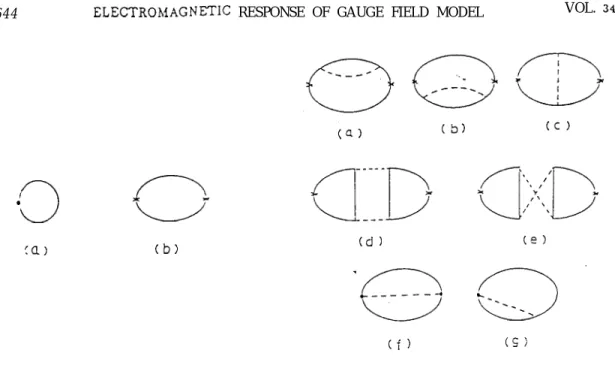
The imaginary part of polarization can be obtained from the next order
diagrams shown in Fig. 2. The summation of diagrams of Fig. 2a, 2b, 2c, 2d, and 2e gives
the imaginary part of polarization IIcfcbj the in following expression (superscript c denotes
the current polarization)
(6)
-~~[~‘(9,w)~j(9,w)~,‘(q,w)]lm[d’(q,w
+
Q)]},
where
) - “j(b)h)
w+
cp - cPfq +i6
’
(7)
-.644 ELECTROhlAGNETIC RESPONSE OF GAUGE FIELD MODEL VOL. 34 /.
3
(0) (b) (CJ 1 -a %h. --. ci 1 (S)FIG. 1. The one loop diagrams’for (a) diamagnetic.diagram, (b) p aramagnetic diagram. The cross and dot denote the current and density vertex respectively.
FIG. 2. The diagrams of the second order in gauge field.
-,
I .I
R/21
FIG. 2. The real part of u as a function of frequency R/21 at (a) T = 1 3 0 ° K (solid line) and (b) 7’ = 200°K (dashed line).
with [ bei_q a pbstive infinitesimal value, and 4 a unit vector. nfci)(t) is the Fermi (Bose-Eiensenj distribution function. The superscript T denotes the retarded function. The
diagra cc Fig. 2g vanishes due to the symmetry reason. The diagram of Fig. 2f with the densky vez-tex (superscript n) has the form:
VOL. 34 DAVID M. T. KU0 AND C. D. HU 6 4 5
where
Pf(b) =
c
p
w +R/(b)kp+q) - Rf(b)(fd
R +
cp - +q +
is’
(9)
The presence of the boson polarizations always makes the contirburion small because the bosons have a much smaller energy scale, T and momentum scale, J’m than fermions have. Therefore, only in the small frequency region (Q (< eF) does JmII;,,,(Q) have significant contribution. The fermion part of ImII”(R) h as the dominant contribution to the conductivity in the intermediate and high frequncg region.
The real part of the optical conductivity using the Eq. (5) is plotted in Fig. 3 und_er t h e c o n d i t i o n 1/2mba’ = t = 0.5 (eV), I/2m,a 2 - J = O.leV, (a is the lattice constant, -1 is the hopping energy and J is the exchange energyj and the concentration of d0ppin.g 7 = 0.15. The solid line and the dashed line correspond to temperture T = 15O”li and T = 200°K respectively. The result of Fig. 3 showed a sophisticated behavior of spectrum of optical conductivity. In the small-frequency region, the optical conductivity is sensitive to temperature because of boson excitations. The dominant contributution comes from
lmIl~,,,(n). I n t h e intermediate and high frequency region it is not sensitive because
fermion excitations dominates. The entire spectrum can be viewed as a curve proportional to l/n plus a structure given by ImI’I;Ibj( R in the freqency range of a fraction of the Fermi) energy. The latter is due to’ the excitation of a particle-hole pair and a gauge-field by. a photon. Most HTSC material did show a non-Drude behavior in the infrared spectrum f3] and experimental data give u a R-” where CY is slightly greater than 1 while in the Drude model a = 2. Therefore the gauge field model is a candidate for HTSC.
R e f e r e n c e s
[ l] P. A. Lee and X. Nagaosa, Phys. Rev. B46, 5621 (1992).
[ 21 J. M. Wheatley and A. J. Schofield, Phys. Rev. B47, 11607 (1993).
[ 3] D. B. Tanner et al, High - Temperature Superconducfor, ed. by J. Ashkenazi ef al, (Plenum Press, New York, 1991).
[ 4 ] Y. B. Kim, A. Furusaki, X. G. Wen, and P. A. Lee, Phys. Rev. B50 17917 (1994).