國立交通大學
電子工程學系電子研究所碩士班
碩 士 論 文
用於低錯誤率限制下高畫質 H.264 視訊在超寬頻無線技術 WiMedia 傳輸
之分散式頻寬保留協定與即時重傳機制演算法設計
Error-Constrained DRP Reservation For HD H.264 In
WiMedia MAC With Imm-ACK
研 究 生:吳東祐
指導教授:黃經堯 博士
中 華 民 國 九十七年八月
用於低錯誤率限制下高畫質 H.264 視訊在超寬頻無線技術 WiMedia 傳輸之分 散式頻寬保留協定與即時重傳機制演算法設計
Error-Constrained DRP Reservation For HD H.264 In WiMedia MAC With Imm-ACK
研究生:吳東祐
Student:Tung-Yu Wu
指導教授:黃經堯
Advisor:Ching-Yao Huang
國 立 交 通 大 學
電子工程學系電子研究所碩士班
碩 士 論 文
A ThesisSubmitted to Department of Electronics Engineering & Institute of Electronics College of Electrical and Computer Engineering
National Chiao Tung University in Partial Fulfillment of the Requirements
for the Degree of Master
in
Electronics Engineering August 2008
Hsinchu, Taiwan, Republic of China 中華民國 九十七年八月
用於低錯誤率限制下高畫質 H.264 視訊在超寬頻無線技術 WiMedia 傳輸之分 散式頻寬保留協定與即時重傳機制演算法設計
學生:吳東祐 指導教授:黃經堯 博士
國立交通大學電子工程學系電子研究所碩士班
摘 要
H.264/AVC 是一個高壓縮率的影像壓縮技術並且長用來壓縮高畫
質影像畫面,由於高畫質影像傳輸必須切割成大量的封包以及擁有嚴格
的錯誤條件限制,使得高畫質影像傳輸在有限頻寬及錯誤率較易產生的
無限通訊系統上有很大的挑戰性。
在 本 論 文 中 , 我 們 提 了 一 個 高 畫 質 影 像 傳 輸 架 構 , 它 結 合
H.264/AVC 和目前受歡迎的超寬頻技術 WiMedia 的分散式頻寬保留機
制,可保證高畫質影像傳輸品質;此外我們提供一個數學模型,來找出
封包中最佳的負載資料長度,並且找出在容易產生封包錯誤的環境下最
小的包括重傳的保留傳輸時間,在使用我們所提供的傳輸控制機制下,
在容易產生封包錯誤得環境裡,仍然有良好的高畫質影像的傳輸品質。
Error-Constrained DRP Reservation For HD H.264 In WiMedia MAC With Imm-ACK
Student:Tung-Yu Wu
Advisor:Dr. Ching-Yao Huang
Department of electronics Engineering
Institute of Electronics
National Chiao Tung University
ABSTRACT
H.264/AVC, a high-efficiency video coding technique, is used to
compress high definition (HD) video frames. The resulting lager video
packet size and strict error criteria increase the challenge in successfully
transmitting HD video over a band-limited and error-prone wireless system.
In this paper, an architecture combining both the H.264/AVC and distributed
reservation protocol (DRP) in WiMedia, one of the popular UWB wireless
systems, will be proposed to guarantee the transmission quality of HD video.
An analytical model will also be established to optimize the payload length
while minimizing the reservation time for retransmission in various
error-prone environments. Based on the proposed control architecture, the
performance of HD video transmission is guaranteed even under high-error
environment.
誌 謝
時間過的很快,轉眼間碩士畢業了,感謝老師 黃經堯教授在我碩士期間的指導以及 鼓勵,才能讓我快速的找到論文方向並且更了解無限通訊系統的知識及設計方法, 在對人生規劃及一些未來方向,老師也常與我討論也給我適當的建議,在平常報告 時老師訓練我上台報告的技巧,也讓我的報告技巧增進不少,感謝老師能夠在我最 後報告的時候,提供我意見,點破我思考上的盲點,也讓我的研究內容能更趨完整 與豐富,此外也謝謝蔣迪豪教授在多媒體壓縮技術上的指導,讓我的論文更加充實, 並且適時的給我鼓勵,讓我的研究過程走的更加平順。 除了鄭重的感謝老師們的指導外,更想要跟一起過日子的朋友們說聲感謝。首先, 就是要感謝實驗室裡面有問必答的學長們,子宗、傑堯、勇嵐、鴻輝、建銘、LC、 伯翰、CGI、玠原及世璞,因為你們讓我在研究的時候多了很多的靠山並指引了我很 多重要的觀念,再來是陪我一起走過兩年研究的同學、學弟們,純孝、志展、宗耿、 士恆、Qmo、彥甫、明憲、家弘、怡萱、易達、強哥、禹伸、信駿、等,因為你們 才能夠讓我在苦悶的實驗室裡得到精神上的歡樂,並在非常無聊的時候,跟我一起 玩樂。 2008 年 吳東祐撰CONTENTS
摘 要 ... i ABSTRACT ... ii 誌 謝 ... iii Contents ... iv Figures ... v Table ... vi Chapter 1 Introduction ... 1Chapter 2 Overview of h.264/AVC ... 3
Chapter 3 Background On WiMedia MAC ... 7
3.1 Frame Structure of WiMedia MAC ... 7
3.1.1 Superframe Structure ... 7
3.1.2 Frame transaction ... 8
3.2 DRP Mechanism ... 8
3.2.1 Reservation mechanism: ... 9
3.2.2 Negotiation ... 9
3.2.3 Retransmit procedures in DRP reservations: ... 10
Chapter 4 System Architecture ...11
Chapter 5 Protocol Overhead In WiMedia ...13
5.1 Overhead in DRP reservation period ...13
5.2 MAC/PHY overhead...14
Chapter 6 Optimize The Payload Length In DRP ...16
6.1 Packet Success Rate (PSR) ...16
6.2 Mathematical Model for throughput analysis in DRP with Imm-ACK ...17
6.3 Numerical Result ...19
Chapter 7 Minimal Reserved Time for HD H.264 Video ...24
7.1 Minimal Reservation Time under fixed Packet Error Rate ...24
7.2 Minimal Reserved Time Analysis ...26
7.3 Numerical Result ...27
Chapter 8 Conclusiion...34
References ...35
FIGURES
Figure 1 Structure of H.264/AVC video encoder [14] ... 4
Figure 2 Superframe structure ... 7
Figure 3 Frame Transaction... 8
Figure 4 System architecture based on WiMedia MAC ... 11
Figure 5 Standard PPDU structure ... 14
Figure 6 Frame transaction analysis with Imm-ACK ... 17
Figure 7 Variation of throughput with bit error rate in AWGN using Lopt and Lopt′ at 480 Mbps and 200Mpswith M=4 ... 20
Figure 8 Variation of throughput with bit error rate in AWGN using Lopt and Lopt′ at 480 Mbps and 200Mpswith M=8 ... 21
Figure 9 Variation of Lopt′ with different RPSDU ... 21
Figure 10 Variation of packet error rate with different RPSDU ... 22
Figure 11 Throughput and packet error rate with different bit error rate using the optimal payload length at RPSDU = 480Mbps ... 22
Figure 12 Throughput and packet error rate with different bit error rate using the optimal payload length at RPSDU = 200Mbps ... 23
Figure 13 Variation of minimal reservation packet number to the number of fragmented packets with bit error rate ... 28
Figure 14 Payload length in different bit error rate for minimal reservation time with Pe = 10 − 8 ... 30
Figure 15 Number of reserved MAS per superframe with Pe = 10 − 8 ... 31
Figure 16 Reserved MAS number with different bit error rate at R=480Mbps under the error constraint Pe = 10 − 8, 10 − 12, and 10 − 14 ... 31
Figure 17 Reserved MAS number with different bit error rate at R=200Mbps under the error constraint Pe = 10 − 8, 10 − 12, and 10 − 14 ... 32
TABLE
Table I H.264 CODEC PERFORMANCE OF DIFFERENT VIDEO SEQUENCES ... 5
Table II ENCODER PARAMETERS FOR THE EXPERIMENTS ... 6
Table III WiMedia MAC timing parameters ... 14
Table IV Throughput for different payload length ... 23
Table V Frame error rate for different NR at NF=30 ... 25
Table VI Table of NminNF ... 29
Table VII Parameter of video ... 29
CHAPTER 1
INTRODUCTION
High definition (HD) video in the consumer electronics is expecting to be widely used in home entertainment. H.264/AVC is a high-coding-efficiency video coding technique and can compress HD video frames into much smaller frames which is especially important for error-prone wireless environments. Among different wireless systems, ultra wide band (UWB) designed for high-speed transmission is especially suitable for HD video applications which require high transmission rates and strict low packet error rates. WiMedia [1], a distributed control topology, is the most popular technology for cable replacement for home entertainment. WiMedia could provide enough bandwidth to transmit the HD video and its Distributed Reservation Protocol (DRP) mechanism can be used to guarantee the required bandwidth for HD video service. Although the size of HD H.264 video is much smaller than uncompressed HD video, its size is still large and need to be fragmented into a great number of packets. As mentioned, the the packet error rate is small and the cost to reduce the packet error rate will be high from either RF resources (the power) or the hardware solutions. C. Duan [2] and H. Singh [3] have improved the PHY layer performance to transmit HD video, but the error criteria is still hard to satisfied, and the complexity of PHY is high. It might also increase the proportion of overhead in a packet, because the payload length of a packet must be small to satisfy the error constraint. Priority contention transmission mechanism which is popular used in the wireless system is hard to control the arrival time of video frames, and the latency of video is hard to prevent. It is possible to solve those problems by having a proper retransmission even with a higher packet error rate using DRP. Although WiMedia could supply enough bandwidth and could retransmission to transmit the HD H.264 video, we must calculate the needed time including retransmission to satisfy the error constraint of video and then reserved it before the delay bound of video frames. In this paper, we propose a mathematical model to analyze the impact of payload length on the need reservation time and find the optimal payload length to fragment the video frame and then calculate the minimal reservation time.
In WiMedia MAC, for isochronous streaming applications, Distributed Reservation Protocol mechanism is considered to guarantee the required bandwidth for the transmission [4], besides, to effectively support the video streaming, the system also needs to know the characteristics of the video streaming and the available
be resolved: proper MAC buffering slots for video frames and MAC algorithm for assuring the delay constraint of the video frames [5].
In this paper, an algorithm for reserving minimum medium access slots with strict error constraint of video frames will be proposed. The associated optimal payload length to maximize the throughput will be analyzed based on a mathematical model formulated based on HD H.264 transmission in WiMedia. Results show that the payload length which minimize the reservation time will be close to the optimal payload length for maximizing throughput.
The paper is organized as follows: The overview of H.264/AVC and WiMedia system will be discussed in Chapter 2 and Chapter 3 respectively. In Chapter 4, we provide the system architecture for HD H.264 transmission in WiMedia. Chapter 5 reviews the protocol overhead in WiMedia. An analytical solution of optimal payload length to reach the maximal throughput is investigated in Chapter 6. In Chapter 7, the minimal reservation time under various error constraints of the HD video frame are studied. Finally, the conclusions are drawn in Chapter 8.
CHAPTER 2
OVERVIEW OF H.264/AVC
H.264/AVC video coding is a high efficiency video coding standard [8]. It supports several powerful coding methodologies to improve coding efficiency, such as flexible block size motion estimation, quarter pixel motion compensation, multiple reference frames, spatial intra prediction, in-loop de-blocking filters and context-based adaptive binary arithmetic coding, etc. To address the requirement for the most-demanding professional environments, the JVT (Joint Video Team: ITU-T Video Coding Experts Group and ISO/IEC Moving Picture Experts Group) recently completed the new amendment and some extensions to the original standard that are known as the Fidelity Range Extensions (FRExt) [13]. These extensions enable higher quality video coding by supporting increased sample bit depth precision and higher-resolution color information, including sampling structures known as YUV 4:2:2 and YUV 4:4:4. Several other features are also included in the Fidelity Range Extensions project, such as adaptive switching between 4×4 and 8×8 integer transforms, encoder-specified perceptual-based quantization weighting matrices, efficient inter-picture lossless coding, and support of additional color spaces. It provides more efficient lossy coding of video content and preserves the same or better image quality compared with other video coding standards such as MPEG-4 Part 2 [9], H.263 [10], H.262/MPEG-2 Part 2 [11], JPEG2000 [12]. The H.264/AVC is designed for technical solution of various application areas, for example, a broadcast system over cable or satellite, internet video, interactive storage on optical devices, wireless and mobile network, and multimedia streaming service, etc. Especially, the H.264/AVC has been adopted as an industrial standard by consortiums for digital high-definition television (HDTV) broadcasting and storage applications like HD-DVD and Blue-ray disc, since it provides high video quality and excellent coding efficiency.
Figure 1 [14]shows the structure of H.264/AVC encoder. It covers two main layers, Video Coding Layer (VCL) and Network Abstraction Layer (NAL). The VCL is designed to efficiently represent the video content, and the NAL formats the VCL representation of the video and provide the header information in a manner appropriate for conveyance by a variety of transport layers or storage media.
Figure 1 Structure of H.264/AVC video encoder [14]
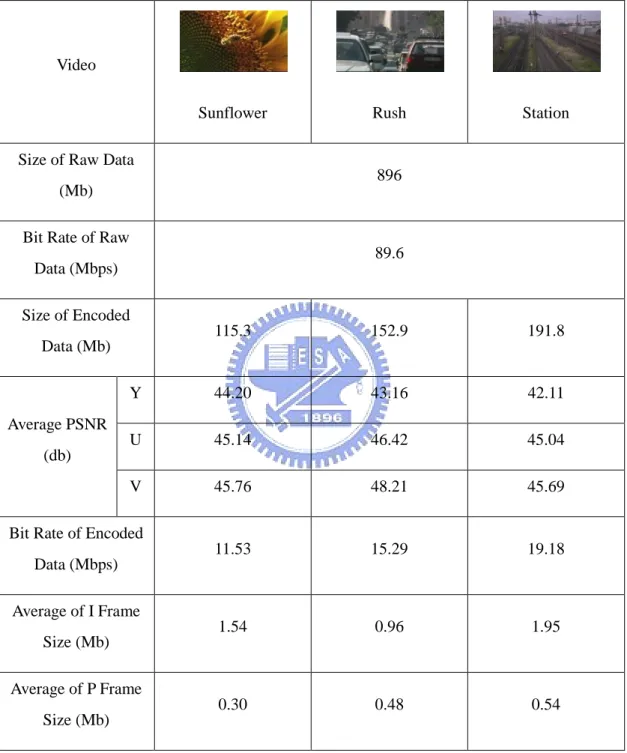
In Table I, we show the H.264 codec performance of different video sequences using H.264 reference software JM12.3. The setting of encoder parameter is shown in
Table II. As can be seen in Table I, the bit rate of encoded video is much smaller than
that of uncompressed video, and the performance of the encoded data is good even with high peak to signal to noise ratio (PSNR). The bit rate of HD H.264 video is from 10 to 20 Mbps. The I-frame size is much larger than P-frame size, so the I-frame must takes more time to transmit. Because H.264/AVC is created to have coding efficiency while maintaining good decoded video quality, it is more flexible in all kinds of HD video applications. The transmission time of encoded HD video is much less than that of uncompressed one, so it could save the transmission power and time. If the size of the video frame is smaller, we could also save the memory of the player. With many benefits on transmission, H.264/AVC is suitable coding scheme for wireless HD video transmission.
Table I H.264 CODEC PERFORMANCE OF DIFFERENT VIDEO SEQUENCES
Video
Sunflower Rush Station Size of Raw Data
(Mb)
896 Bit Rate of Raw
Data (Mbps) 89.6 Size of Encoded Data (Mb) 115.3 152.9 191.8 Average PSNR (db) Y 44.20 43.16 42.11 U 45.14 46.42 45.04 V 45.76 48.21 45.69
Bit Rate of Encoded Data (Mbps) 11.53 15.29 19.18 Average of I Frame Size (Mb) 1.54 0.96 1.95 Average of P Frame Size (Mb) 0.30 0.48 0.54
Table II ENCODER PARAMETERS FOR THE EXPERIMENTS Frame Size HD (1920 × 1088)
Frame Rate 30 fps
GOP Structure IPPPP…P
Total Frame 300
Intraperiod 15
Reference Frame Number 1 Motion Estimation Range 176
Quantization Parameter
I frame 20 P frame 21
CHAPTER 3
BACKGROUND ON WIMEDIA MAC
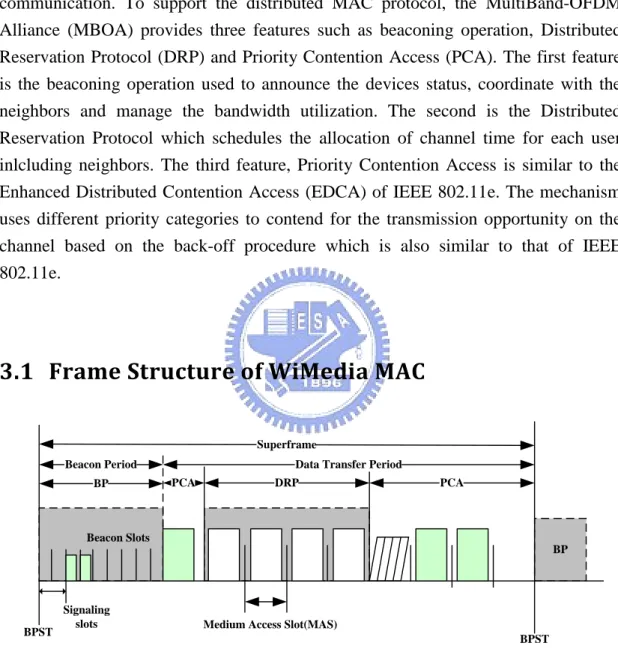
The MAC of WiMedia is a distributed MAC protocol in a short range communication. To support the distributed MAC protocol, the MultiBand-OFDM Alliance (MBOA) provides three features such as beaconing operation, Distributed Reservation Protocol (DRP) and Priority Contention Access (PCA). The first feature is the beaconing operation used to announce the devices status, coordinate with the neighbors and manage the bandwidth utilization. The second is the Distributed Reservation Protocol which schedules the allocation of channel time for each user inlcluding neighbors. The third feature, Priority Contention Access is similar to the Enhanced Distributed Contention Access (EDCA) of IEEE 802.11e. The mechanism uses different priority categories to contend for the transmission opportunity on the channel based on the back-off procedure which is also similar to that of IEEE 802.11e.
3.1 Frame Structure of WiMedia MAC
BP DRP
Superframe
Beacon Period Data Transfer Period
PCA PCA
BPST Medium Access Slot(MAS) BPST
BP
Beacon Slots
Signaling slots
Figure 2 Superframe structure
3.1.1 Superframe Structure
In the WiMeida MAC protocol, the duration of the superframe is 65.536 msec which is divided into 256 medium access slots (MASs) shown in Figure 2. The
superframe consists of two major parts, the beacon period (BP) and the data transfer period (DTP). Each superframe starts based on a beacon period to maintain the synchronization with the neighbors. The length of beacon period varies in each device due to the presence of the neighbors. Each device announces its existence by sending a beacon in the beacon period and listens to the beacons from other devices. The period followed by the beacon period is the data transfer period contributed by two mechanisms, PCA and DRP. The data transfer period is used for data communication. Packet data unit (PDU) is transmitted between devices by fragmenting and reassembling multiple service data units (MSDU).
RTS CTS Frame (I-ACK) Imm-ACK Frame (I-ACK) Imm-ACK Frame transaction Frame transaction SIFS SIFS SIFS SIFS SIFS
Imm-ACK
Figure 3 Frame Transaction
3.1.2 Frame transaction
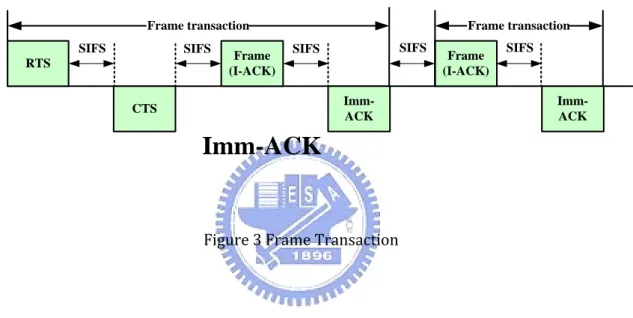
In the data transfer period, the basic operation of data communication is called frame transaction which consists of an optional request to send and clear to send (RTS/CTS) frame exchange, single packet and associated acknowledgement packet if requested by the acknowledgement policy. Figure 3 shows an example of frame transaction. The acknowledgement policy composed of no acknowledgement (No-ACK), block acknowledgement (B-ACK), and Immediate acknowledgement (Imm-ACK) is used to verify the delivery of a packet. The basic packet exchange sequence is the same as the rules in 802.11, namely RTS-CTS-Data-ACK.
3.2 DRP Mechanism
In WiMedia MAC, there are two mechanisms to transmit data. One is PCA and the other is DRP. PCA based on Carrier Sense Multiple Access/Collision Avoidance
(CSMA/CA) protocol, which reduces the probability of collision by invoking a back-off procedure, has four priorities in traffic category for differentiating traffic. Although PCA can provide service differentiation within different traffic categories, it cannot guarantee the service for transmitting real time traffic, like video and voice. To support the real time traffic transmission, the MBOA specifies the reservation based medium access mechanism, namely distributed reservation protocol (DRP). In general, PCA is used to transmit asynchronous traffic and DRP is used to transmit isochronous traffic.
3.2.1 Reservation mechanism:
In this mechanism, a device can request a number of time slots for reservation and should announce its reserved MASs in its beacon. All devices within transmission range should listen to beacons from other devices during the beacon period. In DRP, there are two schemes for data reservation. One is the hard reservation in which a device can transmit immediately at the beginning of the reserved time slots; another is soft reservation in which a device needs to contend for the channel with the highest priority and does not need process the back-off procedure like 802.11e.
In a hard reservation period, only the reservation owner and target can transmit data frames. Because all transmission should be terminated at least pSIFS plus mGuardTime before the beginning of the reserved MAS, the owner can start transmission without frame transactions in reserved MAS. In a soft reservation period, devices need to contend for the channel slot time using PCA rules. The reservation owner has the highest priority AIFS without performing back-off procedure. If there is the remaining time after the reservation owner completing his transmission, the other devices can contend for the channel slot time when the remaining time is enough for other devices to complete a frame transaction. Hence, the soft reservation has a benefit to the owner’s neighborhood to use the remaining slot time by executing PCA procedure.
3.2.2 Negotiation
There are two mechanisms for devices to negotiate a reservation: explicit and implicit. The explicit is done by sending a DRP Reservation Request and responding a DRP Reservation Response command frame. For implicit negotiation, the reservation owner and target use the DRP IE embedded in their beacons to negotiate the reservation. If there is the remaining time in a hard reservation block after a reservation owner completes the transmission of associated buffered traffic, it should release the reservation block by sending an Unused DRP Reservation Announcement
(UDA) frame. And the owner’s neighborhood listed in the UDA frame should respond with an Unused DRP Reservation Response (UDR).
3.2.3 Retransmit procedures in DRP reservations:
In a hard DRP reservation period, if the reservation owner transmit a packet using I-mm ACK or B-ACK but does not receive the acknowledgement frame, it may retransmit the packet within the same reservation period. In a soft DRP reservation period, devices retransmitting a packet shall follow the PCA mechanism with back-off procedure except the reservation owner.
CHAPTER 4
SYSTEM ARCHITECTURE
Payload length optimization Video stream server Video frame packetization DRP MAS reservation Lopt NF RPSDU & PS SNR Video frame bufferPe & AckPolicy Nmin
Video Frame PDU Stream Data path Control path WiMedia MAC
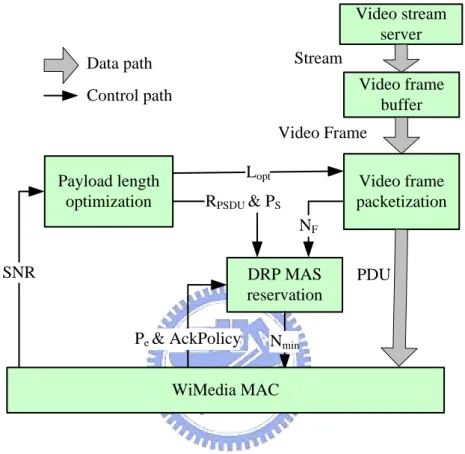
Figure 4 System architecture based on WiMedia MAC
In this paper, the objective is how to obtain the minimal number of reserved medium access slots while achieving the quality of service for video transmission. To achieve the design objective, we propose a system architecture that shows the communication between the WiMedia MAC and applications, depict in Figure 4. We add additional optimization mechanism supporting the minimal reservation based on the WiMedia MAC. To provide maximal throughput in the optimization process, we propose a method to calculate the optimal payload length according to the bit error rate (BER) produced by the modulation scheme and the signal to noise ratio (SNR) from the lower MAC. The method to obtain the optimal payload length is to calculate the effective throughput by selecting the appropriate packet error rate consisted of the bit error rate and the payload length. Hence, we can obtain the optimal payload length from the maximal effective throughput.
transmission from the video stream server. This mechanism integrating the payload length optimization, the MAC layer acknowledgement policy and the video frame packetization provides the minimal number of reserved medium access slots for achieving the target frame error rate from the requirement of MAC layer. The packetization could fragment or pack the frame from the video frame buffer depending on the expected payload length. In this mechanism, we reduce the frame error rate through the retransmission and reduce the overhead in the reserved medium access slots by the optimization combining with the packetization. Finally, we can derive the number of reserved medium access slots from estimating the necessary frame transactions including the retransmission to satisfy the target frame error rate.
In the system architecture, we use the Imm-ACK for our acknowledgement policy. The reason to use Imm-ACK rather than B-ACK is that B-ACK may not guarantee the delay requirement of real-time traffic in the reserved medium access slots each superframe when the interval of retransmission is not chosen correctly. The requirement of using B-ACK for high speed transmission is that the packet error rate needs to be small. Otherwise, the transmitted packets may be seriously dropped due to the high packet error rate. On the other side, we may use the Imm-ACK to protect the transmitting packet even when the channel condition is bad or the packet error rate is large.
CHAPTER 5
PROTOCOL OVERHEAD IN WIMEDIA
In the WiMeida MAC, we find the variation of the payload length and the frame transaction mostly affects the throughput in wireless environment. Hence, this section will describe an overhead of frame exchange in a reservation period.
5.1 Overhead in DRP reservation period
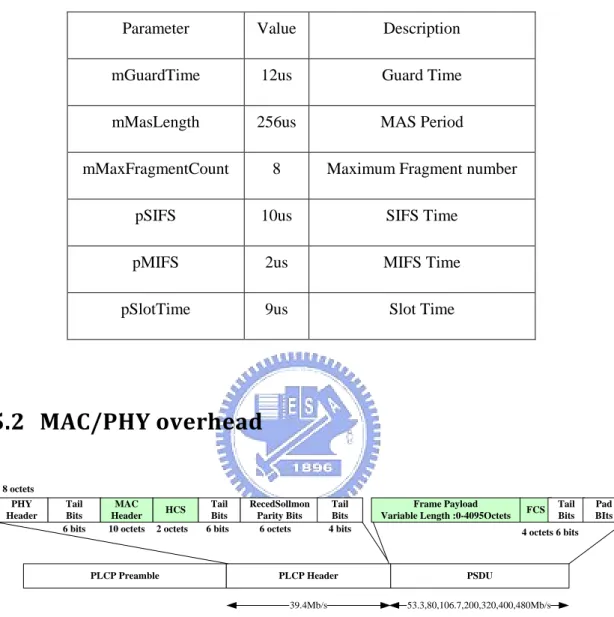
In the hard reservation, no other device except for the reservation target and owner can access the channel, so the overhead is mostly contributed by frame transactions. At the beginning of reserved MASs, the owner should initiate the frame transaction by transmitting request to send (RTS) to the reservation target. While the reservation target receives RTS, it should respond clear to send (CTS) after a period of time. The period of time between RTS and CTS is called the Short Inter-frame Space (SIFS). If the reservation owner receives the CTS correctly, it starts to transmit data packet according to different acknowledgment policy. There are three kinds of acknowledgment policies. The first is the No-ACK policy in which a packet should not be acknowledged by the recipient. The second is the Imm-ACK policy in which the reservation target should respond with an Imm-ACK frame after a period of time, SIFS, while receiving the packet which is shown in Figure 3. The third is the B-ACK in which allows the reservation owner to transmit multiple packet with receiving a single acknowledgement packet from the recipient indicating which packets need to be retransmitted. And the interval between each frame transmitted by reservation owner is minimum inter-frame space (MIFS). All the related parameters are shown in
Table III WiMedia MAC timing parameters Parameter Value Description mGuardTime 12us Guard Time mMasLength 256us MAS Period
mMaxFragmentCount 8 Maximum Fragment number pSIFS 10us SIFS Time
pMIFS 2us MIFS Time pSlotTime 9us Slot Time
5.2 MAC/PHY overhead
PLCP Preamble PHY Header Tail Bits MAC Header HCS Tail Bits RecedSollmon Parity Bits Tail Bits Frame PayloadVariable Length :0-4095Octets FCS Tail Bits Pad BIts PLCP Header PSDU 53.3,80,106.7,200,320,400,480Mb/s 39.4Mb/s 8 octets
6 bits 10 octets 2 octets 6 bits 6 octets 4 bits 4 octets 6 bits
Figure 5 Standard PPDU structure
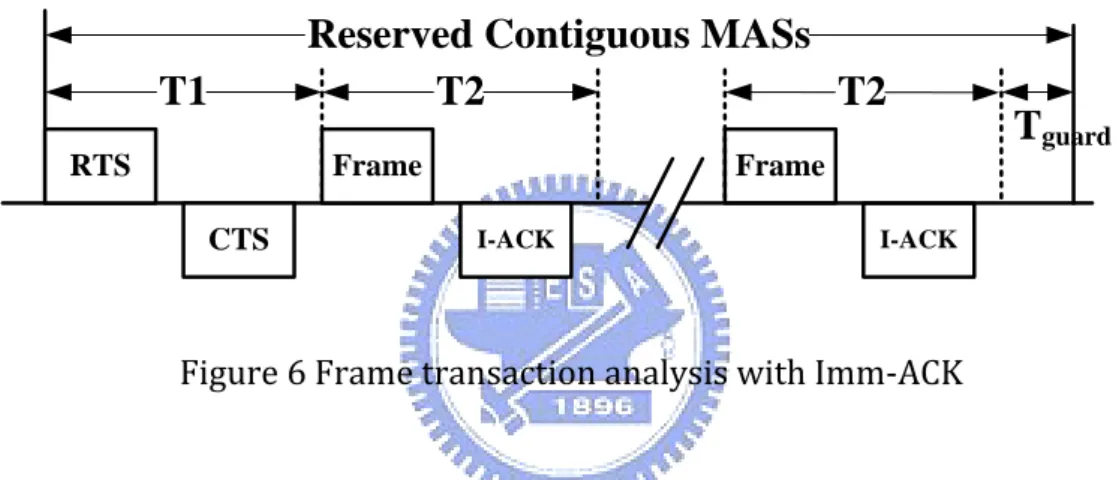
The physical layer convergence procedure (PLCP) is a frame format for MAC layer controlling the PHY layer. The physical protocol data unit (PPDU) is composed of three components: the PLCP preamble, the PLCP header, and the physical service data unit (PSDU). These components are shown in Figure 5. The PLCP preamble formed by a frame synchronization sequence and a channel estimation sequence is to assist the receiver in timing synchronization, carrier-offset recovery, and channel estimation. The PLCP header is to convey necessary information about the PHY and the MAC to aid in decoding the PSDU at the receiver. The PSDU is formed by
concatenating the payload with the frame check sequence (FCS), tail bits, and pad bits, which are inserted in order to align the data stream on the boundary.
When transmitting a packet, the PLCP preamble is sent first, followed by the PLCP header and then the PSDU. The interval of PLCP preamble defined as a Standard PLCP preamble or a burst PLCP preamble is 9.375us or 5.625us which depends on the frame transaction type. The PLCP header must be sent at a data rate of 39.4Mb/s. The PSDU can be sent at the data rate chosen from 53.3Mb/s, 80Mb/s, 106.7Mb/s, 160Mb/s, 200Mb/s, 320Mb/s, 400Mb/s, and 480Mb/s. The length of PLCP Header mainly composed of PHY header, MAC header, and header check sequence (HCS) is 26 bytes. The length of PSDU varies according to the frame payload from 0-4095 bytes.
CHAPTER 6
OPTIMIZE THE PAYLOAD LENGTH IN DRP
In this section, we formulate a mathematical model to analyze the throughput variation with the payload length changed in DRP and find the optimal payload length to reach the maximal throughput.
6.1 Packet Success Rate (PSR)
If the locations of the transmitter and the receiver are fixed, the channel condition is relative stable. The packet success rate is constant and depends on the payload length, PHY mode, and SNR. The packet success rate is given by [6][7]:
Ps γ, L = PPLCPi γ, L
PLCP ∗ PPSDUj γ, L (1) where
L: payload length in bytes,
LPLCP: length of PLCP header in bytes,
Ps(): packet success rate (PSR) defined as the probability of receiving a packet correctly at receiver,
PPLCPi (): the probability of receiving a correct PLCP header corresponding to PHY mode i, PPSDUj (): the probability of receiving a right PSDU corresponding to PHY mode j,
γ: signal to noise ratio (SNR).
In AWGN channel, the PSR in WiMedia is
Ps γ, L = 1 − beri γ 8∗LPLCP ∗ 1 − ber
j γ 8∗LPSDU
(2) where berk() is bit error rate corresponding to PHY mode k.
Because the PLCP header is transmitted at lower data rate (39.6 Mbps) than the rate of PSDU, the error of the PLCP header is small, and the packet success rate is dominated by the probability of receiving a right PSDU. That is
Ps γ, L ≈ PPSDUj γ, L (3) and
Ps γ, L ≈ 1 − berj γ 8∗LPSDU
(4)
in AWGN channel, where L=LPLCP.
6.2 Mathematical Model for throughput analysis in
DRP with Imm-ACK
RTS CTS Frame I-ACK Frame I-ACKT2
T2
Reserved Contiguous MASs
T1
T
guardFigure 6 Frame transaction analysis with Imm-ACK
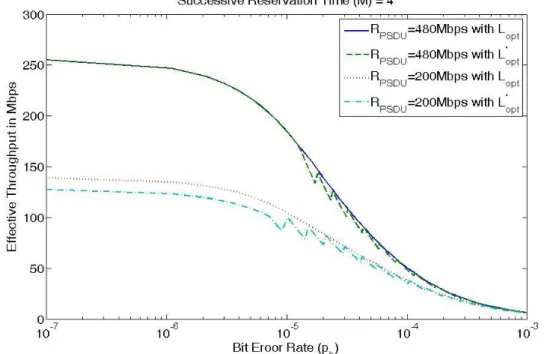
We define the throughput as the average number of payload bits per second received correctly in a successive reserved time. The transmission mechanism using Imm-ACK policy in a contiguous reserved time is shown in Figure 6. Using Imm-ACK, the transmission time of each packet contains not only the transmission time of PPDU but also the transmission time of Imm-ACK and two SIFS time. For convenience, we define that T2 is the total transmission time of a packet, as shown in Figure 6. If the payload length of each packet is constant in a continuous time, the number of packets during the time is
N =M ∗ TMAS − T1 − Tguard
T2 (5)
where
M: the number of reserved MAS, TMAS: the interval of a MAS,
TRTS: the time for transmitting a RTS frame, TCTS: the time for transmitting a CTS frame, TPre: the time of preamble,
TPacket : the time consumed by a packet, TAck: the time consumed by Imm-ACK frame, Tguard: guard time,
T1: the transmission time of RTS an CTS, which is equal to 2 ∗ TPre +RLPLCP
PLCP +
SIFS T2: 2∗SIFS+2∗ TPre+8∗LPLCPRPLCP)+LPSDURPSDU
RPSDU: data rate corresponding to PHY mode, RPLCP: data rate (39.6Mbs) to transmit PLCP header
For the environment where the transmitter and the receiver’s locations are fixed, the PSR of each packet is the same, so the number of correct received packets X could be considered a random variable with the binomial distribution. The probability mass function of X, B(X, N, Ps γ, L ) is
B(X, N, Ps γ, L ) = NX Ps γ, L x 1 − P γ, L 𝑁−𝑋 (6) The throughput in a successive reserved time is given by:
Th =N ∗ Ps γ, L ∗ (8 ∗ L)
M ∗ TMAS (7) To reach the maximal throughput, the optimal payload length could be obtained by solving the following optimization problem:
Max N ∗ Ps γ, L ∗ (8 ∗ L) M ∗ TMAS subject to 0 ≤ L ≤ 4095,
L ∈ N
This optimization problem is an integer programming problem, and it is hard to solved in MAC. In order to get analytical solution, we approximate it as:
Max Ps γ, L′ ∗ L′ T2
subject to 0 ≤ L′ ≤ 4095
(9)
where L’ is a approximate real number of L. In AWGN channel, the problem becomes:
Max 1 − pb 8∗L ′ ∗ L′ T2 subject to 0 ≤ L′ ≤ 4095 (10)
where pb is equal to berj γ , which is constant in our environment.
The optimization is solved in [6]. Using the procedure in [6] to solve the optimization problem, the analytical solution of optimal L,opt in AWGN channel is
L′opt = −b − b2− 4ac
2a (11)
where
a = 64 ∗ log(1 − pb),
b = 8 ∗ log 1 − pb ∗ 38 + RPSDU ∗ 2 ∗ SIFS + 2 ∗ TPre +RLPLCP
PLCP ,
c = 38 + RPSDU ∗ 2 ∗ SIFS + 2 ∗ TPre +LRPLCP
PLCP
The approximated solution of optimal payload length in AWGN channel, Lopt is Lopt = 4095, L′opt > 4095 round L′ , 0 ≤ L opt ′ ≤ 4095 0, L′opt < 0 (12)
where round() is a function which output is an nearest integer to the input.
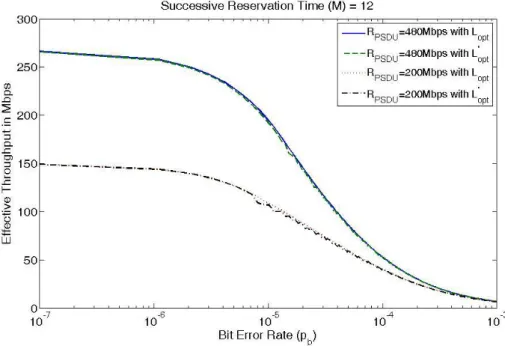
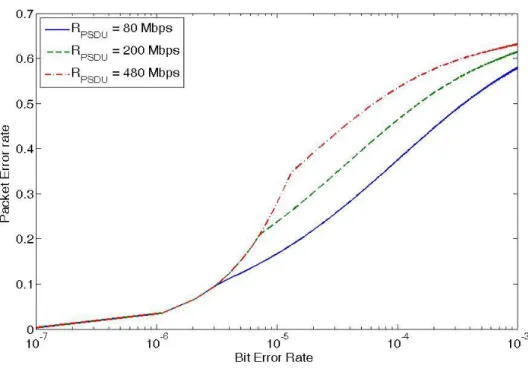
The variation of throughput with various bit error rates in AWGN is shown in Figure 7 and Figure 8. If the successive reservation time is fixed, the throughput using the payload length L′opt would be close to the maximal throughput using the payload length Lopt at higher tramission rate RPSDU. Because the packet transmission time T2 is shorter at the higher data rate, the number of successful packets be more, and N′ approximates N very well. With the same reason, N′ approximates N at longer reservation time. In Figure 9 and Figure 10, it shows the variation of packet error rate and L′opt with different RPSDU. If the bit error rate is small, the payload length could be larger, because the packet error rate increases slowly when the payload length gets longer. The number of packets in the continuous interval would becomes more at higher RPSDU, but the packet error rate increases more slowly than it, . Figure 11 and Figure 12 show the throughput and packet error rate with different bit error rate using the optimal payload length at RPSDU = 480Mbps and RPSDU = 200Mbps. In Table IV, we set the target packet error rate must be less than 0.05. It shows its throughput is much less than that with larger packet error rates, because the proportion of overhead is too large. We must consider both the proportion of overhead and the packet error rate to reach the maximal throughput.
Figure 7 Variation of throughput with bit error rate in AWGN using Lopt and L′opt at 480 Mbps and 200Mpswith M=4
Figure 8 Variation of throughput with bit error rate in AWGN using Lopt and L′opt at 480 Mbps and 200Mpswith M=8
Figure 9 Variation of L′opt with different R PSDU
Figure 10 Variation of packet error rate with different RPSDU
Figure 11 Throughput and packet error rate with different bit error rate using the optimal payload length at RPSDU = 480Mbps
Figure 12 Throughput and packet error rate with different bit error rate using the optimal payload length at RPSDU = 200Mbps
Table IV Throughput for different payload length Reservation MAS Number 8
Bit Error Rate 10−5
RPLCP 480 Mbps 200 Mbps Packet Error Rate 0.27 0.05 0.23 0.05 Payload Length in bytes 4007 (Lopt) 636 3261 (Lopt) 636 Throughput in Mbps 193 75.5 107.9 61.4
CHAPTER 7
MINIMAL RESERVED TIME FOR HD H.264
VIDEO
In this section, we propose a model to evaluate the minimal reservation time for the wireless HD H.264 video transmission under the error constraint. First, we formulate an optimization problem to calculate the minimal number of packets that we must reserved to satisfy the error constraint before the decoder is empty. Second, we will show that the ratio of the minimal number of reserved packets to the packets to be transmitted approximates the reciprocal of packet success rate, when the number of transmitted packets is large enough. Third, we consider the impact of the payload length on the reservation time and find the optimal payload length to reach the minimal reservation time in AWGN. We would prove that the payload length for minimal reservation time would converge to L,opt if the number of packets to be transmitted is large enough. The condition is always satisfied because the video frame size of the HD H.264 video is large and would be fragmented into a large number of packets.
7.1 Minimal Reservation Time under fixed Packet Error Rate
For the wireless HD H.264 video transmission, the error rate of the video frame per 120-minute HD movie should be less than one [15]. The error rate of the video frame 𝑃𝑒 of this requirement must be less than 1 120 ∗ 60 ∗ f at f fps, where f is the frame rate of the transmitted video. Suppose that a video frame is fragmented into NF packets, and the packets error rate must be less than 1 − 1 − PN F e to satisfy the constraint without retransmission. If NF becomes larger, the packets error rate gets smaller. Because the size of the H.264 HD video frame is large, it could be fragmented to a great number of packets, so the packet error rate must be very small, and the complexity of PHY would be high. We could use the retransmission policy to solve this problem, but we must calculate the exact time for retransmission and reserve it before the deadline of the video frame, or the latency would happen. Assume that we reserve the time which is enough to transmit NR packet where NR is larger than NF, the error rate of the video frame is the probability that there is less than NF-1 packets transmitting correctly. From Eq. (6), the probability of error is:
PF = Pi∗ 1 − P NR−i
NF−1
i=0 (13)
where P is the packet success rate.
An example is shown in Table III, we assume P=0.9 and NF=30, and the PF = 6.2 ∗ 10−5, P
F = 5.7 ∗ 10−9, and PF = 6.7 ∗ 10−13 for NR = 44, NR = 51, and NR = 57 respectively.
TABLE V FRAME ERROR RATE FOR DIFFERENT NR AT NF=30 NR = 44 NR = 51 NR = 57 PF 6.2 ∗ 10−5 5.7 ∗ 10−9 6.7 ∗ 10−13
Although the transmission time of the video frame may be less than the time we reserved, the remaining time would not be wasted, because it could be released in WiMedia. To find the minimal reservation time under the fixed packet error rate, we could find smallest NR and then times the T2 shown in Figure 6. We suppose that there are NMB video frames in the MAC buffer, and they are fragmented into NF packets in fixed payload length L. The minimal number Nmin of packets under the error constraint Pe could be solved by:
Min NR subject to NF−1P L i 1 − P L i=0 𝑁𝑅−𝑖 ≤ 1 − 1 − 𝑃𝑒 𝑁𝑀𝐵, N MBϵN (14)
where P L is the packet error rate in payload length L.
This optimization problem is an integer programming problem. We must solve it and create a table to look up ahead of implementation. If NF and the packet error rate is small, Nmin would be several times of NF . It takes much time to retransmit the error packet. When NF big enough, the ratio Nmin to NF converges to the reciprocal of packet success rate. It is shown below:
If NF → ∞, then Nmin → ∞. By central limit theroem, X − Nmin ∗ P L
Nmin ∗ P L ∗ 1 − P L
~N 0,1 ,
P X − Nmin ∗ P L Nmin ∗ P L ∗ 1 − P L ≤ t = Φ t , where t = NF− 1 − Nmin ∗ P L Nmin ∗ P L ∗ 1 − P L NF = t ∗ Nmin ∗ P L 1 − P L + Nmin ∗ P L + 1 lim NF→∞ t ∗ Nmin ∗ P L 1 − P L + Nmin ∗ P L + 1 NF = 1 lim NF→∞ Nmin NF = 1 P L
Because the video frame size of HD H.264 video is large and we can hold some video frame in the MAC buffer, the amount of fragmented packets is large enough to make NNmin
F converges to the reciprocal of packet error rate.
7.2 Minimal Reserved Time Analysis
The minimum reservation time is to ensure the QoS of HD video transmission over the error-prone wireless environments. In home environment, the transmission rate is basically stable, in this case, the minimal reserved time is primarily affected by the payload length. To calculate the optimal payload length for achieving the minimal reservation time, following optimization problem is constructed:
Min Nmin(L) ∗ T2 L (15) where Nmin(L) is minimal reserved number of packets fragmented by payload length L, and T2 L is the packet transmission and ACK response time using payload length L.
To find the optimal payload length Lrop, we need to solved the optimization problem, but it hard to solve it in MAC. As discussed, when NF is large enough, L′opt in Eq. (12) approximates L
rop. The proof is shown below: If NF L → ∞,Nmin L
NF L = 1 P L
where NF L is the number of the fragmented packets of each video frame using payload length L.
The optimization problem (15) is equivalent to: Max 1
Nmin(L) ∗ T2 L
⇒ Max P L ∗ L
L ∗ NF L ∗ T2 L
Because the video frame size to transmit is constant for this problem, L ∗ NF L is a constant. The optimization problem becomes:
Max P L ∗ L T2(L)
This problem is the same as equation (9) and also an optimization problem to maximize the throughput, so L′opt = Lrop. For HD H.264 video transmission, the condition is always satisfied. We can use L′opt to fragment the video frames and use the equation (15) to calculated the reservation time in AWGN. The reservation time is
TR = Nmin L′opt ∗ T2 L′opt (16)
7.3 Numerical Result
When the number of fragmented packets is getting large, the ratio of minimal reservation packet number t would converge to the reciprocal of packet success rate. The result is shown in Figure 13. It means that average retransmission times of each packet are about PSR1 .
Figure 13 Variation of minimal reservation packet number to the number of fragmented packets with bit error rate
If we buffer NMB video frames in the MAC and send NMB video frames every NMB ∗ f second, and the decoder buffer holds the same number of video frame, the latency of video would not happen. It means that the deadline of the NMB video frames is NMB ∗ f second, it must reserve enough time including retransmission to transmit NMB video frames before the deadline. Table VI is an example of created table by solving Eq. (14), where NMB is 15 at f=30, and the bit rate of video is from 10 Mbps to 20Mbps, and the range of payload length is from 125 bytes to 4095 bytes. If NF is not on the table, we can use the linear interpolation to calculate the value of NMIN
NF , and it could also satisfy the error constraint, because the convexity of the curve
in Figure 13. Suppose that the bit rate and the frame rate of the HD H.264 video is 10 Mbps and 30fps respectively and buffer fifteen video frames in the MAC for our following simulation. The detail of parameter of video in our simulation is shown in Table VII.
TABLE VI Table of NNmin F PSR 1 PSR NF=1 NF=10 NF=100 NF=1000 NF=10000 0.5 2 17 4.7 2.67 2.195 2.0598 0.6 1.67 13 3.7 2.17 1.812 1.7113 0.7 1.43 10 3 1.81 1.537 1.4617 0.8 1.25 7 2.4 1.52 1.328 1.2737 0.9 1.11 5 1.9 1.29 1.161 1.1261 1 1 1 1 1 1 1
Table VII Parameter of video
Bit Rate 10 Mbps Frame Rate 30 Number of Frames in the MAC Buffer 15
Dead Line of the Video Frames 0.5 second (≈ 7 superframes) Data Size in the Buffer 5 Mb
In Figure 14, we find that the approximated payload length for maximal throughput L′opt and the payload length Lrop of minimal Reservation time are close, and there is a little difference at small bit error rate, because the number of fragmented packets of the video is small. Figure 15 shows that the number of reserved MAS per superframe. The maximal MAS number which we can use per superframe is 224. From Figure 15, it could also transmit the HD video when the error rate is small such as 4 ∗ 10−4. Figure 16 and Figure 17 show the reserved MAS number with different bit error rates of 480Mbps and 200 Mbps with the error constraints of P = 10−8, 10−12, and 10−14 . We would find the reservation time is almost the same
and we can reserve a little more time to reach much smaller error rate of video frame. When the bit error is small enough, the reservation time is small, and could support several to transmit HD H.264 video. If we try to let the packet error rate get small, the payload length must be getting small, and the overhead of each packet becomes larger, so the minimal reservation time must be longer to satisfy the error criteria of video frame. A numerical example is shown in Table VIII.
Figure 14 Payload length in different bit error rate for minimal reservation time with Pe = 10−8
Figure 15 Number of reserved MAS per superframe with Pe = 10−8
Figure 16 Reserved MAS number with different bit error rate at R=480Mbps under the error constraint Pe = 10−8, 10−12, and 10−14
Figure 17 Reserved MAS number with different bit error rate at R=200Mbps under the error constraint Pe = 10−8, 10−12, and 10−14
Table VIII Minimal reservation time for different payload length Bit Error Rate 10−5
Bit rate of video 10 Mbps Frame Rate of video 30 fps
NMB 15
Delay Constraint 0.5 s (≈7 superframe) Error Rate of video frame 10−7
RPLCP 480 Mbps 200 Mbps
Packet Error Rate 0.28 0.05 0.24 0.05
Payload Length in bytes 4095 (Lopt′) 636 3384 (Lopt′) 636 Total Reservation Time 31729 μs 65480μs 55127μs 81597μs
Total Reserved MAS 124 256 216 319 MAS Per Superframe ≈19 ≈37 ≈31 ≈46
CHAPTER 8
CONCLUSIION
In this work, we have proposed an control architecture to transmit the HD H.264 in WiMdeia system. We have shown that HD H.264 video transmission can meet its performance criteria even with large packet error rate. An analytical model is also established to calculate the payload length for the minimal reservation time which is enough to transmit the fragmented packets with retransmission to satisfy the error constraint of video before the encoder buffer is ran out. The reservation time is close to the transmission time of the fragmented packet without retransmission multiplying the reciprocal of packet success rate. It means that the average retransmission times of each packet are about the reciprocal of PSR. Reserving additional time for retransmission, the error rate criteria of video frame could be satisfied easily, and could reduce the complexity of PHY layer. When the bit error rate is small enough, the architecture could support several users to transmit HD H.264 video.
REFERENCES
[1] "Standard ECMA-368 - High Rate Ultra Wideband PHY and MAC Standard," ECMA International, December 2005.
[2] C. Duan, G. Pekhteryev, J. Fang, Y. Nakache, J. Zhang, K. Tajima, Y. Nishioka and H. Hirai, "Transmitting multiple HD video streams over UWB links," Consumer Communications and Networking Conference, 2006. CCNC 2006. 3rd IEEE, vol. 2, pp. 691-695, 2006.
[3] H. Singh, Huaning Niu, Xiangping Qin, Huai-rong Shao, Chang Yeul Kwon, Guoping Fan, Seong Soo Kim and Chiu Ngo, "MAC 23-2 - Supporting Uncompressed HD Video Streaming without Retransmissions over 60GHz Wireless Networks," Wireless Communications and Networking Conference, 2008. WCNC 2008. IEEE, pp. 1939-1944, 2008.
[4] Chun-Ting Chou, J. del Prado Pavon and N. Sai Shankar, "Mobility support enhancements for the WiMedia UWB MAC protocol," Broadband Networks, 2005 2nd International Conference on, pp. 136-142 Vol. 2, 2005. [5] Haitao Wu, Yuan Xia and Qian Zhang, "Delay analysis of DRP in MBOA
UWB MAC," Communications, 2006. ICC '06. IEEE International Conference on, vol. 1, pp. 229-233, 2006.
[6] Sayantan Choudhury and J. D. Gibson, "Payload Length and Rate Adaptation for Multimedia Communications in Wireless LANs," Selected Areas in Communications, IEEE Journal on, vol. 25, pp. 796-807, 2007. [7] Wu Xiuchao and A. L. Ananda, "Link characteristics estimation for IEEE
802.11 DCF based WLAN," Local Computer Networks, 2004. 29th Annual IEEE International Conference on, pp. 302-309, 2004.
[8] Draft ITU-T Recommendation and Final Draft International Standard of Joint Video Specification, "ITU-T Recommendation H.264 and ISO/IEC 14496-10 AVC", Joint Video Team (JVT) of ISO/IEC MPEG and ITU-T VCEG, JVT-G050, Mar. 2003.
[9] ISO/IEC 14496-2, Information Technology—Coding of Audio-Visual Objects Part 2: Visual, Dec. 1998.
[10] ITU-T Video Coding Experts Group (VCEG), Video Codec Test Model Near-Term, Version 10 (TMN10) Draft 1, Apr. 1998.
[11] ITU-T Recommendation H.262 and ISO/IEC 13818-2, Information Technology—Generic Coding of Moving Pictures and Associated Audio Information: Video, Jul. 1995.
[12] T. Halbach, ―Performance comparison: H.26L intra coding vs. JPEG2000‖, JVT-D039, July, 2002.
[13] G. J. Sullivan, T. McMahon, T. Wiegand, and A. Luthra, Eds., Draft Text of H.264/AVC Fidelity Range Extensions Amendment to ITU-T Rec. H.264 j ISO/IEC 14496-10 AVC, ISO/IEC JTC1/SC29/WG11 and ITU-T Q6/SG16 Joint Video Team document JVT-L047, Jul. 2004.
[14] T. Wiegand, G. J. Sullivan, G. Bjontegaard, and A. Luthra,―Overview of the H.264/AVC Video Coding Standard,‖IEEE Trans. on Circuits Syst. Video Technol., vol. 13, No. 7, pp.560–576, July 2003.
[15] CE-SIG (Panasonic/Philips/Samsung/Sharp/Sony), ―Consumer Electronic Requirements for TG3a‖, IEEE 802.15-03/276r0, July 20.
![Figure 1 Structure of H.264/AVC video encoder [14]](https://thumb-ap.123doks.com/thumbv2/9libinfo/8612098.190795/12.892.173.723.132.466/figure-structure-h-avc-video-encoder.webp)