Optical phase conjugation in a nematic
liquid-crystal film modulated
by a quasi-static electric field
Shu-Hsia Chen and Yuhren ShenInstitute of Electro-Optical Engineering, National Chiao Tung University, 300 Hsinchu, Taiwan
Received April 1, 1996; revised manuscript received January 10, 1997
A quasi-static field can play an important role in molecular reorientation of the optical nonlinearity in liquid crystals because of the combination of the critical behavior of the sample at the Freedericksz transition and of nonlinear coupling of the optical and quasi-static fields. The nonlinear-optical phenomenon, optical phase conjugation, was observed in an electric-field-biased nematic liquid-crystal film and can be predicted by mo-lecular reorientation calculated with continuum theory. The external field-modulated intensities of the phase-conjugation beams were obtained by both numerical calculation and experimental measurement. At the same time, the rise times of the intensities of phase-conjugation beams were measured for various external fields. © 1997 Optical Society of America [S0740-3224(97)02507-1]
1. INTRODUCTION
Previously we and others reported that in a biased quasi-static electric field degenerate four-wave mixing (DFWM) can be induced or enhanced dramatically when two coher-ent laser beams overlap in a nematic liquid-crystal film. The enhancement effects were attributed to the critical behavior of the sample at the Freedericksz transition. Our results showed that the first-order diffraction inten-sity is proportional to the cube of the laser inteninten-sity in the low-optical-field regime.1,2 We have since found that the crucial factor influencing the first-order diffraction effi-ciency peak shift from the Freedericksz threshold voltage is twist deformation in the molecular reorientation grat-ing. The first-order DFWM diffraction efficiency reaches its maximum at a biased ac voltage that depends on the elastic constant, the sample thickness, and the grating period.3,4 In other words, the diffraction efficiency can be modulated by the biased voltage. This is important in applications utilizing DFWM, such as optical phase con-jugation (OPC). However, of the reports5–7that involved the study of OPC in liquid crystals, in only one was the external biased discussed. Those researchers5used a bi-asing magnetic field. In this paper we report using a mo-lecular reorientation mechanism and a DFWM scheme to study OPC in a quasi-static electric-field-biased nematic liquid-crystal film. The intensity of the phase-conjugation beam can be modulated by the quasi-static electric field. This has been shown for various incident beam intensities by both numerical calculation and ex-perimental measurement in planar-aligned nematic liquid-crystal films. At the same time, we measured the rise times of intensity of the phase-conjugation beam for various biased voltages at a fixed total incident laser power. The reflected beam, the phase conjugation beam, is also shown, by observation of phase-correction behavior with a cylindrical lens used as a phase aberrator, to be conjugate with the incident beam.
2. THEORY AND NUMERICAL RESULTS
A schematic diagram of the DFWM experimental appara-tus and the geometry of a planar-aligned nematic liquid-crystal cell with thickness d are shown in Fig. 1. The nematic liquid crystal is assumed to have positive optical and dielectric anisotropies, namely, ne. no and ei . e', where n ande, respectively, denote the refractive indices and the dielectric constants andeiande'refer to the directions parallel and perpendicular, respectively, to the director nˆ . The incident laser beams have the same wavelength,l. Pump beam I2and probe beam I1overlap in the nematic liquid-crystal film and intersect at a small anglea. They are nearly normally incident upon the cell and are linearly polarized in the y-axis direction. An-other pump beam, I3, propagates in a direction counter to that of beam I2and has the same polarization. A quasi-static electric field (1 kHz) is applied perpendicular to the unperturbed molecular director nˆ . The optical field is superposed upon the applied electric field and induces the molecular reorientation that then gives rise to a spatially modulated refractive-index grating. Pump beam I3’s first-order diffraction beam from this phase grating corre-sponds to phase-conjugation beam I4 in the nonlinear DFWM process.
Following the derivation in our previous studies,3,4,8we can obtain the local molecular orientation angle u (x, z) with respect to the y axis by minimizing the total Frank free energy F, F 5 *vF dv. The Frank free-energy
den-sity F is given by F 5 1 2
F
K11~1 2 K sin 2 u!S
]u ]zD
2 1 K22S
]u ]xD
2G
2 Dz 2 8pe'~1 2 W sin2 u!2 Ine c~1 2m sin2 u!1/2, (1)1750 J. Opt. Soc. Am. B / Vol. 14, No. 7 / July 1997 S.-H. Chen and Y. Shen
where K5 1 2 K33/K11, W5 1 2ei/e', m 5 1 2 (ne/no)2, Dz is the z component of the electric
dis-placement, I is the optical intensity, c is the velocity of light in vacuum, and K11, K22, and K33 are the splay, twist, and bend elastic constants, respectively. Instead of solving foru (x, z) by using the Euler–Lagrange equa-tion, in the first-order approximation4we assume that
u ~x, z! 5$u11u2@cos~2px/L!#%sin~pz/d!, (2) with the boundary condition u (z 5 0) 5 u (z 5 d) 5 0. Hereu1 corresponds to the spatial average reorientation angle,u2is the amplitude of the grating modulation angle at z5 d/2, and L is the grating period. We can calculate equilibrium values of constantsu1andu2 from the mini-mization of F by letting]F/]u15 0 and]F/]u25 0.
If the local reorientation angleu is known, the effective refractive index neff(u) for a uniaxial medium can be ex-pressed as
neff~u! 5 ne/@~1 2m sin2 u!#1/2
> n¯ 1 Dn¯NLcos~2px/L!, (3) where n¯ 5 ne1mne@1 2 J0(2u1)#/4 is the spatially uni-form refractive index, Dn¯NL5mneu2J0(2u1)/2 is the modulation index of the grating, and J0(2u1) is the zero-order Bessel function. Consequently, the phase modula-tion experienced by a normally incident laser beam can be expressed as
d~x! > d01 d1cos~2px/L!, (4) where d0> (f/2)@1 2 J0(2u1)#, the first-order phase-modulation amplitude is d1>fu2J1(2u1), and f 5 pmned/l. The intensity of phase-conjugation beam
I4, which is diffracted from pump beam I3, is derived as I45 I3J12~d1!, (5) and the phase-conjugation reflectivity R can be expressed as
R5 I4/I15 ~I3/I1!J12~d1!, (6) where J1(d1) is a first-order Bessel function.
Numerical calculations were made for ]F/]u15 0, ]F/]u25 0, and relations (1)–(6). The parameters of the nematic liquid crystal E7 used9 are n
e5 1.7464, no
5 1.5211, m 5 20.31817, ei2e'5 13.8, K 5 20.54, Vth5 1.05 V, Ith5 335.15 W/cm2, and K22/K115 0.51. The experimental parameters used are L 5 100mm, l
5 514.5 nm, d5 200mm, and beam ratios
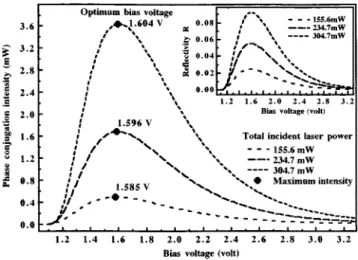
I1:I2:I351:2.84:3.90. The intensities of phase-conjugation beam I4 versus the bias voltage were calcu-lated for various total incident laser powers of I1, I2, and I3 from 155.6 to 304.7 mW. The numerical results are shown in Fig. 2. It is obvious that the intensity of phase conjugation beam I4 can be modulated by a quasi-static electric field. There is an optimum biasing voltage for a fixed total incident laser power, and this optimum biasing voltage increases monotonically with the total incident la-ser power.
3. EXPERIMENTAL RESULTS AND
DISCUSSIONS
We prepared the liquid-crystal sample by sandwiching nematic E7 between two indium tin oxide–coated glass windows that had been treated with polyvinyl alcohol for planar alignment. A 1-kHz electric field generated by a
Fig. 1. DFWM geometry and a planar-aligned nematic liquid-crystal cell: LC, liquid crystal; BS’s, beam splitters; PBS’s, po-larizing beam splitters; M’s, mirrors; AD, analog to digital; UDT, united detector technology; u, molecular reorientation angle;
Eop, optical field; Eac, quasi-static electric field; n, the molecular
director, d, sample thickness. ITO, indium thin oxide.
Fig. 2. Numerical illustration of the intensity of phase-conjugation beam I4versus bias voltage for various incident total
laser powers. The beam ratio is I1:I2:I351:2.84:3.90 The filled circles show the maximum intensity, and the corresponding volt-ages are the bias voltvolt-ages.
microcomputer’s waveform synthesizer (Quatech, Inc., WSB-A12M) was applied normally to the sample’s glass windows. The laser light was separated into three beams, with beam ratio I1:I2:I351:2.84:3.90, by beam splitters and mirrors. Probe beam I1and pump beam I2 recombined at the small intersection angle a ('5 3 1023 rad) on the cell; beams I
2 and I3 were counter-propagating. The experimental measurements were car-ried out with a microcomputer. The intensity of phase-conjugation beam I4was recorded at various times while incident laser beams impinged upon the sample with a bi-ased quasi-static electric field. The steady-state mea-surements were recorded while the samples were in equi-librium.
The intensities of phase-conjugation beam I4versus the bias voltage for various total incident laser powers is shown in Fig. 3. It is obvious that the intensity of beam
I4can be modulated significantly by the biasing voltage. There is also an optimum biasing voltage for a fixed total incident laser power. The maximum intensity biasing voltage, which was found by the least-mean-squares fit-ting method, increases monotonically with the total inci-dent laser power, as predicted by numerical calculation.
The intensities of I4versus time for various biased volt-ages from 0.86 to 2.25 V at a fixed total incident laser power (269 mW) are shown in Fig. 4. Figure 5 shows the rise time, which is the time interval from 10% to 90% of maximum intensity, obtained by the least-mean-squares fitting method from Fig. 4. It is obvious that the rise time decreases with the biasing voltage. The result is the same as the prediction in Ref. 10.
Figure 6 is a schematic diagram of the experimental setup for confirming that beam I4is a phase-conjugation beam. When we observed the OPC reconstruction prop-erty, the cylindrical lens was used as an aberrator that changed the width of probe beam I1along the direction of the y axis. Phase-conjugation beam I4 was split off by two 50% beam splitters at positions 1 and 2 then shone on
Fig. 3. Experimental results of measurement of the intensity of phase-conjugation beam I4versus bias voltage for various
inci-dent total laser powers. The beam ratio I1:I2:I3 is
approxi-mately 1:2.84:3.90. The filled circles show the maximum inten-sity obtained by the least-mean-squares fitting method, and the corresponding voltages are the bias voltages. The dashed curves show the results from the least-mean-squares fitting cal-culation.
Fig. 4. Experimental results of measuring the intensities of phase-conjugation beam I4versus time for various bias voltages at a fixed total incident laser power of 269 mW.
Fig. 5. Experimental results showing rise time versus bias volt-age. The results were obtained by the least-mean-squares fit-ting method from Fig. 4. The solid curve is a guide to the eye.
Fig. 6. Schematic diagram of the experimental apparatus: LC, liquid crystal; BS, beam splitter.
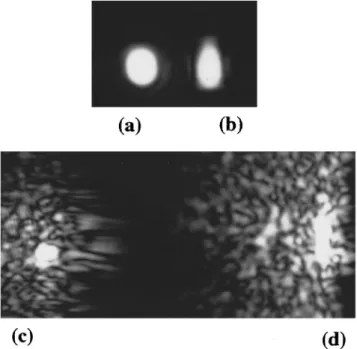
the screen. Figure 7 shows the results of experimental observation. Figure 7(a) shows a circular optical pattern from probe beam I1 at position 1 without the cylindrical lens in the way. With a cylindrical lens in the way, the optical pattern of beam I1describes an elliptical shape at position 2, as shown in Fig. 7(b). The optical patterns of beam I4 on the screen are shown in Figs. 7(c) and 7(d). Figure 7(d) shows the optical pattern from beam I4, which was reflected onto the screen by the beam splitter at po-sition 2. We found that this optical pattern had a gener-ally elliptical shape, with the long axis in the same direc-tion as that of beam I1in Fig. 7(b). Figure 7(c) shows the generally circular-shaped optical pattern of beam I4, which was reflected onto the screen by the beam splitter at position 1. It also shows that the aberration of inci-dent beam I1that was caused by the cylindrical lens was reconstructed as reflected beam I4passed through the ab-errator. In other words, it is shown unambiguously that reflected beam I4is conjugate to beam I1.
4. CONCLUSIONS
We have demonstrated unambiguously the nonlinear-optical phase-conjugation phenomenon in a nematic liquid-crystal film by examining the reconstruction prop-erties of the phase-conjugation beam. Molecular reorien-tation is the mechanism for this phenomenon and can be predicted by continuum theory. We found that a biasing electric field not only can induce but can also modulate the conjugation beam with respect to the biasing voltage, which agrees with the calculation prediction very well. At the same time, we found that the rise time of the phase-conjugation beam intensity decreases with increas-ing biased electric field.
ACKNOWLEDGMENT
This research was supported by the Chinese National Sci-ence Council under contract NSC84-2112-M-009-001.
REFERENCES AND NOTES
1. S.-H. Chen, C.-L. Kuo, and M.-C. Lee, ‘‘Quasi-static electric-field-enhanced degenerate four-wave mixing in a nematic liquid-crystal film,’’ Opt. Lett. 14, 122 (1989).
2. C.-L. Kuo, S.-H. Chen, and M.-C. Lee, ‘‘Optical phase grat-ing diffraction in a quasi-static electric field biased nematic liquid crystal film,’’ Liq. Cryst. 5, 1309 (1989).
3. S.-H. Chen and C.-L. Kuo, ‘‘Crucial influence of the twist degenerate four-wave mixing process in homeotropically aligned nematic liquid crystals,’’ Appl. Phys. Lett. 55, 1820 (1989).
4. C.-L. Kuo and S.-H. Chen, ‘‘Optimal electric bias for the dif-fraction efficiency of the degenerate four-wave mixing pro-cess in nematics,’’ J. Appl. Phys. 68, 4413 (1990).
5. I.-C. Khoo and S. L. Zhuang, ‘‘Wavefront conjugation in nematic liquid crystal films,’’ IEEE J. Quantum Electron.
QE-18, 246 (1982).
6. M. Ye, P.-Y. Wang, J.-H. Dia, and H.-J. Zhang, ‘‘Vector phase conjugation by degenerate four-wave mixing in a nematic liquid crystal film,’’ Opt. Commun. 104, 129 (1993). 7. Y. Wang and Z. Guo, ‘‘Optical phase conjugation in an
azo-doped liquid crystal valve,’’ Opt. Eng. 34, 1482 (1995). 8. S.-H. Chen, T.-J. Chen, Y. Shen, and C.-L. Kuo, ‘‘Wave
mix-ing in electric field biased nematic thin films,’’ Liq. Cryst.
14, 185 (1993).
9. The parameters are from Merck’s data sheet and from H. Hakemi, E. F. Jagodzinski, and D. B. DuPre, ‘‘Temperature dependence of the anisotropy of turbidity and elastic con-stants of nematic liquid crystal mixture E7,’’ Mol. Cryst. Liq. Cryst. 91, 129 (1983).
10. S.-T. Wu, ‘‘Dual field effect on liquid-crystal molecular re-laxation,’’ J. Appl. Phys. 58, 1419 (1985).
Fig. 7. (a) Optical pattern of probe beam I1. (b) Optical pattern of beam I1with a cylindrical lens in the way. (c) Optical pattern
of phase-conjugation beam I4reflected onto the screen by a beam
splitter at position 1 as phase-conjugation beam I4 passes
through the lens; (d) optical pattern of beam I4reflected onto the screen by the beam splitter at position 2. Positions 1 and 2, the locations of the beam splitters, are shown in Fig. 6.