Te-Mei Wang, and Szu-Che Yeh
Abstract—A high dynamic range liquid crystal display (HDR-LCD) can enhance the contrast ratio of images by utilizing locally controlled dynamic backlight. We studied the HDR-LCD as a dual-panel display: a backlight module and a liquid crystal (LC) cell. As the gamma of the LC signal, the backlight module was also en-dowed with a gamma function to control the contrast ratio of HDR images. The inverse of a mapping function (IMF) method proposed as a dynamic gamma mapping curve for the backlight module, has been demonstrated to further improve in HDR image quality. By implementing the IMF method on a 37 HDR-LCD TV with 8 8 backlight zones, the image contrast ratio can reach 20 000:1 while maintaining high brightness, clear image detail, and an av-erage power reduction of 30%.
Index Terms—Backlight determination, contrast ratio, dual-panel, dynamic backlight, high dynamic range (HDR).
I. INTRODUCTION
L
IQUID crystal displays (LCDs) have become popular monitors/TVs because of their lightweight, high resolu-tion, good color performance, and other features. However, a drawback of conventional LCDs is poor image contrast due to light leakage from liquid crystals and a pair of nonideal cross polarizers. After dynamic-backlight-related technologies were proposed, the backlight signal could be modulated to extend the image dynamic range of LCDs [1]–[4]. Consequently, de-termining a suitable backlight signal has become an important factor in high dynamic range (HDR) systems. Two methods, “average” and “square root,” were conventionally used for the backlight signal determination. The average method calculated the average gray level of all sub-pixel values in each backlight region, the mapping function of original and modified backlight levels is an oblique line with a slope of one (Fig. 1). On the other hand, the square root method calculated the average value in each backlight region first, and then took its square root after normalizing the average value. Thus, it could enhance the backlight signal to maintain the brightness of the final image.For practical applications, the number of backlight blocks in the HDR-LCD was reduced for lowering the usage of IC
Manuscript received November 29, 2007; revised December 27, 2007. This work was supported in part by the National Science Council, Taiwan, R.O.C., for the Academic Project NSC96-2628-E-009-020-MY3.
F.-C. Lin and L.-Y. Liao are with the Department of Photonics & Institute of Electro-Optical Engineering, National Chiao Tung University, Hsinchu, Taiwan 30010, R.O.C. (e-mail: [email protected]).
Y.-P. Huang, C.-Y. Liao, and H.-P. D. Shieh are with the Display Institute, National Chiao Tung University, Hsinchu, Taiwa, 30010, R.O.C.
T.-M. Wang and S.-C. Yeh are with the AU Optronics Corporation, Hsinchu Science Park, Hsinchu, Taiwan 300, R.O.C.
Color versions of one or more of the figures in this paper are available online at http://ieeexplore.ieee.org.
Digital Object Identifier 10.1109/JDT.2008.920175
Fig. 1. Mapping functions of two conventional backlight determination methods, the average and square root methods [1].
drivers and for simplifying hardware computation complexity. However, due to the decrease of backlight resolution, many image details were lost by applying the average method because of low backlight brightness. Using the square root method, the image details were much clearer than that of the average method, but the contrast ratio (CR) decreased substantially because of “overenhancement” on darker backlight zones. Ad-ditionally, both of these methods used fixed backlight mapping curves (see Fig. 1) that might not be suitable for various types of images, such as high and low CR images.
Consequently, we propose an efficient method, the inverse of a mapping function (IMF), to control backlight signals [5]. The IMF method is decided by inverting the mapping function of each image; that is to say, the IMF method provides the back-light signal with a dynamic gamma to optimize the backback-light signal, thus it can not only maintain a high contrast ratio but also maintain maximum luminance and clear image detail. Ad-ditionally, power consumption and image distortion can also be reduced.
II. DUAL-PANELDISPLAY FORHDR IMAGES
For enhancing the image quality of a HDR-LCD TV, we studied the HDR-LCD as a dual-panel display (see Fig. 2). One panel was a low resolution backlight module for controlling the contrast ratio of images. According to each input image, a mapping curve was determined to control the output backlight signal. The IMF method was proposed to optimize the backlight
140 JOURNAL OF DISPLAY TECHNOLOGY, VOL. 4, NO. 2, JUNE 2008
Fig. 2. Schema of a dual-panel display with a low resolution backlight and a high resolution LC panel.
“image” according to each frame, thus it could maintain not only a high contrast ratio but also the maximum luminance of images. The second panel, LC cell, was a high resolution panel for maintaining the image details according to the intensity distribution of the modified backlight panel. Therefore, a high dynamic range/high contrast image, could be achieved by a low resolution display (backlight panel), and the image details were maintained by a high resolution display (LC panel).
A. Backlight Determination: IMF Method
Several mapping methods have been proposed to success-fully enhance image performance [6]–[10]. In this paper, his-togram equalization [6] was utilized as the mapping function. The basic procedure of the IMF method was first to compute the global histogram of a target image to get a probability den-sity function (PDF). Then the PDF from the lowest gray-level to the highest was accumulated to obtain the mapping function (also called the cumulative distribution function, CDF) of the traditional histogram equalization. Finally, inverting the map-ping function (CDF) of the target image with the oblique line generated a new curve for backlight modulation named “Inverse of a Mapping Function (IMF).”
Before using the IMF processing, the zone-weighting value of each backlight zone had to be decided. To optimize the image quality and power consumption, a weighting
was taken for the average ( ) and maximum ( ) values in each backlight zone. The zone value was, therefore, given by (1). In this work, was the optimization value for the IMF method
- (1)
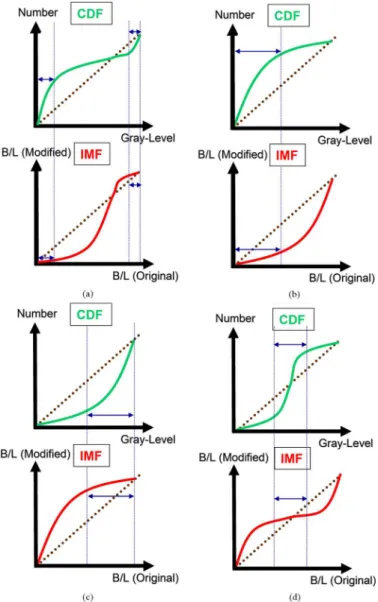
A very significant feature of the IMF method was to optimize the backlight signal according to each input image, i.e., back-light signals with a dynamic gamma could be controlled frame by frame to produce high quality images in high and low CR im-ages. For example, in a high CR image [see Fig. 3(a)], the CDF curve has steep slopes in the high and low gray level areas; in contrast, the IMF curve has gentle slopes in these two areas. Therefore, backlight signals for dark regions would distribute to the lower IMF area, and backlight signals for bright regions would distribute to the higher IMF area. Hence, the backlight
Fig. 3. CDF and IMF response of backlight curve for: (a) high CR; (b) dark; (c) bright; and (d) medium gray-level images.
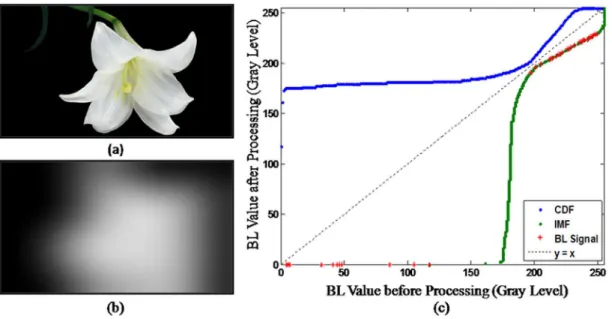
panel could show a high CR image by the IMF method. Addi-tionally, IMF also maintained the brightness of the target image to show the image details with less distortion. Fig. 4 shows a high CR target image_ Lily, and its backlight image obtained by the IMF method.
With the exception of high CR images, Fig. 3(b)–(d) shows the CDF and IMF curves of low CR images, i.e., dark, bright, and medium gray-level images. Most backlight signals were dis-tributed to particular area with uniform values, thus, eliminating the visible boundaries of each LED backlight block. For ex-ample, most backlight signal values of the bright image, Yushan (see Fig. 5) distributed to the higher IMF area (with the gray level between 220 and 250). Likewise, dark and medium gray-level images could also be modulated with a uniform brightness distribution, thus the LC signals would be able to adjust to pro-duce a high-quality image.
B. LC Compensation
With determined backlight signals, the backlight image could be convolved with a light spread function (LSF) which
repre-Fig. 4. An example of using the IMF method. (a) High CR target image—Lily. (b) BL image of Lily. (c) Mapping curves of CDF and IMF.
Fig. 5. An example of using the IMF method. (a) Low CR target image (bright image)—Yushan. (b) BL image of Yushan. (c) Mapping curves of CDF and IMF.
Fig. 6. The processing of convolution. (a) BL signal. (b) Light spread function. (c) BL image.
sents the spatial intensity distribution of each LED zone (see Fig. 6) [11]. The backlight images using the average, square root, and IMF methods are shown in Fig. 7(b)–(d). These convo-lution results were ideally simulated for distribution of backlight illumination. Based on brightness preservation, the
compensation signals of liquid crystal could be ob-tained through (2) [12]
142 JOURNAL OF DISPLAY TECHNOLOGY, VOL. 4, NO. 2, JUNE 2008
Fig. 7. (a) Target image. Convolution results of backlight signal determined by: (b) average, (c) square root, and (d) IMF methods.
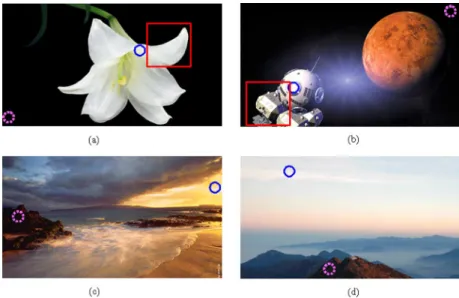
Fig. 8. Target images with their CR measuring points; Lmax and Lmin are respectively marked with a solid-blue circle and a dotted-pink circle. Areas within the red rectangles in Figs. (a) and (b) are magnified, shown in Figs. 9 and 10. (a) Lily (high CR image). (b) Robot (dark image). (c) Shore (medium GL image). (d) Yushan (bright image).
Fig. 9. Results of the magnified section in the test image—Lily. (a), (b) and (c) are produced by using the average, square root, and IMF methods, respectively. (d) Target image.
where and denote the intensity of conventional (full-on) backlight and the intensity of HDR backlight, respec-tively; denotes the original signals of a target image. Finally, an HDR image was created by combining the back-light convolution result and LC compensation signals consid-ering the gamma effect. However, if the gray level of LC com-pensation, , exceeded 255, the HDR system could not show the signal correctly, thus the “clipping effect” would be observed [12].
III. MEASUREMENT
A. Target Images and the Hardware
The main objective of the HDR system was to achieve a high contrast ratio (CR) image to match the human vision range in the real world (high dynamic range) [13]. A high CR target image, Lily, and three low CR images, Robot (dark
image), Shore (medium GL image), and Yushan (bright image) shown in Fig. 8 were simulated and then implemented on a 1920 1080 resolution HDR-LCD TV with 8 8 backlight zones. The CR was measured by using a luminance analyzer, CA-210 [14], with a measuring area of 27 mm in diameter (covering about 12 834 pixels); the positions of maximum lumi-nance and minimum luminance are respectively marked with a solid-blue circle and a dotted-pink circle in Fig. 8. Areas within the red rectangle parts in Fig. 8(a) and (b) are magnified for image detail comparison and shown in Figs. 9 and 10.
B. Target Parameters
Based on the concept of a dual-panel display, the target contrast ratio of high CR images should be enhanced more than 10 000:1 by controlling the backlight signal and with a 30% average power reduction. Additionally, with the LC panel
Fig. 10. Results of the magnified section in the test image—Robot. (a), (b), and (c) are produced by using the average, square root, and IMF methods, respectively. (d) Target image.
Fig. 11. Lateral pictures of a 37-in HDR-LCD by using the: (a) the full-on backlight, (b) IMF, (c) square root, and (d) average methods.
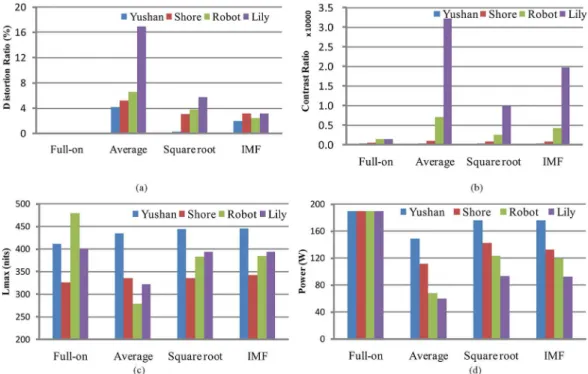
Fig. 12. Image characteristics of different images using different methods. (a) Distortion ratio, (b) contrast ratio, (c) maximum luminance, and (d) power consumption.
144 JOURNAL OF DISPLAY TECHNOLOGY, VOL. 4, NO. 2, JUNE 2008
TABLE I
DISTORTIONRATIO(D), LUMINANCE(L ANDL ), CR,ANDPOWERCONSUMPTION(P)OFLILY(HIGHCR IMAGE), ROBOT(DARKIMAGE), SHORE(MEDIUM
GL IMAGE),ANDYUSHAN(BRIGHTIMAGE)BYUSING THECONVENTIONALMETHOD(FULL-ON)ANDTHREEDIFFERENTBACKLIGHTDETERMINATIONMETHODS
Fig. 13. Comparisons of mapping curves by using 256 and 4 registers in computing histogram. (a) Lily and (b) Yushan.
control, the maximum luminance should be maintained to approach that of the target image with low distortion of less than 5%.
The distortion ratio, , quantizing the distortion of the final HDR images is given in (3)
(3)
where is the total clipped sub-pixel number and is the total sub-pixel number (1920 1080 3). The physical meaning of D is the distortion severity due to the limited maximum trans-mittance (100%) of the LC. An HDR image with a smaller D value implies the HDR system can produce a more detailed image and get a higher quality image. Therefore, the four param-eters: contrast ratio (CR), power consumption (P), maximum luminance , and distortion value (D) were set for evalu-ating and optimizing HDR-LCDs.
IV. RESULTS ANDDISCUSSIONS
The experimental results of the four target images, Lily, Robot, Shore, and Yushan, are listed in Table I and Figs. 11 and 12. For the high CR image, Lily, the D values were 16.97%, 5.70%, and 3.17% by using the average, square root, and IMF methods, respectively. From D values and the partly magnified
section in the images as shown in Fig. 9, the image details in the high brightness region were almost lost by using the average and square root methods. Conversely, the image details could be preserved well in the IMF method with a distortion of only 3.17% [see Fig. 9(c)]. Although the average method had the highest CR of 32,150:1, the distortion of 16.97% was the largest [see Fig. 9(a)] and the brightness (321.5 nits) was much lower than that of the conventional method (401.4 nits). Comparing and CR values of the IMF and square root methods, values were close to the conventional full-on backlight, and the CR of the IMF method (19 695:1) was much higher than that of the square root method (9855:1) in this high CR image.
For the low CR image, Robot, the IMF method could also preserve most image details with 2.45% of D value (shown in Fig. 10 and Table I), and consumed less power than the square root method. The 4278:1 of CR value was also higher than that of the square root method (2557:1). For the other two low CR images, the IMF method also maintained good image details with high maximum brightness.
Because the IMF method provided a suitable dynamic gamma for the backlight panel according to the display image, it not only produced a high CR image, but also displayed clear de-tails and high brightness in each image frame. Therefore, the IMF method is a good option for backlight determination in op-timizing image quality for HDR-LCDs.
was chosen as our mapping function. For further reducing the computational complexity, the registers in computing histogram were reduced from 256 to 4 units only. The simulation results presented that 4-register also could reach similar results as 256-register (see Fig. 13). Therefore, the IMF method can be easily implemented.
V. CONCLUSION
The HDR-LCD was studied as a dual-panel display: a back-light module and an LC cell. The backback-light unit was a low resolution panel to control the CR of the HDR image, and the LC cell was a high resolution panel to preserve the image details.
We propose the IMF method to determine backlight signal for high dynamic range (HDR) displays. IMF can provide an optimized dynamic gamma for a backlight panel to produce high quality images, including high/low contrast images. We have demonstrated the IMF method on a commercial 37” HDR-LCD TV to achieve a high contrast ratio 20 000:1 image, and to preserve clearer image details with low distortion . Furthermore, the IMF method still maintained high brightness to yield a more active image for human vision with an average power reduction of 30%. Therefore, the IMF method can be applicable for HDR-LCD TVs for optimizing image quality and lowering power consumption.
ACKNOWLEDGMENT
The authors would like to thank Y.-K. Cheng, C.-H. Chen, Z.-W. Chen, and S.Wallace of National Chiao Tung University, Taiwan, R.O.C., for their valuable discussions. They also thank P.-J. Tsai of AU Optronics Corporation for his hardware sup-port. Finally, they would like especially to express their appre-ciation to the reviewers for their suggestions resulting in this complete paper.
REFERENCES
[1] H. Seetzen, W. Heidrich, W. Stuerzlinger, G. Ward, L. W. M. Trenta-coste, A. Ghosh, and A. Vorozcovs, “High dynamic range display sys-tems,” SIGGRAPH 2004, ACM Trans. Graphics, vol. 23, no. 3, pp. 760–768, 2004.
[2] H. Seetzen, L. A. Whitehead, and G. Ward, “A high dynamic range display using low and high resolution modulators,” in SID Symp. Dig. Tech Papers, 2003, vol. 34, pp. 1450–1453.
[3] E. Y. Oh, S. H. Baik, M. H. Sohn, K. D. Kim, H. J. Hong, J. Y. Bang, K. J. Kwon, M. H. Kim, H. Jang, J. K. Yoon, and I. J. Chung, “IPS-mode dynamic LCD-TV realization with low black luminance and high contrast by adaptive dynamic image control technology,” J. Soc. Inf. Display, vol. 13, pp. 215–219, 2005.
[4] Y. W. Wang, Y. K. Cheng, H. P. D. Shieh, T. M. Wang, and H. W. R. Lin, “Analyses of point spread function in high dynamic range display system,” Opt. Photon. Taiwan 2005, no. G-SA-X 4-3, 2005. [5] F. C. Lin, C. Y. Liao, L. Y. Liao, Y. P. Huang, and H. P. D. Shieh,
“Inverse of mapping function method for image quality enhancement of high dynamic range LCD TVs,” in SID Symp. Dig. Tech Papers, 2007, vol. 38, pp. 1343–1346.
radiography with mixture models and local gamma correction,” IEEE Trans Med. Imag., vol. 25, no. 1, pp. 113–121, 2006.
[9] T. C. Hsu, T. M. Lin, and Y. C. Chen, “Fuzzy contrast correction (FCC) for image contrast enhancement,” in SID Symp. Dig. Tech. Pa-pers, 2006, vol. 37, pp. 303–305.
[10] C. C. Sun, S. J. Ruan, M. C. Shie, and T. W. Pai, “Dynamic contrast enhancement based on histogram specification,” IEEE Trans Consumer Electron., vol. 51, no. 4, pp. 1300–1305, Jul. 2005.
[11] L. Y. Liao, F. C. Lin, Y. P. Huang, H. P. D. Shieh, and S. C. Yeh, “A real-time liquid crystal signal compensation method for high dynamic range LCD,” IDW’07, vol. 14, pp. DES5–1L, 2007.
[12] L. Kerofsky et al., “Brightness preservation for LCD backlight dim-ming,” J. Soc. Inf. Display, vol. 14, pp. 1111–1118, 2006.
[13] B. Hoefflinger, Ed., High-Dynamic-Range (HDR) Vision. New York: Springer, 2007, pp. 1–4.
[14] Konica Minolta Sensing, Inc., Measurement Instruments CA-210, Re-trieved Dec. 27th, 2007 [Online]. Available: http://www.konicaminolta. com/instruments/products/display/color-analyzer/ca210/features.html
Fang-Cheng Lin received the M.S. degree from Department of Physics, National Cheng Kung University, Tainan, Taiwan, R.O.C., in 2002, and is currently working toward the Ph.D. degree at the Institute of Electro-Optical Engineering, National Chiao Tung University, Hsinchu, Taiwan, R.O.C.
His current research is to develop high image-quality with low power consumption LCDs, espe-cially in high-dynamic-range and field-sequential-color technologies.
Yi-Pai Huang received the B.S. degree from Na-tional Cheng-Kung University in 1999 and admitted to Institute of Opto-Electronic Engineering, National Chiao Tung University (NCTU) in Hsinchu, Taiwan, R.O.C., with merit, so did in Ph. D. program.
He is currently an assistant professor in the depart-ment of photonics & display institute, National Chiao Tung University in Hsinchu, Taiwan, R.O.C. He was a project leader in the technology center of AU Op-trinic(AUO) Corp.. He had joined the group of Pho-tonics and Communications Laboratory, the School of Optics/CREOL, University of Central Florida (UCF) as an internship student from 2001 to 2002. He was awarded the SID2001 Best Student Paper Award, SID2004 distinguished student paper award, 2005 Golden Thesis Award of Acer Foundation, and 2005 AUO Bravo Award. He had successfully developed “ad-vanced-MVA LCD” for the next generation products of AUO in 2005. His cur-rent research interests are advanced display systems (High dynamic range LCD and Field sequential LCD), display human vision evaluation, 3-D displays, and display optics. He has published 7 journal papers, 20 international conference papers, and has 11 US patents (5 granted, 6 pending) to his credit.
Lin-Yao Liao received the B.S. degree in electronics engineering from National Sun Yat-sen University, Kaohsiung, Taiwan, R.O.C., in 2006, where his cur-rently working toward the Ph.D. degree in photonics engineering.
His research interests include high efficiency dis-play system, and liquid crystal lenses design.
146 JOURNAL OF DISPLAY TECHNOLOGY, VOL. 4, NO. 2, JUNE 2008
Cheng-Yu Liao received the M.S. degree from National Chiao Tung University, Hsinchu, Taiwan, R.O.C., in 2007.
His current interests include digital image pro-cessing and backlight dimming of LCD-TV.
Han-Ping D. Shieh (F’07) received the B.S. degree from the National Taiwan University in 1975 and the Ph.D. degree in electrical and computer engineering from Carnegie Mellon University, Pittsburgh, PA, in 1987.
He joined National Chiao Tung University (NCTU) in Hsinchu, Taiwan, R.O.C., as a professor at the Institute of Opto-Electronic Engineering and Microelectronics and Information Research Center (MIRC) in 1992 after being a Research Staff Member at the IBM T.J. Watson Research Center, Yorktown Heights, NY, since 1988. He currently is an AU Optronics chair professor and Associate Director, MIRC, NCTU. He founded and served as the director of Display Institute at NCTU in 2003, the first graduate academic institute in the world dedicated to display education and research. He also holds a joint-appointment as a Research Fellow at the Center for Applied Sciences and Engineering, Academia Sinica since 1999. His current research interests are in display, optical MEMS, nano-optical components, and optical data storage technologies.
Dr. Shieh currently serves as a Director, SID (Society for Information Dis-play) and has served as program chair and committee member and has organized conferences on major data storage (ISOM, MORIS, Intermag, ODS, APDSC) and displays (SID, IDRC, ASID, FPD Expo, etc.). He has published more than 100 journal papers and has more than 30 patents to his credit. He was awarded as a Society for Information Display (SID) Fellow in 2005.
Te-Mei Wang is the project leader of AUO Tech-nology Center. She initiated the high dynamic contrast display project in AUO and worked with Prof. Han-Ping Shieh and his students of NCTU Display Institute to successfully demonstrate this new technology in FPD International 2005 and 2006 in Yokohama.
Szu-Che Yeh received the M.S. degree in electronics engineering from National Chiao-Tung University, Hsinchu, Taiwan, R.O.C., in 1999. Since 2003, he has worked at AU Optronics Corporation, where his work focused on color image processing for display.
![Fig. 1. Mapping functions of two conventional backlight determination methods, the average and square root methods [1].](https://thumb-ap.123doks.com/thumbv2/9libinfo/7589675.127252/1.891.466.818.259.542/mapping-functions-conventional-backlight-determination-methods-average-methods.webp)