THE USE OF ENGLISH REQUEST STRATEGY
BY TAIWANESE COLLEGE STUDENTS:
A PILOT STUDY IN THE ACADEMIC SETTING
Beryl Chinghwa Lee
11
Assistant Professor, Center of General Education, China Medical University
Abstract
The study aims to identify the request strategies used by Taiwanese college students in the academic setting. According to Brown and Levinson (1987), request is a face-threatening act. More often than not, speakers would adopt strategies to prevent damage to the hearer’s or the speaker’s own face. Chinese people have long been described as people who favor direct request strategies, which usually evoke rude and awkward impressions in the speakers since inappropriate requests in cross-cultural contact situations may lead to communication breakdown or even misunderstanding. The present study invited 18 Taiwanese female freshmen to respond to a written questionnaire in the form of the Discourse Completion Task. The data of 215 requests were analyzed according to Blum-Kulka, House, and Kasper’s (1989) coding scheme. The findings portrayed a different picture of stereotypes of Chinese students. In specific, the participants used significantly more indirect strategies (74%) than direct strategies. Among the indirect strategies used, 81% was
hearer dominance. The favorite Supportive Moves were grounders. In terms of the structure of the Head Act and the Supportive Moves, pre-posed structure was preferred over post-posed structure.
Key words: Request strategy, Pragmatics, Cross-cultural communication
Requests for reprints should be sent to Beryl Chinghwa Lee, General Education Center, China Medical University, 91 Hsueh-Shih Road, Taichung 404.
BACKGROUND AND RATIONALE
According to Brown and Levinson (1987), request is a face-threatening act (FTA). More often than not, speakers would adopt strategies to prevent damage to the hearer’s or the speaker’s own face. It is suggested that the choice of strategy is made on the basis of the speaker’s assessment of the size of the FTA (Thomas, 1995). The speaker can calculate the size of the FTA by estimating such parameters as power, distance and rating of imposition. These combined values determine the overall “weightiness” of the FTA, which in turn influences the request strategy use (ibid). In cross-cultural contact situations, inappropriate requests are likely to evoke rude or awkward impressions in the speakers as the inadequacy may lead to communication breakdown or even misunderstanding. It is therefore important to find out whether Taiwanese college students are equipped with adequate pragmatic competence to make polite English requests.
Chinese have long been described as people who favor direct request strategies. For example, Wong (2000, as cited in Lee, 2004) found that when making requests in Chinese, both PRC (Pepople’s Repulbic of China) and non-PRC respondents preferred impositives. The second preference is conventionally indirect strategy and requestive hints. The use of the three strategies, however, varied with power and social relationship between the speaker and the hearer. In addition, Rose (1999) reported that in the 154 Cantonese requests he collected, 37% were direct requests. The number was more than had been found in previous request research such as Blum-Kulka, House, and Kasper’s (1989) CCSARP (Cross-Cultural Speech-Act Realisation Project). Rose (1999) claimed that his finding indicated that directness in Cantonese was regarded as appropriate in more contexts than in other languages studied. He suggested that L1 pragmatic transfer might explain the directness in the English of Hong Kong Chinese-English bilinguals. For example, Rose had the experiences of being told by bank tellers to “sit down over there and wait,” to “just put those books down over there,” by university library staff and to “give me your
ID” by various salespeople.
Lee (2004) drew similar conclusions in her study. Lee made use of naturalistic enquiry to investigate written request strategies in emails which were sent by Hong Kong Chinese learners of English to their teachers. Six hundred emails to six English teachers were collected; three of the English teachers were native English speakers and the other three were Chinese speakers. The researcher identified 56 requestive emails, and then analyzed the data by CCSARP coding scheme. The findings indicated that the Chinese learners tended to use conventional direct strategies and hints. In the case that the teacher was a Chinese, the total frequency of the conventional direct strategies was 32 (64%) and requestive hints 17 (34%). When the teacher was a native English speaker, the high frequency of the use of direct strategies and requestive hints was still maintained (i.e. 60.9% and 39.1% respectively). The author claimed that the findings were consistent with Wong’s. He also noted that her results conformed to the traditional Chinese values and beliefs, in which young people, subordinates and students are supposed to respect or show politeness when interacting with older people, bosses and teachers.
However, Lee’s results are not unproblematic. For the first place, Lee (2004) classified the linguistic expression such as Could you, Would you, Can I, May I as conventionally direct strategies, or impositives but in Blum-Kulka et al.’s (1989) categorization, they are conventionally indirect strategies, which are illustrated by such specific examples as “Could you clear up the kitchen, please?” and “Would you mind moving your car?” in the study of Blum-Kulka et al. As Lee mistook indirect strategies for direct ones, the percentage of direct strategies used by Hong Kong Chinese was inflated.
In addition, in CCSARP, Weizman (1989, p. 73) defines a requestive Hint as …an utterance which, under certain circumstances, may be interpreted as an indirect request; but which being inherently opaque, leaves the hearer uncertain as to the speaker’s intentions, and leaves the speaker the possibility to opt out.
An often-cited example of requestive Hints is “It’s cold in here”, which was uttered as a request to close the window. Lee somehow classified “potential grounder + request” and “request+potential grounder” as Requestive hints. One example of Hints in her data is: “I am a year-3 student. I hope you can help me to correct my cover letter (request) as soon as possible because the deadline for submission is Oct 3 (potential grounder).” According to Blum-Kulka et al’s scheme, the example aforementioned should belong to a direct strategy followed by a grounder instead of being classified as a Hint. As Lee’s coding deviates from Blum-Kulka et al.’s instruction, we have reasons to cast doubts on the percentage of request strategies she reported. Therefore, the research is intended to revisit the issue by making conscious efforts to follow the coding instructions of CCSARP in a more rigid way.
In specific, the study aims to address the following research questions related to the use of English request strategy by Taiwanese college students:
1. In the academic setting, what is the most frequently used request Head Act? 2. In the most highly used request strategy, what request perspective is used most
frequently?
3. In the academic setting, what is the most frequently used Supportive Moves? 4. In the academic setting, what is the most frequently used structure of the Head
Act and the Supportive Move strategy?
METHODOLGY
The participants
The participants involved in this study were 18 female biomedical technology freshmen in their first semester. They had learned English for at least 6 years. Two of them had been to an English-speaking country for a short period of time before the study. Each stay was no longer than two months. The other sixteen students had never been to any English-speaking country. Their English proficiency was about low-intermediate to intermediate. The level was defined by their reading score of
High-Intermediate Level Test of General English Proficiency Test (GEPT). The average of their test scores was 58.5, lower than the passing score 80.
To exclude the gender variable, only female students were invited to participate in the study. Totally, there were 18 female freshmen who gave their consents to be involved in the study. Like Byon’s (2004) study, the word “request” was not mentioned in the instruction. The purpose was to avoid influences on the subjects’ responses. The required task of the research was to respond to the questionnaire in written English. The participants finished the task in about 30 minutes without reporting any difficulties.
Instrument
Data for this study were collected through a written questionnaire in the form of the “Discourse Completion Task” (DCT). The written questionnaire used in this study was designed by Byon, A. S. (2004) when he conducted sociopragmatic analysis of Korean requests in the academic setting. Byon’s questionnaire aimed to investigate the systemic variation of two main social factors, i.e., power and distance. The rationales for his questionnaire design were as follows:
The distance variable was treated as a binary value: interlocutors either knew each other [-distance] or did not know each other [=distance]. In addition, the power variable was treated as a ternary value where the hearer was either of lower status [-power], interlocutors were of equal status [=power], or the hearer was of higher status [=power]. The combinations of these two social variable result in six possible combinations: [+power, +distance], [+power, -distance], [=power, +distance], [=power, -distance], [-power, + distance], and [-power, -distance] (Byon 2004, p. 1677).
To obtain more reliable data, Byon’s DCT form included two situations for each variable combination. The result was a total of 12 situations. Byon claimed that the advantage of his instrument which involved 12 different situations could elicit more representative data in the academic setting. To accommodate the local culture of
Taiwan, some of the questionnaire items were slightly modified. For example, in item 5, the activity “skiing” was replaced with “swimming” so that the situation did not sound awkward in the tropical island area. After the modification, the questionnaire was translated into Chinese by the researcher. A native Chinese university instructor with long experience in English teaching was invited to evaluate whether the Chinese version was semantically equal to the English version. His feedback was positive. He also agreed that the wording of the translation version was idiomatic in Chinese. Moreover, two non-participant freshmen were invited to judge whether the situations designated in the questionnaire were common in the academic setting. Both students showed their approval.
The researcher then finalized the questionnaire for this study (See the Appendix). The Chinese question was superposed on the English question for each situation. The aim is to provide the participants with English lexical equivalents to respond to the questionnaire.
The coding scheme
The data were coded according to Blum-Kulka et al’s (1989) CCSARP coding scheme. According to Blum-Kulka et al’s Coding Manual, the speech act of strategy could be segmented into a Head Act, Alters and Supportive Moves. The Head Act is the minimal unit which can realize a request. In other words, the Head Act is the core of the request sequence. An example from Blum-Kulda et al. (1989) is “John, get me a beer, please. I’m terribly thirsty”, in which “get me a beer” is the Head Act.
Alerter and Supportive Moves are two non-essential parts for realizing the request. Alerters tend to occur before the Head Act. They include such elements as some formulaic expressions (e.g., “excuse me”), titles, names, address forms, etc. They are intended to get the attention of the addressee. In the aforementioned example regarding the request of a beer, “John” is the Alter.
In terms of structure, Supportive Moves can precede or follow the Head Act. They are regarded as units external to the request used to modify the impact by either aggravating or mitigating its force. In the given example about a beer request, “I’m
terribly thirsty” belongs to Supportive Moves. In the absence of a requestive Head Act, a certain type of Supportive Move can assume itself the status of a request and thus makes a Hint. In other words, the Supportive Moves, when occurring on their own, can be raised to the status of requestive Head Acts.
Possible structures of the Head Act and Supportive Moves include (1) the Head Act only, (2) Post-posed (Head Act + Supportive Moves), and (3) Pre-posed (Supportive Move + Head Act). In addition, a request can be realized from (1) Hearer dominance, (2) Speaker dominance, (3) Speaker and hearer dominance, and (4) impersonal.
The Head Acts of request speech act, according to Blum-Kulka et al., can be divided into nine sub-strategies. However, this study only focuses on three main levels, i.e., (1) direct strategies, (2) conventionally indirect strategies, and (3)
nonconventionally indirect strategies. The mitigating Supportive Moves, on the other hand, can be classified into (1) preparator, (2) getting a precommitment, (3) grounder, (4) disarmer, (5) promise of reward, and (6) imposition minimizer.
The coding procedure
The hand-written data elicited from the 18 participants were transformed into typescripts after the DCT was finished. Except for minor spelling errors, most of the errors were left uncorrected. That is, their semantic and syntactic errors were recorded faithfully. For example, in the case that they used “borrow” instead of “lend”, we documented exactly what they wrote.
The researcher first segmented the Head Acts, highlighted them in bold-faced letters in the typescript, and identified their categories. Similarly, the Supportive Moves and their subcategories were identified and coded. After that, categories of the Head Act, the Supportive Moves, and their structures were tallied. The frequencies were then counted and tabulated for comparison and analysis.
RESULTS AND DISCUSSION
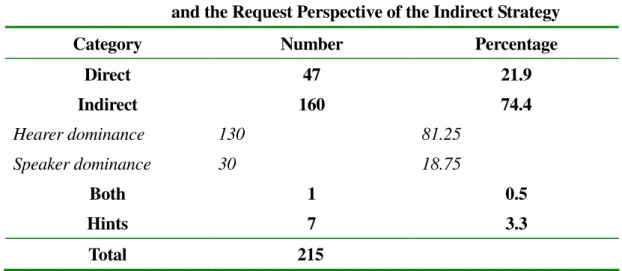
In total, there are 215 requests elicited from the participants in that one of the students failed to respond to situation 11 for some unknown reason (i.e. 18 participants × 12 situations –1). The number and percentage of their Speech Act are shown in Table 1.
Table 1 Number and Percentage of the Head Act
and the Request Perspective of the Indirect Strategy
Category Number Percentage
Direct 47 21.9 Indirect Hearer dominance Speaker dominance 160 130 30 74.4 81.25 18.75 Both 1 0.5 Hints 7 3.3 Total 215
Table 1 aims to answer research questions one and two, i.e., to find out the most frequently used request strategy and its dominant perspective. As noted, there were 160 indirect strategies out of 215 requests (i.e., 74.4%), followed by 47 direct strategies (21.9%), and 7 Hints (3.3%). Indirect strategies took about two-thirds of the total. In other words, it is indirect strategies which are used most frequently. The results portrayed a different picture from Lee’s (2004) findings in which Chinese people were depicted as heavy direct strategy users. As for the perspective, hearer dominance outnumbered speaker dominance. To be more specific, in the 160 indirect strategies used by the participants, 130 were hearer dominance (81.25%) while 30
were speaker dominance (18.75%). That is to say, in the indirect strategies used by the participants, hearer dominance is the most frequently adopted perspective. Speaker dominance perspective, on the other hand, takes only a small fraction of the total indirect strategies.
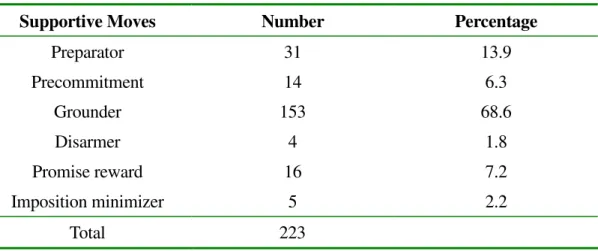
Table 2 The Number and Percentage of the Supportive Moves
Supportive Moves Number Percentage
Preparator 31 13.9 Precommitment 14 6.3 Grounder 153 68.6 Disarmer 4 1.8 Promise reward 16 7.2 Imposition minimizer 5 2.2 Total 223
Research questions three is answered by Table 2, which shows the number and percentage of Supportive Moves used by the participants. The results indicate that grounder was the most frequently used Supportive Move. In 223 Supportive Moves, 153 (68.8%) are grounders, with only 31 (13.9%) as preparators, followed by 16 promise reward (7.2%), 14 precommitment (6.3%), 5 imposition minimizer (2.2%), and 4 disarmer (1.8%).
Table 3 The Number and Percentage of the Structure of the Head Act and the Supportive Moves
Category Number Percentage
Pre-posed 117 54.4
Post-posed 36 16.7
Both 11 5.1
Head Act alone 50 23.3
Between 1
Total 215
Table 3 aims to answer research question four, i.e., to find out the structures of the favorite Head Act and Supportive Moves used by the participants. According to the number and percentage of the structures under investigation, in 215 requests, 117 were pre-posed structures (i.e. 54.4%), 50 were Head Act alone (23.3%) and 36 were post-posed structure (16.7%). The findings indicate that the participants favored pre-posed structure over Head Act alone, which in turn outnumbered post-posed post-structure.
CONCLUSION
The present research describes the request strategy used by Taiwanese college learners. By the DCT questionnaire, it is found that the picture of request strategy use in this study is different from the stereotypical description of Chinese learners in terms of English request making. To be more specific, the participants in the present study use considerably more indirect strategies. They prefer grounders as Supportive Moves to mitigate the request. As for the structure, pre-posed structure is used more often than post-posed structure. When indirect strategies are used, the hearer dominance request perspective is preferable to the speaker dominance. The
small-scaled study demonstrates that the participants are equipped with adequate pragmatic competence to make polite English requests. Future research will aim to investigate whether these students’ request strategies vary with the power and distance variables. In addition, it is also intriguing to learn whether Taiwanese college students are capable of making good English requests in authentic language use situations. We hope more pragmatic competence research in this regard may give us insights into English request strategy use in Taiwan and bring us important pedagogical implications.
Acknowledgements:
I am grateful for the participants in the study. This study is funded by a grant from China Medical University with the award number (CMU95-086).
REFERENCES
1. Blum-Kulka, S., House, J., & Kasper G. (1989). Cross-cultural pragmatics:
Requests and apologies. Norwood, NJ: Ablex Publishing Corporation.
2. Brown, P., & Levinson, S. C. (1987). Politeness: Some universals in language
usage. Cambridge, UK: Cambridge University Press.
3. Byon, A. S. (2004). Sociopragmatic analysis of Korean requests: pedagogical settings. Journal of Pragmatics 36, 1673-1704.
4. Rose, K. R. (1999). Teachers and students learning about requests in Hong Kong. In E. Hinkel (Ed.), Cultural in second language teaching and learning (pp. 167-180). Cambridge, UK: Cambridge University Press.
5. Thomas, J. (1995). Meaning in interaction: An introduction to pragmatics. London: Longman.
6. Weizman, E. (1989). Requestive hints. In S. Blum-Kulka, J. House, & G. Kasper (Eds.), Cross-cultural pragmatics: Requests and apologies (pp. 71-95). Norwood, NJ: Ablex Publishing Corporation.
APPENDIX: Questionnaire for Request Strategies
這份問卷是用來調查大學生的英文表達能力,結果僅供研究用,不會影響你的 學期成績。請勾選是否願意做答,並填寫基本資料。謝謝您的合作! □ 願意做答 □ 不願意做答 李菁華 敬上假設你在美國留學遇到下列 12 種想像的狀況,你會怎麼開口表達,
請用英文作答
請用英文作答
請用英文作答
請用英文作答。
。
。
。
情況一
: 你發現一門畢業前一定得修完的必修課已經額滿,你決定請授課老師加簽。你 和這位老師不熟,你會怎麼開口對他/她說?You really have to take this course in order to graduate, but you found that the course is already closed. So, you decide to ask the professor, whom you DO NOT KNOW personally, to allow you to take this course. What would you say to get this professor to grant you permission to participate in this course?
I will say: ___________________________________________________________
情況二:
你到別的大學去找朋友,到他/她的學校時,你不知道宿舍怎麼走,你想問路過 的學生,學生宿舍在哪裡,你會怎麼對他/她說?
You are going to visit your friend, who lives in the college dormitory. Your are on campus, but don’t know where the dorm is. You are going to ask a student, who is passing by, for the location of the dorm. How will you ask the student?
I will say: ___________________________________________________________
情況三:
旁邊的大一新生他/她知道瑪莉的電話。你和這位同學不熟,你會怎麼對他/她 說
You are a senior and the vice president of a campus club/organization. You need to get the phone number of Mary, another member of the club. You think that a new member (who seems to be a FRESHMAN and whom you DO NOT know personally), sitting next to you may know Mary’s number. So, you decide to ask the new member Mary’s phone number. How would you ask?
I will say: ___________________________________________________________
情況四:
你想去旁聽金教授(Professor Kim)的課,你曾經上過二門金教授的課,和他/她 非常熟。你想請老師允許你旁聽,你會怎麼對他/她說?
You are very much interested in auditing a class taught by Professor Kim. You already have taken two classes from Professor Kim, and you KNOW him personally very well. So you decided to ask this professor’s permission to audit. What would you say to get this professor to allow you to audit this class?
I will say: ___________________________________________________________
情況五:
你和你最要好的朋友都參加大學游泳社,你們一起坐車要去游泳,你的好朋友 在車上擦防曬油,你想借他/她的防曬油,你會怎麼對他/她說?
You and your best friend are members of the college swimming club. You are riding the bus and have just arrived at the mountain. You see that your BEST FRIEND, seated next to you, is applying sunscreen lotion. You want to use that lotion because you have forgotten to bring your own. You turn to your best friend. How would you ask?
I will say: ___________________________________________________________
情況六:
你的室友是你高中學妹,他哥哥是你最要好的朋友。你的電腦中毒不能用,明 天又要交報告,你決定向你室友借電腦,你會怎麼對他/她開口借電腦? Your roommate is your best friend’s younger sibling, who is your high school junior. Your computer is out of order because of a virus, but you have a paper due tomorrow. You decide to ask your ROOMMATE whether you can borrow his computer tonight. What would you say to get your roommate to do this favor for you?
I will say: ___________________________________________________________
情況七:
你發現英文期中考和你哥哥結婚典禮同一天,你希望去參加這個重要的家庭聚 會,你想向教授請假並請他允許你補考,你和這位教授不熟,你會怎麼對他/ 她說?
Your English mid-term exam is approaching and you find that the scheduled date of the test is the same date as that of your brother’s wedding. You can’t do both on that day and you prefer to join this unforgettable moment of your family, so you decide to ask the professor (whom you DO NOT know personally) to rearrange another day especially for you to take this test. What would you say to get this student to take your picture together?
I will say: ___________________________________________________________
情況八:
你的同鄉好友從台灣來看你,你帶他/她參觀校園,想照相留念,於是想請路過 的陌生人幫你們拍照,你會怎開口對他/她說?
A friend of yours from Taiwan is paying you a visit. You are showing your friend around campus and both of you would like to take a photo together to remember this
happy moment, so you decide to ask a nearby person (who is a STRANGER to you) to do you this favor. What would you say to get this student to take your picture together?
I will say: ___________________________________________________________
情況九:
你是學生會的資深成員,你正在開會時,需要一張白紙作筆記。坐在你旁邊的 大一新生有多餘的紙,可是你和他不熟,你會怎麼開口向他/她要?
You are a senior member of a student organization. You are in a meeting now. You need to borrow a piece of paper in order to take some notes. An unfamiliar member, who seems to be a FRESHMAN and whom you DO NOT know personally, is sitting next to you and might have a piece of extra folder paper. How would you ask this new member for a piece of paper?
I will say: ___________________________________________________________
情況十:
你想申請獎學金,想請自己的指導教授 Professor White 幫你寫推薦信,你和他/ 她很熟,你會怎麼說?
You are applying for a scholarship, and you decide to ask Professor White, who knows you very well as your ACADEMIC ADVISOR, to write a recommendation letter for you. What would you say to get Professor White to do this favor to you?
I will say: ___________________________________________________________
情況十一:
你上週因感冒沒有上到歷史課,你想向自己的好朋友借筆記把進度補齊,你會 怎麼向他/她開口借筆記?
enrolled in. So you decide to borrow your INTIMATE classmate’s notes to catch up with the rest of the class. What would you say to get this friend to lend you notes for the class you missed?
I will say: ___________________________________________________________
情況十二:
你是某學生社的資深成員,同時也是該社團的會長,在開會的時候你想做筆記, 找不到筆。一個跟你很熟的學弟(妹)坐在旁邊,你想向他/她借筆,你會怎麼說? You are a senior and the president of a student organization. You are in a meeting now. You would like to take some notes, but you don’t have a pen. A close junior member (who is a sophomore, and whom you KNOW very well personally) of the organization is sitting next to you and might have an extra pen. What would you say to get this close junior member to lend you a pen?
I will say: ___________________________________________________________