A multi-center phase II study of biweekly capecitabine in combination
with oxaliplatin as first-line chemotherapy in patients with locally
advanced or metastatic gastric cancer
Yee Chao1,2, Jan-Sing Hsieh3, Hsien-Tang Yeh4, Yu-Cheih Su5, Cheng-Chung Wu2,6,
Jen-Shi Chen7, Cheng-Jeng Tai8, Li-Yuan Bai9, Kun-Huei Yeh10, Wu-Chou Su11, and
Chung-Pin Li2,12
1Cancer Center, Taipei Veterans General Hospital, Taipei, Taiwan; 2National
Yang-Ming University School of Medicine, Taipei, Taiwan; 3Department of Surgery, Kaohsiung Medical University Hospital and Department of Surgery, Faculty of Medicine, College of Medicine, Kaohsiung Medical University, Kaohsiung, Taiwan; 4Department of Surgery, Lotung Poh-Ai Hospital, Yilan County, Taiwan; 5Division of
Hematology–Oncology, Department of Internal Medicine, Dalin Branch, Buddhist Tzu Chi General Hospital, Chiayi County, Taiwan; 6Division of General Surgery, Department of Surgery, Taichung Veterans General Hospital, Taichung, Taiwan; 7Division of Hematology-Oncology, Department of Internal Medicine, Chang Gung
Memorial Hospital & Chang Gung University, Taoyuan County, Taiwan; 8Division of Hematology and Oncology, Department of Medicine, Taipei Medical University and Hospital, Taipei, Taiwan; 9Division of Hematology and Oncology, Department of
Internal Medicine, China Medical University Hospital and School of Medicine, College of Medicine, China Medical University, Taichung, Taiwan; 10Department of Oncology, National Taiwan University Hospital and National Taiwan University College of Medicine, Taipei,Taiwan; 11Division of Hematology-Oncology, Department of Internal Medicine and Graduate Institute of Clinical Medicine, National Cheng Kung University Hospital, College of Medicine, National Cheng Kung University, Tainan, Taiwan; 12Division of Gastroenterology, Department of Medicine, Taipei Veterans General
Hospital, Taipei, Taiwan
Correspondence:
Dr. Chung-Pin Li, Division of Gastroenterology, Department of Medicine, Taipei Veterans General Hospital, No. 201, Sec. 2, Shih-Pai Road, Taipei 11217, Taiwan. Tel: (886) 2-2875-7506; Fax: (886) 2-2873-9318; E-mail: [email protected].
ABSTRACT
Purpose: We evaluated efficacy and safety of biweekly capecitabine in combination with oxaliplatin in previously untreated patients with locally advanced or metastatic gastric cancer.
Methods: Patients received oral capecitabine 1,000 mg/m2 twice daily on days 1-10 plus oxaliplatin 85 mg/m2 as a 2-h intravenous infusion on day 1, every 2 weeks (XELOX). The primary end point was overall response rate. Secondary end points included progression-free survival, overall survival, and toxicity.
Results: From March 2007 to October 2010, 46 patients were enrolled. The median age was 64 years (range: 32-85). A total of 391 (median 7.5, range 1 - 29) cycles were delivered. Among the 41 patients evaluable for tumor response, 9 had partial responses and 25 had stable disease. The overall response rates of the evaluable and intent-to-treat (ITT) populations were 22% (95% CI: 10–42%) and 20% (95% CI: 9–34%), respectively. The disease control rates in these populations were 83% (95% CI: 68– 93%) and 74% (95% CI: 59–86%), respectively. In the ITT analysis, the progression-free survival and overall survival were 5.6 months (95% CI, 4.1- 6.3 months) and 8.0 months (95% CI, 6.3-10.1 months), respectively. The most common hematological toxicities were thrombocytopenia (35%) and leucopenia (34%) and the most common non-hematological toxicities were neuropathy (35%), fatigue (33%), diarrhea (27%), vomiting (26%), and hand-foot syndrome (25%). Major grade 3–4 toxicities were
anemia (11%), diarrhea (9%), and hand-foot syndrome (7%). No patient died of treatment-related toxicities.
Conclusion: In advanced gastric cancer, biweekly XELOX failed its primary response rate endpoint. However, biweekly XELOX still shows modest efficacy and an acceptable safety profile in the treatment of advanced gastric cancer. ClinicalTrials.gov number: NCT00436241.
INTRODUCTION
Gastric cancer is the fourth most common cancer and the second leading cause of cancer death in the world.1 According to global estimates, gastric cancer was newly
diagnosed in an approximate 880,000 people and caused an approximate 650,000 deaths. The highest rate of gastric cancer occurs in Eastern Asia.2 Although the early
diagnosis of gastric cancer is improved, most patients show locally advanced or metastatic disease upon diagnosis. Even if surgery is performed with a curative intent, 60% of resectable patients ultimately relapse.3
It has been demonstrated that combination chemotherapy regimens in advanced gastric cancer improve outcomes of patient such as overall survival, progression-free survival and maintain quality of life.4 However, there is no accepted standard regimen
worldwide. 5-fluorouracil (5-FU) in combination with cisplatin is a generally accepted standard treatment option for advanced gastric cancer patients.5-9 The combination
regimen with 5-FU and cisplatin achieves overall response rates of 20%-51%, median progression-free survival of 3.3-6.5 months, and median overall survival of 7-11 month.5-9 Nevertheless, protracted intravenous infusion of 5-FU is inconvenient,
cumbersome, and associated with the risk of infection and thrombosis._ENREF_7
Capecitabine, a novel oral fluoropyrimidine, which was designed to mimic continuous infusion 5-FU, is administered orally. After oral administration, it is extensively absorbed unchanged from the gastrointestinal tract, metabolized primarily in
the liver and sequentially converted to the cytotoxic moiety, 5-FU, in tumor tissues by the enzyme thymidine phosphorylase through the significantly higher concentration of thymidine phosphorylase in tumor tissues compared with normal tissues. In several phase II studies, capecitabine has shown good response rates in advanced gastric cancer patients when provided as mono-therapy or the combination regimen with cisplatin, and the response rates were 19%-34% and 55% respectively.12-15 Oral fluoropyrimidine
administration can avoids the inconvenience, venous thrombosis, and sepsis due to the administration of 5-FU. Furthermore, capecitabine showed non-inferior effect compared with 5-FU.16
Oxaliplatin which was initially developed to treat colorectal cancer is an alkylating agent that forms adducts between two adjacent guanines or guanine and adenine molecules leading to the inhibition of DNA replication.17 In contrast with cisplatin,
oxaliplatin appeared to have a more favorable tolerability profile; in particular, the renal toxicity and ototoxicity are not associated with oxaliplatin, but commonly seen during the cisplatin therapy.18 Its dose-limiting toxicity is a cumulative sensory peripheral
neuropathy. In randomized phase III trials, oxaliplatin was non-inferior to cisplatin in the treatment of esophagogastric cancer. Triweekly oxaliplatin plus oral capecitabine has become a new standard for treating advanced gastric cancer.21-26 In published phase
II studies, triweekly oxaliplatin plus oral capecitabine achieved response rates of 42-63% in patients with advanced gastric cancer.21-25These results suggest that this drug
combination is worthy of further testing in patients with gastrointestinal malignancies. The aim of this study is to demonstrate efficacy and safety of biweekly capecitabine in combination with oxaliplatin in previously untreated patients with locally advanced or metastatic gastric cancer.
PATIENTS AND METHODS Study Design
This is a multi-center study to investigate the efficacy and safety profiles of biweekly capecitabine (Xeloda®) in combination with oxaliplatin (Eloxatin®) as first-line therapy in patients with locally advanced or metastatic gastric cancer. The primary objective was to investigate the objective response rate of capecitabine plus oxaliplatin treatment in previously untreated locally advanced or metastatic gastric cancer patients. Secondary objectives included progression-free survival, duration of response, overall survival (OS), and safety profiles. The study protocol was approved by the medical ethics committees of all participating centers and was registered as ClinicalTrial.gov (NCT00436241). Signed informed consents were obtained from all patients.
Patients
Inclusion criteria for this study were as follows: histologically confirmed gastric adenocarcinoma with unresectable locally advanced or metastatic disease; at least one measurable lesion according to the Response Evaluation criteria in Solid Tumors (RECIST)27 which has not been irradiated; 18 years of age or older; calculated
creatinine clearance 50 ml/min using Cockroft and Gault formula; Eastern Cooperative Oncology Group (ECOG) performance status ≤ 1.
cytotoxic chemotherapy (except given as adjuvant or neoadjuvant treatment completed at least 6 months prior to enrollment); organ allografts; clinically significant cardiac disease or myocardial infarction within the last 12 months; evidence of CNS metastases; history of another malignancy within the last five years except cured basal cell carcinoma of skin and cured carcinoma in-situ of uterine cervix; radiotherapy within 4 weeks of treatment start; major surgery within 4 weeks of the start of study treatment, without complete recovery; serious uncontrolled intercurrent infections; lack of physical integrity of the upper gastrointestinal tract or malabsorption syndrome; abnormal audiogram or auditory abnormality; significant or uncontrolled gastrointestinal bleeding; the following laboratory values: neutrophils ≤ 1.5 × 10⁹/L, platelet count < 100 × 109/L; serum bilirubin ≥ 1.5 × upper normal limit; alanine aminotransferase,
aspartate aminotransferase > 2.5 × upper normal limit or > 5 × upper normal limit in the
case of liver metastases; alkaline phosphatase > 2.5 × upper normal limit or > 5 × upper normal limit in the case of liver metastases or > 10 × upper normal limit in the case of bone disease.
Treatment Schedule
Capecitabine (1,000 mg/m2 twice daily, days 1–10, followed by four days of rest period) was administered plus oxaliplatin (85 mg/m2 as a 2-h intravenous infusion on day 1) every 2 weeks. Patients found to have clearly documented progressive disease (PD) at any time came off study due to insufficient therapeutic response. Patients with
complete response (CR), partial response (PR) or stable disease (SD), and who tolerated treatment, continued to be treated and followed until disease progression.
Dose Modification for Adverse Events
The intensity of clinical adverse events was graded according to the National Cancer Institute (NCI) Common Terminology Criteria for Adverse Events v3.0 (CTCAE). Dose modifications were based on hematologic and non-hematologic toxicities.
For hematological toxicity, dose modifications were based on hematological parameters at the start of a treatment cycle. Administration of capecitabine was interrupted during a treatment cycle if grade 3 or 4 hematologic toxicity developed. The next treatment cycle can only start if hematologic toxicity has recovered to grade ≤ 1. No dose reduction or interruption was required for anemia (non-hemolytic) as it can be satisfactorily managed by transfusions.
For non-hematologic toxicity of capecitabine, if grade 2 or 3 non-hematological toxicity occurred, capecitabine was interrupted immediately; if grade 4 non-hematological toxicity occurred, treatment was discontinued unless investigator considered it to be in the best interest of the patient to continue at 50 % of original dose, once toxicity has resolved to grade 0-1. The next treatment cycle can only start if non-hematologic toxicity has recovered to grade ≤ 1. Capecitabine dose was reduced by 25% for patients experiencing a second occurrence of a given grade 2 or any grade 3 event. The capecitabine dose was reduced by 50% for patients who experienced a third
occurrence of a presented grade 2 or a second occurrence of a presented grade 3. If a given toxicity occurred for a fourth time at grade 2 or a third time at grade 3, treatment was discontinued.
For grade < 3 non-hematological toxicities of oxaliplatin, management was symptomatic if possible. For grade ≥ 3 non-hematological adverse events, oxaliplatin was held for a maximum of 4 weeks until toxicities were resolved. After patients recovered from toxicity grade 3 to grade 2 or less, a dose reduction of oxaliplatin to 65 mg/m2 in subsequent cycles was made. In case of no resolution to grade 2 or less after a maximum of 4 weeks from the planned date of next cycle, patients were discontinued from oxaliplatin treatment. In case of grade 4, patients were removed from oxaliplatin treatment and followed until the adverse event was resolved.
Evaluation of Efficacy and Toxicities
Evaluations, including patient’s medical history, physical examination, complete blood count, blood chemistry, abdominal-pelvic computed tomography (CT) scan, and chest X-ray, were preformed before chemotherapy. After starting the protocol treatment, blood chemistry and complete blood count were examined at every cycle prior to the start of next cycle. Tumor measurement was taken place after every 3 cycles of treatment prior to the start of next cycle or when progression was suspected. Confirmation of overall response (complete or partial response), when applicable was done at a minimum of 4 weeks after the first response has been recorded. Tumor
response was evaluated according to the Response Evaluation Criteria in Solid Tumors (RECIST) criteria.27 _ENREF_24 Toxicities were graded according to the National Cancer Institute Common Terminology Criteria grading system version 3 from the time of study entry through 28 days after the last dose of study medication was administered. Statistical Methods
Simon’s two-stage optimal design was applied to calculate the sample size assuming the minimum response rate of capecitabine plus oxaliplatin in the study as 29% and the expected overall response rate as at least 50%, under α=0.05, with 80% power, the estimated total evaluable patient number was 38 to detect more than 15 patients having partial response. Considering 10% drop-out rate, the estimated enrolled patient number was 42. Progression-free survival was measured as the duration from the date of starting protocol treatment to the date of first recording disease progression or the date of death if death came first. Overall survival was measured as the duration from the date of starting protocol treatment to the date of death. Duration of response was measured from the first date measurement criteria which were met for CR/PR to the first date that recurrent or progressive disease or death was objectively documented. Survival was estimated by the Kaplan–Meier analysis. All statistics were two-sided and performed using SAS software (version 9.2, SAS Inc., Cary, NC, USA).
RESULTS
Patient Characteristics
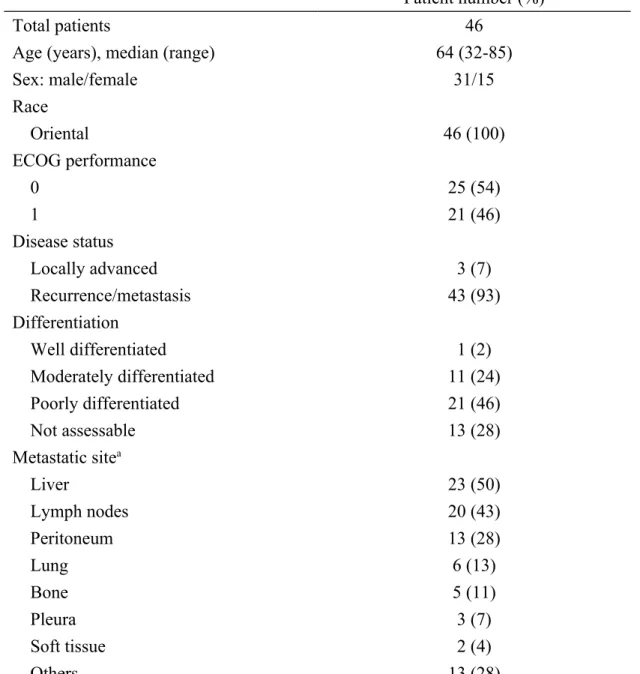
Between March 2007 and November 2008, forty-six patients (ITT population) from ten medical centers in Taiwan were enrolled in this study. The clinical and pathologic characteristics are listed in Table 1. A total of 391 (median: 7.5; range: 1 - 29) cycles of chemotherapy were given. The median relative dose intensity was 88.5% (range: 51.4– 103.2%) for capecitabine and 99.3% (range: 43.6–103.9%) for oxaliplatin. In total, 82.6% of the patients received more than 80% of the intended doses of capecitabine, and 95.7% received more than 80% of the intended doses of oxaliplatin.
Efficacy
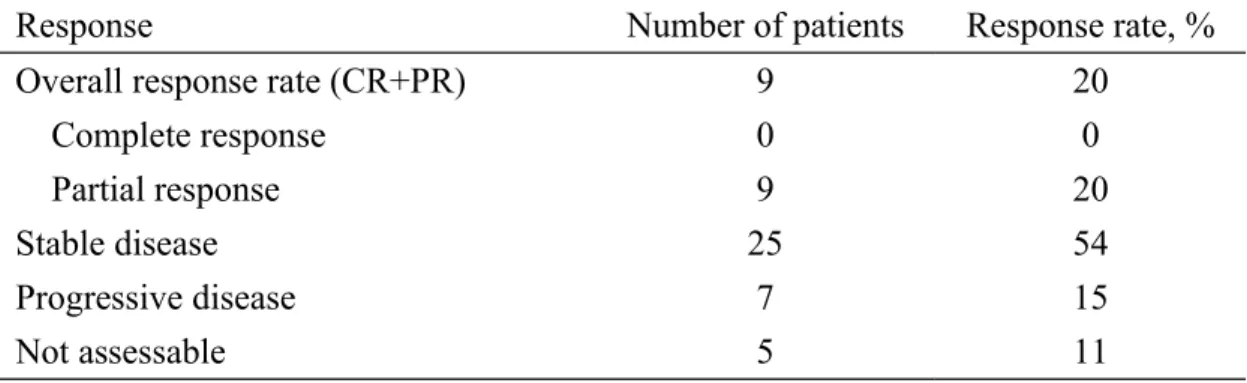
The tumor response rates are shown in Table 2. Five patients were not evaluable for responses: all were due to failure to return for tumor measurements. Among the 41 evaluable patients, the best tumor response was partial response (PR) in 9, stable disease in 25, and progressive disease in 7. The overall response rates of the evaluable and intent-to-treat (ITT) populations were 22% (95% CI: 10–42%) and 20% (95% CI: 9– 34%), respectively, whereas the disease control rate in according population was 83% (95% CI: 68–93%) and 74% (95% CI: 59–86%), respectively. The response rates of patients with 80 and <80% of the scheduled capecitabine dose intensity were 15.8% (6 out of 38) and 37.5% (3 out of 8), respectively (P=0.18). The response rates of patients with 80 and <80% of scheduled oxaliplatin dose intensity were 20.5% (9 out of 44)
and 0% (0 out of 2), respectively (P=1). Median time to tumor response was 1.4 (range: 1.2–2.8) months. The median duration of response was 5.1 months (95% CI, 2.8-9.7 months). Of the 46 patients, 26 received second-line and subsequent therapies with a total of 47 additional regimens received. Among them, 6 patients received monotherapy ( 2 UFUR, 1 capecitabine, 1 everolimus, 1 irinotecan, 1 paclitaxel), 9 patients received cisplatin plus fluoropyrimidine based therapy, 4 patients received anthracyclin based therapy with various combination of 5-FU, cisplatin and cyclophosphamide, 4 patients received taxane based therapy, 3 patients received oxaliplatin based therapy, 4 patients received irinotecan based therapy and 2 patients received 5-FU plus cyclophosphamide or cetuximab. Three additional patients also received mainly fluoropyrimidine based therapy in their subsequent therapy.
Median follow-up time was 7.8 (range 0.7-35.9 months) months. Median progression-free survival and overall survival were 5.6 (95% CI, 4.1- 6.3) months and 8.0 (95% CI, 6.3-10.1) months, respectively. The Kaplan–Meier estimated progression-free survival and overall survival curves are shown in Figures 1 and 2, respectively. The fraction of patients alive at 1 year was 26.9% and at 2 years was 13.4%.
Safety
All patients were evaluated for toxicities (Table 3). The most common hematological toxicity was thrombocytopenia (33%), with no grades 3-4 thrombocytopenia. Grade 3
leucopenia was observed in 2% of the patients. Grades 3–4 anemia developed in five patients (11%). The most common non-hematological toxicities were neuropathy (35%), fatigue (31%), diarrhea (26%), vomiting (26%), and hand-foot syndrome (22%). Major grade 3 toxicities were diarrhea (9%) and hand-foot syndrome (7%). Treatment was delayed in 82 cycles (21%), and dose modifications were implemented in 13 cycles (3%). The most of the treatment delays was due to thrombocytopenia (31/82; 38%), and the major reason for dose modification was hand-foot syndrome (6/13; 46%). There were no treatment-related deaths.
DISCUSSION
The combination chemotherapy regimen of 5-FU plus cisplatin has been widely used for the treatment of advanced gastric cancer patients.5-9 However, the regimen is
inconvenient, cumbersome, and associated with the risk of infection and thrombosis due to the continuous 5-FU infusion, and has a poor tolerability that occur with cisplatin, especially the renal toxicity. Triweekly oxaliplatin plus oral capecitabine has been used for treating advanced gastric cancer, with response rates of 42-63% and overall survivals of 10.0-11.9 months.21-25 Biweekly oxaliplatin plus oral capecitabine has been
shown to be equally active with similar quality of life compared to oxaliplatin plus intravenous 5-FU/leucovorin in treating metastatic colorectal cancer.28 There is no study
investigating the efficacy and toxicities of biweekly oxaliplatin plus oral capecitabine in treating advanced gastric cancer. This is the first biweekly oxaliplatin plus oral capecitabine phase II trial in advanced gastric cancer.
In a multi-center open-label phase II study, oral capecitabine is an active and well-tolerated treatment in gastric cancer patients.14 According to a phase III trial,
capecitabine has shown non-inferior effect compared with 5-FU in the treatment of advanced gastric cancer patients with similar safety.16 In two published phase III
studies, oxaliplatin was non-inferior to cisplatin, and reduced toxicity as compared with cisplatin in the treatment of esophagogastric cancer patients. Based on these published articles, capecitabine and oxaliplatin are as effective as 5-FU and cisplatin respectively;
administration of capecitabine is convenient compared with 5-FU for patients; oxaliplatin is more tolerable than cisplatin. Therefore, capecitabine and oxaliplatin are able to replace 5-FU and cisplatin respectively.
The aim of this phase II study was to demonstrate efficacy and safety of biweekly capecitabine in combination with oxaliplatin in previously untreated patients with locally advanced or metastatic gastric cancer. In this study, the overall response rate of ITT patients was 20%. Median progression-free survival was 5.6 months and median overall survival was 8.0 months. Although this biweekly XELOX study failed to meet its primary response rate endpoint, it still shows modest efficacy in the treatment of advanced gastric cancer.
One thing that deserved to be mentioned from our phase II multi-center study was that biweekly combination regimen with capecitabine and oxaliplatin had a good safety profile. In our study, 2 patients withdrew from the study because of treatment-related toxicities, and there were no treatment-related deaths. Grade 3 and 4 hematological and non-hematological adverse events were infrequent, and all toxicities were generally of mild to moderate intensity. The most common adverse events were thrombocytopenia (33%), neuropathy (35%), leucopenia (35%), neutropenia (31%), fatigue (31%), diarrhea (26%), vomiting (26%), anemia (24%), and hand-foot syndrome (22%). The safety profile reported in our trial was compared favorably with other phase II clinical studies with 3-weekly combination regimen of capecitabine/oxaliplatin.21-25 In our trial,
the major distressing toxicity of oxaliplatin - neuropathy occurred in 35% of patients, which was relatively low as compared to that reported in other studies (22%-70%). 21-25
_ENREF_7 Hand-foot syndrome was also infrequently seen as compared with other
3-weekly capecitabine/oxaliplatin studies (22% versus 20%-39%).21-25 Neutropenia
occurred in 31% of patients in this study which was less than that was shown in other studies (35%-56%).21-25
In conclusion, the combination of biweekly capecitabine and oxaliplatin shows modest activity and an acceptable safety profile. The therapeutic index of the current regimen, which can be helpful to advanced gastric cancer patients, should be further explored.
ACKNOWLEDGEMENTS
This work was supported by F. Hoffmann-La Roche Ltd. and grants from Taipei Veterans General Hospital (V101C-178), National Science Council (NSC 98-2314-B-075-029), and the National Research Program for Biopharmaceutics of Taiwan (100CT202).
Conflict of interest
REFERENCES
1. Crew KD, Neugut AI: Epidemiology of gastric cancer. World J Gastroenterol 12:354-62, 2006
2. Hohenberger P, Gretschel S: Gastric cancer. Lancet 362:305-15, 2003
3. Chiang CY, Huang KH, Fang WL, et al: Factors associated with recurrence within 2 years after curative surgery for gastric adenocarcinoma. World J Surg 35:2472-8, 2011
4. Benson AB: Advanced gastric cancer: an update and future directions. Gastrointest Cancer Res 2:S47-53, 2008
5. Ychou M, Astre C, Rouanet P, et al: A phase II study of 5-fluorouracil, leucovorin and cisplatin (FLP) for metastatic gastric cancer. Eur J Cancer 32A:1933-7, 1996
6. Lin YC, Chen JS, Wang CH, et al: Weekly high-dose 5-fluorouracil (5-FU), leucovorin (LV) and bimonthly cisplatin in patients with advanced gastric cancer. Jpn J Clin Oncol 31:605-9, 2001
7. Ohtsu A, Shimada Y, Shirao K, et al: Randomized phase III trial of fluorouracil alone versus fluorouracil plus cisplatin versus uracil and tegafur plus mitomycin in patients with unresectable, advanced gastric cancer: The Japan Clinical Oncology Group Study (JCOG9205). Journal of Clinical Oncology 21:54-9, 2003
8. Vanhoefer U, Rougier P, Wilke H, et al: Final results of a randomized phase III trial of sequential high-dose methotrexate, fluorouracil, and doxorubicin versus etoposide, leucovorin, and fluorouracil versus infusional fluorouracil and cisplatin in advanced gastric cancer: A trial of the European Organization for Research and Treatment of Cancer Gastrointestinal Tract Cancer Cooperative Group. Journal of Clinical Oncology 18:2648-57, 2000
9. Kim NK, Park YS, Heo DS, et al: A phase III randomized study of 5-fluorouracil and cisplatin versus 5-fluorouracil, doxorubicin, and mitomycin C versus 5-fluorouracil alone in the treatment of advanced gastric cancer. Cancer 71:3813-8, 1993
10. Budman DR, Meropol NJ, Reigner B, et al: Preliminary studies of a novel oral fluoropyrimidine carbamate: capecitabine. Journal of Clinical Oncology 16:1795-802, 1998
11. Ishitsuka H: Capecitabine: preclinical pharmacology studies. Invest New Drugs 18:343-54, 2000
12. Koizumi W, Saigenji K, Ujiie S, et al: A pilot phase II study of capecitabine in advanced or recurrent gastric cancer. Oncology 64:232-6, 2003
regimen in advanced or recurrent gastric cancer. Anticancer Drugs 17:231-6, 2006 14. Hong YS, Song SY, Lee SI, et al: A phase II trial of capecitabine in previously untreated patients with advanced and/or metastatic gastric cancer. Annals of Oncology 15:1344-7, 2004
15. Kim TW, Kang YK, Ahn JH, et al: Phase II study of capecitabine plus cisplatin as first-line chemotherapy in advanced gastric cancer. Annals of Oncology 13:1893-8, 2002 16. Kang YK, Kang WK, Shin DB, et al: Capecitabine/cisplatin versus 5-fluorouracil/cisplatin as first-line therapy in patients with advanced gastric cancer: a randomised phase III noninferiority trial. Annals of Oncology 20:666-73, 2009
17. Woynarowski JM, Faivre S, Herzig MC, et al: Oxaliplatin-induced damage of cellular DNA. Mol Pharmacol 58:920-7, 2000
18. Extra JM, Espie M, Calvo F, et al: Phase I study of oxaliplatin in patients with advanced cancer. Cancer Chemother Pharmacol 25:299-303, 1990
19. Al-Batran SE, Hartmann JT, Probst S, et al: Phase III trial in metastatic gastroesophageal adenocarcinoma with fluorouracil, leucovorin plus either oxaliplatin or cisplatin: a study of the Arbeitsgemeinschaft Internistische Onkologie. Journal of Clinical Oncology 26:1435-42, 2008
20. Cunningham D, Starling N, Rao S, et al: Capecitabine and oxaliplatin for advanced esophagogastric cancer. N Engl J Med 358:36-46, 2008
21. Park YH, Lee JL, Ryoo BY, et al: Capecitabine in combination with Oxaliplatin (XELOX) as a first-line therapy for advanced gastric cancer. Cancer Chemotherapy & Pharmacology 61:623-9, 2008
22. Xiang XJ, Zhang L, Qiu F, et al: A Phase II Study of Capecitabine plus Oxaliplatin as First-Line Chemotherapy in Elderly Patients with Advanced Gastric Cancer. Chemotherapy 58:1-7, 2012
23. Luo HY, Xu RH, Wang F, et al: Phase II trial of XELOX as first-line treatment for patients with advanced gastric cancer. Chemotherapy 56:94-100, 2010
24. Yang T, Shen X, Tang X, et al: Phase II trial of oxaliplatin plus oral capecitabine as first-line chemotherapy for patients with advanced gastric cancer. Tumori 97:466-72, 2011
25. Dong NN, Wang MY, Zhang Q, et al: [Oxaliplatin combined with capecitabine as first-line chemotherapy for patients with advanced gastric cancer]. Aizheng 28:412-5, 2009
26. Park YH, Kim BS, Ryoo BY, et al: A phase II study of capecitabine plus 3-weekly oxaliplatin as first-line therapy for patients with advanced gastric cancer. British Journal of Cancer 94:959-63, 2006
27. Therasse P, Arbuck SG, Eisenhauer EA, et al: New guidelines to evaluate the response to treatment in solid tumors. European Organization for Research and Treatment of Cancer, National Cancer Institute of the United States, National Cancer
Institute of Canada. J Natl Cancer Inst 92:205-16, 2000
28. Comella P, Massidda B, Filippelli G, et al: Randomised trial comparing biweekly oxaliplatin plus oral capecitabine versus oxaliplatin plus i.v. bolus fluorouracil/leucovorin in metastatic colorectal cancer patients: results of the Southern Italy Cooperative Oncology study 0401. J Cancer Res Clin Oncol 135:217-26, 2009
Table 1. Clinicopathologic features of the patients
Patient number (%)
Total patients 46
Age (years), median (range) 64 (32-85)
Sex: male/female 31/15 Race Oriental 46 (100) ECOG performance 0 25 (54) 1 21 (46) Disease status Locally advanced 3 (7) Recurrence/metastasis 43 (93) Differentiation Well differentiated 1 (2) Moderately differentiated 11 (24) Poorly differentiated 21 (46) Not assessable 13 (28) Metastatic sitea Liver 23 (50) Lymph nodes 20 (43) Peritoneum 13 (28) Lung 6 (13) Bone 5 (11) Pleura 3 (7) Soft tissue 2 (4) Others 13 (28)
Table 2. Treatment response (n=46)
Response Number of patients Response rate, %
Overall response rate (CR+PR) 9 20
Complete response 0 0
Partial response 9 20
Stable disease 25 54
Progressive disease 7 15
Not assessable 5 11
Table 3. Percentages of toxicity of the biweekly capecitabine plus oxaliplatin regimen a Toxicity Grade 1 2 3 4 Hematological Leucopenia 15 17 2 0 Neutropenia 9 21 0 0 Thrombocytopenia 20 13 0 0 Anemia 4 9 9 2 Gastrointestinal Mucositis 11 4 2 0 Anorexia 20 4 0 0 Nausea 9 4 2 0 Vomiting 9 11 4 2 Diarrhea 11 7 9 0 Constipation 9 7 0 0 Abdominal pain/distension 9 9 2 0 Weight loss 9 11 4 0 Neurological Neuropathy 26 7 2 0 Insomnia 13 2 0 0 Dizziness 9 0 0 0 Others Hand-foot syndrome 11 4 7 0 Fatigue 28 2 0 0 Fever 4 2 2 0 Pitting edema 11 4 2 0 Hypertension 2 2 2 0
Figure legends
Figure 1 Progression-free survival of the 46 patients. Figure 2 Overall survival of the 46 patients.
Figure 1