Observation of quantum-classical correspondence from high-order transverse patterns
Y. F. Chen,*Y. P. Lan, and K. F. HuangDepartment of Electrophysics, National Chiao Tung University, Hsinchu, Taiwan, Republic of China
共Received 23 October 2002; published 6 October 2003兲
We experimentally observe the formation of high-order transverse patterns in a laser resonator with a high degree of frequency degeneracy. It is found that the transverse patterns are well localized on the Lissajous orbits. The connection between the wave functions and the classical periodic orbits is analytically constructed by using the representation of SU共2兲 coherent states. With this connection, the observed transverse patterns are reconstructed very well. The nice reconstruction suggests that the laser resonators can be deliberately designed to attain a more thorough understanding of the quantum-classical connection.
DOI: 10.1103/PhysRevA.68.043803 PACS number共s兲: 42.60.Jf, 03.65.⫺w, 05.45.Mt
It is well known that the paraxial wave equation for the spherical laser resonators has the identical form with the Schro¨dinger equation for the two-dimensional 共2D兲 har-monic oscillator关1,2兴. The eigenfunction of the 2D quantum harmonic oscillator can be analytically expressed as a Hermite-Gaussian function with Cartesian symmetry共x,y兲 or a Laguerre-Gaussian function with cylindrical symmetry (r,) 关1–3兴. Since the functional forms of the 2D quantum oscillator and the spherical resonators are similar, the higher transverse modes of the spherical resonators can be in terms of Hermite-Gaussian 共HG兲 modes or Laguerre-Gaussian
共LG兲 modes.
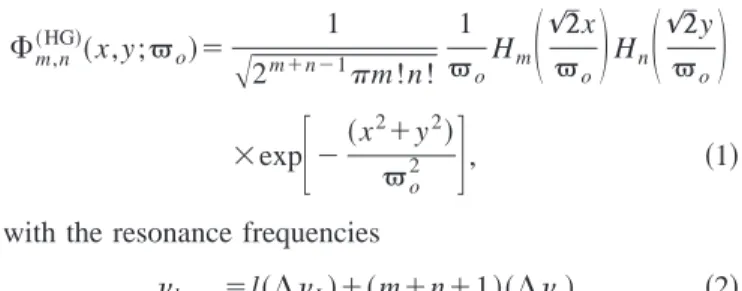
The wave functions of HG mode native to a spherical resonator are given by
⌽m,n共HG兲共x,y;o兲⫽ 1
冑
2m⫹n⫺1m!n! 1 o Hm冉
&x o冊
Hn冉
&y o冊
⫻exp冋
⫺共x 2⫹y2兲 o2册
, 共1兲with the resonance frequencies
l,m,n⫽l共⌬L兲⫹共m⫹n⫹1兲共⌬t兲, 共2兲
where Hn(•) is a Hermite polynomial of order n, o is the
laser beam waist, l is the longitudinal mode index, m and n are the transverse mode indices, ⌬L is the longitudinal
mode spacing, and⌬Tis the transverse mode spacing. For a
plano-concave resonator, as shown in Fig. 1, the transverse mode spacing is given by
⌬T⫽⌬L
冋
1
cos⫺1
冉
冑
1⫺d
R
冊册
, 共3兲where d is the cavity length and R is the radius of curvature of the output coupler. Recently, we use a doughnut pump profile to generate the LG0⫾Nmodes in an a-cut Nd:YVO4 laser 关4兴 and to generate the elliptical modes in a c-cut Nd:YVO4laser关5兴. The emission from a-cut Nd:YVO4 crys-tals is linearly polarized, whereas the emission is usually a random polarization for c-cut crystals. The polarization
prop-erty is the main difference between a-cut and c-cut crystals. Therefore, when a linear polarized emission is desired, a-cut crystals are used. The LG0⫾N modes are formed by the superposition of the degenerate HG eigenmodes
⌽K,N(HG)⫺K(x,y ; o), where K⫽0,1,2, . . . ,N 关3兴 ⌽0,共LG兲⫾N共x,y;兲⫽2⫺N/2
兺
K⫽0 N冉
N K冊
1/2 共⫾i兲K⌽K,N ⫺k 共HG兲 共x,y;o兲. 共4兲To generate LG0⫾N modes we setup the resonator length to be as short as possible for reaching single-longitudinal mode operation and ⌬LⰇ⌬T.
As indicated in Eq.共3兲, adjusting the cavity length d may result in the ratio⌬L/⌬Tto be an integer S. These cavity
configurations constitute a high degree of frequency degen-eracy. From Eq.共2兲 it can be seen that lowering 共raising兲 the longitudinal mode index l by K, while simultaneously raising
共lowering兲 the sum of the transverse mode indices n⫹m by
S⫻K, will leave the frequency unaltered. It has been shown that configurations with a high degree of frequency degen-eracy allow closed geometric trajectories 关6兴. So far, the transverse modes suited in a frequency degenerate cavity are focused on one dimension关7兴. Here we use the cavity shown
*Email address: [email protected]
FIG. 1. Schematic of a fiber-coupled diode-end-pumped micro-chip laser; a typical pump profile of a fiber-coupled laser diode away from the focal plane; the cavity length d is set at ⌬L/
in Fig. 1 to investigate 2D transverse modes in a frequency degenerate cavity with an a-cut Nd:YVO4 microchip laser. The radius of curvature of the output coupler is 10 mm. The pump radius on the crystal is controlled to be around p
⫽0.16– 0.22 mm. Experimental measurement reveals that
the thickness of the pump ring can be approximately ex-pressed as⌬p⫽0.025⫹0.16p (mm). In other words, the thickness of the pump profile relatively increases with in-creasing the pump radius. The fundamental mode size in the present cavity is o⬇0.04 mm. From the formula Fr
⫽p
2
/(02), the Fresnel number can be estimated to be 5–10. Since the emission from an a-cut crystal is naturally linearly polarized, the experimental pattern is a pure scalar field. Slightly adjusting the cavity length in the vicinity of
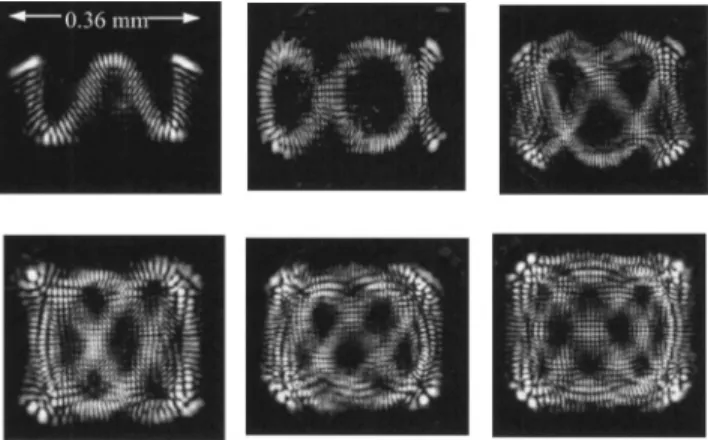
⌬L/⌬T⫽3 and controlling the pump spot size, several
typical sharp patterns on the concave mirror are obtained and shown in Fig. 2. The sharp patterns outside the resonator are found to be preserved in free-space propagation. The preser-vation of the experimental patterns consists of the property that HG modes remain HG field patterns as they propagate. The incident angle of the pump beam is controlled to be within⫾5° with respect to the longitudinal axis. The critical points to obtain a locked pattern consist in the adjustment of the cavity length and the use of the doughnut pump profile. The fine modification of the pump angle can further enhance the sharp patterns, however, it is very difficult to precisely define the optimal incident angle for each pattern. Although each different sharp pattern is obtained at a different cavity length, the change of the cavity lengths is rather short. The difference between the cavity lengths of two sharp patterns is approximately 30 m. The difference of the cavity lengths for different sharp patterns mainly arises from the fact that the effective cavity length depends on the order of the trans-verse mode, even though the dependence is very weak. Spe-cifically there is unavoidable astigmatism in the present cav-ity because of the thermal lensing effect and anisotropic properties of the gain medium. Astigmatism-induced split-ting of the two degenerate mode frequencies can lead to a significant influence on laser dynamics关4兴. Here we believe that the inevitable astigmatism plays an important role not only for the dependence of the effective cavity length on the transverse order but also for the origin of the symmetry
breaking of the present experiment. The range of the cavity length for each sharp pattern to be structure stable is around 10 m. When the cavity length does not meet the range of the locking modes, the transverse pattern is usually irregular and vague. It can be seen that the observed sharp patterns are completely unlike a HG or LG mode. Interestingly, these patterns are well localized on the Lissajous figures that are classical periodic orbits for a 2D anisotropic harmonic oscil-lator with commensurate frequencies. The measurement of the optical spectrum shows that all observed patterns are single frequency emissions. In other words, the transverse pattern formation is a spontaneous process of cooperative frequency locking关8兴. However, it is worthwhile to note that the frequency locking of the present patterns is among dif-ferent transverse order with the help of difdif-ferent longitudinal order.
To explain the observed patterns, it is essential to know how the wave functions can be associated with the classical trajectories for a 2D harmonic oscillator. Here we use the representation of the SU共2兲 coherent state to make a connec-tion between the wave funcconnec-tions and the classical trajectories in a 2D anisotropic oscillator with commensurate frequen-cies. The Hamiltonian for a 2D quantum harmonic oscillator is generally given by H⫽⫺ប 2 2mx 2 x2⫹ ⫺ប2 2my 2 y2⫹ mxx 2 x2 2 ⫹ myy 2 y2 2 . 共5兲 The eigenfunctions of Eq. 共5兲 can be expressed as
⌽m,n共x,y;x,y兲⫽ 1
冑
2m⫹n⫺1m!n! 1冑
xy ⫻Hm冉
&x x冊
Hn冉
&y y冊
⫻exp冋
⫺冉
x 2 x 2⫹ y2 y 2冊册
, 共6兲 where x⫽冑
2ប/(mxx) and y⫽冑
2ប/(myy). Theei-genvalues associated with the eigenfunctions
⌽m,n(x,y ;x,y) are given by
Em,n⫽
冉
m⫹12
冊
បx⫹冉
n⫹ 12
冊
បy. 共7兲 As is well known, the classical trajectory for 2D anisotropic harmonic oscillator with commensurate frequencies is a pe-riodic orbit, called a Lissajous figure关9兴. However, the con-ventional eigenstates⌽m,n(x,y ;x,y) do not manifest thecharacteristics of classical periodic orbits even in the corre-spondence limit of large quantum numbers.
FIG. 2. Experimental results for the typical transverse patterns observed in a cavity length near⌬L/⌬T⫽3.
Recently, the wave functions associated with the classical elliptical trajectories in a 2D isotropic harmonic oscillator have been analytically constructed by using the representa-tion of SU共2兲 coherent states 关10,11兴. Mathematically, the SU共2兲 coherent states is a superposition of degenerate eigen-states. Here we find that the wave functions related to the Lissajous figures can be constructed by coherent states simi-lar to the SU共2兲 representation. Consider a 2D anisotropic harmonic oscillator with frequencies in the ratio x:y
⫽q:p, where p and q are integers. The eigenvalues can be
rewritten in the form
Em,n⫽
冋冉
m⫹12
冊
q⫹冉
n⫹ 12
冊
p册
ប, 共8兲 where is the common factor of the frequencies x and y. For q:p anisotropic quantum oscillators, it is explicitthat a family of the eigenstates ⌽pK,q(N⫺K)(x,y ;x,y)
with K⫽0,1,2, . . . ,N are degenerate for a given index N and the eigenvalue of these eigenstates is given by EN⫽关pqN
⫹(p⫹q)/2兴ប. As in the Schwinger representation of the SU共2兲 algebra, the coherent state for q:p anisotropic quantum oscillators is given by ⌿N p,q共x,y; x,y,兲⫽ 1 共1⫹兩兩2兲N/2
兺
K⫽0 N冉
N K冊
1/2 ⫻K⌽ pK,q共N⫺k兲共x,y;x,y兲, 共9兲where the parameter is, in general, complex and 兩兩2 is approximately the ratio of the mean energies in the x and y axes. With the SU共2兲 coherent state in Eq. 共9兲, the mean energies in the x and y axes are derived to be
EN,x⫽
冋
pqN冉
兩兩 2 1⫹兩兩2冊
⫹ q 2册
ប, EN,y⫽冋
pqN冉
1 1⫹兩兩2冊
⫹ p 2册
ប. 共10兲 It can be found that EN⫽EN,x⫹EN,y and the ratio EN,x/EN,yapproaches兩兩2 for NⰇ1.
For making a connection with the classical periodic or-bits, it is convenient to express the parameteras the polar representation, i.e., ⫽A exp(i). In terms of A and , the coherent state ⌿Np,q(x, y ;x,y,Aei) can be associated
with the Lissajous figures,
x共t兲⫽
冑
2具
x2典
cos冉
qt⫺ p冊
, y共t兲⫽冑
2具
y2典
cos共pt兲, 共11兲 where具
x2⬘典
⫽冉
A 2 1⫹A2pN⫹ 1 2冊
x 2 2 ,具
y2典
⫽冉
1 1⫹A2qN⫹ 1 2冊
y 2 2 . 共12兲Note that
具
x2典
and具
y2典
are, respectively, the expectation values of x2 and y2 for the coherent state⌿N p,q
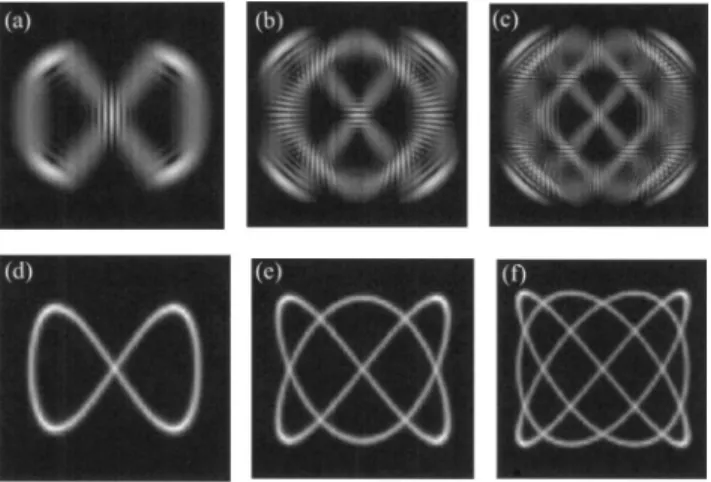
(x, y ;x,y,Aei). Figure 3 shows a comparison
be-tween the SU共2兲 coherent states and the classical Lissajous figures for the frequency ratio of 2:1, 3:2, and 4:3 with A
⫽1, ⫽/2, x⫽y, and N⫽30. It can be seen that the
distributions of 兩⌿N p,q
(x,y ;x,y,Aei)兩2 are in good
agreement with the classical periodic orbits. Moreover, the behavior of 兩⌿Np,q(x, y ;x,y,Aei)兩2 illustrates
geometri-cally Bohr’s correspondence principle: the velocity of the classical particle is at a minimum at the apogees of the mo-tion, and therefore the probability density has a peak at these points.
Although the number of eigenstates used in the coherent state⌿Np,q(x,y ;x,y,Aei) is N⫹1, the number of
domi-nant eigenstates for wave localization is rather small for high-order states. To manifest the efficiency of wave local-ization, we modify⌿Np,q(x,y ;x,y,Aei) to define a
par-tially coherent state as
⌿N, M p,q 共x,y;x ,y,Aei兲 ⫽
冋
兺
K⫽J N⫺J冉
N K冊
A 2册
⫺1/2冋
K兺
⫽J N⫺J冉
N K冊
1/2 AKeiK ⫻⌽pK,q共N⫺K兲共x,y;x,y兲册
, 共13兲where the index M⫽N⫺2J⫹1 represents the number of eigenstates used in the state ⌿N, Mp,q (x, y ;x,y,Aei).
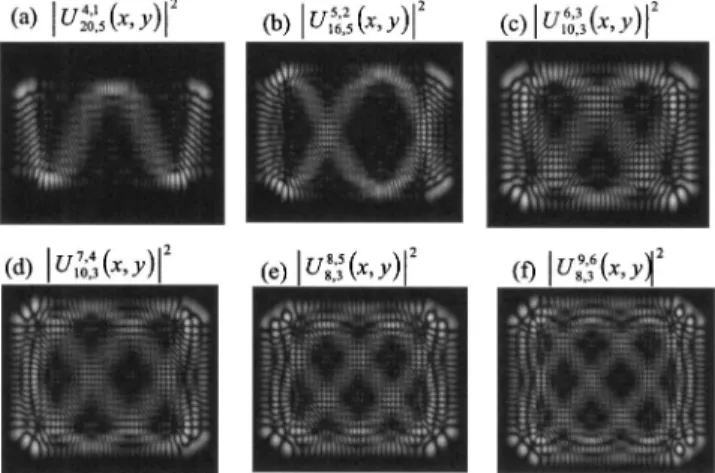
Numerical analyses reveal that the transverse pattern shown in Fig. 2 can be nicely explained by the partially coherent state in Eq. 共13兲. As mentioned earlier, the forma-tion of the observed patterns is a cooperative frequency lock-ing among different transverse orders with the help of differ-ent longitudinal orders. For a cavity near⌬L/⌬T⫽3, the
FIG. 3. A comparison between the coherent states and the clas-sical Lissajous periodic orbits for p:q to be 2:1, 3:2, and 4:3.
共a兲–共c兲 The coherent states calculated with Eq. 共9兲 and ⫽exp(i/2) and N⫽30. 共d兲–共f兲 The coherent states calculated
family of the transverse modes ⌽pK,q(N(HG) ⫺K)(x, y ;o) with a
given index N can be frequency locked by a different longi-tudinal index l⫽L⫿K with a given index L, where K
⫽0,1,2,...,N and p⫺q⫽⫾3. Substituting m⫽pK, n⫽q(N ⫺K), l⫽L⫿K, p⫺q⫽⫾3, and ⌬L/⌬T⫽3 into Eq. 共2兲,
the laser frequency of the family ⌽pK,q(N(HG) ⫺K)(x,y ;o) can be found to be L,N⫽L(⌬L)⫹(qN⫹1)(⌬T) independent
of K. From the numerical analysis, the transverse patterns shown in Fig. 2 are found to be associated with the partially coherent states in Eq. 共13兲 with A⫽1 and ⫽0. In other words, the wave functions related to the observed patterns can be in terms of HG modes as
UN, Mp,q 共x,y兲⫽
冋
兺
K⫽J N⫺J冉
N K冊
册
⫺1/2冋
K兺
⫽J N⫺J冉
N K冊
1/2 ⫻⌽共HG兲pK,q共N⫺K兲共x,y;o兲册
共14兲with p⫺q⫽⫾3. Note that for a spherical cavity, the trans-verse components of the resonance frequencies are not de-generate for each eigenstate in Eq.共14兲 except for p⫽q. For the Kth eigenstate of the coherent state UN, Mp,q (x,y ), the transverse components of the resonance frequencies are
关qN⫹1⫹(p⫺q)K兴⌬T. If the condition of p⫺q⫽⫾3 is
satisfied, then the frequency of each eigenstate in the coher-ent state UN, Mp,q (x, y ) can be possibly locked with the help of different longitudinal component of (L⫿K)⌬L because of ⌬L/⌬T⫽3. To be brief, the formation of the present
trans-verse patterns is a spontaneous frequency locking in the 2
⫹1 dimension, not a pure transverse mode locking. Figure 4
shows the numerically reconstructed patterns for the results shown in Fig. 2, calculated with Eq.共14兲 for several cases of p⫺q⫽⫾3. It is clear that only 3–5 eigenstates are already sufficient to localize the wave patterns on the classical tra-jectories, even for high-order periodic orbits. The present analysis indicates that the wave function obtained as a linear superposition of a few degenerate eigenstates can provide a more physical description of a phenomenon than the true eigenstates in mesoscopic systems关12兴. The good agreement between the experimental and reconstructed patterns con-firms that the interrelation between wave optics and geo-metrical optics is somewhat similar to that between quantum and classical mechanics. Such an analogy enables us to em-ploy quantum theory in analyzing the formation of high-order laser transverse modes.
In conclusion, we have used the representation of the SU共2兲 coherent state to make a connection between the wave functions and the classical trajectories in a 2D anisotropic oscillator with commensurate frequencies. With the analyti-cal wave function, the experimental transverse patterns asso-ciated with the Lissajous trajectories can be explained very well. The nice explanation suggests that the laser resonators with an identical functional form can be used to attain a more thorough understanding of the quantum-classical connection. It is worthwhile to mention that a similar phenomenon is found in a nonintegrable classical system; the wave patterns of the eigenstates are usually concentrated along unstable periodic orbits instead of being randomly distributed 关13– 15兴. In addition, there are some striking phenomena in open quantum ballistic cavities associated with the wave functions in terms of classical periodic orbits 关16–18兴. Therefore, to construct the connection between the wave functions and classical periodic trajectories is not only useful for explain-ing the present transverse patterns but also helpful for under-standing quantum-classical correspondence as well as the quantum transport in mesoscopic systems. Recently, Doya et al.关19,20兴 have introduced the paraxial approximation to establish an analogy between light propagation along a mul-timode fiber and quantum confined systems. We believe that these analogies will continue to be exploited for understand-ing the physics of mesoscopic systems.
The authors thank the National Science Council for finan-cially supporting this research under Contract No. NSC-91-2112-M-009-030.
关1兴 H. A. Haus, Waves and Fields in Optoelectronics
共Prentice-Hall, Englewood Cliffs, NJ, 1984兲.
关2兴 A. E. Siegman, Lasers 共University Science Books, Mill Valley,
CA, 1986兲.
关3兴 L. Allen, M. W. Beijersbergen, R. J. C. Spreeuw, and J. P.
Woerdman, Phys. Rev. A 45, 8185共1992兲.
关4兴 Y. F. Chen and Y. P. Lan, Phys. Rev. A 63, 063807 共2001兲. 关5兴 Y. F. Chen and Y. P. Lan, Phys. Rev. A 66, 053812 共2002兲.
关6兴 I. A. Ramsay and J. J. Degnan, Appl. Opt. 9, 385 共1970兲. 关7兴 J. Dingjan, M. P. van Exter, and J. P. Woerdman, Opt.
Com-mun. 188, 345共2001兲.
关8兴 L. A. Lugiato, C. Oldano, and L. M. Narducci, J. Opt. Soc.
Am. B 5, 879共1988兲.
关9兴 H. Goldstein, Classical Mechanics, 2nd ed. 共Addison-Wesley,
Reading, MA, 1980兲.
关10兴 S. De Bie`vre, J. Phys. A 25, 3399 共1992兲.
FIG. 4. The numerically reconstructed patterns for the results shown in Fig. 2, calculated with Eq. 共14兲. 共a兲 兩U20,54,1(x,y )兩2; 共b兲
兩U16,5 5,2 (x,y )兩2;共c兲 兩U 10,3 6,3 (x,y )兩2;共d兲 兩U 10,3 7,4
(x,y )兩2;共e兲 兩U 8,3 8,5 (x,y )兩2; 共f兲 兩U8,3 9,6 (x,y )兩2.
关11兴 J. Pollet, O. Me´plan, and C. Gignoux, J. Phys. A 28, 7282 共1995兲.
关12兴 R. Narevich, R. E. Prange, and O. Zaitsev, Phys. Rev. E 62,
2046共2000兲.
关13兴 M. V. Berry, Proc. R. Soc. London, Ser. A 423, 219 共1989兲. 关14兴 E. J. Heller, Phys. Rev. Lett. 53, 1515 共1984兲.
关15兴 F. Simonotti, E. Vergini, and M. Saraceno, Phys. Rev. E 56,
3859共1997兲.
关16兴 R. Akis and D. K. Ferry, Phys. Rev. B 59, 7529 共1999兲.
关17兴 I. V. Zozoulenko and K. F. Berggren, Phys. Rev. B 56, 6931 共1997兲.
关18兴 Y. H. Kim, M. Barth, H. J. Sto¨ckmann, and J. P. Bird, Phys.
Rev. B 65, 165317共2002兲.
关19兴 V. Doya, O. Legrand, F. Mortessagne, and C. Miniatura, Phys.
Rev. Lett. 88, 014102共2002兲.
关20兴 V. Doya, O. Legrand, F. Mortessagne, and C. Miniatura, Phys.