行政院國家科學委員會專題研究計畫 成果報告
波長可調及掃頻式半導體量子點光源
研究成果報告(精簡版)
計 畫 類 別 : 個別型 計 畫 編 號 : NSC 98-2221-E-009-176- 執 行 期 間 : 98 年 08 月 01 日至 99 年 10 月 31 日 執 行 單 位 : 國立交通大學電子工程學系及電子研究所 計 畫 主 持 人 : 林國瑞 計畫參與人員: 碩士班研究生-兼任助理人員:葉庭聿 碩士班研究生-兼任助理人員:陳竑霖 碩士班研究生-兼任助理人員:馬江智 碩士班研究生-兼任助理人員:蘇倍瑩 博士班研究生-兼任助理人員:戴文長 報 告 附 件 : 出席國際會議研究心得報告及發表論文 處 理 方 式 : 本計畫可公開查詢中 華 民 國 99 年 12 月 30 日
行政院國家科學委員會補助專題研究計畫
■ 成 果 報 告
□期中進度報告
波長可調及掃頻式半導體量子點光源
計畫類別:■個別型計畫 □整合型計畫
計畫編號:NSC 98-2221-E-009-176
-
執行期間: 98 年 8 月 1 日至 99 年 10 月 31 日
執行機構及系所:國立交通大學電子工程學系暨電子研究所
計畫主持人:林國瑞
共同主持人:
計畫參與人員:葉庭聿、蘇蓓瑩、馬江智、陳竑霖、戴文長、鄭旭傑
成果報告類型(依經費核定清單規定繳交):□精簡報告 □完整報告
本計畫除繳交成果報告外,另須繳交以下出國心得報告:
□赴國外出差或研習心得報告
□赴大陸地區出差或研習心得報告
■出席國際學術會議心得報告
□國際合作研究計畫國外研究報告
處理方式:
除列管計畫及下列情形者外,得立即公開查詢
□涉及專利或其他智慧財產權,□一年□二年後可公開查詢
中 華 民 國 98 年 10 月 31 日
波長可調及掃頻式半導體量子點光源
Tunable and Swept Quantum Dot Light Sources 計畫編號:NSC98-2221-E-009-176 執行期間:98 年 8 月 1 日 至 99 年 10 月 31 日 主持人:林國瑞 國立交通大學電子工程學系暨電子研究所 助理教授 一、 中文摘要 關鍵詞:量子點雷射、外腔式二極體雷射、波 長可調雷射、掃頻式雷射、光學斷層掃描 本年度計畫延續NSC96的啁啾式推疊量 子點雷射結構(該結構已於本年度獲得兩件美 國專利及一件台灣專利),以及NSC97的大光 學共振腔(Large Optical Cavity)設計,NSC98 中在主動區插入一層低折射率的磊晶層,試圖 將量子點雷射的垂直發散角降低至25度。依此 設計之雷射磊晶片經脊狀波導雷射製程後, L-I-V量測發覺元件起始電流過高,以遠場影 像確認其無法在基態橫模下操作,推測為載子 注入出了問題,往後設計方向將減少LOC厚度 並降低插入層的能障。 由於量子點的載子侷限可以有效地減低 主動區因載子擴散所造成的電流散佈,因此水 平方向的光束成絲現象獲得抑制,即使寬達10 µm的波導仍能維持水平單光模;而當波導蝕 刻穿過主動區時,即使寬度甚窄,蝕刻界面仍 不會造成大量的非輻射表面復合,而量測3 µm 波導的水平發散角更可高達25度,這說明了近 似圓形對稱的量子點邊射型雷射是可以被實 現的。 以量子點為主動層的半導體光源具有寬 廣的增益頻譜,應用上可研製成波長可調或頻 率掃描的光源。為最佳化調啾式推疊的量子點 結構,我們要對量子點的增益頻譜進行量測, 此處採用了多區段雷射共振腔結構,搭配多通 道電流源以及協同廠商開發之16支腳之探針 卡,我們得以對不同區段的量子點主動區各別 施加偏壓,藉由量測自發性放大輻射來萃取量 子點的增益或吸收頻譜。實驗顯示七層堆疊量 子點雷射,在電流密度800 A/cm2下,發光頻寬 可達130 nm。 最後,我們將量子點雷射晶粒封裝在特殊 訂製的TO46(共振腔長度可達5 mm),並以 Littrow架構實現外腔式量子點雷射,雷射必須 以TEC溫控以維持穩定的輸出波長,而透過旋 轉光柵的角度得以達成波長可調的目的。 二、 英文摘要
Keywords: Quantum Dot Lasers, External Cavity Diode Lasers, Tunable Lasers, Frequent Swept Lasers, Optical Coherence Tomography
In NSC96, we proposed the chirped multilayer quantum dot (QD) laser structure. In NSC97, large optical cavity (LOC) design was incorporated to reduce the vertical far-field angle down to 34 degree. In this year (NSC98), we try to further reduce the vertical far-field angle down to 25 degree by insertion of low-index layers in the active region. However, lasing was not achieved in this new design. To have efficient current injection, we should reduce the thickness of LOC and the barrier height of low-index layers.
Since the carrier confinement of QDs can effectively reduce the current spreading due to carrier diffusion, the beam filamentation is much
reduced in QD lasers, and stable single lateral mode is preserved even when the ridge width is as wide as 10 μm. Moreover, non-radiative surface recombination is suppressed even though the ridge waveguide is etched through active region. With good device performances, the lateral far-field angle is as large as 25 degree in our 3 μm etched-through-waveguide structure. It is therefore very promising to achieve QD lasers with near-circular beam divergence.
The possible applications for broad gain spectrum of QD medium is wavelength-tunable or frequency-swept lasers. To optimize the layer structure of chirped QD lasers, we have to first experimentally determine the gain spectrum of QDs. The improved segmented contact scheme is implemented with 16-pin probe card and multi-channel current sources. The amplified spontaneous emissions are measured and analyzed to extract the gain and/or absorption spectrum. The spectral width is determined to be as large as 130 nm for 7-layer QD emitters under current injection of 800 A/cm2.
Finally, we packaged the QD chips on the specially designed TO46, and the external cavity QD lasers are assembled in Littrow configuration. To stabilize the output wavelength, the TO-packaged lasers should be TEC controlled, and the wavelength tuning is achieved by rotating the external mounted grating.
三、 計畫緣由與目的
寬頻可調雷射(widely tunable lasers)在 工程、科學與醫學等領域一直是受到關注的熱 門研究主題,特別可應用於波長分波多工技術 (Wavelength Division Multiplexing or WDM)
所 需 的 可 調 光 源 及 光 學 斷 層 掃 描 (Optical
Coherence Tomography or OCT)所需的掃頻光 源。通常對於半導體雷射的波長調制,除了藉 由改變元件操作溫度、變化雷射共振腔的長度 來達成,比較有效而實際的方式可將雷射共振 腔串接數個不同功用的主動/被動光腔的多區 段結構(multi-section / multi-segment lasers) 或著使用外部反射裝置的外腔式架構來達成。 由於多區段結構的可調雷射需要昂貴而 複雜的電子束微影製程及磊晶再成長步驟,而 且在波長調制範圍及效率的考量下,使用外部 共振腔的方式最為廣泛的採用,除此之外,外 腔式半導體雷射還有兩項特點,第一:外部共 振腔結構能夠提供良好的旁模抑制比而達到 穩定的單模操作;第二:外部共振腔結構具有 較長的光子生命期,能夠有效降低雷射頻譜的 線寬。 近年來,隨著量子結構的發展,量子井與 量子點半導體雷射已逐漸地應用於外腔式結 構 以 作 為 單 模 操 作 且 具 窄 線 寬 的 可 調 光 源 [1-4]。目前外腔式量子井雷射的波長調制範 圍,最佳研發成果在1.5 µm波段高達240 nm [3];而在1.3 µm波段也有160 nm [4],然而缺 點是臨界電流密度太大(> 30 kA/cm2)而限制 其實用性。 相較於量子井雷射,量子點雷射有兩項特 性,第一:量子點的能態密度較低,其基態光 學增益很容易達到飽和;亦即在較低的注入電 流密度下(~1 kA/cm2)就有相當數量的載子 佔據較高的能階。第二:因為均勻與非均勻寬 化效應(homogeneous/inhomogeneous spectral broadening)的相互作用,連續變化量子點雷 射的發光波長變得可行,而且可以抑制模態跳 躍(mode-hopping)的現象。 由於量子點的成長條件及堆疊應力控制 需要相當的經驗累積,國內僅少數單位展示1.3 µm波段的雷射,因此尚無外腔式量子點雷射 的 相 關 研 發 , 而 國 外 文 獻 發 表 也 相 當 有 限
[5-10] : 一 則 在 砷 化 鎵 基 板 上 成 長 InAs/InGaAs/GaAs量子點,其波長連續變化涵 蓋1033~1234 nm,調制範圍高達201 nm [5]; 另一則於磷化銦基板上成長InAs/InGaAsP量 子點,在1.55 µm的發光波段附近,其波長連 續調制範圍亦達166 nm [8]。除了上述提升波 長調制範圍,國外研究單位也正開始關注降低 頻譜線寬及提高輸出光功率等特性 [9-10]。 本年度計畫將在砷化鎵基板上成長量子 點來研發1.3 µm波段之波長可調半導體量子 點雷射,並以實現可應用於OCT之掃頻式等效 寬頻光源為目標。一方面考量砷化鎵基板的成 本低、磊晶材料及技術成熟,未來將在消費市 場上具有競爭優勢;另一方面則是光源波段可 應用於都會區域網路的通訊光源,同時也符合 生醫光源中兼顧解析度與穿透深度的波段。 四、研究方法及成果 本提案中之外腔式半導體雷射選擇以自 組式成長(self-assembled growth)量子點為主 動區,由於量子點的大小、形狀及成分組成呈 現相當寬廣的分佈,加上量子點本身的密度亦 受到成長條件的限制而相當有限(1E10~1E11 cm-2),因此以量子點作為半導體雷射的增益 介質,其材料增益偏離理論的預測而呈現相當 低的飽和增益,解決方式為多層堆疊來提升元 件操作所需的光模增益。ㄧ般來說,傳統量子 點雷射的多層堆疊均採用相同的磊晶成長條 件,以符合雷射窄頻的發光特性,我們稱之為 均勻堆疊量子點(uniformly stacked QDs)。 量 子 點 主 動 區 的 飽 和 增 益 雖 然 相 當 有 限,然其增益頻譜(gain spectrum)卻相當的 寬廣,為充分運用其寬廣的頻譜,L. H. Li et al. [4] 改變覆蓋於InAs QDs 上方之InGaAs QW 的In 成分來連續調變各層量子點的中心發光 波長,獲致發光頻寬高達121 nm 的超高亮度 二極體,我們將此調變方式稱之為連續啁啾式 堆疊(continuously chirpy stack)量子點。
本年度計畫延續 NSC96 的啁啾式推疊量
子點雷射結構(該結構已於本年度獲得兩件美
國專利及一件台灣專利),以及NSC97 的大光
學共振腔(Large Optical Cavity)設計,NSC98 中在主動區插入一層低折射率的磊晶層,試圖 將量子點雷射的垂直發散角降低至 250,結構 設計及雷射近場模擬結果如圖一。依此設計之 雷射磊晶片經脊狀波導雷射製程後,L-I-V 量 測發覺元件起始電流過高,以遠場影像確認其 無法在基態橫模下操作,推測為載子注入出了 問題,往後設計方向將減少 LOC 厚度並降低 插入層的能障。 圖一:多層量子點雷射結構及橫模近場模擬 由於量子點的載子侷限可以有效地減低 主動區因載子擴散所造成的電流散佈,因此水 平方向的光束成絲(beam filamentation)現象 獲得抑制,即使寬達10 μm 的波導仍能維持水 平單光模;而當波導蝕刻穿過主動區時,即使 寬度甚窄,蝕刻界面仍不會造成大量的非輻射 表面複合(non-radiative recombination)。圖二 顯示之量子點主動區已被蝕刻,而其中 3 μm 波導的水平發散角可高達 250,這說明了近似 圓形對稱的量子點邊射型雷射是可以被實現 的。
-30 -20 -10 0 10 20 30 0.0 0.2 0.4 0.6 0.8 1.0 Ridge Width 3μm 10μm 20μm In tensi ty (no rm .) Angle (degree) 圖二:脊狀波導量子點雷射及其水平發散角 以量子點為主動層的半導體光源具有寬 廣的增益頻譜,應用上可研製成波長可調或頻 率掃描的光源。為最佳化調啾式推疊的量子點 結構,我們要對量子點的增益頻譜進行量測, 此處採用了多區段雷射共振腔結構,搭配多通 道電流源以及協同廠商開發之 16 支腳之探針 卡,我們得以對不同區段的量子點主動區各別 施加偏壓,藉由量測自發性放大輻射來萃取量 子點的增益或吸收頻譜。圖三顯示其量測示意 圖及七層堆疊量子點雷射的量測結果,在電流 密度800 A/cm2下,發光頻寬可達130 nm。 1150 1200 1250 1300 1350 1400 -20 -10 0 10 20 Ne t gai n ( cm -1) Wavelength (nm) 133 A/cm2 267 A/cm2 533 A/cm2 800 A/cm2 圖四:七層量子點增益頻譜及量測示意圖 最後,我們將量子點雷射晶粒封裝在特殊 訂製的 TO46(共振腔長度可達 5mm),並以 圖四之 Littrow 架構實現外腔式量子點雷射, 雷射必須以 TEC 溫控以維持穩定的輸出波 長,而透過旋轉光柵的角度得以達成波長可調 的目的。 圖五:外腔式量子點雷射量測架構
五、結論與建議 本年度計畫中,我們以 Littrow 架構試作 外腔式量子點雷射,同時也對多區段電極架構 進行頻譜量測與分析,其發光頻寬高達 130 nm。在磊晶與製程上,雖然新設計無法獲致 垂直發散角小於 25 度的實驗結果,但可透過 製程吃穿量子點主動層將水平發散角提升至 25 度。 今後將繼續進行量子點雷射的結構設計 與製程改進,期能實現發散角小於30度之近似 圓形對稱的量子點邊射型雷射。此外,我們也 開始以相對雜訊強度研究啁啾式堆疊之多層 量子點雷射的動態特性;我們還觀測到新奇的 自鎖模現象,這在砷化鎵基板是首次被展示, 也將在未來的計畫提案中深入探討。本計劃的 研究成果,已於本年度發表國內外會議論文共 5篇,期刊論文共2篇以及專利獲證共3件。 六、參考文獻
[1] D. Mehuys, M. Mittelstein, A. Yariv, R. Sarfaty, and J. E. Ungar, “Optimized Fabry-Perot (AlGa) As quantum-well lasers tunable over 105 nm,” Electron. Lett., vol. 25, pp. 143–145, 1989.
[2] A. Lidgard, T. Tanbun-Ek, R. A. Logan, H. Temkin, K. W. Wecht, and N. A. Olsson, “External-cavity InGaAs/InP graded index multiquantum well laser with a 200 nm tuning range,” Appl. Phys. Lett., vol. 56, pp. 816–817, 1990.
[3] H. Tabucho and H. Ishikawa, “External grating tunable MQW laser with wide tuning range of 240 nm,” Electron. Lett., vol. 26, pp. 742–743, 1990.
[4] C. P. Seltzer, M. Bagley, D. J. Elton, S. Perrin, and D. M. Cooper, “160 nm continuous tuning of an MQW laser in an external cavity across the entire 1.3 μm communication window,” Electron. Lett., vol. 27, pp. 95–96, 1991.
[5] P. M. Varangis, H. Li, G. T. Liu, T. C. Newell, A. Stintz, B. Fuchs, K. J. Malloy, and L. F. Lester, “Low-threshold quantum dot lasers with 201 nm tuning range,” Electron. Lett. vol. 36, pp. 1544-1545 , 2000. [6] H. Li, G.T. Liu, P.M. Varangis, T.C. Newell, A. Stintz,
B. Fuchs, K.J. Malloy, L.F. Lester, “150-nm Tuning Range in a Grating-Coupled External Cavity Quantum-Dot Laser,” IEEE Photon. Technol. Lett. Vol. 12, pp. 759, 2000.
[7] C. Ni. Allen, P. J. Polle, P. Barrios, P. Marshall, G. Pakulski, S. Raymond, and S. Fafard, “External cavity quantum dot tunable laser through 1.55 μm,” Physica E, vol. 26, pp. 372 , 2005.
[8] G. Ortner, C. Ni. Allen, C. Dion, P. Barrios, D. Poitras, D. Dalacu, G. Pakulski, J. Lapointe, P. J. Poole, W. Render, and S. Raymond, “External cavity InAs-InP quantum dot laser with a tuning range of 166 nm,” Appl. Phys. Lett. vol. 88, 121119, 2006.
[9] A. Tierno, T. Ackemann, “Tunable, narrow-band light source in the 1.25 μm region based on broad-area quantum dot lasers with feedback,” App. Phys. B, vol. 89, pp. 585-588, 2007.
[10] A. Yu. Nevsky, U. Bressel, I. Ernsting, Ch. Eisele, M. Okhapkin, S. Schiller, A. Gubenko, D. Livshits, S. Mikhrin, I. Krestnikov, A. Kovsh, “A narrow-line-width external cavity quantum dot lasers for high-resolution spectroscopy in the near-infrared and yellow spectral ranges,” App. Phys. B, vol. 92, pp. 501-507, 2008.
出席國際學術會議心得報告
計畫編號 NSC 98-2221-E-009-176 (98N327) 計畫名稱 波長可調及掃頻式半導體量子點光源 出國人員姓名 服務機關及職稱 Van-Truong Dai / 交通大學電子工程系所 / 博士候選人會議時間地點 4–8 October 2009 @ Antalya, Turkey
會議名稱 The 22nd Annual Meeting of the IEEE Photonics Society Meeting - LEOS 2009
發表論文題目 Modeling the Simultaneous Two Ground-State Lasing Emissions in Chirped
Quantum Dot Lasers
一、參加會議經過
22nd Annual Meeting of the IEEE Photonics Society was held at Belek, Antalya, Turkey, October, 4th – 8th 2009. This year’s Annual Meeting features a broad spectrum of activities including plenary, invited and contributed papers, special symposia, short courses and special sessions on Creative Teaching Methods and on Careers in Research. The program sub-committees have put together an excellent program consisting of about 135 invited talks and 320 contributed papers. The conference has 21 topics and divided into 8 rooms. The conference topics are as follows:
− Bio-photonics − Display
− Electro-optic sensors and systems − Integrated optics and optoelectronics − High power and short wavelength lasers − Microwave photonics
− Nano-photonics − Nonlinear optics
− Optical communications
− Optical fiber and planer waveguide technology − Optical interconnects and processing systems − Optical material and processing
− Optical network and systems − Semiconductor lasers
− Optoelectronic packaging, manufacturing and reliability − Photo-detectors and imaging
− Solid State Lasers
− SPECIAL SYMPOSIUM ON The Convergence of Wired and Wireless Services in In-Building and Access Networks
− SPECIAL SYMPOSIUM ON New Materials for Photonics
− SPECIAL SYMPOSIUM ON Optical Networks and Devices for Data Centers
二、與會心得
The conference brings to the participants opportunity to present their works in different research branches in photonics society. Especially, this is the good opportunity for young researchers to learn a lot of things from experienced researchers in the photonics field. The first day, there are three short courses. These courses not only informed about fundamental of these fields, but also about hot research topics today. Especially, in the evening photonics society leaders gave their talks about creative teaching and research career. The second, third and fourth day, the conference began from 8h30 to 17h00. All presentations at the conference are oral. These talks provided much effective information for participants discussing and sharing their experience in science and technology. Our paper about “Modelling the Simultaneous Two Ground-State Lasing Emissions in Chirped Quantum Dot Lasers” was presented on “Inter-band and Quantum Dot Lasers” section (9h45-10h00, 8th October).
In summary, the conference not only gave me a big chance to present my work but also opened in my mind many directions in my future research. I also learnt many things in science as well as in education from the conference.
Modeling the Simultaneous Two Ground-State
Lasing Emissions in Chirped Quantum Dot Lasers
Gray Lin, Van-Truong Dai, and Chien-Ping Lee
Dept. of Electronics Engineering, National Chiao-Tung Univ., Hsinchu, 30010, Taiwan, R.O.C.
Abstract-Rate-equation model is employed to investigate the
anomalous threshold lasing spectra of chirped quantum dot lasers. Simultaneous two-wavelength lasing is attributed to two ground-state emissions from chirped multilayers of InAs/InGaAs quantum dots.
I. INTRODUCTION
Self-assembled quantum dots (QDs) are subjected to inhomogeneity in shapes, sizes, as well as compositional non-uniformity. Optical emitters incorporated with QD gain media are therefore characterized with low saturated gain but broad gain spectra. Moreover, QD lasers with multilayer stacking, either uniform or chirped [1, 2], exhibit device characteristics and spectral behaviors very different from conventional quantum well lasers.
Simultaneous ground-state (GS) and excited-state (ES) lasing emissions well above threshold were demonstrated for uniform-stacked 3-layer QD lasers in [2]. Master-equation model was employed to explain these results. Incomplete gain clamping and retarded carrier relaxation is identified as the origin of that effect.
In this paper, rate-equation model is carried out to theoretically analyze our recent experimental works of simultaneous two-wavelength lasing emissions around threshold in chirp multilayer QD lasers [1]. Inter-well transport in multilayer QD structure as well as linear optical gain for chirped QD ensembles is included to consistently explain the measured results.
II. THEORETICAL MODEL
The light-current-spectrum characteristics of QD lasers can be theoretically calculated by solving a coupled set of carrier and photon rate equations [3, 4], taking into account both the size distribution of QDs and a series of longitudinal cavity modes.
Each QD is assumed to have discrete GS and ES, as well as continuum-like upper states (US), with degeneracy of 2, 6, and 30, respectively. Condition of charge neutrality is assumed and an electron-hole pair is treated as an exciton. Relaxation and recombination can occur only within the same QDs and approximated by a common time constant [4].
InAs wetting layer and InGaAs QW layer, where InAs QDs are embedded, serve as carrier reservoirs for QDs and are modeled by one discrete level with degeneracy of 100. Since carrier populations among multilayer QDs is facilitated only through QW states, carrier distribution among multilayer
structure is better described by transport between neighbor wells. For simplicity, we assume that all carriers are injected into the QW state in the first layer. An inter-well transport time is adopted for the first time to access the non-uniform contribution intrinsic in chirped multilayer QD structure.
Based on the density-matrix equation as suggested in [4], linear optical gain for each group of QD ensembles contributing to multi-longitudinal photon modes is separately calculated for subsequent convolution integral. Homogeneous broadening due to polarization dephasing is considered by Lorentzian lineshape function while inhomogeneous broadening due to the dot size fluctuation is represented by Gaussian distribution function.
III. RESULTS AND DISCUSSION
The calculation model shown above is applied first to the uniform 3-layer QD lasers as in [2] and then to the chirped 10-layer QD lasers shown in Fig. 1. Chirped multi10-layer QD 10-layers with 2-, 3- and 5-layer of longer-, medium- and short-wavelength QD stacks (designated as 2*QDL, 3*QDM and
5*QDS) are engineered in the laser structure, which
corresponding to InAs QDs of 2.6 ML capped by InGaAs of 4 nm, 3 nm and 1 nm, respectively. The stacking sequence is arranged so that QDL is near the n-side.
The carrier relaxation time in QDs (i.e. τue=τeg=τug) is taken
as 7 ps while the radiative recombination time (τr) is taken as
0.75 ns, without any dependence on QD states to a first approximation. However, the carrier relaxation time constants from QW states to US of QDs (i.e. τwu) are setting parameters
dependent on energy separation of ΔEwu. The relation between
relaxation and escape times is dictated by the principle of detailed balance.
Figure 1. The schematic diagram of chirped multilayer QD structure. This work was supported by the Ministry of Education under the Aiming for
the Top University and Elite Research Center Development Plan, Taiwan National Science and Technology Program for Nanoscience and Nanotechnology (NSC 97-2120-M-009-004) and the National Science Council (NSC 97-2221-E-009-158). QDS QDS QDS QDL QDL QDM QDM QDM N-AlGaAs cladding P-AlGaAs cladding GaAs spacer GaAs spacer QDS QDS InGaAs QW InAs QDs 672 ThH5 9.45 - 10.00 978-1-4244-3681-1/09/$25.00 ©2009 IEEE
In uniform 3-layer QD lasers, consistent calculated emission spectra of simultaneous GS and ES lasing well above threshold are achieved both with and without inter-well transport. The only difference is the carrier populations in the QW and QD states are higher in the first layer. An inter-well transport time of 0.1 ps shows almost even carrier distribution, which is the case in MQW system with large conduction band offset [5]. Uniform multilayer structure can therefore be lumped into one group without transport.
For chirped 10-layer QD lasers, 2*QDL, 3*QDM and 5*QDS
are lumped into three groups with inter-group transport time of 0.5 ps. The center wavelengths of QDL, QDM and QDS are
experimentally determined to be 1261 nm, 1220 nm and 1170 nm, respectively, for the GS and 1183 nm, 1146 nm and 1102 nm, respectively, for the ES. Other parameters we used are as follows. The QD density per layer is 5*1010 cm-2. The full
width at half maximum (FWHM) of inhomogeneous and homogeneous broadening are 25 meV and 15 meV, respectively. The cavity length is 2 mm, the optical confinement factor per layer is 0.0075, as-cleaved mirror reflectivity is 32%, the cavity loss is 4.7 cm-2, the effective
refractive index is 3.5, and the stripe width is 5 μm.
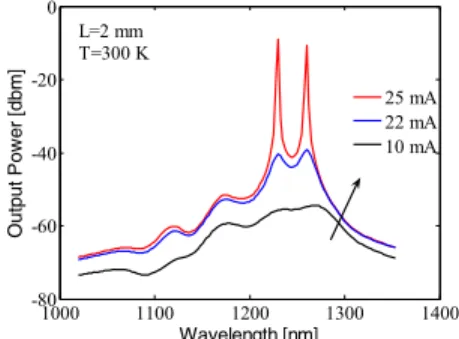
The calculated light-emission spectra are shown in Fig. 2. Simultaneous two-wavelength lasing around threshold current of 30 mA is well resolved from two GS of QDL and QDM with
peak wavelength of 1261 nm and 1215 nm, respectively. Fig. 3 shows the average populations as a function of injection current for individual GS and ES of QDL, QDM and QDS. The
origin of the effect is attributed to the carrier population of 3*QDMGS is pinned at threshold gain approximately of the
same level as the saturated gain of 2*QDLGS. That the QDLES
population increases at a higher rate than QDMES and QDSGS is
due to the lower energy state of QDLES. By the way, saturated
population of QDSGS and increasing higher population of
QDSES do not contribute to emission spectra as they are
subjected to large absorption. Note that carrier leakage under high current injection may be severe and is not considered in our calculation. Fig. 4 shows the percentage of carrier recombination in all QD states and QW state. Most of injected current recombines through QD states. Below lasing threshold, carrier distribution per-QD layer is higher in longer-wavelength QD-stack near the n-side. However, carrier pinning
and retarded relaxation render decreasing fraction of current recombination above threshold.
IV. SUMMARY
We have theoretically analyzed the chirped 10-layer QD lasers. The average population of QD states and the percentage of recombined carriers among chirped multilayers are quantitatively understood within a rate-equation model. Simultaneous two GS lasing emissions around threshold is attributed to the threshold gain of medium-wavelength stack is pinned to the saturated gain of longer-wavelength QD-stack at the particular cavity length. A further understanding of the lasing properties of various QD material systems may lead to improved device performance as well as novel device applications.
REFERENCES
[1] G. Lin et al., “Novel chirped multilayer quantum dot laser,” Proc. SPIE, Vol. 6997, pp. 69970R, April 2008.
[2] A. Markus et al., “Simultaneous two-state lasing in quantum-dot lasers,” Appl. Phys. Lett., vol. 82, pp. 1818-1820, March 2003.
[3] C. Meuer et al., “Static gain saturation in quantum dot semiconductor optical amplifiers,” Opt. Exp., Vol.16, pp. 8269-8279, May 2008. [4] M. Sugawara, K. Mukai, Y. Nakata, and H. Ishikawa, “Effect of
homogeneous broadening of optical gain on lasing spectra in
self-assembled InxGa1-xAs/GaAs quantum dot lasers,” Phys. Rev. B, vol. 61,
pp. 7595-7603, 2000.
[5] A. Hangleiter, A. Grabmaier, and G. Fuchs, “Damping of the relaxation resonace in multiple-quantum-well lasers by slow interwell transport,” Appl. Phys. Lett , vol. 62, pp. 2316-2318, May 1993.
1000 1100 1200 1300 1400 -80 -60 -40 -20 0 Wavelength [nm] Outp ut P ow er [d bm ] 25 mA 22 mA 10 mA L=2 mm T=300 K
Figure 2. The light-emission spectra of chirped multilayer QD lasers.
0 0.02 0.04 0.06 0 0.1 0.2 0.3 0.4 0.5 0.6 0.7
Injection Current [A]
P er centage Q QDS QDM QDL L=2 mm QWS/QWM/QWL
Figure 4. The percentage of carrier recombination versus injection current in chirped multilayer structure.
0 0.02 0.04 0.06 0.08 0.1 0 0.5 1 1.5 2 2.5 3 3.5
Injection Current [A]
Popul
at
ion
L=2 mm
Figure 3. The average populations of QD states versus injection current.
ThE3 09.15 - 09.30
Quadrature Imbalance Compensation Algorithms for Coherent PDM QPSK Systems, C. S. Petrou, A. Vgenis,
I. Roudas, University of Patras, Patras,
Greece and L. Raptis, Attica Telecom, Athens, Greece
We compare three quadrature imbalance compensation algorithms suitable for coherent PDM QPSK systems, including a novel, blind, adaptive, constrained equal-izer, based on the constant modulus algorithm. We show that dedicated quadrature imbalance compensation is mandatory and cannot be performed by regular distortion mitigation adaptive equalizers.
ThE4 09.30 - 09.45
Hybrid Amplitude/Phase/Polarization Coded Modulation for 100 Gb/s Optical Transmission and Beyond,
H. G. Batshon and I. B. Djordjevic,
University of Arizona, Tucson, AZ, USA
In this paper, we propose a novel hybrid amplitude/phase/polarization (HAPP) LDPC-coded-modulation-scheme suitable to achieve 100Gb/s optical transmission rate and beyond with coding gain of 7dB and above. The proposed scheme intro-duces up to 3dB performance improvement over the corresponding QAM scheme at BER of 10-6.
10.30 - 12.00
Session ThM: OFDM AND MULTI-CARRIER TRANSMISSION
Session Chair: Lynn E. Nelson, AT&T,
Middletown, NJ, USA
ThF3 09.15 - 09.45 (Invited) Graphene Plasmonics for
Subwavelength Terahertz Oscillators,
F. Rana, J. H. Strait, P. A. George, H. Wang and J. D. Besant, Cornell
University, Ithaca, NY, USA
Plasmons are strongly coupled to inter-band transitions in graphene. In population inverted graphene terahertz plasmons can be amplified via stimulated emission with extremely large gain values. We present experimental results for real-izing micron-scale graphene terahertz plasmon oscillators.
ThF4 09.45 - 10.00 Experimental Demonstration of Injection-Locked Fabry-Perot Lasers with Integrated Phase Modulators,
S. S. Saini, University of Waterloo,
Waterloo, ON, Canada and M. Dagenais, University of Maryland, College Park, MD, USA
An injection-locked Fabry-Perot laser with an integrated phase modulator is demon-strated for wavelength division multiplexed passive optical networks, which allows for adjusting the wavelength of the internal Fabry-Perot modes to match that of the input injected signal.
10.30 - 12.00
Session ThN: WAVEGUIDE PHYSICS AND ENGINEERING
Session Chair: David J. Moss, CUDOS,
University of Sydney, Sydney, Australia
ThG4 09.30 - 09.45
Microwave Characteristics of Ge n-i-p Waveguide Photodetectors on Silicon-on-Insulator Substrate, A. Ramaswamy,
N. Nunoya, University of California
-Santa Barbara, -Santa Barbara, CA, USA,
T. Yin, Intel Corporation, Santa Clara, CA,
USA, L. A. Johansson and J. E. Bowers, University of California - Santa Barbara, Santa Barbara, CA, USA
We present microwave characteristics of evanescently coupled Ge waveguide photodetectors grown on Si rib waveg-uides. At 1GHz and 40mA of photocurrent, an OIP3of 36.49dBm is measured.
Additionally, the maximum RF power extracted at 1GHz is 14.35dBm at 60mA of photocurrent and 8V reverse bias.
ThG5 09.45 - 10.00
Enhancing Slow and Fast Light Effects in Quantum Dot Optical Amplifiers through Ultrafast Dynamics, Y. Chen and J. Moerk,
Technical University of Denmark, Kgs.
Lyngby, Denmark
We numerically demonstrate an important role of ultrafast carrier dynamics in quantum dot amplifiers in achieving tunable microwave phase shifts at frequencies beyond the limits of the carrier lifetime.
10.30 - 11.45
Session ThO: MICROWAVE PHOTONIC APPLICATIONS
Session Chair: Stavros Iezekiel,
University of Cyprus, Nicosia, Cyprus
ThH4 09.30 - 09.45
Low Threshold Current Operation of 1.3 µm Quantum Dots Laser with High Mirror Loss Structure, T. Amano,
R. S. K. Hettiarachchi, T. Sugaya, K. Komori and M. Mori, National Institute
of Advanced Industrial Science and Technology, Tsukuba, Ibaraki, Japan
We have proposed a 1.3-µm QD stripe laser with a half etching mesa (HEM) structure. We could achieve the low threshold current operation of the QD laser at 7 mA with a high mirror loss of 16 cm–1.
ThH5 09.45 - 10.00
Modeling the Simultaneous Two Ground-State Lasing Emissions in Chirped Quantum Dot Lasers, G. Lin, V. T. Dai and
C. P. Lee, National Chiao Tung University,
Hsin Chu, Taiwan, R.O.C.
Rate-equation model is employed to investigate the anomalous threshold lasing spectra of chirped quantum dot lasers. Simultaneous two-wavelength lasing is attributed to two ground-state emissions from chirped multilayers of InAs/InGaAs quantum dots.
10.30 - 12.00
Session ThP: QUANTUM DOT LASERS II
Session Chair: Yu Tanaka, Fujitsu
Laboratories Ltd., Atsugi, Kanagawa, Japan
Page 69
COFFEE BREAK / EXHIBITS 10.00 - 10.30
OTTOMAN 2 OTTOMAN 3 BERLERBEYI 4 YILDIZ 5
國科會補助計畫衍生研發成果推廣資料表
日期:2010/12/30國科會補助計畫
計畫名稱: 波長可調及掃頻式半導體量子點光源 計畫主持人: 林國瑞 計畫編號: 98-2221-E-009-176- 學門領域: 固態電子無研發成果推廣資料
98 年度專題研究計畫研究成果彙整表
計畫主持人:林國瑞 計畫編號: 98-2221-E-009-176-計畫名稱:波長可調及掃頻式半導體量子點光源 量化 成果項目 實際已達成 數(被接受 或已發表) 預期總達成 數(含實際已 達成數) 本計畫實 際貢獻百 分比 單位 備 註 ( 質 化 說 明:如 數 個 計 畫 共 同 成 果、成 果 列 為 該 期 刊 之 封 面 故 事 ... 等) 期刊論文 0 0 100% 研究報告/技術報告 0 0 100% 研討會論文 3 0 100% 篇 論文著作 專書 0 0 100% 申請中件數 0 0 100% 專利 已獲得件數 1 0 100% 件 件數 0 0 100% 件 技術移轉 權利金 0 0 100% 千元 碩士生 4 0 100% 博士生 0 0 100% 博士後研究員 0 0 100% 國內 參與計畫人力 (本國籍) 專任助理 0 0 100% 人次 期刊論文 2 0 100% 研究報告/技術報告 0 0 100% 研討會論文 2 0 100% 篇 論文著作 專書 0 0 100% 章/本 申請中件數 0 0 100% 專利 已獲得件數 2 0 100% 件 件數 0 0 100% 件 技術移轉 權利金 0 0 100% 千元 碩士生 0 0 100% 博士生 1 0 100% 博士後研究員 0 0 100% 國外 參與計畫人力 (外國籍) 專任助理 0 0 100% 人次其他成果