Lo cal Struc ture and Elec tronic States of Li(Mn
2-xCo
x)O
4Studied by X-ray
Ab sorp tion Spec tros copy
C. H. Shena ( ), R. S. Liua* ( ), L.-Y. Jangb ( ), J. F. Leeb ( ) and J. M. Chenb ( )
aDe part ment of Chem is try, Na tional Tai wan Uni ver sity, Tai pei 106, Tai wan, R.O.C. bSyn chro tron Ra di a tion Re search Cen ter, Hsinchu 300, Tai wan, R.O.C.
The lo cal struc ture and elec tronic states of Co3+ sub sti tuted lith ium manganate spi nels of the com po si tion Li(Mn2-xCox)O4 (0 x 0.4) have been probed by Xray ab sorp tion nearedge struc ture (XANES) and ex -tended X-ray ab sorp tion fine struc ture (EXAFS) spectroscopies at the Mn and Co edges. The sub sti tu tion of Co3+ into the Mn sites causes an ox i da tion of Mn3+ to Mn4+, de creas ing the lo cal ized Jahn-Teller dis tor tion of the lat tice. This in turn leads to a short en ing of the Mn-O(M) bond length and a re duc tion in lo cal struc tural dis or der of the Mn(Co)O6 octahedra. The data show that the re place ment of d4 Mn3+ by d6 Co3+ in the oc ta he -dral sites of the spinel struc ture elim i nates the lo cal dis or der in the lat tice around the Mn3+O6 octahedra which are dis torted by Jahn-Teller sta bi li za tion of the elec tronic state.
IN TRO DUC TION
High volt age cath ode ma te ri als for use in lith ium-ion based sec ond ary bat tery sys tems have been of con sid er able in ter est in re cent years.1,2 In all lith ium-ion bat tery sys tems, en ergy stor age is as so ci ated with a re vers ible lith ium ions in -ter ca la tion into the pos i tive elec trode ma te rial. High en ergy den sity, small change in volt age dur ing dis charge, high power den sity, ex cel lent re vers ibil ity, lim ited en vi ron men tal im pact and low cost ma te ri als are nec es sary for ideal com mer cial lith ium ion bat ter ies. Com mer cially avail able lith -ium cells with lith -ium co balt ox ide cath odes have high cost and are lim ited in work ing po ten tial. En hance ment of the work ing po ten tial leads to a col lapse of the LiCoO2 struc ture; to pre vent this, an ad di tional de vice would be nec es sary, in -creas ing the cost of the cell. Among the ma te ri als un der study at pres ent, man ga nese ox ides were found to be prom is ing in terms of spe cific en ergy, nontoxicity, low cost and en vi ron -men tal benignancy. Lith ium spinel LiMn2O4 is now a days the most prom is ing can di date for in no va tive lith iumion (rock -ing chair) bat ter ies.3-5
LiMn2O4 pos sesses cu bic Fd m3 sym me try at room tem -per a ture with an av er age man ga nese va lence of 3.5, where the Mn ex ists in Mn4+ (t2g3eg0) and Jahn-Teller ac tive Mn3+
(t2g3eg1) con fig u ra tions. One of the prob lems for com mer cial
ap pli ca tion of LiMn2O4 is the poor cyclability of the discharge pro cess in the 4V re gion. Some se ri ous de fects re -spon si ble for the ca pac ity loss of the LiMn2O4 ma te rial are as
fol lows:6,7 (i) The more sta ble one-phase struc ture in the low-voltage re gion trans forms to an un sta ble two-phase mix ture in the high-voltage re gion. (ii) The Mn3+ ions of LiMn3+Mn4+O4 cath ode ma te ri alsun dergo a selfredox re ac -tion to Mn2+ and Mn4+ at high volt ages, in duc ing ca pac ity loss due to a loss of the cath ode. The Mn2+ so gen er ated ir re vers ibly dis solves into the elec tro lyte, caus ing an in crease in re sis tance of the cell. Sev eral stud ies have been aimed at im -prov ing the prop er ties of LiMn2O4, par tic u larly for its ef fi -ciency in main tain ing elec tro chem i cal ca pac ity over a large num ber of cy cles with out sac ri fic ing ini tial re vers ible ca pac -ity and also its per for mance at room tem per a ture.8 Par tial sub sti tu tion of magnanese by an other cat ion, such as Ni,8 Co,3,8 Cr,8,9 or Ti10..., can be used to tai lor the prop er ties of LiMn2O4 both to im prove the cyclability and to change the elec tro chem i cal be hav ior of the re charge able bat tery cath -ode. Guohua et al.8 have shown that the sub sti tu tion of M ions at the Mn site, Li(Mn,M)2O4 (M = Cr, Co and Ni), sta bi lizes the lat tice through a re duc tion in Jahn-Teller dis tor tion of the lat tice at the lo cal level. How ever, sub sti tu tion was found to lower the ca pac ity of the cell by re duc ing the quan tity of oxidisable Mn3+ and re plac ing it with a nonoxidisable cat -ion. X-ray ab sorp tion spec tros copy is the most ef fec tive tool for prob ing the chem i cal en vi ron ment of the metal atom, since it does not re quire a long range struc tural or der.11-20 Ammundsen et al.19,20 have in ves ti gated the chro mium sub -sti tu tion in LiMn2O4 and have found that sta bi li za tion of the short-range struc ture oc curs when Cr3+ is sub sti tuted for
Mn3+. The re vers ible chem i cal ex trac tion and re-insertion of lith ium takes place with changes in the ox i da tion states. The re place ment of Jahn-Teller dis torted Mn3+ by Cr3+ re duces lo -cal dis or der in the lat tice. Aitchison et al.11 and Ammundsen et al.20 have ob served that the Co3+ is fa vor able as a dop ant into LiMxMn2-xO4 due to the sim i lar ity in size be tween Co3+ and Mn4+. The ex tended X-ray ab sorp tion fine struc ture (EXAFS) data con firm that co balt is ho mo ge neously dis trib -uted in the lat tice and is re spon si ble for an in crease in lo cal struc tural or der. The im prove ments in cyclability when Mn3+ is sub sti tuted by the co balt ion can be at trib uted to an in crease in lat tice sta bil ity driven by a re duc tion in the lo cal lat tice dis -tor tion by Jahn-Teller sta bi lized Mn3+. How ever, the ion sub -sti tu tion in duces lo cal struc tural and elec tronic per tur ba tion, which can af fect lith ium dif fu sion in the lat tice and hence the elec tro chem i cal per for mance.
In this work, we ap plied X-ray ab sorp tion near-edge struc ture (XANES) and EXAFS spec tro scopic in ves ti ga tions of the Li(Mn2-xCox)O4 (0 x 0.4) sys tem. Using these tech -niques, we have stud ied the vari a tions in the lo cal struc ture sur round ing metal ion Mn(Co)O6 oc ta he dral (16d sites) which are re lated to its long range struc ture and per for mance as a bat tery cath ode ma te rial.
EX PER I MEN TAL
Sam ples of the sys tem Li(Mn2-xCox)O4 (0 x 0.4) were syn the sized by the solid state re ac tion of Li2CO3, MnO2 and Co3O4. Well ground mix tures of the start ing ma te ri als were heated at 800 C in air for 24 h, fol lowed by two ad di -tional treat ments each of 24 h at 800 C with in ter me di ate grind ings. The pro cess was re peated to min i mize the im pu ri -ties Mn2O3 and Li2MnO3.
Pow der X-ray dif frac tion anal y ses were car ried out with a SCINTAG (X1) diffractometer (Cu K ra di a tion, = 1.5406 Å) at 40 keV and 30 mA. Data for the Rietveld re fine -ment were col lected in the 2 range 15 ~ 120 with a step size of 0.02 and a count time of 10 s per step. The GSAS pro -gram21 was used for the Rietveld re fine ment in or der to ob tain the in for ma tion about the crys tal struc tures of Li(Mn2-xCox)O4. In all cases the XRD pat terns could be in dexed on the ba sis of a cu bic cell. The va lence of Mn was de ter mined by chem i cal ti tra tion. The sam ples were dis solved in an ex cess of 20 mL K2C2O4 and 2 mL H2SO4 around 65 C main tained by a wa ter bath to re duce all Mnn+ to Mn2+ (2 < n 4), and then the ex -cess C2O42- ions in the so lu tion were de ter mined by ti tra tion at 65 C with a stan dard so lu tion of KMnO4.22 The chem i cal compositional anal y ses were per formed us ing a
Elmer AA-3100 atomic ab sorp tion spec trom e ter and DX4 en ergy dispersive X-ray spec trom e ter.
The X-ray ab sorp tion ex per i ments were car ried out at the Syn chro tron Ra di a tion Re search Cen ter (SRRC), Hsinchu, Tai wan, with an elec tron beam en ergy of 1.5 GeV and a max i -mum stored cur rent of 200 mA. All the spec tra were col lected at room tem per a ture. The XANES mea sure ments at the Mn L23 edge were per formed at the 6-m high-energy spher i cal grat ing mono chro ma tor (HSGM) beamline BL20A. The sam ples were in pow der form, at tached on con duct ing tape, and then put into an ultrahigh vac uum cham ber (10-9 Torr) in or der to avoid sur face con tam i na tion. The spec tra were re -corded in the sam ple cur rent mode. The in ci dent pho ton flux (I0) was mon i tored by a Ni mesh lo cated down stream the exit
slit of the monochomator. The reproducibility of the ab sorp -tion spec tra of the same sam ple in dif fer ent runs was found to be ex tremely good. The pho ton en er gies were cal i brated within an ac cu racy of ~0.1 eV us ing the known O Kedge ab -sorp tion peaks of CuO.
The EXAFS mea sure ments at Mn K and Co K edges were per formed in trans mis sion mode at the Wig gler beamline BL17C with a dou blecrystal Si (111) mono chro -ma tor. It is im por tant that the size of the par ti cles be s-maller than one ab sorp tion length in the ma te rial, d < 1, where d is the par ti cle size and is the to tal ab sorp tion co ef fi cient. Thus, all sam ples for the EXAFS mea sure ments were finely ground to pass through a 400 mesh sieve. Af ter this treat -ment, the re sul tant pow der was rubbed ho mo ge neously onto Scotch tape. Fur ther more, to avoid the sam ple thick ness ef -fect, the con di tion x 1 must be sat is fied, where x is the edge step. There fore, the thick ness of the sam ples was ad -justed by fold ing the sam ple-coated Scotch tape to achieve
x ~ 1. All the spec tra were ob tained at room tem per a ture
us ing gas-ionization cham bers as de tec tors with a scan step of ~ 0.4 eV for the XANES re gion and ~ 1.5 eV for the EXAFS re gion. More over, to en sure re li abil ity of the spec tra, the spec trum of Mn(or Co) metal foil was also mon i tored to eval -u ate the sta bil ity of the en ergy scale for each mea s-ure ment.
The data anal y sis for the ex per i men tal EXAFS spec tra was per formed us ing the UWXAFS pack age.23 The AUTOBK24 code was used for back ground sub trac tion. Back ground sub -trac tion was by lin ear ex trap o la tion of the pre-edge and EXAFS spec tra were in di vid u ally nor mal ized in the (k) -o(k) con ven tion, sim u lat ing o(k) with third or der spline
func tions. The nor mal ized EXAFS spec trum ob tained is (1) Where k 2m E E( 0) /h is the wavenumber, E is the pho
-0 0 ( ) ( ) ( ) (0) k k k
ton en ergy, E0 is the thresh old en ergy, h is 6.62608 10-34/2
Js, (k) is the mea sured ab sorp tion co ef fi cient, o(k) is the back ground, and o(0) is the edge jump. The re sult ing EXAFS spec tra were k3-weighted and Fou rier trans formed in the range 2.95 k 13.85 Å-1 with a Hanning apodization func tion. A non lin ear least-squares curve fit ting pro ce dure in the FEFFIT code25 was car ried out in the range 1.28 R 3.45 Å, cor re spond ing to the first shell of M-O and sec ond shell of M-M, where M was Mn or Co. Based on the plane wave sin gle scat ter ing, the gen eral EXAFS for mula26 can be ex pressed as a sum ma tion over all shells i by the equa tion
(2) where Fi(k) is the back scat ter ing am pli tude from each of the
Ni at oms in the shell i at dis tance Ri, with Debye-Waller fac tor i2. So, i(k) and (k) are re spec tively the am pli tude re duc tion
fac tor, the to tal phase shift, and the pho to elec tron mean free path. The val ues of Fi(k), i(k), and (k) were the o ret i cally
cal cu lated by a curved wave ab in itio pro ce dure in the code FEFF 7.0.27 The re fine ments were based on the mini miza tion of the R fac tor,28 which is de fined as fol lows:
(3)
where fi = ~datai - ~modeli is the func tion to be min i mized, ~ is
the func tion weighted by k3, and N is the num ber of func tion eval u a tions. When fit ting in R-space, N = 2(Rmax-Rmin)/ R,
where R is the grid spac ing in Rspace. The MO(M) dis -tance and the cor re spond ing Debye-Waller fac tor rep re sented an other two refinable pa ram e ters ( RM-O(M) and M-O(M)
2 ). In the fit ting pro ce dure, only E0 (shift of the pho to elec tron en
-ergy or i gin), RM-O, RM-M, M-O2and M-M2 were var ied, and the co or di na tion num ber Ni and S02 were fixed. Here, S02 =
0.56 was found from fit ting the spec trum for the x = 0.0 sam -ple, with the Mn-O dis tances and the co or di na tion num ber fixed on the ba sis of the val ues from the known crys tal struc -ture.13,16
RE SULTS AND DIS CUS SION
The pow der XRD pat terns of Li(Mn2-xCox)O4 (0 x 0.4) are shown in Fig. 1. Af ter the three heat treat ments with in ter me di ate grind ings, the sam ples are of sin gle phase. The pow der X-ray dif frac tion data can be in dexed on the ba sis of an Fd m3 cu bic unit cell.29 The cell sym me try of spinel was
iden ti fied by the ob ser va tion of the re flec tions with the lim it -ing con di tion on hkl: h, k, l ei ther all odd or all even, with the
F cen ter ing of the unit cell. The ob served and cal cu lated
ray dif frac tion pro files of the sam ple with x = 0.1 are shown in Fig. 2. The ideal crys tal struc ture of Li(Mn2-xCox)O4 with a cu bic cell is shown in the in set of Fig. 2. We as sume that the Co3+ ions sub sti tute the Mn sites ho mo ge neously while re -tain ing the Fd m3 space group sym me try. Low spin Co3+ ion has an ionic ra dius of 0.545 Åfor C.N. (co or di na tion num ber) = 6, com pared to Mn3+ (0.645 Å for C.N. = 6, in low crys tal field) and Mn4+ (0.53 Å for C.N. = 6, in low crys tal field).30
2 2 2 / 2 2 0 2 ( ) ( ) i i sin 2 ( ) Ri k i i i i i N F k k S kR k e e kR 2 2 1 2 2 data data 1 Re( ) Im( ) Re( ) Im( ) N i i i N i i i f f
% % Fig. 1. X-ray pow der dif frac tion pat terns of theLi(Mn2-xCox)O4 (0 x 0.4) sam ples.
Fig. 2. Rietveld plot of Li(Mn2-xCox)O4 with x = 0.1 at
300 K. The ex per i men tal data points are shown as plus (+) signs. The solid line is the cal cu lated pro file. The tick marks be low the pro file in di cate the po si tions of the al lowed Bragg re flec tions. The dif fer ence plot (ob served mi nus cal -cu lated) is shown at the bot tom. A por tion of cu bic Li(Mn2-xCox)O4 spinel struc ture with O at
32e site, Mn(Co) at 16d site and Li at 8a site is
The for mula can thus be writ ten as LiMn4+1Mn3+1-xCo3+xO4. The lat tice con stant a and the cell vol ume of the Li(Mn2-xCox)O4 de crease with the ad di tion of Co at room tem per a ture as shown in Ta ble 1. The Co ion pre fers to sub sti tute at the oc ta -he dral Mn site and sub sti tutes for t-he Mn3+ ion. This causes the M-M (M = Mn,Co) bond lengths to de pend not only on the va lence state of Mn, but also on the con cen tra tion and va -lence state of Co.
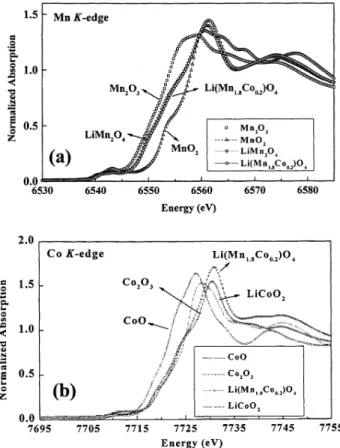
The Mn and Co K-edge XANES spec tra are shown in Fig. 3. The K-edge en er gies of all the tar get el e ments were de fined as the en ergy at half the height of the ab sorp tion edge.31 The Mn K-edge X-ray ab sorp tion spec trum of the Co sub sti tuted lith ium manganate, Li(Mn1.8Co0.2)O4, is shown to gether with the ref er ence spec tra of Mn3+2O3, LiMn3.5+2O4, and Mn4+O2 in Fig. 3(a). The edge en ergy of Li(Mn1.8Co0.2)O4 is found to be lower than that of the Mn4+ ref er ence but higher than that of the Mn3.5+ ref er ence, in di cat ing the mixed ox i da -tion state of man ga nese (Mn3+/Mn4+) in these com pounds. Fig. 3(b) clearly shows that there is a large dif fer ence in the edge po si tion be tween Co2+ in CoO and the oc ta he dral Co3+ of Co2O3 and LiCoO2. The Co Kedge en ergy of all the sub sti -tuted man ga nese spinel is ob served at the same en ergy as that of LiCoO2. The sim i lar ity in the fea ture of the XANES spec -tra at the Co and Mn edges of spinel strongly sup ports the fact that co balt is pre dom i nantly tri va lent and is pres ent in 16d oc
-ta he dral sites.11,19,20 The co balt ion is ran domly dis trib uted in the spinel struc ture and is tri va lent, re plac ing Mn3+. The Co3+ ion sta bi lizes the lat tice through a re duc tion in Jahn-Teller dis tor tion of the lat tice at the lo cal level, but can limit the frac tion of lith ium that may be ex tracted due to its re dox in ac -tiv ity at po ten tials up to ~ 4V. The 5V pla teau re ported dur ing the elec tro chem i cal ex trac tion of Li from Li(Mn2-xCox)O4 ap -pears to be due to the ox i da tion of Co3+ to Co4+.4,5,11
The XANES spec tra of the Li(Mn2-xCox)O4 spinel man -ga nates are char ac ter ized by the fea tures la beled A to D shown in Fig. 4. Pre-edge fea tures A1 and A2 re sult from tran -si tions to bound fi nal states in the 3d or bital. The main ab sorp tion edge rises in two dis tinct steps, which may be dis tin -guished as two in flec tion points B1 and B2. There is a rel a -tively in tense and sym met ric res o nance above the ab sorp tion edge (C), and a broader struc ture to high en ergy (D).12-19 To ob tain de tailed in for ma tion on the elec tronic and geo met ric struc tures around the man ga nese ion, each spec trum has been in ves ti gated by ex am in ing the sec ond de riv a tive method, which is quite ef fec tive in am pli fy ing small dif fer ences in the spec tral fea tures as shown in Fig. 4(b). Each spec trum shows dou bly split pre-edge peaks, A1 and A2,which are at trib uted to the quadrupole-allowed tran si tions from the core 1s level to un oc cu pied 3d states.17,18 Such a split ting of the pre-edge peak def i nitely orig i nates from the sep a ra tion of de gen er ate
Table 1. Average Mn Valence, Refined Fractional Atomic Positions, Cell Parameters and Reliability Factors ( ) of Li(Mn2-xCox)O4.. The Atomic Positions are Li: (0.125, 0.125, 0.125),
Mn(Co): (0.5, 0.5, 0.5), O: (x, x, x) for Fd3m Space Group at Room Temperature
x = 0 x = 0.1 x = 0.2 x = 0.3 x = 0.4 Li 102u iso(Å2) 3.3(6) 4.0(5) 2.4(6) 2.4(7) 4.6(7) Mn (Co) 102u iso(Å2) 2.37(3) 2.02(3) 2.42(4) 2.42(5) 2.31(5) O x 0.2641(2) 0.2623(2) 0.2635(2) 0.2645(3) 0.2625(3) 102u iso(Å 2 ) 3.81(7) 3.7(1) 3.03(9) 3.2(1) 2.8(1) a (Å) 8.2422(2) 8.2336(2) 8.2178(6) 8.1996(9) 8.173(1) Volume (Å3) 559.93(2) 558.17(3) 554.98(7) 551.3(1) 546.0(1) Rp ( ) 9.78 8.99 10.16 10.99 10.06 Rwp ( ) 12.91 12.18 13.96 15.2 14.3 2 ( ) 1.08 1.32 1.65 2.35 3.28 Mn-Mn x 6 (Å) 2.91406(6) 2.91101(7) 2.9055(2) 2.8990(2) 2.8897(4) Mnn+ 3.51(1) 3.52(1) 3.56(1) 3.58(1) 3.61(1) oi ci oi p y y y R | ||/ (R-pattern), 2 21/2 ] ) ( / ) ( [ i oi ci i oi wp W y y W y R (R-weighted pattern), (goodness of fit),
whereyoiis the observed intensity at the ith step, ycis calculated at theith step, Wiis 1/yi, M is
residual,Nois the number of observations,Nvis the number of parameters adjusted. Uisois the thermal
parameter and Mn-Mn is the average Mn-Mn bond distance. 2
O V
M
3d level un der the oc ta he dral crys tal field. For the Li(Mn2-xCox)O4 spinel com pounds with a weak crys tal field, the 1s13dt2g3eg1
fi nal state, due to the 1s to 3deg tran si tion, is ex pected to be
more sta ble than the 1s13dt2g4eg0 state re sult ing from the 1s to
3dt2g tran si tion. There fore, the lower en ergy peak, A1, is at -trib uted to a tran si tion from 1s to 3deg, while the higher one,
A2, is as signed as a tran si tion from 1s to 3dt2g, even though
the en ergy of 3dt2g level is lower than that of 3deg level. The
stron ger in ten sity of A2 com pared to A1 can be un der stood from the fact that Mn in Li(Mn2-xCox)O4 has the mixed ox i da -tion state with Mn4+ and Mn3+. The shift in the edge po si tion for Li(Mn2-xCox)O4 to higher en ergy cor re sponds to an in -creased av er age Mn ox i da tion state with in creas ing x.
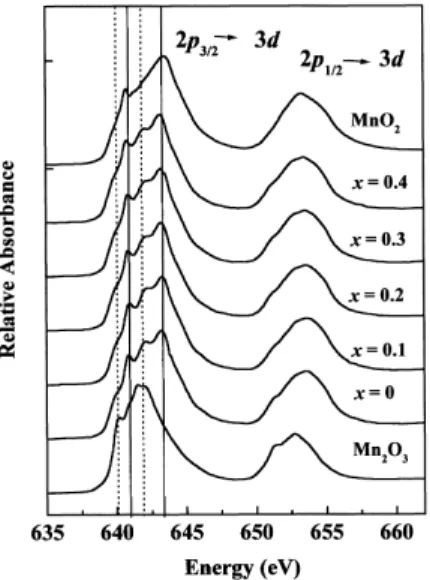
The Mn L-edge XANES spec tra of Li(Mn2-xCox)O4 are shown in Fig. 5. The spec tra show two broad mul ti ple struc -tures sep a rated by spin-orbital split ting (Mn 2p3/2 and Mn 2p1/2).17,32 The chem i cal shift is caused by the change in the elec tro static en ergy at the Mn site, driven by vary ing the ionic va lence in the com pounds. The 2p3/2 ab sorp tion peaks of
MnO2 and Mn2O3 are marked by solid and dashed lines, re -spec tively. The 2p3/2 peak of the Li(Mn2-xCox)O4 con tains both Mn3+ and Mn4+ ab sorp tion tran si tions, which im plies that Mn3+ and Mn4+ are dis trib uted ran domly in the struc ture and the elec trons in the 3d or bital of Mn3+ are lo cal ized.32,33 Thus, it is seen that charge lo cal iza tion and mixed va lence of Mn3+ and Mn4+ are found in the sys tem. The Mn va lence of the sam ples from x = 0 to x = 0.4 was de ter mined by chem i cal ti tra tion. The cal cu lated av er age Mn va lence for x = 0 to x = 0.4 in LiMn4+1Mn3+1-xCo3+xO4 is 3.50, 3.53, 3.56, 3.59 and 3.63, re spec tively, whereas the ac tual ex per i men tal val ues are 3.51 0.02, 3.52 0.01, 3.56 0.01, 3.58 0.01 and 3.61 0.03 as shown in Ta ble 1. At noted, there is a good agree -ment be tween the cal cu lated and ob served val ues.
The ef fect of sub sti tu tion in the Mn sites of LiMn2O4 spinel ox ide has been in ves ti gated by K-edge EXAFS. The ex per i men tal k3-weighted Mn and Co K-edge EXAFS spec tra of Li(Mn2-xCox)O4 (0 x 0.4) are shown in Figs. 6(a) and (b), and the cor re spond ing Fou rier trans forms (FTs) in the k range of 2.95-13.85 Å–1 and 2.95-11.9 Å–1 are shown in Fig. 7
Fig. 3. (a) Mn K-edge XANES spec tra of Mn2O3,
MnO2, LiMn2O4 and Li(Mn1.8Co0.2)O4 and (b)
Co K-edge XANES spec tra of Li(Mn2-xCox)O4,
where the spec tra are iden ti cal for x = 0.1 to 0.4, and the spec tra of CoO, Co2O3 and LiCoO2.
Fig. 4. (a) Mn Kedge XANES spec tra and (b) the sec -ond-derivative spec tra of Li(Mn2-xCox)O4 (0
x 0.4) in the range 6530-6580 eV. The in set of (a) shows the ex panded view of the pre-edge range 6540-6544 eV.
and Fig. 8, re spec tively. As can be seen from Fig. 6, the over -all spec tral fea tures of EXAFS os cil la tion of the Li(Mn2-xCox)O4 com po si tions are quite sim i lar. The ex per i men tal EXAFS sig nal con tains all con tri bu tions from dif fer ent scat ter ing paths in clud ing sin gle scat ter ing and mul ti ple scatterings. The com par i son be tween ex per i men tal and sim u lated data sug gests that the mul ti ple scatterings are ne glected for the
pur pose of struc tural re fine ments re gard ing the near est ox y -gen and man ga nese neigh bors. Ow ing to the high sym me try of the spinel struc ture, con sid er ing only the first and sec ond co or di na tion shells prac ti cally all the es sen tial struc tural in -for ma tion can be de rived.16,18 At low-k (< 3Å-1) re gion, mul ti -ple scat ter ing con tri bu tions be come more im por tant, caus ing some de vi a tion from the fit, which uses a sin gle scat ter ing for mu la tion. The ob served spec tral sim i lar i ties be tween the cu bic spinel LiMn2O4 and chem i cally sub sti tuted Li(Mn2-xCox)O4 (0.1 x 0.4) sug gest that both phases pos sess nearly the same lo cal atomic ar range ment.
The Fou rier trans forms of the Mn and Co K-edge EXAFS spec tra of Li(Mn2-xCox)O4 (0 x 0.4) are shown in Figs. 7 and 8, re spec tively. The first prom i nent peak in the Fou rier trans form is as signed to the M-O (M = Mn and Co) con tri bu tion, and is fol lowed by the sec ond peak cor re spond -ing to the Mn-M and Co-M (M = Mn or Co) con tri bu tion. The best-fit re sults (solid lines) are com pared to the ex per i men tal spec tra (cir cles) and the fit ted struc tural pa ram e ters for M-O shell and M-M shell are listed in Ta ble 2. For all sam ples, the first co or di na tion shell around both Co and Mn ions was fixed
Fig. 5. Mn 2p-edge XANES spec tra of Li(Mn2-xCox)O4
(0 x 0.4) along with two stan dards, MnO2
(Mn4+, shown by the solid line) and Mn 2O3
(Mn3+, shown by the dashed line) for com
-paries.
Fig. 6. (a) Mn and (b) Co k3-weighted K-edge EXAFS
spec tra of Li(Mn2-xCox)O4 (0 x 0.4).
Fig. 7. Fou rier trans forms F(R) of the k3-weighted Mn
K-edge EXAFS spec tra of Li(Mn2-xCox)O4 (0
x 0.4). The range us ing the Fou rier fil ter ing is shown by the ar rows. The solid lines and cir cles rep re sent the fit ted and ex per i men tal data, re spec tively. The first prom i nent peak in the Fou rier trans form is as signed to the MnO con tri bu tion, and is fol lowed by the sec ond peak cor re spond ing to the MnMn and MnCo con tri bu -tions.
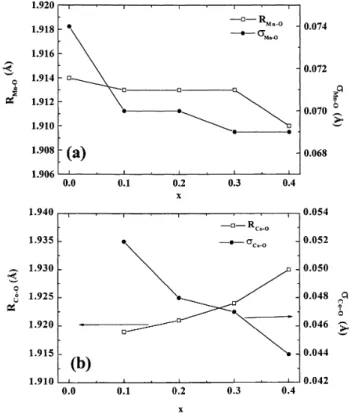
at six ox y gen at oms, in agree ment with the ex pected num ber for an oc ta he dral site. Sub sti tuting Co3+ for Mn3+ in LiMn2O4 leads to a short en ing of the Mn-O bond length with in creas ing co balt sub sti tu tion.11 The Debye-Waller fac tor ( Mn-O) for the Mn-O shell of Li(Mn2-xCox)O4 ob tained from EXAFS data is shown in Fig. 9(a) as a func tion of the de gree of sub sti tu tion. A de crease in the Debye-Waller fac tor is ob served, con sis tent with an en hanced sym me try of the av er age Mn en vi ron ment caused by the re duc tion in the num ber of Mn3+ ions. Con tri -bu tions from the Jahn-Teller dis tortion man i fest pri mar ily as damp ing of the os cil la tions in EXAFS due to in co her ence in the pho to elec tron waves, pro duc ing a re duced in ten sity Fou -rier trans formed peak and higher Debye-Waller fac tor in the anal y sis.15-19 The re moval of the con tri bu tion from Mn3+ ions by in creas ing Co3+ sub sti tu tion is seen in the data as a marked de crease in the Debye-Waller fac tors for the Mn-O shell. In Fig. 9(b), a slight in crease in Co-O bond length (RCo-O) and a de crease in the Debye-Waller fac tor ( Co-O) are also ob served for x = 0.1 to 0.4. The Co-O Debye-Waller fac tors are no ta bly smaller than those for Mn-O, and sig nif i cantly lower in the doped spi nels than in LiMn2O4, in di cat ing a higher de gree of
reg u lar ity of the CoO6 octahedron in the three-dimensional spinel frame work. Co or di na tion num bers for the man ga -nese-metal and co balt-metal shells were fixed to 6 in fit ting. In Fig. 10, a dif fer ence is ob served be tween the Mn-M (RMn-M) and Co-M (RCo-M) bond length (M = Co or Mn). As x in -creases, the Mn-M dis tance (RMn-Mn/Co) and the Debye-Waller fac tor ( Mn-Mn/Co) were found to de crease (as shown in Fig. 10(a)). This re sult is con sis tent with the de crease in the lat tice pa ram e ter a on in creas ing x as stud ied by XRD. Sub sti tuting Mn3+ with the smaller non-Jahn Teller Co3+ ion re duces lat -tice strain at the 16d site, and the shorter Co-M dis tance (~2.86 Å) ob served by EXAFS shows that the Mn lat tice con tracts about Co (as shown in Fig. 10(b)). This lo cal con trac -tion and the dif fer ence in coulombic re pul sion be tween Co3+/Mn4+ and Mn4+/Mn4+ in di cate that the av er age Co-M bond length is shorter than Mn-M.19-20 With in creas ing co balt con tent, the Debye-Waller fac tor Mn-Mn/Co de creases whereas Co-Co/Mn in creases. At low lev els of sub sti tu tion, lower Debye- Waller fac tors are ob served for the Co-M shell than
Fig. 8. Fou rier trans forms F(R) of the k3-weighted Co
K-edge EXAFS spec tra of Li(Mn2-xCox)O4 (0.1
x 0.4). The range ap ply ing the Fou rier fil ter -ing is shown by the ar rows. The solid lines and cir cles rep re sent the fit ted and ex per i men tal data, re spec tively. The first prom i nent peak in the Fou rier trans form is as signed to the Co-O con tri bu tion. The sec ond peak cor re sponds to the Co-Mn and Co-Co con tri bu tions.
Fig. 9. The M-O (M = Mn or Co) bond lengths (RM-O)
and Debye-Waller fac tor ( M-O) as a func tion of
the compositional pa ram e ter x for (a) Mn K-edge EXAFS data of Li(Mn2-xCox)O4 with x
= 0 ~ 0.4 and (b) Co K-edge EXAFS data of Li(Mn2-xCox)O4 with x = 0.1 ~ 0.4.
for the MnM shell, in di cat ing a higher de gree of cat ion or -der ing around the Co ions than around the Mn ions. This can be at trib uted to the fact that un like the tetragonally dis torted Mn3+O6 octahedra, the Co3+O6 octahedra do not in duce dis tor
-tions in the sur round ing lo cal lat tice struc ture.In creasing the num ber of Co-M in ter ac tions caused a change in the range struc tural or der, which ap pears as a con tin u ous de -crease in the cell pa ram e ters. Ox i da tion of man ga nese from Mn3+ to Mn4+, the Mn sites sub sti tuted with Co3+ is re flected in a short en ing of the Mn-O(M) bond length and a re duc tion in Mn-O(M) due to the re duced lo cal ized Jahn-Teller dis tor tion of the lat tice. A sim i lar de crease is seen in MnMn/Co dis -tance, com pared to the smaller change in Co-Co/Mn dis tance due to the re duc tion in cell vol ume.
The sub sti tu tion of Co3+ on the frame work would be lo -cal ized to the 16d site, which is sim i lar to ex cess Li+ be ing sub sti tuted into the Mn site.34 From the chem i cal for mula LiMn4+1Mn3+1-xCo3+xO4 (0 x 0.4), the the o ret i cal ca pac i -ties based on a one-electron charge-discharge re ac tion were cal cu lated to be in the range 148 mAh/g to 96 mAh/g. Since the deintercalation of Li+ from the spinel struc ture must be elec tri cally com pen sated by ox i da tion of Mn3+ to Mn4+, this sug gests that even for sub sti tuted spinel phases, only the amount of Mn3+ con trib utes to the chargedischarge ca pac -ity.35-38 Ac cord ingly, the ini tial ca pac ity of Li(Mn2-xCox)O4 (0
x 0.4) is lim ited by the ini tial amount of Mn3+ in the 16d sites. At pres ent, the dis charge ca pac ity of the doped com po -si tions (x = 0.1 ~ 0.4) is more sta ble than that of the LiMn2O4 spinel phase, and the ca pac ity fad ing was slightly sup pressed by in creas ing the Co con tent from 0.1 to 0.4.35 There fore, the spinel struc ture be comes more tol er ant to re peated discharge by dop ing of Co, which is at trib ut able to the re duc -tion of Mn va lence giv ing rise to the sup pres sion of the JahnTeller dis tor tion via Co dop ing. The im prove ment in cy -cling per for mance is also at trib uted to sta bi li za tion in the spinel struc ture via doped metal cat ions.
Table 2. Structural Parameters of Li(Mn2-xCox)O4Determined from EXAFS
Mn-O Mn-Mn(Co) Li(Mn2-xCox)O4 R (Å) (Å) R (Å) (Å) Residue ( ) x = 0 1.914 (26) 0.074 2.9150 (2) 0.076 2.4 x = 0.1 1.913 (50) 0.070 2.9130 (2) 0.075 1.6 x = 0.2 1.913 (36) 0.070 2.9082 (2) 0.075 1.6 x = 0.3 1.913 (25) 0.069 2.9008 (2) 0.075 1.7 x = 0.4 1.910 (35) 0.069 2.8889 (18) 0.074 2.6 Co-O Co-Co(Mn) Li(Mn2-xCox)O4 R (Å) (Å) R (Å) (Å) Residue ( ) x = 0.1 1.919 (45) 0.052 2.864 (46) 0.065 2.2 x = 0.2 1.921 (41) 0.048 2.864 (46) 0.067 1.3 x = 0.3 1.924 (38) 0.047 2.863 (47) 0.068 1.3 x = 0.4 1.930 (32) 0.044 2.865 (45) 0.070 1.8
Fig. 10. The M-M (M = Mn or Co) dis tances (RM-M)
and Debye-Waller fac tor ( M-M) as a func tion
of the compositional pa ram e ter x for (a) Mn K-edge EXAFS data of Li(Mn2-xCox)O4 with x
= 0 ~ 0.4 and (b) Co K-edge EXAFS data of Li(Mn2-xCox)O4 with x = 0.1 ~ 0.4.
CON CLU SIONS
We re ported the EXAFS re sults for undoped and doped spinel Li(Mn2-xCox)O4 with 0 x 0.4. The data show that the re place ment of Mn3+ (d4) ions by Co3+ (d6) in the oc ta he -dral frame work of the spi nels elim i nates the lo cal dis or der pres ent in the lat tice around [Mn3+O6] octahedra. Un der -stand ing the ef fect of Co sub sti tu tion on the lo cal struc ture of the LiMn2O4 pro vides im por tant in sights into how the struc ture of these ma te ri als can be tai lored to give op ti mum chem i -cal and elec tronic prop er ties.
AC KNOWL EDG MENTS
This re search was fi nan cially sup ported by the Na tional Sci ence Coun cil of the Re pub lic of China un der the grant num ber NSC 89-2113-M-002-059 and the SYN ergy ScienTech Corp.
Re ceived Au gust 22, 2001. Key Words
X-ray ab sorp tion near-edge struc ture (XANES); Ex tended X-ray ab sorp tion fine struc ture (EXAFS); Li(Mn2-xCox)O4; Lith ium-ion based sec ond ary
bat tery.
REF ER ENCES
1. Thackeray, M. M.; Da vid, W. I. F.; Bruce, P. G.; Goodenough, J. B. Ma ter. Res. Bull. 1983, 18, 461. 2. Moritomo, Y.; Asamitsu, A.; Kuwahara, H.; Tokura, Y. Na
-ture 1996, 380, 141.
3. Kawai, H.; Nagata, M.; Kageyama, H.; Tukamoto, H.; West, A. R. Electrochem. Acta 1999, 45, 315.
4. Ohzuku, T.; Takeda, S.; Iwanaga, M. J. Power Sources 1999, 81-82, 90.
5. Terada, Y.; Yasaka, K.; Nishikawa, F.; Konishi, T.; Yoshio, M.; Nakai, I. J. Solid State Chem. 2001, 156, 286.
6. Xia, Y.; Kumada, N.; Yoshio, M. J. Power Sources 2000, 90, 135.
7. Mukerjee, S.; Thurston, T. R.; Jisrawi, N. M.; Yang, X. Q.; McBreen, J.; Daroux, M. L.; Xing, X. K. J. Electrochem. Soc. 1998, 145, 466.
8. Guohua, L.; Ikuta, H.; Uchida, T.; Wakihara, M. J. Electrochem Soc. 1996, 143, 178.
9. Sigala, C.; Guyomard, D.; Verbaere, A.; Piffard, Y.;
Tournoux, M. Solid State Ionics 1995, 81, 167.
10. Rob ert son, A. D.; Lu, S. H.; Averill, W. F.; Howard, W. F. J. Electrochem. Soc. 1997, 144, 3500.
11. Aitchison, P.; Ammundsen, B.; Jones, D. J.; Burns, G.; Rozière, J. J. Ma ter. Chem. 1999, 9, 3125.
12. Ammundsen, B.; Jones, D. J.; Rozière, J. J. Solid State Chem. 1998, 141, 294.
13. Kim, M. G.; Yo, C. H. J. Phys. Chem. B 1999, 103, 6457. 14. Balasubramanian, M.; Sun, X.; Yang, X. Q.; McBreen, J. J.
Power Sources 2001, 92, 1.
15. Nakai, I.; Shiraishi, Y.; Nishikawa, F. Spectrochim. Acta Pt. B 1999, 54, 143.
16. Ammundsen, B.; Jones, D. J.; Rozière, J. Chem. Ma ter. 1996, 8, 2799.
17. Treuil, N.; Labrugère, C.; Menetrier, M.; Portier, J.; Campet, G.; Deshayes, A.; Frison, J. C.; Hwang, S. J.; Song, S. W.; Choy, J. H. J. Phys. Chem. B 1999, 103, 2100.
18. Hwang, S. J.; Park, H. S.; Choy, J. H. Chem. Ma ter. 2000, 12, 1818.
19. Ammundsen, B.; Jones, D. J.; Rozière, J. J. Phys. Chem. B 1998, 102, 7939.
20. Ammundsen, B.; Is lam, M. S.; Jones, D. J.; Rozière, J. J. Power Sources 1999, 81-82, 500.
21. Larson, A. C.; von Dreele,R. B. Gen er al ized Struc ture Anal -y sis S-ys tem, Los Alamos Na tional Lab o ra tor-y, Los Alamos, NM, 1994.
22. Katz, M. J.; Charke, R.C.; Nye, W. F. Anal. Chem. 1956, 28, 507.
23. Frenkle, A. I.; Stern, E. A.; Voronel, A.; Qian, M.; Newville,
M. Phys. Rev. B 1994, 49, 11662.
24. Newville, M.; Livins, P. Yacoby, Y.; Rehr, J. J.; Stern, E. A. Phys. Rev. B 1993, 47, 14126.
25. Newville, M.; Ravel, B.; Haskel, D.; Rehr, J. J.; Stern, E. A. Physica B 1995, 208, 154.
26. Stern, E. A. In X-ray Ab sorp tion: Prin ci ples, Ap pli ca tions, Tech niques of EXAFS, SEXAFS, and XANES; Konings -berger, D. C., Prins, R., Eds; Wiley-Interscience: New York, 1988; pp 3-51.
27. Zabinsky, S. I.; Rehr, J. J.; Ankudinov, A.; Albers, R. C.; Eller, M. J. Phys. Rev. B 1995, 52, 2995.
28. Newville, M. FEFFIT doc u ment 1996.
29. Berg, H.; Goransson, K.; Nolang, B.; Thomas, J. O. J. Ma ter. Chem. 1999, 9, 2813.
30. Shan non, R. D. Acta Crystallogr. Sect. A 1976, 32, 751. 31. Maurin, I.; Barboux, P.; Lassailly, Y.; Boilot, J-P.; Vil lain, F.
J. Magn. Magn. Ma ter. 2000, 211, 139.
32. de Groot, F. M. F.; Fuggle, J. C.; Thole, B. T.; Sawatzky, G.
A. Phys. Rev. B 1990, 42, 5459.
33. Ro dri guez-Carvajal, J.; Rousse, G.; Masquelier, C.; Hervieu,
M. Phys. Rev. Lett. 1998, 81, 4660.
34. Yamaguchi, H.; Yamada, A.; Uwe, H. Phys. Rev. B 1998, 58, 8.
35. Shen, C. H.; Liu, R. S.; Gundakaram,R.; Chen, J. M.; Huang, S. M.; Chen, J. S.; Wang, C. M. J. Power Sources 2001, 102, 21.
36. Shen, C. H.; Gundakaram, R.; Liu, R. S.; Sheu, H. S. J.
Chem. Soc., Dal ton Trans. 2001, 37.
37. Pistoia, G.; Antonini, A.; Rosati, R.; Bellitto, C.; Ingo, G. M. Chem Ma ter. 1997, 9, 1443.
38. Sanchez, L.; Tirado, J. L. J. Electrochem. Soc. 1997, 144, 1939.