La0.7Sr0.3MnO3films with thicknesses from 3 to 70 unit cells resulted in the identification of a lower critical thickness for a nonmetallic nonferromagnetic layer at the interface with the SrTiO3 共001兲 substrate of only three unit cells共⬃12 Å兲. Furthermore, linear-dichroism measurements demonstrate the presence of a preferred 共x2-y2兲 in-plane orbital ordering for all layer thicknesses without any orbital reconstruction at the interface. A
crucial requirement for the accurate study of these ultrathin films is a controlled growth process, offering the coexistence of layer-by-layer growth and bulklike magnetic/transport properties.
DOI:10.1103/PhysRevB.78.094413 PACS number共s兲: 75.70.Ak, 68.55.A⫺, 75.47.Lx, 78.70.Dm
I. INTRODUCTION
Doped-manganite perovskites have been extensively in-vestigated in the last decade due to their tantalizing magne-totransport properties, such as colossal magnetoresistance1 and half-metallicity,2 which make them very promising for applications in spintronic devices.3–8The properties of man-ganites are related to the coupling of the lattice, orbital, charge, and spin, which can be affected in various ways: ionic radii,9 lattice strain,10–12 doping level,13 oxygen stoichiometry,14 temperature, magnetic field,15 electric field,16hydrostatic pressure,17,18and photoexcitation.19Many doped manganites exhibit a magnetic transition at the Curie temperature, TC, accompanied by a metal-insulator transi-tion, which makes them paramagnetic insulators at high temperature and ferromagnetic half-metals at low temperature.9,20–23
Many investigations have focused on La0.7Sr0.3MnO3 共LSMO兲, which shows the highest Curie temperature among the family of manganites共TC⬃369 K兲.13An extensive num-ber of studies have demonstrated the fabrication of such manganites in the form of thin films, which display very different properties as compared to bulk. Lattice mismatch can cause structural modifications at the interface between the film and the substrate, strongly affecting the magnetic properties.24For example, tensile strain suppresses ferromag-netism and reduces the ferromagnetic Curie temperature, which is generally interpreted by considering a strain-induced distortion of MnO6 octahedra based on Jahn-Teller distortion theory.25 The existence of an interfacial layer, which shows insulating behavior over the whole temperature range without a metal-insulator transition, has been sug-gested. A so-called “dead-layer” thickness can be defined as the thinnest layer for which metallic as well as ferromagnetic behaviors are observed. Estimates of a dead-layer thickness for films on NdGaO3 共110兲, SrTiO3 共001兲, MgO 共001兲, and LaAlO3 共001兲 substrates are ⬃3, 4, 4, and 5 nm, respectively.26–28 However, the origin of the dead layer is still controversial. Magnetic-resonance measurements29,30
and scanning tunneling spectroscopy31have shown that it is connected to a phase-separation phenomenon32 at the inter-face where ferromagnetic insulating and metallic phases separate at a scale of a few nanometers.33 It has been sug-gested that the mechanism driving such a phase separation is related to the presence of structural inhomogeneities local-ized at the interface between film and substrate. Very re-cently, evidence was also given for a possible orbital recon-struction at the LSMO interface, for which a strain-induced distortion of the MnO6octahedra led to crystal-field splitting of the eg levels and lowering the 共3z2-r2兲 orbital over the 共x2-y2兲 orbital34resulting in a local C-type antiferromagnetic structure at the interface.
Although the material properties of LSMO films depend strongly on growth mode and oxidation level, most of the studies on ultrathin LSMO films commonly focused on the optimization of only one of them. Typically, such focusing on growth behavior can lead to inferior magnetic properties. In this paper, special attention was given to the relationship among growth mode, oxidation level, and material properties to ensure the coexistence of layer-by-layer growth and bulk-like magnetic/transport properties. Both are required to study accurately the behavior of ultrathin LSMO films. In order to obtain information about the suggested presence of dead-layers and orbital reconstruction at LSMO interfaces, we studied high-quality ultrathin LSMO films down to a thick-ness of three unit cells 共⬃12 Å兲. SrTiO3 共001兲 single crys-tals were selected as substrates due to the low mismatch with LSMO and the fact that the surface can be well defined by a single-termination treatment. The growth dynamics was in-vestigated by monitoring the intensity variations of various features in the reflection high-energy electron-diffraction 共RHEED兲 patterns. Transport and magnetic properties of the ultrathin films were measured to provide individual critical thickness values for metallic and ferromagnetic behaviors, which were used together to determine the so-called dead-layer thickness. Furthermore, linear dichroism共LD兲 was in-vestigated by x-ray absorption spectroscopy 共XAS兲 to dem-onstrate the absence of orbital reconstruction for ultrathin LSMO films.
II. EXPERIMENT
The films used in this study were grown epitaxially using pulsed-laser deposition from a stoichiometric La0.7Sr0.3MnO3 target on TiO2-terminated SrTiO3 共100兲 substrates35 by ap-plying a KrF excimer laser at a repetition rate of 1 Hz and a laser fluence of ⬃1.5 J cm−2. During growth, the substrate was held at 750 ° C in an oxygen environment in the range 100–300 mTorr. The growth was monitored in situ by RHEED analysis36 allowing precise control of the thickness at the unit cell共uc兲 scale and accurate characterization of the growth dynamics. For these conditions a growth rate of ⬃0.12 Å/sec was determined. After the growth, the samples were slowly cooled to room temperature in 1 atm of oxygen at a rate of ⬃5 °C/min to improve the oxidation level.
RHEED has already been proven to be a very versatile technique for growth and surface studies of thin films and has also been used to investigate the growth of La1−xSrxMnO3 thin films.24,37 Although layer-by-layer growth was concluded in earlier studies from the observed intensity oscillations, interruption of the deposition was then still necessary to recover them. For our growth conditions such interruptions are not necessary anymore and continuous layer-by-layer growth can be maintained. On the other hand more attention has been given to the dependence of the growth mode on the deposition pressure and additional infor-mation from the features in the corresponding RHEED dif-fraction patterns has been utilized in contrast to previous studies. Analysis techniques, such as atomic force micros-copy 共AFM兲 and four-circle x-ray diffraction 共XRD兲, were additionally used to demonstrate the atomically smooth sur-face and single-crystal structure 共not shown in this paper兲.
Transport properties were determined in a Van der Pauw four-probe configuration with a Quantum Design physical properties measurement system共PPMS兲 in the range 10–350 K. Gold contacts had to be deposited to establish good ohmic contact between aluminum bonding wires and the LSMO surface. A Quantum Design superconducting quantum inter-ference device 共SQUID兲 measurement system was used to measure the magnetic properties in the temperature range 10–380 K with the magnetic field applied in-plane along the 共100兲 direction of the SrTiO3crystal. Linear dichroism was investigated for some LSMO films by x-ray absorption
spec-troscopy measurements of the Mn 2p edge at beamline 4.0.2 of the Advanced Light Source38 共Lawrence Berkeley Na-tional Laboratory兲 to directly probe the orbital character of 3d states in these ultrathin manganite films.39
III. RESULTS
A. Unit-cell-controlled growth process
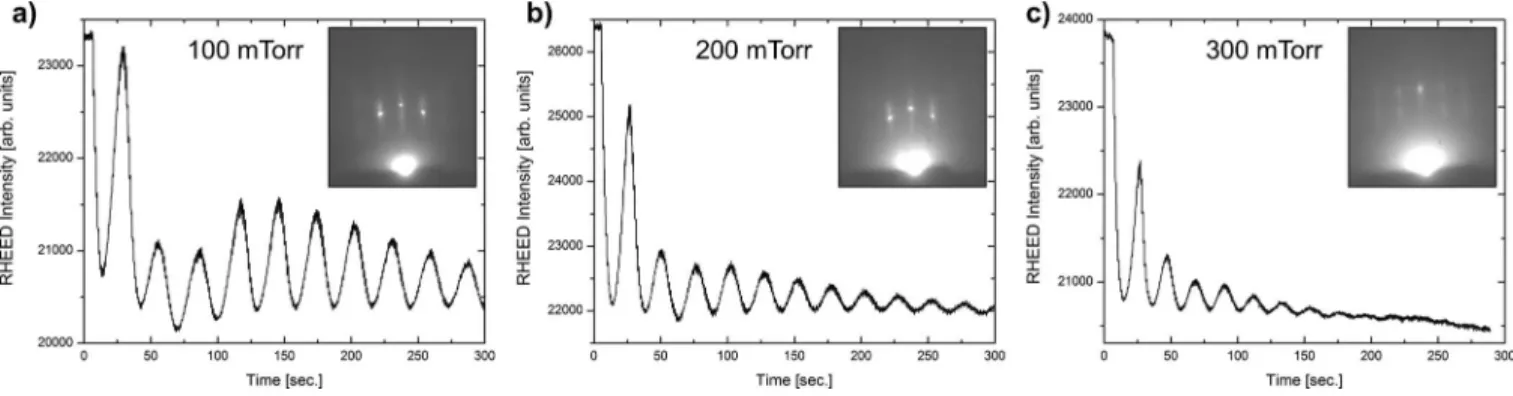
Figure1 shows the RHEED specular intensities recorded during the initial growth of the first La0.7Sr0.3MnO3unit cells on TiO2-terminated SrTiO3surfaces at various oxygen depo-sition pressures of 100, 200, and 300 mTorr, respectively. Clear RHEED oscillations can be observed, indicating layer-by-layer growth. However, large differences in the RHEED intensities for the different pressures indicate the possible occurrence of different growth modes. For LSMO growth at 100 and 200 mTorr关Figs.1共a兲and1共b兲兴 RHEED oscillations will remain visible for the total deposition of 70 unit cells 共⬃28 nm兲, suggesting continuous layer-by-layer growth. No additional interruption of the deposition was necessary to recover them as demonstrated by earlier studies.24 The ab-sence of islands is confirmed by the preab-sence of sharp two-dimensional spots in the corresponding RHEED diffraction patterns of the surface of the 70 unit cells thick layer, which are shown in the insets. The presence of these sharp spots lying on concentric Laue circles indicates true reflective dif-fraction from a smooth surface. However, for LSMO growth at 300 mTorr RHEED oscillations disappear very quickly after ⬃10 unit cells and the growth mode changes from layer-by-layer growth to island growth. This is confirmed by the periodic pattern of vague three-dimensional spots in the RHEED pattern, which originates from transmission through particles on the surface. These results were confirmed by atomic force microscopy, displaying island formation for growth at 300 mTorr and atomically smooth terraces sepa-rated by unit-cell steps, similar to the original substrate sur-face, for deposition pressures of 100 and 200 mTorr.
The magnetic properties of the LSMO films were mea-sured in a SQUID system. Figure2共a兲shows clear ferromag-netic hysteresis loops for the different samples at 10 K after magnetic-field cooling at 1 T from 360 K. However, large differences in the saturation magnetization values can be ob-FIG. 1. Surface analysis by reflection high-energy electron diffraction 共RHEED兲 during initial growth of La0.7Sr0.3MnO3 on
TiO2-terminated SrTiO3共001兲 substrates at various oxygen deposition pressures of 共a兲 100, 共b兲 200, and 共c兲 300 mTorr. The insets display
served. LSMO films grown at 200 and 300 mTorr display a magnetization of ⬃550 emu/cm3 comparable to bulk val-ues, while films grown at 100 mTorr exhibit a reduced mag-netization of ⬃300 emu/cm3. These results together with the RHEED observations indicate that an oxygen deficiency is responsible for the reduced magnetization and not the sur-face roughness. Although LSMO growth at 100 mTorr shows the best RHEED oscillations and a smooth surface, it pos-sesses inferior magnetic properties when compared to films grown at 200 mTorr. The diminished quality of the magnetic properties is also demonstrated by the increase in the coer-cive field from⬃12 to ⬃40 Oe 关see inset of Fig. 2共a兲兴 and the decrease in the Curie temperature, TC, from ⬃345 to ⬃330 K 关see Fig. 2共b兲兴. Annealing the LSMO films after
growth in 1 atm oxygen for 60 min at 750 ° C and during subsequent cool down did not improve the magnetic proper-ties as can be seen in Fig. 2. From these results we can conclude that high-quality unit-cell-controlled LSMO layers with bulklike magnetic properties can be fabricated in a nar-row deposition regime but only when the gnar-rowth dynamics and magnetic properties are monitored simultaneously and not focusing on only one individual part.
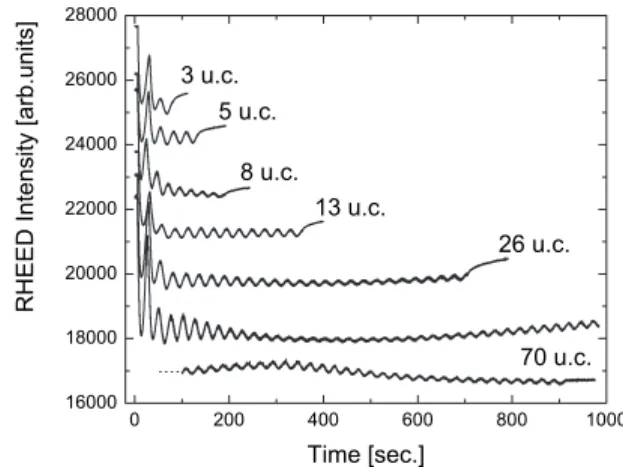
Subsequently, thin films of LSMO with various thick-nesses between 3 and 70 unit cells were grown at the opti-mum deposition temperature and oxygen pressure, 750 ° C and 200 mTorr, to ensure the coexistence of layer-by-layer growth and bulklike magnetic properties. Figure 3 shows clear RHEED intensity oscillations during the total growth of the various samples indicating controlled layer-by-layer growth of individual unit cells. X-ray diffraction analysis of the thickest samples revealed that they are tensile strained on the SrTiO3 共001兲 substrate 共⬃3.905 Å兲 and have a shorten-ing of the c axis 共⬃3.843 Å兲 as compared to bulk 共⬃3.889 Å兲.40
B. Transport measurements
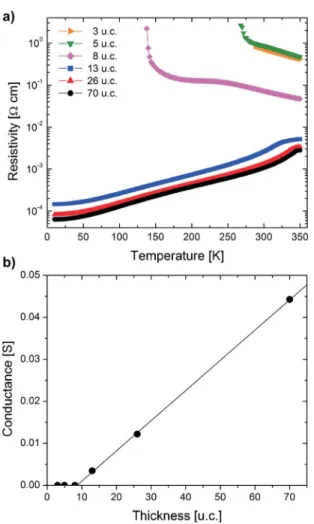
The temperature dependence of the resistivity in zero magnetic field for ultrathin LSMO films with variable thick-ness between 3 and 70 unit cells is given in Fig.4共a兲. Thicker films show a bulklike metallic behavior over the whole tem-perature regime. The residual resistivity at 10 K is in the 60– 80 ⍀ cm range, which is close to previously reported values.26 When the LSMO layer thickness decreases the re-sistivity increases quite drastically over the whole tempera-ture range. For LSMO layers with thicknesses of eight, five, and three unit cells a continuous resistivity increase is ob-served with a pronounced rise, which indicates the presence of a layer with dramatically reduced conductivity. This can be seen more clearly in the thickness dependence of the total conductance G of the films, where G = 1/RS with RS as the measured sheet resistance 关Fig.4共b兲兴. A linear thickness de-pendence of the conductance was found as expected for uni-FIG. 2. 共Color online兲 Magnetic properties of 28-nm-thick
La0.7Sr0.3MnO3 films on SrTiO3共001兲 grown at different oxygen
pressures. 共a兲 Magnetic hysteresis loops measured at 10 K. The diamagnetic contribution to magnetization 共not shown兲 has been attributed to the substrate and has been subtracted. The inset shows an enlargement near the origin.共b兲 Temperature dependence of the magnetization measured at 100 Oe. All samples were field cooled at 1 T from 360 K along the关100兴 direction before the measurements were performed.
FIG. 3. RHEED intensity recorded during growth of La0.7Sr0.3MnO3 ultrathin films on TiO2-terminated SrTiO3 共001兲
with thicknesses from 3 to 70 unit cells at the optimum deposition temperature and oxygen pressure of 750 ° C and 200 mTorr, respectively.
form films. The intercept of the horizontal axis provides an estimate of the nonmetallic layer of about eight unit cells 共⬃32 Å兲, which is lower than the previously reported criti-cal thickness of metallic behavior 共⬃40 Å兲 共Ref. 28兲 for
LSMO on SrTiO3 共001兲.
C. Magnetic measurements
The magnetic properties of the ultrathin LSMO films are shown in Fig. 5. A large reduction in the saturation magne-tization as well as an increase in the coercive field HC关Fig.
5共a兲兴 can be observed for thicknesses below 13 unit cells 共⬃48 Å兲. At the same time the Curie temperature TCis low-ered as well displaying a double transition for a layer thick-ness of eight unit cells共⬃32 Å兲 before drastically decreas-ing for LSMO films of only five and three unit cells 共⬃20 and⬃12 Å, respectively兲 关Fig.5共b兲兴. The thickness depen-dence has been summarized in Fig.5共c兲, where coercive field and Curie temperature, HC and TC, are nearly constant for thicknesses down to 13 unit cells. Further reduction in the layer thickness results in a dramatic change in the magnetic properties, although the films remain ferromagnetic down to three unit cells共⬃12 Å兲. The observation of a critical thick-ness for ferromagnetism of three unit cells共⬃12 Å兲 together
with the measured critical thickness for metallicity of eight unit cells 共⬃32 Å兲 results in the determination of a dead-layer thickness of eight unit cells, which is the thinnest dead-layer with metallic as well as ferromagnetic behaviors. This value for a so-called dead layer of ⬃32 Å is about two unit cells lower then the previously reported dead-layer thickness 共⬃40 Å兲 共Ref. 28兲 for LSMO on SrTiO3 共001兲.
FIG. 4. 共Color online兲 Transport properties of ultrathin LSMO films on SrTiO3共001兲 substrates. 共a兲 Temperature-dependent resis-tivity for films of different thicknesses.共b兲 Thickness dependence of the total conductance of films at 10 K.
FIG. 5. 共Color online兲 Ferromagnetic properties of ultrathin LSMO films on SrTiO3共001兲. 共a兲 Magnetic hysteresis loops
mea-sured at 10 K. The diamagnetic contribution to magnetization共not shown兲 has been attributed to the substrate and has been subtracted. 共b兲 Temperature dependence of the magnetization measured at 100 Oe. All samples were field cooled at 1 T from 360 K along the关100兴 direction before the measurements were performed. 共c兲 Layer-thickness dependence on the coercive field HC and the Curie tem-perature TC.
spectively兲. The difference between those spectra 共Iab c兲 provides the LD values and gives direct insight of the empty Mn 3d states.39 Considering the crystal-field splitting, the effect can be mainly related to the occupation of the two eg states共3z2-r2兲 and 共x2-y2兲 with majority spin; a LD, which is on average positive共negative兲, is due to a preferential occu-pation of the in-plane共x2-y2兲 关out-of-plane 共3z2-r2兲兴 orbital. LD-XAS measurements were performed on ultrathin LSMO films on SrTiO3 共001兲 substrates with LSMO layer thicknesses of 5, 8, and 70 unit cells, as described above. The experimental spectra of the ultrathin films are shown in Fig.
6共a兲and, although the intensity changes with layer thickness, the shape remains essentially unchanged. When the LD sig-nal is investigated in detail关see Fig.6共b兲兴 small changes in
relative LD signal intensity and shape can be observed. However, the average LD signal remains positive for all three LSMO thicknesses, which means that the preferred or-bital ordering stays共x2-y2兲 in plane for all LSMO films down to layer thicknesses of five unit cells. This result is in sharp contrast with earlier observations of orbital reconstruction in ultrathin LSMO films and can even be strengthened by the absence of a sign reversal for a photon energy directly above
E⬇644 eV, which was used as an additional qualitative
ar-gument by Tebano et al.34
IV. DISCUSSION
The results of transport, magnetic, and x-ray absorption spectroscopy measurements all indicate a gradual change in magnetoelectronic structure for our ultrathin LSMO films. In this section we will discuss the observations of a reduced thickness for a nonmetallic nonferromagnetic interface layer, as well as the absence of any orbital reconstruction, with respect to the unit-cell-controlled growth process.
To study the properties of ultrathin films correctly, the first important task was to determine a fabrication procedure, which could deliver bulklike magnetic/transport properties while still providing a growth control on the unit-cell scale. Since the magnetic/transport properties depend strongly on the oxygen stoichiometry, special attention had to be given to the relation between growth dynamics and oxidation level. Although we analyzed the RHEED intensity variations as other groups have done before, more attention was given to specific shapes in the corresponding RHEED patterns. To-gether with the measurements of the magnetic 共transport兲 properties in a SQUID 共PPMS兲 system, we determined that ideal atomically smooth LSMO layers with bulklike proper-ties could only be fabricated in a small regime with deposi-tion condideposi-tions of 750 ° C and 200 mTorr. Focus on either
the growth dynamics or the magnetic/transport properties would result in inferior properties of the other. However, such specific focusing was commonly done in previous stud-ies of ultrathin LSMO films, and we believe that the intro-duction of detailed analysis of the growth dynamics in our study provides the best method to accurately investigate the properties of only a few unit cells of LSMO.
Detailed investigations of ultrathin LSMO films, where the thicknesses were controlled at the unit-cell scale, demon-strated clearly the existence of a nonmetallic nonferromag-netic layer at the interface between the LSMO layer and the SrTiO3substrate. Individually, critical thickness values were determined for metallicity of eight unit cells 共⬃32 Å兲 and ferromagnetism of three unit cells 共⬃12 Å兲. Interestingly, very recently an elongation of the out-of-plane lattice con-stant at the substrate-film interface was determined by sur-face x-ray diffraction41 with a critical thickness of precisely three unit cells. This increase in c axis at the interface is the opposite of the expected decrease in in-plane tensile-strained layers. No interfacial defects could be revealed and, there-fore, the role of a possible interface roughness was negli-FIG. 6. 共Color online兲 Experimental XAS and LD measure-ments at 100 K at the Mn-L2,3edge for LSMO films with
thick-nesses of 5, 8, and 70 unit cells:共a兲 average between XAS signals taken in both polarization directions;共b兲 LD in percent of the XAS
gible. They concluded that stoichiometry changes were re-sponsible for the dilation at the substrate-film interface with most likely Sr enrichment in the topmost monolayer due to segregation. However, such local elongations of the crystal structure have also been determined by surface x-ray diffrac-tion at the interface42,43between LaAlO3and SrTiO3. In that case the LaAlO3was also tensile strained to the SrTiO3 sub-strate and similarly resulted in an unexpected dilation of the first few unit cells at the interface. Displacements of the cat-ions and ancat-ions, due to electronic reconstruction at this polar/nonpolar interface, were suggested to cause a two-dimensional conducting layer at the interface between those otherwise insulating oxides. For our interface between the LSMO layer and the SrTiO3 substrate a dramatic change in material properties is very conceivable without any varia-tions in the stoichiometry but only caused by very small changes in the atomic positions close to the interface. How-ever, more detailed experiments are necessary to determine if structural or stoichiometric changes play an important role.
Furthermore, linear-dichroism analysis from XAS mea-surements has been used to study the orbital ordering for several LSMO films with various thicknesses. The preferred orbital ordering was共x2-y2兲 in plane for all layer thicknesses down to only five unit cells. This is in good agreement with previous studies of relatively thick LSMO films共100 uc兲 on SrTiO3共001兲 substrates,37 which gave evidence of a prefer-ential occupation of the in-plane共x2-y2兲 orbitals as a conse-quence of the decrease in the in-plane Mn-O bond lengths due to tensile epitaxial strain. However, in our case no change in orbital ordering was found also for ultrathin LSMO films and, therefore, the suggestion of orbital recon-struction at the interface34 was denounced. An out-of-plane 共3z2-r2兲 orbital ordering, as observed also in LSMO layers on LaAlO3 共001兲 substrates,37,44 indicating a C-type antifer-romagnetic insulating phase was not present in our ultrathin LSMO films down to a thickness of only five unit cells.
V. CONCLUSION
We have studied ultrathin LSMO films with thicknesses ranging from 3 to 70 unit cells on SrTiO3 substrates. It is found that an ideal unit-cell-controlled growth process, re-sulting in layer-by-layer growth and bulklike magnetic/ transport properties, can only be achieved in a small regime with growth conditions of 750 ° C and 200 mTorr. By using this optimized growth process, we have been able to study the properties of LSMO layers with thicknesses down to only a few unit cells.
As a result, lower values have been determined for the critical LSMO layer thickness to produce ferromagnetism 共⬃12 Å兲 and metallicity 共⬃32 Å兲. Although the magnetic ordering and conductivity behavior are coupled in LSMO layers, a large difference was found for their critical thick-nesses. An explanation could be the loss of a conducting percolation path for LSMO layers thinner than ⬃32 Å, which could possibly be caused by phase separation due to the formation of ferromagnetic/metallic and nonferromagnetic/nonmetallic regions. This effect has been predicted in a recent theoretical study,45 which modeled the changes in average ionic charge per atomic 共001兲 plane. They found that an electronic phase separation between a ferromagnetic/metallic phase and a spin/orbital-ordered insu-lator phase occurs at the manganite-insuinsu-lator interface. This instability is favored by the reduction in carriers at the inter-face, which weakens the ferromagnetic coupling between the Mn ions, making more relevant the superexchange antiferro-magnetic interaction. Interestingly, our value of ⬃12 Å for the critical LSMO layer thickness, which is completely non-ferromagnetic as well as nonmetallic, matches nicely with previous observations by surface x-ray diffraction of an elon-gated crystal structure at the film-substrate interface as well as previous theoretical modeling of phase separation locally at the manganite-insulator interface.
Detailed analysis of linear dichroism by x-ray absorption spectroscopy in these ultrathin LSMO films has also demon-strated that the preferred orbital ordering remains 共x2-y2兲 in plane for all layer thicknesses, which clearly opposes previ-ous reports of an orbital reconstruction at the interface into out-of-plane共3z2-r2兲 orbitals.
In total we can conclude that heterostructures with high-quality LSMO films can be fabricated for device applications even with thicknesses down to several unit cells. However, dramatic changes in the material properties will always be significant locally at the interfaces.
ACKNOWLEDGMENTS
This work was supported by the Director, Office of ence, Office of Basic Energy Sciences, and Materials Sci-ences and Engineering Division of the U.S. Department of Energy under Contract No. DE-AC02-05CH11231. G.R. ac-knowledges support from the Netherlands Organization for Scientific Research 共NWO兲. Y.H.C. would like to acknowl-edge the support of the National Science Council, R.O.C., under contract NSC 97–3114–M-009–001.
1S. Jin, T. H. Tiefel, M. McCormack, R. A. Fastnacht, R. Ramesh,
and L. H. Chen, Science 264, 413共1994兲.
2J. H. Park, E. Vescovo, H. J. Kim, C. Kwon, R. Ramesh, and T.
Venkatesan, Nature共London兲 392, 794 共1998兲.
3S. Mathews, R. Ramesh, T. Venkatesan, and J. Benedetto,
Sci-ence 276, 238共1997兲.
4A. J. Millis, Nature共London兲 392, 147 共1998兲.
5H. Q. Yin, J. S. Zhou, and J. B. Goodenough, Appl. Phys. Lett.
77, 714共2000兲.
6M. B. Salamon and M. Jaime, Rev. Mod. Phys. 73, 583共2001兲. 7S. Yuasa, T. Nagahama, and Y. Suzuki, Science 297, 234共2002兲. 8C. Israel, M. J. Calderón, and N. D. Mathur, Mater. Today 10, 24
H. Kuwahara, Y. Tomioka, A. Asamitsu, Y. Moritomo, and Y. Tokura, Science 270, 961共1995兲.
16A. Asamitsu, Y. Tomioka, H. Kuwahara, and Y. Tokura, Nature
共London兲 388, 50 共1997兲.
17H. Y. Hwang, T. T. M. Palstra, S. W. Cheong, and B. Batlogg,
Phys. Rev. B 52, 15046共1995兲.
18Y. Moritomo, A. Asamitsu, and Y. Tokura, Phys. Rev. B 51,
16491共1995兲.
19M. Fiebig, K. Miyano, Y. Tomioka, and Y. Tokura, Science 280,
1925共1998兲.
20P. Schiffer, A. P. Ramirez, W. Bao, and S. W. Cheong, Phys. Rev.
Lett. 75, 3336共1995兲.
21R. Maezono, S. Ishihara, and N. Nagaosa, Phys. Rev. B 58,
11583共1998兲.
22Y. Konishi, Z. Fang, M. Izumi, T. Manako, M. Kasai, H.
Kuwa-hara, M. Kawasaki, K. Terakura, and Y. Tokura, J. Phys. Soc. Jpn. 68, 3790共1999兲.
23Z. Fang, I. V. Solovyev, and K. Terakura, Phys. Rev. Lett. 84,
3169共2000兲.
24M. Izumi, Y. Konishi, T. Nishihara, S. Hayashi, M. Shinohara,
M. Kawasaki, and Y. Tokura, Appl. Phys. Lett. 73, 2497共1998兲.
25A. J. Millis, T. Darling, and A. Migliori, J. Appl. Phys. 83, 1588
共1998兲.
26J. Z. Sun, D. W. Abraham, R. A. Rao, and C. B. Eom, Appl.
Phys. Lett. 74, 3017共1999兲.
E. Dagotto, T. Hotta, and A. Moreo, Phys. Rep. 344, 1共2001兲.
33A. Biswas, M. Rajeswari, R. C. Srivastava, T. Venkatesan, R. L.
Greene, Q. Lu, A. L. de Lozanne, and A. J. Millis, Phys. Rev. B 63, 184424共2001兲.
34A. Tebano et al., Phys. Rev. Lett. 100, 137401共2008兲. 35G. Koster, B. L. Kropman, G. J. H. M. Rijnders, D. H. A. Blank,
and H. Rogalla, Appl. Phys. Lett. 73, 2920共1998兲.
36G. J. H. M. Rijnders, G. Koster, D. H. A. Blank, and H. Rogalla,
Appl. Phys. Lett. 70, 1888共1997兲.
37C. Aruta, G. Ghiringhelli, A. Tebano, N. G. Boggio, N. B.
Brookes, P. G. Medaglia, and G. Balestrino, Phys. Rev. B 73, 235121共2006兲.
38E. Arenholz and S. O. Prestemon, Rev. Sci. Instrum. 76, 083908
共2005兲.
39D. J. Huang et al., Phys. Rev. Lett. 92, 087202共2004兲. 40P. G. Radaelli, G. Iannone, M. Marezio, H. Y. Hwang, S. W.
Cheong, J. D. Jorgensen, and D. N. Argyriou, Phys. Rev. B 56, 8265共1997兲.
41R. Herger et al., Phys. Rev. B 77, 085401共2008兲.
42V. Vonk, M. Huijben, K. J. I. Driessen, P. Tinnemans, A.
Brink-man, S. Harkema, and H. Graafsma, Phys. Rev. B 75, 235417 共2007兲.
43P. R. Willmott et al., Phys. Rev. Lett. 99, 155502共2007兲. 44A. Tebano et al., Phys. Rev. B 74, 245116共2006兲. 45L. Brey, Phys. Rev. B 75, 104423共2007兲.