
統包工程技術與專案組織結構之關係研究
161
0
0
全文
(2)
(3) Technology-Structure Relationships in Design-Build Projects. SYNOPSIS The Design-Build delivery method has gained popularity in the construction industry in the 21st century among clients seeking singular responsibility, shorter delivery time frame and management of complex works. In this exploratory study, a model that considers the effects of project technical system on the project organisation structure has been proposed. Project technical system comprises of two dimensions: technical uncertainty and technical complexity, while integration, organisational differentiation, information processing and project size were considered as dimensions of the project organisation structure. Several hypotheses linking the relationship between technical uncertainty, technical complexity and project structure has been developed. A self-administered questionnaire was developed as the data collection instrument. Field data were collected from design-build projects in the civil and architectural construction industry in Taiwan, and analysed at the project level. The technical system-structure relationships were tested statistically mainly by multiple regression. Results indicate that various scholarly perspectives of uncertainty have a common underlying construct. Several inter-correlations among components of the technical system were identified, and interactively they affect the project organisation structure. Technical uncertainty was found to be a better predictor of information processing and internal integrative efforts than technical complexity. Less structured and flexible information processes and coordinative mechanisms were favoured under high levels of technical uncertainty and complexity. Technical complexity was found to partially predict organisational differentiation, particularly by the interacting effects of project scope and concurrency. The level of technical staffing could be explained by project scope and technical differentiation of the complexity dimension. Lastly, the results were mixed for technical complexity as a predictor of the extent to which project work is subcontracted. The findings of this study contributed to the understanding of the relationships between technical system and organisation structure in complex Design-Build projects. Various managerial implications were outlined. The model proposed in this study can be extended to include project effectiveness, which may lead to the identification of key structural arrangements that contribute to improved project performance. KEYWORDS:. Technical System, Uncertainty, Complexity, Project Organisation Structure, Design-Build Project. i.
(4) Technology-Structure Relationships in Design-Build Projects. 摘 要. 在 21 世紀的營造業裡,「建造-設計合一制」(Design-Build)的統包工程已被 尋求單一窗口、較短的交付時間以及管理複雜工程的業主所採用。本探索性研究 提出了一個專案工程技術系統對專案組織結構影響的模式。專案技術系統包含技 術不確定性及技術複雜性等兩個構面;專案組織結構則考量了整合、組織分化、 資訊處理方式及組織規模。. 本研究提出了若干技術不確定性、技術複雜性以及專案組織結構之間關係的 假設。本研究並發展了一份問卷作為資料蒐集工具,蒐集到台灣地區內土木、營 建業之統包工程,並以個別工程專案為分析單位。技術系統與結構之關係則主要 以多元回歸進行分析。. 研究結果顯示諸多學者對不確定性的觀點,其背後有共同的構念。在技術系 統內,因子之間有若干相關性,在其交互作用之下共同影響專案組織結構。相對 於技術複雜性,技術不確定性更可預測專案的資訊處理及內部整合程度。在高度 的技術不確定性及複雜性下,專案組織偏好採用較未結構化及較有彈性之資訊處 理方式及協調機制。技術複雜性,特別是專案範疇及作業同步性的交互作用,可 預測組織分化程度。技術複雜性之專案範疇及技術分化等因子亦可解釋專案的技 術人員規模。最後,對於技術複雜性用以解釋分包程度,結果是不明確的。. 本研究的發現增長了對統包工程的技術系統與專案組織架構之間關係的了 解,並列舉若干研究結果在管理上的意涵。本研究之模式架構可再延伸至專案效 能構面,以辨別出增進專案績效的關鍵組織結構型態。. 關鍵字:. 技術系統、不確定性、複雜性、專案組織結構、統包工程專案. ii.
(5) Technology-Structure Relationships in Design-Build Projects. ACKNOWLEDGEMENT During the January 2004 Chinese lunar New Year break, I reviewed my career prospects with the employment current at the time. Colleagues around me were seeking for shelter that offered job security, proximity to residence and regular work hours. The mentality to this inclination was not one of deteriorating job market conditions, but rather one that lacked motivation to strive for competitiveness and self-advancement in life. If I were to stay with the job for a couple more years, the laid-back bureaucratic culture would eventually engulf me, taking another prisoner. This was definitely not what I wanted. To break out of this mould, I needed something to add to my competitiveness for the international job market. Hence, in the same year, I prepared and enrolled for the MBA program at the NSYSU. I felt the need to record this as another critical milestone of my life, so that in retrospect, it would be an encouragement to continually learn. I would like to thank 徐廣田, 黃亮嘉 (colleagues), 許嘉榮, 賴世忠 (classmates), 張政豐 (friend) for reviewing and distributing the survey questionnaire and helping me with the English-Chinese translation. For the review of the manuscript, I express my gratitude again to my dear brother. I would also like to thank many good and helpful friends in the construction industry, 呂東隆經理, 陳文彬, 蔡豐澤, 陳偉鴻, 郭慶斌, 劉 建男, 邱岱蔚, 呂昱賢, 陳憲輝, 林裕珍, 劉勺端, 蔡家臻, 許朝榮, 楊玉信, 鄭惠文, 陳 右昇, 林偉政, 侯政佑, and many others for finding and distributing the questionnaire. Special thanks to Prof. C. T. Lee (李清潭), who was so kind and generous to accept supervision of my thesis rather late in the academic year, and, in light of Prof. Gary Hu’s (胡國強) health condition. It was unfortunate that Prof. Gary Hu could not see me through the completion of this thesis. His words of encouragement and to benchmark my master thesis against doctoral dissertations kept ringing to me throughout the research. I felt somewhat sorry, and regretful, to have failed his expectation, as I deleted the section on organisation effectiveness from the scope of this study. This would have been ground breaking work in the project management domain and never tried before in organisation science. Moreover, I like to thank the examiners, 梁慧玫老師, 王子真老師 and 屠益民老師 for pointing out the blind spots and their valuable comments. Last, but not the least, I should also like to thank my wife 麗萍, neglected child Kyle and parents, who were very supportive of my studies. I felt the pressure to finish this thesis quickly before Kyle grows too big to be able to colour in this thesis and fold paper frog, airplanes and bang-bangs out of the pages.. iii.
(6) Technology-Structure Relationships in Design-Build Projects. TABLE OF CONTENT Synopsis ............................................................................................................ i 摘 要 .................................................................................................................. ii Acknowledgement ..........................................................................................................iii Table of Content............................................................................................................ ivii List of Figures ................................................................................................................vii List of Tables..................................................................................................................vii Chapter 1 - Introduction ............................................................................................... 1 1.1. Introduction to Design-Build............................................................................ 1. 1.2. Motivation and Importance of the Study.......................................................... 6 1.2.1 Need for study of technology-structure relationships in projects ...........................................8 1.2.2 Need for theory building in project management...................................................................9 1.2.3 Importance of the study.......................................................................................................10. 1.3. Objectives of the Study ................................................................................. 11. 1.4. Scope of the Study........................................................................................ 12. 1.5. Chapter Structure.......................................................................................... 12. Chapter 2 - Literature Review .................................................................................... 14 2.1. Chapter Outline............................................................................................. 14. 2.2. Properties of Design-Build Projects .............................................................. 14 2.2.1 The nature of projects .........................................................................................................15 2.2.2 Employers’ requirement and scope of work ........................................................................16 2.2.3 Design development and management...............................................................................17 2.2.4 Employer representation and monitoring ............................................................................18 2.2.5 Shorter time frame ..............................................................................................................18 2.2.6 Project cost .........................................................................................................................19 2.2.7 Subcontract management ...................................................................................................20 2.2.8 Multi-disciplinary skills.........................................................................................................21 2.2.9 Project life-cycle ..................................................................................................................21 2.2.10. 2.3. Summary and Postulation ..............................................................................................22. Technology Constructs in Organisation Domain ........................................... 23 2.3.1 Key technology constructs ..................................................................................................24 2.3.2 Levels of technology study..................................................................................................29 2.3.3 Brief summary .....................................................................................................................30. 2.4. Technology Constructs in Project Management Domain .............................. 31 2.4.1 Technology constructs in project domain ............................................................................31. iv.
(7) Technology-Structure Relationships in Design-Build Projects. 2.4.2 Technical uncertainty...........................................................................................................35 2.4.3 Technical complexity ...........................................................................................................41 2.4.4 Brief summary .....................................................................................................................50. 2.5. Dimensions of Project Structure.................................................................... 51 2.5.1 Integration ...........................................................................................................................51 2.5.2 Organisational differentiation...............................................................................................60 2.5.3 Information processing........................................................................................................62 2.5.4 Organisation size ................................................................................................................66 2.5.5 Brief summary .....................................................................................................................67. Chapter 3 - Research Design..................................................................................... 68 3.1. Conceptual Model ......................................................................................... 68. 3.2. Variables, Operationalisation and Measurement .......................................... 71 3.2.1 Technical uncertainty...........................................................................................................71 3.2.2 Technical complexity ...........................................................................................................74 3.2.3 Project organisation structure..............................................................................................77. 3.3. Hypothesis .................................................................................................... 79 3.3.1 Technical uncertainty and technical complexity...................................................................79 3.3.2 Technical uncertainty and project organisation structure.....................................................80 3.3.3 Technical complexity and project organisation structure .....................................................81. 3.4. Design of Survey Questionnaire ................................................................... 83. 3.5. Sampling Frame............................................................................................ 87. 3.6. Data Analysis ................................................................................................ 88. Chapter 4 – Analysis and Discussion ....................................................................... 90 4.1. Description of Sample................................................................................... 90. 4.2. Reliability and Validity ................................................................................... 92. 4.3. Dimension Characteristics ............................................................................ 96 4.3.1 Dimension correlations........................................................................................................96 4.3.2 Relationships within technical system dimensions ..............................................................99. 4.4. Technical Uncertainty and Structure ........................................................... 103. 4.5. Technical Complexity and Structure............................................................ 108 4.5.1 Information processing and integrative effort ....................................................................108 4.5.2 Organisational differentiation............................................................................................. 111 4.5.3 Subcontracting .................................................................................................................. 116. 4.6. Summary of Results and Major Findings .................................................... 119. 4.7. Additional Tests ........................................................................................... 123. v.
(8) Technology-Structure Relationships in Design-Build Projects. Chapter 5 – Conclusion............................................................................................ 124 5.1. Review of Major Findings............................................................................ 124. 5.2. Limitations ................................................................................................... 128. 5.3. Further Researches .................................................................................... 129. 5.4. Contribution and Managerial Implications ................................................... 131. References ................................................................................................................ 134 Appendix 1 - Survey Questionnaire ........................................................................ 146. vi.
(9) Technology-Structure Relationships in Design-Build Projects. LIST OF FIGURES Fig. 1.1 – Time frame of traditional design-bid-build ...................................................... 3 Fig. 1.2 – Time frame of design-build ............................................................................. 4 Fig. 1.3 – Growth of design-build projects...................................................................... 6 Fig. 2.1 – Fast-tracking approach................................................................................. 19 Fig. 2.2 – Major Design-Build project phases............................................................... 21 Fig. 2.3 – Perrow’s technology framework ................................................................... 25 Fig. 2.4 – Project Scope and Complexity ..................................................................... 33 Fig. 2.5 – Uncertainty profile ........................................................................................ 39 Fig. 2.6 – Integration, cost vs. effort ............................................................................. 58 Fig. 2.7 – Media continuum .......................................................................................... 65 Fig. 3.1 – Exploratory Conceptual Model ..................................................................... 69. vii.
(10) Technology-Structure Relationships in Design-Build Projects. LIST OF TABLES Table 2.1 – Summary of technology conceptualisations in organisation literature ....... 29 Table 2.2 – Shenhar’s classification of technological uncertainty ................................ 38 Table 2.3 – Technological uncertainty, project management style and communication 38 Table 2.4 – Perspectives of technical uncertainty ........................................................ 40 Table 2.5 – Shenhar’s classification of project complexity ........................................... 45 Table 2.6 – Perspectives of technical complexity......................................................... 47 Table 2.7 – Factors increasing technical complexity .................................................... 48 Table 2.8 – Factors decreasing technical complexity................................................... 49 Table 2.9 – Technical integrative mechanisms ............................................................. 54 Table 2.10 – Organisational integrative mechanisms................................................... 56 Table 3.1 – Operational measures of Technical Uncertainty ........................................ 73 Table 3.2 – Operational measures of Technical Complexity......................................... 77 Table 3.3 – Reliability of variables, survey pre-test ...................................................... 84 Table 4.1 – Sample profile............................................................................................ 90 Table 4.2 – Project value and characteristics of project structure ................................ 91 Table 4.3 – Project arrangement .................................................................................. 91 Table 4.4 – Reliability of survey instrument.................................................................. 92 Table 4.5 – Factor analysis of project’s technical system............................................. 93 Table 4.6 – Rotated factor structure of technical uncertainty ....................................... 94 Table 4.7 – Rotated factor structure of technical complexity ........................................ 95 Table 4.8 – Descriptive statistics of technical system .................................................. 97 Table 4.9 – Descriptive statistics of project organisation.............................................. 97 Table 4.10 – Pearson correlation matrix of technical uncertainty ................................. 98 Table 4.11 – Pearson correlation matrix of technical complexity.................................. 98 Table 4.12 – Pearson correlation of technical uncertainty and complexity................... 99 Table 4.13 – Regression analysis of complexity as a function of uncertainty............. 100 Table 4.14 – Stepwise regression of complexity as a function of uncertainty ............ 102 Table 4.15 – Regression of information process as function of technical uncertainty 103 Table 4.16 – Regression of integrative effort as function of technical uncertainty...... 104 Table 4.17 – Regression of coordinative device as function of technical uncertainty. 106 Table 4.18 – Regression of structure as function of technical uncertainty ................. 107 Table 4.19 – Regression of information process as function of technical complexity. 109 Table 4.20 – Regression of integrative effort as function of technical complexity ...... 110 Table 4.21 – Regression of organisational differentiation as function of technical complexity ........................................................................................................... 112 Table 4.22 – Regression of organisational differentiation as function of technical. viii.
(11) Technology-Structure Relationships in Design-Build Projects. complexity ........................................................................................................... 113 Table 4.23 – Regression of vertical organisational differentiation as function of technical complexity ........................................................................................................... 115 Table 4.24 – Regression of technical staffing as function of technical complexity ..... 116 Table 4.25 – Regression of subcontracting as function of technical complexity ........ 117 Table 4.26 – Stepwise regression of subcontracting as function of technical complexity ............................................................................................................................ 118 Table 4.27 – Regression of Material supplier as function of technical complexity...... 118 Table 4.28 – Summary results of hypothesis testing .................................................. 122 Table 4.29 – ANOVA results for technical system ...................................................... 123. ix.
(12) Technology-Structure Relationships in Design-Build Projects. Chapter 1 - Introduction. 1.1 Introduction to Design-Build. Design-build (DB) is not a new concept in the construction industry. In ancient times, architectural works were commissioned to master builders, who undertake both design and construction of the facilities commissioned to him (Beard, Loulakis and Wundram, 2001:13). It never occurred to the master builders such as Filippo Brunelleschi (Florence Cathedral, 15th century, Italy) to consider design independent of construction. Such trade specialisation in design independent of construction would be foreign to the master builders (or design-builders in modern terms) in ancient times.. The industrial revolution brought revolutionary impact in the manner in which design and construction were organised. Beard et al (2001:19-20) outlined some factors leading to the separation of design and construction. (a) Dramatic increase in demand for new industrial facilities required the designer to specialise in order to improve productivity and technical efficiency. (b) Urbanisation expanded the market for design services which did not have to be performed locally, hence encouraged its separation from the builders. Designer’s requirements for construction can be communicated through standardised systems of drawings and specifications. (c) The difference between intellectual design process and the physical act of Page 1 / 150.
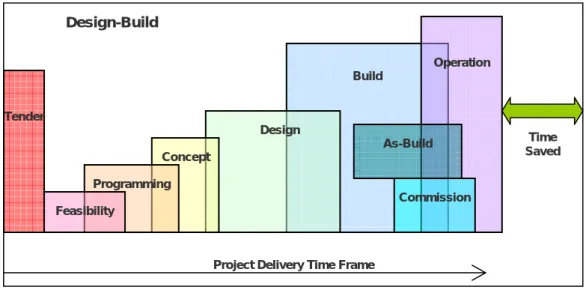
(13) Technology-Structure Relationships in Design-Build Projects. construction lead to the division of labour between design and construction.. Traditionally (since the industrial revolution), a facility is realised through two distinct phases – design and construction. It is common practice to first complete the design work before commencing the construction work. Design is typically an employer’s undertaking through independent engagement of design consultants. With his assistance, the employer would invite tenders for the construction work, which commenced only after the award of tender. The business entity undertaking the construction (typically known as the contractor) assumes no design responsibility and its efficiency are derived from a focus on construction. This sequential process is known as the design-bid-build project delivery method (DBB) (Beard et al, 2001:1). However, there are exceptions to the use of design-bid-build delivery method. Isolated niche markets such as electric power, chemical and food processing industries make use of single entity responsibility for the facility design, equipment selection and construction (Beard et al, 2001:2). Similarly in Taiwan, petrol-chemical facilities, incinerators and waste water treatment works have been reported constructed using the design-build method (Wu, 吳俊明, 2000).. The differences between design-bid-build (DBB) and design-build (DB) are shown in Fig. 1.1 and Fig. 1.2. Fig. 1.1 (DBB) shows a specific tender process separating the design phase from the construction phase, whereas in Fig. 1.2 (DB), such a process is discarded. Contemporary design-build projects are fast-tracked, meaning that there is overlap between the design and construction activities. Clearly from Fig. 1.2, time to delivery of the final product is shortened by eliminating the additional tender process and fast-tracking. This is one of the most cited benefit of design-build project delivery method in the literature (Beard et al, 2001; Ling, Ofori and Low, 2003; Molenaar and Page 2 / 150.
(14) Technology-Structure Relationships in Design-Build Projects. Gransberg, 2001). Other advantages of the design-build method include cost saving and better value, better quality, reduced administration, improved risk management, single point responsibility (employer deals with one DB contractor), better coordination and communication (reduced interfaces between designer and builder) and early knowledge of firm costs (Beard et al, 2001; Brouillard, 2003; Yates, 1995; Talal, 2005; Yen 顏敏仁, 2000; Wei 魏騰輝, 2003; Wu 吳俊明, 2000).. Design-Bid-Build Operation Build Tender. Tender Design As-Build Concept Programming Commission Feasibility. Project Delivery Time Frame. Fig. 1.1 – Time frame of traditional design-bid-build Source: Liao H-P (2004), Study of QA/QC Practice in a Design/Build Project - C260 Works of Taiwan High Speed Railway Project, Chaoyang University of Technology, Department of Construction Engineering, unpublished thesis [廖煥平, 2004]. Several renowned professional institutes have attempted to define “design-build”, cited below (adapted from Yen 顏敏仁, 2000; Wu 吳俊明, 2000; Tam, 2000). These definitions have one common point: single point of responsibility to the employer. The employer deals with and manages only one contractor to undertake full range of work from design through to deliver of final product. Very often, such a single point of responsibility is shared by a group of firms teamed up as joint ventures.. Page 3 / 150.
(15) Technology-Structure Relationships in Design-Build Projects. Design-Build Operation Build Tender Design As-Build Concept. Time Saved. Programming Commission Feasibility. Project Delivery Time Frame. Fig. 1.2 – Time frame of design-build Source: Liao H-P (2004), Study of QA/QC Practice in a Design/Build Project - C260 Works of Taiwan High Speed Railway Project, Chaoyang University of Technology, Department of Construction Engineering, unpublished thesis [廖煥平, 2004]. American Institute of Architects (AIA): In the design/build delivery approach, responsibility for both design and construction is vested in a single entity. ... the owner writes one contract, assigning “single point” responsibility for the project. The design/build entity usually proposes the design and the construction price simultaneously, and the construction commitment is made very early in the process. Design and construction may or may not be fast-tracked.. American Society of Civil Engineers (ASCE): A turnkey construction contract is a contract which holds a single entity responsible for the design and construction of a specified facility. The entity may be a single party or an association of firms necessary to design and construct the project.. Design-build Institute of America (DBIA): Also known as “design-construct” or “single responsibility”. Design-build is a system of contracting under which one entity performs both architecture / engineering and construction under one single contract.. Chartered Institute of Building (CIOB): The client deals directly with the contractor for the complete building and it is the Page 4 / 150.
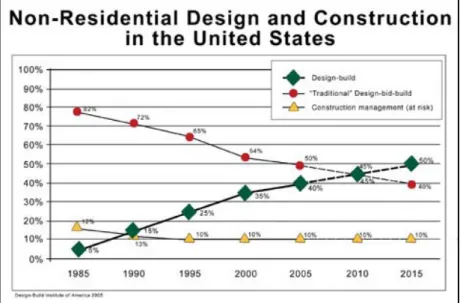
(16) Technology-Structure Relationships in Design-Build Projects. contractor who is not only responsible for, but also coordinates the separate design and construction processes, including engagement of the design team who are, therefore, contractually linked with the contractor and the client. The construction process, whilst linked, is still separate from the design process, leaving the consultants free to concentrate on their own roles. The client may, however, directly appoint either in-house staff or a separate consultant to check that the product the contractor is providing is value for money and that content and quality are satisfactory.. Construction industries worldwide in the 21st century is characterised by a move towards adopting design-build for project delivery. According to a study commissioned by the Public Construction Commission (PCC, 公共工程委員會) in 2001, about 30% of all projects in the United States adopted the design-build methodology. Locally, Wei (魏 騰輝, 2003) and Yang (楊人能, 2002) have also reported a significant increase in projects being delivered through the design-build process since the Taiwan High Speed Rail 1 commenced construction in year 2000. In particular, when the Government Procurement Act (政府採購法) came into effect in 1998, design-build was given a legal frame of reference in public works. Subsequent Build-Operate-Transfer (BOT) programs, such as the Kaohsiung Metro, also utilised design-build as its principal means of procuring facilities needed for operation. The potential advantages of this project delivery process have also led Taipei Metro, which was once realised through design-bid-build, to now adopt the design-build delivery method.. The Design-Build Institute of America published on the projection of the growth of design-build in the U.S., shown in Fig. 1.3. In this projection, the use of design-bid-build has correspondingly decreased as design-build becomes the predominant method of. 1 THSR, the first large scale Build-Operate-Transfer (BOT) program in Taiwan, see Taiwan High Speed Rail Corporation website, www.thsrc.com.tw.. Page 5 / 150.
(17) Technology-Structure Relationships in Design-Build Projects. project delivery. Increasing application of design-build in transportation projects has also been reported by Molenaar and Gransberg (2001). The study commissioned by the PCC (2001) also indicated that public works requiring design-build or turnkey as a means of project delivery amounts to as much as 87.1% and that more than 76% of public institutions are willing to adopt design-build.. Fig. 1.3 – Growth of design-build projects Source: Design-Build Institute of America, http://www.dbia.org/fr_industryin.html, 2006/3/25. 1.2 Motivation and Importance of the Study. The growth in popularity of design-build project delivery method has inspired a very large body of literature in the field of engineering and project management. Some studies shows support for the use of design-build (e.g., Gransberg, 2003; Talal, 2005), whilst others reported disadvantages (e.g., Fahmy and Jergeas, 2004). Some discovered through statistical testing the factors that determine the performance of design-build projects (e.g., Ling, 2004; Ling, Chan, Chong and Ee, 2004).. Page 6 / 150.
(18) Technology-Structure Relationships in Design-Build Projects. Combining engineering design and construction functions in one single project increases internal interfaces of the design-build entity and generally elevates the level of complexity in the project. Given the freedom of the design-builder to choose a design that will enable it to deliver the facility in the most cost effective and efficient manner, the design-builder is exposed to higher levels of uncertainty. Growth in project scale and scope (such as packaging electrical and mechanical work with civil and architectural works), and concurrent execution of project activities, further add complexity to the project. Such factors impact the structuring of engineering project organisations directly, and eventually the effectiveness of the project organisation. These forces are major challenges for the local industry to seek more effective methods to manage such complex projects. We have seen some well-known construction companies under-performing in the design-build context. We have also observed that most civil and building contractors are “locked-in” to the mindset of traditional design-bid-build project framework, which may explain why some project organisations are performing poorly.. In the search for ways to better organise and structure a design-build project, we looked into organisation literature, where organisation effectiveness is the main theme in academic study. In retrospect to the project management literature, we find many writers in the project management literature have often associated project success with effectiveness, making no conceptual differentiation between the two. Furthermore, we find very little concern for the effectiveness of project organisations in the project management practice. Yet, looking back again into organisation literature, we find deficiency in the study of “remote” project organisations which characterises design-build projects.. Perhaps the most widely cited organisation form for project work is matrix structure Page 7 / 150.
(19) Technology-Structure Relationships in Design-Build Projects. and project team (Galbraith, 1971, 1974; Galbraith and Kazanjian, 1986; Larson and Gobeli, 1989). Different structural forms are effective under different settings, for example Larson and Gobeli found that project success varied according to project structure. However, the matrix and project forms exist within an existing organisation. Members of the project are drawn from a pool of staff within the organisation, and project work is executed within the boundary and context of the organisation.. Construction projects in Taiwan are often executed by remote projects formed in an ad hoc manner. By “remote”, we refer to temporary project organisations established outside the boundary of an enduring business organisation, for the sole purpose of executing the project work. They are not “temporary organisations within organisations” (Shenhar, 2001:395). This is evident from field observation that many design-build project organisations in Taiwan are staffed with only few members assigned to the project from the parent organisation that has solicited the project work. Bulk of the project staff is drawn elsewhere, mostly at an ad hoc basis and through subcontracting.. From the preceding discussion, there are several gaps in both the project management and organisation literature that warrant further study. These gaps motivated this study.. 1.2.1. Need for study of technology-structure relationships in projects. Various contingency factors shape organisation structure. Mintzberg (1980) identified four sets of contingency factors that have received most attention: age and size, technical system, environment and power. In particular, technology has received substantial attention in the literature. Several technology constructs exist in organisation Page 8 / 150.
(20) Technology-Structure Relationships in Design-Build Projects. literature, relating technology to various dimensions of the organisation structure. Several studies have also looked into the link between technology, structure and performance.. In the project management domain, Shirazi, Langford and Rowlinson (1996) have discussed the contingent impacts of technology and environment on construction organisations. Shenhar (2001) has developed a typology to classify technical projects along the dimension of technological uncertainty and complexity. Pich, Loch and De Meyer (2002) conceptualised a model of uncertainty, ambiguity and complexity in project management, relating the level of uncertainty to the project management structure. Despite these studies, there is a need for more specific technology-structure studies in project management. Design-build projects are often called for in complex engineering works where managerial effort is required as much as the technical effort. Previous studies of technology’s effects on project organisation structure are qualitative, and in our opinion, an under-studied phenomenon. More rigorous study of such relationships is necessary to gain more in-depth understanding.. 1.2.2. Need for theory building in project management. Shenhar (2001) argued that “theory development in project management is still in its early years” (p.394). Turner (2006a, 2006b, 2006c) presented a theoretical framework for project management, which has been further refined by Sauer and Reich (2007). We see as one of our objectives in this study to contribute to the growing theoretical foundation of the project management discipline. We approach this research with model building in mind.. Page 9 / 150.
(21) Technology-Structure Relationships in Design-Build Projects. By theory building, we seek to develop a model explaining the forces that affect the structuring of project organisations, in the face of the technology adopted, utilised and involved by the project organisation. The context in which we choose to extend the theory is design-build projects.. 1.2.3. Importance of the study. Based on our experience and observation of Taiwan High Speed Rail (THSR) and Kaohsiung Metro projects, as well as reports of Yang (楊人能, 2002), most local construction companies enter into design-build contracts by means of joint venture. Typically, the design function is subcontracted to consulting firms, although architects/engineers (the designers) may play a leading role as reported by Yates (1995) and Yen (顏敏仁, 2000). We are also aware that the local construction industry is in its early days of using the design-build method. Varying configurations of design-build project organisations have been used in the THSR, Kaohsiung Metro, Taipei Metro and various public works projects. But what constitutes an effective organisation configuration? This question requires a series of studies.. An effective project configuration is shaped by various forces (Mintzberg, 1980; Daft, 2004). Having identified such factors, we can critically evaluate the effect of each factor on the structuring of project organisations. When the performances (or effectiveness) of various project organisations are compared, differences in the pattern of project structuring between good and poor performing projects will surface, thereby identifying the key structural elements of effective project organisations. The identification of good performance projects will allow us to benchmark them against other projects, and pinpoint the deficiencies of projects that are underperforming. The Page 10 / 150.
(22) Technology-Structure Relationships in Design-Build Projects. research process described is consistent with Lawrence and Lorsch (1967a), Doty, Glick and Huber (1993), Miller, Glick, Wang, Huber (1991), and, Ketchen, Thomas and Snow (1993).. This study is important to the local construction industry. Taiwan’s participation in the World Trade Organisation (WTO) indicates exposure of the local market to foreign competition. As design-build delivery method gains popularity worldwide, local firms need to learn to manage design-build projects effectively so that they can compete at the international level. This study is an initial attempt to identify one of the factors that affect project organisation structure – technology; the means through which project organisations execute project tasks. It seeks to establish the relationships between technology and the project organisation structure, and lay the foundation for future studies.. 1.3 Objectives of the Study. Problem statement: What kinds of technology-structure relationships exist in design-build engineering projects? How does technology affect the organisation structure of design-build projects?. The objectives of this study are: (a) To identify the key features of design-build projects. (b) To identify the dimensions of the technical system in projects. (c) To identify the key dimensions of project structure. (d) Establish the relationship between the technical system and the project Page 11 / 150.
(23) Technology-Structure Relationships in Design-Build Projects. structure. (e) To develop a model of technology and organisation structure in the context of design-build projects.. 1.4 Scope of the Study. The design-build delivery method has many applications (Beard et al, 2001). We chose to focus the study on one engineering discipline which we are familiar with – architecture and civil engineering. The primary knowledge domains are civil engineering, structural engineering, hydraulics, geotechnical, surveying, building technologies and project management practices associated with these disciplines. Moreover, we focus on the project level (or site level) (Shirazi et al, 1996) as our level of analysis.. The design build projects we studied are all in Taiwan. The type of work studied includes mass transit, building works, railway, hydraulic, power substations, roadway and environmental protection works.. 1.5 Chapter Structure. Chapter 1 outlined the backgrounds leading to this research, and described the motivation of the study before stating the research problem. Chapter 2 reviews the literature and introduces the theoretical framework underlying this study. Key dimensions of organisation structure and the factors influencing organisation structure in the general management discipline are discussed. Various schools of thoughts on Page 12 / 150.
(24) Technology-Structure Relationships in Design-Build Projects. technology are outlined. Based on the literature review, chapter 3 proposes a model linking technology and project organisation structure and establishes several hypotheses. This chapter also reports the research methodology and instrument. Chapter 4 analyses the field data and discusses the results. The study report is concluded in chapter 5 with managerial implication and proposes some recommendations for further research.. Page 13 / 150.
(25) Technology-Structure Relationships in Design-Build Projects. Chapter 2 - Literature. Review. 2.1 Chapter Outline. We start this chapter by first outlining some specific features of design-build (DB) engineering projects that are different to design-bid-build (DBB). These features are considered contextual factors that influence the structure of a DB project. Among some of the well-recognised factors that cause structure in organisation science, we focus on the technical system (Mintzberg, 1979; Shenhar, 2001). Several technology constructs in the organisation science are reviewed, followed by similar work in the project domain. Two dimensions of a project’s technical system are identified; their components and influence on project organisation structure are further identified and discussed. We also reviewed the key structural dimensions of a project organisation relevant to the technical system.. 2.2 Properties of Design-Build Projects. Complex large scale projects involve a wide spectrum of skills and resources under given constraints. In particular, where design and construction are brought together within the scope of one project, the need for project management becomes more Page 14 / 150.
(26) Technology-Structure Relationships in Design-Build Projects. prominent. In addition to adopting the design-build delivery method, there is growing trend by employers to package dissimilar engineering works under one contract2 to realise the greatest benefit of this method. In contrast with the traditional design-bid-build (DBB) delivery method, design-build (DB) exhibit some unique features discussed below.. 2.2.1. The nature of projects. A wide variety of definitions for “project” could be found in the literature. The Project Management Institute (PMI, 2000) defined project as “a temporary endeavour undertaken to create a unique product or service” (p.4). Turner and Müller (2003) studied the nature of projects and defined project as “a temporary organisation to which resources are assigned to undertake a unique, novel and transient endeavour managing the inherent uncertainty and need for integration in order to deliver beneficial objectives of change” (p.7). These definitions suggest some common characteristics of projects.. (a) Projects exist temporarily, indicating a limited life span with a target completion date (Steele, 1989:135). With “time to market” becoming an important issue for employers, a sense of urgency is promoted in projects (Beard, Loulakis and Wundram, 2001:107). (b) Projects are unique, one of a kind, and differ from other products and services in some distinguishable ways. A certain degree of uncertainty is embedded. 2. For example, the scope of civil work projects in the Kaohsiung Metro includes civil engineering, architectural work and building services such as air-conditioning, water system and some electrical work. A further example is the depot project (bid no. CD550) of Taipei Metro. This civilwork project further included a range of mechanical systems to be procured and installed by the contractor (http://www.cec.com.tw/web/home_c.htm, 2006/5/17). Page 15 / 150.
(27) Technology-Structure Relationships in Design-Build Projects. under this uniqueness as minimal precedence exists. (c) Projects exist to deliver a specific product or service, i.e. goals or objectives are pre-established to guide the outcomes of the project. (d) Projects are characterised by limited resources: time, budget, human resource, space, materials, equipments and knowledge. The success of project hence depends partly on its ability to acquire resources. (e) Projects are performed by people whom through their skills and efforts transform input to outputs. Project members are organised structurally so that the flow of information and coordination of efforts can be facilitated (Turner and Müller, 2003:3). (f). Finally, projects are elaborated progressively (PMI, 2000:5), with details developed in an incremental manner.. 2.2.2. Employers’ requirement and scope of work. Under the traditional DBB method, the employer is responsible for the preparation of full design documents (specifications, detailed design, work instructions and so on). As the term “design-build” suggests, whole or part of the design responsibility is shifted to the design-builder. Typically, the design-builder would develop technical details based on the performance requirements defined by the employer. The underlying difference between the DBB and DB is the manner in which employer’s requirements and needs are communicated. The design-builder receives criteria for design from the employer, and not the design itself (Beard et al, 2001:39). Typically, such communication can be articulated in a number of ways: employer’s brief (Chan, Ho and Tam, 2001), request for proposal (RFP) (Beard et al, 2001:184) or even a certain percentage of the completed design (Molenaar and Gransberg, 2001). It has been further noted that the abstraction Page 16 / 150.
(28) Technology-Structure Relationships in Design-Build Projects. and processing of employer requirements in a clear and unambiguous way is essential to the success of DB projects (Anumba and Evbuomwan, 1997).. 2.2.3. Design development and management. The most distinguished feature of DB is the design-builder undertaking design work. Thus it is the onus of the design-builder to interpret the employer’s needs and project objectives. A major advantage to the employer is the transfer of project risks arising from design errors, omissions, ambiguities in the design to the design-builder (Beard et al, 2001; Yates, 1995:36).. Under DBB, where design (by the employer before commencing construction) and construction (after completion of design) are performed by separate entities, project goals are divergent (Love, Gunasekaran and Li, 1998). Interfaces between design and construction are inter-organisational and external to each entity. Under DB, this interface becomes internal, and the design function needs to be available throughout the project life working closely with the construction crew. Comparative with DBB, a higher degree of integration between design and construction is thus necessary in DB.. The design function of a DB project has three core tasks: (1) interpretation of employer needs, (2) preparation of design work packages and construction documents, and, (3) provide solutions to project design issues on an on-going basis, by tracking problems or changes, issuing design clarifications and maintaining and communicating up-to-date record documents (Bear et al, 2001:124). These core tasks are by and large informational, and technical in nature.. Page 17 / 150.
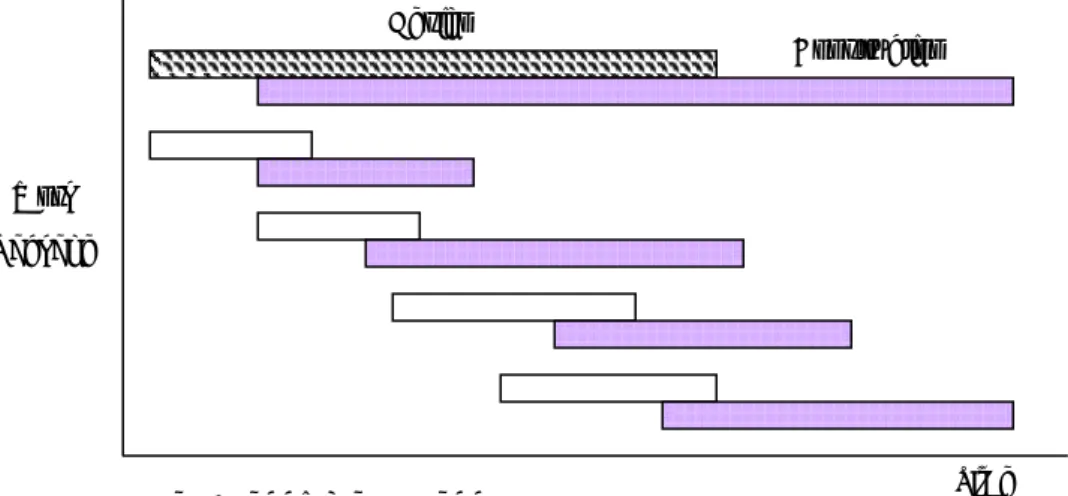
(29) Technology-Structure Relationships in Design-Build Projects. 2.2.4. Employer representation and monitoring. In DB, the employer is drawn away from direct design input (Songer and Molenaar, 1997), but is involved in the design development process. This process is generally performed through a series of design reviews and approval by the employer or employer’s consultant (Beard et al, 2001:89). The degree of employer-design-builder interaction is critical to the design-builder, so that misunderstandings and ambiguities can be avoided, and design output can be aligned with the employer’s needs (Chan et al, 2001). In contrast, design is fully developed under the DBB method. To the construction entity, the employer plays a monitoring role, ensuring that the built facility follows design.. 2.2.5. Shorter time frame. DB projects are characterised by relatively shorter project duration resulting from the perceived time-saving benefits and employers demanding shorter time-to-market (Anumba and Evbuomwan, 1997:272; Beard et al, 2001:3; Fahmy and Jergeas, 2004; Molenaar and Gransberg, 2001:215). Often, a pre-determined project completion date is established; a constraint which the design-builder must work within.. Compression of time is generally achieved in two ways. First, by overlapping design and construction activities3, a process known as fast-tracking, concurrency or parallel engineering (Anumba and Evbuomwan, 1997; Fazio, Moselhi, Théberge and Revay, 1988:195; Ibbs, Lee and Li, 1998:36). Secondly, subcontract portions of the work. 3. In contrast, design and construction activities are sequential in DBB projects. See Fig. 1.1 and Fig. 1.2. Page 18 / 150.
(30) Technology-Structure Relationships in Design-Build Projects. to a third party.. In practice, both design and construction activities are broken down into relatively independent work packages. Such breakdown facilitates concurrent engineering. Designs that are substantially complete can be released for construction package by package (refer Fig 2.1 for graphic representation of fast-tracking). Fast-tracking is further facilitated by accommodating the design and construction functions as internal interfaces.. Design. Construction. Work Package. Fig. 2.1 – Fast-tracking approach. Time. Source: Fazio, P., Moselhi, O., Théberge, P., Revay, S., 1988, “Design impact of construction fast-track”, Construction Management and Economics, 5(3) 195-208. 2.2.6. Project cost. DB is one of the ways that an employer transfers project risks to the design-builder. To the employer, this indicates early knowledge of project cost and hence reduced financial risk (Beard et al, 2001; Chan, Scott and Lam, 2002). Often the design-builder receives contract on a lump-sum basis, which indicates that the design-builder needs to generate design options and select construction methods within budgetary constraints.. Page 19 / 150.
(31) Technology-Structure Relationships in Design-Build Projects. Beard et al (2001:122) outlined the use of project WBS (work breakdown structure) to identify the work packages as cost centres for management of cost and monitoring of cost performance.. The practice that the design-builder needs to develop design, subject to the approval of the employer, places the design-builder at risk of cost overrun, particularly in lump sum contracts. This problem is exacerbated by ambiguous employer’s scope or the employer lacking the experience to administrate DB contracts (Chan et al, 2001).. 2.2.7. Subcontract management. Subcontracting portions of a project to specialist trade contractors is a distinguishing characteristic of the construction industry (Eccles, 1981:449; Gil, Tommelein and Ballard, 2004). Beard et al (2001), Fahmy and Jergeas (2004), Gil, Tommelein, Kirkendall and Ballard (2001), and Ling (2004) have reported benefits gained from engaging subcontractors, particularly specialists of a specific system who may undertake portions of the design and construction responsibility.. The use of subcontractors allows the DB entity to maintain a flat management hierarchy rather than a traditional vertical hierarchy that places designers and primary contractor at the top and subcontractors/ suppliers at the bottom. The use of subcontractors requires the design-builder to integrate the design-build process with subcontractors (Beard et al, 2001). Hence, in contrast with DBB, integration of subcontract work under DB method is extended to the level of design. Furthermore, concurrent execution of project activities indicates that any change in the project brings multi-nodal (Ivory and Alderman, 2005) impact to the subcontractor level. Page 20 / 150.
(32) Technology-Structure Relationships in Design-Build Projects. 2.2.8. Multi-disciplinary skills. DB is often used for complex projects (Beard et al, 2001). There is growing trend of packaging dissimilar engineering work under single DB project. Taken together, a DB project that makes use of multiple engineering functions or disciplines, is becoming a wide spread practice (Williams, 1999:273). It must be recognised that task characteristics and engineering science vary across engineering functions or disciplines.. 2.2.9. Project life-cycle. The employer’s scope of work sets out the breadth and depth of the project and may determine the number of life cycle phases in a design-build project. A full-service design-builder begins their project involvement at project inception, providing feasibility and programming services for the employer (Beard et al, 2001:114). A seven phase model of DB is illustrated in Fig. 2.2. The main difference between DB and DBB lies in the overlap of design phases and construction, as well as two-staged design phase (conceptual design and design development).. Project Intensity of Effort. Operation. Programming Construction Feasibility Design Concept Commissioning. Fig. 2.2 – Major Design-Build project phases Source: Beard J. L., Loulakis M. C. Jr. and Wundram E. C. (2001), Design-Build: Planning through Development, McGraw-Hill, p.115 Page 21 / 150.
(33) Technology-Structure Relationships in Design-Build Projects. 2.2.10. Summary and Postulation. In this section, we have briefly outlined some of the key features of DB projects. Projects, by their very nature, are temporary with specific objectives under constrained resources. The design-builder receives design criteria from the employer and is responsible for design development. How the design-builder implements the design is somewhat contingent on the choice of design selected and approved by the employer. Yet it is an area where the design-builder has some degree of flexibility to promote design and construction practices most familiar to him. We also note that time constraint is a major feature of DB projects which forces design implementation to be carried out concurrently with design development. The trend of employers packaging dissimilar trades of work under one project requires the design-builder to make use of subcontracting and multiple engineering skills.. Several organisational issues have surfaced from the above review. Incomplete design, availability of design function throughout the project life cycle, employer representation in design development, and the very nature of projects itself, all point to uncertainty as a key element of DB projects. At the same time the design-builder has freedom of choice in design and construction implementation; he is thus faced with uncertainty in terms of how or what to deliver as the final product, what kinds of technology, methods, materials, machinery and skills to use. Limited resources, parallel execution of project activities, use of subcontractors and involvement of multiple engineering disciplines suggest another core element – complexity. Design-builder is faced with larger frame of interfaces both at design and construction levels. As pointed out in the literature review, changes in one aspect of the project may lead to ripple-effect impacts on the overall project. Different subcontractors and engineering disciplines Page 22 / 150.
(34) Technology-Structure Relationships in Design-Build Projects. require integration and constant exchange of information to achieve the project objective.. So far we have identified two elements central to DB projects: uncertainty and complexity. How then does the DB project organisation respond to uncertainty and complexity in the context of the engineering work it is contracted to carry out? In what manner does DB projects organise itself to tackle these forces? Since the focus of this study is on engineering projects, we first look into organisation literature, in particular on technology, and then into project management literature for answers.. 2.3 Technology Constructs in Organisation Domain. The notion that “context determines form” (Pugh, Hickson, Hinings and Turner, 1969; Inkson, Pugh and Hickson, 1970) has been one of the central themes in organisation literature. Several academics (for example, Daft, 1995, 2004; Hall, 1991; Mintzberg, 1979; Perrow, 1970; Robbins, 1990; Thompson, 1967) have studied the relationships of a wide range of contextual factors with respect to structure. This stream of research is known as the contingency theory (Galbraith and Kazanjian, 1986). Among a number of contextual factors (e.g., strategy, environment, life cycle stage, culture) identified, technology has received substantial attention. Thompson (1967) argued that technology and environment are two principal domains that influence the structuring of organisations. Randolph (1981) considers the choice of technology as the primary factor in determining an effective organisation. In this section, we first review some important perspectives of technology in organisation literature before we review similar writings in the project management literature. Page 23 / 150.
(35) Technology-Structure Relationships in Design-Build Projects. 2.3.1. Key technology constructs. In organisation domain, the term “technology” generally refers to the means, techniques, skills and knowledge that transform input into output (Daft, 2004:243; Fry, 1982;. Randolph,. 1981;. Robbins,. 1990:176).. However,. several. technology. classifications exist in organisation theory. For example, operations techniques, characteristics of materials, complexity in knowledge system, degree of routineness of operations, and interdependence between work systems (Hickson, Pugh and Pheysey, 1969; Robbins, 1990:177).. The notion that technology affects the structuring of organisations was first introduced by results of Woodward’s (1965) study on industrial organisations in England. Woodward found that organisations utilising different production technologies were characterised by different structural forms, and effectiveness of the organisations were related to the ‘”fit” between technology and structure. Three broad categories of technology (unit, mass and process production systems) were identified along a scale, referred to as technical complexity. Increasing levels of technical complexity was matched by more structure (i.e., formalisation, centralisation, hierarchy). This relationship has been confirmed by the work of Khandwalla (1973), who indicated that mass output orientation of manufacturing firms is related to vertical integration and use of sophisticated controls. Although the level of Woodward’s study was at the organisation level (Fry, 1982), such conceptualisation of technology in the manufacturing. context,. including. engineering,. has. been. a. long-standing. technology-structure framework in organisation studies (Mintzberg, 1979).. Woodward’s (1965) work originates from manufacturing. An alternate perspective Page 24 / 150.
(36) Technology-Structure Relationships in Design-Build Projects. was put forth by Perrow (1970). Perrow considered technology as the means to transform raw materials (human, symbolic, or material) into desirable goods and services (p.75). Articulating technology in terms of the knowledge necessary to execute work within an organisation, he identified two dimensions of technology. Task variability considers the number of exceptions encountered in one’s work. A routine task would be characterised by low task variability. Task analysability considers the type of search procedures followed to find successful methods of responding to exceptions. These two dimensions form a two-by-two matrix and represent four types of technologies depicted in Fig. 2.3. In Perrow’s (1970) perspective, routineness is the key element that determines the coordination and control mechanisms in organisations. The more routine the technology, the more structured the organisation in terms of formalisation, centralisation and hierarchy. Routine organisation tasks can be accomplished best through standardisation and control. In contrast, non-routine technology calls for greater structural flexibility, and interdependence between organisation units are relatively higher. Organisations characterised by non-routine technology would be decentralised with little formalisation.. Not analysable. Craft Technology. Non-Routine Technology. Analysable. Routine Technology. Engineering Technology. Few Exceptions. Many Excepions. Fig. 2.3 – Perrow’s technology framework Source: Perrow, C., (1970) Organisational Analysis: A Sociological Review, Tavistock Publications, London. Another perspective of technology that has had substantial influence on Page 25 / 150.
(37) Technology-Structure Relationships in Design-Build Projects. organisation literature was that of Thompson (1967), who argued that technology is a source of uncertainty in organisations. He identified three types of technology based on the nature of tasks performed by organisation units by conceptualising the interdependence between work units. Long-linked technology is characterised by tasks linked in a sequential manner as often found in assembly lines. Owing to this serial independence, coordination among activities can be done by standardisation and planning. However, uncertainties related to this technology are at the input and output side of the organisation. Mediating technology is one that links clients or customers on both input and output side of the organisation. Banks, telephone utilities, retail stores and employment agencies are examples (Robbins, 1990). The type of interdependence identified in this technology is pooled interdependence. The last type of technology called intense technology represents a customised response to a diverse set of contingencies where units are dependent on each other’s feedback. Coordination in such technology is achieved by mutual adjustment as standardisation and planning would prove relatively ineffective and units depend on each other in a reciprocal manner.. In sum, coordination between interdependent work units can be achieved through standardisation, planning, use of formal communication channels and mutual adjustments (Daft, 2004:268; Thompson, 1967; Van de Ven, Delbecq and Koenig, 1976). Structural formalisation would decrease from mediating to long-linked and to intense technology, while structural complexity (such as centralisation, hierarchy) would increase in this order (Robbins, 1990:191).. With the observation that technology has the greatest effect on the operating core of an organisation, Mintzberg (1979) argued that conceptualisation of technology is in Page 26 / 150.
(38) Technology-Structure Relationships in Design-Build Projects. disarray and renders difficulty in research. He suggested that technical system (or operations technology), i.e. the “collective instruments used by the operators to do their work” (p.250), is a more suitable articulation of the instrument that transforms inputs into outputs. This view is supported by Aldrich (1972) and Robbins (1990). Two dimensions are identified of a technical system (Mintzberg, 1979). The regulation dimension describes the extent to which work is controlled by the instrument. In the project context, this would be considered as constraints to which project activities must accommodate. The sophistication dimension describes the complexity or intricateness of the technical system, or how well it is understood. For example, Woodward’s (1965) unit production technology would be one of little regulation and sophistication, while process production systems are frequently highly regulated with high degree of sophistication.. Mintzberg (1979) hypothesised that the more regulating the technical system, the more formalised the operating work and the more bureaucratic the structure of the operating core (p.261). He further hypothesised that the more sophisticated the technical system, the more elaborate the administrative structure, specifically the larger and more professional the support staff, the greater the selective decentralisation, and the greater the use of liaison devices (p.262).. More recently, Burton and Obel (2004) discussed technology from an information processing perspective. Consolidating various academic perspectives of technology, Burton and Obel have shown that technology is characterised by complexity, interdependence and uncertainty (p.246). These three properties have generated a need for information to reduce complexity and uncertainty while facilitating coordination between interdependencies. Burton and Obel further showed that organisations need to be designed with appropriate information processing capacity to match the demand for Page 27 / 150.
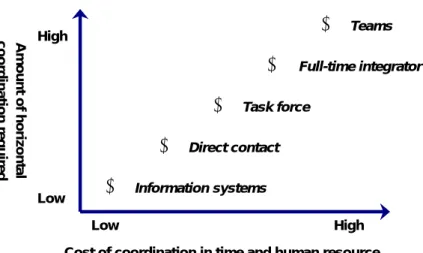
(39) Technology-Structure Relationships in Design-Build Projects. information (p.7). An effective organisation would be characterised by a close fit between demand for information and information processing capacity. Neither inadequate nor excessive capacity is likely to be associated with effectiveness and efficiency. Burton and Obel posited several technology-structure relationships outlined below.. (a) Routineness of technology is positively associated with formalisation, but the association is not strong if many professionals are employed (after Miller, Glick, Wang and Huber, 1991). (b) Routine technology is associated with centralisation, but only in the case where organisation size is small. Robbins (1990) holds a slightly different view arguing the relationship holds only if formalisation is low. (c) If the organisation size is small and the organisation has a routine technology, then complexity (vertical and horizontal differentiation) should be medium. (d) Routine technology is more prone to the use of rules and procedures as a means of coordination. Non-routine technology calls for a large amount of information, and coordination by integrators and groups using richer media are preferred.. Table 2.1 sums up the various perspectives of technology in organisation domain reviewed above. As a generalisation, the constructs reviewed so far can perhaps be summarised by Hunt’s (1970) observation that “the critical technological element to which organisational structure must respond seems best conceptualised as complexity” [italics in original text] (p.244). The more complex (non-routine, sophisticated and high degree of interdependence between organisation units) the technology, the more an organisation structure becomes differentiated by occupational specialty (Dewar and Page 28 / 150.
(40) Technology-Structure Relationships in Design-Build Projects. Hage, 1978) and structured (Robbins, 1990). However, based on the above review, the technology-structure is moderated by several factors such as size and type of technology.. Table 2.1 – Summary of technology conceptualisations in organisation literature Scholar Thompson (1967). Key Concept. Taxonomy of Technology. Interdependence and coupling between work units. Pooled coupling (mediating technology) Serial coupling (sequential technology) Reciprocal coupling (intense technology). Perrow (1970). The means to transform raw material into goods and services. The dimensions are: task variety (exceptions) and analysability. Routine Non-routine Craft Engineering. Mintzberg (1979). Technical system as the instruments used to do work.. Dimensions of technical system: Regulation and Sophistication. Burton and Obel (2004). Complexity, interdependence and uncertainty. None. 2.3.2. Levels of technology study. The level at which technology and organisation structure are measured bears significance on the validity of the technology-structure constructs. Mohr (1971) warned of problems arising from measuring structure across the organisation whilst characterising only the production technology. The variety of technologies adopted by an organisation can be overlooked at the organisational level (Mahoney and Frost, 1972).. Fry (1982) and Robbins (1990) have pointed out two levels of technology research: Page 29 / 150.
(41) Technology-Structure Relationships in Design-Build Projects. organisational and work unit-level. They further identified that large and moderate sized organisations employ multiple technologies. By averaging results, measured for work units, to arrive at a dominant technology at the organisational level may result in the misinterpretation of the technology-structure relationship. This is supported by propositions put forward by Burton and Obel (2004) that the relationships between technology and structure are moderated by size. Moreover, work-level studies of technology have found higher support by researchers as the concept of technology is more homogeneous and poses lesser methodological problems (Fry, 1982), particularly at the operating core (Mintzberg, 1979, Robbins, 1990). Furthermore, Perrow’s (1970) framework has been shown to have high validity (Withey, Daft and Cooper, 1983).. 2.3.3. Brief summary. Various perspectives of technology exist in organisation literature. Thompson (1967) conceptualised technology as interdependence while Perrow (1970) focused on the knowledge to perform work. Burton and Obel (2004) identified three dimensions of technology as opposed to two for the operating core by Mintzberg (1979).. Extensive research on the technology-structure relationship can be found in organisation literature. Robbins (1990) and Miller, Glick, Wang and Huber (1991) argued that the common theme underlying the main perspectives of technology is routineness, while Hunt (1970) has described this theme as complexity. Different degrees of routineness are associated with varying degrees of uncertainty and sophistication in the technology. Research has also shown organisations are structured differently in the face of technology it uses (Miller et al, 1991). Simple technology is matched by simple structure while complex technology requires more structural devices Page 30 / 150.
(42) Technology-Structure Relationships in Design-Build Projects. to be effective. In particular, intensive technologies require a constant flow of information and greater integrative effort than simple technologies. Two levels of technologystructure research have also been identified. The central tendency perspective at organisation level may overlook variations (or outliers) at the work unit level where richer knowledge of organisation can be gained (Daft and Lewin, 1990).. 2.4 Technology Constructs in Project Management Domain. Studies of the technology-structure relationships in organisation literature are founded on organisations that are of an on-going nature, i.e. an undetermined life span. Engineering projects, with limited life span, specific in its objectives, and sophisticated in technology, exhibit different kinds of technology-structure relationship to those identified in the organisation literature. This section reviews several streams of related work in the project management domain and discusses in detail two key dimensions of the project technical system.. 2.4.1. Technology constructs in project domain. In the project management domain, we see several streams of work on the relationship between technology and structure, particularly that of Nam and Tatum (1988), Shirazi, Langford and Rowlinson (1996), Dvir, Lipovetsky, Shenhar, and Tishler (1998), Shenhar (1997, 1998, 2001), Shenhar and Dvir (1996) and Shenhar and Bonen (1997).. Nam and Tatum (1988) argued that construction technology exhibit five Page 31 / 150.
數據
+7
相關文件
Department of Mathematics National Cheng Kung
Department of Mathematics National Cheng Kung
Department of Mathematics National Cheng Kung
W EN -C HING L IEN Department of Mathematics National Cheng Kung
Department of Mathematics National Cheng Kung
Department of Mathematics National Cheng Kung
Department of Mathematics National Cheng Kung
Department of Mathematics National Cheng Kung
