ESTABLISHMENT OF A COMPETITIVE ELISA FOR
DETECTION OF FLORFENICOL ANTIBIOTIC IN FOOD
OF ANIMAL ORIGIN
Shi-Yuan Sheu,1,2,3 Yueh-Kuei Wang,4 Yung-Te Tai,5 Yi-Chih Lei,4 Tong-Hsuan Chang,5 Chun-Hsu Yao,6 and Tzong-Fu Kuo4
1 School of Chinese Medicine, China Medical University, Taichung, Taiwan, ROC
2 School of Medicine, Chung Shan Medical University, Taichung, Taiwan, ROC
3 Department of Integrated Chinese and Western Medicine, Chung Shan Medical University
Hospital, Taichung, Taiwan
4 Department and Graduate Institute of Veterinary Medicine, School of Veterinary Medicine, National
Taiwan University, Taipei, Taiwan, ROC
5 Taiwan Advance Bio-Pharmaceutical Inc., New Taipei City, Taiwan, ROC
6 Department of Biomedical Imaging and Radiological Science, China Medical University, Taichung,
Taiwan, ROC
Address correspondence to Prof. Tzong-Fu Kuo, School of Veterinary Medicine, National Taiwan University, Taipei, Taiwan, ROC. E-mail: [email protected]
Abstract
Florfenicol (FF) is a synthetic antibiotic with a broad antibacterial spectrum and the high therapeutic effectiveness that has been developed specifically for veterinary use. Obviously, FF adulterated in animal supplies is one of essential global concerns. A competitive ELISA for the detection of florfenicol in food of animal origin (swine, chicken, and fish) is described. Influence of immunoconjugate structure on the assay sensitivity and specificity was investigated. The new ELISA
showed much lower than the MRPLs for FF at 100 to 3,000 mg kg-1 in the European Communities and
the sensitivity of our ELISA method was superior to that described in other reports. According to the
test preparation record, the limit of detection of the developed ELISA performed on meat species was 0.3 g kg-1 (IC
50 value 1.9 g kg-1). The method developed permits FF concentrations to be determined
in the range 0.3-24.3 g kg-1. A low cross-reactivity with florfenicol amine (FFA), thiamphenicol (TAP),
and chloramphenicol (CAP) was displayed (16.2%, 9.5% and 9.4%, respectively). Recovery in different food samples (swine, chicken and fish) averages between 87 to 115%. The method can be applied for inspection of animal supplies for trace florfenicol residues.
Keywords
florfenicol, hapten, residues, food safety,
INTRODUCTION
Florfenicol (2,2-dichloro-N-{(1R,2S)-3-fluoro-1-hydroxy-1-[4-(methylsulfonyl)phenyl]propan-2-yl}acetamide, FF, Fig.1) is a synthetic antibiotic, selected from a series of fluorinated analogs of thiamphenicol (TAP) and chloramphenicol (CAP), with a broad antibacterial spectrum and the high therapeutic effectiveness that has been developed specifically for veterinary use.[1-3] The fluorine at the -methyl position in place of the hydroxyl group differentiates FF from TAP and this substitution makes the antibiotic significantly more active in vitro than CAP and TAP.[1,4-5] Because of the low risk of toxicity, florfenicol is administered in modern husbandry, as feed additives or in drinking water, for either therapeutic or prophylactic purposes.[6-8] Since residues of the pharmacologically active antibacterial could present a potential hazard for public health safety. The European Union (EU) has defined maximum residue limits (MRLs) for FF and its metabolites (expressed as florfenicol-amine, FFA), the MRLs have been set for 100 to 3,000 mg kg-1 in food matrix to date.[9] The MRL policies in the European Union, United States, Canada and Taiwan are presented in Table 1.[9-12]
FIGURE 1 Structures of FF, TAP and CAP.
Table 1
Maximum residue limits (MRLs) for florfenicol set by Taiwan, European Union, United States, and Canada.
MRLs, g kg-1
Species Tissues Taiwan European Union United States Canada
Bovine Muscle 300 200 300 200 Liver 3,700 3,000 3,700 2,000 Kidney a 300 a a Porcine Muscle 300 300 200 250 Skin fat 500 500 a a Liver 2,000 2,000 2,500 1,400 Kidney 500 500 a a Chicken Muscle 100 100 a a Skin fat 200 200 a a Liver 2,500 2,500 a a Kidney 750 750 a a
Fish Skin fat 1,000 1,000 a 800
a Not established.
The residual control needs to define an analytical strategy based on the combination or not of screening and confirmatory methods. Various methods have been published for the determination of florfenicol in a variety of matrices by LC,[13] EC,[14] HPLC,[15-17] HPLC-MS,[18-19] GC,[20-21] and GC-MS. [22-24] However, reports concerning the immunoassays for FF residue analysis are limited.[25-27] In an effort to provide a low cost, rapid and high-capacity screening analysis for florfenicol determination, ELISA (enzyme-linked immunosorbent assay) can provide a specificity, sensitive and high throughput screening. During the course of an investigation into the effect of FF on animal cells growing in tissue culture, it became desirable to obtain antibody to the antibiotic. The structural design of the hapten is an important step in the development of immunoasssays for small organic analytes, specifically tailored or modified antibodies are capable of detecting fluorinated antibiotics through the use of an enlarge target
compound, which can be formed by a simple derivatisation step.[28] Recent efforts in ELISA development have led to the production of specific antibodies. The polyclonal rabbit antibodies were produced with the immunogen hapten, FF-SH and FF-MH, and the 50% inhibition values (IC50) of 1.02 g kg-1 of FF was achieved, the limit of detection (LOD) was found to be 20 g kg-1 for FF in the swine feed.[27] Similar approach was undertaken into an indirect competitive ELISA that the metabolite florfenicol amine was incorporated to bovine serum albumin by a formaldehyde coupling method as an immunogen to immunize rabbits; the LOD was found to be 1.6 g kg-1 for FF in swine muscle tissue (Table 2).[26]
Table 2
Linear detection range and limit of detection for florfenicol detection with different ELISAs. Luo et al., 2009 [26] Luo et al., 2011 [27] Homemade Linear detection range
(g kg-1) 0.1-8.1 0.5-40.5 0.3-24.3
Species Swinefeed muscleSwine Swine, chicken, Fishmuscle
Limit of detection, LOD
(g kg-1) 1.6 20 0.3
In this study, polyclonal antibodies raised against the immunizing hapten, FF succinate (FF-SA), exhibited comparable sensitivity. The main analytical performance of the developed method was reported herein, and its applicability to analysis of FF in swine, chicken and fish muscle samples was discussed, so as to make the immunoassay suitable for high throughput screening.
EXPERIMENTAL Reagents
Florfenicol, chloramphenicol, thiamphenicol, succinic anhydride (SA), N-hydroxysuccinimide (NHS), N-(3-dimethylaminopropyl)-N’-ethylcarbodiimide hydrochloride (EDC), ovalbumin (OVA), porcine thyroglobulin (TG), bovine serum albumin (BSA), 1,8-diaminooctane, sodium acetate, sodium carbonate, sodium periodate, ethylene glycol, sodium borohydride, sodium hydroxide, anhydrous magnesium sulfate, hydrochloric acid and Freund’s complete/incomplete adjuvant were commercially available from Sigma (USA). Horseradish peroxidase (HRP) was from Roche (Switzerland). TMB (3,3’,5,5’-tetramethylbenzidine), ready-to-use substrate was obtained from Kem-En-Tec (Denmark). Pyridine, ethyl acetate (EA) and N,-N-dimethylformormamide (DMF) were of liquid chromatographic grade. All other chemicals were of analytical-reagent grade and were used as obtained. Deionized water was purified on a Milli-Q system (Millipore, MA). 10 mM PBS containing 140 mM NaCl and 2.7 mM KCl (pH 7.4) was used in dialysis; 50 mM carbonate/bicarbonate buffer (pH 9.6) was used as a coating buffer; and 10 mM PBST (0.05% Tween) was used as a washing buffer.
Materials and Instruments
Ninety-six-well plates were obtained from Costar #2592 (Cambridge, MA). A High Speed Refrigerated Centrifuge and a Tabletop Centrifuge (Kubota 6900 and 5400, Tokyo) were used. The antibody was dispensed in microtiter plates using a Fill microplate dispenser (Bio-Tek, Winooski VT). The microtiter plates were washed with the washing solution to remove unbounded antibodies using a 96PW microplate washer (Tecan, SLT., Salzburg). The absorbances of each well were measured with the EMax microplate reader (Molecular Devices, Sunnyvale).
Immunogen Design and Synthesis
Synthesis of Florfenicol Succinate (FF-SA). The hapten was synthesized by coupling florfenicol
with succinic anhydride [28]. Briefly, florfenicol (716 mg, 2 mmol) was reacted with succinic anhydride (200 mg, 2 mmol) under pyridine reflux for 24 h. After cool down to room temperature, the mixture was concentrated with a rotary evaporator. The residue was extracted with ethyl acetate (3 x 50 ml), dried with anhydrous magnesium sulfate, filtered and finally concentrated to yield a white solid. The modification of florfenicol may have benzene ring, hydroxyl, chlorine atom and carbonyl group, analyzed by ultraviolet absorption spectrum. The binds among atoms were determined by 1H-NMR (CDCl3) (Brucker, 500 MHz): 12.35 (b, 1H, COOH), 8.62 (s, 1H, CONH), 7.87 (s, 2H, Ph), 7.63 (s, 2H, Ph), 6.46 (s, 1H, COCHCl2), 6.17 (s, 1H, CH), 4.60 (t, 2H, CH2F), 4.29 (s, 1H, CH), 3.12 (s, 3H, OSOCH3), 2.66 (m, 4H, OCCH2CH2CO).
Synthesis of NHS Ester of Florfenicol Succinate (FF-SA-NHS). The desired product was made by
dissolving florfenicol succinate (458 mg, 1.0 mmol), NHS (138 mg, 1.2 mmol) and EDC (287 mg, 1.5 mmol) under DMF reflux for 24 h. After evaporated, the residue was re-dissolved with a small amount of ethyl acetate and water. The pH in aqueous layer was adjusted to 9.0-11.0 with 1 N NaOH and the upper EA layer was then discarded. S ubsequently, the remaining aqueous layer was adjusted to pH 2.0-4.0 with 1N HCl. The residue was extracted with appropriate ethyl acetate, dried with anhydrous magnesium sulfate; the product was then evaporated with vacuum to yield a white solid; 1H-NMR (CDCl3): 8.90 (s, 1H, CONH), 7.90 (s, 2H, Ph), 7.63 (s, 2H, Ph), 6.45 (s, 1H, COCHCl2), 6.04 (s, 1H, CH), 4.61 (t, 2H, CH2F), 4.51 (s, 1H, CH), 3.20 (s, 3H, OSOCH3), 3.04 (m, 4H, OCCH2CH2CO), 2.81 (s, 4H, OCH2CH2CON).
Synthesis of FF−Protein Conjugates. The hapten was covalently attached to carrier proteins (BSA
and OVA) using active ester method.[29] After dissolution of 20.7 mg of FF-SA-NHS (37 mol) in 1 mL dry DMF, the activated hapten derivative (405 L) was then added dropwise to BSA solution (20 mg in
4 mL of 0.1 N phosphate buffer, pH 8.0) by selecting protein:hapten molar ratio equal to 1:10 (BSA/hapten); the activated hapten derivative (595 L) was added dropwise to OVA solution (20 mg in 4 mL of 0.1 N phosphate buffer, pH 8.0) by selecting protein:hapten molar ratio equal to 1:50 (OVA/hapten). The resultant solutions were stirred for 1 h at room temperature, and the conjugates were then dialyzed against 3 L of 10 mM PBS buffer for 1 day with 2 changes of buffer at 4°C. The dialyzed solution of immunogen was frozen at -20°C until use.
Hapten-HRP Tracer Synthesis
A two-step, general synthesis of FF-SA-NHS-ed-HRP conjugates was presented.[30] The first phase of the synthesis involved the preparation of octanediamine-modified HRP: 2 mg of HRP was dissolved in 0.2 mL of a 5 mM sodium acetate buffer, pH 4.5, and 20 L of a freshly prepared 46.8 mM solution of sodium periodate in Milli-Q water was then added. The color rapidly changed from brown to green. This solution was incubated for 30 min at room temperature in the dark. 2 L of ethylene glycol was added to stop the reaction. After an additional incubation for 15 min, the reaction mixture, 100 μL of 1,8-diaminooctane solution (0.35 M, dissolved in 1N HCl, pH adjusted to 2.5), and 300 L of Milli-Q water were added and mixed. Subsequently, this mixture was adjusted to pH 9.5 with sodium carbonate solution and was allowed to react for 1.5 h at room temperature in the dark. Finally, 32 L of freshly prepared 0.26 M solution of sodium borohydride in Milli-Q water was added, mixed, and reacted for 1 h at room temperature in the dark. The resultant HRP solution was then dialyzed against 5 L of PBS overnight at 4°C with two changes of buffer. The second step of the synthesis was the preparation of FF-ed-HRP conjugates: 4 mg of FF-SA-NHS (7.2 mol) and 4 mg of EDC (20.9 mol) were dissolved in dry DMF (1 mL). The mixture was gently stirred at room temperature for 3 h. The activated hapten was added while stirring to the dialyzed HRP in phosphate buffer to obtain a molar ratio 10:1 (hapten/HRP). The conjugation mixture was stirred at room temperature for 1.5 h and the formed
product was purified and concentrated using Centriprep-30 unit (Amicon). The tracer obtained was diluted with an equal volume of glycerol and kept at -20°C until used.
Antiserum Production
FF antiserum was prepared according to the following schedule. Three New Zealand rabbits were immunized by sc injection with 1.0 mg of FF-SA-BSA antigen in 1.0 ml of a 1:1 mixture of complete Freund’s adjuvant by subcutaneous multi-site injections. Booster injections of 1.0 mg of antigen in 1.0 ml of a 1:1 mixture of PBS were given one week post-immunization with complete adjuvant replaced by incomplete adjuvant, and followed by two additional boosters given at two-week intervals. The blood was collected every time before each immunization for monitoring the antibody response.
Evaluations of Rabbit Anti-FF Antibodies by Indirect ELISA
The competitive ELISA format described was used to determine the sensitivity and specificity to free FF of test bleeds of the polyclonal antisera. Titer check was done in an indirect ELISA format, using FF-SA-OVA as the coating antigen (3 g mL-1) and rabbit sera (1:1,500-1:25,000) as the primary antibody; the goat anti-rabbit IgG antibody conjugated with HRP was diluted (1/1,000) in 0.1% BSA as the secondary antibody. The specificity test was performed in an indirect competitive ELISA format as described.[30] The antiserum showed to have the strongest competition toward FF was selected for further purification.
The optimum antiserum was determined by checkerboard titration. FF standard solutions were prepared serially, and the spiked concentrations of 1, 3, 10, 30, 100, 300 and 1,000 g kg-1 were used for obtaining standard curves. Assays were performed according to the indirect ELISA, and the midpoint of each displacement standard curve was calculated in order to determine its IC50. The IC50 was defined as the concentration of inhibitor required to inhibit color development by 50% compared to control wells
containing no competitors. The highly sensitive and specific polyclonal antibody was selected; purified by affinity chromatography on a Protein A-Sepharose column (GE Healthcare) and concentrated using Centriprep-50 unit (Amicon). The protein concentration of FF-specific antibodies was determined by the Bio-Rad protein assay (Bio-Rad Laboratorie).
Establishment of Direct ELISA
Optimal concentrations/dilutions of the antibody adsorbed to the plate, enzyme conjugate, and substrate solution were determined through checkerboard titrations of each reagent against all other reagents, following confirmation of the best choice of reaction vessels. The ELISA was carried out using the methodology described previously.[31] To each well of a split-type microtiter plate (12 strips of 8 wells each) was added 100 L of anti-FF polyclone antibody (2 g mL-1) in a coating buffer with a Fill microplate dispenser, and incubation was performed overnight at 4°C. The plate was then washed with washing buffer 3 times using a 96-well ELISA plate washer. After washing, the wells were treated with 200 L of 0.1% nonfat dried milk powder in PBS for 2 h at room temperature. After 2 h of incubation, the microtiter plates were dried at 20°C, 25% RH for 4 h. The entire 96 well plates were then placed into the resealable plastic bags with desiccant and store at 4°C until use.
The quantitative ELISA kit for florfenicol consists of a 96-well microtiter plate coated with an anti-FF polyclonal antibody, six standards (0, 0.3, 0.9, 2.7, 8.1, and 24.3 g kg-1), 100× conc. horseradish peroxidase (HRP)-labeled conjugate and a substrate solution (TMB) and stop solution (0.5 N HCl).
Preparation of Swine, Chicken and Fish Samples for ELISA
Oreochomis sp. (Taiwan tilapia) fish samples were purchased from the retail outlets; swine and
chicken samples were collected from the local meat markets. No measurable FF residues were observed by previous ELISA determinations and HPLC method. Before being analyzed, the fish was filleted, the
skin and bones were removed and the muscles were minced. An amount of 2.0 g of the homogenized muscle samples (including swine chicken and fish) was accurately weighted into a centrifuge tube and 4 ml ethyl acetate was added with vortex vigorously (30 s) and centrifuged (3,000 rpm, 10 min). The upper ethyl acetate layer (2.0 mL) was transferred into glass tubes and the extract was evaporated by heating to dryness at 50°C using a Turbovap evaporator system (Caliper). Hexane (2.0 mL) was added to the sample evaporate and vortexed thoroughly followed by the addition of PBS (1.0 mL). After vortexing again (30 s), samples were centrifuged (3,000 rpm, 10 min) and the upper hexane layer discarded; the remaining extract was used for ELISA determination.
ELISA Methodology
All reagents of the test kit were supplied ready and required number of strips to reach room temperature prior to use. 100 L of standard (0, 0.3, 0.9, 2.7, 8.1 and 24.3 g kg-1 Florfenicol) or sample with 100 L of FF-horseradish peroxidase enzyme conjugate was applied to each well. Maximum binding was assessed by adding no inhibitor (zero standards) to the relevant wells. Plates were incubated for 30 min at room temperature in the dark and the wells were then manually washed 3 times with the washing buffer (250 L per well). After washing, the plates were inverted onto absorbent paper. Substrate solution (100 L per well) was added and the contents were mixed thoroughly. After 20 min the enzymatic reaction was stopped by the addition of the stop solution (100 L per well). Absorbance was measured at 450 nm. FF concentration values were calculated by interpolation from the calibration curve, where the bound enzyme activity, expressed as the logit of the ratio (in present) between FF signal at each concentration of FF (B) and the bound activity in the absence of unlabeled FF (B0) was plotted against the log of FF concentrations. The percent binding (B/B0%) was calculated by the following equation: B/B0% = (OD standard or sample/OD blank) × 100%.
ELISA Performance and Characteristics
According to the Office International des Epizooties (OIE) guidelines, analytical sensitivity of the assay is assessed by the smallest detectable amount of the analyte, and the analytical specificity is the degree to which the assay does not cross-react with other analytes (cross-reactivities as calculated at 50% relative binding).[32] Spiked concentrations of 0.3, 0.9, 2.7, 8.1 and 24.3 g kg-1FF in PBS were used for obtaining standard curves. Accuracy can be assessed by inclusion of one or more standards in each run of the assay. The precision of the assay was assessed by the measurement of FF concentration of replicate standards containing 1.0 g kg-1, 5.0 g kg-1, and 10.0 g kg-1. Recovery was investigated by adding increasing amounts of FF (0.3, 1.0, 3.0 and 9.0 g kg-1) to blank swine, chicken and fish samples, which have previously been proved to be free of contaminants. The recovery values were calculated from the formula: Recovery% = Conc. measured/Conc. fortified × 100%.
Cross-Reactivity Studies
Specificity of the assay was estimated by measuring percent cross-reactivities (CR%), determined by measuring their IC50 values using the midpoint of the FF standard curve. Competitors, the analytical standard solutions of antibiotics (FFA, CAP, TAP, PC-G, TC, CTC, OTC, GM, STR) and were used to prepare spikes for the analysis of kit selectivity. All fortified samples were made from 100 mg kg-1 working stock solutions prepared in distilled water. The cross-reactivity values were determined from the formula: CR% = (IC50 FF / IC50 competitor) × 100%.
RESULTS AND DISCUSSION
Influence of Immunoconjugates on the Basic Characteristics of Antibody Activity Against FF-BAS and FF-OVA.
extracellular fluids that serve as the first response and comprise one of the principal effectors of the adaptive immune system. The ability of antibodies to bind an antigen with a high degree of affinity and specificity has led to their species-specific use. The decision regarded to develop and use polyclonal antibodies, which were relatively easy to produce in a timely and cost-efficient way. Experimentally, the structural design of the hapten is an important step in the development of immunoasssays for small organic analytes, specifically tailored or modified antibodies are capable of detecting fluorinated antibiotics through the use of an enlarge target compound, which can be formed by a simple derivatisation step. Functional rabbit antibodies were prepared when FF was enlarged. FF hapten derivative was prepared by linking succinyl moiety to the terminal hydroxyl group of florfenicol. This material was linked to proteins by the classical carbodiimide reaction.[33] In this study, FF derivative containing a succinate esters bridge was therefore synthesized and analyzed by ultraviolet absorption spectrum; the NMR data was confirmed the presence of the desired products. The binds among atoms in FF-SA were determined by 1H-NMR (CDCl
3) (Brucker, 500 MHz): 12.35 (b, 1H, COOH), 8.62 (s, 1H, CONH), 7.87 (s, 2H, Ph), 7.63 (s, 2H, Ph), 6.46 (s, 1H, COCHCl2), 6.17 (s, 1H, CH), 4.60 (t, 2H, CH2F), 4.29 (s, 1H, CH), 3.12 (s, 3H, OSOCH3), 2.66 (m, 4H, OCCH2CH2CO). The NHS ester of florfenicol succinate was determined by 1H-NMR (CDCl
3): 8.90 (s, 1H, CONH), 7.90 (s, 2H, Ph), 7.63 (s, 2H, Ph), 6.45 (s, 1H, COCHCl2), 6.04 (s, 1H, CH), 4.61 (t, 2H, CH2F), 4.51 (s, 1H, CH), 3.20 (s, 3H, OSOCH3), 3.04 (m, 4H, OCCH2CH2CO), 2.81 (s, 4H, OCH2CH2CON).
After activation of FF succinate with NHS, the active ester of hapten was conjugated to two carrier proteins; BSA and OVA. Different polyclonal antisera obtained against the immunogens (FF-SA-BSA and FF-SA-OVA) were tested by the indirect ELISA using two different antigens. The presence of FF on the conjugated proteins was validated by indirect ELISA; in the present study, the prepared FF-SA-BSA was used as immunogen for production of anti-FF hyperimmune serum. In our immunization experience, subcutaneous (s.c.) and intravenous injection (i.v.) are the common and major routes to
inject substance solution in to the laboratory rabbits. The rate of absorption is dependent on the route of administration. The substance will immediately disperse following intravenous injection and precautions are taken to avoid getting the solution outside the vein; then intravenous administrations require technical expertise and skill. Subcutaneous administrations are easy, as they are rarely painful, it would be safe and effective to use in our program on immunization.
For further investigations, it is found to lengthen the immunization period required for this experiment and increase the sensitivity of the antibodies to FF, the antisera with the best titres were used. Based on the most sensitive antibody (rabbit #2), which was selected for further characterization with regards to sensitive and specificity, and a final bleed was taken 8 weeks after second booster and was purified from polyclonal antisera B2W8 using a Protein A-Sepharose column.
Experimentally, the concentrations of anti-FF polyclone antibody and immobilized antigen are very important to enhance the sensitivity for immunoassay. To determine the optimum concentrations of anti-FF polyclone antibody and anti-FF-SA-OVA providing the highest sensitivity, the absorbance value and IC50 were investigated simultaneously. Dose-response curves of inhibition ratio versus the logarithm of FF concentration were performed, using a 1:8,000 dilution of FF-SA-NHS-ed-HRP.
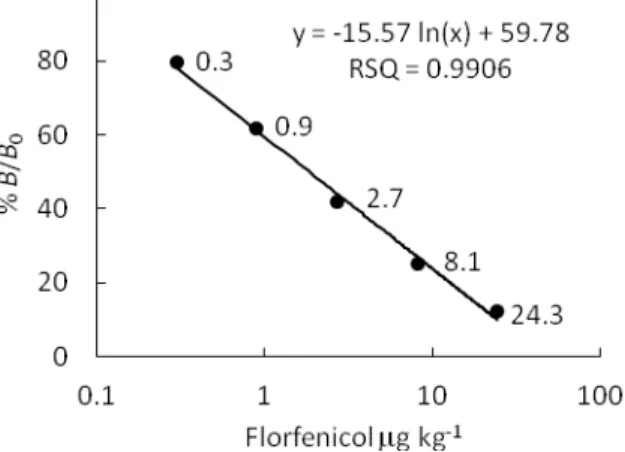
The antibodies formed enable the establishment of a competitive ELISA. Under the optimum conditions, the calibration curve of the method (Fig. 2) was performed using anti-FF polyclone antibody with a coating concentration of 2 g mL-1; and indicated that the linear working range (13-80% B/B0) for the assay was 0.3 to 24.3 g kg-1. The limit of detection,[34-35] based on 90% inhibition of binding was 0.15 g kg-1.
FIGURE 2 Calibration curve for FF ELISA. B/B0 was the normalized response relative to the zero standard. The regression curve equation was y = -15.57 ln(x) + 59.78 (RSQ = 0.9906).
Performance Characteristics of the FF ELISA.
It is important to perform the minimum verification experiments to confirm that the new assay is acceptable for use in the routine laboratory for residue screening.
The analytical specificity is the ability of an assay to exclusively identify a target analyte rather than a similar but different analyte in a specimen. With this approach specificity of the polyclonal antibody (rabbit #2, B2W8) in optimized assays was tested by the measurement of cross-reactivity using FF and related compounds as described. Under the optimized ELISA conditions, the specificity of the antibody was estimated nine frequently-used antibiotics as competitors, including FF-A (florfenicol amine), CAP, TAP, PC-G (penicillin G), TC (tetracycline), CTC (chlortetracycline), OTC (oxytetracycline), GM (gentamicin) and STR (streptomycin). The results show that the cross-reactivity rates for the above-mentioned were all less than 0.1% excluding fluorinated analogs of FF-A, TAP and CAP. As the limited reports concerning the immunoassays for FF residue analysis described, the cross-reactivities and IC50 among florfenicol and related antibiotics of interest in ELISA are shown (Table 3). The results suggest that the indirect competitive ELISA (Wu et al. [25]) was specific to FFA but not FF; experimentally, the indirect method was not suitable for high throughput screening on FF determination.
Table 3
Cross-reactivities and IC50 among florfenicol and related antibiotics of interest in 4 different ELISAs. Wu et al., 2008 [25] Luo et al., 2009 [26] Luo et al., 2011 [27] Homemade
Competitor IC50a CR%b IC50a CR%b IC50a CR%b IC50a CR%b
Florfenicol 32 11 2.9 97 1.0 100 1.9 100
Florfenicol amine 3.5 100 2.8 100 299 0.3 11.8 16.2
Thiamphenicol 82 4 45 6 2.6 40 19.8 9.5
Chloramphenicol 226 2 > 10,000 < 0.1 1048 0.1 20.2 9.4
a IC50, 50% inhibition concentration, g kg-1;b Cross-reactivity, CR% = (IC50 FF/IC50 competitor) × 100%
Precision is a measure of dispersion of results for a repeatedly tested sample; repeatability in an immunoassay including the amount of agreement between replicates of each sample within a run of the assay, and the amount of between run agreements for each fortified sample. The precision of the assay was assessed by the measurement of FF concentration of replicate standards containing 1.0 g kg-1, 5.0 g kg-1, and 10.0 g kg-1. The obtained mean values ± SD and CV (%) by replicate analyses (n = 12 and 24, respectively) in the same run (intra-assay) and in separate runs (inter-assay) are reported in Table 4. The CV% values were below 14.8%, demonstrating an acceptable level of precision.
Recovery studies were performed to assess the accuracy of the direct ELISA. Blank muscle samples (swine, chicken and fish) determined by HPLC were fortified at different amounts of FF (0.3, 1.0, 3.0 and 9.0 g kg-1); and the recoveries were measured. Each sample was evaluated three times in duplicate to verify the repeatability. The proposed method proved accurate, with a recovery percentage of 87 to 115% (Table 5) and has been successfully applied to real sample analysis.
According to the test preparation record, the sensitivity of the assay was evaluated by examining muscle samples and the detection limit of this assay was 0.3 g kg-1 (Table 2), which was well below
the maximum residue limits for FF at 300 g kg-1 in swine muscle, 100 g kg-1 in chicken muscle and 1,000 g kg-1 in fish tissue in the European Commission.
Table 4
Intra- and inter-assay variations of direct ELISA spiked with FF at three concentrations. Forfified FF conc. (g kg-1) FF concentration found Mean a SD (g kg-1) Intra-assay (12 replicates) 1.0 1.1 0.23 5.0 5.4 0.56 10.0 10.5 0.84
Inter-assay (24 replicates: 4 replicates in 6 plates)
1.0 1.1 0.33
5.0 5.5 0.72
10.0 10.5 0.96
In conclusion, the described ELISA for the quantitative determination of florfenicol in animal edible tissues showed appreciable accuracy and precision. Anti-FF hyperimmune serum can be used for simplifying the development of immunoassay. This can greatly reduce the cost of production of a drug specific monoclonal antibody. In addition, the result demonstrates that the immunogen design and the synthesis was a highly sensitive and practical method. The new assay shows great potential in detection work concerning extremely low concentrations of analyte and the advantages of good specificity and high sensitivity in screening of FF residues.
Table 5
Recovery values obtained in muscle samples for the determination of FF by direct ELISA (n = 3). Species Forfified conc. (g kg-1) Recovered conc. (g kg-1) Recovery (%) CV (%)
Swine 0.3 0.26 ± 0.021 87 8.1 1.0 0.93 ± 0.16 93 17.2 3.0 3.40 ± 0.58 113 17.1 9.0 8.85 ± 0.83 98 9.4 Chicken 0.3 0.34 ± 0.019 113 5.6 1.0 0.98 ± 0.09 98 9.2 3.0 3.20 ± 0.54 107 16.9 9.0 9.89 ± 1.04 110 10.5 Fish 0.3 0.35 ± 0.022 115 6.3 1.0 1.12 ± 0.12 112 10.7 3.0 3.11 ± 0.33 104 10.6 9.0 9.75 ± 1.02 108 10.5 ACKNOWLEDGMENTS
This investigation was made within project 94AS-4.1.4-BQ-B1 and was financially supported by the Council of Agriculture, Executive Yuan, Taiwan, ROC.
REFERENCES
1. Varma, K.J.; Adams, P.E.; Powers, T.E.; Powers, J.D.; Lamendola, J.F. Pharmacokinetics of Florfenicol in Veal Calves. J. Vet. Pharmacol. Ther. 1986, 9, 412-425.
207.
3. Ueda, Y.; Ohtsuki, S.; Narukawa, N. Efficacy of Florfenicol on Experimental Actinobacillus Pleuropneumonia in Pigs. J. Vet. Med. Sci. 1995, 57, 261-265.
4. Nordmo, R.; Varma, K.; Sutherland, I.; Brokken, E. Florfenicol in Atlantic Salmon, Salmo Salar L.: Field Evaluation of Efficacy Against Furunculosis in Norway. J. Fish Dis. 1994, 17, 239-244. 5. Liu, J.; Fung, K.F.; Chen, Z.; Zeng, Z.; Zhang, J. Pharmacokinetics of Florfenicol in Healthy Pigs
and in Pigs Experimentally Infected with Actinobacillus Pleuropneumoniae. Antimicrob. Agents
Chemother. 2003, 47, 820-823.
6. Hoar, B.R.; Jelinski, M.D.; Ribble, C.S.; Janzen, E.D.; Johnson, J.C. A Comparison of the Clinical Field Efficacy and Safety of Florfenicol and Tilmicosin for the Treatment of Undifferentiated Bovine Respiratory Disease of Cattle in Western Canada. Can. Vet. J. 1988, 39, 161-166.
7. Samuelsen, O.B.; Bergh, O. Efficacy of Orally Administered Florfenicol and Oxolinic Acid for the Treatment of Vibriosis in Cod (Gadus Morhua). Aquaculture 2004, 235, 27-35.
8. Shin, S.J.; Kang, S.G.; Nabin, R.; Kang, M.L.; Yoo, H.S. Evaluation of the Antimicrobial Activity of Florfenicol Against Bacteria Isolated from Bovine and Porcine Respiratory Disease. Vet.
Microbiol. 2005, 106, 73-77.
9. EMEA Florfenicol (Extension to all food producing species), Summary Report (6), EMEA/822/02-FINAL, London, 2002.
10. Code of Federal Regulation 556.283, Wshington DC, 2002.
11. Regulations amending the food and drug regulations (1527Maximum residue limits for veterinary drugs), Ottawa, 2012.
12. Standards for veterinary drug residue limits in foods, DOH Food No. 0940403032, Taipei, 2005. 13. Wrzesinski, C.L.; Crouch, L.S.; Endris, R. Determination of Florfenicol Amine in Channel Catfish
Electrokinetic Capillary Chromatographic Method for Simultaneous Determination of Sulfonamide and Amphenicol-Type Drugs in Poultry Tissue. J . Pharm . Biomed . Anal . 2011, 54, 160-167.
15. Hormazabal, V.; Steffenak, I.; Yndestad, M. Simultaneous Determination of Residues of Florfenicol and the Metabolite Florfenicol Amine in Fish Tissues by High-Performance Liquid Chromatography. J. Chromatogr. 1993, 616, 161-165.
16. Hormazabal, V.; Steffenak, I.; Yndestad, M. Simultaneous Extraction and Determination of Florfenicol and the Metabolite Florfenicol Amine in Sediment by High-Performance Liquid Chromatography. J. Chromatogr. A 1996, 724, 364-366.
17. Hayes, J.M. Determination of Florfenicol in Fish Feed by Liquid Chromatography. J. AOAC Int.
2005, 88, 1777-1783.
18. Zhang, S.; Liu, Z.; Guo, X.; Cheng, L.; Wang, Z.; Shen, J. Simultaneous Determination and Confirmation of Chloramphenicol, Thiamphenicol, Florfenicol and Florfenicol Amine in Chicken Muscle by Liquid Chromatography-Tandem Mass Spectrometry. J. Chromatogr. B Analyt.
Technol. Biomed. Life Sci. 2008, 875, 399-404.
19. Rezende, D.R.; Filho, N.F.; Rocha, G.L. Simultaneous Determination of Chloramphenicol and Florfenicol in Liquid Milk, Milk Powder and Bovine Muscle by LC-MS/MS. Food Addit. Contam.
Part A, Chem. Anal. Control. Expo. Risk Assess. 2012, 29, 559-570.
20. Pfenning, A.P.; Madson, M.R.; Roybal, J.E.; Turnipseed, S.B.; Gonzales, S.A.; Hurlbut, J.A.; Salmon, G.D. Simultaneous Determination of Chloramphenicol, Florfenicol, and Thiamphenicol Residues in Milk by Gas Chromatography with Electron Capture Detection, J. AOAC Int. 1998, 81, 714-720.
21. Pfenning, A.P.; Roybal, J.E.; Rupp, H.S.; Turnipseed, S.B.; Gonzales, S.A.; Hurlbut, J.A.
Simultaneous Determination of Residues of Chloramphenicol, Florfenicol, Florfenicol Amine, and Thiamphenicol in Shrimp Tissue by Gas Chromatography with Electron Capture Detection J.
22. Li, P.; Qiu, Y.; Cai, H.; Kong, Y.; Tang, Y.; Wang, D.; Xie, M. Simultaneous Determination of Chloramphenicol, Thiamphenicol, and Florfenicol Residues in Animal Tissues by Gas
Chromatography/Mass Spectrometry. Se Pu 2006, 24, 14-18.
23. Azzouz, A.; Jurado-Sanchez, B.; Souhail, B.; Ballesteros, E. Simultaneous Determination of 20 Pharmacologically Active Substances in Cow's Milk, Goat's Milk, and Human Breast Milk by Gas Chromatography-Mass Spectrometry. J. Agric. Food Chem . 2011, 59, 5125-5132.
24. Azzouz, A.; Souhail, B.; Ballesteros, E. Determination of Residual Pharmaceuticals in Edible Animal Tissues by Continuous Solid-Phase Extraction and Gas Chromatography-Mass Spectrometry. Talanta 2011, 84, 820-828.
25. Wu, J.E.; Chang, C.; Ding, W.P.; He, D.P. Determination of Florfenicol Amine Residues in Animal Edible Tissues by an Indirect Competitive ELISA. J. Agric. Food Chem. 2008, 56, 8261-8267.
26. Luo, P.; Jiang, H.; Wang, Z.; Feng, C.; He, F.; Shen, J. Simultaneous Determination of Florfenicol and Its Metabolite Florfenicol Amine in Swine Muscle Tissue by a Heterologous Enzyme-Linked Immunosorbent Assay. J. AOAC Int. 2009, 92, 981-988.
27. Luo, P.J.; Jiang, W.X.; Chen, X.; Shen, J.Z.; Wu, Y.N. Technical Note: Development of an
Enzyme-Linked Immunosorbent Assay for the Determination of Dlorfenicol and Thiamphenicol in Swine Feed. J. Anim. Sci. 2011, 89, 3612-3216.
28. Hamburger, R.N. Chloramphenicol-Specific Antibody. Science 1966, 152, 203-205.
29. Lei, Y.C.; Tsai, Y.F.; Tai, Y.T.; Lin, C.Y.; Hsieh, K.H.; Chang, T.H.; Sheu, S.Y.; Kuo, T.F. Development and Fast Screening of Salbutamol Residues in Swine Serum by an Enzyme-Linked Immunosorbent Assay in Taiwan. J. Agric. Food Chem. 2008, 56, 5494-5499.
30. Cheng, C.C.; Hsieh, K.H.; Lei, Y.C.; Tai, Y.T.; Chang, T.H.; Sheu, S.Y.; Li, W.R.; Kuo, T.F. Development and Residue Screening of the Furazolidone Metabolite, 3-Amino-2-oxazolidinone
(AOZ), in Cultured Fish by an Enzyme-Linked Immunosorbent Assay. J. Agric. Food Chem. 2009,
57, 5687-5692.
31. Sheu, S.Y.; Lei, Y.C.; Tai, Y.T.; Chang, T.H.; Kuo, T.F. Screening of Salbutamol Residues in Swine Meat and Animal Feed by an Enzyme Immunoassay in Taiwan. Anal. Chim. Acta 2009, 654, 148-153.
32. Jacobson, R.H. Principles of validation of diagnostic assays for infectious diseases. Manual of Standards for Diagnostic Tests and Vaccines, Third Edition, Office International des Epizooties, Paris, France, 1996, pp. 8-15.
33. Pattarawarapan, M.; Nangola, S.; Tayapiwatana, C. Establishment of Competitive ELISA for Detection of Chloramphenicol. Chiang Mai J. Sci. 2006, 33, 85-94.
34. Shelver, W.L.; Smith, D.J. Application of a monoclonal antibody-based enzyme-linked immunosorbent assay for the determination of ractopamine in incurred samples from food animals.
J. Agric. Food Chem. 2002, 50, 2742-2747.
35. Shen, Y.D.; Zhang, S.W.; Lei, H.T.; Wang, H.; Xiao, Z.L.; Jiang, Y.M.; Sun, Y.M. Design and synthesis of immunoconjugates and development of an indirect ELISA for rapid detection of 3, 5-dinitrosalicyclic Acid hydrazide. Molecules. 2008, 13, 2238-2248.