Association of Alpha B-Crystallin (CRYAB) Genotypes with Breast Cancer Susceptibility in Taiwan
Chen-Hsien Su1,2,*, Liang-Chih Liu1,2,*, Yi-Hsien Hsieh5,*, Hwei-Chung Wang1,2, Chia-Wen Tsai2,3, Wen-Shin Chang2,3, Chien-Yi Ho2, Chao-I Wu2, Chih-Hsueh Lin2,3, Hsien-Yuan Lane4, Da-Tian Bau2,3,4
1
Department of Surgery, China Medical University Hospital, Taichung, Taiwan, R.O.C.; 2
Terry Fox Cancer Research Laboratory, China Medical University Hospital, Taichung, Taiwan, R.O.C.;
3
Institution of Basic Medical Sciences, China Medical University, Taichung, Taiwan, R.O.C.;
4
Clinical Medical Sciences, China Medical University, Taichung, Taiwan, R.O.C.; 5
Institutions of Biochemistry and Biotechnology, Chung Shan Medical University, Taichung, Taiwan, R.O.C.
* These Authors contributed equally to this study
Correspondence to: Da-Tian Bau, Terry Fox Cancer Research Laboratory, China Medical
University Hospital, 2 Yuh-Der Road, Taichung 40402, Taiwan. Tel. +886 422052121 ext. 1523, e-mail: [email protected]; [email protected]
Key Words: Alpha B-crystallin, polymorphism, breast cancer, carcinogenesis.
Abstract. Aim: Alpha B-Crystallin (CRYAB) is purported to be a metastasis suppressor protein, and lack or lower CRYAB expression is a prognostic biomarker for several types of cancer, such as that of the prostate and head and neck. However, the association of genomic variation of CRYAB and breast cancer is not well studied. The aim of this study was to evaluate the association of polymorphic genotypes of
CRYAB with breast cancer within a Taiwanese population. Materials and
Methods: In this hospital-based study, 1232 patients with breast cancer and an equal number of healthy controls in central Taiwan were genotyped via polymerase chain reaction and restriction fragment length polymorphism (PCR-RFLP) and the association of CRYAB A-1215G (rs2228387), C-802G (rs14133) and intron 2 (rs2070894) polymorphisms with breast cancer risk in a central Taiwanese population was investigated. Results: Those individuals with CRYAB C-802G CG and GG genotypes had 1.50- and 2.22-fold risk for breast cancer than those with the CC genotype. As for the A-1215G and intron 2 polymorphisms, there was no significant association of the genotype with breast cancer risk. In allelic frequency analysis, the G allele CRYAB C-802G conferred a significantly (P=5.63×10⁻¹⁰) increased risk of breast cancer. Our results provide evidence that the G allele of CRYAB C-802G is correlated with breast cancer risk and this polymorphism may be a useful marker for early
Breast cancer is the most frequent cancer affecting women all over the world. Accumulation of specific, and often largely unknown, genomic alterations is responsible for abnormal cell proliferation, genomic instability and acquisition of increasingly invasive and drug-resistant phenotypes. It is believed that breast cancer is largely multicausal and its susceptibility is conferred by multigenic variations of the genome, each contributing to the overall breast cancer risk.
Mammalian alpha B-crystallin (CRYAB) is a member of the small heat- shock protein (sHSP) family and a molecular chaperone continuously expressed in various tissues (1, 2). Among the various sHSPs, Hsp22, Hsp27 and CRYAB (HspB5) are true heat-shock proteins whose synthesis is increased in response to stress. To date, the most studied sHSPs are Hsp27 and CRYAB. CRYAB gene, encoding a major structure protein of the lens that can function as a molecular chaperon (3), has been identified as a tumor suppressor gene in several types of cancer, including breast and ovarian cancer (3-5). However, the association of their genotypes and cancer risk is seldom studied. In 2006, it was reported that
CRYAB, together with six other genes, was down-regulated in breast
tumors and metastases (6). In 2009, a comparison between tumor interstitial fluid and normal interstitial fluid demonstrated that expression of CRYAB was clearly lower in the tumor interstitial fluid of breast
cancer patients by 17.74-fold (7). As yet, the genomic status of CRYAB and the linkage between its genotype and clinical outcome are largely unknown. In order to understand the genomic role of CRYAB in breast cancer, we have chosen three polymorphic loci of CRYAB, two promoter
loci, A-1215G (rs2228387) and C-802G (rs14133), and one in the intron region, intron 2 (rs2070894), and investigated their genotypic distribution in a relatively large Taiwanese breast cancer population.
Materials and Methods
Study population and sample collection. The study population consisted
of 1232 breast cancer patients and 1232 age-matched cancer-free control volunteers. The patients, diagnosed with breast cancer, were recruited at the Outpatient Clinics of General Surgery between 2004 and 2008 at the China Medical University Hospital, Taichung, Taiwan, Republic of China. The clinical characteristics of the patients, including their histological details, were all graded and defined by expert surgeons (Dr. Wang, Liu and Su). All patients voluntarily participated, completed a self-administered questionnaire and provided peripheral blood samples. The same number of age-matched non-breast cancer healthy volunteers as controls were selected after initial random sampling from the Health Examination Cohort of the hospital. The exclusion criteria of the control
group included previous malignancy, metastasized cancer from other or unknown origin, and any familial or genetic diseases. Both groups completed a short questionnaire which included habits.
Genotyping assays. Genomic DNA was prepared from peripheral blood
leucocytes using a QIAamp Blood Mini Kit (Blossom, Taipei, Taiwan) and further processed according to previous studies (8-14). Briefly, the following primers were used: CRYAB A-1215G (rs2228387): 5’-ACCTG- TTGGAGTCTGATCTT-3’ and 5’-ATGCACCTCAATCACATCTC-3’;
CRYABC-802G (rs14133): 5’-TTGACCATCACTGCTCTCTT-3’ and
5’-TTGGCAATGTGACACATACC-3’; CRYAB intron 2 (rs2070894): 5’-GTCTAGAAGACTAAGTTAGG-3’ and 5’-AGAGAAGTCACAAC- TCAAGT-3’. The following cycling conditions were performed: one cycle at 94oC for 5 min; 35 cycles of 94℃ for 30 s, 55℃ for 30 s, and 72℃ for 30 s, and a final extension at 72℃ for 10 min. The PCR products were studied after digestion with FauI, FatI, and DPNI, restriction enzymes for A-1215G (cut from 212 bp A type into 67+145 bp G type), C-802G (cut from 363 bp G type into 85+278 bp C type), and intron 2 (cut from 363 bp T type into 74+339 bp C type), respectively.
Statistical analyses. In our study, only those matches with all single
nucleotide polymorphism data (case/control =1232/1232) were selected for final analysis. To ensure that the controls used were representative of
the general population and to exclude the possibility of genotyping error, the deviation of the genotype frequencies of CRYAB SNPs in the controls from those expected under the Hardy-Weinberg equilibrium was assessed using the goodness-of-fit test. Pearson’s two-sided chi-square test or Fisher’s exact test (when the expected number in any cell was less than five) was used to compare the distribution of the CRYAB genotypes between cases and controls. Data was recognized as significant when the statistical P-value was less than 0.05.
Results
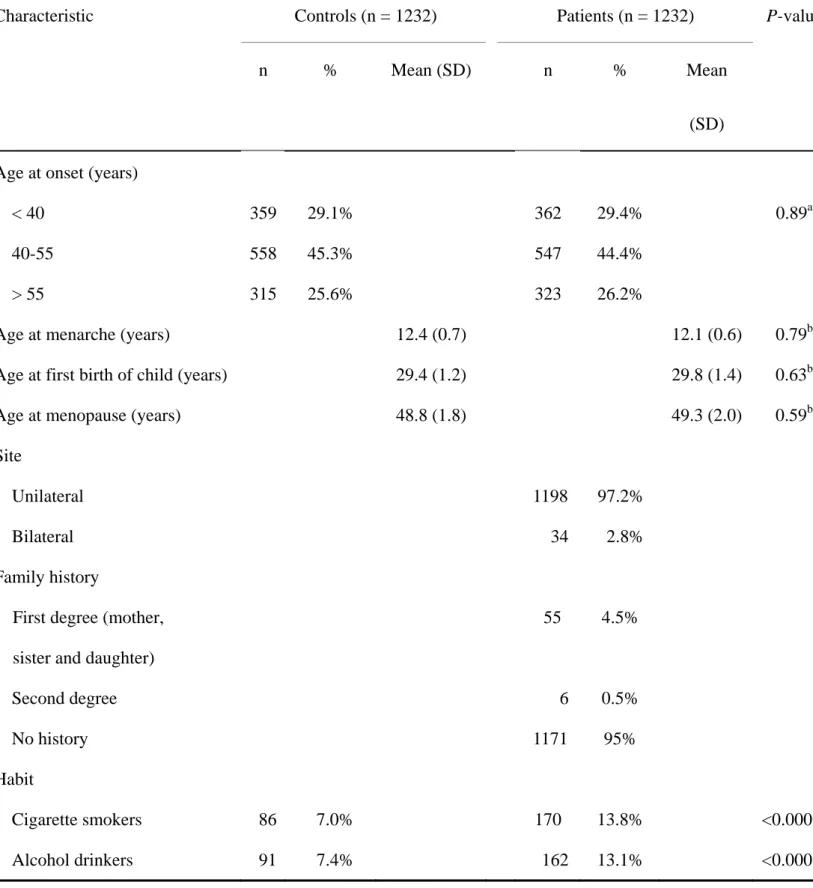
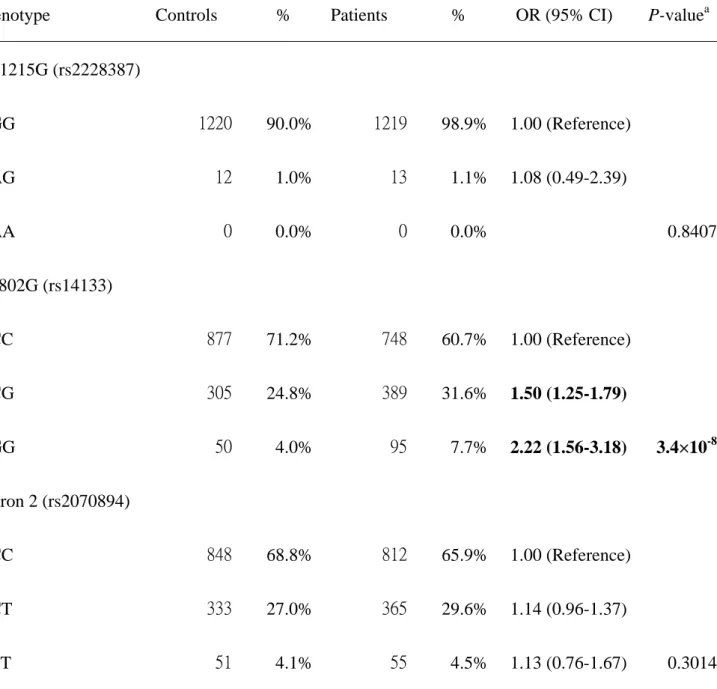
The clinical characteristics and analysis of the 1232 recruited breast cancer patients and 1232 age- and gender-matched controls are shown in Table I. There were no significant differences between groups in their age, or sex; regarding habits, there were significantly more smokers and drinkers in the patient group (Table I). The distributions of the genotypic frequencies for CRYAB A-1215G, C-802G, and intron 2 polymorphisms between controls and breast cancer patients are shown in Table II. The genotypic distribution of the different genetic polymorphisms of CRYAB C-802G is significantly different between breast cancer and control groups (P=3.4×10⁻⁸), while those for A-1215G or intron 2 were not significant (P=0.8407 and 0.3014, respectively). In detail, these with
C-802G CG and GG genotypes were at 1.50- and 2.22-fold greater risk for breast cancer than those with the CC genotype (Table II).
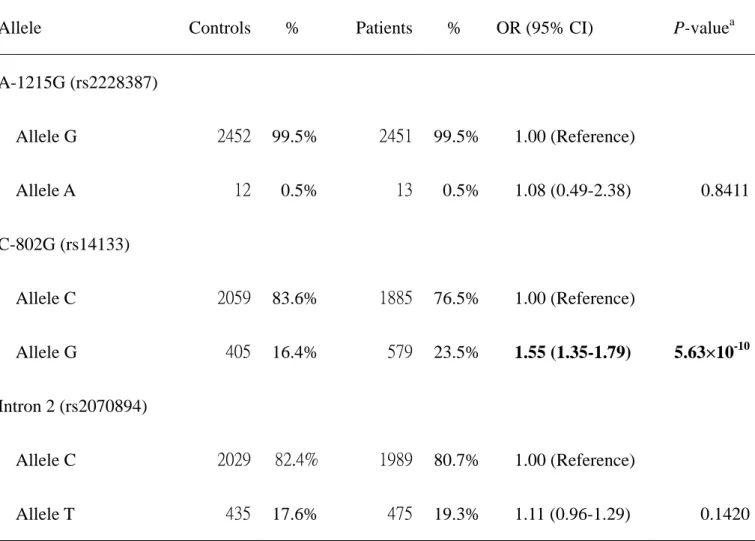
In Table III, the distributions of the allelic frequencies for the CRYAB A-1215G, C-802G and intron 2 polymorphisms between controls and oral cancer patients are presented. Consistent with the findings in Table II, the G allele of the CRYAB C-802G is associated with 1.55-fold higher susceptibility for breast cancer compared with the C allele (Table III).
Discussion
Overall, breast carcinogenesis is very complicated and varies with individual cases, and should be investigated from multiple angles. From the proteomic viewpoint, CRYAB was found to be down-regulated in breast tumors (6), and in the tumor interstitial fluid of breast cancer patients by 17.74-fold (7). As yet, the genomic contribution of CRYAB to breast cancer has not been well studied. In this study, we selected three SNPs of the CRYAB gene, and investigated the associations with the susceptibility to breast cancer in a population of central Taiwan. Among the three polymorphisms selected, two were in the promoter region, and one was in the intron 2 region. The result indicated that variant genotypes of CRYAB C-802G were significantly associated with a higher susceptibility to breast cancer (Tables II and III). The C-802G SNP is
located in the CRYAB promoter region, where two conserved heat-shock elements and several cis-acting regulatory elements have been identified (15-17). However, the detailed correlation between the different genotypes of CRYAB C-802G and gene expression needs further verification, such as by promoter activity assay. In addition to playing a role as a heat-shock protein, CRYAB is also considered to be an anti-apoptosis protein, interacting with multiple target proteins. In 2001, crystallins, including CRYAB, were shown to prevent apoptosis induced by various agents, including hydrogen peroxide, tumor necrosis factor, and staurosporine (18). In addition, CRYAB has been shown to inhibit the autoproteolytic cleavage of caspase3, therefore suppressing the activation of caspase3 (19). Furthermore, CRYAB can also interact directly with the pro-apoptotic members BAX and BCL-XS in vitro and
in vivo, with sequestration of these proteins preventing translocation to
mitochondria and hence reduction of overall apoptosis progress (20). The clinical and proteomic evidence mentioned above indicate the significance of CRYAB in breast carcinogenesis, and arose our interest in investigating the genomic contribution of CRYAB to breast cancer.
In this study, our results showed that CRYAB C-802G was associated with breast cancer susceptibility, and since this SNP is located on the promoter of the CRYAB gene, its change may cause differential
expression of the protein product. Phenotype assays, such as immunohistochemistry and Western blotting, are needed in fresh breast cancer tissues to provide more detail and realistic correlations with clinical outcomes. In the future, knowledge of CRYAB status, available from routine immunohistochemical examination of a tumor biopsy, may therefore be an invaluable marker for those at risk of breast cancer, and for clinical outcomes.
In conclusion, this is the first study which focuses on the SNPs of
CRYAB and breast cancer in Taiwan, and the presence of the G allele of
C-802G was associated with a higher risk of breast cancer. The G allele of C-802G may be a useful marker in breast oncology for cancer detection.
Acknowledgements
We thank Fang-Jing Li, Yeong-Ruey Chu, Tzu-Shin Weng and Tissuebank in China Medical University for their technical assistance. This study was supported by research grants from the Terry Fox Cancer Research Foundation, China Medical University Hospital (CMU-100-179) and the National Science Council (NSC 98-2320-B-039-010-MY3).
References
1 Iwaki, T, Kume-Iwaki A and Goldman JE: Cellular distribution of alpha B-crystallin in non-lenticular tissues. J Histochem Cytochem
38: 31-39, 1990.
2 Bhat, SP and Nagineni CN: alpha B subunit of lens-specific protein alpha-crystallin is present in other ocular and non-ocular tissues. Biochem Biophys Res Commun 158: 319-325, 1989.
3 Horwitz, J: Alpha-crystallin can function as a molecular chaperone. Proc Natl Acad Sci U S A 89: 10449-10453, 1992.
4 Stronach, EA, Sellar GC, Blenkiron C, Rabiasz GJ, Taylor KJ, Miller EP, Massie CE, Al-Nafussi A, Smyth JF, Porteous DJ and Gabra H: Identification of clinically relevant genes on chromosome 11 in a functional model of ovarian cancer tumor suppression. Cancer Res 63: 8648-8655, 2003.
5 Fujiwara, Y, Ohata H, Kuroki T, Koyama K, Tsuchiya E, Monden M and Nakamura Y: Isolation of a candidate tumor suppressor gene on chromosome 8p21.3-p22 that is homologous to an extracellular domain of the PDGF receptor beta gene. Oncogene 10: 891-895, 1995.
6 Seitz, S, Korsching E, Weimer J, Jacobsen A, Arnold N, Meindl A, Arnold W, Gustavus D, Klebig C, Petersen I and Scherneck S:
Genetic background of different cancer cell lines influences the gene set involved in chromosome 8-mediated breast tumor suppression. Genes Chromosomes Cancer 45: 612-627, 2006.
7 Cortesi, L, Barchetti A, De Matteis E, Rossi E, Della Casa L, Marcheselli L, Tazzioli G, Lazzaretti MG, Ficarra G, Federico M and Iannone A: Identification of protein clusters predictive of response to chemotherapy in breast cancer patients. J Proteome Res 8: 4916-4933, 2009.
8 Wang HC, Chang WS, Tsai RY, Tsai CW, Liu LC, Su CH, Cheng HN, Tsou YA, Sun SS, Lin CC and Bau DTL: Association between ataxia telangiectasia mutated gene polymorphisms and breast cancer in Taiwanese females. Anticancer Res 30: 5217-5221, 2010.
9 Wang HC, Liu CS, Chiu CF, Chiang SY, Wang CH, Wang RF, Lin CC, Tsai RY and Bau DT: Significant association of DNA repair gene Ku80 genotypes with breast cancer susceptibility in Taiwan. Anticancer Res 29: 5251-5254, 2009.
10 Wang HC, Chiu CF, Tsai RY, Kuo YS, Chen HS, Wang RF, Tsai CW, Chang CH, Lin CC and Bau DT: Association of genetic polymorphisms of EXO1 gene with risk of breast cancer in Taiwan. Anticancer Res 29: 3897-3901, 2009.
SY and Bau DT: A new single nucleotide polymorphism in XRCC4 gene is associated with breast cancer susceptibility in Taiwanese patients. Anticancer Res 28: 267-270, 2008.
12 Liu CJ, Hsia TC, Wang RF, Tsai CW, Chu CC, Hang LW, Wang CH, Lee HZ, Tsai RY and Bau DT: Interaction of cyclooxygenase 2 genotype and smoking habit in Taiwanese lung cancer patients. Anticancer Res 30: 1195-1199, 2010.
13 Liu CJ, Hsia TC, Tsai RY, Sun SS, Wang CH, Lin CC, Tsai CW, Huang CY, Hsu CM and Bau DT: The joint effect of hOGG1 single nucleotide polymorphism and smoking habit on lung cancer in Taiwan. Anticancer Res 30: 4141-4145, 2010.
14 Wu HC, Chang CH, Tsai RY, Lin CH, Wang RF, Tsai CW, Chen KB, Yao CH, Chiu CF, Bau DT and Lin CC: Significant association of methylenetetrahydrofolate reductase single nucleotide polymorphisms with prostate cancer susceptibility in Taiwan. Anticancer Res 30: 3573-3577, 2010.
15 Iwaki, A, Nagano T, Nakagawa M, Iwaki T and Fukumaki Y: Identification and characterization of the gene encoding a new member of the alpha-crystallin/small HSP family, closely linked to the alphaB-crystallin gene in a head-to-head manner. Genomics 45: 386-394, 1997.
16 Gopal-Srivastava, R, Haynes JI, 2nd and Piatigorsky J: Regulation of the murine alpha B-crystallin/small heat-shock protein gene in cardiac muscle. Mol Cell Biol 15: 7081-7090, 1995.
17 Gopal-Srivastava, R and Piatigorsky J: The murine alpha B-crystallin/small heat-shock protein enhancer: identification of alpha BE-1, alpha BE-2, alpha BE-3, and MRF control elements. Mol Cell Biol 13: 7144-7152, 1993.
18 Mao, YW, Xiang H, Wang J, Korsmeyer S, Reddan J and Li DW: Human BCL2 gene attenuates the ability of rabbit lens epithelial cells against H2O2-induced apoptosis through down-regulation of the alpha
B-crystallin gene. J Biol Chem 276: 43435-43445, 2001.
19 Kamradt, MC, Chen F, Sam S and Cryns VL: The small heat-shock protein alpha B-crystallin negatively regulates apoptosis during myogenic differentiation by inhibiting caspase-3 activation. J Biol Chem 277: 38731-38736, 2002.
20 Mao, YW, Liu JP, Xiang H and Li DW: Human alphaA- and alphaB-crystallins bind to Bax and Bcl-X(S) to sequester their translocation during staurosporine-induced apoptosis. Cell Death Differ 11: 512-526, 2004.
Table I. Characteristics among breast cancer patients and controls.
Controls (n = 1232) Patients (n = 1232) P-value Characteristic
n % Mean (SD) n % Mean
(SD) Age at onset (years)
< 40 359 29.1% 362 29.4% 0.89a
40-55 558 45.3% 547 44.4%
> 55 315 25.6% 323 26.2%
Age at menarche (years) 12.4 (0.7) 12.1 (0.6) 0.79b
Age at first birth of child (years) 29.4 (1.2) 29.8 (1.4) 0.63b
Age at menopause (years) 48.8 (1.8) 49.3 (2.0) 0.59b
Site
Unilateral 1198 97.2%
Bilateral 34 2.8%
Family history
First degree (mother, sister and daughter)
55 4.5% Second degree 6 0.5% No history 1171 95% Habit Cigarette smokers 86 7.0% 170 13.8% <0.0001a Alcohol drinkers 91 7.4% 162 13.1% <0.0001a
Table II. Distribution of CRYAB genotypes among oral cancer patients and controls.
Genotype Controls % Patients % OR (95% CI) P-valuea A-1215G (rs2228387) GG 1220 90.0% 1219 98.9% 1.00 (Reference) AG 12 1.0% 13 1.1% 1.08 (0.49-2.39) AA 0 0.0% 0 0.0% 0.8407 C-802G (rs14133) CC 877 71.2% 748 60.7% 1.00 (Reference) CG 305 24.8% 389 31.6% 1.50 (1.25-1.79) GG 50 4.0% 95 7.7% 2.22 (1.56-3.18) 3.4×10⁻⁸ Intron 2 (rs2070894) CC 848 68.8% 812 65.9% 1.00 (Reference) CT 333 27.0% 365 29.6% 1.14 (0.96-1.37) TT 51 4.1% 55 4.5% 1.13 (0.76-1.67) 0.3014
OR, Odds ratio; CI, confidence interval. aP-value based on two-sided Chi-square test with Yate’s correction or Fisher’s exact test.
Table III. Distribution of CRYAB alleles among breast cancer patients and controls.
Allele Controls % Patients % OR (95% CI) P-valuea A-1215G (rs2228387) Allele G 2452 99.5% 2451 99.5% 1.00 (Reference) Allele A 12 0.5% 13 0.5% 1.08 (0.49-2.38) 0.8411 C-802G (rs14133) Allele C 2059 83.6% 1885 76.5% 1.00 (Reference) Allele G 405 16.4% 579 23.5% 1.55 (1.35-1.79) 5.63×10⁻¹⁰ Intron 2 (rs2070894) Allele C 2029 82.4% 1989 80.7% 1.00 (Reference) Allele T 435 17.6% 475 19.3% 1.11 (0.96-1.29) 0.1420 OR, Odds ratio; CI, confidence interval. aP-value based on two-sided Chi-square test with Yate’s
correction.